
At its meeting on March 10, 2026, the SRG Board of Directors made three important personnel decisions: Roger Elsener was elected as the new Director of Swiss Radio and Television (SRF). The Board of Directors thus unanimously followed the proposal of the SRG German-speaking Switzerland Regional Executive Board. At the request of Director General Susanne Wille, Nicolas Pernet was also elected as Director of Supply and Moritz Stadler as Director of Operations. All three individuals will join the new SRG Executive Board.
Transformation into a digital media company
SRG is continuing its transformation and is resolutely driving change forward with the "Enavant SRG SSR" transformation project launched at the end of 2024. The goal: a more digital, leaner and more agile media company. In future, SRG will work more closely together across the regions, pool its strengths, exploit internal synergies and at the same time remain regionally anchored.
Following the election of Head of HR Severine Schori-Vogt and Stephanie Jutzi, Head of Communications and Public Affairs, the Executive Board is now being further developed with three additional, complementary profiles. The three leaders bring digital innovation, operational excellence and a keen understanding of the public service and the needs of the audience - skills that are central to the SRG of the future.
Roger Elsener: Media manager and digital expert
As the new Director of SRF, Roger Elsener will continue to develop the strong programme in terms of content and quality, drive forward digitalization in line with the audience's changing usage habits and also focus on the young audience. He succeeds Nathalie Wappler, who announced her resignation in September 2025.
The 47-year-old from central Switzerland is currently CEO of Zattoo, the leading Swiss internet TV streaming provider. He convinced the members of the nomination committee headed by Lukas Bruhin, President of SRG Deutschschweiz. Roger Elsener has many years of experience in the radio, TV and streaming business and has a profound understanding of the Swiss media market. Elsener was previously Managing Director of Ch Media Entertainment and has been a member of the Executive Board of the Ch Media radio and TV group since 2018. Elsener was also CEO of Ch Media TV, the joint venture between Ch Media and Sunrise for their TV group and the streaming service oneplus.
Before joining Ch Media, Roger Elsener held management positions at various media companies, including AZ Medien, the 3+ Group and Viacom International Media Networks (MTV, Viva, Nickelodeon). Roger Elsener graduated from the University of Zurich in 2003 with a Master's degree in journalism. He is married, has a family and now lives in Menzingen ZG, where he was born.
Lukas Bruhin, President of SRG Deutschschweiz: "The Regional Board of SRG Deutschschweiz is delighted that Roger Elsener has been elected by the SRG Board of Directors. Roger Elsener has everything it takes to further develop SRF in a challenging phase in the service of the public service in German-speaking Switzerland. He also impresses us on a personal level with his down-to-earth attitude, clarity and openness."
Susanne Wille, Director General of SRG: "Roger Elsener is an experienced media manager and digital expert who will consistently continue SRF's digital transformation. He combines strategic media expertise, innovative strength and a deep understanding of the Swiss and international journalism and media market. He is therefore ideally suited to take SRF forward as a leading medium in a rapidly changing environment and develop it into a modern, digital medium with relevant programming in German-speaking Switzerland."
SRF Director Nathalie Wappler is leaving SRF at the end of April. Roger Elsener will take up his new role seamlessly on May 1, 2026.
Nicolas Pernet takes over management Offer
Nicolas Pernet has headed Radiotelevisiun Svizra Rumantscha (RTR) since 2021 and has been Deputy Director General of SRG since 2025. He is also co-head of the "Enavant" transformation project. Born in the Lower Engadine, the 46-year-old media manager studied business administration at the University of St. Gallen and received his doctorate in 2010 after study visits to the University of Michigan and HEC Paris.
Before joining SRG, he spent around ten years at the media company Ringier, where he worked for the former Blick Group as Head of Marketing and Head of Publishing & News Business. Most recently, as Head of Commercial Management, he was responsible for commercial revenues. Nicolas Pernet is married, has a family and lives in Egg near Zurich and Chur.
Among other things, the new Offering division will manage the live and streaming platform Play+ as well as the future SRG-wide offering units Fiction and Sport. This will ensure that SRG's offering meets the needs of the audience even better in future and is at the cutting edge of technology. Thanks to regionally organized teams, proximity to viewers is guaranteed.
Susanne Wille: "Nicolas Pernet has many years of experience at the interface between media content and distribution. He is ideally qualified to further develop SRG's offering strategy in a targeted manner. The focus here is on the expectations and needs of the audience, the media market and its future developments and which technologies are driving it."
Nicolas Pernet will take up his new position on April 1, 2026. The position of Director of RTR will be advertised externally. In the meantime, a transition team will take over the management of RTR on an interim basis.
Moritz Stadler is responsible for operations
The new Operations division combines production and technology and, among other things, sets uniform framework conditions for all production and technological activities. The future integrated infrastructure for all language regions and intensified collaboration across Switzerland is an important lever of the "Enavant" transformation project.
Moritz Stadler has been in charge of stream operations at "Enavant" since mid-2025. In 2024, he was elected Co-Executive Producer of the Eurovision Song Contest 2025 in Basel. Until mid-2025, he was a member of the RTS Executive Board as Head of Operations, where he further developed technology and production and consistently aligned them with the organization's strategic goals.
Previously, he was Head of Project Management Office at Eurovision Services, a subsidiary of the European Broadcasting Union (EBU) in Geneva, where his responsibilities included the operational implementation of major international projects. Before joining SRG and the EBU, Moritz Stadler worked in various positions in the media and event industry, including as Deputy Production Manager at Europe 1 in Paris and on assignments for UEFA and FIFA in various regions of the world. He trained as a radio technician and also holds a degree in management from the University of Caen. Moritz Stadler (40) is married, has a family and lives in Neuchâtel.
Susanne Wille: "In Moritz Stadler, we have gained a leader who will drive SRG and the public service forward in the areas of production and technology with all his might. He brings with him international implementation experience and a high level of operational excellence - crucial for the efficiency, quality and security of our structures and processes."
Moritz Stadler will assume his new role on April 1, 2026.
]]>

On January 19, 2026, the ARD Board of Representatives (GVK) elected Nathalie Wappler as the only Swiss member of the German Media Council, which is made up of six members. The election of the SRF Director was made by the ARD Board Representatives Conference. The six-member supervisory body takes a system-wide view of ARD, ZDF and Deutschlandradio, analyzes the fulfillment of their mandates and formulates impulses for their further development.
"I am delighted about the trust that has been placed in me with this appointment. I have dedicated my entire professional career to the public media service. Accordingly, I will do my utmost to strengthen and further develop public service media - out of conviction and inner commitment, because they are central to democracy and society. I am very happy to contribute my perspectives and many years of practical experience as a media manager in Switzerland and Germany to the Media Council," explains Nathalie Wappler.
Recognition for Swiss public service
SRG Director General Susanne Wille emphasizes: "The election of Nathalie Wappler to this central supervisory body in Germany is an honour for the Swiss public service and underlines the high reputation we enjoy with our northern neighbors. And it confirms the great experience and foresight for which Nathalie Wappler is recognized far beyond SRF. Congratulations."
Klaus Sondergeld, Chairman of the GVK, says: "With Nathalie Wappler, the committee representatives of the state broadcasters have been able to gain a proven and proven expert from the practice of public service broadcasting - in Germany as well as in Switzerland - for the Media Council. She will not only contribute her experience from within the media business, but also her view from the outside, from a neighboring country, to its work."
New control level for public service broadcasting
The Media Council is an independent body of experts based in Weimar. The German federal states created the Media Council with the Reform State Treaty that came into force at the end of 2025. One of its tasks is to regularly review how ARD, ZDF and Deutschlandradio are fulfilling their legal mandate - in other words, how well public service broadcasting is fulfilling its information, education, culture and entertainment mandate.
The Media Council submits a commissioned report every two years. This is based on current scientific standards and criteria laid down in the Interstate Media Treaty. The report is submitted to the directors and the responsible radio, television and broadcasting councils and then published.
The Media Council represents a new level of control in Germany and is intended to strengthen the media landscape of public broadcasting as a whole by working independently of the existing control bodies. If the six-member body identifies deficits, the supervisory bodies of the individual broadcasters are required to deal with the assessments and recommendations of the Media Council. The Media Council examines, for example, the accessibility of the offerings, their use by the target groups, the effect on opinion-forming, the balance in reporting, the diversity of topics and the innovative capacity of the offerings.
Nathalie Wappler will start the part-time mandate after leaving SRF in spring 2026.
]]>Media consumption has changed fundamentally: away from linear television and toward on-demand services. With 38 million streaming hours in 2024, SRF is posting record growth. The transition to the «Play SRF» streaming platform was essential for reaching audiences in the digital age.
Leadership Under Budget Constraints
Wappler had to cut costs by about 80 million francs over seven years. Despite this pressure, she emphasizes the importance of a creative spirit: «Trust the discomfort»—doubts are often the necessary driving force behind innovation. Painful program cuts were unavoidable in order to free up resources for the digital future
The Future of Public Service
In light of political initiatives, Wappler warns against weakening the SRG. Public service acts as the social glue, especially in a fragmented country like Switzerland. Massive fee cuts would lead to centralization and jeopardize regional diversity as well as costly infrastructure for sporting events such as the Lauberhorn Race.
New Responsibilities in Germany
Following her departure from SRF, Wappler has been appointed to Germany's newly created Media Council. There, she will evaluate the performance of ARD, ZDF, and Deutschlandradio and contribute her expertise at the intersection of media and society.

Journalist and host Reto Lipp speaks with trailblazers from the Swiss media and communications industry on ComSumCast.
ComSumCast is available in video and audio versions at Spotify and Youtube as well as in an audio version at Apple Podcasts and on the other major podcast platforms.
Produced by Tablecast / Christoph Soltmannowski / Soltmannowski Kommunikation GmbH. http://www.solt.ch
]]>
Fake news is omnipresent - on social media, on the internet and in group chats. The use of artificial intelligence is making fakes increasingly difficult to detect, even for media professionals. SRF is tackling this highly topical issue and focusing on it from 26 January to 1 February 2026. At the heart of the theme week are experiences and examples from the audience.
Audience submits examples for review
As part of the "Fact or Fake?" theme week, SRF is calling on viewers, radio listeners and users to submit examples of fake news that move them. From the Pope in a down coat to scam videos featuring celebrities: Videos, images, audio or texts can be submitted until January 30, 2026 via srf.ch/factcheck or Whatsapp (+41 79 592 01 40). The submissions will be checked by SRF's fact-checkers. The two hosts Andrea Vetsch and Leon Morson will present the findings in various programs and enter into dialogue with the audience on SRF's digital channels.
SRF also sheds light on various aspects of the topic of fake news on TV and radio as well as online: Which health tips can still be believed? How can fakes be recognized in social media? Who makes money with fake news? And is this even a new phenomenon?
Experiments, discussions and background information
In an experiment, "Einstein" shows what effects fake news has on people. For "rec.", Donat Hofer talks to people who refrain from consuming information from traditional media. And the health magazine "Puls" focuses on influencers who also spread false health information via social media.
From Monday to Friday, the topic of fake news will also be the focus of a series on "10 to 10". It sheds light on the history of fake news, tells of the experiences of a fake news victim and shows how politicians are dealing with it today. The "Rundschau" program looks at fake news as a propaganda weapon using Russia as an example. Kassensturz" and "SRFglobal" also deal with the topic from different perspectives. "Sternstunde Philosophie" poses the question of whether and how fake news and AI are changing our concept of truth.
Radio and online included
Radio SRF listeners can find out more about the topic of fake news in the programs "Morgengast", "Ratgeber" and "Drivetime" - with exciting discussion partners and reports on prominent fake news victims. In "Tagesgespräch", the writer and journalist Tom Kummer, who caused a media scandal by giving fictitious interviews, gives his views.
On the SRF News app and on srf.ch the fact checkers continuously report on the fact checks carried out on submissions from the public. And on social media, users take part in a street survey to find out how they deal with fake content, which is often generated by AI.
Tradition of the theme week
The theme week has been part of the tradition of regular journalistic focal points for years. For example, SRF 2024 highlighted the effects of artificial intelligence with "KI & Wir". The 100th anniversary of electronic media in German-speaking Switzerland was the occasion for the thematic focus "Fascination Media". And in 2023, the focus was on the diversity of Swiss folk music.
]]>
SRF recorded outstanding audience figures across all channels in 2025. The TV channels SRF 1, SRF zwei and SRF info achieved a market share of 33.4% - the second-highest figure since the measurement changeover in 2013. Between 7 p.m. and 10.30 p.m., the evening broadcasting time with the largest audience, SRF's TV channels even reached a new high with a market share of 42.1%. SRF is also the market leader among the younger target group of 15 to 29-year-olds, with a market share of 31.4 percent for the whole day and 36.4 percent for the main evening. Overall, SRF's TV program reached an average of 3.6 million people per week, or almost two thirds of the Swiss-German population who watch television.
Landslide and US tariffs move Switzerland
The most-watched information program of the year, with an average of 878,000 viewers, was the main edition of "Tagesschau" on 28 May 2025, when a devastating landslide occurred in Blatten VS. "Schweiz aktuell" and "10 vor 10" also achieved above-average ratings on that Wednesday, with an average of 499,000 and 446,000 viewers respectively. The natural disaster had a strong impact on all channels in the days before and after. The live tickers on srf.ch and in the SRF News app, which ran from May 20, 2025, were viewed over 4.6 million times in total. The video recordings of the landslide achieved a total of almost 1.3 million starts on the SRF online platforms.
Over the year as a whole, an average of 577,000 people watched the main edition of "Tagesschau". The market share of 53.0% corresponds to the highest value outside of the pandemic years 2020 and 2021, when the population's need for information was above average. With around 607,000 daily visits, the SRF News app achieved a new record since the measurement changeover in 2020. The high usage figures reflect the eventful year, in which the inauguration of US President Donald Trump, the death of Pope Francis and the conflicts in the Middle East and Ukraine were among the topics of interest. August 1, 2025, when the US announced tariffs of 39% on Swiss exports, was the day with the highest number of visits on the SRF News app in 2025, with almost 1 million visits.
Swiss ski stars and women's national team inspire
The men's downhill in Wengen on January 18, 2025 was the most popular broadcast of the year, with an average of 965,000 people watching the Swiss one-two victory by Marco Odermatt and Franjo von Allmen. The Lauberhorn downhill has not recorded higher viewing figures since 2015. The market share was 80.1 percent. Around three weeks later, von Allmen was crowned downhill world champion at the Alpine Ski World Championships in Saalbach. An average of 925,000 viewers tuned in to SRF zwei to follow the Bernese Oberlander. An average of 943,000 people watched the World Championship final of the Swiss men's national ice hockey team against the USA in Stockholm on May 25, 2025.
A particular highlight in 2025 was the UEFA Women's EURO in Switzerland. The dramatic final between England and Spain was watched by an average of 889,000 viewers, corresponding to a market share of 56.4%. The Swiss national team also generated a great deal of interest among the SRF audience with its performances. An average of 725,000 people watched the national team's four matches. The quarter-final against Spain set a new record for a women's national team match with an average of 817,000 viewers and a 61.6% market share.
The broadcast of the "Eidgenössisches Schwing- und Älplerfest" at the end of August 2025 also reached new heights. On average, 472,000 people watched the entire 15-hour live broadcast, which corresponds to a market share of 71.8%. This is the highest audience share for an ESAF since the measurement changeover in 2013. The livestream on the SRF online platforms was started around 2.3 million times over the two days, making it one of the most used of the year.
Eurovision Song Contest and Happy Day in focus
Another highlight of the SRF program was the "Eurovision Song Contest", which was held in Switzerland for the first time since 1989. With an average of 764,000 viewers and a market share of 58.2%, the broadcast of the final from Basel on May 17, 2025 achieved the highest figure of all ESC editions since the measurement changeover in 2013.
The year was also marked by a change of presenter for "Happy Day". Röbi Koller stepped down from the stage 37 years after his first TV appearance on SRF. His last "Happy Day" show on April 5, 2025 was watched by an average of 623,000 viewers, which corresponds to a market share of 45.4 percent. The first show with Koller's successor Nik Hartmann even reached an average of 713,000 people and a market share of 51.1 percent - the highest "Happy Day" market share since 2013.
The five episodes of the fifth season of "SRF bi de Lüt - Winterhüttengeschichten" reached an average of 632,000 viewers and a market share of 40.5 percent, the second-highest figure since its launch in 2021. "Donnschtig-Jass" also continues to enjoy great popularity: the 24 July 2025 edition in Klosters achieved the highest viewer ratings since 2017 with an average of 575,000 viewers. With an average of 575,000 viewers, the 24 July 2025 edition in Klosters achieved the highest viewing figures since 2017. Online, the new dating format "Alone Together" was particularly impressive: the six episodes of the first season achieved a total of around 650,000 starts on Play SRF. This makes it the most successful entertainment format on the SRF online platform to date.
Documentaries and series score points online
The most-watched "DOK" in 2025 was "Umbruch im Bergdorf - Von der Zukunft in den Alpen" on September 25, 2025. On average, 434,000 people watched the documentary, which corresponds to a market share of 35.5 percent. The program also achieved around 195,000 starts on Play SRF and YouTube. The "Impact" report on cocaine use in Switzerland also attracted interest on both platforms - it achieved a total of 675,000 stream starts. On YouTube, over 80 percent of all viewers were under the age of 45.
With over 1.3 million online views, the 16th season of "Auf und davon" was also convincing. Linear, the "DOK" series about Swiss emigrants reached an average of 670,000 viewers per episode and a market share of 42.6 percent. The "Puls" program about dementia among young people also attracted interest, with an average of 415,000 viewers and a market share of 31.8%.
Finally, the new "DOK" series on the Hotel Gstaad Palace as part of "Inside Gastro" caused quite a stir. The four episodes were streamed over 1.5 million times in total on the various online platforms. The first episode of the series alone achieved around 501,000 starts. The new SRF crime series "Maloney" was also frequently streamed online: the eleven cases of the thuggish private detective have so far achieved a total of 835,000 views on Play SRF.
Radio SRF remains market leader
46.5 percent is the market share of Radio SRF 1, Radio SRF 2 Kultur, Radio SRF 3, Radio SRF 4 News, Radio SRF Musikwelle and Radio SRF Virus in 2025. On weekdays between 06.00 and 09.00, the time of day with the highest number of listeners, on average half of all radio listeners in German-speaking Switzerland chose a station in the SRF radio family. Radio SRF 1 remains the market leader in German-speaking Switzerland with a market share of 23.1 percent. Around 58% tuned into an SRF radio station every week. The "Rendez-vous" edition at 12.30 p.m. reached an average of 418,000 listeners on weekdays, while the "Echo der Zeit" at 6 p.m. reached 234,000 listeners. This corresponds to a market share of 44.6 and 27.8 percent respectively. Due to the switch-off of FM frequencies by the SRG at the end of 2024, the use of SRF radio stations is lower than in previous years.
]]>
The correspondent position in Chur has a new face: Sandro Oertli is reporting as a 60% TV correspondent for the Graubünden region. Oertli has been working as an audio editor at SRF since March 2024 and will continue to work part-time for the radio.
Sandro Oertli succeeds Claudio Spescha as the new Chur correspondent. He will continue to present from the newsroom in Leutschenbach, but will also work for RTR's background programs. The changeover is part of the switch to multimedia newsrooms, which has been underway since December 1, 2025.
Sandro Oertli on his new role: "Graubünden is incredibly diverse in journalistic terms. I'm looking forward to being close to the people, picking up on their topics and categorizing them for a broad audience. The mixture of regional roots and national relevance makes the work here particularly appealing."
Marc Melcher, head of the regional editorial office for Eastern Switzerland and Graubünden at SRF: "With Sandro Oertli, we have a passionate young journalist on our team who puts his heart and soul into researching, analyzing and reporting. This passion for journalism and his critical reporting will also set him apart as a TV correspondent."

With this award, the Solothurn Film Festival honors a personality who has journalistically accompanied film, and Swiss film in particular, for more than three decades, critically reflecting on it and placing it in a larger cultural context.
With his knowledge, analytical acuity and passion for cinema, Michael Sennhauser has inspired a wide audience for Swiss film.
During his 26 years as film editor at SRF 2 Kultur, Sennhauser played a decisive role in shaping national film reporting. His approach was always characterized by depth, context and critical dialogue. He saw cultural journalism as a benevolent, responsible examination of cinematic creation, based on respect, classification and an interest in making films understandable and accessible. He was awarded the Prix Pathé (2010) and the Greulich Culture Prize (2016) for his work.
In addition to his work at SRF, Michael Sennhauser was temporarily president of the Swiss Film Journalists' Association, co-responsible for the Semaine de la critique at the Locarno Film Festival and, among other things, editor at the Sonntagszeitung, freelancer for the NZZ and the Basellandschaftliche Zeitung. Even after his self-imposed early retirement in 2024, Sennhauser is still active: he runs the widely read "Sennhausers Filmblog" and is a member of the Zurich Film Foundation's fiction commission.
With the "Prix d'honneur" 2026, the Solothurn Film Festival not only wishes to highlight his professional achievements, but also to set an example for the importance of strong, independent cultural journalism. At a time when media structures are under increasing pressure, the critical classification of films is becoming more and more important: it promotes the examination of other realities of life and thus strengthens social dialog and cohesion.
Daily podcast during the Solothurn Film Festival 2026
The Solothurn Film Festival honors film criticism and at the same time opens a window for dialogue and the promotion of cultural journalism. With a daily podcast during the 61st Solothurn Film Festival (January 21-28, 2026), they are creating a space for film criticism and exchange.
Michael Sennhauser talks to young, independent journalists about cinema, cultural journalism and current films.
The podcast is broadcast in cooperation with Radio Bern RaBe and sees itself as a contribution to the promotion of independent voices and the visibility of Swiss film.
Festive award ceremony
The "Prix d'honneur" will be presented to Michael Sennhauser on Thursday, January 22, 2026, at 4:30 pm in the Landhaus Solothurn. The laudatory speech will be held by Seraina Rohrer. This will be followed by a screening of "La cache" by Lionel Baier, a film from the current program selected by Michael Sennhauser.
]]>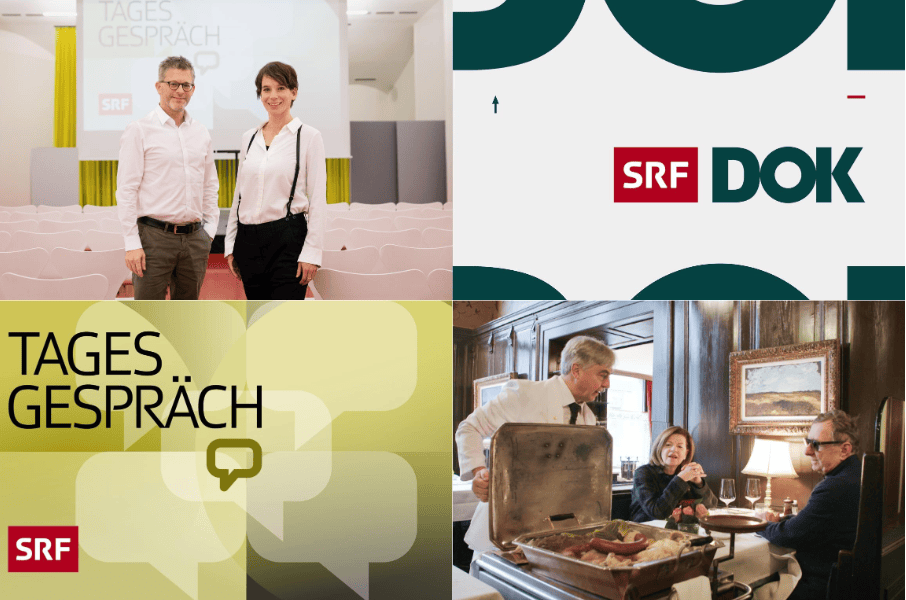 The SRF program "Tagesgespräch" and the "DOK" series "Inside Kronenhalle - Luxus und Tradition im Kultrestaurant" have won the Zurich Radio and Television Award 2025, which was presented on Monday evening, November 24, 2025, at the Zunfthaus in Zurich.
Radio Foundation honors "Tagesgespräch"
Since 2001, "Tagesgespräch" has been broadcast every weekday on Radio SRF 1 and Radio SRF 4 News. Every day, the program takes an in-depth look at a current topic with guests from politics, business, sport and society - knowledgeable, critical and fair.
The Radio Foundation emphasizes the work of the program's interview hosts: "They have fulfilled this requirement over the years up to the present day with remarkable consistency and in a journalistically convincing manner," the foundation said in the press release. In view of the constant pressure to keep up to date and the often short time available for research and interview preparation, this is a par force achievement worthy of an award.
Award for "Inside Kronenhalle"
The jury praised the technical quality of the "DOK" series, which was broadcast in April 2024: The exemplary and careful overall staging of camera, sound, editing and music allows an unbiased and authentic view into the ongoing operational events.
The prize is only awarded every two years
Every two years, the Zurich Radio Foundation organizes a competition to award the Radio and Television Prize. The two prizes are regarded as the most culturally significant radio and television awards in German-speaking Switzerland and aim to promote outstanding, pioneering media achievements.
]]>
Flury, who grew up in Davos GR, has been working for "SRF Meteo" since summer 2012. He previously worked briefly for the Institute for Snow and Avalanche Research and for several years at Meteo Switzerland. Flury studied geography with a specialization in climatology and atmospheric physics at the University of Zurich.
Tristan Brenn, Editor-in-Chief CR Video: "I am delighted that in Gaudenz Flury we have found an experienced meteorologist and climate expert from the 'Meteo' team for this challenging role. SRF Meteo' is highly regarded not only for its reliable forecasts and weather warnings, but also as a specialist newsroom for all SRF editorial teams. I wish Gaudenz Flury all the best for his important role from mid-2026."
Gaudenz Flury: "Weather forecasts and everything that goes with them are my great passion. Over the past few years, Thomas has built up a strong team that shapes 'SRF Meteo'. Continuing his work as Editorial Director is an exciting challenge for me, which I approach with great pleasure and respect."
Thomas Bucheli retires in 2026
Thomas Bucheli has worked for SRF since 1992. He took over as head of "SRF Meteo" in 1995. Before joining SRF, the nationally renowned meteorologist worked for six years at the Federal Office of Meteorology and Climatology and for one year at Meteomedia AG.
It is not yet clear when Thomas Bucheli will present his last program. SRF will provide further information in due course.
Felix Blumer's last show next Friday
In addition to Bucheli, another member of the "Meteo" team, Felix Blumer, is taking his well-deserved retirement. Blumer, who holds a doctorate in natural sciences, has been with "SRF Meteo" since 2004. Previously, he was head of information at the National Alarm Center.
Blumer will host his last show next Friday, October 31, 2025, between 05:30 and 09:40 on the radio stations SRF 1, SRF 3 and SRF Musikwelle.
Felix Blumer: "The last 20 years have been a very exciting time professionally. Thanks to my work at SRF, I've had the opportunity to meet lots of interesting people and I've been to some places I would never have gone otherwise. Since 2012, I've also had the opportunity to set meteorological and climatological highlights with my own 'Die Wetterwoche' (The Weather Week) show on SRF 1 every Sunday morning at 9.15 a.m."
Gregor Sonderegger, Head of Staff at CR Video: "With Felix Blumer, an institution is retiring: his knowledge and enthusiasm for explaining weather topics and weather phenomena to the audience in a clear and colorful way made him a trademark of 'SRF Meteo'. We would simply like to say thank you for over 20 years of weather expertise."
(Source: SRF)

The 34-year-old Strasser has a sound academic background. After studying history and media studies in Basel, he completed a bilingual Master's degree in European Studies at the University of Fribourg. He began his journalistic career as a freelance journalist for various print and online media in Switzerland and abroad. He later became a parliamentary correspondent for private radio stations before joining Swiss Radio and Television in 2019. He currently works as a domestic editor at Radio SRF.
In addition to his work as a journalist, Strasser is also committed to supporting young professionals. From 2016 to 2018, he chaired the "Young Journalists Switzerland" network, which he helped to set up.
"The coming years will be formative for relations between Switzerland and the European Union. It is a great privilege to be able to critically accompany this phase for the SRF audience on location in Brussels," says Matthias Strasser about his new role.
Susanne Brunner, Head of International Editor-in-Chief Audio/Digital, emphasizes: "Matthias Strasser has everything you need for an EU correspondent: in-depth knowledge of Europe and the EU and a high level of motivation to make complex issues understandable to a broad audience."
]]>
Until her departure from SRG, she will continue to press ahead with the ongoing cost-cutting and transformation projects, remain fully committed to the political process surrounding the halving initiative and the implementation of the new "Enavant SRG SSR" organizational model, and ensure an optimal handover to her successor.
Nathalie Wappler has shaped the further development of Swiss Radio and Television over the past six and a half years as Director - under increasingly challenging financial and political conditions. Under her leadership, SRF has transformed itself and set the course for the digital future with a new corporate strategy.
Among other things, Nathalie Wappler has established a modern organizational structure geared towards digital media use, numerous digital formats and new job profiles and skills in the public media company. This transformation enables SRF to react more quickly to changing market and technological developments as well as audience needs.
Political decisions, combined with a significant reduction in the financial framework and rapidly advancing developments in the media market, made a reduction in jobs and program offerings unavoidable. The SRF Director has implemented these measures carefully and with a great sense of responsibility. She leaves behind a strong SRF company that is well equipped for the challenges ahead.
Susanne Wille, CEO of SRG: "Nathalie Wappler has consistently thought ahead and brought SRF forward. She has strategically repositioned SRF as a leader in times of digitalization and rapid technological change with entrepreneurial foresight. I very much regret her decision to leave SRF. We have worked closely and very well together in key areas. I would like to thank Nathalie warmly for everything she has achieved at SRG, at SRF and for the people of our country in the area of conflict between audience expectations, financial pressure and politics."
Jean-Michel Cina, Chairman of the SRG Board of Directors: "The departure of Nathalie Wappler is a great loss for SRG. As Director of the largest business unit in German-speaking Switzerland, she initiated and implemented decisive changes and also took unpopular but necessary cost-cutting and reorganization decisions. Nathalie Wappler has always led the way and intensively promoted talent. On behalf of the Board of Directors: Thank you very much for almost 20 years of convincing commitment to our public media company SRG."
Nathalie Wappler, Director of SRF: "Working for our public media company was a great privilege for me; I was passionate about working for a strong public media service of today and tomorrow - and for an attractive program that our audience appreciates. At the age of 58, I want to start a new chapter in my career. Until my departure, I will continue to support SRG and the ongoing entrepreneurial transformation to the best of my ability, to accompany the political challenges with commitment and to ensure an optimal handover to new forces. With Susanne Wille as Director General, SRG is in good hands."
Nathalie Wappler's SRG and SRF career began over 20 years ago. From 2005, she initially worked as an editor at "Kulturplatz", three years later she became editorial director of "Sternstunden" and in 2011 she finally took over as head of the culture department at SRF. In this role, she brought together the television, radio and online editorial teams, modernized SRF 2 Kultur radio and developed new film and series strategies. In 2016, Nathalie Wappler moved to MDR in Germany as Program Director. In March 2019, SRG was able to win her back as SRF Director and subsequently also as Deputy SRG Director General.
Nathalie Wappler will retain her functions at SRF and SRG until the end of April 2026 and will continue to drive forward the ongoing savings and transformation projects. She will also be fully involved in the political processes surrounding the halving initiative and the next steps of "Enavant SRG SSR".
The search for Nathalie Wappler's successor will be led by the SRG German-speaking Switzerland Regional Board. The choice will be made by the SRG Board of Directors. SRG will provide information about the process in due course.
]]>
Monika Schoenenberger, anchorwoman Tagesschau
Eliane Leiser will be in front of the camera as the new presenter of "10 vor 10" from spring. The 38-year-old has been working for SRF for over ten years and has established herself as the voice of Radio SRF 4 News, including as host of the podcast "Einfach Politik" and presenter of the "Samstagsrundschau". She will continue her previous role as domestic editor on a reduced workload. Born in Zurich, she lives with her family in Bern.
"In times when one flashy news story chases the next, it is even more important to look behind the headlines, to classify and analyze them. I am delighted to be able to do this as the presenter of '10 to 10'," says Leiser.
New face for the "Tagesschau" main edition
Monika Schoenenberger joins the team of presenters of the main edition of "Tagesschau". She has been working for SRF since 2012 and has so far presented the midday and 6 p.m. editions as well as special broadcasts on current events such as the war in Ukraine or the storms in Switzerland in 2021. In addition to her new role as presenter, she will remain the producer of the main edition of "Tagesschau".
"As a producer, I am responsible for the content and journalism of 'Tagesschau'. It is a great honor and a pleasure to be able to present Switzerland's most-watched news program," says Schoenenberger.
Head of news sees "great enrichment"
Gregor Meier, Head of TV News at SRF, emphasizes: "I am delighted to have won Monika Schoenenberger and Eliane Leiser, two outstanding news journalists with a strong screen presence, to present the 'Tagesschau' main edition and '10 vor 10'. They will be a great asset to our two flagship news programs."
Eliane Leiser and Monika Schoenenberger are expected to present their respective programs for the first time towards the end of March.
]]>