
With the brand values "Authentic, formative, optimistic, popular and far-sighted", the Swiss Illustrated as a biographer of Switzerland since 1911. To this day, she offers readers stories that touch them and her very own closeness to stars and celebrities.
In the current image campaign, the Swiss Illustrated is now getting even closer and focusing on three Swiss celebrities and the headlines about them. In the TV commercials, presenter Christa Rigozzi, cult singer Baschi and the king of wrestling are confronted with headlines that revolve around their lives. The more concretely the words capture the essence of the story, the more the camera zooms in and literally brings them closer to the viewer.
The three TV commercials with the respective celebrities will be broadcast immediately in several waves on the TV channels of SRF, CH Media and the Seven.One Group stations. The campaign will also be accompanied online and on social media in various formats with short snippets and background stories.
Responsible for Swiss IllustratedMaximilian Börke (Head of Marketing), Silvia Binggeli (Editor-in-Chief SI), Martina Eith (Project Manager), Sabrina Fürst (Brand Manager SI), Andrea Bachofner (Art Director). Responsible at Stories (film production): Rhea Mandanis (Producer), Juliane Taudt (Director), Fabian Kimoto (DoP).
]]>
"Closer to personalities" is in the DNA of the Swiss Illustratedn anchored. Every week, the editorial team presents people from a personal perspective. The current campaign picks up on this and shows in five subjects where the Swiss Illustrated comes closer to the personalities.
The subjects show people during SI-Reading in an everyday situation: at home, on the road, in a restaurant, getting ready to go out. The magazine itself is depicted in the image as a symbol of the personalities' lives: Thus the SI sometimes a swinger pants, sometimes a movie hat or a chef's hat.


The idea and concept of the advertising campaign came from advertiser Frank Bodin. "The Swiss Illustrated is the seismograph of Swiss society, because no other medium has such personal access to exceptional people and is therefore able to bring them closer to a broad public," explains Bodin. "This special closeness is also the idea behind the campaign. Swiss Illustrated actually holds important things of the stars and personalities portrayed in it. Deliberately, readers and their interest in people important to our society are brought into focus."


Responsible at Bodin Consulting: Frank Bodin (Concept & Idea). Production & Casting: Find A Face, Rennie Diethelm (Styling), Bigi Otto (Hair & Make up). Locations & Art Direction: Saloon Creatives, Marcel Britt, Vera Studhalter. Photography: Geri Born (Photographer Swiss Illustrated). Project Management: Martina Eith (Brand Manager Swiss Illustrated).
]]> After the magazine was discontinued in 2020 (Advertisingweek.ch reported) - 35 jobs were cut in the process - the magazine celebrates Style is now enjoying a revival in a new form. Three times a year, it is to be published as an additional issue for subscribers of Swiss Illustrated and L'Illustré will appear and celebrate the beautiful sides in life in a varied mix, the publisher announced.
Style shows the latest trends in fashion, beauty, watches and design, and portrays exciting personalities from the lifestyle world. It is "a magazine to browse through and discover, and is published in both German and French in a high circulation.
Silvia Binggeli, Editor-in-Chief Swiss Illustrated: "We have to make our purchasing decisions carefully. But pleasure must not be neglected in the process. We introduce people who set trends and create pleasure, present news from the world of fashion, beauty, cars and watches. Some things will remain a feast for the eyes, others precisely for the readers of Style fit."
]]>
The first issue of the Swiss Illustratedn was published in 1911. The 100-page special edition bridges the gap from yesterday to today. 11 events - one from each decade - which were SI were accompanied, serve as a hook for interviews with Swiss personalities. The interviews are accompanied by historical images from the SI illustrated.
In addition, political scientist Adrian Vetter has used the SI conducted a study on the popularity of federal councillors. For this, he evaluated more than 3,000 issues from over 60 years. Who tops the rankings and who received the most front pages before, during and after their term in the Federal Council is clearly recorded.
"Sometimes the Swiss Illustrated Sometimes she is criticized for being harmless, sometimes for being too aggressive. Everyone has an opinion about it - precisely because everyone has a relationship with it," says Monique Ryser, deputy editor-in-chief of the Swiss Illustrated, quoted in a statement. "With this special edition, we celebrate the achievements of our predecessors, revive highlights and give personalities of today a glimpse into the future. For once, we also chat a bit from the sewing box and present trouvailles from our archives."
]]>
For SI Editor-in-Chief Silvia Binggeli, who took over the title in February, it's back to the roots. "I started my journalistic career over twenty years ago as a journalism student at the Swiss Illustratedn began. I'm very excited to now lead the cult magazine into the future with a great team." The Swiss Illustrated will appear from Friday with a refreshed layout and additional new sections.
Personalities in focus
Meeting and showing personalities in private is part of the DNA of the SI. There are now additional sections: In the future, two Swiss personalities from different fields will exchange views on current social issues in the "Gipfeltreffen" discussions. In "Meine Kulturwoche" (My Culture Week), celebrities reveal which films, books, concerts or art exhibitions inspire them. In addition, Swiss people who have moved abroad talk about what they experience abroad and what they miss about Switzerland.
In the back section of the magazine, the service pages are visually upgraded and expanded with lifestyle: Interior, watches and sustainability are new additions to the established topics of travel, health, food, cars, fashion and beauty. The expanded lifestyle section also appears in the French-language sister magazine L'Illustré.
Expanded view, refreshed layout
The logo again gets a prominent appearance and moves to the left margin on the cover. The weekly content will be visible on the cover in all its diversity. In the magazine, clear structures, new fonts and tidy graphics will ensure better reader guidance. The pictures - the trademark of a magazine - are given space. The service section will be visually enhanced. Although playful elements freshen up the appearance, the reader guidance has become calmer and clearer.
"The SI content formula is not new - but we want to strengthen it. Loyal readers should not have the feeling that they are holding a completely different magazine in their hands - just a refreshed one, one that brings well-known personalities closer to them each week, but also presents newcomers, lets them discover and shows the diversity of Switzerland," explains Binggeli. "We keep an eye on social developments. Above all, we want to surprise and entertain with honest, relevant stories and strong images of personalities."
]]>Reto Lipp conducted the interview with the new Swiss Illustrated-Chief Executive Officer. Silvia Binggeli is still very new in her post. Previously, she was Editor-in-Chief of the Annabelle. It specializes in the production of magazines and journals. But does a printed magazine with celebrities in focus still have a chance at all in an age of social media channels? Today, anyone can follow their celebrity on Facebook, Instragram or Tiktok. What place is there for a celebrity magazine? After all, who gets on the cover today? Who is really prominent? And where do you find celebrities in a market as narrow as Switzerland? SI editor-in-chief Silvia Binggeli ("From Guggisberg to New York") wants to combine tradition with new beginnings, mixing well-known celebrities with new figures who are given celebrity status.

In the Comsumcast, SRF journalist and presenter Reto Lipp talks to heads from the media and communications industry. The topic: How the Corona pandemic is affecting the industry. The Comsumcast is the replacement for the Communication Summit of the ZPRG and the ZPV. Due to the pandemic, the annual event at ETH Zurich was cancelled in both 2021 and 2022. A new episode of the Comsumcast is published every month.
The Comsumcast is also available on Spotify and with Apple Podcasts to listen to. It is produced by Tablecast / Christoph Soltmannowski.
]]>
De Schepper has been in this role since 2015 and Siegrist since 2020 for the Swiss Illustrated as Ringier Axel Springer Switzerland announced on Tuesday.
From 2013 to 2019, the 49-year-old Binggeli was editor-in-chief of the Annabelle, she previously held various positions at the magazine. For the Swiss Illustrated she worked as an editor from 1997 to 1999.
"With many years of experience and a broad network, Silvia Binggeli is ideally suited for the challenging task," Alexander Theobald, CEO of Ringier Axel Springer Switzerland, is quoted as saying in the statement. Bingelli is to lead the Swiss Illustrated in terms of both journalism and personnel. The editorial team currently has 48 permanent employees.
De Schepper remains at Ringier
De Schepper will continue to work for Ringier, according to the statement. He will be chief author of consumer magazines and will be responsible for publishing projects of the publishing house in the future.
Siegrist had also been offered another management position in the company. However, talks about her future activities are still ongoing. (SDA)
]]>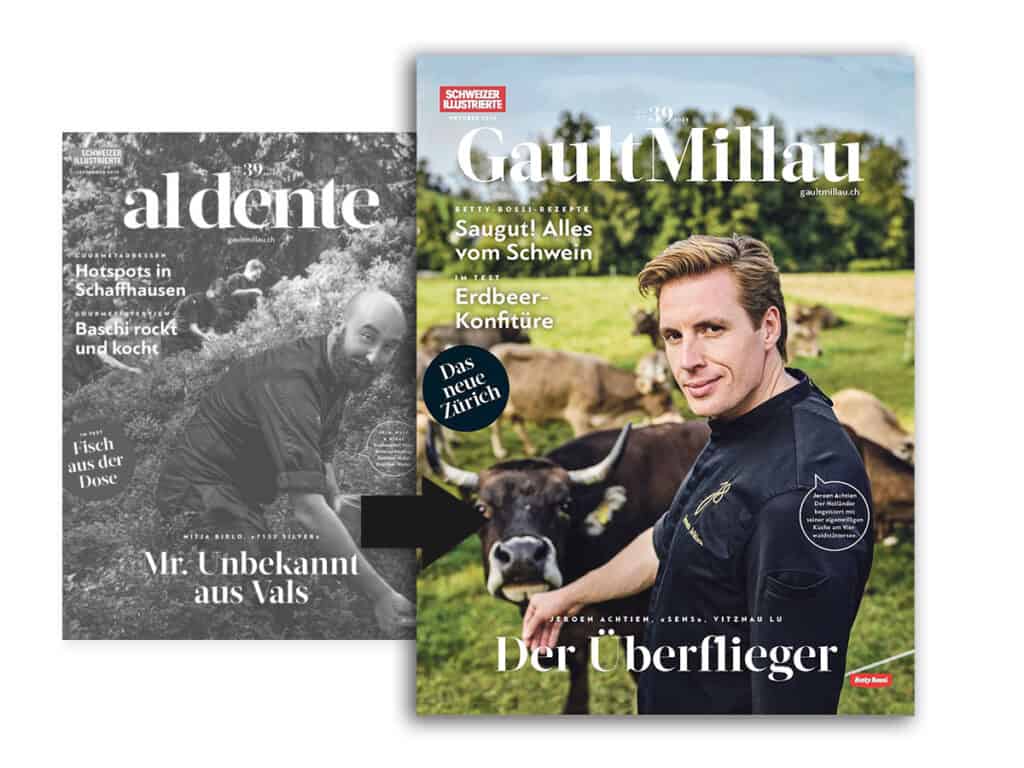
Al Dente appeared for the first time on June 3, 2002, together with the Swiss Illustrated. The epicurean magazine was a printed supplement to the cooking show "Al Dente" with Sven Epiney. In its 20th year of publication, the magazine is now being integrated into the GaultMillau world and will appear for the first time on Friday under the new title of GaultMillauas Ringier Axel Springer writes in a press release.
"We want to bundle all our activities on the topic under one label. The yellow guide. The very successful GaultMillau Channel. The weekly newsletter. Our appearances on social media," explains Urs Heller, GaultMillau-Chef. "We change at Al Dente but only the name, not the content concept."
Much remains the same
The content concept is to remain untouched and will continue to provide stories and interviews from all regions on the subject of food and enjoyment, the best pubs and restaurants, producer stories and Betty Bossi's recipes, according to the statement.
The editorial team also remains unchanged: In the lead is GaultMillauUrs Heller is the editor-in-chief, Isabel Notari is the editorial director. The authors of the GaultMillau-Channels also write for the printed edition. The cooperation with Betty Bossi also remains in place, and the GaultMillau-magazine continues to be published four times a year as an extra issue of the Swiss Illustrated.
]]>
Innovative projects and digital quantum leaps are created in Silicon Valley, in the world's metropolises or in urban centers. That is the popular opinion. But rural regions in particular are a place of progress; creativity is often more necessary far from the centers, and flexibility and speed are greater. Together with Swiss innovation representatives, the Swiss Illustrated and L'Illustré The company is therefore putting those rural regions in the showcase that are playing a pioneering role in the field of digitization.
Corona accelerates digitization - in every corner of Switzerland
The farm family offers products from the farm store in the online store. The local museum takes visitors on a virtual tour of the exhibition rooms. From one week to the next, village schools have switched to digital distance learning. The pandemic has presented the Swiss with a whole new set of challenges. In the big city as well as in the remote valley. Not only companies are affected, but also communities, schools, tourist destinations and private individuals. Digital solutions have made inroads in many areas in recent months. With the digitization of services, but also of social interactions.
Regional inventiveness receives award
With the search for the most digital valley in Switzerland, the Swiss Illustrated and L'Illustré innovative regions a platform. To this end, the initiators have teamed up with renowned partners. Swisscom and Blue News, Generali Switzerland, the Gebert Rüf Foundation and Digitalswitzerland, as well as individuals from politics and education, are supporting the national initiative with their expertise. A jury of experts will select the most outstanding projects from all the applications and send six regions to the finals.
The jury of experts is composed of Johanna Gapany (Member of the Council of States FDP), Judith Bellaiche (CEO Trade Association Swico, National Councillor GLP), Martin Vetterli (President EPFL), Roland Siegwart (Professor ETH), Roger Wüthrich-Hasenböhler (Chief Digital Officer Swisscom), Andreas Krümmel (CEO Generali Switzerland), Pascale Vonmont (CEO Gebert Rüf Foundation), Diana Engetschwiler (Director Public Dialogue & Head of Digital Day) and Christian Wenger (Swiss Autonomous Valley, Wenger & Vieli).
Winning talent is chosen by readers
The six finalists will be announced in the Swiss Illustrated and L'Illustré and thus have the opportunity to convince readers of their digital thought leadership. The "Digi-Valley of Switzerland 2021" will be chosen by the readers. The winning valley will be announced on Digitaltag on November 10, 2021.
"In addition to the award, the winning valley benefits from further presence in the two magazines with a total reach of around 850,000 readers," explains Werner De Schepper, co-chief editor of the Swiss Illustrated. "With this initiative, we want to show that digitization has become part of everyday life across the country."
In addition, the valley receives support from the main partners to continue its success story and to spread it to other regions of Switzerland.
"Despite its small size, Switzerland has repeatedly produced innovations that have gained worldwide recognition," says Roger Wüthrich-Hasenböhler, Chief Digital Officer Swisscom and member of the Digi-Tal jury. "In areas such as agriculture, tourism or the construction industry as well as in high-precision technology or the pharmaceutical industry. We live in a nation of innovation that is on the verge of taking on a pioneering role in digitization as well. To this end, Swisscom is building and operating modern infrastructure with mobile communications, fiber-optic network, data centers and digital solutions. And it's doing so all the way to the farthest valley. Digi-Tal 2021' gives creative ideas in these regions and valleys a stage".
"Education is the basis for the success of Switzerland as a place to do business and live," says Pascale Vonmont, CEO/Director of the Gebert Rüf Foundation. "How do we learn and teach to train the next generation to be responsible shapers? Schools and teachers across the country are already making relevant contributions through pilot projects. We are pleased to put these pioneers in the showcase and engage them in an exchange."
Interested parties can submit projects by July 15, 2021, at. Digi-tal-switzerland.ch submit
]]>

According to the Covid 19 ordinance, which is no longer valid, only daily and weekly magazines that provide current news, cover a wide range of topics and are aimed at a broad audience receive this indirect press subsidy. This was stated by the Federal Administrative Court in a ruling published on Wednesday.
The regulation was intended to give state protection to those media that contributed to the democratic political discussion among the population. The focus of the Swiss Illustratedn the view of the Federal Administrative Court, however, is not to convey current information, but to entertain. This was shown by the analysis of the content.
Incorrect justification
The Federal Administrative Court has rejected the appeal of Ringier Axel Springer Schweiz - publisher of the Swiss Illustratedn - against the prior decision of the Federal Office of Communications (OFCOM) was therefore rejected.
In its ruling, Bakom also came to the conclusion that no indirect press subsidies were to be provided. However, it incorrectly justified the decision by stating that the Swiss Illustrated belonged to "extended special press".
Ringier submitted its application for indirect press funding in July 2020. The Illustrated is published weekly with a circulation of over 127,000 copies and has an average readership of just over 490,000. (SDA)
]]>
The case concerned an article in the run-up to the March 7 vote on electronic identity. As the Press Council stated on Friday, the reference to blick.ch "in cooperation with ..." is not sufficient because the article was published in the usual appearance.
Thus, the voting propaganda of the Digital Switzerland business association did not sufficiently stand out from the editorial content. The reference was also easy to read over, so that the article was not clearly declared as advertising.
Only the third and final version met the requirements, as the Press Council writes. The clear sentence stating that it was political advertising with the author's line "This is a paid contribution, presented by ..." created the necessary transparency.
Surreptitious advertising for farmers
Also the Swiss Illustrated violated the requirement to separate paid and editorial content. Between April and June 2020, the magazine published a four-part series of reports on farms as part of the "More Switzerland in the Plate" campaign.
This was financed by Agro-Marketing Suisse, the marketing company of the farmers' organizations. According to the Press Council, the financing was not disclosed. The first report stated that it was produced in collaboration with Swiss farmers.
Only in the last article, however, did it say "in collaboration with Agro-Marketing Suisse and the Swiss Farmers' Union", which is not enough according to the rebuke. In order not to mislead the readership, the cooperation must be clearly declared as commercial and paid in each individual article.
Concerns about Native Advertising
The Council also recalls that the obligation to label advertising also applies to social media. For example, it found the reference "sponsored" on a Facebook page to be insufficient. Instead, the Press Council recommends the clear labeling "Paid advertising partnership.
In general, the Press Council is concerned about the spread of so-called native advertising, i.e. advertising in the "familiar environment" of a publication that hardly differs from the editorial content. Newspaper publishers are under pressure to generate advertising revenue.
But commercial articles in the guise of editorial copy would do them a disservice. They show "a lack of respect for the readership and undermine the credibility of journalism," the council writes. (SDA)
]]>
Especially the fashion and lifestyle magazine Style is heavily dependent on the advertising market and has suffered an additional decline since the Corona crisis, Ringier Axel Springer Switzerland wrote in a statement. The title's advertising revenues have halved in the last four years, it said. To avoid further losses, the magazine is to be discontinued and its editorial team disbanded. "The decision has been extremely difficult for us," Alexander Theobald, CEO of Ringier Axel Springer Switzerland, said in a statement. "Due to the steadily deteriorating market situation, exacerbated by the effects of the Corona crisis, we can no longer justify continuing the magazine." The printed edition of Style is expected to appear for the last time on August 20, 2020.
Style, 2006 as a side extension of the Swiss Illustrated under the name SI Style was launched, became a lifestyle magazine in its own right in 2008, and in 2016 was also named by the Swiss Illustrated decoupled. In 2013, the web presences of Swiss Illustrated and Style merged. In February 2020, Style underwent a final relaunch (Werbewoche.ch reported).
Bolero: continuation through external production
The setting of Style would also have consequences for the fashion and culture magazine Bolerowhich is currently produced by the same editorial team and will be produced externally in the future. "Bolero was put on a solid economic footing last year with the adjustment of the sales concept. However, due to the restructuring, production could no longer be realized internally in the future," says Alexander Theobald. "With outsourcing, we can design and ensure the continued existence of the magazine in a more flexible way." Bolero Published as a supplement to business publications since 2019 Handelszeitung and Balance (Werbewoche.ch reported).
Sabina Hanselmann-Diethelm leaves the company
With regard to the planned measures at Style and Bolero the current Editor-in-Chief Sabina Hanselmann-Diethelm would also leave Ringier Axel Springer Switzerland. "I regret this very much and thank her for her convincing work as Editor-in-Chief to date. Sabina Hanselmann-Diethelm has led the two titles with a great deal of passion, creativity and know-how and has always been intensively committed to the employees and looked after customers," said Alexander Theobald.
Schweizer Illustrierte: Merging Print and Online
In addition, the editorial offices of the Swiss Illustrated and SI online will be downsized and organizationally merged in order to work consistently across channels in the future. Nina Siegrist, Co-Editor-in-Chief of the Swiss IllustratedI deeply regret the fact that we have to part with valued colleagues. The close integration of print and online should enable the traditional brand to achieve a positive result in the current market environment and continue to offer its readers high-quality journalism.
Consultation procedure opened with immediate effect
The savings that have become necessary envisage a total reduction of 35 jobs. A social plan is to be implemented for the corresponding employees - with measures that go beyond the legal requirements, as the media company emphasizes. The consultation process is open with immediate effect. Employees have until August 21, 2020 to submit alternative proposals on how the planned measures could be mitigated.
Syndicom regrets mass dismissal
The Syndicom trade union regrets that the corresponding measures have to be taken despite short-time working. In a statement, the union demands that a decent social plan be worked out for those affected and expects the company to cushion the consequences of the job losses.
The measures taken by Ringier Axel Springer would show that public support without guard rails would not save jobs. The example of Axel Springer shows that even successful companies immediately cut jobs during economic turbulence, despite short-time work, which the Federal Council and Parliament must take into account when they revise media subsidies: "If the federal government supports media groups with public money without guard rails, as planned, this money will flow primarily into corporate profits and dividends," the union says.