
The Lia Rumantscha has launched a long-term collaboration with the Department of Computational Linguistics at the University of Zurich. The aim of the collaboration is to develop a translation program that covers all idioms of Romansh, Rumantsch Grischun and German. Radiotelevisiun Svizra Rumantscha (RTR) launched a tool for translating between Rumantsch Grischun and German back in 2022. The new project now complements this offering with the idioms and will be further developed under the direction of the Lia Rumantscha.
The software should be ready for operation one year after the start of the project. It will be freely accessible via the web and will also be made available for professional use via programming interfaces (APIs). The Lia Rumantscha is responsible for coordinating and providing the linguistic data. The University of Zurich is developing the underlying technology, while RTR is providing support in the form of text material and editorial expertise. This data is used to create a language model that serves as the technical foundation for the translation software.
"Thanks to the long-term collaboration with the University of Zurich, we are at the cutting edge of technology and can continue to create new services for the benefit of the Romansh language in the future," says Markus Solinger, Secretary General of the Lia Rumantscha. "This project represents a concrete step in the implementation of the digital transformation strategy, which is based on close cooperation between Romansh institutions."
Digital transformation is being driven forward
The project arose from the needs of over 20 municipalities and institutions that had articulated their requirements as part of the strategic groundwork. RTR was subsequently involved in the process. "RTR works with the Romansh language on a daily basis, develops it further, regularly creates and translates idiomatic texts and distributes them to a broad audience across language borders," explains Nicolas Pernet, Director of RTR. "As a Rhaeto-Romanic media company, it is important for us to support this project and join forces in Rhaeto-Romanic."
The translation software is part of the strategy for the digital transformation of Romansh published in March 2025. Its aim is to increase the visibility of Romansh in the digital space and thus facilitate its use in everyday life. The projects are coordinated across institutions by Lia Rumantscha, RTR, Fundaziun Medias Rumantschas and Dicziunari Rumantsch Grischun.
]]>
No employees will be made redundant, RTR Head of Communications Tamara Deflorin emphasized on request. "The cuts will take place in all areas, in programming, marketing and communication, in technology and in central services," Deflorin told the Keystone-SDA news agency.
The reduction corresponds to around four percent of the workforce. RTR's total budget this year amounts to CHF 24.9 million. In 2025, it will still amount to CHF 24.6 million, which is 1.2 percent lower.
Reduced offer for children
Despite the wide range of measures, it is not possible to achieve the necessary savings without cutting back on programming, according to RTR. For example, the offer for children on the Internet will be greatly reduced, the radio program will be adjusted, a summer information program will be discontinued and the weather forecast in the news program "Telesguard" will be cancelled.
The need to make savings is a result of the SRG SSR's cost-cutting measures, it said. It will have to save CHF 50 million next year and is expected to save CHF 65 million in 2026. Further savings will be required in the near future due to the planned adjustment of the annual media levy for households. (SDA)
]]> The automated translation can be used for individual words, whole texts or Word documents in the web interface. It works similarly to freely available translation services on the Web, according to a statement from RTR on Tuesday.
The system translates from the standard language Rumantsch Grischun into the other three national languages and into English. It is possible that individual Romansh idioms will also be translated in the future.
The media house wants to use machine translation to make editorial work easier. "This technology will allow us to increasingly subtitle our broadcasts and make them available to a wider audience on different platforms," RTR Director Nicolas Pernet is quoted as saying in the statement.
Public online service under consideration
It is conceivable that the Rhaeto-Romanic translator will be offered as an online service in the future, thus providing access to the Rhaeto-Romanic language for the entire population, writes RTR.
Talks about long-term financing of such a platform are already underway, said Tamara Deflorin, head of communications, in response to a query from the Keystone-SDA news agency. It would also depend on the financing whether the service could be made available free of charge.
One sticking point, according to Deflorin, are the idioms, which are of central importance to the population. To enable their automatic translation, a great deal of text material is needed from which the system learns the specifics of the idioms. However, this material still has to be compiled and processed. (sda.)
]]>
According to the current status, RTR will have to save around CHF 1.5 million by 2024, the smallest SRG business unit in Chur announced on Wednesday. The total budget will be reduced from CHF 25 million to CHF 23.5 million as a result, as was reported on request.
Jobs are also being cut. By 2024, the number of full-time positions must fall from the current 138 to 128. The reduction is to take place over the next four years through natural fluctuation.
"Transform and focus"
In order to be able to implement the cost-saving measures, but also to meet the needs of the audience, RTR must and wants to "transform itself and focus even more strongly", it said. The journalistic offering must take account of changes in media consumption.
According to RTR, the increased use of digital platforms not only requires adjustments to programming, but also to the production and distribution of broadcasts. In the long term, the aim is to achieve a balance between digital and linear offerings. (SDA)

Pernet, who was presented in Chur on Thursday, was elected by the SRG SSR Board of Directors. He succeeds Ladina Heimgartner, who moved to the Ringier Group at the end of last year. As director of the smallest SRG broadcasting chain, Pernet manages an annual budget of just under 22 million Swiss francs, and he is the new head of some 140 employees.
Raised in Sent in the Lower Engadine, Pernet completed his studies in business administration at the University of St. Gallen, where he later earned his doctorate - after spending time abroad.
The new RTR Director, who will also become a member of the SRG Executive Board, has spent his entire professional life to date at the Ringier media group. He first worked there from 2010 as Project Manager Corporate Development for "Digital Business". Since April of this year, he has been "Head of Commercial Management" at the Blick Group. Pernet is married and has two children.
15 applications
SRG Director General Gilles Marchand said in Chur on Thursday that he was pleased to welcome Nicolas Pernet to the Executive Board. The expertise of the new RTR director and his knowledge of the Swiss media landscape are of great benefit in this phase of SRG's transformation, he said.
A total of eleven men and four women had applied for the RTR director position in response to the public call for applications. The Corona pandemic delayed the selection process, according to a statement made at the media briefing. (SDA)

Image: SRF
The "Fundaziun Medias Rumantschas", the successor agency to the "Agentura da Novitads Rumantscha", will launch next year with an editorial team that produces texts in all Rhaeto-Romanic idioms and in the written language Rumantsch Grischun. The agency is run by a foundation of the same name.
The content will be made available to the Romansh media on a platform, with Rhaeto-Romanic radio and television RTR also contributing texts. The service is free of charge for customers. (SDA)

With the "RTR ed jau" campaign, Rhaeto-Romanic radio and television is positioning itself as an important pillar of Rhaeto-Romanic Switzerland. The campaign focuses on employees of the SRG subsidiary. RTR shows that it not only documents Romansh culture, but also lives and promotes it. The campaign to strengthen the RTR brand was developed together with the Chur-based Bureau 08Eins.
Cross-media campaign
The lynchpin of the campaign is the landing page Play.rtr.ch/rtredjau on which portrait videos of RTR employees have been shown since the start of the campaign. The focus is on the personalities, their passions and how they are influenced by Romansh culture. In addition to background information and the portrait videos, tips and tricks from the testimonials create additional added value for visitors to the page. The portraits are teased on social media platforms and linked to the landing page. The poster campaign with the two testimonials runs simultaneously.

Family life and the love of cooking
TV presenter Isabella Wieland and radio man Sergio Guetg are the first two protagonists of the campaign. Both describe the influence that Romansh in general and RTR in particular have on their lives. Wieland explains how she, as a working mother of three daughters, organizes her everyday work and family life and the central role that Rhaeto-Romanic culture plays in this. Guetg compares working at RTR with his greatest passion, cooking. Both are creative and connect cultures and generations.
Real identification
"You can sense in the collaboration with RTR that the employees are not simply doing their job, but identify with the company, the language and the Rhaeto-Romanic culture. This pride and the passion of the protagonists inspired us to create the campaign," explains Marco Tscholl, project manager at 08Eins. This identification is conveyed to the viewers of the contributions and has an infectious effect.
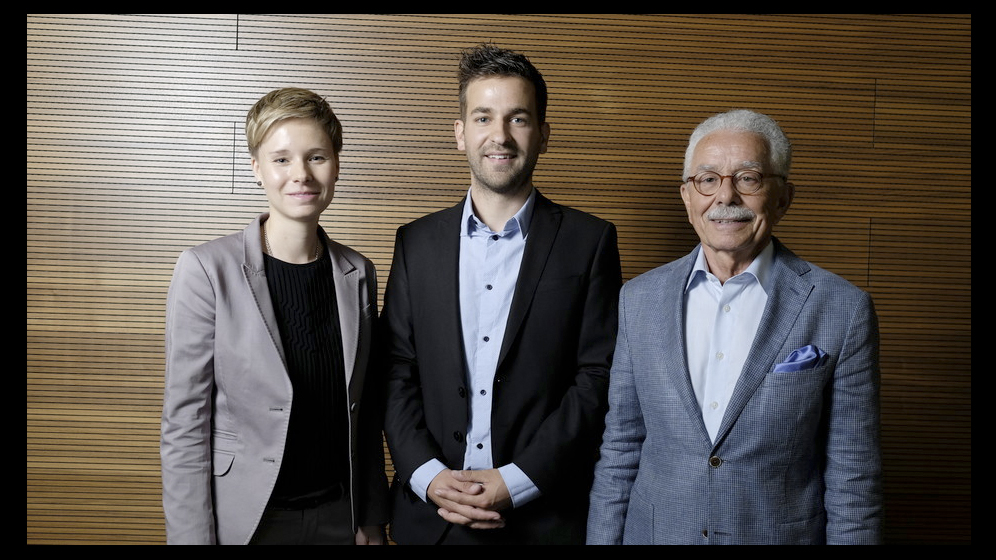
Flavio Bundi will be responsible for the radio, TV and online offerings of the public media house of Rhaeto-Romanic Switzerland, RTR announced on Tuesday. On November 1, Bundi will succeed Gian Ramming, who has headed the editorial department since 2009. Ramming, 58, will take charge of the new development department within the company.
Bundi, a native of the Grisons Oberland, is known in Graubünden primarily for his work as a composer and conductor. As a journalist, he is a little-described leaf. While studying German, political science and social science, the Ilanzer worked as a freelancer for the regional newspaper Bündner Tagblatt. In addition, he also worked for four years in the Pontifical Swiss Guard in Rome as a media officer and as head of personnel.
Enrichment for Rhaeto-Romanic media house
Bundi has "experience in making complex political topics accessible to a broad audience," SRG.R President Oscar Knapp is quoted as saying in the statement. He is familiar with the Graubünden cultural scene and will enrich the Rhaeto-Romanic media house with his fresh and committed manner. RTR Director Ladina Heimgartner is delighted with the choice. As a passionate musician and conductor, Bundi understands how to deal constructively with harmonies but also with dissonances, the RTR boss is quoted as saying. That is an important quality for a media executive. (SDA)

The 58-year-old will take charge of the new Development department within the company. The new department will deal comprehensively with the further development of the company, RTR announced on Tuesday. The aim is to strengthen the public media house of Rhaeto-Romanic Switzerland in the long term.
Gian Ramming has worked for RTR for 13 years. As editor-in-chief, he has played a key role in shaping the company since 2009, it said. The position of Editor-in-Chief will be advertised internally and externally in the coming weeks.
RTR also announced changes in the management team. The Head of Communications will now be a member of the management team, which is made up as follows: Ladina Heimgartner (Director), Tamara Deflorin (Head of Communications), Beat Lozza (Head of Central Services), Pius Paulin (Head of Technology), Gian Ramming (Head of Development) and vacant (Editor-in-Chief). (SDA)
Recently, the vintage VW bus has been on the road in Graubünden as a multimedia mobile called "Microlotta". The vintage VW bus (1974), developed by evoq, propagates the program offering of RTR, the television and radio of Rhaeto-Romanic Switzerland. It is to be made known to a broader Grisons population - with a special focus on new online offerings.

The bus is equipped with audio, video and multimedia infrastructure. It was converted by Diprint and technically realized by TPC Zurich. The screens show live images from the radio studio and Rhaeto-Romanic TV broadcasts, but also social media content that encourages participation and sharing. Interested people can meet the presenters in person or chat with them. With the "Play RTR" app, visitors can experience the RTR broadcasts on permanently installed iPads using videos and podcasts.
RTR's concern: having its finger on the pulse
"In close collaboration with those responsible at RTR, we developed the brand positioning with communication matrix in parallel with the roadshow," says Evoq Partner and Creative Director Christian Sutter. "This gave rise to the claim "al Puls dal Grischun," which is at the heart of the communication. Reflect the pulse of Rhaeto-Romanic Switzerland at the place where it happens. To be where the audience is. Radio and television very close to the local population, to touch and participate. The VW bus "Microlotta" functions as a sympathy carrier and eye-catcher."

The "pulse" was visualized with appropriate graphic elements, which at the same time recall the topography of the mountain canton. It shapes RTR's future brand identity visually and ideally, and will be applied to all media, from advertising locomotives to advertisements. The new graphic elements expand RTR's corporate design, which is based on SRF's specifications.

"Microlotta" will be present at numerous events, open airs and festivals this year. The bus owes its name to the RTR audience, which was able to submit suggestions on various RTR online platforms and was then drawn by lot on the radio.
Heimgartner was elected by the SRG SSR Board of Directors at the request of the SRG.R Regional Board. She will take up the post of Director on August 1. She is currently Head of Markets and Quality at the SRG Directorate General in Bern. As Director, Heimgartner will also be a member of the SRG Executive Board, as SRG wrote on Presseportal.ch on Thursday. Several qualified candidates of both genders responded to the job advertisement.
The election was unanimous. Oscar Knapp, President of the SRG.R Regional Board, said this on Thursday at the media orientation in Chur, according to SDA. For reasons of personal protection, it was not possible to go into more detail about the other candidates. However, he emphasized that "the best" had been chosen.
The choice is obviously not entirely unproblematic in terms of language policy. This is due to a lack of regional balance. After all, the president of the regional broadcaster SRG.R, the editor-in-chief of RTR and now also the director belong to the Ladin and Engadin groups respectively. According to SDA, Oscar Knapp said that quality could not be sacrificed for the position of RTR director just to solve a regional problem.
Ladina Heimgartner succeeds Mariano Tschuor, who is stepping down from the Board of Directors after five years. He will move to the SRG Directorate General in Bern in October. There he will take over as Head of the Markets and Quality department.
(Image: Rtr.ch)
]]>Mariano Tschuor was elected to the new post by the SRG SSR Board of Directors at the request of Director General Roger de Weck. Tschuor will report directly to de Weck, as SRG announced on Thursday. The 55-year-old Tschuor is the second Grisons native to be brought on board in Bern by the SRG Director General within a short space of time. Maurus Dosch will join the Director General's Office in April. Dosch is Tschuor's deputy and is responsible for finance and personnel at RTR. In Bern, he heads the Planning and Processes division. The position of RTR Director is to be advertised immediately. The outgoing RTR Director Mariano Tschuor has worked for SRG since 1982, initially as an editor at RTR in Chur. He then worked for 13 years in various program functions at the former Schweizer Fernsehen in Zurich. (SDA)
Picture: RTR
]]>