Anyone looking out of the window in the conference room of the 25hours Hotel on Zurich's Langstrasse would see an old Aqui sign. A relic from the days when mineral water still came out of the depths in Zurich. Today it bubbles differently. Not from Zurich's springs, but from the development centers of tech companies. Visibility, reach, data, attention: the city's new streams are digital. And they no longer flow freely.

This is exactly where the first Riverside Talk on April 15 came in. The setting was deliberately kept intimate, but the topic was all the more important: «The power of digital media: do algorithms and AI control our reputation?» A question that almost took on an added irony in this location. After all, just a few steps away is Google Land in Zurich, where YouTube, Maps and other global products are being co-developed. Inside, people were talking that evening about the consequences of precisely those platform logics that help set the pace of the digital present outside.

The Internet as monopoly and graveyard
Martin Andree, media expert and bestselling author, kicked things off. And he did so without a run-up. His diagnosis was drastic, his language deliberately pointed. Anyone who still sees the internet as an open space in which content can assert itself freely was served a harsh rebuttal. Andree showed a distribution curve of digital attention which, in his interpretation, hardly knows any competition. A dozen providers bundle practically the entire usage time, the rest, according to his exaggerated formula, «lie in a huge graveyard».

It was the tone of a wake-up call, not an academic footnote. Andree spoke of monopolies, regulatory failure and platforms that keep users trapped in their own systems. His image of the department store, which you can enter deeper but are no longer allowed to leave, was simple but effective. In his view, the free Internet has not disappeared, but it has been emptied: there is still content outside the platforms, but it lacks traffic. Attention no longer circulates openly, but is siphoned off and redirected within a few systems.
Andree became particularly pointed when he linked the logic of visibility with the logic of the transaction. Anyone who wants to sell in the digital world moves through a funnel in which the decisive gates have long been occupied by monopolists: Google for search, YouTube for free moving images, Meta in the social sector, Amazon for the transaction itself. His question to companies was therefore less moral than economic: how will you get any attention, data and transactions in the future if access is controlled by just a few players?
From media problem to management issue
This was precisely the strength of his presentation. Andree not only spoke about media and democracy, but also shifted the problem directly to the boardroom. Anyone who believes that platform power is primarily a journalistic issue is falling short. It has long been a business model issue. Content marketing is becoming ever more expensive, organic visibility ever scarcer and dependencies on the major gatekeepers ever greater. Even companies that are not interested in media policy issues have to ask themselves how they still want to operate independently under these conditions.

It was only logical that he also turned his attention to generative AI and ChatGPT. If, in future, an AI plays out the product recommendation, the point of power will only shift even further. Then it will no longer just be a search engine that decides on visibility, but a system that selects exactly one option from a multitude of possibilities. Andree called this a kind of feudalistic road toll in his typically pointed way. Either you are recommended - or you don't exist.
You don't have to share every one of his formulations to take the core of his message seriously. The first Riverside Talk therefore began not as a cozy after-work event, but as an alarm call. And that is exactly what gave the evening its pulse.
Trust in a world of plausible fakes
After this powerful diagnosis, the discussion did not tip over into resignation, but into a second, almost even more delicate level for companies: If digital spaces are characterized by platform logic, AI and synthetic content, how can reputation be shaped at all?
Tanja Hollenstein, strategy and communications expert, shifted the focus away from criticism of the system to the question of leadership. Trust, according to the central line of her input, is becoming the scarcest currency. She referred to studies according to which three quarters of the population already use AI assistance, but trust in these systems remains significantly lower - and at the same time many hardly check their results. The sentence she put into the room hit home: we actually trust people, but ask machines.

Hollenstein thus described a dilemma that affects companies very directly. Today, information circulates in fragmented public spheres, topics are pushed up in networks and mistakes are no longer forgiven. At the same time, organizations are under pressure to take a stand, provide transparency, react quickly and still remain credible. For Hollenstein, the basis of trust therefore lies not just in reactive communication, but in the interplay between self-image, strategy and communication. If these three levels are not coordinated with each other, reputation quickly collapses in a crisis.
It was remarkable that she did not describe communication as a cosmetic discipline. Quite the opposite. Communication should not patch up what was previously left strategically unresolved. It can only be effective if there is a basis for decision-making in the company - before the shitstorm, deepfake or misperception occurs.
When plausibility becomes stronger than verification
In the subsequent discussion with Diana Ingenhoff, communication scientist and media researcher, the evening gained further depth. Moderated by Hans Peter Riegel, who used AI-generated Trump memes to demonstrate the proximity of satire, manipulation and visual perfection, the discussion focused on the socio-cultural shift behind the problem of trust.
Ingenhoff formulated a sentence that sticks: It's less and less about whether something is verified - but whether it fits into your own interpretative framework. This is precisely where the actual shift lies. In a media world characterized by synthetic visual communication, plausibility often becomes more important than truth. Images, memes and AI-generated content are not effective because they are correct, but because they are connectable.

This is an unpleasant realization for companies. After all, a sober correction is often too late or too weak to counter a viral, emotionally powerful but false narrative. Ingenhoff did not make any false promises. You can no longer manage everything. Anyone who wants to manage reputation today must first accept that complete control has become an illusion.

This is precisely why preparation is gaining in importance. Social listening, a precise understanding of the relevant stakeholders, a clear value framework, functioning processes and practiced response patterns: these are no longer optional extras, but prerequisites. In this logic, reputation is not only created in a crisis, but long before it occurs.
People remain the eye of the needle
It was exciting that, despite all the technology debate, the evening kept coming back to people. Hollenstein spoke about leadership, enabling and strategic agility. Ingenhoff emphasized media competence, further training and the declining ability to classify content at all. And Riegel put his finger on a sore point in many organizations: Managements also often lack a deep understanding of digital mechanisms, even though their economic consequences have long been real.
This was perhaps the most productive insight of the evening. It is not the technology alone that is the problem, but how society and organizations deal with it. Anyone who only understands algorithms, platforms and AI technically does not understand them enough. Those who only use them communicatively also do not understand them well enough. We need a broader understanding of how visibility, belief, emotion and power interact today.
Or to put it more bluntly: reputation is no longer just the result of good work and clever communication. It is increasingly also the result of systems in which perception is distributed, amplified and distorted.


A start with friction
The first Riverside Talk thus had exactly what a new format needs: friction, focus and enough open flanks for contradiction. Martin Andree delivered the shock. Tanja Hollenstein translated it into leadership and communication issues. Diana Ingenhoff showed that the real challenge lies even deeper - in our patterns of interpretation, in our media competence and in a public sphere that is increasingly splitting into partial realities.
The old Aqui logo was emblazoned outside. Inside, it was no longer about water, but about the streams of attention. Whoever directs them does not direct everything. But a lot. And that is precisely why this evening was more than just another talk about digitalization. It was an indication that reputation today is no longer just something to be cultivated. In an increasingly confusing system, it has to be defended, explained and constantly re-established.

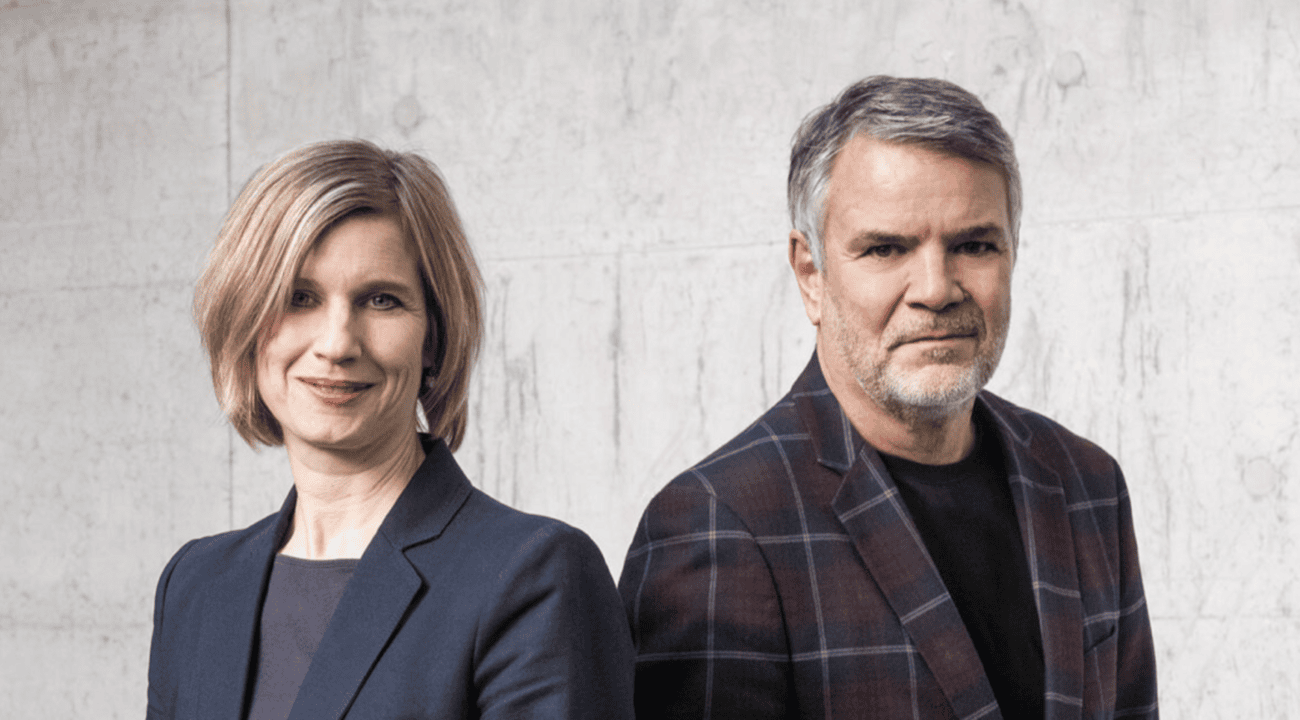 Riverside is realigning its corporate structure to strengthen its offering. Founded in 1995, the company will in future be managed as a holding company under which Riverside Strategy and Digital Media will operate as operationally independent units for strategy consulting and communication as well as digital media production.
With this structure, Riverside is responding to an increasing demand for differentiated solutions at the interface between corporate strategy and communication. In recent years, it has become clear that strategic tasks can hardly be solved without dovetailing them with communications expertise.
Managing Director Tanja Hollenstein explains: "With the new structure, we can respond to the needs of our clients even more quickly and with greater focus. In an increasingly dynamic environment, strategic clarity and professional implementation are crucial, especially in digital media. We are strengthening these skills with our units."
Riverside Strategy: Strategy and communication as an integrated offering
The areas of strategic consulting and strategic communication are given an even clearer profile at Riverside Strategy. The focus is on topics such as corporate strategy, transformation, change and crisis management, reputation and leadership communication.
The special feature of the offer is to combine entrepreneurial consulting with communicative measures right from the start of projects. This accelerates processes, motivates employees and strengthens the entire organization's commitment to identity, positioning and stakeholder management.
Digital Media: Digital media production with innovative tools
This new company bundles the units that deal with digital media production - in the areas of video, publishing and digital culture: Riverside Productions, Riverside Publishing and Riverside Culture. The aim is to further expand the specialized expertise for high-quality content in a digital media world. On the one hand, this bundled know-how is available to the strategy projects. On the other hand, it is positioned independently in the market.
The units are under the professional leadership of Hans Peter Riegel as Creative Director. The multi-award-winning digital pioneer, designer, author and filmmaker explains: "In today's media reality, content is a strategic success factor. Our specialized units therefore stand for high-quality output in digital media - from social media and video to on-demand publications. In addition, there is the Culture Unit, with which we realize top-class digital culture projects that create relevance. After all, companies and brands develop their charisma when they occupy a place in social consciousness."
Network of associated partners strengthens expertise
Riverside has long relied on a network of renowned associated partners to expand its expertise in a targeted manner and ensure the highest quality in consulting and implementation. New additions are Dr. Martin Andree, media expert and bestselling author from Cologne, and Videofactory as a partner in the field of video production.
With the new structure, Riverside is creating the basis for further expanding its offering in the future and developing additional collaborations and platforms - particularly at the interface of strategy, communication and digital culture.
Riverside was founded in 1995 by Hans Peter Riegel. Tanja Hollenstein has been an equal co-owner since 2020. As an owner-managed company, Riverside stands for a personal, efficient style and high standards in consulting, creativity and implementation. The company supports well-known companies and organizations in development, transformation, crisis and restructuring processes. A special feature of Riverside is the deliberate avoidance of pitches. Instead, new clients get to know the company in a joint situation analysis workshop.
]]>
werbewoche.ch: Mr. Riegel, your career began in 1984 when you accepted the first ADC award.
Hans Peter Riegel (Riverside): I was lucky enough to start my career very young, at the age of just 24, in 1984, immediately as an art director at GGK Düsseldorf, one of the most successful agencies in Germany at the time. After only six months, I had already received five ADC awards, and many more followed. In the course of my advertising career, during which I also worked for BBDO, Publicis and LOWE, I had the pleasure of learning from greats like Michael Schirner, Wolf Rogowski, Karl Gerstner, Vilim Vasata and Walter Lürzer. Above all, I was always working in other countries and met agency legends such as Hans Brindfors in Stockholm, Maurice Lévy in Paris or Allen Rosenshine in New York.
What are the "sizes" today?
Bolt: Good question. When I look at the current scene, I think there is a lack of outstanding minds that existed in the past. There are certainly outstanding advertisers and PR professionals, but there is an overall shortage of top talent.
How do you leverage your competitive advantage of experience and also talent?
Bolt: Our advantage is the diversity and quality of our experience combined with the esprit of our designs. Tanja Hollenstein and I come from different backgrounds in communications. Tanja has a background in PR and corporate communications with extensive experience in digital and moving image media. Like myself, she was appointed to executive positions very early on and has been able to advise high-profile clients.
I bring great experience in classic advertising, but also as a director and producer in the field of moving images and events. Finally, I was one of the first advertisers to work with digital media. I also have specialized know-how in management consulting, and have advised companies in areas such as change management, restructuring and IPOs. Above all, I am a manager and entrepreneur. At the age of 29 I was already managing director and partner of a BBDO agency. Since then I have always been co-owner or owner of the companies I work for. Tanja has these entrepreneurial genes as well.
Who is "Riverside"?
Tanja Hollenstein: Our services are broader than just advertising or PR. We are not a classic advertising or PR agency, but a management consultancy. One part of our services is communication, but our field of activity extends far beyond that into strategic consulting. We offer this because we can and have the experience to do so, rely on an excellent young team as well as professionals who work with us.

What most distinguishes Riverside from advertising and PR agencies?
Bolt: We are not only active in strategic consulting and communication, but also as producers of culture. With the Digital Art Zurich Festival, the DAZ, we have built the largest digital culture event in Switzerland, one of the largest in Europe. In connection with this, we have completely different perspectives than conventional agencies.
Hollenstein: What also sets us apart: We don't pitch. That's an aberration that we're trying to avoid. The bottom line is that agencies pay less for pitches, and the clients are then looked after by juniors instead of the bosses who were still sitting at the table when the pitch was made.
How do you get orders then?
Hollenstein: Primarily through recommendations and networking. We then carefully consider whether to accept a mandate. If we are not convinced of the cooperation in terms of content and especially in human terms, we prefer to leave it alone.
How would you characterize the form of your work?
Bolt: We strive to be lean and agile in every area we serve. Our approach is different from many others in the communications industry that have overly large and costly operational structures. These costs need to be covered on a monthly basis and may require taking on assignments that don't necessarily fit, but are done to pay salaries and rent. Our principle, on the other hand, is to work with the most suitable experts from different countries, depending on the task at hand, and to bring them in for projects as needed. In this way, we can offer our clients the optimal solution, both in terms of content and economy.
Tanja Hollenstein, can you give an example of such collaboration?
As a matter of principle, we do not talk about cases. One of our success factors is absolute confidentiality. We do not advertise what we do for clients. It is not least from such familiarity that a close cooperation with the client develops, a partnership from the very beginning. This allows us to bring in the clients' knowledge and combine it with our holistic approach, which encompasses all disciplines and subject areas. We often start with a workshop that looks at the big picture and condenses it into solution approaches early on. From there, we develop strategic guidelines that are effective in the long term. Which ultimately leads to an equally lasting collaboration with clients.
With Hans Peter Riegel, there was the momentum of the ADC awards in 1984. What was your entry momentum?
My entry moment was the Swissair crash in Halifax. At the time, I was in the agency supporting Beatrice Tschanz in communications. I was fresh out of school and saw firsthand how crucial communication is in such situations. We all knew what could happen if the wrong information got out. That experience shaped me, and I knew that I wanted my professional future to be in the communications industry. I saw the meaningful impact communication can have.
What was your takeaway from that pivotal moment?
Hollenstein: My most important insight was the importance of honesty in communication, then as now. Especially in a time when news can spread at breakneck speed and fake news can surface, it's crucial to be honest and transparent. The way you deal with issues is what counts most in the end.
How do you create trust?
Bolt: What I learned very early in my career is that you have to keep promises. If we tell a client they will have something tomorrow, they will have it. We don't deliver empty promises. We are precise and check things multiple times. Our principle is next to precision, high speed and constant availability. We are virtually always on the job because we know that problems can arise when you least expect it. This sense that professionals are at work, delivering what they promise, on time and within budget, builds trust.
How do you measure success?
Bolt: Our success is reflected in the fact that our clients remain loyal to us. Since Riverside 2020 was relaunched with Tanja, we have only gained clients, not lost any. I see that as a clear indicator of our success.
Hollenstein: Success in our clients' projects is also of great importance. Together we set goals that we want to achieve. The success of the client is our benchmark.
Bolt: Sometimes it's simple things like click-through rates. A project where we have reached almost 500,000 views within a few days or when we get an email that simply says MEGA! as praise for one of our productions. All of this is very motivating.
How do you encourage your customers to be bolder?
Bolt: That's an excellent question and an interesting point. Our goal is always to motivate our customers to think outside the box. We encourage them to say, "Look, if you take this step, it could have an impact, maybe you're going too far in an internal situation, but on the other hand, we say if you don't try, if you stop, you're going to fall behind, you're going to miss the music."
Do you have an example?
One example was a project for a series of image films. We put together a mood clip in a very short time and said, "This is what it could look like." We didn't go to any great lengths, we just went for it because we were convinced we were doing the right thing. We delivered in record time, and the client immediately understood the direction it was going in.
Hollenstein: In the world of moving images, it's particularly difficult to convey things using only sketches, storyboards or animatics. You have to go a step further, and experience plays a crucial role, especially in the communications industry. On a strategic level, it's also about mapping out the framework, identifying opportunities and risks, and limiting the risks in a way that allows you to try things out. This also requires analysis to find out what is possible.
Bolt: Another important point is reputation. It may sound banal, but it is essential: people know us and what we stand for, that we ask questions based on our knowledge and experience, and that we sometimes also address unpleasant aspects.
Hollenstein: Another point is that we always challenge ourselves. We always think that what we're doing is good, but we're always asking ourselves, "Can we do better?" This attitude that we always want to be a little bit better sometimes requires the courage to break new ground. But because we embody this attitude, we can encourage our clients to do the same.
Experience is an important part of your identity and unique selling proposition. But when can this experience also be a hindrance, in a world that is constantly changing?
Bolt: My attitude is always to be open and remain curious. On the other hand, this accumulated experience is extremely important, especially for training young talent and showing them the way. My cultural projects, my experience as artistic director of the DA Z Festival and as an expert in digital media art are of great importance here. This front-edge situation enables me to show others the way. I have trained many talented people, including some very renowned names in the industry. That's only possible if you know how to do it.
Hans-Peter Riegel is an author, media artist and curator. He studied visual communication, photography, film, art history and philosophy. From 1979 to 1984 he was assistant and private secretary as well as project partner of Jörg Immendorff. After this period and an extended stay in New York, Riegel worked as an art director. He received numerous awards for his creative work. This was followed by entrepreneurial activities in the fields of new media and culture as well as tasks as a strategic consultant. Since the early 2000s, Riegel has been primarily active as an artist and cultural entrepreneur. He was one of the first artists worldwide to take a critical look at the Internet. In 2020, he initiated the international festival for digital art in Zurich, DA Z DIGITAL ART ZURICH, which he continues to artistically direct. He has published the biographies of Jörg Immendorff and Joseph Beuys as well as numerous, journalistic articles on art and culture. Hans Peter Riegel lives in Zurich.

Hans Peter Riegel, you have been in the industry since 1984 and in Switzerland since 1989. How do you assess the changes in the advertising industry and especially in the creative sector of the industry?
Bolt: We used to develop campaigns and present them to clients, convinced that it was the best proposal. The customers agreed. Whether the campaigns were always economically successful in the end is another question. But that wasn't the only criterion in the past. Image was actually more relevant. We could make clever and beautiful advertisements, we were designers, artists almost, and thus had a different status, enjoyed greater respect. Over time, however, this respect was lost. Because suddenly everything was measured and evaluated quite technocratically. But also because the achievements of creative people did not necessarily get better.
What do you think are the reasons for this change?
Bolt: The reasons are many. Clients have become smarter and built their own teams for communications and marketing. Agencies were challenged and some parity emerged. Then came Internet development, and many small and agile Internet agencies and creative hotshops formed, while traditional advertising agencies did not take the developments seriously. That was the beginning of the end. The agencies lost their status as creative entities, were degraded to advertising processing service providers. Advertising and PR agencies as we knew them are a discontinued model. In my opinion, there will be no more advertising agencies in ten years at the latest.
That's a grim prediction.
Bolt: It may sound gloomy, but I made similar predictions back in the 90s and they have come true. The agencies as we know them are no longer necessary. There is no need for them anymore. We are the prime example of this development. We provide services like a large agency, but we only need a fraction of their infrastructure because Riverside was designed from the beginning to be innovative and highly efficient.
We'll leave it at that.
You've stated that companies that can no longer find creativity in classic agencies come to you. That's great - for you. But apart from the question of where clients go to find creativity, what might a future model look like in which classic creativity is possible again?
Bolt: The decisive factor is strategy. What we strongly emphasize is strategic consulting. First you have to know what you want to do in the first place. You have to have a basis. We scrutinize every single assignment for its strategic impact. At the same time, we have an immense spectrum of scientific input through our socio-culturally oriented cultural projects. And to be honest, most advertising and PR agencies are hardly in a position to offer such strategic approaches.
The second point is the total fragmentation of the communications landscape, which has split into countless micro-disciplines. Agencies have made the mistake of trying to integrate everything. But it does me no good at all to buy up one agency after another in the hope of securing their know-how.

What are the arguments against it?
Apart from the fact that it is economic nonsense, because most agencies are low-yielding and the return on investment will fail to materialize, this is a misguided approach, because the bought-in units do not work together in reality. They don't come close to covering the "full service" that is promised. As a consulting company - and that's how we see ourselves - we have to master the entire keyboard. We have to know the different registers, but we don't have to play them ourselves. We have to know how to play, where to get individual elements from. But above all, I have to guide the client through this jungle of communicative possibilities.
Which alternative model will prevail?
There will be small teams of highly skilled professionals who really know their stuff, and these teams will be assembled as needed to develop creative strategies and measures. Everything else is craft, technology and execution, and there are plenty of specialists for that who can be found all over the world, especially in the digital sector. The decisive factor is the quality of the team, which must be very competent and creative.
So that means that after the end of big ideas comes the beginning of new big ideas?
Exactly. That's the right way to look at it. Big ideas are still in demand, but you also need clients who are interested in them and with whom you can work on such projects. Then it will work.
]]>

Camilla Toman has been responsible for cultural and communications projects since last October; Aline Fürer for strategy, communications and social media services since January of this year.
Aline Fürer has extensive experience in leading integrated communication campaigns, with in-depth expertise in the digital media world. She is also active as a journalist in the field of electronic music.
Camilla Toman is an art historian who applies her knowledge to cultural projects in the corporate sector. She also curates the DA Z - Digital Art Zurich Festival together with Hans Peter Riegel, Creative Director and Chairman of Riverside.
Managing Director Tanja Hollenstein is very pleased about this outstanding professional and personal addition. "With Aline and Camilla, we have two talented employees on board who, together with us, will create the basis for further growth. In this way, we can ensure the increasing demand of our clients in the future in the usual quality."
Riverside was founded in 1995 as a strategy and management consultancy. With Tanja Hollenstein joining the company in 2020, the range of services was expanded to include communications services as well as film and cultural production.
]]>
Bligg is a trained plumber and thus represented the perfect ambassador for the building services industry. In the first video clip, he talks about how he came to his career choice and why he still counts it as one of his best decisions today. The production focuses on Bligg and his story as well as his connection to the industry. Bligg's off-screen voice and his honest insight into his career are intended to create an authentic and credible connection from his apprenticeship to his current job. The authentic story is intended to motivate young professionals and their parents to take an interest in this promising industry. The professional pride of existing professionals should also be strengthened with Bligg and the following ambassadors and their success stories.
The main clip and various teaser clips are played out on social media and partner channels. In addition, the topic of professional pride and the meaningfulness of professions in connection with Bligg's experiences will be further addressed with expanded storytelling. Bligg's story continues as part of his own WebTV series. In the coming episodes, the musician will explain why the professions of building technicians are so important - today and in the future.
Responsible at SuissetecChristian Brogli (Head of Marketing and Communication), Helena Montag (Project Manager Communication). Responsible at Riverside Productions: Tanja Hollenstein (overall responsibility), Hans Peter Riegel (creative director, direction), Andi Fruet, Trenary Guerrero (camera and editing), Marie-Joëlle Eschmann and Lisa Preuss (social media).
]]>