 Switzerland moves up two places from 14th to 12th in the 2023 World Press Freedom Ranking, which means it remains one of the countries where the situation can be described as "fairly good," but not one of the eight countries where the
freedom of information is best protected and the situation is "good".
This slight improvement is primarily due to the end of the Corona measures. They had led to an unprecedented rise in verbal hostility against the media, for example at demonstrations by "opponents of the measures," and sometimes to physical attacks on media professionals. This had contributed to Switzerland's fall from 10th to 14th place last year.
Worse than before the pandemic
However, the end of the Corona measures did not result in Switzerland regaining the position it had previously occupied. The indicator measuring the quality of the legal environment deteriorated further, with Switzerland slipping from 29th to 37th place in this area. One of the reasons for this was the federal parliament's approval of a tightening of the so-called "precautionary measures" that can be imposed by civil courts against the media, RSF informs. Parliament's decision would also have an impact on the indicator that measures whether the political environment is conducive or obstructive to freedom of information.
In the area of "legal framework," Article 47 of the Banking Act also contributed to Switzerland's lower ranking. This provision can be applied to media professionals when they use data from illegally obtained leaks for their research. On this point, RSF Switzerland was pleased to note that the National Council passed a motion in February this year calling on the Federal Council to examine the compatibility of this provision with press freedom.
The economic situation of the Swiss media remains difficult. Even though it has improved slightly with the end of the Corona crisis, it also influences Switzerland's ranking. For RSF Switzerland, the diversity of the media landscape is a component of press freedom. With the rejection of support measures for the media sector in the February 2022 referendum, the question of financial support for the media offering at the federal level remains unresolved.
 Reporters Without Borders' (RSF) annual tally of attacks on journalists worldwide sets a new record in 2022, with 533 media professionals imprisoned. The number of people killed also rose again this year - to 57, an increase of 18.8 percent over 2021. In addition, 65 journalists are being held hostage and 49 are considered missing. The number of detainees has thus increased by 13.4 percent compared to the previous year.
The three countries with the most media prisoners are China, Myanmar (formerly Burma) and Iran. But in Russia, for example, the state is also cracking down, according to the "Annual Press Freedom Review 2022" , which the human rights organization published today.
"Dictatorial and authoritarian regimes are filling their prisons faster than ever by imprisoning journalists. This new record in the number of media professionals imprisoned confirms the urgent need to resist these ruthless governments and to exercise our active solidarity with all those who embody the ideal of journalistic freedom, independence and diversity," said Christophe Deloire, Secretary General of RSF International.
Even countries considered peaceful dangerous
More than 60 percent of the media professionals killed did not die in war, but in countries that were considered peaceful in 2022. Mexico alone recorded eleven journalists murdered. These figures, along with those from Haiti (six killed) and Brazil (three killed), contribute to making the Americas the most dangerous region for journalists.
RSF's 2022 review also looks at some of the most sensational cases of the year. For example, the case of Ivan Safronov, one of Russia's top investigative journalists, who was sentenced to 22 years in prison for publishing "state secrets" that were already public on the Internet. This is the highest sentence recorded by RSF in 2022.
Since 1995, Reporters Without Borders (RSF) has produced an annual tally of attacks on journalists based on accurate data collected between January 1 and December 1 of the year of publication. The 2022 figures include professional journalists, non-professional journalists and media workers. (sda/RSF)
]]>
 On the occasion of the International Day to End Impunity for Crimes against Journalists, the media union Syndicom and the International Federation of Journalists call on the international community to finally guarantee the safety and protection of media workers with a UN convention.
Such an agreement is needed because to date there is no binding international instrument obliging member states to ensure the safety of media professionals and investigate crimes against them, according to a media release Wednesday.
Prosecutors from eight countries joined Reporters Without Borders (RSF) in criticizing the widespread impunity of perpetrators of crimes against journalists. Lack of security for media professionals also undermines the right of the population to form an opinion and decide freely, they said.
Murder should not be an occupational hazard for media professionals, the media release said. According to RSF, more than 1000 media professionals have been murdered worldwide since 2019. In the current year alone, 50 journalists have already been killed in the course of their work.
Referring to the United Nations Educational, Scientific and Cultural Organization (Unesco), the media release states that almost 90 percent of crimes against journalists go unpunished.
The security situation for media professionals is precarious in many countries around the world. Media professionals in Switzerland are also confronted with increasing pressure and dangers in relation to the legal, political, economic, social and physical framework conditions, writes Syndicom.
Eight prosecutors from Mexico City, Brazil, Slovakia, the Democratic Republic of Congo, Serbia, the Republic of Congo, Gambia and the United Kingdom have signed a commitment. To preserve the independence and impartiality of their investigations, they intend to resist pressure of any kind and publicly reject any form of collusion. (SDA)
]]> But the economic indicator used by RSF, which measures media diversity in particular, strongly influenced this result. The legal environment also showed gaps, and an unprecedented climate of hostility and intimidation toward the media emerged on the brink of the Corona crisis, largely unheard of until then and characterized by verbal and sometimes physical violence against media professionals.
With this 14th place, Switzerland is now one of the countries where the press freedom situation is rated as "rather good", having been in the top ten of the ranking since 2016. Nevertheless, Switzerland remains a safe country for media professionals, where the political environment remains favorable and ensures that they can work free from government and party pressure.
At the moment, however, the Swiss media landscape remains exposed, without a solution, to the extensively documented developments that had prompted the Federal Council and Parliament to propose an increase in state media funding with the "Package of Measures for the Media": an inexorable reduction in the diversity of titles and steadily declining revenues. The rejection of the media package in the February 13 referendum leaves unresolved the question of how to regulate in the long term a situation whose impact on citizens' information and on the quality of public debate - especially at the local level - is worrying. RSF Switzerland calls on the public authorities, especially in the cantons, to reopen the dossier and promote lasting solutions for the media landscape.
Weaknesses are also evident in the legal framework that applies to the media in Switzerland. The increase in civil law "precautionary measures" applied for and often obtained against the media has shown that even Switzerland is not immune to so-called "gagging proceedings" aimed at preventing legitimate publications of general interest. The fact that the Council of States last year and the National Council Commission at the beginning of this year agreed to tighten these measures against the media without a serious study proving the need for them has sent the wrong signal. In addition, the "Suisse Secrets" affair has highlighted the threat to freedom of information posed by the penal provisions on banking secrecy. On these two points, RSF Switzerland repeats its appeals to Parliament to fully respect the freedom of the press and to adapt the laws accordingly.
In connection with the Corona crisis, 2021 was also marked by the sudden increase in verbal and, in some cases, physical attacks on media professionals, especially during demonstrations by opponents of the measures imposed by the authorities to combat the pandemic. The extent of this intimidation and violence has also surprised and worried media professionals. Our organization hopes that such acts will disappear with the end of the pandemic. It has always condemned them and called on the authorities to prosecute and convict the perpetrators promptly and severely.
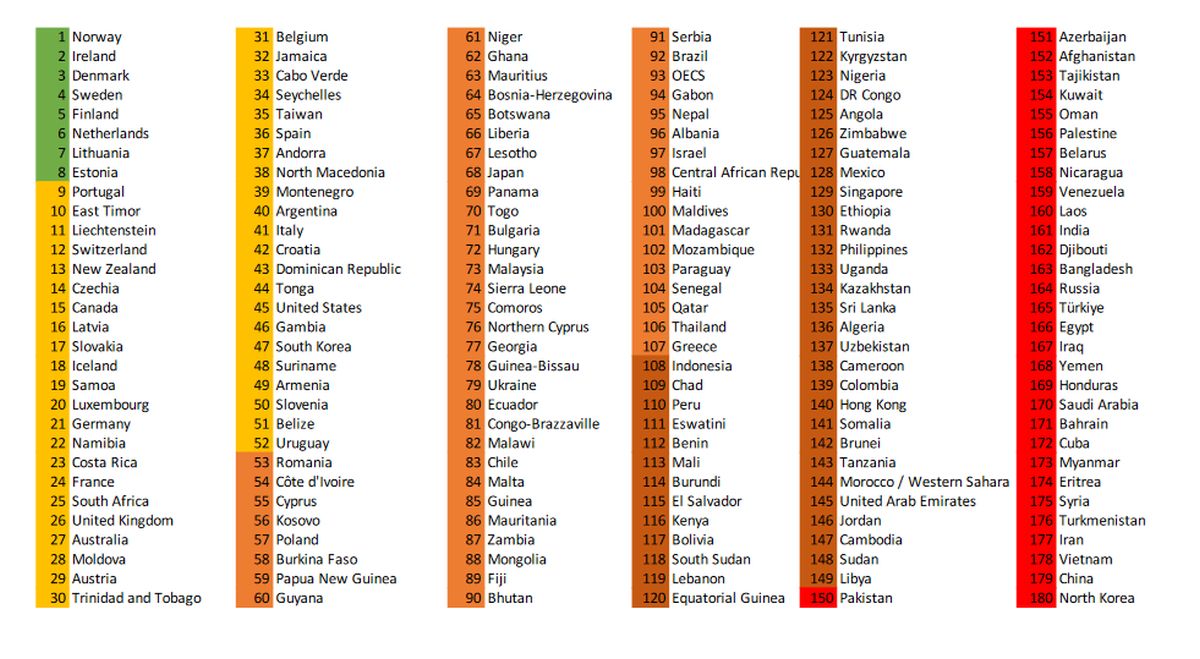
Norway (1st), Denmark (2nd) and Sweden (3rd) occupy the top three spots on the list; Iran (178th), Eritrea (179th) and North Korea (180th) bring up the rear.
Reporters sans frontières have published the entire ranking on their Website published.
]]>
In the ranking published on Tuesday by Reporters Without Borders (RSF), Switzerland's result remained stable. As in the previous year, it lost two places and is now ranked 10th.
It thus remains in the "white" zone of the world rankings. This includes countries in which freedom of information is best protected in an international comparison, as stated in the media documents.
However, according to RSF Switzerland, this good result could be called into question in the future. The ranking does not reflect the recent sharp rise in verbal and sometimes physical attacks on media professionals and the media in Switzerland.
"Increasing hostility"
The Swiss section expressed "extreme concern about the increasing hostility" toward the media. This had become particularly accentuated during the Corona pandemic. RSF Switzerland expects everyone to respect the work of journalists, RSF Switzerland Secretary General Denis Masmejan was quoted as saying in the press release.
Journalism is the "most important vaccine against disinformation," writes RSF. However, in 73 percent of the 180 countries assessed, it is blocked in whole or in part. In these countries, the environment for press freedom is very poor, poor or at least problematic.
Never since the start of the continuous statistics have there been so few countries in which RSF has rated the situation of press freedom as "good. Their number fell from 13 to 12; bringing up the rear, with minor shifts, remain China, the ex-Soviet republic of Turkmenistan in Central Asia, North Korea and the African country of Eritrea.
Pandemic consolidates repression
According to RSF, the pandemic strengthened and consolidated repressive tendencies worldwide: "In countries as diverse as China, Venezuela, Serbia and Kosovo, media professionals were arrested for their Corona reporting," concludes the global survey. In China, more than 100 media professionals are in prison, more than in any other country in the world.
The Nordic countries Norway, Finland, Sweden and Denmark continue to lead the press freedom rankings. They are followed by Costa Rica, the Netherlands, Jamaica, New Zealand, Portugal and Switzerland. Liechtenstein ranks 23rd.
Germany was knocked out of the top group, dropping two ranks and now in 13th place. "The main reason for this rating is that violence against media professionals in Germany reached an unprecedented dimension in 2020," the organization said, explaining the downgrade. The majority of physical and verbal attacks occurred at or on the fringes of demonstrations against Corona measures, according to the reporters' organization. (SDA)
]]>
There is a temptation for authorities to control the public debate, the organization wrote on Thursday about the study. The study was commissioned by the Federal Office of Communications (Bakom). The study examined possible regulation of the online debate from the perspective of Swiss law.
Disinformation, hate messages, manipulation attempts by bots and fake accounts are rampant on the internet. They are a challenge for an open, free and diverse debate, as the study states. However, according to the author, this challenge can only be overcome with full respect for freedom of expression and media freedom.
These freedoms must be protected, both against state interference and against distortions by platforms. This is how the diversity of public debate can be guaranteed.
Delicate regulation
The study considers direct regulation through the law, the platforms' moderation policy or through usage rules to be tricky in view of fundamental rights. This would often result in the digital giants being given the inappropriate power to arbitrarily discriminate against legal or supposedly illegal statements. They only exercise this private censorship in order to limit legal or reputational risks.
According to the study, regulation must counter the risk of private censorship and refrain from measures that provide for the control of content. This is particularly the case when the illegality of content depends on the context or a balancing of interests.
Among the measures examined, the study focused in particular on the transparency of algorithms. According to the information provided, this is a prerequisite for the desirable political, ideological and religious neutrality of platforms. It would also promote the right to reliable information on the internet.
These are also the goals of the Partnership for Information and Democracy, which was initiated by the international secretariat of Reporters Without Borders and which Switzerland joined in 2019 together with around thirty countries.
Ban on bots and fake accounts
The organization recommends that tools such as bots and fake accounts should not be used in connection with referendums. A ban should be considered if technically possible. Under existing law, the authorities are obliged to react and correct facts if grossly inaccurate information is disseminated on the networks.
According to the study, government support for the media industry in the digital transformation is necessary. This would protect the public's right to relevant, diverse and trustworthy information. However, support must fully respect editorial freedom and must not influence the content produced. (SDA)

Although Switzerland has dropped from 6th to 8th place in the current year's press freedom ranking, the organization Reporters Without Borders (RSF) announced on Tuesday. However, the index remained constant in the annual ranking.
The decisive factor for the drop of two places was that Jamaica and Costa Rica made significant gains in their press freedom indices. Switzerland remains in the "white zone" of countries where press freedom is fully guaranteed.
The press freedom ranking is led by Norway, Finland and Denmark. Germany is in 11th place. Switzerland's other neighboring countries do less well. Austria is in 18th place, France in 34th and Italy in 41st.
Difficult position of the media
However, the Swiss media are concerned because the economic situation is deteriorating rapidly. RSF denounces the accelerated concentration in the Swiss press. The diversity of titles is decreasing. Regional reporting, which is particularly important in direct democracy for shaping public opinion, is under great pressure, it says.
In addition, the coronavirus pandemic is turning into an economic disaster for the media. Advertising revenues are disappearing at breakneck speed. The RSF criticizes the Federal Council for refusing to help the media with emergency aid. The ball is now in Parliament's court.
Attack on a journalist
It is worrying that journalists are increasingly facing attacks from outside. Recently, for example, the entourage of Cameroonian President Paul Biya attacked a journalist from French-speaking Switzerland's radio and television station in Geneva.
Furthermore, government representatives in the cantons of Vaud and Geneva had taken legal action against journalists. And a journalist was convicted of trespassing. She had wanted to write a report in a house occupied by activists.
Crisis of democracy
In general, hostility toward journalists is on the rise worldwide. A crisis of democracy is on the horizon. Elected representatives of the people, such as U.S. President Donald Trump or Brazilian President Jair Bolsonaro, are fueling distrust of the media with fake news.
Weakened by the crisis of confidence, journalists were targeted by angry citizens at demonstrations. In France, they had become victims of police violence.
Call for mobilization
"All these crises mean that the next ten years will be crucial," says Christophe Deloire, RSF secretary general. "What will freedom, pluralism and reliability of information look like by 2030? The answer to that question is at stake today."
According to Deloire, authoritarian governments are taking advantage of the coronavirus pandemic to take measures against press freedom that would be impossible in normal times. The world's population is called upon to defend itself against such attacks so that journalists can continue to do their work. (SDA)
In collaboration with the company Blockworks, the NGO has opened the gates to the Minecraft digital library for the World Day against Internet Censorship. In the library, journalists can publish and distribute censored articles in their home countries. At the moment, the library holds 200 books, but more are to be added steadily.
In addition to an entrance hall with information on press freedom, the building includes five other rooms, each dedicated to a country. In Egypt, Russia, Saudi Arabia, Mexico and Vietnam, censorship is still a major problem. This makes it particularly difficult for the younger generations to form their own opinions. The in-game library is supposed to make that possible now, since Minecraft is mainly played by younger generations.
24 Minecrafters from around the world completed the library, which consists of more than one and a half million building blocks, in just over three months. Among them is an art director from the DDB Berlin agency, which is responsible for the idea and concept.
Responsible at Reporters without BordersChristian Mihr (Managing Director); Kristin Bässe (Media and Public Relations Officer). Responsible at DDB Berlin: Dennis May (CCO); Jan Harbeck, David Mously (Managing Director); Patrik Lenhart (Creative Director); Marko Lemcke (Senior Art Director); Tpnoas Natterer (Senior Copywriter); Sandro Heierli (Art Director); Sirena Grace Martinelli (Junior Art Director). Responsible at BlockworksJames Delaney (Founder and Managing Director). Responsible at Mediamonks: Robert-Jan Blonk (Senior Media Producer); Javier Sancho Rodriguez (Senior Project Manager); Jamie Moodley (Senior Creative); Jeroen Hol (UX Designer); Rene Drieënhuizen (Frontend Developer Lead); Johan Holwerd (Technical 3D Developer); Reinder Nijhoff (R&D Developer). Responsible at The HumblebragJessica Hartley (Managing Partner).

The fact that newspapers all over the world are being closed down because they represent the "wrong" opinion or report too critically actually seems absurd. Unfortunately, however, it is the reality. According to Reporters Without Borders, there were 140 media organizations in 2018 alone, including many daily newspapers.
The agencies Serviceplan and Achtung! cleverly staged this as part of the "Fonts of Freedom" campaign and made a (type) statement against the worldwide suppression of the press. The creative team meticulously reconstructed the house fonts of nine newspapers that were banned in Turkey, Azerbaijan, Vietnam, Cambodia, Tanzania, Hungary and Russia, and used them to create entire font sets. They made these available to German daily newspapers, which used them to produce their front pages and media pages. The participants were The world, the South German Newspaper, the TAZ and Augsburger General.
The motto: Out of sight, but not out of mind. To ensure that the suppressed, banned newspapers are not forgotten, the ROG campaign also includes a portal (Fonts-for-freedom.com), on which the reconstructed writings can be downloaded or own statements can be written with it. And, of course, donations may be made for the freedom of the press.

The threats are a consequence of research on Andriy Pavelko, the president of the Ukrainian Football Federation, which Bédat recently published. They are unacceptable and must be strictly condemned, ROG said in a statement Thursday. The organization calls on the relevant judicial and police authorities to "react with great determination and ensure the absolute protection of the journalist."
In his articles for L'Illustré highlighted Arnaud Bédat a loan of 4 million euros received by the president of the Football Federation of Ukraine (FFU), Andriy Pavelko, on behalf of the Ukrainian Football Association from the Union of European Football Associations (UEFA), based in Nyon (VD). Last November, the journalist was called by a stranger with a Ukrainian phone number; the caller made explicit death threats against Bédat.
Alarmed by these threats, Bédat filed a criminal complaint with the Swiss Attorney General's Office. The latter forwarded it to the Jura authorities, who were responsible for the matter. According to Bédat, the telephone number on which the threats were made corresponds to one of the numbers of Andriy Pavelko - who was recently elected as a member of the UEFA Executive Committee.
Despite his very long experience as an investigative journalist, Bédat admits that such threats are "more difficult to bear than one might imagine." He has formally asked the Swiss authorities to protect him.
Such threats are extremely rare in Switzerland, unacceptable and constitute a serious violation of freedom of information, ROG Switzerland warns. In an environment marked by a rise in violence against journalists around the world - it reached unprecedented and worrying levels in 2018, according to ROG's latest annual report - Swiss media professionals work in a particularly favorable environment so far, the NGO writes: In ROG's latest freedom of information ranking, Switzerland ranks 5th out of 180 countries.
Switzerland's stability is welcome, says the report published by ROG on Wednesday, especially because the situation of the media has deteriorated in many European countries.
Reporters Without Borders cites several factors as justification for its assessment of the Swiss situation:
- The economic pressure on the private media, in particular the print media, in 2017. further increased. The decline in advertising revenues, mainly in favor of the big "social networks", is reflected in a continuous decrease in the number of journalists and increased stress for those who remain.
- The difficult economic situation had also led to the fact that several major publishers their editorships Locally concentrated except for the regional departments - and had created newspaper shells. Tamedia is mentioned in relation to both German-speaking and French-speaking Switzerland. This would lead to more concentration, the elimination of many journalist positions and a loss of diversity. The same applies to the joint venture of the NZZ regional newspapers with the AZ Medien newspapers.
- 2017 was also characterized by the Disappearance of L'Hebdo after more than 35 years of existence, as well as by the Restructuring of Le Temps been coined.
- Furthermore, in 2017 the Fusion between the Swiss Dispatch Agency SDA and Keystone has been initiated, which is expected to result in the loss of several dozen journalistic jobs and, especially in the French- and Italian-language newsrooms, a deterioration in quality. It is not yet clear whether any form of public support can mitigate the consequences of this profound restructuring.
- The intensity of the debate surrounding the "No Billag" initiative had shown that the SRG, its financing and the scope of its activities were being called into question to an unprecedented extent. Despite the clear rejection of the initiative on March 4, this had already led to a cap on fees for the SRG, forcing it to make savings of around CHF 100 million. A similarly heated debate is to be expected when the new federal law on electronic media is discussed, he said. (SDA)

The journalists' organization counted more than 60 cases in more than 20 countries over the past two years. They ranged from threats via the Internet to murder. According to the report, violence against journalists who deal with women's rights issues is partly carried out by religiously motivated groups, such as the radical Islamic Taliban in Afghanistan or anti-abortion activists in the United States. However, criminal groups or authoritarian governments are also behind some of this. According to Reporters Without Borders, countries such as China, Turkey and Egypt lead the negative list.
More than ten percent of the cases documented by ROG were murders, such as the 2017 murder of Mexican journalist Miroslava Breach, who had reported on women killed in the city of Ciudad Juarez on the U.S. border. ROG also mentions the case of Indian journalist Gauri Lankesh. The editor-in-chief of a feminist magazine was shot dead by two men on a motorcycle.
The most widespread, according to the report, are insults or threats via the Internet, in addition to physical violence against women (28 percent of cases). They account for 43 percent of documented cases. "This phenomenon is borderless, affecting poor countries as well as the most democratic ones," Reporters Without Borders said. In the U.S., according to the report, it is mainly journalists who cover abortion who are affected.
Reporters Without Borders speaks of a high number of unreported cases. The organization recommends, among other things, that the perpetrators be held more firmly accountable and that attention be drawn to violence against journalists at the UN level. (SDA)