
Today, moving image planning no longer means thinking in terms of channels, but in terms of user behavior. The focus is on attention, context and impact - regardless of the channel and screen.
Traditional linear TV is still very important in the Swiss media market. On the one hand, high net reach can still be achieved with linear TV. On the other hand, classic TV picks up viewers in a "lean back" situation. At this moment, the focus is on more relaxed, passive use; media content is consumed without actively "interfering" in the action (for example by quickly scrolling or swiping or when using gaming content). This passive use in turn has a positive effect on the advertising impact and thus on the overall success of the campaign, as the activation level of content and advertising is close to each other (source: Video Impact, SevenOne Media GmbH, January 2020).
Despite these advantages of traditional, linear television, linear TV usage is declining. There are increasing gaps in reach, particularly in younger age segments. These gaps can be filled - at least in part - by using moving image offerings that pick up the target audience in the same emotional state, i.e. address them in a comparable "lean back" situation. This includes streaming offers, but also replay ads. Outstream formats (such as those offered by news platforms) and social media formats, on the other hand, are less suitable, as the target audience is in a different emotional state when using them.
If you want to pick up the target persons in "lean back" mode, the TV screen remains central as the playout device, provided the TV is a connected TV, i.e. a device connected to the Internet (such as a smart TV). However, passive media consumption behavior can also take place on mobile devices, be it on a desktop or laptop or even on a smaller screen, whether at home or on the move.
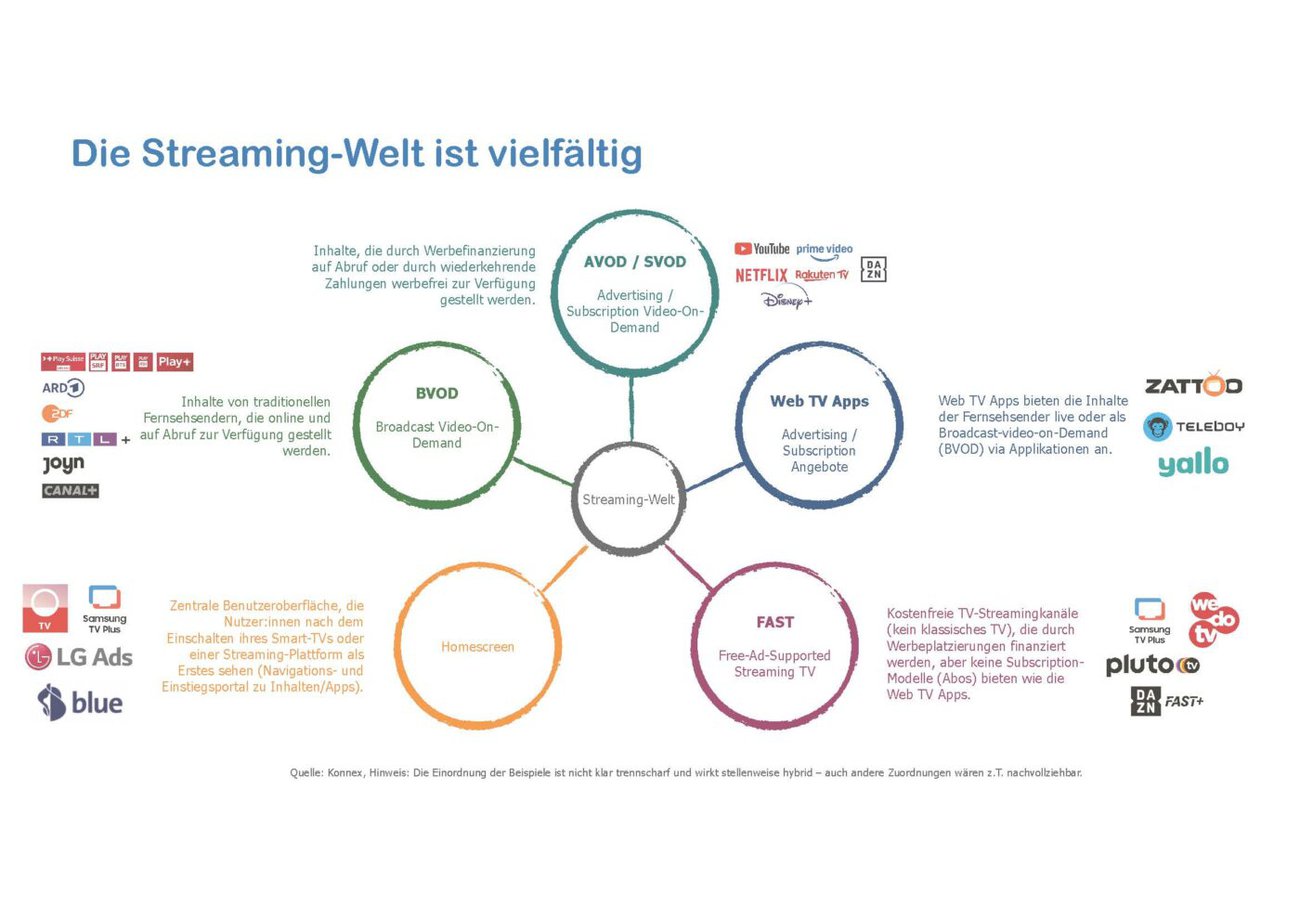
However, implementing holistic moving image planning that combines to form an effective whole is not easy. Even with a focus on the streaming world or even just the CTV sector (i.e. content that is played exclusively on a TV set connected to the internet), advertisers are faced with a highly fragmented ecosystem of platforms, publishers and end devices.
Although the various streaming services can be categorized by provider, type of service or financing, the same inventory is offered by several marketers, which leads to countless overlaps. Here is an example: pluto tv, a free, ad-financed streaming service from Paramount, can currently be booked to target Swiss users via Goldbach Media, Ringier, Screen on Demand and, of course, the Google advertising platform DV360, among others. No marketer can specify the priority of the bookings made through them.
Device owners (i.e. TV device brands such as Samsung or LG) are another market player alongside app and content owners as well as pure marketers. This multitude of providers marketing identical inventory increases the risk of campaign cannibalization. If the same campaign accesses the same advertising space across different platforms, it competes with itself and drives up bid prices. This in turn reduces the efficiency of playout. The advertiser can therefore only focus on as few providers as possible and exclude offers that are marketed by several providers, thus preventing double booking.
However, the streaming market is not only characterized by strong fragmentation on the marketer side, but also on the content supplier side. Irrespective of the risk of possible duplication, this generally makes it more difficult to control playout. The issue of brand safety therefore represents a further challenge.
In contrast, brand safety is a given for bookings in the linear TV environment (at best, the brand fit of certain environments can be discussed). Ad fraud is also becoming a risk with the increasing importance of streaming inventory. This involves the use of bots or fake CTV devices that simulate viewer numbers. As a result, advertisers pay for non-existent or unseen ad placements. Ad fraud can be countered by booking through established, trustworthy marketers. But here too, fraudsters are always one step ahead!
Another major challenge for holistic video planning is the lack of uniform research standards and metrics. When planning TV, we are used to obtaining reach and contact figures. With the exception of replay ads, there are no corresponding standards from the digital platforms. At the moment, it is primarily the gross reach of a campaign that can be measured, i.e. the number of video ads played. Multiple contacts can sometimes be identified at device level, but without personal information. Statements on the number of people reached or on incremental reach are therefore generally based on estimates. In most cases, these are based on login data. However, this does not say anything about who actually uses the media content played and whether only one or several people are sitting in front of the respective device (so-called "co-viewing"). At the same time, this means that in most cases it is not possible to work with target group criteria analogous to TV planning. It is necessary to work much more with environment-related criteria. This is not a disadvantage per se, as the relevance of age-related criteria is debatable. However, the comparability or "fit" with linear TV use is only possible to a limited extent.
This makes the test carried out as part of a joint initiative by Goldbach and Mediapulse to measure the net personal reach of online video ads and combine this with TV reach all the more interesting. The test run was carried out in October 2024 with a Migros campaign. According to the partners involved, the test was so successful that the possibilities of further developing the measurement approach are now being examined and the costs and refinancing options are being clarified.
Until a standardized and neutral measurement solution is available to the market, many assumptions and estimates still have to be made when planning and implementing overall moving image campaigns. The data provided by WEMF's MACH Strategy and IGEM's "igemDigiMonitor" on the use of various moving image platforms is a great help here.
Replay ads are advertisements that are displayed within time-shifted television. They are available on the Swiss advertising windows of German TV channels marketed by Goldbach Media and on CH Media channels and are expected to be available on SRG channels marketed by Admeira in German- and French-speaking Switzerland from January 1, 2026. Their performance can be evaluated both ex ante and ex post and in combination with linear TV campaigns using the TV replay ad data collected by Mediapulse.
Checklist for advertisers for holistic moving image planning:
- Definition of the relevant target group and analysis of their media usage behavior (e.g. using the MACH Strategy)
- Definition of the requirements for the emotional state in which the target group should find itself (based on the communication objectives or the advertising message and campaign content)
- Selection of relevant media channels and platforms and budgetary weighting based on reach potential, environmental criteria, etc. (Rule of thumb: for target groups aged 30 and over, linear TV is still a key medium; for younger target groups, the focus is on digital offerings)
- When booking digital offers: Selection of relevant marketers in order to maximize reach potential while avoiding overlaps.

The measurement of these decoupled TV ads takes place within the existing TV measurement system and is based on the established survey standards of TV research. With this methodological innovation, Mediapulse is creating an important prerequisite for the assessment, comparability and acceptance of the new TV advertising formats.
The development of the Replay Ad Measurement was carried out in close cooperation between Mediapulse and the TV stations and marketers involved, and was based on two central objectives:
- The representative recording of all replay ad contacts and their aggregation to the established campaign parameters of net reach, contact frequency and contact duration.
- The ability to combine replay ad measurement and measurement of traditional TV ad units on a net level with the goal of convergent campaign reporting across old and new forms of advertising.
The measurement of replay ads is based on the hybrid measurement system (Hi-Res TV), with which Mediapulse has been providing the official usage data for the Swiss TV market since summer 2022.
Two additional exhibition levels integrated
In order to be able to record the Replay Ad contacts within this measuring system, two additional measuring levels were integrated:
- Measurement of replay ad contacts within the TV measurement panel operated by Kantar based on watermarking technology.
- Counting of Replay Ad contacts within the virtual SettopBox panel operated by Mediapulse based on the delivery data of the Replay Ad Platform (RAP).
With this integrated approach, it has been possible to measure the moving image advertising formats Start Ads and Fast Forward Ads since the beginning of July 2023. For the complete recording of the so-called Pause Ad, on the other hand, methodological further development is still required, which is why the performance values of this static advertising form will only be available at a later date. The replay ad data already collected will be supplied by Mediapulse to the AGFS planning and reporting tool (EvoAd), where it can be analyzed individually or in combination with data from conventional TV campaigns.
More detailed information on data access can be requested from the AGFS. More detailed information on the methodological design of the Replay Ad measurement can be found in the Methodological profile.
]]> Meike Leimbacher and Christian Arm from Goldbach reviewed the first 100 days of Replay Ads and showed creative implementations from the more than 100 Replay advertising campaigns already implemented. They also gave an overview of the key figures to date and looked to the future of the further development of these new forms of advertising.
Roger Elsener of CH Media followed with an overview of the development of replay TV over the last ten years, demonstrating its popularity in Switzerland. At the same time, according to Elsener, over 70 percent of advertising on replay TV is avoided or fast-forwarded - three times more than on live TV. Accordingly, the TV broadcasters are happy that they were able to find a solution with the network operators and introduce replay ads on October 4, 2022. (Werbewoche.ch reported). The Seven.one Group, the RTL Group and the national TV stations of the CH Media Group have successfully launched with Replay Ads, he said. Elsener explained that on March 20, seven more stations, including TeleZüri and four other regional TV stations, will launch with Replay Ads. Elsener concluded by pointing out the great media outcry before the launch of Replay Ads, which subsequently proved to be a storm in a teacup, however. For him, it was a successful start all in all.
In the panel discussion chaired by Stephan Küng, IGEM President and owner of TWmedia, questions from the 220 or so members of the audience were also answered. The discussion focused in particular on the next development and expansion steps. Questions about the future planning and control of the replay ads were also clarified.
"The first 100 days of Replay Ads tell a success story: over 100 campaigns have already been implemented, the technical ramp-up has been achieved and delivery is working, after an initial tempest in a teapot there has been hardly any negative media coverage, and Mediapulse is already calibrating for neutral measurement of Replay Ads. All this certainly provides a good basis for the further expansion of the Replay advertising offering," IGEM President Küng sums up.
The recording of the webinar will be available in the coming days on Igem.ch available.
]]>