
The films have been online for a few days.
"From the Internet directly to the car" is the claim of Reifentotal.ch, and the store is effectively "different" from the usual anonymous tire web stores. Although customers can order online or by telephone, they do so from a selected exclusive partner of Reifentotal.ch. Without exception, these exclusive partners are members of the Swiss Tyre Group, the association of leading independent tire dealers. The tires are then fitted, balanced and mounted there. Customers only pay after fitting and also receive a free tire guarantee, effectively a form of fully comprehensive insurance (external tire damage is also covered).
The service of Reifentotal.ch is therefore more comprehensive and requires more explanation than that of conventional tire web stores. For this reason, a modern and dynamic explanatory film and commercials have now been produced. These have been used in the online store, on the websites of various partners and on social media (Facebook and Twitter) since October.
Responsible at Swiss Tyre Group: Gianni Covre (CEO), Sandra Bösch (Head of Marketing, Production D), Jean-François Chariatte (Production F). Responsible at Fruitcake: Lahor Jakrlin (concept, casting, graphics), Lara Hitz-Jakrlin (organization, coordination). Responsible at Regardez! Jürg Steudler (producer) and Bart Wasem (director). Film studio: FTK Filtechnikerkollektiv Zurich. Recording studio: Walter Rohrbach, Zurich.
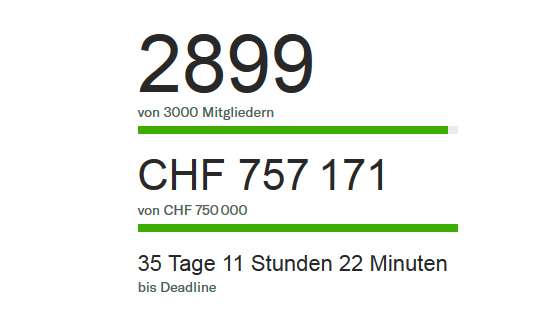
"Actually, we would have imagined the first morning of crowdfunding to be a bit more intimate. More poetic. A dozen or two people. Mild spring air. Sleepy conversations over coffee. A quiet start. It wasn't like that. Not at all. It was like this: a line of one, two hundred people. In the sleet. Instead of spring, there was the kind of wet, dark cold that made everyone look unshaven: men, women, even the baby in the car. Then, after the doors opened inside, a crowd like in a club, plus the smell of excitement, dog and wet coat. It was really quite different from what we thought. Now we are writing journalism history!", these sentences were already posted a few hours after the start of crowdfunding on the page of Republic.ch to read. Another two and a half hours later, the hurdle of 750`000 francs and 3000 subscribers, is reached. Before 6 p.m., the 1 million franc mark was reached.

The investors and donors, who had already pledged money in mid-March, do not have to pay until those responsible have fulfilled their part. The investors had tied their sum of 3.5 million francs to the condition that at least 3,000 subscribers sign up. This goal has now been achieved. In total, this results in a starting capital of currently around 4.2 million francs.
Even though the hurdle has been cleared, the crowdfunding will continue for another 35 days, as planned. More money will certainly not hurt the cause, because: "Republik will finance itself without advertising. And thus without distractions from the readers. The magazine will have to produce usable goods, otherwise it won't survive. Its task will be to provide readers with clarity, attitude, ideas and occasional annoyance... In other words, journalism without bullshit," the Republik crew announced Wednesday morning.
Regardez! realized the crowdfunding trailer: In collaboration with the editorial team of Projekt R, director and motion designer Bart Wasem implemented the funding call for the successful campaign.
WW: You are merging your two companies again at the beginning of March. What prompted this?
Bart Wasem: Due to our close proximity and shared infrastructure, we have already moved closer together again in recent years. In addition, we have realized most of our projects together anyway, so this step was a logical one. A joint company is less administratively complex and, in the age of social media, we don't have to manage all channels multiple times.
Another new development is that you want to push video-based content marketing. Why now?
Jürg Steudler: We have been monitoring developments in this area for a long time. Over the past two years, a lot has happened in this country. The ad-free streaming service Netflix came to Switzerland and national telecommunications providers introduced time-shifted television. Commercial breaks can now be bypassed completely. This makes it increasingly difficult for the advertising industry to get its messages across to consumers via traditional channels.
Wasem: A similar development is taking place on the Internet. Ad blockers are now very widespread and are already built into web browsers by certain manufacturers. This is why a rethink is needed.
Steudler: There is an increasing demand for films that offer cognitive or emotional added value and are therefore watched voluntarily. Film can convey emotions better than any other medium and is therefore suitable for conveying brand messages. However, the way we design films in future must start with the target audience and be geared more towards their needs and motivations.
Wasem: This is a great opportunity for creatives. They are no longer so limited to a maximum of 30 seconds and can once again prioritize their ideas over length.
You have focused on YouTube channel marketing. Why is YouTube the central channel for video-based content marketing?
Wasem: In this country, many see YouTube primarily as a play channel for the young. But many international companies are already relying heavily on YouTube for their marketing communications. They do so with good reason: YouTube is not only a digital video player, but also the second largest search engine in the world and an intensively used social media channel with sharing, liking and commenting functions.
Steudler: This is why YouTube is ideal for customer retention. Companies can regularly bring their new subscribers into contact with their own content.
Wasem: At the same time, they also use the search function to reach users who are not tied to the company channel but simply want to find out more about a topic or product. Video is very convenient. It is much easier to press the play button than to read a post.
Which companies are already successfully using YouTube channel marketing - and what can we learn from them?
Steudler: These are often brands with many different products or products that require explanation. Good examples are Edeka, Volvo Trucks and Sennheiser. These companies operate extensive channels, which they cleverly link to their own website and social media channels. Some of the videos are elaborately produced, while others are kept simple in the style of video bloggers. There are storytelling forms like in classic commercials alongside typical corporate movies, editorial contributions and music videos, all of which complement each other. Google refers to this as the HHH strategy. It is also interesting to note that successful YouTube films usually have a longer lifespan than conventional commercials.
You have been producing commercials for over 20 years. Do you know the recipe for success for YouTube films?
Wasem: I think the most successful approach is the right mix of creativity, authenticity and relevance. Traditional film and advertising knowledge no longer works unconditionally. YouTube is dynamic and remains unpredictable in many ways. Even Google doesn't have a simple recipe for success. One thing is certain: trial and error and iterative optimization are becoming more important. Only those who don't take risks are sure to do the wrong thing.
What exactly does your offer look like?
Steudler: In the future, we will create entire channels. We create the microcosm of a channel, i.e. welcome videos, headers, thumbnails, playlists and so on. We also offer support and management of the channel. This also includes the preparation of existing films for the YouTube channel as well as the interface to online marketing agencies, for example for linking the channel with online campaigns.
You have undergone further training over the past few months. Where did you do this and what did you focus on?
Steudler: At the moment, we can often be found at Google and actively participate in their seminars. We also attend workshops, mostly in Germany. Culturally, the Germans are closer to us than the Americans - and they are also further ahead than us in content marketing. But the most important thing for us is observing and trying things out, as well as exchanging experiences.
Interview: Simone Isliker ]]>