
At the General Assembly of the QuaJou Quality in Journalism Association on Tuesday at the NZZ in Zurich, a new Co-Presidency was elected and the Board was expanded. Alexandra Pavlović and Reto Vogt will jointly head the network, which promotes quality in journalism.
Reto Vogt, Head of Digital Studies at Maz and freelance journalist, has extensive experience in the fields of digital communication, artificial intelligence and journalism. He succeeds Claudia Schlup, also from Maz, who is stepping down from the Board after three years. "I look forward to working with my colleagues on the Board to promote high journalistic quality and actively shape the discourse on the subject," says Vogt about his new role.
Alexandra Pavlović, who has been a member of the QuaJou board since 2024, is Head of Social Media at CH Media and also works as an online daily manager. She has extensive experience in digital journalism. "I'm looking forward to my new role on the board and working with Reto and my new colleagues. With the QuaJou team, I want to continue to contribute to the discussion about quality in journalism and the importance of our profession. Our association should be even more visible to the outside world," says Pavlović.
The term of office of the previous Co-Chair Franz Fischlin and Fabienne Kinzelmann ended after three years. Both did not stand for re-election to the Board for professional and personal reasons and to make room for something new. The QuaJou team thanked them at the AGM for their commitment and their formative work for the network, especially in the challenging years following the pandemic.
New members on the Executive Board
In addition to Reto Vogt, Lena Berger, deputy editor-in-chief of the Observer at Ringier Media Switzerland, Sebastian Dürst, Editorial Director of the Glarus News at the publishing house Somedia, and Michael Burkard, Co-Managing Director of the professional association Impressum.
There has also been a change in the administration of QuaJou: Samina Stämpfli is taking over from Valeria Aiello. As a journalist, Stämpfli brings with her extensive experience from various media, including TX Group, The lamb and Nau Media. Since her return from Colombia, she has been working full-time at Swisscom.
The QuaJou Board is now made up of the Co-Presidium with Alexandra Pavlović and Reto Vogt as well as the Board members Urs Bühler (NZZ, Vice President), Marco Schnurrenberger (SRF, Treasurer), Christian Beck (Personal.com), Lena Berger (Observer), Michael Burkhard (Impressum), Sebastian Dürst (Somedia), Silke Fürst (IKMZ), Eva Pfirter (Keystone-SDA) and Larissa Rhyn (Tamedia). Also working for the QuaJou are Samina Stämpfli (Administration) and Charlotte Widmaier (Project Officer Journalism Day).
Discussion round on local journalism
A guided tour of the NZZ newsroom took place before the official part of the Annual General Meeting. NZZ CEO Felix Graf personally welcomed the attendees to Falkenstrasse 11 in Zurich.
After the AGM, the topic of "Local journalism under pressure" was debated as part of the "Q-Club" discussion. Under the direction of QuaJou board members Alexandra Pavlović and Urs Bühler, Noemi Heule (St. Galler Tagblatt), Fabienne Sennhauser (Tages-Anzeiger), Elio Donauer (Tsüri) and Daniel Fritzsche (NZZ) on current challenges and opportunities in local journalism.
"Good journalism keeps an eye on the powerful - even at local level," Noemi Heule summed it up right at the beginning. However, the current challenges in the media industry do not stop at local journalism. "In recent years, work has been increasingly disturbed by background noise. Fewer and fewer employees have to do more and more," said Fabienne Sennhauser. And yet local journalism has never been as good as it is today.
The work of local journalists has become more exciting in the last 20 years, "because you no longer have to cover every municipal meeting, but can focus on specific topics", says Daniel Fritzsche. A formula for financing journalism does not yet seem to have been found in local journalism either. Elio Donauer said: "A lot is about identification. People think a medium is great and relevant." And that is why there is a willingness to invest in local journalism in the same way as in a Netflix subscription.


With 170 participants, the Journalism Day 2024 organized by the QuaJou Quality in Journalism Association on Thursday in Winterthur met with great interest. To mark its 25th anniversary, the association offered the event free of charge for the first time - a deliberate signal in economically challenging times.
Keynote speaker Silvia Princigalli, who was one of the founding editors of "Izzy", opened the day with a forward-looking analysis: How can crises promote innovation in journalism? "I've cried so many times and been devastated. The important thing is: don't lose hope, stay agile and don't be afraid to be different," said Princigalli. "Stay open and curious about possibilities, stay humble and hardworking and look for like-minded people and talent."

The program focused on current challenges facing the industry: ZHAW media professor Vinzenz Wyss presented the results of the latest ZHAW occupational field study on political orientation in editorial offices for the first time (Markt-kom.com reported). This shows: There is a threat of precarization in Swiss journalism - and Swiss journalism is not very diverse. "If we could get people without a university degree into the editorial offices, there would probably be more political diversity in reporting," said panel participant Camille Lothe (NebelspalterSVP). The statement by freelance journalist Eva Hirschi is worrying: "I know journalists who also work in a bar on the side - and it's often not voluntary."

"As a journalist, you shouldn't deceive"
Simon Bärtschi, Head of Journalism at Tamedia, answered critical questions on the reduction of regional online presences in a panel discussion. Matthias Ackeret, publisher and editor-in-chief of Personal, assessed the development as an independent media expert. At the start of the panel, it was agreed that all information should remain in the room in order to facilitate as open a discussion as possible.
The other panels opened up new perspectives: Thomas Benkö from the Blick Group presented the opportunities and limitations of AI tools in journalism in a workshop. However, it is important: "As a journalist, you should not deceive - not even with the new possibilities that are available." Three award-winning young media professionals - Livia Fischer (CH Media), Deniz Kurtogullari (SRF News) and Ernst Field (Bajour) - showed how the profession can remain attractive despite austerity programs. Their common message: "Opportunities for further development, support when things go wrong and good leaders."
During the discussion on the US presidential election, SRF presenter Arthur Honegger and Isabelle Stadelmann-Steffen, Professor of Comparative Politics at the University of Bern, analyzed the role of traditional and social media. Honegger said that we need to think about why we no longer reach the public: "Many people no longer believe an elite - and journalists are part of this elite. This has to do with the strong academization of our profession."
Among others, Press Council President Susan Boos and Hansi Voigt (founder of Watson, now Bajour) debated journalistic self-responsibility and its impact on media freedom. Among other things, they discussed the pending court ruling in the Spiess Hegglin case. Boos said that the View had clearly behaved wrongly - but: "It has become clear that the View has changed a lot. Stories like this are no longer made today." Voigt also agreed with this.

"Forced to focus on journalism"
The event concluded with a panel discussion on quality assurance in times of scarce resources. SRF presenter Sandro Brotz discussed with Stefan Ryser (Blue News), Sabine Eva Wittwer (Migros Magazine) and Marcello Odermatt (The Covenant) discussed the challenges and solutions from the perspective of the editorial offices. Odermatt said: "The fact that the lemon has been squeezed further and further has forced us to focus our journalism over the last ten years." Wittwer said: "We have much less time in which we are basically unproductive." But it is precisely in this "dead time" that ideas and thus diverse reporting are created. Ryser added: "What bothers me is that the whole discussion is often just about saving money and not about how to reach young people."

"The intensive discussions show how important the exchange of ideas and new perspectives are in the industry," summarize Fabienne Kinzelmann and Franz Fischlin, co-presidents of QuaJou. "Especially in times of upheaval, platforms like Journalism Day are needed where we media professionals can talk openly about challenges and develop solutions together. The high number of participants confirms our commitment to quality in journalism."
Free admission to Journalism Day, which traditionally takes place at the IAM Institute of Applied Media Studies at the ZHAW, was made possible by sponsors and the association's financial reserves. This decision was made against the backdrop of the current cost-cutting programs at almost all major publishing houses as well as SRG and Keystone-SDA.

The next JournalismDay will take place on November 20, 2025.
]]>
The prelude to the JournalismDay.24 will make the keynote speech by Silvia Princigalli, who draws on her many years of experience in various editorial offices such as 20 minutes, Annabelle and Izzy reports. In her presentation, she shows how journalists have to constantly reinvent themselves in the digital transformation. Princigalli makes it clear that crises can also be seen as opportunities for innovation and provides concrete insights into how media professionals can overcome these challenges.
The results of the ZHAW's current occupational field study will be presented at the event for the first time. The study raises various questions: How does political orientation relate to diversity in editorial offices? What role does gender-equitable language play in different types of media? Media professor Vinzenz Wyss discusses the findings with journalists Camille Lothe from the Nebelspalter and Eva Hirschi from the NZZ.
Panels and workshops will continue to focus on hot topics such as the financial situation of the media industry, non-discriminatory reporting and the role of the media in the US presidential election campaign. The panelists include Simon Bärtschi from Tamedia and Arthur Honegger from SRF. In a workshop, Thomas Benkö from Ringier will demonstrate the possible uses and limits of AI applications in everyday editorial work.
A special focus is on the next generation of media professionals. Three journalists under 30 discuss the future prospects of the industry. Finally, new editors-in-chief from various Swiss media, led by Sandro Brotz, will debate quality journalism in times of scarce resources, including Sabine Eva Wittwer from the Migros Magazine or Marcello Odermatt from the Confederation.
JournalismDay.24 will take place on November 21, 2024 and will begin at 12 noon with a networking opportunity. After an intensive program, the event will end in the evening with an aperitif riche. The venue is the IAM Institute for Applied Media Studies of the ZHAW at Theaterstrasse 15c in Winterthur.
]]>
The Association Quality in Journalism QuaJou elected Larissa Rhyn and Alexandra Pavlović to the Board of Directors at its Annual General Meeting on Thursday evening.
Alexandra Pavlović is Head of Social Media at CH Media and also works as Online Daily Manager, where she is primarily responsible for national and international topics. Previously, she was deputy head of the online editorial department of the St. Galler Tagblatt. She learned her journalistic trade at the local editorial office in Rorschach. She studied popular cultures, journalism and Slavic linguistics in Zurich. She completed her Master's degree in Hamburg at the Hamburg Media School, where she obtained an Executive Master of Arts in Journalism.
"By exchanging ideas with each other, we help to further develop journalism and focus on important trends and topics that affect our industry," says 37-year-old Pavlović, describing her motivation for joining the QuaJou association.
The 31-year-old Larissa Rhyn is head of Tamedia's editorial office for the Swiss parliament and deputy head of the domestic department. Previously, she worked as a parliamentary editor for SRF and the NZZ worked. She started her career in journalism at the Südostschweizwhere she worked as a freelance journalist during her studies. She studied political science in Zurich and Montreal and completed her Master's degree in International Relations at the Graduate Institute in Geneva.
"I would like to join the QuaJou board because I think it is important that journalism continues to develop - and that quality remains a key criterion," says Rhyn.
Barbara B. Peter, trainer and podcast producer at Schweizer Radio und Fernsehen SRF. She has been a volunteer board member of the association since 2016 and was its Co-President from 2020 to 2022.
The new ten-member QuaJou Board therefore consists of the Co-Presidium with Fabienne Kinzelmann (Handelszeitung) and Franz Fischlin (self-employed) as well as the board members Urs Bühler (NZZVice President), Marco Schnurrenberger (SRF, Treasurer), Christian Beck (Personal), Silke Fürst (IKMZ), Alexandra Pavlović (CH Media), Eva Pfirter (Keystone-SDA), Larissa Rhyn (Tamedia) and Claudia Schlup (MAZ). Also working for the QuaJou are Valeria Aiello (Administration) and Charlotte Widmaier (Project Officer Journalism Day).
SRF management and quality debate
In the run-up to Thursday's General Assembly, a guided tour of the Schweizer Radio und Fernsehen SRF newsroom took place. This was followed by the Q-Club discussion on the topic of "The pressure to save money and time is increasing - what does this mean for journalism?". The panel included Nicole Anliker (Deputy Editor-in-Chief and Head of Newsroom NZZ), Conny Tovar (Co-Head Media Creation Ringier Media Switzerland) and Tristan Brenn (Editor-in-Chief SRF TV). The Q-Club was moderated by QuaJou board members Urs Bühler and Marco Schnurrenberger.
This meant that representatives from private media companies and the public service sat opposite each other on the podium. Tristan Brenn noted: "There used to be less competition. Everything was nicely organized in boxes: Radio, TV and print. Today, everyone meets online." When asked about making savings, he said that the lemon was slowly being squeezed out: "A public service company like us cannot simply generate additional income. We have to try to position ourselves more efficiently - or, as a last step, cut back on programming."
Ringier has also invested heavily in the newsroom. Conny Tovar said: "The days when we could rely on readers automatically coming back to us are over." On the podium, she expressed her enthusiasm for the opportunities that artificial intelligence now offers in everyday editorial work. Tovar assured the audience that the time gained would be reinvested in journalism.
When asked whether the NZZ Nicole Anliker replied to the question of whether we had a sponsor that never felt the need to make savings there: "For many years, we have also looked at the very small expenditure items." However, there have also been job cuts in the traditional writing departments. Instead, investments have been made in other areas such as visuals and podcasts. "Since 2015, the journalistic area has actually been expanded on balance," says Anliker.
The QuaJou association, founded in 1999 - 25 years ago - sees itself as a quality lobby for the Swiss journalism industry. It leads and accompanies the quality debate and organizes the annual Journalism Day (JourTag) as well as topical discussion rounds (Q-Clubs). Its members mainly come from editorial offices, media companies, media trade unions, professional associations, media science and education.
]]>
Ticket sales for the JournalismDay.23 is open as of now. Organized by the association Quality in Journalism QuaJou, the industry meeting will take place at the IAM Institute for Applied Media Science at the ZHAW in Winterthur on Thursday, November 23, 2023, from 12 to 8 pm.
Keynote speaker Uli Köppen heads the AI + Automation Lab at Bayerischer Rundfunk. At JournalismusTag.23, she will show ways out of dependence on tech companies and examples of how journalists can use AI technology and automation for their goals.
AI-generated images in journalism are also a topic at #JourTag23. This will be explored in depth at a workshop with author and satirist Patrick "Karpi" Karpiczenko, among others. Other workshops and panels will deal with toxic work environments, journalism on social media, the balancing act between journalistic practice and science, and the question of whether Swiss media still play a role for major Swiss corporations.
The final round takes place with the new editors-in-chief Steffi Buchli of View, Désirée Pomper from 20 minutes and Nadine Sommerhalder from Watson takes place. The program is currently being continuously supplemented.
]]>
On Thursday, the JournalismDay.22 organized by the association Quality in Journalism QuaJou attracted more than 110 participants to the IAM Institute for Applied Media Science at the ZHAW in Winterthur. After the industry meeting had to be cancelled due to the corona pandemic in 2020 and was held online in 2021, this time it was held physically again for the first time.
"To be able to hold the first physical journalism day since the start of the pandemic with so many participants and such a program is fantastic. In addition to the highly topical topics, we are particularly proud of the high proportion of women among the speakers and the cross-generational participants," says Fabienne Kinzelmann, co-president of QuaJou.
The program was officially opened with a keynote by Sabrina Weiss, co-founder of the Climate Journalism Network in Switzerland. She gave a forecast for climate journalism. CH Media reporter Kurt Pelda and SRF correspondent Luzia Tschirky shared their experiences with war reporting from Ukraine. What would it take for young media professionals to see a future in their profession again? Simona Boscardin from the Young Journalists of Switzerland (JJS) made a fiery appeal. The final panel was made up of the newly appointed editors-in-chief Isabelle Jacobi of The Covenant, Kerstin Hasse from Tamedia and Jürg Steiner from Capital.
JournalismusTag.22 was broken up by four workshops devoted to the following questions: How could local journalism be strengthened again? How do you react when the police suddenly show up in the newsroom and want to take research material? How can those affected by hate speech take precautions and strengthen themselves mentally? And what has the industry learned from the "Relotius case"? The fact that the Swiss soccer team won 1:0 against Cameroon at the World Cup in Qatar on the same day became a minor matter in view of the packed program. At the apéro riche that followed, there were more important topics to discuss.
QuaJou Co-President Franz Fischlin sums up: "Fortunately, JournalismDay is back. The mix of inputs from very different speakers and the exchange over coffee and soup with colleagues acts as a motivational injection for our profession."
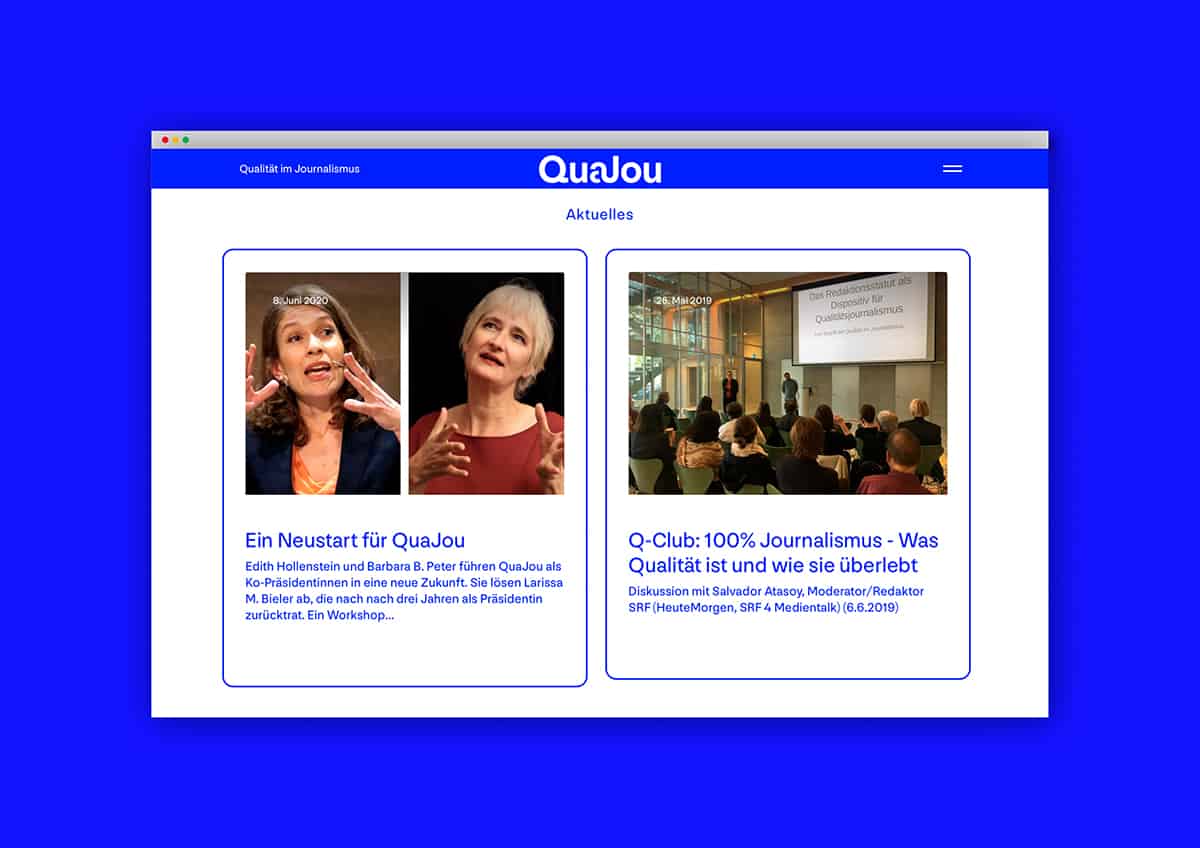
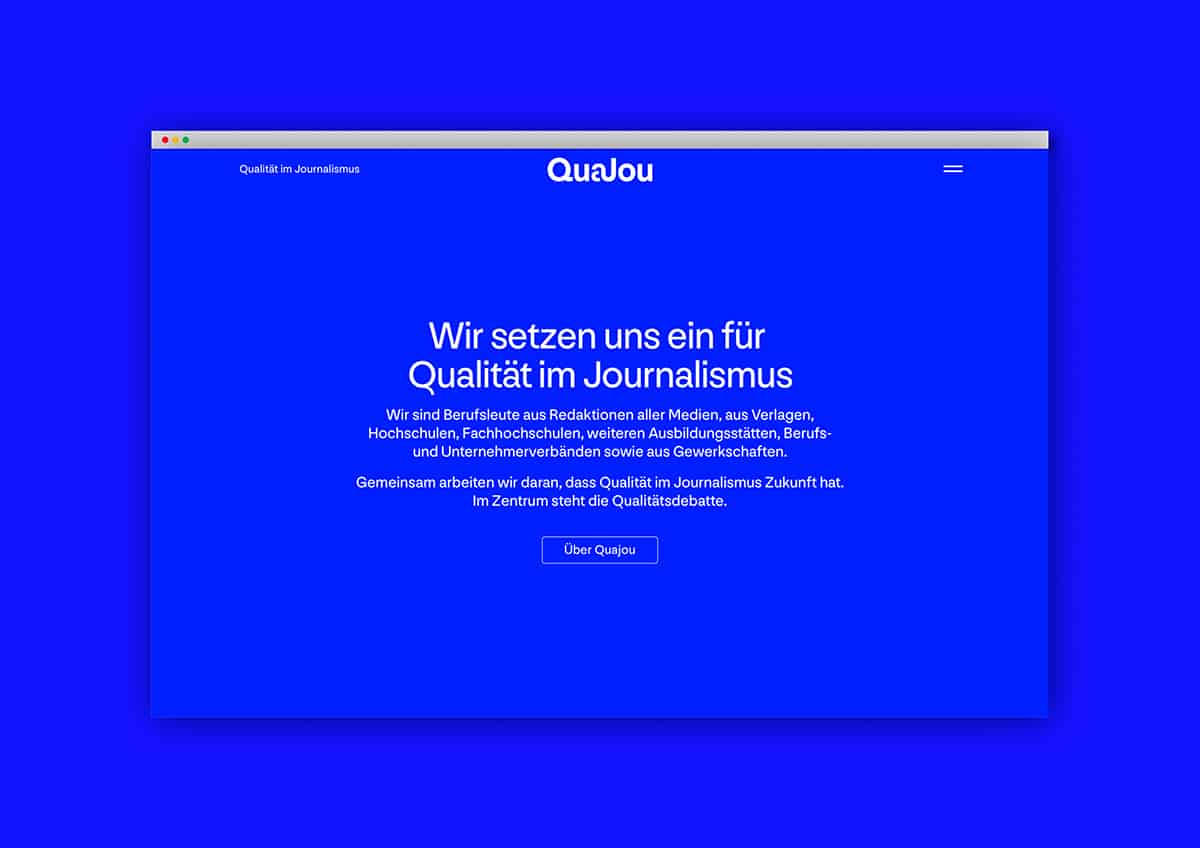
 "The website is now very dynamic and user-friendly. It represents our values in a contemporary way," Frank Hänecke, a long-time QuaJou board member, was quoted as saying in a statement. With the relaunch of the website Quajou.ch/ the appearance was also refreshed at the same time.
"The new logo visualizes the initiative's mission to combine quality and journalism," says Janine Widler, managing director and partner of Hej, about the new communications presence. "The rich blue lends new radiance to the long-standing commitment as a quality lobby for the Swiss journalism industry, and the typeface 'Nouvelle Grotesk' joins the tradition of Swiss type design with the claim to inspire and elicit a smile." The website was programmed by Werkstatt für Digitales in Zurich.
The relaunch comes about two months before Journalism Day.21, where aspects of journalistic work will again be debated. The Event is organized by QuaJou and will take place on Thursday, November 25, 2021. The focus is on digital journalism, science journalism and future-oriented business models.
The association Quality in Journalism - QuaJou - has been in existence since 1999 and is committed to promoting and ensuring journalistic quality in the Swiss media. It is aimed at journalists - employed or freelance. In addition, scientists and professionals who deal with professional communication are among the current 130 members.
 ]]>
]]>