
August saw the launch of the new Basel online medium Prime News to the start (Werbewoche.ch reported). Chief Christian Keller focuses on local stories and a simple payment model. The local boss left the Basel Newspaper after the Announcement of the sale to Tamedia in April. The 35-year-old focuses on local stories from the Basel region. Anyone who wants to read an article comes across the Smartwall, developed by the Lausanne-based company Swisspay: You have the choice of paying a single price, taking out an annual subscription or watching a 15-second commercial. Keller's goal is to operate profitably in the long term. Werbewoche has taken a closer look at the Prime News-We talked to the founder about his business model, his motives and his future prospects.

Advertising week: You have the Basel Newspaper after the announcement of its sale to Tamedia. What were your motives?
Christian Keller: The decision to build something of our own was made much earlier. We only learned from the newspaper in April that the Basler Zeitung was to be sold. As early as August Prime News started. It would not have been possible for me to get the portal up and running in such a short time without preliminary work.
So in addition to being employed by Basel Newspaper with Prime News started?
Yes, I have been turning the idea over in my head for a long time. After all, I've seen the media crisis at the Basel Newspaper get the message. You do a good job, get positive feedback from readers. And yet, every year the newspaper has fewer subscribers and less and less advertising revenue. You have to cut the budget. Cut back. It's a hassle. You start to doubt whether the business model can work in the future. I'm only 35 years old, and I wondered what was next for me as a journalist. My goal was always to be self-employed, and now the moment has come to try it out - with a business model that I'm convinced of and hope will work.
My goal was always to be independent
You are working with a smartwall. Many media have abolished paywalls or not even tried them. One argument that is often put forward is that readers are not willing to pay on the Internet. With you, it's true that articles can be unlocked with advertising shows instead of money. Nevertheless, why are you convinced that what established media fail to do will work for you?
On the one hand, readers have the advantage with us that they do not have to register. If they want to read a single article, they can either watch a promotional video or pay an amount of 1.50 francs. Click twice and bang, the article is available to them. On the other hand, I am not convinced by the inflationary use of advertising banners and videos. They light up everywhere unwanted and disturb the readers. We turn that around: With us, a reader deliberately clicks on the "Play commercial" function. Through a logo of the advertiser, he already knows who is advertising. We can therefore argue to advertisers: Your content is consumed voluntarily.
Is it easy for you to get to these advertisers?
The feedback from the media agencies has been very good so far. We have been able to make our first sales. That makes me feel very positive, because the concept is obviously well received. Nevertheless, we first have to convince many advertising customers.
You do this persuasion work?
No, my brother does that. I'm a journalist and a bad salesman. You charge 1.50 francs for a single article. How much do you earn with a commercial if it is clicked on? If the reader cancels, nothing. But if he watches the spot for 15 seconds, the article is released and we get 50 centimes.
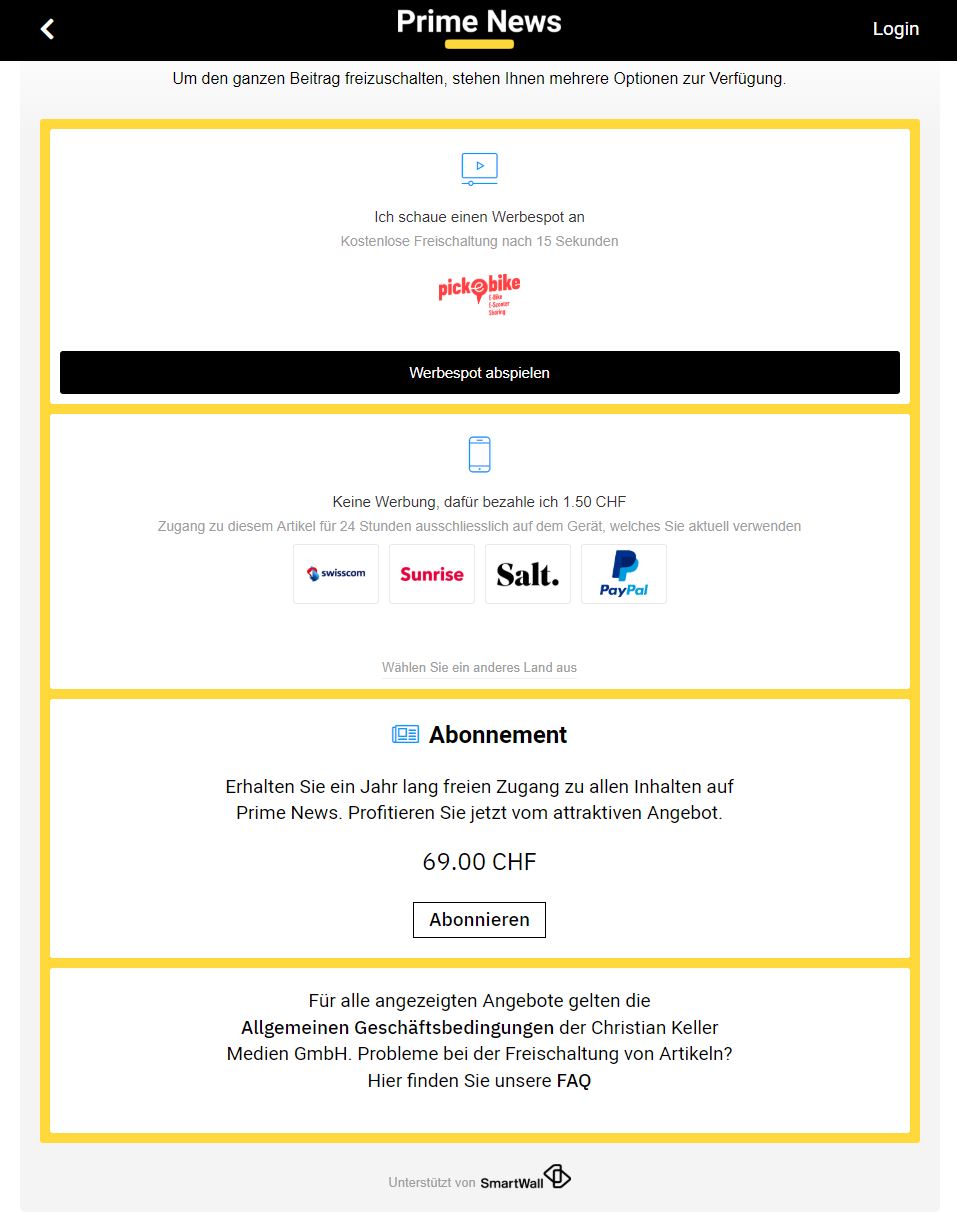
1.50 francs per article that is only activated for 24 hours seems quite a lot to me personally in comparison and to the price of print editions. How do you come up with that amount?
The experience of smartwall provider Swisspay is that it doesn't matter much whether you charge one or two francs. The decisive factor is rather that someone is specifically looking for an article and is keen to read it. If you set the price too low for individual articles, the subscription is no longer attractive. But the price is not set in stone. We're also still considering whether to make certain articles available only to subscribers. That's great about the Smartwall: We can test out what works and gain experience. For example, we could offer articles for 30 centimes for one week. Then, of course, we would have to sell five times as many articles. Would that work then?
The start-up phase is certainly exciting to follow. What do the first figures show?
In the first few days, readers often cancelled when starting an advertising video. We think this means that people are not yet familiar with the system. After all, the Smartwall is not yet available in German-speaking Switzerland. However, this observation changed a few days later: In the meantime, those who start an advertising video let it run for at least 15 seconds in over 90 percent of cases. I interpret this as a gradual build-up of a growing number of regular readers who access our latest articles daily via the video function.
What is the ratio between those who watch the ads, pay once and subscribe?
Our aim is to appeal to adults aged 28 and over who are interested in the region. For some of them, that's worth taking out a subscription for 69 francs a year. But a large proportion are used to receiving content free of charge - as is the case with the BZ Basellandschaftliche Zeitung and the Basel Newspaper. This part of the visitors is more likely to click on the promotional video.
A large proportion are used to receiving content for free - as with the BZ Basellandschaftliche Zeitung and the Basler Zeitung.
What do you think of the free culture that has been mentioned?
I am a big opponent of it. I am convinced that the free culture is destroying journalism. With banner advertising, you earn less every year, it's an inflationary business. Readers expect all articles to always be objectively and seriously researched, without errors. But they don't want to pay. That doesn't add up.
Prime News focuses on the local. It's hard to score points with reach. How do you plan to generate enough revenue in the long term?
With the Smartwall, we have a much higher thousand-contact price that we can charge advertisers. This is because we have a local reference and the advertising is viewed voluntarily. In addition, we have a lean setup; we don't have a budget in the millions.
I find it exciting that you reject government subsidies. Why would you not accept financial support?
In the online sector, where you have so many opportunities as a small number like me? You might need one or two colleagues who have an IT company and are willing to help you. But if you have so little confidence in your own product that you have to ask the government for help, yes, you're lost. With subsidies, you are implementing something into the market that will survive with tax dollars, but may be the wrong thing. Others who offer the right thing then no longer have a chance. That cannot be in the interest of the taxpayer.
If you have so little confidence in your own product that you have to ask the government for help, you're doomed.
Prime News has a lean setup. Only you and your brother are permanent employees. Do you have a plan if and when more permanent employees will join?
You can start tomorrow if you want. We just won't pay you a salary (laughs). After all, we're just getting started now. Many people say that's an incredibly bold step. I think so: Writing about the drug mafia in Colombia would be brave. We're trying something out. If it goes well and we gain subscribers and advertisers, we will hopefully soon be able to hire staff. But maybe there will be two of us. We'll see.
So you don't have a five-year plan in mind yet?
You can make big plans, but in the end reality will catch up with you. What we certainly don't do: Hiring people on the basis of fantasy figures only to go broke after a month.
How many freelancers do you currently work with? How much comes from the freelancers, how much from yourself?
We work with about ten freelancers. They write much more than they should because they are enthusiastic about it. I write three or four articles a week.
But the freelancers are paid?
Right. According to the usual approaches.
Are there any topics that you would like to Prime News consciously exclude?
We do without news reports that cover everyone else. We don't need to attend press conferences that are already attended by 50 journalists. Our unique selling point is stories, with which we offer a valuable supplement.
We don't have to attend press conferences that are already attended by 50 journalists.
What are your thematic focuses?
It's about politics, about contributions critical of the state and grievances. We report when citizens are harassed. But we also feature success stories about people who have achieved something. And we write touching stories, for example about animal welfare officers. We want to be surprising and versatile - with topics from the Basel region.
The online portal Barfi has just had to cease operations. What do you want to do better than Barfi?
Barfi has managed to reach people. That is an achievement. The tragedy of it is that it's not enough. And that's exactly what I mean. For me, reach is not decisive: I don't have to reach everyone in the Basel region. If we have a certain core audience of subscribers and people who regularly watch our content via advertising, then we will survive. Barfi would have needed an insane amount of clicks per employee to survive - you can never do that with just banner ads.
Interview: Ann-Kathrin Kübler



The reason given for this step is the economic situation of the company, which no longer permits the continuation of operations. "Our coffers are empty", holds Barfi.ch founder Christian Heeb notes.
Not surprisingly
The end of Barfi.ch does not come as a surprise: Christian Heeb had already told the Keystone-SDA news agency in February that his portal, with a dozen permanent employees and a budget of 2.4 million Swiss francs, was on the brink of collapse.
Barfi.ch had been searching unsuccessfully for a partner for quite some time. And in January, the takeover by the local TV station Telebasel had also failed (Werbewoche.ch reported).
For months, Barfi.ch also courted advertisers under the slogan "Solibarfi. The local advertising industry, however, has been cautiously reticent in the new digital world for them, notes Heeb, who is quite proud of the reach of his free medium. Just this week, Barfi.ch reached the "record of an incredible 493,845 users.
Already in the last week of July, the civil court of Basel-Stadt had granted the news portal a provisional moratorium. But because suppliers subsequently insisted on payment in advance, the bill did not add up, Heeb notes. According to him, he announced the end of the online platform to the employees on Friday morning.
New online medium in Basel since Monday
Heeb launched his portal, including his own app, at the end of July 2015 as a network medium fully focused on mobile communication devices; thus, it did not need a license. "Barfi" is the dialect abbreviation for Barfüsserplatz in the center of Basel's inner city.
Just a few days before Barfi.ch ceases operations, a new online medium has been founded in Basel. Prime News, launched by Christian Keller, the former local boss of the Basel Newspaper went online on Monday. Keller relies on local stories and a simple payment model (Werbewoche.ch reported). (SDA)
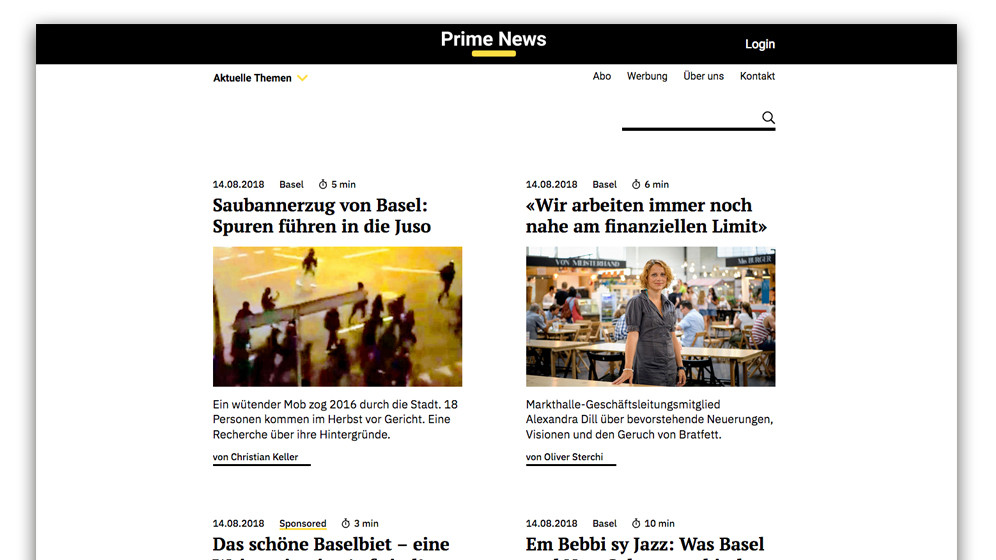
Head Christian Keller focuses on local stories and a simple payment model. The local boss left the Basel Newspaper after the announcement of the sale to Tamedia in April. Formerly with Telebasel for ten years, Keller, who was born in 1982, had wanted to become self-employed for some time, as he told the Keystone-SDA agency. Now he has found a software tool that makes the step seem realistic.
Keller wants to avoid the free culture of many online media by consistently selling his texts. On the Prime News-Only the title, lead and image can be viewed free of charge on the website; more costs money. Videos are only being considered; we are starting with statically illustrated texts - silence is the concept.
Someone always pays
He offers three options: You can watch a 15-second commercial; the company in question then pays for you to read the text in question. Or you can pay one franc per text using your cell phone number via your provider bill; the major providers and Paypal are included. Thirdly, there are annual subscriptions for 69 francs.

Founded as a sole proprietorship in Binningen BL in May, Keller has been operating as a limited company in Basel since mid-July. Keller counters skepticism about the business model with optimism that such a simple payment method has a good chance against all the complicated existing models. He does not disclose budget figures; only his brother - who does the advertising administration - and he are permanently employed, although he himself is not drawing a salary for the time being. He could expand the team very quickly if it is successful.
Ten freelance authors, paid according to the usual rates, will help to provide two new stories every day. Keller locates the latter in the local niche, primarily Basel and the surrounding area. With background stories, portraits and columns, he has his sights set on a target audience between the ages of 30 and 65.
Flexible as a small company
Keller relies on the SmartWall software from the Lausanne-based start-up SwissPay.ch. This makes texts accessible with just two clicks. Advertisers, who are named in advance, pay when someone watches their 15-second spot. Sufficient advertisers are available for the launch, says Keller. It is lean and flexible without publisher-related considerations. SmartWall has already proven itself with two newspapers (the La Liberté in Freiburg and Journal du Dimanche in France), albeit selectively and adapted to publishing needs.
As a well-connected journalist, Keller had already placed a primeur (on the personnel consequences of the BVB rail debacle) on his Facebook page before the start, thus ensuring mentions and attention.
On Monday evening - Tuesday was announced - the Prime News The new edition started with eight texts, including on the left-wing background to a clean banner march, the course of business in the market hall, jazz references to New Orleans and a sponsorship text from a Basel wine house.
Stormy environment
Prime News is not tilling a fallow field: since 1998, Peter Knechtli's OnlineReports News and stories online free of charge, and according to its own figures is in the black. Launched in 2011, the DailyWeek publishes online on an ongoing basis, which is becoming increasingly important as the print edition is reduced to a fortnightly rhythm due to cost savings. All regional providers, including Telebasel, which is strongly promoting its internet channel, are using multimedia. The online portal Barfi.ch by former Radio Basilisk co-founder Christian Heeb was the last to go online in 2015. Due to a lack of advertising revenue, Barfi.ch is now in debt-restructuring moratorium and is looking for partners. (SDA)