
The strategic role of corporate communications falls short of expectations in many organizations. This is the result of the PR Trend Monitor 2025, which was conducted by Dpa subsidiary News Aktuell together with communications agency PER. The analysis is based on an online survey of 192 communications experts from companies and organizations in Switzerland and Germany.
94% of respondents consider it important for corporate communications to have a seat at the table when strategic decisions are made in the company. Specifically, 62 percent rate this involvement as "very important" and 32 percent as "somewhat important". However, the reality is different: Only 13 percent of participants stated that their department is an integral part of the strategic decision-making team. A further 16 percent are at least occasionally involved.
The largest proportion, namely a third, describe their own role as advisory, while 30% merely act as an operational mouthpiece for decisions that have already been made. Six percent do not see themselves in any of these categories.
The results highlight a persistent discrepancy between aspiration and reality: although the strategic relevance of communication is recognized, its systematic integration into decision-making processes often fails to materialize. The PR Trend Monitor thus provides an insight into a central challenge facing the industry - and at the same time underlines the potential for a stronger positioning of communication at the highest management level.
]]>
As the survey shows, 82% of the communication professionals surveyed have access to AI tools such as ChatGPT & Co. A closer look at the support on offer reveals clear deficits: despite the technical possibilities available, there is a lack of structural and content-related support: only 29% receive regular training on AI topics. Only 25 percent work with clear guidelines or strategies for the use of AI. Only 23 percent receive technical support from internal AI experts. And only 18 percent of respondents have a budget for AI projects. Regular training on ethical and legal issues in dealing with AI is also rare: Only one in ten respondents receive such offers (10 percent).
No guidelines, professional leadership or further training
The reasons given by those who do not feel sufficiently supported by their company in the use of AI confirm precisely these deficits: in first place, respondents complain about the lack of a strategy or guidelines for the use of AI (47%). In each case, 40 percent criticize the lack of technical or specialist support, the lack of best practices and the insufficient AI expertise of their superiors. Another 40 percent criticize the fact that there are too few or no further training opportunities. Access to AI tools, on the other hand, is less of a problem: only 14% of those who feel unsupported have no access to ChatGPT & Co.
The results of the survey in detail
Do you feel supported by your company in the use of artificial intelligence (AI) in your work?
- Fully supported 15%
- Rather supports 52%
- Rather not supported 19%
- Not supported at all 6%
- I do not currently use AI in my work 6%
- Don't know 1%
[If fully and rather supported:] How does your company specifically support you in the use of artificial intelligence (AI)?
- Access to AI tools such as ChatGPT & Co 82%
- Supervisors actively promote AI competence and AI use 38%
- Time is allowed for familiarization with AI tools 35%
- Regular internal communication about AI initiatives or strategies 33%
- Regular AI training on AI topics and tools 29%
- There are best practices or how-tos for using AI 28%
- There are internal communities for exchanging information on AI developments 25%
- Clear strategy or guidelines for the use of AI 25%
- Technical and specialist support from internal AI experts 23%
- Budget for AI projects is provided 18%
- There is regular training on ethical and legal issues in dealing with AI 10%
[If rather not supported or not supported at all:] Why do you not feel sufficiently supported by your company in the use of AI?
- No strategy or guidelines for the use of AI 47%
- Lack of technical or professional support from internal AI experts 40%
- No best practices or how-tos for using AI 40%
- Lack of AI competence among line managers 40%
- Too little or no training on AI topics and tools 40%
- AI is not considered a priority in the company 29%
- No time for familiarization with AI tools 27%
- Lack of internal communication about AI initiatives or strategies 26%
- No budget for AI projects 23%
- Lack of AI expertise in own department 23%
- No access to AI tools such as ChatGPT & Co 14%
- Other reasons 7%
- AI tools in the company that are too complex or difficult to understand 4%
- Use of AI in the company not desired 3%
An online survey of 276 communications professionals from companies, organizations and PR agencies in Switzerland and Germany was conducted in February 2025 for the PR Trend Monitor by News Aktuell and PER. The survey results provide insights into trends, challenges and developments that are emerging in the communications industry. The studies have been published for over 20 years.
]]>
The vast majority of PR professionals see their professional situation as stable: 81% rate their job as secure or very secure. This means that the feeling of security in the industry remains almost at the same level as the previous year, when 87% saw their job as secure. At the same time, many companies are struggling with cost-cutting measures that also affect communication budgets. Almost half of those surveyed (45%) expect budgets to shrink, while only 15% expect them to grow.
Communication under cost pressure
The main reason for the falling budgets are company-wide cost-cutting programs, which 80% of respondents cite as the reason. Budget shifts to other areas of the company (37%) and an increased focus on in-house PR instead of external support (27%) are also putting pressure on communication budgets. Just under a fifth cite investments in more cost-effective digital channels and an increase in efficiency through technical support as reasons.
According to the survey results, insufficient measurability (16 percent), the reduced importance of communication for the company (15 percent) and the reduction of communication activities due to a reduced need for communication (7 percent) are less significant.
Despite the financial restrictions, business development remains stable: 42% rate it as satisfactory, while 34% expect a positive development. However, around a fifth (21%) see poor to very poor prospects for 2025.
Mixed career prospects
A differentiated picture emerges with regard to personal career prospects. While 31% of respondents expect an improvement, 36% expect the situation to remain stable. However, the proportion of those who fear a deterioration in their professional situation has increased: 30% expect a negative development, compared to 25% in the previous year.
]]>
According to the survey, a large majority (91%) of PR professionals are able to carry out their work independently and autonomously. In addition, 78% of communication experts are able to organize their working hours flexibly. And management is also increasingly relying on a modern understanding of leadership: 75 percent of managers actively support self-determined work and give their teams more responsibility. This development is supported by clear company guidelines on remote work and the free choice between working from home and the office - 71% of respondents say this about their company.
Almost two thirds (65%) of communications experts also state that their company promotes a learning culture that supports continuous training and personal development. At the same time, almost as many companies and PR agencies (63%) ensure that work and private life are in balance (work-life balance). Diversity is already promoted in 62 percent of companies, according to the PR experts.
For 58% of PR professionals, it is now possible to increasingly work from home, and exactly half (50%) of those surveyed state that managers are increasingly handing over responsibility in their companies. Agile working has become the standard for almost as many (49%).
Only one in three (31%) say that everyone in the team works in the same city, and just under a quarter (24%) even work completely remotely. For a good one in five PR professionals (22%), the respective company even promotes remote work in other European countries.
Communicators have stated that
- I can do my work independently and autonomously 91 %
- I can organize my working hours flexibly 78 %
- In my company, managers support, encourage and empower their teams to work autonomously 75 %
- My company has clear guidelines on remote work 71%
- I can choose whether I work from home or in the office 71 %
- My company promotes a learning culture that supports continuous training and personal development 65 %
- In my company, care is taken to ensure that work and private life are in balance 63 %
- Diversity is promoted in my company 62 %
- I am increasingly working from home 58 %
- In my company, managers are increasingly handing over responsibility 50 %
- I have a say/participation in company decisions 50 %
- Agile working is standard in my company 49 %
- Everyone in my team works in the same city 31 %
- Everyone in my team works remotely 24 %
- My company promotes remote work in other European countries 22 %
For the PR Trend Monitor News Aktuell and Per conducted an online survey in February 2024 among 327 communications professionals from companies, organizations and PR agencies in Switzerland and Germany.
]]>
When asked about the most dangerous triggers for communication crises, one in three respondents cited disinformation as the greatest risk factor (33 percent). Nearly as many PR professionals believe that covering up mistakes is the biggest factor accelerating a crisis (32 percent). The third most commonly cited cause among respondents is personal misconduct by top management (28 percent).
For one in four people, social media backlashes are the most dangerous trigger for a crisis (25 percent); criminal acts against the company—such as a cyberattack—significantly increase the risk of a crisis for just over one in five respondents (23 percent).
About one in ten sees an increased risk of a crisis if the company is subject to a criminal investigation (13 percent), if its products are defective (12 percent), if its own employees engage in personal misconduct (12 percent), or if data protection is violated (10 percent).
Natural disasters, on the other hand, are considered less dangerous by most respondents: Only a meager 6 percent fear earthquakes or storm surges as the most dangerous triggers of communication crises. Respondents are least concerned about potential defamation by competitors (3 percent).
The Most Dangerous Triggers of Communication Crises, According to the Survey
- False Reports & Misleading Information 33%
- Covering Up Mistakes 32%
- Personal Misconduct by Management 28%
- Social Media Backlash 25%
- Crime (e.g., cyberattacks) 23%
- Lack of Transparency 22%
- Failure of Top Management 22%
- Compliance Issues 20%
- Prosecutor's Office Investigation 13%
- Defective Products 12%
- Personal Misconduct by Employees 12%
- Data Breaches 10%
- Economic Problems 9%
- Poor Working Conditions 8%
- Poor Service 8%
- Natural disasters (e.g., storm surges, earthquakes) 6%
- Defamation by Competitors 3%
Within the framework of the PR Trend Monitors by News Aktuell and Per An online survey was conducted in February 2024 among 327 communications professionals from companies, organizations, and PR agencies in Switzerland and Germany. Respondents could select up to three options.
]]>
The main areas in which AI is used in day-to-day communications are translations, copywriting and editing as well as topic and trend identification. Forty-three percent of PR professionals use AI heavily or very heavily for translations, a third use it intensively to help with text creation and revision (33%), and 16% of communicators increasingly rely on the digital assistant for topic and trend identification.
Artificial intelligence is rarely used in areas involving the production and editing of supplementary media material. For example, only 8% already use AI intensively for image recognition and 4% use it heavily or very heavily for video and audio production and editing.
No AI for crisis and reputation management
The use of AI can be significantly expanded in areas such as crisis prevention, reputation management and influencer relations, where the digital helpers are not used at all by the majority of respondents.
When asked how intensively PR professionals use AI in the areas mentioned, almost three quarters (73%) of respondents said that they do not place crisis prevention and crisis management in the hands of AI at all, 68% said the same for reputation management and two thirds said the same for influencer marketing/influencer relations (66%).
Opportunities and risks of AI in everyday communication
Where exactly do PR professionals - if they use AI - place their hopes and where do they have reservations? Two-thirds hope that the use of artificial intelligence will automate routine tasks so that they have more time for more demanding activities such as strategy, conception, creation or stakeholder support (67%). An increase in creativity through AI-supported idea generation is seen as an opportunity by more than half (51%). Just under a third hope for more efficient data evaluation (32%).
When asked about the greatest fears that PR professionals associate with AI and their work, half of those surveyed cited the lack of verifiability and control of information (51%). In second place is the fear of losing human skills such as critical questioning (35%) and in third place is uncertainty about the legal framework and copyright issues when working with AI systems (34%).
Selected results in detail
In which areas of professional communication do you already use AI?
- Text creation and revision 68%
- Translations 54%
- Topic and trend identification 31%
- Image production 25%
- Keywording of content 19%
- Social media planning / conception 14%
- Media monitoring 11%
- Image recognition 10%
- Video production 10%
- Audio production and editing 8%
- Verification of information 8%
- Target group analysis 8%
- Competitive analysis 8%
- Performance analysis and evaluation 7%
- Crisis prevention and crisis management 4%
- Reputation Management 3%
- Influencer Marketing / Influencer Relations 0%
- We do not yet use AI 17%
What are your three greatest hopes that you associate with AI and your work?
- Automation of routine tasks and more time for demanding activities 67%
- Increasing creativity through AI-supported idea generation 51%
- More efficient data evaluation and data analysis 32%
- Improved campaign effectiveness through targeted AI optimization 20%
- Improved target group analysis and more targeted communication measures 15%
- Greater competitiveness 13%
- Faster identification of opportunities and risks 11%
- Extended options for trend forecasts 8%
- Personalized customer communication 6%
- No hopes 5%
- Don't know 2%
What are your three biggest fears that you associate with AI and your work?
- Lack of verifiability and control of information 51%
- Loss of human abilities (e.g. critical questioning) 35%
- Uncertainties about the legal framework and copyright issues when working with AI systems 34%
- Data protection and security concerns (possible misuse of collected data) 27%
- Moral and ethical concerns (transparency, privacy, authenticity) 22%
- Increasing dependence on AI systems and on the quality of AI 21%
- Downsizing and job losses 16%
- Changing ethical standards in the industry 15%
- Loss of creativity 13%
- More work intensification 12%
- Uncertainty and employees' inability to adapt to new technologies 11%
- Lack of knowledge and training opportunities 9%
- Costs and resources for the implementation of new AI technologies 6%
- Change in work dynamics 5%
- No fears 3%
- Don't know 1%
For the "PR trend monitor from News Aktuell and PER" an online survey was conducted in February 2024 among 327 communication professionals from companies, organizations and PR agencies in Switzerland and Germany. Further results on the News blog.
]]>
However, there are significant differences in salary development between media outlets and PR agencies, as the survey shows. While 44 percent on the agency side have not received a salary increase, only 24 percent of PR professionals in companies have had to make do without a salary increase in the past twelve months.
More than half of the media positions received at least a moderate salary increase: As many as 58 percent saw their salary rise by less than 2 percent, which corresponds to the average inflation rate for 2023. Among PR agencies, only one in four benefited from an increase below the inflation rate (25%).
There are also significant differences on the agency and company side when it comes to salary adjustments in line with inflation, with PR agencies being the big winners here: Around a third of communications professionals in PR agencies (31 percent) can look forward to a salary increase of more than 2 percent. This corresponds to a salary increase that is above the average inflation rate of the past year. In contrast, only 18% of PR professionals in media agencies stated that they had received a salary increase above the inflation rate.
Majority satisfied with salary
Despite the rather stagnant development of salaries, the majority of respondents are satisfied with their current salary: very or rather satisfied: 51%, satisfied/neutral 24%. Only one in four PR professionals is rather or very dissatisfied (24%).
But there are also clear differences in satisfaction between companies and PR agencies: over half of respondents from media outlets said they were very or fairly satisfied with their current salary (55%). On the agency side, however, the figure is only 44 percent.
Salary negotiations tend to be more difficult
When it comes to asking for a higher salary, the majority of respondents believe that salary negotiations will be neither easier nor more difficult this year (43%), or that they will become tougher and more or definitely more difficult (41%). Despite this fear, only 18% of respondents are considering changing jobs if their salary does not develop as they would like. This means that 53% - and therefore the majority - will remain loyal to their current employer despite some dissatisfaction with their salary. A further 29% are undecided and might change jobs if their salary still does not meet their expectations.
Additional training opportunities and leisure time desired
If communications professionals could wish for additional benefits from their employer in addition to a higher salary, external training opportunities are at the top of the list. But the desire for additional vacation days is also high.
The top 5 desired additional benefits this year:
- External training courses 49%
- Additional vacation days 47%
- Home office options 20%
- More flexible working hours 16%
- Possibility to work in other EU countries 8%
At the PR Trend Monitor survey by News Aktuell and PER in February 2024, 49 PR specialists and executives have from companies, organizations and PR agencies in Switzerland took part.
]]>
Despite increasing uncertainty about communication budgets, the majority of PR professionals surveyed are optimistic about the current financial year, as the survey shows. Almost 90 percent of those surveyed stated that they consider their jobs to be very secure or secure. In contrast, the majority expect budgets to stagnate or even decline. The general business development and personal professional situation, on the other hand, are viewed rather positively.
PR professionals see their jobs as secure
More than half of those surveyed consider their current job to be secure (52%). Over a third (35%) even believe that their current job is very secure. A smaller proportion of PR professionals (11 percent) are worried about their own job: 9 percent state that their current job is insecure and 2 percent even consider it to be very insecure.
Differences can be seen between PR professionals from agencies and media outlets: Respondents from agencies clearly see their job as less secure, with almost one in five believing their job is at risk this year (19 percent uncertain or very uncertain). In the case of media outlets, only just over one in twenty respondents fear losing their job in 2024 (7 percent uncertain or very uncertain).
Communication budgets are wobbling
This job security is particularly striking when the results are compared with the development of communication budgets in 2024. While PR professionals are optimistic about the future when asked about job security, the results of the question about the development of communication budgets show a great deal of uncertainty. A significant proportion of respondents assume that their own company's communications budget or that of their clients will stagnate or even fall this year: 43% state that it will remain unchanged, 37% assume that it will shrink or shrink significantly. Only around one in six see a positive development and believe that the communication budget will increase or rise sharply (16%).
Media agencies are also more optimistic on this point: a good one in five believe that the communication budget will increase or even increase significantly (21%). In comparison, not even one in ten agencies expect an increase or a strong increase (8 percent).
Positive trends in general business development
Despite the majority of concerns about budgets, the results of the PR Trend Monitor show rather positive signals with regard to the general business development of the industry. A majority of respondents describe current business development as satisfactory or even rather good or very good (43% satisfactory, 31% rather good, 7% very good). Less than a fifth see business at risk in 2024 (16% rather poor, 2% very poor).
Own professional situation remains unchanged or improves
The results on the professional situation reflect these positive trends. PR professionals are rather confident about the year that has just begun: 37% say that their professional situation in 2024 will remain unchanged compared to the previous year. 30 percent even believe that things will get better and 5 percent expect the professional situation to improve significantly. Only a quarter of respondents expect their career prospects to worsen or even deteriorate significantly this year: 21% expect it to get worse, 4% clearly worse.
The results at a glance
Do you think that 2024 will be better or worse for you professionally compared to 2023?
- Clearly better 5%
- Rather better 30%
- Exactly the same 37%
- Rather poor 21%
- Clearly worse 4%
- Do not know 3%
How will your company's communication budget develop in 2024 and how will your customers' communication budgets develop in 2024?
- Will rise sharply 2%
- Will rise 14%
- Unchanged 43%
- Will shrink 31%
- Will shrink considerably 6%
- Do not know 3%
How do you assess the general business development of your company for 2024?
- Very good 7%
- Rather good 31%
- Satisfactory 43%
- Rather poor 16%
- Very bad 2%
- Don't know 2%
How secure do you think your current job will be in 2024?
- Very safe 35%
- Safe 52%
- Unsafe 9%
- Very unsafe 2%
- Don't know 2%
For the PR Trend Monitor News Aktuell and PER conducted an online survey in February 2024 with 327 communicators from companies, organizations and PR agencies in Switzerland and Germany.
]]>
"I'm not available" - only 24 percent of communications professionals in Switzerland and Germany take this complete time off from work. According to News Aktuell's PR Trendmonitor, a large majority of 76 percent are permanently available to their superiors and colleagues even during their career break.
Thus, the work cell phone remains switched on in most cases and is one of the most frequent communication channels. Almost half of the respondents (48 percent) state that they can be reached by their company via SMS, WhatsApp or other messenger services. As many as 39 percent respond to e-mails, and 38 percent answer the phone.
However, the results also show that PR professionals only proactively contact the company in isolated cases. Only one in eight respondents (13 percent) actively write e-mails, only 9 percent actively contact the company via short messages, and 5 percent call the office to actively inquire whether there were any problems during their absence.
Team spirit in the foreground
The survey results also shed light on the motivation and team spirit of communications professionals. Asked about the reasons for being available during their vacations, 70 percent say they want to help colleagues in emergencies. A good third of respondents explicitly want to be available for the team (37 percent). Another 23 percent state that they have to continue working on important projects during their vacation.
Only 10 percent cite any expectations on the part of superiors as a reason. Colleagues are even less likely to demand availability (3 percent). 5 percent are available during their vacation so that they don't miss any important news in their absence. Career, meanwhile, is not a reason: Just 1 percent state that being permanently available during the vacations could actually be beneficial for career advancement.
How do PR pros feel about being accessible to their company during the vacations?
- I can be reached via SMS/WhatsApp/Messenger services 48%
- I can be reached by e-mail 39%
- I can be reached by phone 38%
- I actively write emails 13%
- I am actively reporting via SMS/WhatsApp/Messenger services 9%
- I am actively calling the office 5%
- I am not available 24%
Why are PR professionals available during the vacations?
- To help in emergencies 70%
- I want to be responsive to my team 37%
- Important projects I need to continue working on 23%
- My supervisor or manager expects it 10%
- I do not want to miss anything 5%
- My colleagues expect it 3%
- Beneficial for my career 1%
For the "PR Trend Monitor" by News Aktuell and PER, an online survey was conducted in February 2023 among 297 communications professionals from companies, organizations and PR agencies in Switzerland and Germany. For the results above, the survey asked how the communications industry feels about being reachable during their vacations and for what reasons they are reachable.
]]>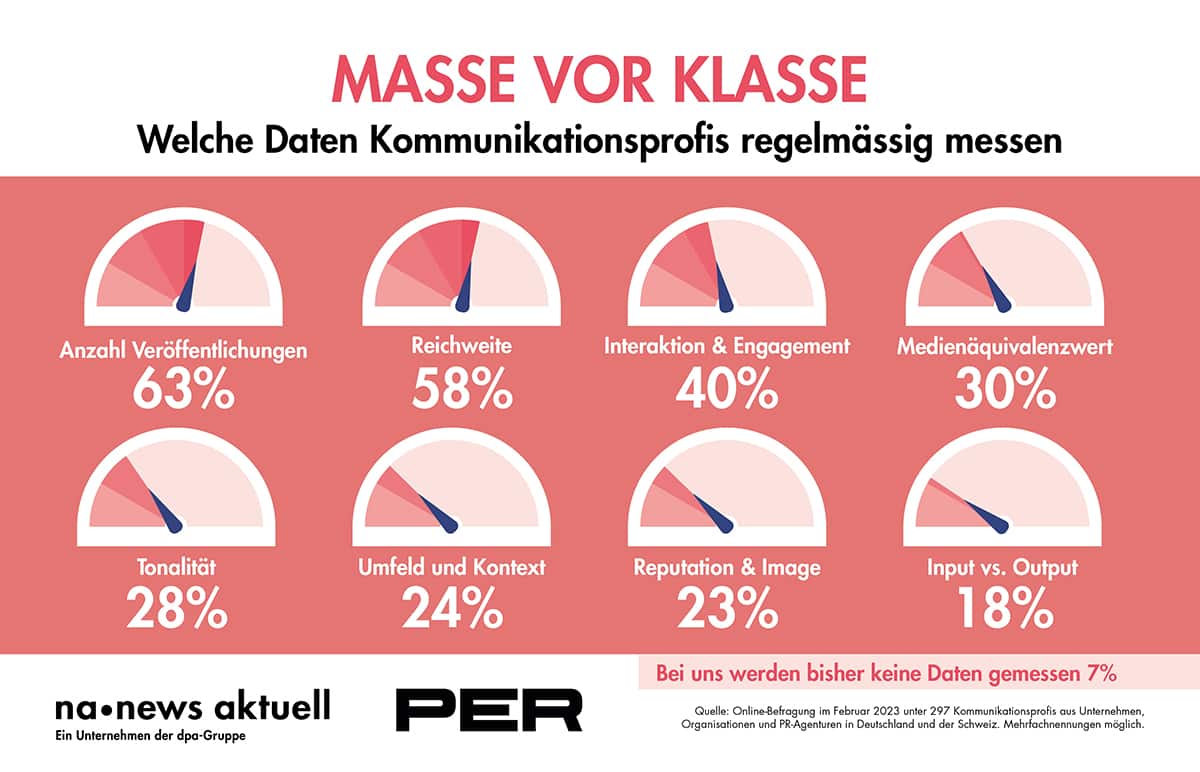 The study asked communications executives what data they regularly measure and evaluate as part of their communications work.
Measuring success is an important and much-discussed topic in the industry. As many as 78 percent of communications professionals consider regular measurement of communications measures to be very or somewhat important. Quantitative data is at the top of the list of criteria that PR professionals continuously measure: 63 percent measure the number of publications and mentions, 58 percent regularly measure the reach of their communication measures, and 40 percent determine interaction and engagement. In fourth place is the media equivalent value, which 30 percent of respondents also calculate regularly.
Reputation & image and topic leadership still expandable
When it comes to qualitative data, however, PR professionals are even more reticent, according to the study. The results show that only 28 percent regularly measure tonality: Accordingly, not even one in three evaluates the extent to which reporting is positive, negative or neutral. Only just under one in four respondents considers the environment and context of the publication (24 percent) or evaluates the extent to which the communications work pays off for the reputation and image of the company (23 percent).
Around one-sixth of PR professionals evaluate the ratio of input to output (18 percent), survey the impact of communication measures, for example on sales (17 percent), or measure topic leadership in the media (16 percent). 7 percent of the PR professionals surveyed state that they have not yet measured any data.
Desire for quality recognizable
Nevertheless, the study shows that there is a desire for more qualitative data measurements. For example, over half of the respondents state that ideally they would like to see the factors of reputation and image in first place in regular measurement (59 percent). The criteria of topic leadership and environment and context are also ideally important indicators of the success of their communications measures for over a third (39 percent). A good third also believe that the ratio of input to output (35 percent) and the effect on sales (33 percent) should be measured regularly.
When it comes to the frequency of data evaluation, most companies and agencies conduct a monthly evaluation (39 percent). Quarterly measures 18 percent, and 13 percent measure at weekly intervals. Less frequently, data is evaluated daily (12 percent), semi-annually (8 percent) or annually (6 percent).
The results at a glance
Importance of measuring the success of communication measures
- Very important 40%
- Rather important 38%
- Draw 7%
- Less important 2%
- Not important at all 1%
- Not specified 12%
Regularly measured and evaluated data as part of the communication work
- Number of publications and mentions 63%
- Range 58%
- Interaction and engagement 40%
- Media equivalent value 30%
- Tonality 28%
- Environment and context of publication 24%
- Reputation and Image 23%
- Ratio of input to output 18%
- Effect of communication, for example on sales 17%
- Theme leadership 16%
- No data is measured at our site so far 7%
Most important factors for measurement in communication in the ideal case
- Reputation and image 59%
- Range 55%
- Interaction and engagement 47%
- Number of publications and mentions 44%
- Publication environment and context 39%
- Theme leadership 39%
- Input to output ratio 35%
- Effect of communication, for example on sales 33%
- Tonality 33%
- Media equivalent value 27%
- Do not know 3%
Frequency of measurement and evaluation of data
- Monthly 39%
- Quarterly 18%
- Weekly 13%
- Daily 12%
- Semiannual 8%
- Annual 6%
- Do not know 4%
The PR Trendmonitor by News Aktuell and Per was conducted as an online survey in February 2023 among 297 communications professionals from companies, organizations and PR agencies in Switzerland and Germany.
]]>