
NZZ am Sonntag« is expanding its offering with a new podcast: »NZZ Weekend« offers space for in-depth discussions that go beyond the day-to-day business. The focus is on personalities from politics, business, science and culture who talk about their careers, their convictions and current challenges. The first episode is available now, with new episodes appearing on Fridays.
Being human in the spotlight
«NZZ Weekend» takes a look behind the scenes and combines biographical anecdotes with current socio-political debates. Beat Balzli, editor-in-chief of «NZZ am Sonntag», is the central voice of the podcast. The host team is complemented by Nicole Althaus, Report and Debate author at «NZZ am Sonntag», and Peer Teuwsen, Head of Culture and History at «NZZ am Sonntag». In each 60-minute episode, guests talk about how they became the people they are today.
Federal Councillor Rösti at the start
In the opening episode, Beat Balzli welcomes Federal Councillor Albert Rösti (SVP), Head of the Federal Department of the Environment, Transport, Energy and Communications (DETEC). Rösti describes his path from a farmer's son from the Bernese Oberland to the Federal Council and reflects on issues of status, ambition and resilience. The interview, which was recorded in March 2026, ranges from personal anecdotes to current topics such as artificial intelligence and Switzerland's future viability.
Beat Balzli says: «With »NZZ Weekend', we are creating space for conversations that go beyond day-to-day business. We are interested in what shapes personalities - and how they make decisions in an increasingly complex world."
The first episode of «NZZ Weekend» is now available on nzz.chfree of charge in the NZZ app and all popular podcast apps.
]]>
Jonathan Meese is one of the most radical artists of his generation. Born in Tokyo and raised in Germany, he combines different cultural influences and visual worlds - always supported by his leitmotif of the «dictatorship of art». On April 12, 2026, he will present his artistic work in a special edition of «NZZ am Sonntag».
Art as a way of life
Provocateur, enfant terrible, artistic genius - Jonathan Meese has many labels attached to him, but none of them really do him justice. The German painter, sculptor, performer and theater maker defies clear attributions with his works. His art is characterized by an irrepressible desire for freedom and powerful expressionism, with which he unites myth, history and pop culture.
For Meese, art is more than a craft, it is a way of life. «For me, art is like breathing, sleeping, eating, drinking, it happens by itself. Art just happens,» he says in an interview with Peer Teuwsen, Head of Culture & History at «NZZ am Sonntag». His art is changeable and difficult to grasp, only his leitmotif remains constant. The «Dictatorship of Art» is an artistic plea for autonomy, imagination and the supremacy of art over ideology, morality and power.
Meese consistently moves outside conventional paths. «I'm crazy because I live on the sidelines,» he says. «I want to act from the sidelines. I am the fool on the hill, like Holden Caulfield. I'm the one who has his head in the clouds and sees really weird things down there.»
Exclusive edition and live event
Jonathan Meese presents his artistic work in the «NZZ am Sonntag» of Sunday, April 12, 2026, which will be published as an art edition on that day. The special edition is supplemented by an interview with Peer Teuwsen and a portrait of Meese by German journalist Georg Diez.
Meese also created an exclusive edition of 20 unicorn drawings for the NZZ. In it, the unicorn appears as a symbol of art liberated from convention. In the accompanying text, Meese's unicorn becomes the figure of a Gesamtkunstwerk, a metaphor for a total art in which love, power, myth, the future, nature and pop culture flow together. The edition thus proves to be a closed cycle within his artistic cosmos. The edition will be available from April 12, 2026 at NZZ Shop available.
In addition, an «NZZ Live» event with the artist will take place on Monday, April 13, 2026. In conversation with Peer Teuwsen, Meese talks about what drives him and what he wants to achieve with his art.
Jonathan Meese, born in Tokyo in 1970, now lives in Berlin and Ahrensburg. His works have been exhibited internationally, including at the Pinakothek der Moderne, the Centre Pompidou and the Museum of Contemporary Art North Miami. His works can be found in important public and private collections, including the K20 in Düsseldorf, the Albertina in Vienna and the Centre Pompidou in Paris.
]]>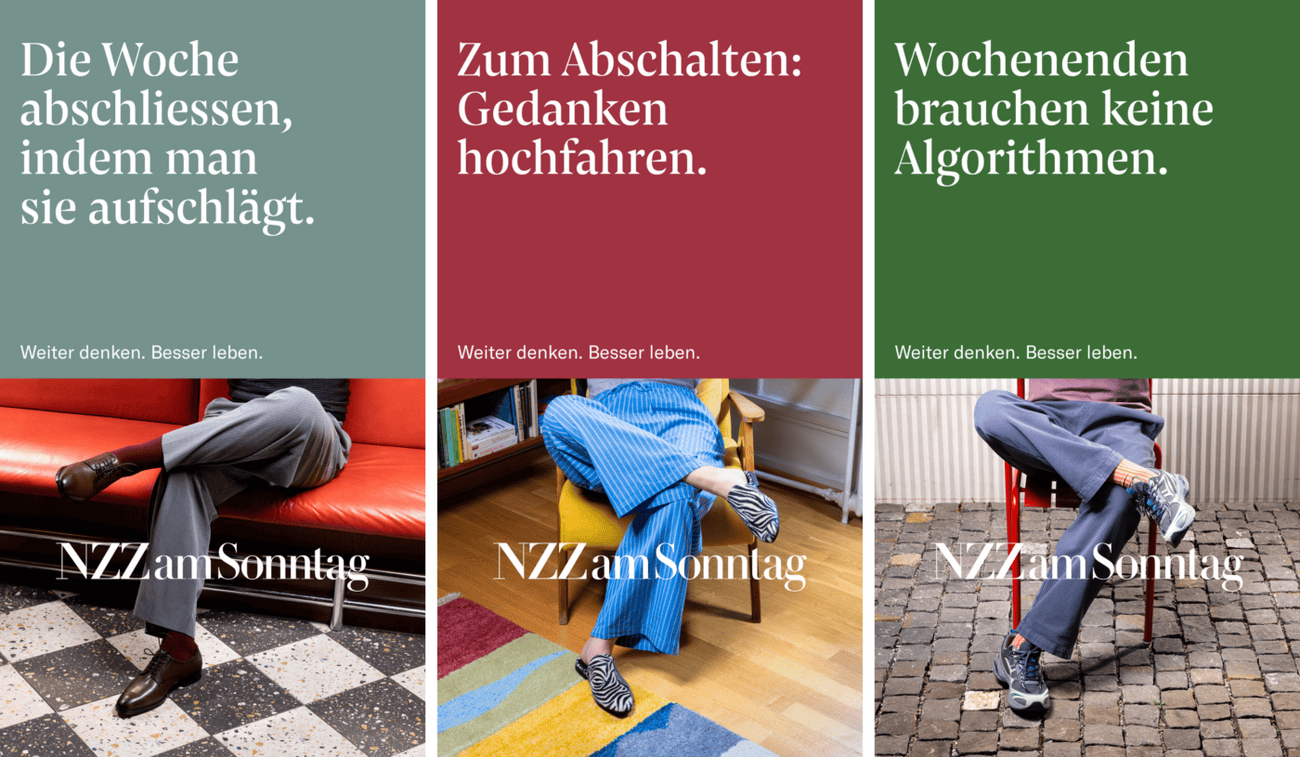
Just in time for its 24th birthday on March 17, 2026, the "NZZ am Sonntag" is launching a new image campaign. It was developed in cooperation between the NZZ Brand & Creation team and the Zurich agency Freundliche Grüsse, which is responsible for the creative concept.
The moment of conscious reading
At the heart of the campaign is a moment that many readers are familiar with: When you cross your legs, consciously block out the noise of the present and fully immerse yourself in reading. In an age of constant streams of information, the need for orientation and classification is growing. Between push notifications, social media feeds and AI-generated headlines, attention is becoming increasingly fragmented.
The "NZZ am Sonntag" deliberately counters this with journalistic depth and stories that people consciously take time for at the weekend - to read, reflect and discover new perspectives. With this campaign, the newspaper is picking up on precisely this moment of deceleration. Its visual trademark is crossed legs - a posture that stands for the moment when you pause, take your time, read and think.
Focus on understanding instead of just knowledge
"Our readers don't just want to know what happened, they also want to understand why," says Beat Balzli, Editor-in-Chief of "NZZ am Sonntag". "The 'NZZ am Sonntag' deliberately focuses on the rhythm of the weekend - on stories that invite readers to linger and reflect."
The creative idea for the campaign came from the Zurich agency Freundliche Grüsse, which has been working with the in-house Creation & Brand team over the past few months. "When you cross your legs, the real rest begins. The noises fade, the head clears and reading becomes the main thing. We occupy this moment and make it the core of the campaign and the visual trademark of 'NZZ am Sonntag'," says Samuel Textor, co-founder of Freundliche Grüsse.
Strategic repositioning
The campaign ties in with the strategic repositioning of "NZZ am Sonntag". With the claim launched in summer 2025 "Think further. Besser leben." (Think further. Live better.), the editorial team underlines its journalistic promise: to provide orientation, show connections and turn the weekend into a moment of further thought and inspiration.
The campaign starts on March 17, 2026 and will be played out via digital out-of-home screens, special placements and various social media channels.
]]>
The Karl Wild Hotel Rating Switzerland has been carried out annually since 1997 by the journalist and author Karl Wild and published as a book by Weber Verlag. There will be a change in the authorship in 2025: Karl Wild will hand over the hotel rating to the gastronomy journalist and author Andrin Willi.
A hotel rating supplement will also be published for the first time in May 2025 in the NZZ on Sunday will be published. The content of the publisher's supplement will also be available online on the "NZZ Bellevue" lifestyle portal. NZZone creates and markets the publishing supplement and the online content, which should give the hotel rating an increased and optimized presence.
"The Karl Wild Hotel Rating Switzerland is the best-known hotel rating in the country. We are delighted to be working with the renowned NZZ on Sunday the ideal media partner," says Annette Weber, owner of Weber Verlag.
]]>
Daniel Foppa will also take on the role of Deputy Editor-in-Chief. Paula Scheidt, currently a member of the AnnabelleEditor-in-Chief and Head of Reports, will join the editorial team as Editor-in-Chief on March 1, 2024. NZZ am Sonntag Magazine to NZZ. She and Kerstin Netsch, who has been Editor-in-Chief since November 1, 2023 Z and Bellevue are responsible for the magazines of the Sonntagstitel.
Daniel Foppa and Christoph Zürcher have NZZ on Sunday since June on an interim basis, Foppa has been the background manager of the NZZ on Sunday. He is now also in charge of the domestic department. Previously, he was the domestic theme planner at Swiss Television SRF and deputy editorial director and producer at Swiss Radio SRF. He worked for twelve years in the domestic desk of the Tages-Anzeiger, most recently for seven years as head of department. He also worked as a parliamentary correspondent for Südostschweiz and as a domestic correspondent for the Swiss News Agency (SDA).
Christoph Zürcher joined the company in 2002 as editor of the then newly launched NZZ on Sunday. He has been head of the Society department there since 2004. In 2019, he also took over the editorial management of the NZZ am Sonntag Magazine. Christoph Zürcher has been Chief Editor since May 2023. Before his time at the NZZ on Sunday he was editor of the business newspaper Cash.
Vin Annabelle to NZZ am Sonntag
In March next year, Paula Scheidt will move from Annabellewhere she is currently head of the reportage department and part of the editorial team. NZZ on Sunday. She worked for eight years as a reporter and editor at The magazine, has been working on the New Zurich Newspaper and worked as a freelance journalist for The time, The daily newspaper and Neon written. Together with the editorial team of the NZZ am Sonntag Magazine she will drive the further development of the weekly magazine from March 1, 2024.
Kerstin Netsch, who is part of the magazine's founding and development team, has been responsible for the lifestyle titles since November 1 Z and Bellevue as Editor-in-Chief and in this role will focus even more strongly on the two titles. She will also continue to be responsible for the lifestyle section of the NZZ am Sonntag Magazine which she successfully established and developed. Kerstin Netsch leads the lifestyle editorial team at NZZ on Sunday Before that, she worked at TX (formerly Tamedia) in various positions, initially in the reportage department at Annabelle; later she worked on the development of the title 20 minutes Friday, which she managed for ten years.
]]> Beat Balzli, most recently editor-in-chief of the WirtschaftsWoche, becomes editor-in-chief of the NZZ on Sunday. In this role, from November 1, 2023, he will be responsible for the further journalistic development and digital transformation of the renowned title, and will coordinate the cooperation with the editorial team of the New Zurich Newspaper strengthen. In the future, the two editorial teams will work more closely together and exploit synergies to drive forward the successful implementation of the NZZ company's strategy, which is focused on independent quality journalism, to further strengthen the NZZ brand in print and digital, and to secure economic success in the core business of journalism.
Originally, it was planned that Beat Balzli would be responsible for a growth project in Germany for the NZZ company in a senior position. As of November 1, 2023, he will now take over the position of Editor-in-Chief NZZ on Sunday.
Editorial teams strengthen cooperation
As part of the strategic development, the Executive Board, in consultation with the Board of Directors, continued its deliberations on how the cooperation between NZZ and NZZ on Sunday can be shaped so that the strengths of the two newspapers can be even better exploited and their long-term success can be ensured. To achieve these goals, the editorial teams will work even more closely together in the future. The Business and Knowledge/Science, Technology & Mobility departments will be merged. Hanna Henkel, Head of the Science, Technology & Mobility department at NZZ, will head the merged Knowledge/Science, Technology & Mobility department. Chanchal Biswas, Head of the Economy Department at the NZZ, will take over as Head of the Economy Department.
Layout & Production Editorial, Newsroom, Art Direction and Picture will also be merged. The Visuals, Video/TV and Podcast teams will work for both editorial teams in the future.
Responsibility for the journalistic profile and content of the two newspapers will remain with the two editors-in-chief. The editor-in-chief of the NZZ on Sunday reports directly to the CEO and is part of the Executive Board. In terms of journalism, he reports to the Editor-in-Chief of the NZZ.
Balzli, born in Hamburg and raised in Lucerne, studied economics and business administration in Bern and Paris and turned to business journalism after graduating. After stations in Switzerland - at the Handelszeitung, the Sunday newspaper and with Facts - In 2001, Balzli joined the Hamburg-based news magazine The mirror. From 2010 to 2013, Balzli was Editor-in-Chief at the Swiss Handelszeitung. From 2013, he worked in the editorial department of the Welt Group and was deputy editor-in-chief for the World on Sunday responsible. In 2016, he was appointed editor-in-chief of the Business Week which he headed until 2023. His editorial work has earned him numerous awards, including the Henri Nannen Prize in 2009, the Herbert Quandt Media Prize in 2009 and the Helmut Schmidt Journalism Prize in 2008. In 2009, Balzli was honored by the magazine Business Journalist voted "Business Journalist of the Year".
]]>
At Tages-Anzeiger Anja Burri will work as daily head of the newsroom and at the same time "concentrate on researching journalistic contributions" as editor in the domestic department, according to a statement on Tuesday.
Since Jonas Projer in June 2023 as editor-in-chief of the NZZ on Sunday had leftBurri will lead the editorial team on an interim basis as part of a team of four. Previously, she worked as a background editor and page maker, among other things, before taking over as head of the domestic department in 2020. (Werbewoche.ch reported). In January 2022 it became the Deputy Editor-in-Chief appointed.
Burri already wrote from 2013 to 2016 for the federal house team of the Tages-Anzeiger. The change back to the Tagi is also "a return to many of her journalistic companions. She is looking forward to "writing more" again.
]]>
Projer had only been editor-in-chief since May 2021 of the NZZ on Sunday and member of the Executive Board. He leaves the newspaper with regret, but also gratitude, he was quoted as saying in a statement.
The former "Arena" presenter is leaving due to "strategic differences," the statement added. Projer has initiated important steps to take the newspaper into the next digital phase, NZZ Board President Isabelle Welton is quoted as saying.
Projer's departure is not the first unexpected change in the German-speaking Swiss editorial teams this year. Ringier Axel Springer parted company with Werner de Schepper, editor-in-chief of Interview by Ringier, View-Chief Executive Officer Christian Dorer had to take six months off and Tamedia replaced editor-in-chief Arthur Rutishauser with Raphaela Birrer.
Four successors ad interim
Projer's successor at the NZZ on Sunday has not yet been clarified, the Board of Directors has initiated the search. Four journalists are taking over the reins on an interim basis: Anja Burri, Head of the Domestic Department, Daniel Foppa, Head of the Background/Opinions Department, Christoph Zürcher, Senior Page Editor, and Thomas Stamm, Head of Digital.
Before his time at the NZZ on Sunday Projer was editor-in-chief of the newly established "Blick-TV," and before that Brussels correspondent and "Arena" presenter at Swiss television SRF. (SDA/swi)
]]>
Dark apocalyptic scenes of charcoal and ink for once encase the title and final page of the NZZ on Sunday Other demonic figures, dancing skeletons and smaller interventions can be found on the full page and also in the margins of the art edition. The drawings are the work of Zurich artist Harald Naegeli. In use are works created from 2018 to 2022, some of them especially for this issue. In an interview with Peer Teuwsen, Head of Culture at the NZZ on Sunday, and NZZ Magazine-editor Urs Bühler, the artist explains: "You could also call it the demony of the unconscious. The theme is death and the present war."
Harald Naegeli became internationally known with his unmistakable graffiti. In his works with charcoal and ink, he developed his own formal language, which is also recognizable in his graffiti. The culture section of the NZZ on Sunday is devoted entirely to the artist in this art issue. In addition to the double-page interview, readers can look forward to a portrait of the 82-year-old by Urs Bühler and an article on his graphic work by NZZ on Sunday-art critic Gerhard Mack. After returning to his native city, Urs Bühler regularly visited the artist in his studio on Hottingerplatz. He says of the collaboration: "We have won over an artist for this project whose life story as well as artistic career is fatefully linked to Zurich. It is not without reason that Harald Naegeli is also called the forefather of graffiti art: His sovereign style has secured a place in the collective memory for his most famous figures, while at the same time his works in public space have polarized for over four decades. In this special NZZ on Sunday-edition, his qualities as a versatile draftsman can now be discovered."


]]>
 Daniel Foppa will be at the NZZ on Sunday take overall responsibility for the Background team as well as for the Opinion section, which will continue to be headed by Thomas Isler. Jonas Projer, Editor-in-Chief of the NZZ on SundayDaniel Foppa brings the leadership skills and track record as a topic planner and writer needed for this important role. His experience in convergent editorial teams will also support us in increasingly orienting the Sunday title to a digital future, while at the same time strengthening the still central role of the print edition."
Daniel Foppa was most recently domestic topic planner at Schweizer Fernsehen SRF and deputy editorial director and producer at Schweizer Radio SRF. Before joining SRF, he worked for twelve years in the domestic department of the Tages-Anzeiger activemost recently as head of department. In this role, he was responsible for the digital transformation into a convergent domestic newsroom, among other things. Before that, the 51-year-old worked as a federal house correspondent for the Südostschweiz and as a domestic correspondent for the Swiss Dispatch Agency (SDA).
Foppa studied German language and literature, political philosophy and journalism at the University of Fribourg and received his doctorate in 2002 with the dissertation "Max Frisch und die Neue Zürcher Zeitung". He also completed the "Columbia Journalism Investigative Course" at Columbia University in New York and is a member of the University Council of the University of Fribourg.
]]> The article only dealt with possible slave-like conditions - the title, however, read "Cuban doctors" enslaved: Thus, the NZZ am Sonntag actively claimed an unsubstantiated slavery in the title, criticizes the Press Council in a statement.
The Press Council has therefore partially approved a complaint against the article on the Cuban medical brigades of February 2021, as it announced on Friday evening.
The Press Council considers a strong exaggeration in the title to be permissible in principle, as it states. But this is only permissible if there is a clarification in the immediate vicinity. The title "Cuban doctors enslaved" is not relativized by the subtitle "Havana sends medical brigades all over the world and cashes in".
Therefore, the "NZZ am Sonntag" violated the journalist code, the statement says. The article is explicitly excluded from this criticism: This was an assumption, but not a fact. "Therefore, the Press Council sees no violation of the duty of truth in the text." (SDA)
]]>
Starting Sunday, Gerhard Schwarz and René Scheu will discuss each month a new aspect of free living in the NZZ on Sunday discuss. They use the messenger service Signal for this purpose. Gerhard Schwarz is now president of the Progress Foundation and a freelance journalist. Until 2016, the economist was director of Avenir Suisse, and before that he was responsible for the business section of the New Zurich Newspaper. René Scheu was editor of the Swiss monthbefore the philosopher took over as head of the NZZ feuilleton. Today, he is managing director of the Institute for Economic Policy IWP at the University of Lucerne.
New to the editorial team is author, stage poet and satirist Patti Basler, who since February has been a regular contributor to the NZZ on Sunday writes. From April, it will also be available in the new NZZ Magazine to be heard. Patti Basler was awarded the Salzburger Stier for Switzerland in 2019
Bütler returns to NZZaS
As of June 2022, the columnist Monika Bütler will also return to the NZZ on Sunday back. Bütler, who is one of the ten most influential economists in Switzerland, has written for Sonntagstitel in the past. Among other things, the economics professor headed the Swiss Institute for Empirical Economic Research at the University of St. Gallen and is vice president of the Gebert Rüf Foundation.
Gentinetta goes
Political philosopher Katja Gentinetta, on the other hand, has decided to give up her column work at the NZZ on Sunday and to concentrate on her activities as a university lecturer and board member as well as her own publications.
]]>