The generational change initiated at Nose a year ago is now being followed by the next step. The agency is founding Futureworks to give the interdisciplinary brand consultancy the necessary entrepreneurial scope. From the fall, Nose will continue to offer services in industrial and interior design under the management of Ruedi Müller and Christian Harbeke. Futureworks, headed by Mattias Weber, will focus on strategic brand consulting and the development of relevant and consistent customer experience chains.
Thomas Fröhlich has worked for an international consulting firm for strategic and operational brand management in Geneva for the last 15 years, 11 of which as Managing Director. He has many years of experience in brand and corporate management issues and accompanied clients across industries from conception to implementation. Thomas Fröhlich joins Nose's interdisciplinary team with the aim of using his diverse experience to provide companies with even more comprehensive support in their strategic and day-to-day business challenges in the future. These include sustainable growth efforts in the core business as well as in new business areas, the conception and management of cultural change processes within the company, questions of corporate and management succession, the sustainable strengthening of profitability, the management of complex brand portfolios as well as support in difficult times. In addition, Thomas Fröhlich will actively shape Nose's business development and further strengthen the agency's commitment both in French-speaking Switzerland and internationally.

Thomas Fröhlich studied business administration with a focus on marketing in Berlin. He then became the marketing manager of an engineering company before moving to Geneva in 1999. He has worked intensively on the topics of brand mobilization and reorganization as well as corporate succession and has accompanied mergers - also in the context of temporary management mandates. Thomas Fröhlich is the father of a daughter and lives in Zurich and Geneva.
SBB's new 29 international high-speed trains are designed to make travel on the north-south axis between Basel/Zurich and Milan even more comfortable, punctual and reliable. With a maximum speed of up to 249 km/h, they are not only faster than the existing tilting trains, but also meet the increased demand expected following the opening of the two base tunnels at the Gotthard and Ceneri. SBB put the contract out to public tender around two years ago - and now the decision has been made: Stadler Rail has been awarded the contract to manufacture the new EC250 single-decker multiple-unit trains.

Experience "On the road at home"
Thanks to its many years of experience in the field of transportation, Nose made a valuable contribution to the offer that Stadler Rail submitted to SBB with the exterior and interior design of the trains. Both the exterior and interior of the trains were designed in line with SBB's brand values and the promise of "at home on the move": fast and aerodynamic on the outside, modern and comfortable on the inside. The specially developed seat therefore has high-quality wood paneling and the indirect lighting also contributes to the pleasant spatial and travel experience. The furnishings of the individual seats have been consistently adapted to the needs of modern travelers - with as much storage space as possible, easily accessible power sockets everywhere and special business, rest and family zones. The dining car, the information screens, the luggage transport concept and an advanced workplace for the train driver were further decisive design criteria. In keeping with the motto "enter instead of board", the low-floor concept makes it easy to enter and exit the train.


Mobile despite limited mobility
The approval of the trains for the three countries Germany, Switzerland and Italy as well as the European standards for persons with reduced mobility (TSI PRM) also placed high demands on the design. Grab handles, contrast values, independent boarding and alighting as well as accessibility within the train were included in the development from the outset. By awarding the contract to Stadler Rail, SBB has opted for state-of-the-art international high-speed trains that combine a wide range of technical standards with their emotional brand promise.


"For our clients, multimedia touchpoints are becoming increasingly important due to the proliferation of smartphones and tablet computers, which is why Nose is further expanding the expertise in digital touchpoints that it has built up over the past 15 years," explains Walter Stulzer, partner and CEO of the agency. In order to deepen the know-how in the field of conception, development and implementation of apps for smartphones or tablets as well as browser-based web applications and to develop customized, digital solutions for clients, the Zurich-based brand agency strengthens the team of employees with two experienced specialists.
Andreas Glutz (pictured) joins the team as Senior Media Integrator. Glutz is a trained multimedia producer and has more than twelve years of experience in front-end development and graphics. He specializes in the conception and development of intuitive user interfaces for web, tablets as well as for various mobile devices. As a junior designer, Felix Högner also newly focuses on the conception and realization of user-friendly applications. He studied integrated design with specialization in interaction design at the HS Anhalt in the Bauhaus town of Dassau.
"Because the Internet is increasingly at the center of all home electronics, customers also attach great importance to an attractive appearance for the router as an access point to the Internet. We therefore created an implementation that discreetly embodies Swisscom's brand values in customers' living rooms," Christian Harbeke, Head of Industrial Design at Nose, explains in a statement. In addition to the durable aesthetics with a seamless white base body and a black cover plate as well as the high-quality finish, the designers also attached importance to simple user guidance.
As part of the intensified expansion of its broadband network, Swisscom has developed an Internet box. Nose contributed the design as well as the user guidance. In summer 2012, Nose won a tender against 4 design agencies from Switzerland and abroad.
"First, we asked all our employees to photograph their router at home in their living situation. Through this contextualization, we came to the conclusion that we didn't want to create just another device, but an intelligent and communicative brand ambassador for Swisscom," Harbeke elaborates. The designers opted for a restrained and aesthetically durable design language, which also exudes high quality thanks to a seamless white base body and a black cover plate. In addition, the Internet box has a surprisingly simple user interface and limits the dialog to the essential topics. For example, a guest WLAN can be activated at the touch of a button and the visitor's password is then shown on the display.
"Archetypal for a Nose solution, we have created Internet access that fits perfectly into all living situations, taking into account the cultural and contextual environment as well as the Swisscom brand," Harbeke specifies. In terms of a modular overall concept, Swisscom would soon like to offer its customers other devices based on the Internet box. Already in the realization phase is, among other things, a wireless landline telephone, which is also being designed by NOSE. The Internet Box is currently being tested with several thousand selected Swisscom customers. From the end of this year, it should be available to customers with a fiber optic connection (FTTH).


"Many decision-makers are now convinced that a seamless brand experience across all touchpoints of customers or employees with the company is a competitive advantage. At Nose, the integral support of customers across the entire experience chain leads to an increased need for highly qualified employees," says Walter Stulzer, Partner and CEO, describing the background to the latest staff expansion.
With Jan Kapteyn, NOSE expands its core team with an internationally experienced branding consultant. Kapteyn has spent more than eleven years at renowned brand agencies in northern Germany working on national and international projects, primarily on strategic brand development and management. Among other things, he has also managed integrated brand campaigns for the DACH region (Germany, Austria, Switzerland).

Corina Sommerau is a trained media engineer. After studying at the Basel School of Art and Design, she worked for various design agencies in Switzerland and abroad. Her main focus was on brand development, exhibition design and signage.

Jonas Hubacher holds a Bachelor's degree in Visual Communication and a Master's degree in Communication Design from the University of the Arts in Bern. After his education, he first worked in a communication agency. Before joining Nose, he worked independently for various clients in the areas of corporate design, print, web design and signaling.

Christina Lipp holds a Master's degree in Modern Philology from Goethe University in Frankfurt am Main, according to a press release. Before joining Nose, she worked as a communications consultant for Swiss and Zurich Connect. Prior to that, she spent several years as Senior Account Director in Marketing Communications for brands such as Nissan, Absolut Vodka and Saab.
Russian rail operator Aeroexpress has awarded Swiss rail vehicle manufacturer Stadler Rail the contract to build 24 double-deck trains worth 350 million euros. Stadler thus prevails over Skoda and Alstom. 24 double-deck trains will connect Moscow with its surrounding airports starting in 2015 and increase the transport capacity of the Moscow network by 30 to 40 percent, according to a statement. Aeroexpress passengers will then be transported in a rolling brand experience "engineered and designed in Switzerland."
Nose designed the exterior shell and interiors of the large-volume airport feeder. The exterior design is adapted to the meteorologically demanding operating conditions in Russia. Inside, passengers can expect a high-quality interior design with leather seats, customized entertainment system and a sophisticated lighting concept.


He studied at the University of Applied Sciences Northwestern Switzerland and holds a degree in industrial design. Before joining Nose, Charles Windlin worked for Sennheiser Innovation in Zurich as a concept designer. There he was jointly responsible for the development of user scenarios, concepts and prototypes.

Hierzer has been a senior designer at Nose since October 2012. He completed a Master's degree in Communication Design at Kingston University in London. Before joining Nose, he worked for Dachcom in Switzerland, Liechtenstein and Germany. As a graphic designer with art direction, he was responsible for the creation of corporate designs, image books and packaging designs, among other things.
]]>
Bruno Aeberli joined the agency as Senior Designer on June 1, 2012. He has fifteen years of experience in product design with a focus on development and production. Aeberli studied industrial design at the University of Technology in Sydney, Australia. Prior to joining Nose, he worked for Australian agencies. In Switzerland, he was responsible for the development of office furniture systems and lighting families at Belux and Denz.
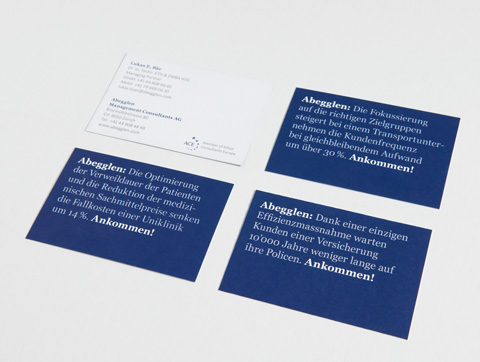
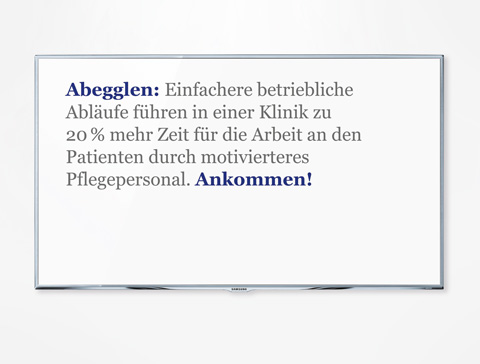
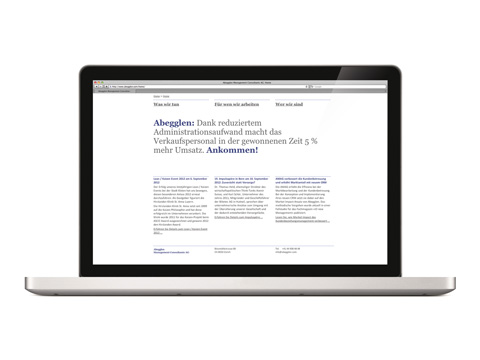
]]>Nose has supported Abegglen in sharpening its profile and translating its vision into its own image, as detailed in a press release. The central element is Abegglen's promise: "Arrive!"
Together with the name "Abegglen", this promise becomes the defining content and stylistic element of the new corporate identity. The other elements of Abegglen's restrained corporate design are limited to the color change between blue, gray and white and the system fonts Georgia and Calibri.