
This year's "Prix Carte de Noël" jury of the Zurich agency evoq recorded an unprecedented decline in Christmas mail compared to previous years. Both the quantity and the creative quality of the Christmas cards and greetings cards received seem to have halved. The question of whether post-corona home office effects or the ubiquitous presence of artificial intelligence are heralding the final farewell to the physical is open to debate.
At a time when offices are deserted, it is impossible not to notice that no one can ask ChatGPT for original holiday sayings and send corresponding Christmas cards without being physically present. The current festive communication seems to be characterized by a certain banality and a lack of creative ideas. Some refer to this positively as the "new sobriety", but whether this represents a forward-looking trend remains questionable.
Despite the noted lack of creativity, there are a few rays of hope, including UMB's initiative, which combines the voluntary work of students for the benefit of biodiversity with Christmas in an original way. Outdoor Publishing impresses with a coherent illustration of a skier in an hourglass, but such original creations with depth of content are a rarity.
Companies that are still expressing themselves at Christmas are increasingly relying on handwritten cards, such as those sent by Tellco or the cantonal banks. The focus here is not so much on the design or the idea, but rather on the authenticity of what is written by heart and hand. Cards from charitable institutions or aid organizations are often used.
Aid organizations, on the other hand, sometimes seem to fall short of expectations with their own festive mail. Either the greeting is clearly interspersed with an appeal for donations, or the card motifs appear uninspired. The jury sees this as a missed opportunity.
The question of whether the Christmas season and its means of communication are still up to date is becoming increasingly urgent in view of the constant corporate communication on various channels throughout the year. The evoq jury encourages companies to consciously join forces, especially at the end of the year, in order to stand out positively with a company and brand-specific idea in the ubiquitous irrelevance.
The meagre yield of creative Christmas cards prompted the evoq jury to decide not to award a "Prix Carte de Noël" for 2023 and to eat the Epiphany cake itself without further ado.
]]> At this year's "Prix Carte de Noël" from Evoq Communications, Swiss Post's media and advertising market team particularly impressed the jury. A lipstick on a purple cardboard envelope beckons to be opened. Inside, a made-up Santa Claus - or is it a Mrs. Claus? - awaits the curious. Under the title "Beautiful Christmas," the post office is calling on people to spruce up for the holidays, dress up nicer and decorate their homes as lavishly as possible. These are activities that are perhaps being neglected during this time of low contact. Swiss Post also wishes the recipients lots of fun, a sense of humor and positive energy for the start of the new year - which I'm sure everyone can use.
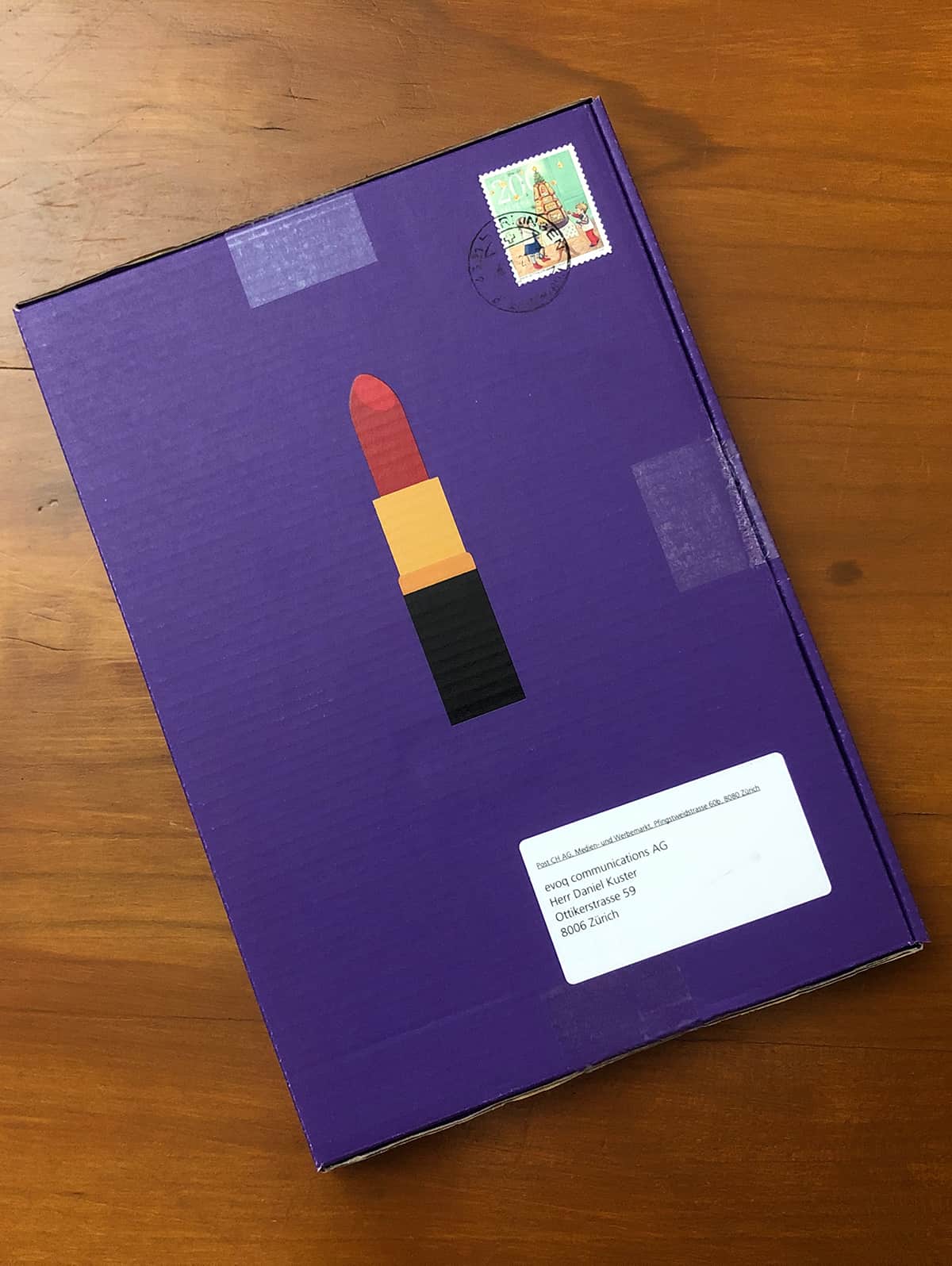
The festive shipment is complemented with a gingerbread cake, which is also decorated with the made-up Christmas creature in icing. The shipment is so well received by Evoq that only a few crumbs are left for judging and documenting the winner. The lipstick envelope with matching content is thus worth the jury the "Prix Carte de Noël", which is crowned as every year with an Epiphany cake.
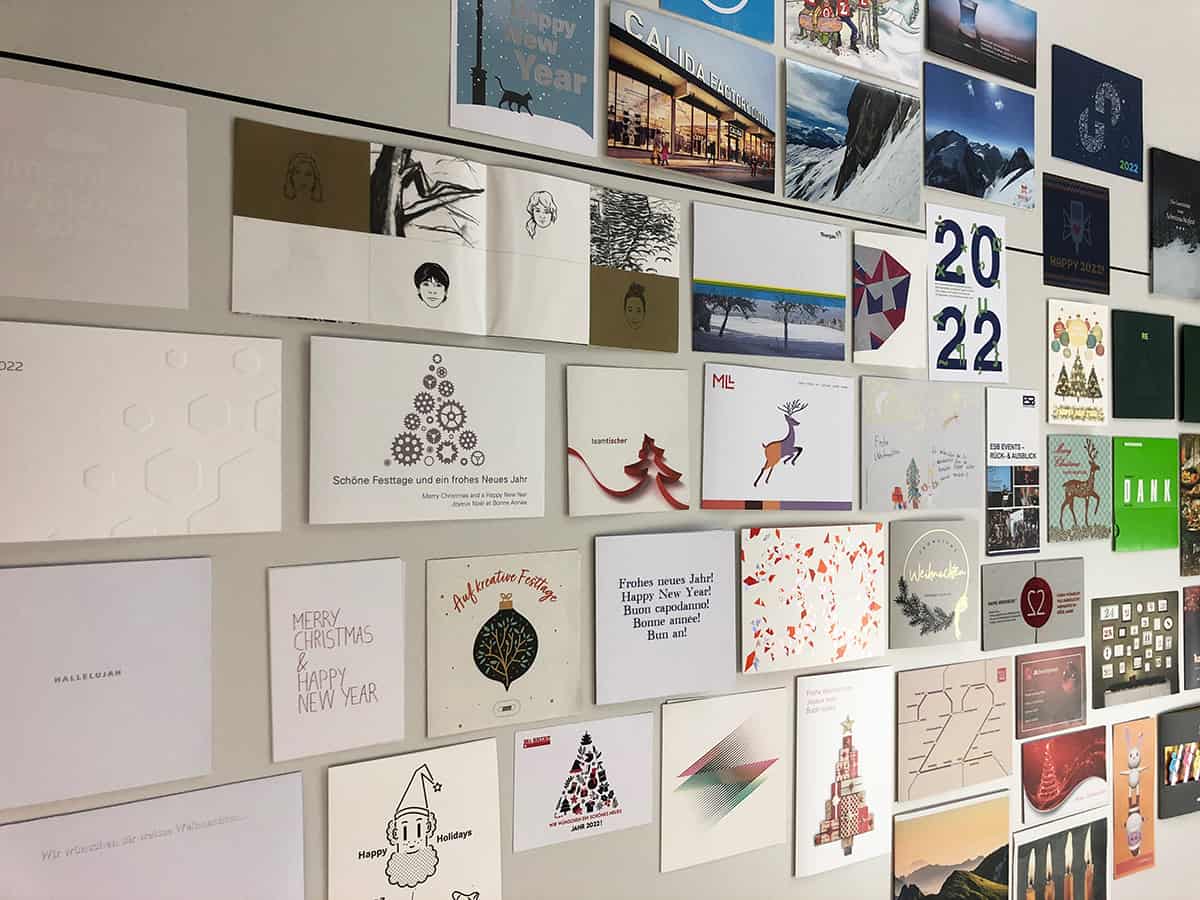
On the second corona marked feast days continues in contrast to 2020 hardly anyone is still dealing with the pandemic. The topic seems to be through, at least on Christmas cards. Instead, the focus is more on traditional holiday subjects, such as fir trees, snowy landscapes or Christmas bearded women.
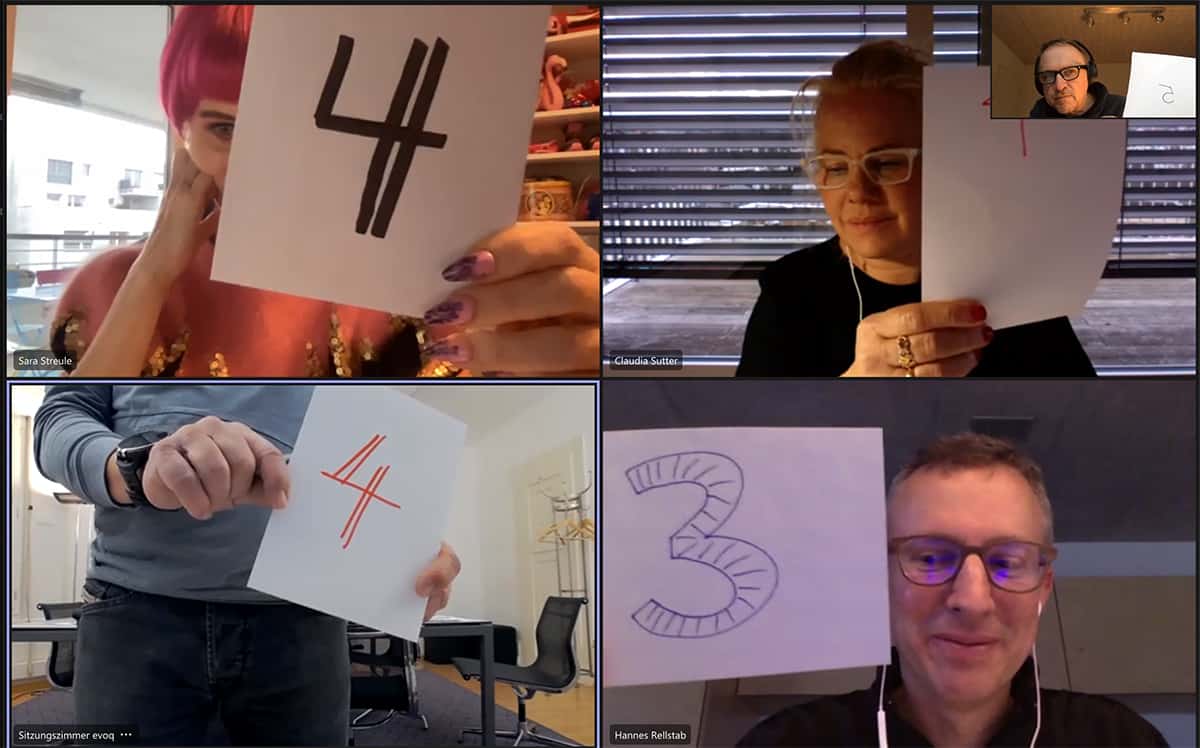
The agency also noticed that the color white and the square format were used particularly frequently in this year's mailings. The judging of the festive verses that have arrived at Evoq in recent weeks has once again taken place under special circumstances: The jury met in a team conference, the cards were individually held in front of the camera and evaluated with grades.

In fact, around 15 percent of the cards Evoq received dealt with the pandemic. Particularly noteworthy - and at the same time the winner of this year's competition - is the Christmas mailing from the Zurich agency Ergo. With the Corona memory "Augenblicke," Ergo Communication playfully and entertainingly addressed the omnipresent mask faces and the communication made more difficult as a result, Evoq writes in a statement.
"We primarily perceive the eyes of the other person; facial expressions and emotions have to be guessed," Ergo writes. The game can be used to practice whether eyes and a statement match. The colors of the playing cards help. The Evoq jury was also convinced by the fact that the game idea works particularly well in the family and in small circles - a corona-conditioned setup that will probably continue for a while beyond the festive season, unfortunately. The agency wins the prize, which comes with an Epiphany cake, for the second time after 2018.

Corona compliant judging
The judging of the Christmas mailings that arrived at Evoq in recent weeks took place under special circumstances. The jury of several members met via video conference and a representative at the agency, who had to hold the approximately 100 cards individually in front of the camera.

Less Christmas mail - because of Corona?
Compared to previous issues, Evoq has received less Christmas mail this year. According to the agency, it is unclear whether this has to do with the increasing tendency to digitize festive greetings or, once again, a Corona-related change in behavior.

Every year, Christmas and New Year's cards arrive at Evoq around the holidays. And every year, the number of purely physical mailings decreases. So it's no surprise that this year Freitag won the Prix Carte de Noël with an online and offline concept.
According to a press release, Freitag convinced the Evoq jury with the idea of a Thank you card for the New Year in the form of a truck sheet. This was sent as a picture by e-mail and is real from 2020 with the first names of all recipients of the Christmas mailing on the way.
The e-mail sent to the greeters reads: "In January, when all the other Christmas cards have been read, eaten or drunk up and have to make their way from the desk to the trash, our thanks to you with your first name will be harnessed to a Planzer truck to then make its rounds through Europe for a few years - until we are finally allowed to cut bags out of it. In this way, Freitag manages to be present for several years and does not produce any waste. The rolling map was designed by David Keller from Freitag Lab.

Simple, sustainable cards dominate
According to Evoq, this year's analysis of the holiday greetings, which took place during the judging process, brings to light some interesting aspects. In contrast to previous years, no typical Christmas color such as green or red stood out in the mailings. Many cards are very simple, with a large proportion of white or black. As with the winning idea, sustainability is a top priority. For example, one dispatch is equipped with a small aluminum box that can be used several times for snacks. Another card mentions that for every recipient at MyClimate, the CO2 equivalent of a Christmas tree - including ornaments - is donated. And another dispatch calls on people to leave the fir tree in the forest.
In terms of motifs, the obligatory stars, Christmas trees and Christmas balls were once again in high demand. Two-thirds of the retailers relied on illustrations, a quarter on photography and a few used purely typographic solutions.
What was even more noticeable this year was the communicative opportunity that companies missed with their festive greetings during the holiday season. Increasing digitization, on the other hand, would offer the opportunity to make a positive impression on addressees with real experiences, creative verses and sustainable messages.
Responsible at Evoq: Sara Streule, Adrian Schaffner.
All Swiss companies and organizations can register their festive and New Year cards until December 24, 2014. A personal thank you at the end of the year makes every customer happy. Festive and New Year's cards are an individual sign of appreciation and - provided they stand out and leave a lasting impression - strengthen customer loyalty. Swiss Post and evoq communications AG are therefore rewarding particularly creative festive cards with the "Nicolas - Prix Carte de Noël". All Swiss companies and organizations that produced an individual, printed card on the theme of Christmas or the turn of the year in 2014 and sent it by post are eligible to apply free of charge.
The Nicolas Award is presented in three categories: "The Most Beautiful," "The Most Extraordinary," and "The Most Appropriate. The five-member jury looks at factors such as the surprise effect, the combination of colors, typography and text, and the material chosen. The winners can look forward to a Nicolas Award - a trophy in the form of a snow globe to shake.
The idea of the "Nicolas - Prix Carte de Noël" is obviously well received: For last year's prize, 131 companies and organizations from all sectors - from small painting businesses to large corporations - applied. The closing date for this year's competition is December 24, 2014 (postmark). The winners will be notified in January 2015. Further information, conditions of participation and entry form: Post.ch/nicolas
The "Prix Carte de Noël" was launched seven years ago by the Evoq agency and relaunched in 2013 together with Swiss Post (Werbwoche.ch reported). Last year, SBB secured the prize and won an Epiphany cake (Werbewoche.ch reported).
]]>