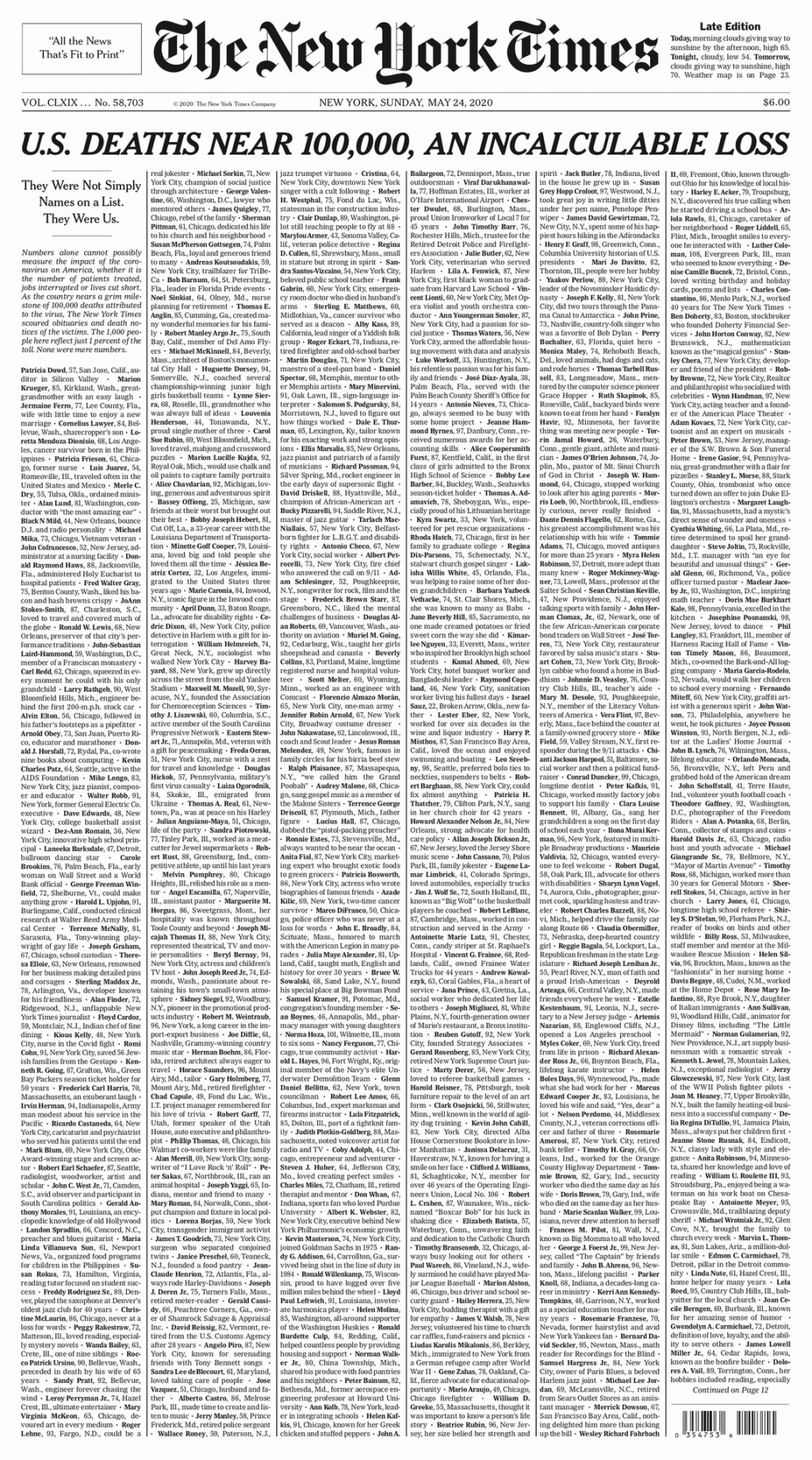
A strong piece: The New York Times listed on Sunday 1000 names who fell victim to the coronavirus. A counterpart to the "statisticification" of the pandemic. We see curves, read the daily statistics, new infections, new deaths, total deaths, expected deaths, deaths compared to other countries. The fact that behind the sober figures there are real people with real stories, relatives and fates is usually forgotten.
In the USA, the number of people who died as a result of the Corona pandemic will soon "crack" the 100,000 mark. A new statistical value, a "magic" limit. The New York Times gives the numbers a face. In which she describes 1000 names in a few words. Among them impressive lines: "Romi Cohn, 91, New York City, saved 56 Jewish families from the Gestapo." Or less spectacular, but no less touching descriptions: "Kyra Swartz, 33, New York, volunteered for pet rescue organizations". And, and, and. The title: "US Deaths near 100,000, an incalculable loss".
The list continued on a double-page spread inside the newspaper. In the Online version all names can be retrieved interactively.
"Social distancing" will probably be chosen as the word of the year 2020. Nobody knew the expression, now it is omnipresent. And in two words it sums up what is expected of the world's population if it wants to bring the corona virus under control. The social environment must temporarily take a back seat and contact with fellow human beings must be reduced to a minimum.
What it means can also be depicted with very many words. Last week, the layout artist of the New York Times used editorial text to visualize what social distancing means: the herd animal human being in its own little bubble.
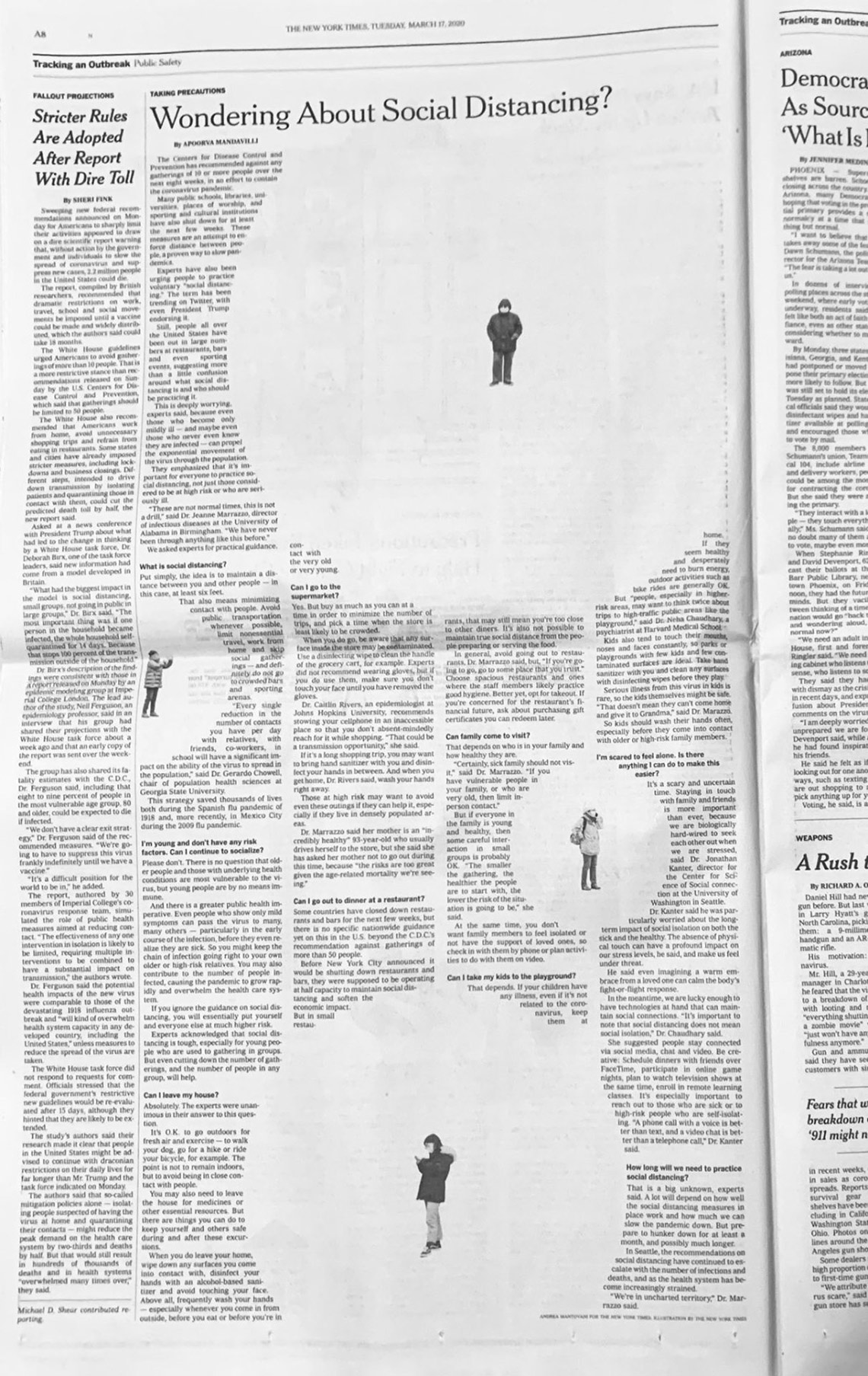
Image: The New York Times. Photo: Theinspiration.com
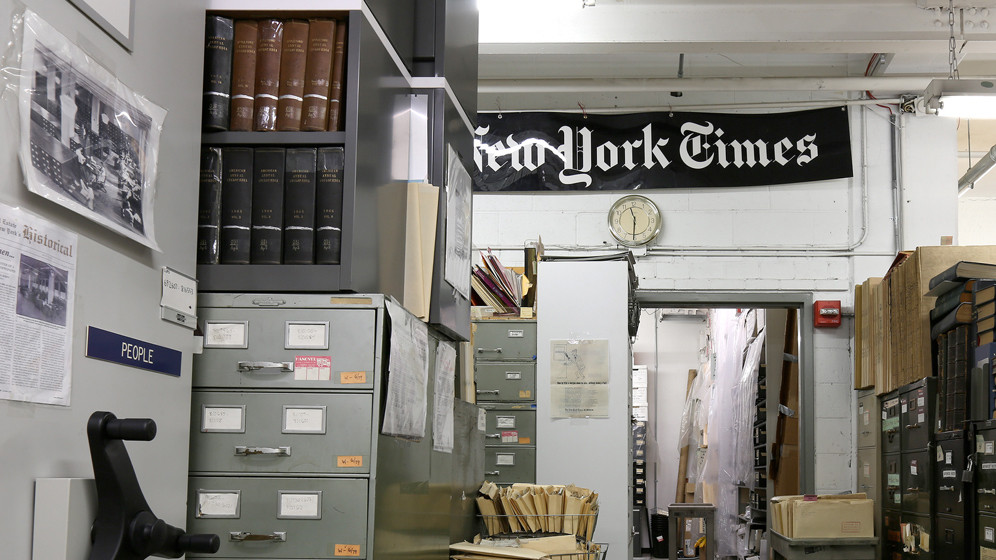
The New York Times has been archiving millions of editorial photos for over 100 years. It's hard to believe that these photos were previously stored in hundreds of filing cabinets underground in Times Square - a place aptly named "the morgue".
These images have immense historical value - most of them cannot be found anywhere else in the world. To preserve and optimize the use of these archives - while making them more accessible - The New York Times has partnered with Google Cloud.
The New York Times uses the advantages of machine learning with the help of the Google Cloud Vision API to determine the content of each image and classify it in this way. This means that manual descriptions are no longer necessary. The team also uses Google Cloud Storage, Cloud Pub/Sub and Cloud SQL to improve disaster recovery while transforming their photo archive into a unique content management system.

"On balance, we have gained an astonishing 308,000 digital news subscriptions," explained publishing director Mark Thompson on Wednesday. This means that the customer base grew more in the first quarter than ever before in the history of the newspaper.
Under pressure from falling print revenues, the traditional newspaper has recently invested heavily in its online offerings. In addition, the newspaper, which has often been particularly harshly criticized by US President Donald Trump, had planned to expand the online readership it gained during the 2016 election campaign with unbiased reporting. The media group's shares shot up by almost eleven percent over the course of the year.
According to Wednesday's figures, the New York Times increased the number of its digital-only subscriptions by 16 percent to 2.2 million in the first three months of 2017. This boom, among other things, catapulted the media group back into the black: A net profit of 13.2 million dollars in the reporting period contrasts with a loss of 8.3 million dollars a year earlier. Turnover rose by 5.1 percent to just under 399 million dollars.
Online advertising revenues, which now account for around 38 percent of the New York Times' total advertising business, rose by just under 19 percent. The downturn in print advertising continued with a drop of just under 18 percent. (SDA)

Trump justified this on Twitter by saying that the terms of the meeting had been changed at short notice. That was "not nice". Trump's team had proposed the meeting itself. The New York Times explained that the terms of the meeting had not changed. After talks on Monday, the two sides had agreed to hold a short part behind closed doors and a much longer part in public with reporters. The cancellation was announced via Twitter. There may be a later meeting, Trump added in another tweet. In the meantime, the paper will continue to report incorrectly about him.
Late on Tuesday afternoon, it was announced that Trump would be meeting with the New York Times after all. This was confirmed by his team and the newspaper in statements. (SDA)

The AFP news agency learned this from a union employee on Wednesday. The paper, formerly known as the International Herald Tribune, will in future be produced in New York and Hong Kong. In Paris, 69 jobs will be cut. The newspaper was founded in 1887 by the then owner of the New York Herald as a European edition. In the 1960s, the New York Times and the Washington Post took over the paper. The latter sold its shares in 2003 and the paper has been called the "International New York Times" since 2013. The newspaper was the only English-language newspaper of international stature to be produced in Paris. It last had a circulation of around 170,000, although this was in decline. (SDA)
One hundred jobs in the editorial department will be cut, according to a letter from the management to employees. According to publisher Arthur Sulzberger Junior and managing director Mark Thompson, this corresponds to around 7.5 percent of the 1,330 employees in the journalistic department. In addition, the paper wants to part with some employees in other business areas.
The New York Times has been struggling to remain profitable for years and is focusing on expanding its online business. To this end, new jobs have been created in the internet and video sectors in recent years. According to the paper, the total number of employees has risen to an all-time high as a result.
The job cuts were "necessary to keep our costs under control and allow us to continue investing in the digital future of The New York Times," it said. The newspaper's management is aware that the cuts are "painful" - "both for those affected and for their colleagues", according to the letter from publisher Arthur Sulzberger and managing director Mark Thompson to employees. As part of the job cuts, those affected should be offered voluntary redundancy. However, if there are not enough people interested, redundancies are also possible.
In addition, "NYT Opinion", a new app for opinion pieces, is to be discontinued due to insufficient user interest. The cost-cutting measures are intended to ensure the newspaper's long-term profitability.
]]>
Customers who log into the coffee house's network are allowed to read three articles a day from five different sections, including news, technology and business. The New York Times recently further restricted the free availability of its texts online and had around 668,000 paying subscribers on the Internet in December. Starbucks is the "ideal environment" for such an offer, the US newspaper said, explaining the agreement reached with the chain. (SDA)
For the first time in its history, revenues from newspaper sales and online subscriptions were higher than those from the advertising business last year, the New York Times Company media group announced on Thursday, according to SDA. The group earned 954 million dollars from print and online readers and 898 million dollars from advertising sales. According to SDA, the group posted a profit of 133 million dollars last year. This contrasts with a loss of 39.7 million dollars in 2011.
"The numbers show the willingness of our users here and around the world to pay for the highest quality journalism that The New York Times and other company titles represent," said CEO Mark Thompson, according to SDA. In the fourth quarter, the number of online subscribers to The Times and International Herald Tribune rose by 13 percent to 640,000, while the Boston Globe increased by eight percent to 28,000.
For unrestricted use of the portal Nytimes.com online readers have had to pay since March 2011 (Werbewoche.ch reported).
]]>
The attackers then gained access to the computers of 53 Times employees. The attack in the fall coincided with work on a report about the wealth of Chinese Prime Minister Wen Jiabao's family. The article, published on October 25, stated that Wen's relatives had amassed a fortune of several billion dollars. The attackers only seem to have been interested in information related to the report, the newspaper wrote. The New York Times computer system has since been made secure again.
The Chinese government rejected the accusations. The NYT's accusations were "groundless", said Foreign Ministry spokesman Hong Lei in Beijing on Thursday. "To say without hard evidence that China participates in such hacking attacks is completely irresponsible." The Ministry of Defense expressed a similar view, emphasizing: "The military has never supported any hacker attacks."
There are repeated reports of hacker attacks on companies and authorities in the USA. China always rejects the accusations. (SDA)
The race for victory seems evenly poised for a long time, but in the end a lucky punch decides the outcome. See for yourself:
]]>Until a successor is found, publisher Arthur Sulzberger Jr. will take over the management himself, according to a statement to the SEC. Robinson will act as a consultant to the New York Times for one year and will receive 4.5 million dollars in return.
No details were given about the reasons for Robinson's departure. She herself wrote in an email to employees on Thursday that she was leaving with mixed feelings, as the New York Times reported in an article on its website. At the same time, referring to informed persons, it was stated there somewhat vaguely that Sulzberger had asked Robinson to a meeting last week and addressed the topic of a "different kind of leadership". No further details were given.
The 61-year-old Robinson was at "Time" for almost three decades. Under her leadership, the newspaper has consistently expanded its Internet offering in recent years and introduced an online payment gate a few months ago, which brought in even more paying customers than skeptics had expected. At the same time, the crisis in the American newspaper industry and the turbulence on the financial markets also left their mark. Among other things, the Group had to make severe cuts at the Boston Globe newspaper and at times had to borrow 250 million dollars from Mexican billionaire Carlos Slim. (SDA)
(Image: Nytimes.com)