 With around 9 million inhabitants in Switzerland, there are about 6 million cars on our roads. That's a lot when you consider that children and very old people don't drive. Not at all good for the CO2-emissions and not at all good for the space in our cities.
Car sharing helps. Because fewer cars means less CO2 and more space. The Mobility cooperative invented car sharing over 25 years ago and can now boast impressive figures: 1 Mobility car replaces 18 private cars on average. Even more in larger cities. So it is clear that STUIQ and Mobility have built the image campaign together on this strong purpose.
The TV commercial and all digital motion assets were produced by STUIQ's in-house film production team. "I really like the style. An original chamber play in a narrow parking lot with only a few camera shots. Together with the grainy vintage look, we want to consciously step out of the familiar high-gloss world and stand out for more car sharing," explains Anna Kindlimann, CD and partner at Stuiq.
Responsible at Mobility Guido Zehnder (Head of Marketing Communications), Amela Becirbasic (Digital Marketing & Campaigns), Muzi Ünal (Social Media & Community); Photography Johannes Diboky Agency & film production: Stuiq; Styling Emilie Fischer; Media Mediatonic - Laura Brun (Senior Media Consultant), Max Stürzekarn (Senior Digital Media Manager), Ali Guihia (Senior Search & Social Consultant), Manuel Leston (Ad Ops & Tracking Specialist), Marco Rose (Co-Owner & Head of Strategy)
]]>
A giant money gun on Sechseläutenplatz in Zurich that spits out banknotes en masse? And soap bubbles that not only come out of a model's nose, but also from a huge, real billboard? What sounds unbelievable is part of the campaign for Mobility Young, the special offer for anyone up to the age of 28, which is now entering the next round - and thus breaking completely new ground. The two central subjects of the campaign were developed as faux-OOH assets. The two characteristic objects can be seen in two commercials, which were implemented in real life and in XXL - or at least that's how they appear.
The digital campaign is consistently aimed at a young target group who can benefit from attractive conditions at Mobility. The FOOH approach is designed to raise awareness on social media and digital channels. The needs of Generation Z are addressed directly with unusual measures and a fresh tone of voice.
"Especially with the younger generation, you always have to think in new ways, stand out and be different. And that's exactly the beauty of our profession. Implementing intelligent and target-oriented strategies with unusual ideas - that's the path we always like to take together with Stuiq," says Guido Zehnder, Head of Marketing Communication at Mobility.
Responsible at Mobility: Guido Zehnder (Head of Marketing Communication), Amela Becirbasic (Digital Marketing & Campaigns), Muzaffer Ünal (Social Media & Community Manager). Campaigning & development/implementation FOOH: Stuiq. Media: Mediatonic, Max Stürzekarn (Senior Digital Media Manager).
]]> Mobility is launching a new app as the centerpiece of its digital carsharing service. For the company, this is a milestone that is to be announced in a big way. For this, Stuiq has developed a new campaign for various digital channels and social media, in which six different subjects and animations are to show the highlight features of the new app: Bluetooth door opener, intuitive maps, app performance, price calculator, digital damage report and gas station finder.
The app is to become the central tool for searching for Mobility cars and locations, for complete booking management, and for using the cars. Because as of now, all 3000 cars can be opened with the app. Mobility has commissioned the specialist Adnovum for the development and implementation.
Responsible at Mobility: Guido Zehnder (Head of Marketing Communications), Amela Becirbasic (Digital Marketing & Campaigns). Responsible at Mediatonic: Max Stürzekarn (Senior Digital Media Manager), Ali Guihia (Senior Search & Social Consultant), Mickael Tyc (Search & Social Consultant), Manuel Leston (Ad Ops & Tracking Specialist).
]]> Why not share a ride service when you have the same destination. With an app, passengers simply book their ride. Just like you know it from other ridehailing services. They are picked up where they are or at defined stopping points, but they are always nearby. An intelligent algorithm processes all ride requests and bundles similar routes to ensure optimum capacity utilization.
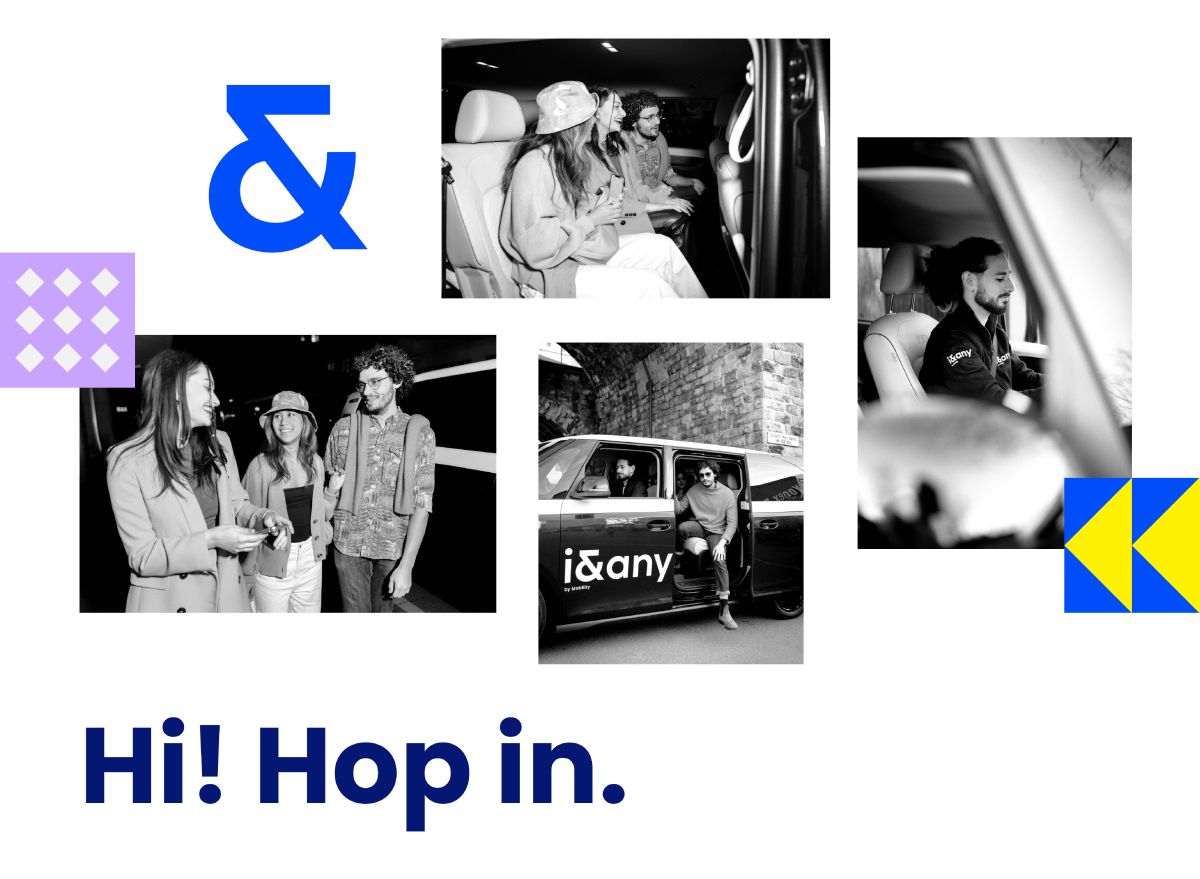
As Mobility's lead agency, Stuiq developed the branding together with Mobility's innovation team: Naming, Purpose and Corporate Design. As a corporate start-up of the Mobility cooperative, i&any is a new ridepooling service. For the time being, it will only be available at night in Zurich - but if it is successful, other use cases will follow soon. Campaigning starts at the same time as the brand launch. Awareness of the new brand is being created primarily via online and social channels, while at the same time sensitizing people to the new, sensible and social way of getting around.
]]>

m&k: Sascha Heiniger, Polestar is an exciting brand. In your own words: What does your brand stand for, what values are associated with it?
Sascha Heiniger: We are the new Swedish brand for all-electric, dynamic vehicles. We have a strong focus on design and sustainability. As a brand, we want to make a decisive contribution to improving our society by accelerating the shift towards electric and climate-neutral mobility.
What sets Polestar apart from its market competitors?
We are still a young automotive brand with a clear focus on all-electric vehicles. And as such, we don't carry a backpack from the past with us. For example, we don't have to promote combustion engine and electric models at the same time. This makes us much more consistent and also more credible in our appearance. I am convinced that this consistency is also very important to many of our customers.
You want to build the world's first climate-neutral car by 2030. What challenges are associated with this?
A climate-neutral car is the only logical next step. Simply installing an electric motor is not enough. The real goal must be to eliminate CO2 emissions from production through operation to recycling of the vehicle. That is of course a huge challenge, because for us it also means that we have to trace back all the supply chains and produce them in a climate-neutral way. Because by climate-neutral, we don't mean CO2 compensation, but a set-up in which no CO2 emissions are produced. For example, factories and transports operated with green energy or the use of recyclable materials.
What is your vision of "mobility in the future"?
Future mobility will be much more sustainable and flexible. We will choose the appropriate means of transportation for each situation even more consciously - be it the car, other individual means of transportation or public transport. I think that personal ownership of vehicles will still play a role, but in urban centers new car-sharing-based offerings will grow.
With which campaigns will Polestar make a name for itself in Switzerland in the future?
We have just opened our first Polestar Space in Zurich and the first Polestar Destination in Geneva. In addition to our exclusively online sales model, a physical presence is very important to us: people should also be able to drive our vehicles and experience them live. With our "2 on Tour" concept, we are also offering test drives of the Polestar 2 at various locations throughout Switzerland. In our communication, we want to continue to challenge entrenched opinions and structures. And finally, in the second half of the year, we look forward to introducing the Polestar 3, our performance SUV.
This interview first appeared in the m&k print edition 5/2022.
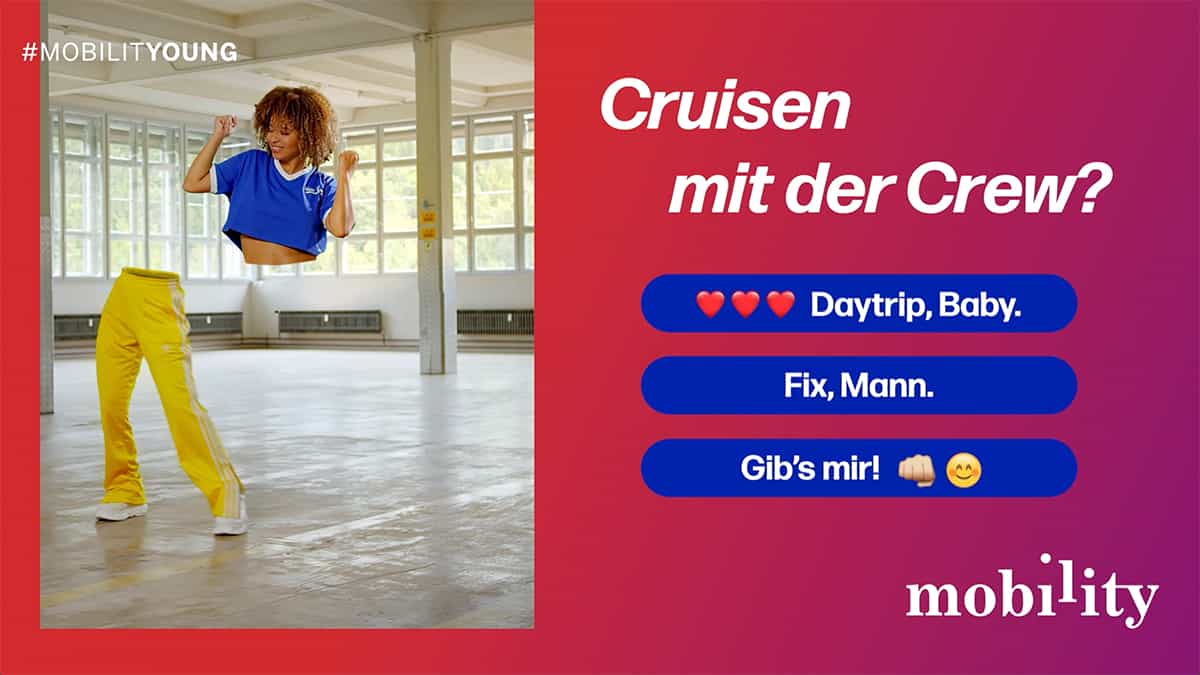 Sharing mobility and traveling sustainably is Mobility's big idea. Today, it is more appropriate than ever and fits perfectly with the needs of the younger generation. In line with the target group, the campaign takes place exclusively on digital channels throughout Switzerland and was developed with Content where the young target group has a direct say.
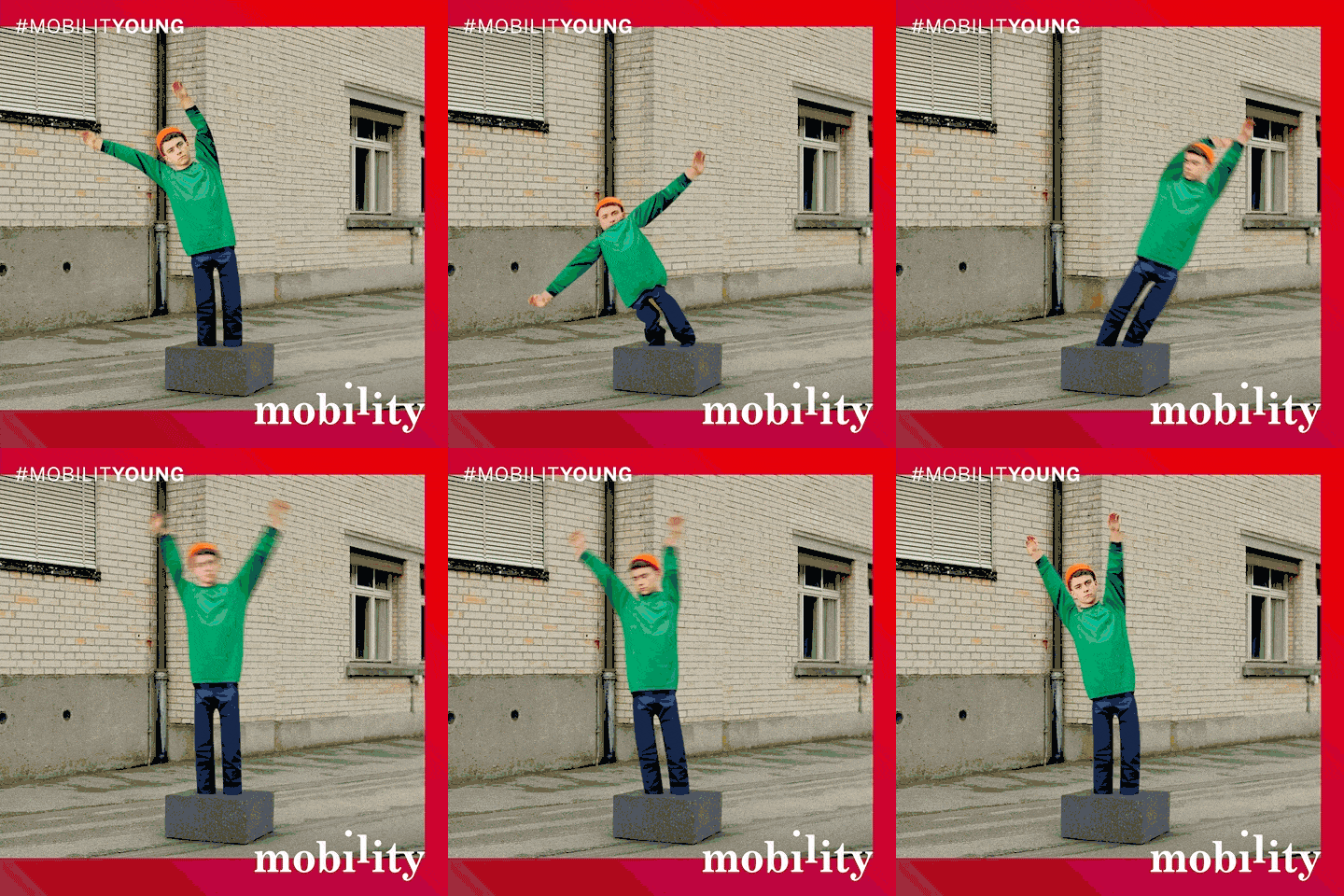
Visually, too, the many assets take a typically digital and young approach. In the social media gif style, eye-catchers were created that will surely make you look twice. "Young, unusual, digital and a little crazy. That's how the campaign should be and that's how it is. We developed five super cool subjects with Stuiq in a very uncomplicated and targeted way," says Guido Zehnder, Head of Marketing Communication at Mobility.
Responsible at Mobility: Lars Kläger (Head of Marketing & Offer Network), Guido Zehnder (Head of Marketing Communication), Seraina Greb (Digital Marketing & Campaigns), Philipp Augenstein (Brand & Media Strategy), Angela Nyffeler (Content), Muzaffer Ünal (Social Media), Silvia Muff (Product Manager - Go to Market), Monica Botero (Digital Analytics), Özlem Can (Data Analytics), Isabell Bludau (Product Manager - Pricing). Responsible at Stuiq: Sandro Walder (Strategy), Anna Kindlimann, Stefan Moeschlin (Creative Direction), Benjamin Kocher (Digital Direction), Torsten Mass (Text), Grit Wolany (Art Direction), Michi Döös, Sam Ribeiro do Couto (Film, Motion Design), Martin Niklaus, Lea Baldinger (Design), Giuseppe Audino, Max Heinen, Flurina Decasper (Content), Yannick Portmann (Consulting).
]]>
Within a tight timeframe, all the building blocks had to be assembled and ready at the right time. The sophisticated redesign with new components, a new content hub with rich story formats around mobility, sustainability and the environment and the numerous project participants were successfully brought to a common denominator through an agile setup. The new website went live at the same time as the launch of the new campaign.
The human being in the center
The well thought-out and widely distributed campaign was launched on all channels (Werbewoche.ch reported). The new website easily keeps up with the fresh and young image concept and conveys Mobility's "Let go!" message. The project focuses not on the product, but on people, and aims to shake things up, raise awareness, and encourage a rethink. As with the design, people are also central to the user-friendliness. The menu navigation has been fundamentally revised so that individual areas, such as private customers, business customers and the magazine, are clearly distinguished from one another.
New content hub with magazine
With its new content hub and magazine, Mobility offers content on the topics of mobility, sustainability, the future, and lifestyle. The articles can be commented on, rated and shared. Articles can be sorted by content and popularity through categorization, keywording and reading metrics.

Responsible at Mobility: Lars Kläger (CCO), Silvia Muff (Subproject Manager), Alex Vavourakis (Subproject Manager), Melanie Wanner (Product Manager mobility.ch). Responsible at Cab: Alexander Legath (overall management), Tizian Schmidlin (technical management), Thomas Bieli (frontend development), Samuel Giss (backend development). Screen Design: Joël Walser. Concept and wireframing: BlueGlass. Concept Content Hub: LinkGroup.
In addition to a flexible offering and the cooperative's basic sustainable orientation, the modern, urban lifestyle is the third pillar of the brand positioning and a decisive factor for the unique Mobility feeling. The campaign conveys the emotional and independent "way of life" and also aims to appeal to a younger audience. No longer owning, but sharing and uncomplicated use. More reduction of complexity, more freedom. That's the style! With its campaign, STUIQ focuses on this megatrend, which is especially strong among Millennials and Generation Z. Against the backdrop of an affluent society in which there is too much of everything - especially cars.
"For me the message is Let go the essence of everything," says Lars Kläger, Chief Commercial Officer at Mobility, "in two words you probably can't express more clearly what Mobility stands for. Combined with the core arguments for the added value of sharing, we want to appeal to hearts as well as brains. That's how we think we can show the timeless relevance of our services to all target groups."
The orchestrated campaign builds on the design and image concept newly developed by Stuiq. With unusual perspectives and staging, it strikes the tone of a self-confident, enlightened and modern society. The car is no longer the focus of communication, but the person, the benefit and his feeling about it.

Responsible at Mobility: Lars Kläger (CCO), Philipp Augenstein (Project Manager Marketing), Astrid Schmidli (Product Manager), Daniel Rohrer (Product Manager). Responsible at Stuiq: Sandro Walder (overall direction), Anna Kindlimann, Stefan Moeschlin (creative direction), Lea Baldinger (art direction), Flurina Decasper (text), Corsin Kessler, Adrian Gasser (graphics), Michael Döös (motion design), Samuel Ribeiro do Couto (film), Benjamin Kocher (digital direction), Daniela Schaefle (consulting). Photo/Film: Lukas Maeder.

Mobility has been active with its ride-sharing app since 2018. It can be used to share journeys with car-sharing cars as well as with private cars. This will come to an end for the time being as of May 13, 2020, as CEO Roland Lötscher explains: "Not enough users came together, and therefore not enough ridesharing opportunities." Although 12,000 people were registered at last - half of them non-Mobility customers - "it would have taken more requests and offers to keep them interested and active. This was not the case."
Swiss do not want to share privacy
The company sees the main reason for the generally sluggish demand in the fact that Swiss people are reluctant to share their private sphere and that public transport is very well developed. "Probably the time is not yet ripe for ride-sharing on a large scale in this country," concludes Lötscher. "But that doesn't mean it never will be. We'll watch the market closely and get back into it when we see a meaningful opportunity." One such opportunity is closed user groups, such as commuter solutions for businesses.
No connection with Corona
Even though the situation surrounding Covid-19 has brought the ride-sharing business to a virtual standstill, Mobility's decision to discontinue the service matured before the lockdown. Ergo, Covid-19 had no influence on the shutdown of Mobility-Carpool. (pd)

Shortly after the relaunch of Stuiq, the Zurich agency wins the creative pitch and takes over brand management, image and product communication of the mobility provider Mobility.
"Stuiq prevailed with its concept against three very strong competitors. The decisive factor was the combination of a convincing strategic derivation, razor-sharp message and outstanding creative approach," says Lars Kläger, Chief Commercial Officer at Mobility.
The campaign launch and repositioning will start in fall 2020.

The motif with Andreas Meyer is used online and offline. Mobility business car sharing is the modern way to be mobile for business. Many people use the train for longer journeys, for example, where they can also still work - and ensure connecting mobility with the Mobility vehicle rental service. Thanks to ten vehicle categories, the right car and now even electric scooters are always available. And not only in the typical Mobility red, but also in gray, white or black.
Responsible at Mobility: Patrick Marti (Managing Director), Adamo Bonorva (Head of Marketing and Sales/CMO), Alexander Dischö (Head of Marketing), Astrid Schmidli (Product Management), Melanie Wanner (Online Marketing Manager). Responsible at Ruf Lanz: Danielle Lanz, Markus Ruf (Creative Direction), Isabelle Hauser, Dave Schellenberg (Art Direction), Markus Ruf (Text), Anita Roth (Consulting). Photography: Jonathan Heyer.

Swiss drivers are lonely: On average, there are only 1.5 people in a vehicle, and only 1.1 people in commuter traffic. Or to put it another way: If 100 people drive back and forth between Lucerne and Zurich every day, they do so in 90 vehicles. This makes neither ecological nor economic sense.
That's why Mobility is launching the "Mobility Carpool" ride-sharing app. This not only allows rides to be shared with car-sharing cars, but also with private cars. "There are only winners. The driver reduces his costs, the passenger gets from A to B quickly and cheaply, and the environment is spared because there is less traffic on the roads," says CEO Patrick Marti in a statement.
Drivers receive 80 percent of the revenue
Mobility as a company should also benefit in the process. "The more diverse our services, the more enthusiastic our customers. We therefore want to offer the most diverse types of shared mobility and promote combined mobility with public transport." Mobility-Carpool, for example, complements classic car sharing as well as the free-floating Mobility-Scooter and Catch a Car models. Providers receive between 2.40 francs and 14.40 francs per passenger. Regular routes from A to B - for example, commuter trips - are just as suitable for Mobility-Carpool as one-off trips. The compensation is fixed and differentiates according to distance. A passenger pays between 3 francs (up to 10 kilometers) and 18 francs (from 150 kilometers). Of this, 80 percent goes to the driver, while Mobility uses the rest to cover the costs of the service.
Mobility wants to create trust with several measures. First, users can rate themselves publicly. Second, it is mandatory to upload a profile picture in the app. Third, passengers can view their driver's car number at any time. And fourth, the phone number of the other person is only visible when a ride is definitely booked. (pd/hae)