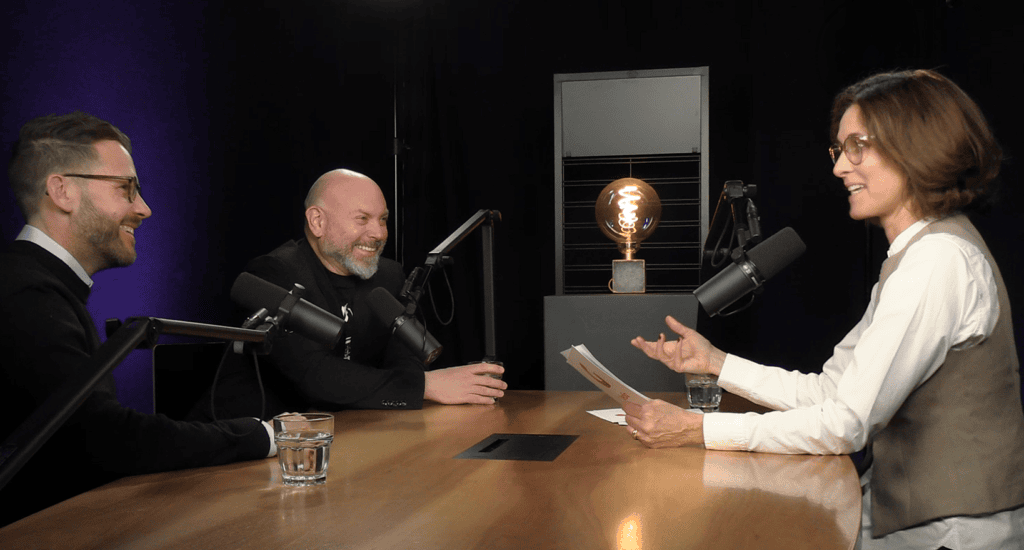
 thjnk Zurich is celebrating its tenth anniversary—and currently ranks first in the Swiss creative rankings. On the M&K podcast «The Creative Sides of Business,» Andrea Bison and Alexander Jaggy speak with Editor-in-Chief Anna Kohler about the company’s early years, positive friction as part of the corporate culture, and the use of AI in the creative industry. Both agree: In the end, it’s the best idea that counts, and that comes from people, not machines. Also discussed: the new Brand Design unit, with which thjnk is responding to the increasing visual fragmentation of brands.
]]>
 Anyone involved in business should be knowledgeable about finance. So far, so uncontroversial—and that’s exactly how Marcus Schögel begins the conversation. But then he shifts gears: The president of the Society for Marketing and professor at the University of St. Gallen (HSG) believes that the demand—which has grown increasingly vocal in recent years—that marketing must speak the language of finance in order to justify its place within a company is misguided. Finance, he argues, is merely a functional perspective on a company—no more and no less than the sales perspective. The fact that this single perspective has become dominant has to do with shareholder value and the quarterly performance reports of publicly traded corporations. According to Schögel, marketing has allowed itself to be co-opted in a way that does not help when it comes to understanding how to manage a company over the long term.
A feature that doesn't come into play until later
Schögel’s objection is fundamental. He argues that stock-market-driven companies are driven by quarterly results, and some even admit that they think too short-term to be able to plan for the long term. So why, of all things, should marketing be subordinate to a discipline that only comes into play once the deal has already been made? He emphasizes that this has nothing to do with an inflated ego, but rather with logic: it simply makes no sense for a single function to dominate all the others.
It all starts with the customer
For Schögel, every business starts with the customer. He cites Peter Drucker, his academic mentor, and the Balanced Scorecard pioneers Kaplan and Norton, who all agree on this point: First, you need a customer who pays—«before I can count the peas.» He attributes the fact that things often work the other way around in everyday practice less to conspiracy than to systems. He expressly refuses to promote a theory circulating on social media that IT providers had early on declared marketing to be an internal corporate enemy. What is verifiable, however, is that with the introduction of ERP systems, the key-figure logic of accounting was pushed to the forefront—researchers like Thomas Davenport have described this. But if a company’s information base is built on accounting metrics, its business model will also be primarily mapped through financial figures. This is evident even in executive training: first strategy, then finance, then HR—and eventually, at the very end, marketing.
No more excuses—but no worship of numbers either
Does that mean marketing tends to resist measurement? Schögel admits that the claim that impact simply cannot be expressed in numbers has a long tradition in marketing—but today it mostly serves as an excuse. There’s now a database for almost everything. The real question is whether a data point is valid and reliable and actually reflects what one believes. As an example, he cites the Net Promoter Score: Hardly anyone measures satisfaction anymore; everyone measures the NPS—even though the metric often doesn’t reflect what it’s supposed to. Data is also retrospective; it says nothing about the future, but it helps us understand the present. Analytical skills, a sense of what’s expensive and what’s affordable, calculating media investments—none of this is rocket science, but rather a necessity. The more interesting question, however, isn’t «Marketing, what do you contribute from a financial perspective?» but rather: What does Finance do, what does Marketing do, where do the two intersect, and how can we develop this further together?
The CMO belongs at the table
This puts Schögel on the management team. A CEO, as he understands the role, facilitates a committee that develops strategy collectively—and in doing so, deliberately gives marketing not just a little, but significant room to operate. He knows plenty of CEOs like that. On the other hand, however, there are those—mostly finance-minded executives—for whom marketing is primarily a cost center that produces «colorful cardboard.» He would recommend that they familiarize themselves with the marketing mindset—because it helps them understand that there are long-term benefits that can be monetized, just not today, but only in the future. And what is the common language that CFOs and CMOs should find? It’s, says Schögel, «business model speak»: a shared understanding of value proposition, structures, operating model, revenue streams, and technologies—always from the perspective of what competitive advantage a company is striving for and how it converts that into money. Because making money remains the goal. «I don’t make a penny,» he quips dryly, «from counting peas.»
From Title to Attitude
The fact that the CMO title is becoming less common—Schögel points to a decline from 71 to 66 percent—worries him less than one might expect. The debate is over twenty years old; BMW, too, had once abolished the CMO role and distributed its responsibilities among the other board members. It wasn’t the role itself that was eliminated, but simply a redistribution of the work. Today, the roles have different names: a Chief Commercial Officer is responsible for revenue and growth, with «growth» being nothing more than the modern form of growth marketing. A company in Basel, on the other hand, has a Chief Customer Officer in charge of marketing and IT—without being any less market-oriented as a result. Whether someone is called a CMO or a Growth Officer, or whether a CEO simply calls himself “customer-centric,” ultimately doesn’t matter to him, as long as the focus is on the customer and that’s what sets the company apart from the competition.
A Matter of Courage
Anna Kohler counters this: The discussion about impact and relevance has been going on for years, and yet surprisingly little has changed. Many brands nodded in agreement but then played it safe. Schögel sees two aspects to this—a question of courage and one of paying close attention. Instead of simply copying best practices, he says, we need to ask what truly contributes to differentiation. He cites the well-known 60/40 rule from Les Binet’s impact research: About 60 percent of resources should go toward long-term brand building, and 40 percent toward short-term sales promotion. In reality, however, up to 86 percent flows into short-term digital measures—and the least goes toward the brand. Those who focus solely on return on advertising are aiming for very short-term effects, and no one knows for sure whether these even work in today’s media landscape. He has a clear answer to the ongoing debate over reach versus relevance: Relevance has always been key; reach is merely a nice-to-have. When a «big corporation from Mountain View» advertises that it owns the most important search engine and the best video platform, it reminds him of the 1990s, when ARD and ZDF boasted about being at the forefront and *Bild* cited a million readers who couldn’t possibly be wrong. The same arguments—now grounded in financial considerations. The question driven by Generative Engine Optimization, on the other hand, leads back to the core: Who are we, and what do we want to be relevant for?
What AI Sees in a Very Matter-of-Fact Way
Both agree that the AI transformation is forcing the industry to engage in precisely this kind of self-reflection. Schögel doubts that someone who puts together a clever campaign in five minutes using Claude or ChatGPT is providing the kind of quality the market truly needs. Above all, however, he rejects the convenient narrative that AI is the realm of values and humanity. An AI doesn’t look at a map of values. It evaluates, in a cold, hard-nosed way, which data points best represent a company—and those aren’t the self-declared values, but rather what’s found on high-reputation platforms like Wikipedia, in press releases, on company websites, and in customer reviews. His colleague Dennis Herrhausen put it aptly: These days, AI sits right next to you as a member of the buying center. The AI evaluates what can realistically be found, while humans overlay their preferences on top of that. This dual evaluation gives rise to an old yet new obligation: to reflect on whether one actually has a functional performance advantage that makes the product unique—and how to convey to the person presented with five options the specific feature that tips the scales in favor of the purchase.
Imagination as a Required Course
«You need both,» says Schögel, «and it’s absolutely essential.» Today’s CMO must have a firm grasp of financial data and metrics and be able to explain where the levers of influence lie. There’s no getting around it. At the same time, he refers to a text from the 1970s: «The Marketing Imagination» by Harvard professor Theodore Levitt. You need the fundamentals, but you also need imagination—a sense of how to fit into a culture. He explains the current boom in cultural marketing by noting that many companies have become estranged from their target groups and subcultures. An Amazon web store with the company’s own logo is not enough; a creatively designed flagship store, on the other hand, sets a company apart. At the HSG, they therefore consciously venture into the creative realm: Students collaborate with agencies and learn what creative processes look like—a demand that agency professionals had been making for years and which he believes is correct. For him, the best students are those with openness, drive, and a unique flair—a mix of creative thinking, curiosity, and a strategic perspective that recognizes that it’s not the fancy Instagram post that drives business. This is developed through project work, group settings, and a three-day boot camp, from which students emerge exhausted but full of joy and a “twinkle” in their eyes. Those who neglect this quickly end up in a place where “operational chaos replaces intellectual calm.”.
Schögel's Advice to a CEO
What advice would he give to a CEO who wants to lead his company into the future in a credible and creative way? “If I had a formula,” Schögel jokes, “I wouldn’t say it out loud”—and responds with examples. Hilti realized as early as the 1960s that its products were too expensive for retail sales, and so it learned to think from the customer’s perspective: direct sales, on-site product development, open innovation, and collaboration. No member of the executive board has ever been able to bypass sales, so discussions there revolve more around customer problems than anything else. He also mentions Jura, the manufacturer that consistently stays close to its customers with its fully automatic coffee machines and doesn’t let itself be distracted by capsules, as well as Stöckli—companies that are all heading in the same direction.
Kohler notes that it is no coincidence these are not publicly traded corporations—and asks whether customer focus isn’t a luxury reserved for those who don’t have to justify themselves on a quarterly basis. Schögel disagrees: It is not a luxury, but a strategic decision. Cooperatively run institutions, an insurance company, a cantonal bank like the one in Graubünden—they are all geared toward avoiding short-term pressure to perform. One of these CEOs once told him that he had the luxury of being able to focus on the customer—and in the same breath corrected himself: It’s not a luxury, but the core of the strategy. And so the conversation ends where it began. After all, it is precisely companies that are not driven by shareholder value that can often demonstrate most convincingly just how financially successful they are. The CEO in question is a virtuoso when it comes to financial metrics—he knows exactly why and how he uses them.
Perhaps that is the real answer to the wrong question. It’s not that marketing needs to learn the language of finance. Both sides need to speak the same language—that of the customer.
The podcast episode on Spotify
You can find Marcus Schögel's article here.
]]>
The question sounds simple, but it hits a nerve in the industry: how much chance does modern advertising still need? For Dennis Lück, creative head at Brinkertlück Creatives and former Advertiser of the Year, the answer was quickly clear: preferably none at all. «We're actually doing a fine little abolition of chance,» is how he describes the central idea behind the campaign, which he developed together with Swiss Post Advertising. What began as a briefing quickly became a statement to the advertising market.
Cross moments instead of scattered fire
At the heart of the concept are so-called cross moments - attention-grabbing everyday situations in which target groups are particularly receptive to messages. Raphael Bratschi, responsible for the cross-media advertising ecosystem at Swiss Post Advertising, cites specific examples: the waiting time at the post office counter, the moment at the letterbox, a push notification on the move. «These are moments where the focus is on and you are not distracted by other topics,» says Bratschi. The targeted combination of such touchpoints - based on first-party data - is increasingly replacing the principle of hope in media planning.
Creativity needs architecture
For Lück, this architecture opens up a larger creative playground, but one that is also more complex. Instead of a single spot or three subjects, it is important to think about a central idea across networked moments. «As a creative, real-life examples always provide me with the food I need to work and play well,» he says. This is how the striking imagery of the campaign came about: a thousand yellow umbrellas as a symbol of the fact that Swiss Post Advertising makes brands visible where it counts - not by chance, but by planning.
Lück is remarkably open about the topic of courage in advertising. The constant talk about courage makes him «sometimes really tired». His credo: «The best ideas no longer require courage. If everyone at the table knows it's a great idea, then you just go for it.» Bratschi confirms this from the customer's point of view. From the outset, the collaboration was based on conviction, not risk calculation. «We are convinced that it will work - and then you just get on with it,» says Bratschi.
Data quality beats data quantity
A key success factor is the quality of the data. Bratschi emphasizes that the origin of the data is more important than its quantity. Swiss Post Advertising works with its own first-party data, which is validated and collected transparently. «First-party data makes advertising more precise and more effective,» he summarizes. He compares the digital status quo with Las Vegas: «Flashing, wildly mixed up and full of sensory overload.» Cross Moments are the alternative - targeted attention instead of constant fire.
Neither of them hide the fact that advertising can never be completely controlled. Data protection sets natural limits, and a little bit of chance is part of life. But Lück counters: «What we can do is plan as well as possible so that we go in with a good feeling and know that we have orchestrated everything.» The «Kein Zufall» campaign is designed as a platform, a drawer full of ideas for future waves and viral campaigns. Presenter Anna Kohler sums up the conversation aptly: today, impact is less about luck - and more about orchestration.
The video podcast episode on Spotify
The podcast was produced in the Castalavista audio and video podcast studio by Soltmannowski Kommunikation on behalf of m&k.
]]>m&k Martin, Philipp - you represent two disciplines. Where does marketing end and creativity begin?
Martin Walthert I don't think you can separate the two any more. Creativity is part of marketing - it's the crucial part. Without it, everything remains mediocre. It's what helps us to create relevance where others only communicate. Philipp Skrabal I agree. Creativity is not a profession, it's an attitude - a way of solving problems. In all situations in life. If you want to be effective in communication, you need a creative mindset. It's not a nice-to-have.
Martin, you lead a team that does almost everything itself - from strategy to production. Philipp, you come to Farner from the outside, as a consultant, sparring partner and source of ideas. What works better - total proximity or creative distance?
Philipp Skrabal The trick is to manage both. It used to be clearly separated: client briefs, agency delivers, then the big magic show follows. Today, we work much more closely together. Closeness and distance are not a contradiction, but rather a rhythm. We need moments of intimacy with the brand - and then the view from the outside to see it anew.
Martin Walthert Proximity is important because it helps to really understand the tone and attitude of a brand. But it can be dangerous if you get too comfortable. We have to constantly take countermeasures - force ourselves to question everything. We must not become complacent. Creativity needs space - without the pressure of expectations, without the stress of having to deliver.
Philipp Skrabal That's the balancing act. We sometimes wish we could look as deeply into the customer as you can. But with you, Martin, it's certainly not easy to keep your distance. I think you have to vary both constantly - closeness to understand, distance to renew.
You both use AI tools. Does that make you more efficient - or more creative?
Philipp Skrabal More efficient in any case. But also more creative. AI is a tool that shows us new paths. It can recognize patterns that we would overlook. And it enables new types of ideas - new mechanics, interactions, involvement. The trick is to use AI and data wisely. This requires creative people. Let's see if I still see it that way in five years' time. (laughs)
Martin Walthert AI can speed up processes. But it does not make the outstanding idea obsolete. I believe creativity will become even more important because it helps us to filter out what is relevant from all the possibilities generated. The machine can produce, but it can't feel.
What if AI suddenly writes better stories than we do?
Martin Walthert Stories only work when they touch us. Even if an AI writes emotionally, in the end it is the human as the addressee who has to judge how credible it is. AI communication has a tendency to be arbitrary, interchangeable, infinitely available and therefore ultimately worthless - and this is precisely when the human and authentic becomes extraordinary again.
Philipp Skrabal Yes, that's the point. Data can be anything - but only someone who understands and interprets it can turn it into something new. A good data scientist is essentially a storyteller. Data tells stories, you just have to be able to read them. And you do that really well at Digitec Galaxus.
Martin Walthert Thank you. We have a lot of data - but the question is: What story does it tell? Where do we put the focus? How do we emotionalize it? This creative focus is the real work.
Philipp, you often say that good advertising needs attitude. Martin, Digitec Galaxus is known for its humor and self-irony. How much attitude can marketing take before it tips over?
Philipp Skrabal A brand that wants to be successful in the long term must stand for something. The attitude is not to jump on the next trend, but to remain consistent. This also means not doing things if they don't fit the brand. Attitude is what remains when the purpose hype is over.
Martin Walthert Yes, attitude is consistency. If you constantly adjust it because the wind is blowing differently, you lose credibility. We have decided to live humor as part of our DNA - because it suits us. Of course, not everyone finds everything equally funny, that's okay. I also answer letters personally if someone complains. Humor is our way of creating emotion without taking ourselves too seriously.
Humor has become rare in advertising. Why?
Philipp Skrabal Because it doesn't suit every brand and can be perceived as artificial. With you, Martin, one can sense that the humor is authentic. It makes you approachable. You don't feel like salespeople, you're on my side as a customer. That's an art. When brands use humor to cover up boredom, it doesn't work. Humor is also an attitude.
Martin Walthert And courage. You have to put up with the fact that not everyone likes everything. But when it's right, humor is the best remedy for distance.
Philipp, you said: "If a new idea takes your breath away for a moment, then you're in the right place." How do you create this space for courage?
Philipp Skrabal By creating security. You need an environment in which everyone dares to say something - no matter how unfeasible an idea may seem. If you reach consensus too quickly, you're still in your comfort zone. The most exciting ideas are the ones where you briefly think: that might be too much or "that won't work". But that's where it gets interesting.
Martin Walthert I see it the same way. We do a lot of brainstorming sessions where everyone can make suggestions. Without evaluation. Allow everything first, then shape it later. If you judge too early, you kill creativity. Mistakes are part of the process.
And do you have enough time for such spaces? Everyday life is very busy.
Philipp Skrabal That is indeed challenging. Everything is measured in hours, but a good idea cannot be measured in hours. That's why it's so important that employees develop ownership - that they say: this is my customer, my project. Then you think along, then you think ahead, then responsibility arises instead of billing. How does that work for you Martin?
Martin Walthert We also have pressure to deliver, of course. But we try to create freedom. Efficiency is important, but if it comes at the expense of effectiveness, you lose what makes brands strong. Better a good idea too late than a mediocre one on time.
You have both been honored - Martin as CMO of the Year, Philipp as Advertiser of the Year. What does that do to you?
Martin Walthert It's nice, but it remains teamwork. I see it as appreciation for everyone who makes ideas possible for us. Of course, I'm also happy about it personally - and yes, my LinkedIn has really picked up since then. (laughs)
Philipp Skrabal It is a nice recognition. It shows that you are making a difference. I got to meet a lot of great people and have exciting conversations. And yes, it has also given us additional visibility as an agency - Farner was sometimes still perceived as a pure PR agency, which is no longer the case. Today, we are a creative network. And awards like this help to make that visible.
Martin, what would you ask Philipp - and vice versa?
Martin Walthert: Philipp, what does it take for you to achieve true excellence?
Philipp Skrabal A CD colleague from Tel Aviv once told me what he told his people: "Bring me what you think you can't do. That's the essence for me. When people dare to push boundaries, something happens. If you stay in your comfort zone, everything stays pretty - but never becomes outstanding.
Philipp Skrabal: Martin, how much freedom do you really give your teams?
Martin Walthert (laughs) Good question. We also have productivity pressure, of course. But I believe that trust is the strongest briefing. When people feel secure, the best ideas emerge. Efficiency must never become an end in itself - otherwise you lose the magic.
When you look at the year 2025 - what remains?
Philipp Skrabal That marketing and creativity are inseparable. We tell stories - and if they are good, they connect people and brands. That remains.
Martin Walthert For me, the realization remains: creativity is not a luxury. It is the hardest currency we have. Because it creates impact where numbers alone have no effect. Good ideas are rare - and therefore priceless.
]]>
With OneID, the Swiss publishers and their marketers Audienzz, CH Media, Goldbach and Ringier Advertising are jointly creating a basic technology in the form of a digital advertising ID. This enables advertisers to address Swiss users easily and without overlaps across publishers via programmatic buying platforms, which was previously only possible on the major international platforms.
]]>
Podcasts offer a welcome break from screens and are easily accessible, says Mackay in conversation with Anna Kohler. However, there is still a need for more education on how to use podcasts. She also emphasizes the importance of storytelling in corporate podcasts. She encourages companies to tell stories that have not yet been told in order to attract new listeners.
Moreover, a podcast is not just another social media platform or marketing tool, but a unique medium with its own purpose and target group, Mackay makes clear. In the next interview, she explains to Anna Kohler the role of podcasts in the overall marketing strategy and the importance of KPIs. Mackay also gives advice for start-ups that want to include podcasts in their marketing mix - regardless of budget.
The podcast was published in Tablecast Audio and video podcast studio produced by Soltmannowski Kommunikation on behalf of m&k Werbewoche.ch.
Cheyenne Mackay is co-managing director of Podcastschmiede. The podcast agency helps companies to develop a content strategy that tells stories and conveys their desired message.
]]>