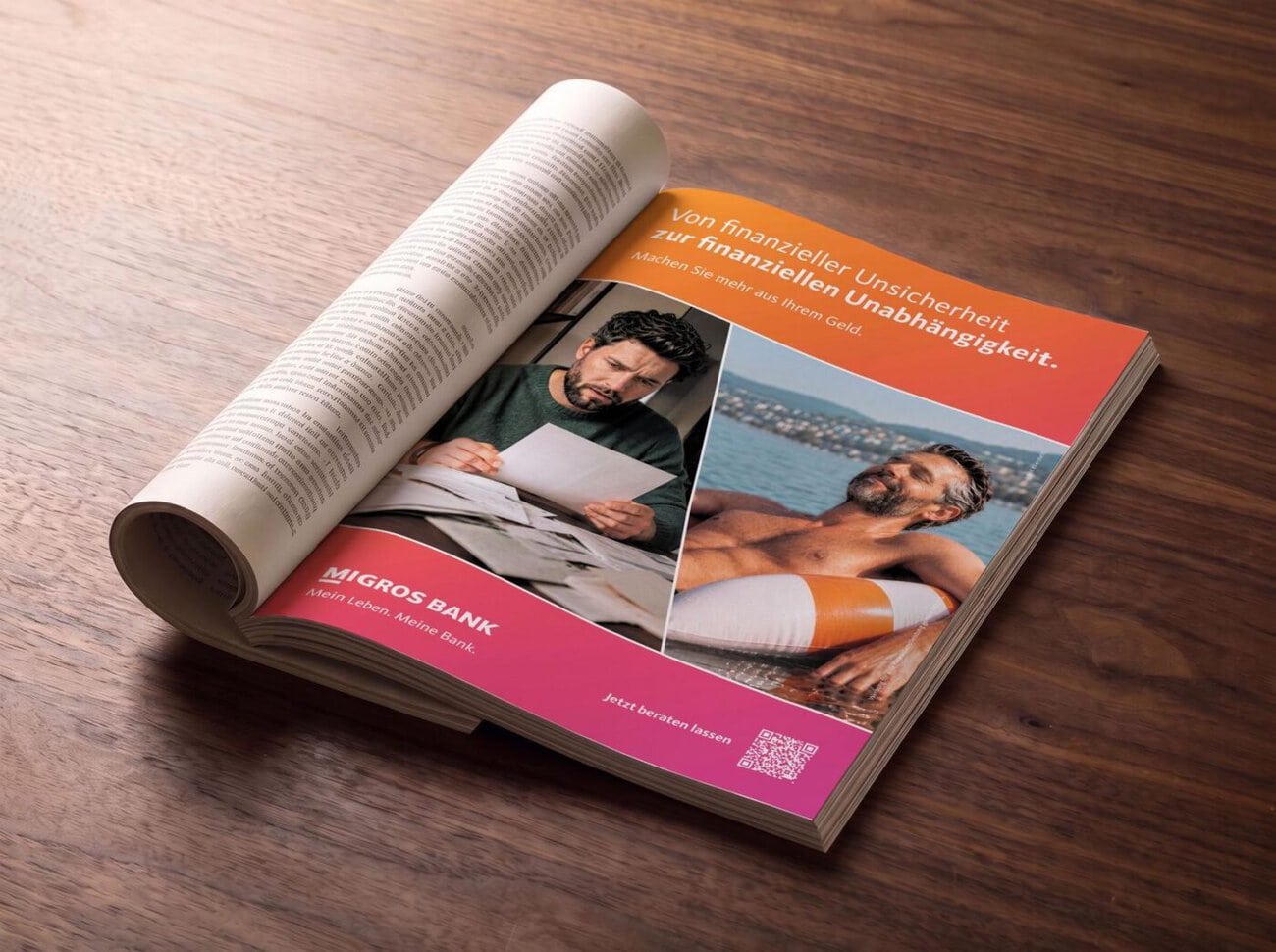
With «My Life. My Bank,» Migros Bank is strengthening its brand identity and putting the real-life experiences of its customers front and center. The Migros Bank campaign, developed by Wirz, shows how the bank accompanies and supports people through different stages and situations in life—from everyday financial decisions to defining turning points.
Life changes, and so do our financial needs. Sometimes it’s about making a dream come true, sometimes about planning for retirement, and sometimes about making the most of our assets. It is precisely these changes in life and finances that form the starting point for Migros Bank’s new campaign.
Instead of focusing on individual products and services, the campaign centers on the situations in which they become relevant to people. In this way, Migros Bank positions itself as a financial partner for the pivotal moments in its customers’ lives—from everyday banking to retirement planning and wealth management.
From one moment in life to the next
The creative thread is a simple «from… to…» logic. For example, the campaign tells stories «from financial uncertainty to financial independence,» «from worrying whether there’s enough to the certainty that there is,» or «from annoying paperwork to easily opening an account online.».
The visual imagery also follows this principle. The images depict the same protagonists in two different situations, thereby illustrating their development. The focus is not only on major life milestones, but also—and intentionally—on everyday moments and financial issues that people face throughout their lives.
«People don’t think in terms of accounts, cards, and loans; instead, they focus on what matters today and what concerns them tomorrow. That’s why we don’t want to explain banking—we want to show how we can help them make better financial decisions,» says Stefanie Fritze, Head of Branding & Marketing Communication at Migros Bank.
A New, AI-Generated Visual World
A new, AI-generated visual style was developed for the campaign. Both the protagonists and the moments in their lives depicted were created using artificial intelligence.
A particular challenge was making the same people recognizable across different situations and, in some cases, different stages of life. At the same time, the visual style was intended to remain natural and approachable. According to those responsible, natural light, everyday situations, and recurring characteristics of the protagonists ensure consistency. Migros Bank’s brand colors are integrated as subtle elements into the respective situations.
«Our campaign thrives on change. People grow older, situations change, and life goes on. The possibilities offered by AI have helped us tell this story across different moments in life while creating a consistent visual style,» says Jannic Mascello, Creative Director at Wirz.
Images created or edited using AI will be labeled accordingly within the campaign.
The campaign will be rolled out across numerous online and offline channels. These include, among others, TV commercials and online video, movie theaters, out-of-home advertising, digital out-of-home advertising, social media, display advertising, print, and Migros Bank’s own channels. In video formats, the various moments in life are connected through smooth transitions.
Responsible at Migros Bank: Stefanie Fritze (Head of Branding & Marketing Communication), Fabian Riedmann (Marketing Communications Specialist), Mark Gantenbein (Online Communications Specialist), Simone Ita (Marketing Communications Specialist), Laura Steinmann (Marketing Communications Specialist), Jasmine Rizzo (Marketing Communications Specialist). Responsible for concept and production: Wirz. Responsible for Media: Webrepublic. Responsible for music: Tonton. Responsible for audio: DubDub Studios.
]]>

On Wednesday, the country's best recruiters were chosen in Zurich and the current recruiting trends were presented to 150 guests. With outstanding results in all categories, Helsana achieved this year's overall victory, ahead of Migros Bank and Graubündner Kantonalbank.

The Best Recruiters study examined the recruiting quality of the 450 largest employers in Switzerland and Liechtenstein for the twelfth time. The results were presented for the first time by Christian Pasteka, who took over the management of the study at the beginning of 2025. His predecessor Agnes Koller will continue to act in an advisory capacity. The new Best Recruiters portal was also presented at the event, which enables companies to carry out individualized analyses and comparisons based on the study results.

The study results at a glance
While TikTok and video content continue to gain ground and usability is also making significant progress, the study results also point to clear deficits in the areas of cyber security, leadership communication and speed of response to applications.
The study is particularly critical of the IT security of career websites. Only six percent of the sites examined are adequately protected against data breaches. In addition, loading times on mobile devices are often too long, which makes them difficult to use.
Shortcomings are also evident in the application process. A test with a fictitious inquiry from a 17-year-old about opportunities to get to know and try out the company revealed that 59% of companies did not respond. Compared to the previous year, this is a decrease of 32 percentage points.
The topic of leadership continues to play a subordinate role in recruiting. Only two percent of job advertisements contain information on leadership style, and the topic is rarely addressed on employers' career websites. Diversity within management is hardly ever made visible.
The use of video content is highlighted positively: 72% of career websites now use videos, three quarters of which provide concrete insights into everyday working life. Social media is also increasingly being used for recruiting purposes - LinkedIn remains the leader, while TikTok is gaining in importance with an increase to 17 percent. At the same time, there is still room for improvement in community management on platforms such as LinkedIn and Instagram, as interaction rates are below ten percent.


Fabrice Zumbrunnen will step down as President of the General Management of the Federation of Migros Cooperatives (MGB) at the end of April 2023. This was announced by the company. According to the statement, after ten years in the General Management and five years as its president, Zumbrunnen would like to pursue new career paths. Under his leadership, the company has strategically focused, successfully expanded its leadership position in online retailing and built up new areas such as health, the statement said.
Sustainability in focus
In an environment with increasing competition, Fabrice Zumbrunnen had initiated important developments and successfully implemented them at an operational level. Under his leadership, MGB has, in particular, streamlined its corporate portfolio, expanded Migros Group's leading position in Swiss online retailing, and driven forward the development and expansion of the health sector. Innovations such as plant-based products of the own brand V-Love or CoffeeB have also been implemented during his tenure. He has also led Migros Bank, Medbase and Hotelplan as Chairman of the Board of Directors. Sustainability for future generations has also always been an important concern for Zumbrunnen, such as the implementation of ambitious climate targets to achieve net zero by 2050 in accordance with the Paris Climate Agreement or initiatives to reduce and make plastic 100 percent recyclable.
A successor is now being sought.
]]>

This much is certain: financial brands are facing profound changes that may even threaten their very existence. Never before has the range of products on the market been larger and more diverse, never before has it been easier for customers to switch. While the older generation still chooses its bank(s) largely on a functional basis, Gen Y and Z are focusing on brands that match their needs, values, and lifestyle.
An interesting phenomenon can be observed here: Today, it is increasingly the younger generation that is introducing parents to new offers and financial service providers, such as Apple Pay, Twint and Revolut. This is a striking paradigm shift, as in the past it was always the parents who showed their children the way to financial services.
AI-based data analysis as a new approach
To understand these fundamental changes, the consulting firm BrandTrust researched the DACH financial markets using a novel approach: Instead of opinion polls, the brand strategy experts rely on Artificial Intelligence and Big Data.
More than 300,000 texts accessible on the Internet, such as corporate websites, forums, blogs or social media, serve as source material. A total of around 33 million data points were processed. Of the 240 financial institutions studied in DACH, 110 are from German-speaking Switzerland. French- or Italian-speaking Swiss banks were not examined, as the algorithms used are based on a German-language model.
This method of analysis provides in-depth insights into the needs and values of customers without survey bias. This is because the algorithms exclusively observe effective behavior on the web, such as comments or likes.
Holistic comparison of all financial service providers
Just as customers do not divide banks into categories - as the industry itself likes to do - this study also compared all types of banks holistically and together: These include digital banks, cooperative banks, big banks, private banks, neobrokers, robo-advisors and payment service providers such as the up-and-coming Klarna.
The reason for this is simple: customers have different decision-making criteria than banks, which like to divide themselves into categories. In the future, the classic "category" boundaries are likely to become increasingly blurred anyway.

Migros Bank scores with millennials
As the ranking of the most relevant Swiss financial brands shows, none of the traditional banks make it into the top 5 among the two younger generations. HSBC (6th place), UBS (8th) and Raiffeisen (12th) as well as Credit Suisse (14th) follow far behind specialized financial service providers such as Google Pay, Klarna or Revolut.
Only one bank stands out: Migros Bank takes first place among Millennials. How is that possible? According to Benedikt Streb, co-author of the study, Migros Bank has successfully rejuvenated its brand in recent years and has a clear focus among Millennials on its Facebook and Instagram social media platforms. "Migros Bank manages to make difficult financial topics such as buying a house, self-employment or starting a fmail business accessible on its social media channels. It speaks the language of Millennials, hits their topics and shows itself to be true to life and human," says brand expert Streb. Central brand values such as cooperativeness, credibility and authenticity would be translated into the community in a modern way, whereby Migros Bank would enable identification and belonging - two highly relevant longings of this generation.

Gen Z in a consumption frenzy
For Generation Z, the themes and style of Migros Bank would be far too serious, says Benedikt Streb. This generation is looking for fun and simplicity; the focus is on the infinite world of consumption. So it's nothing but consistent that payment service providers such as Google Pay, Mastercard and Klarna are high on the list. They all know how to present themselves as part of consumer life. The focus is always on the benefits for customers, not on the technology or the products.
And what about Twint? You look in vain for the Swiss high-flyer among payment apps in the ranking of the younger generation; only among Generation X does it make it onto the ranking list. "While Twint offers a very valuable service, it runs into the typical banking trap when it comes to communication: the payment service provider wants to appeal to everyone from young to old, which means the profile ends up being too vague," Streb explains. In addition, although Twint uses a young visual language, it engages in rather classic product marketing.
For the younger generations, however, the focus should be on the customer (hero) and not on the bank or the function. The older generations (Generation X and baby boomers), for their part, prefer niche banks with a regional focus; there are greater differences between the various cantonal banks, which were consolidated in the study and thus landed in 12th place (Gen X) and 10th place (baby boomers).
What does "relevant" actually mean?
The relevance of a financial brand describes its ability to attract potential customers and convert them into true fans. To turn first-time contacts or interested parties into fans, a financial brand must precisely understand the needs and desires of its target group and address them skillfully and consistently. On the other hand, there is no wow factor at all in attempting to serve all target groups - establishing closeness to life with the younger generations, who are critical to success, is thus practically impossible.
Conclusion
The study shows that each generation has its own attraction drivers. New financial service providers with a clearly defined range of services and a contemporary, consumer goods-oriented image are ahead of the game among the younger generations. One example of success is Migros Bank, which has the courage to focus clearly on millennials and knows how to demonstrate its relevance to everyday life.
* Benedikt Streb is a partner at BrandTrust and specializes in measuring brand success. His motto, loosely based on Galileo Galilei: "Make measurable what cannot be measured".
The financial brand study completed in the summer of 2022 "Money or love? Why financial brands need to become more human" by BrandTrust is based on data analysis using artificial intelligence (AI). A total of 240 financial brands were examined, including 124 German, 110 Swiss-German and 32 Austrian financial institutions and service providers. More than 790 publicly accessible sources on the Internet were sifted through, such as forums, blogs, comparison portals, social and linear media, stores and corporate websites. A total of over 33 million data points were analyzed and 300,000 text analyses were conducted, with the study period covering the last 8 years to the present. In parallel, the three study authors Benjamin Streb, Sebastian Schäfer and Bernhard Scholz from BrandTrust conducted an online survey to secure and validate the results of the AI data analysis.
]]>
The Cumulus credit card is now issued by Migros Bank. Accordingly, the new Cumulus credit card was launched at the beginning of July.
This is how Wirz's campaign works: In the moving image, the old familiar residents of the Migros cosmos advertise the new card. In addition to two TV spots, a handful of online spots were also realized. In five short "cringefluencer" spots, Beat - the single father - tries his hand as an influencer for the new Cumulus credit card. Sometimes with more, sometimes with less success. But always under the highly embarrassed eyes of his daughter Lea.
The moving image formats are flanked by poster sujets, ads, DOOH, bumper ads and display ads.
Responsible at the Federation of Migros Cooperatives: Kristian Brändle, Giovanna Colucci (Umbrella Brand), Ramona Duss (Cumulus), Simone Blaser (Media). Responsible at Wirz Group: Caspar Heuss, Jannic Mascello, Yannick Schaller, Adrian Busse, Nico Schläpfer, Janina Ulrich (creation); Erasmo Palomba, Magdalena Zbiec (agency producing); Valeria Vuckovic, Carolina Jimenez (consulting); Hinrich Wittern (strategy); Giovanni Bucca, Yussef Serrat, Andrea Bosshard, Karin Gartmann, Oliver Fäs, Rahel Signer, Angelo Mabellini (media realization). Responsible at Stories AG (film production): Natascha Vavrina (Director / DOP); Michèle Seligmann (Executive Producer); Chenyi Guo (Producer - Postproduction); Karina Kirschner (Producer); Wolfgang Weigl (Editing); Sara Bosshard (Styling); Peter Scherz (Production Design); Erica Büsser (Make-up); Edoardo Moruzzi (Postproduction).
]]> Today, a universal bank can no longer differentiate itself through its products alone. Migros Bank is therefore focusing on its most original competence: interpersonal contact. In doing so, the bank is returning to its roots. Gottlieb Duttweiler, the founder of Migros Bank, put people at the center of everything he did and said: "What counts is serving the customer.


Human since always
The new campaign claim "Human since always" is intended to build a bridge to the new positioning. It specifies how Migros Bank will communicate at all levels in the future: simply, honestly, and from life. "We want to meet people at eye level already in brand communication. In the campaign, we talk to people the way we would if we were in direct contact with them," explains Gwendy Walbert, Head of Marketing at Migros Bank.


Real customer questions
The aim of the campaign is to pick people up at the most diverse points in their lives. To do this, it asks questions that come from people's everyday lives - literally: surveys and pretests were used to identify questions from people's most diverse life phases. The films go one step further: The aim here is to make audible what many people think but never dare to say. This should create recognition as well as the necessary trust to turn to Migros Bank with one's concerns.
Migros Bank's customer advisors provide initial answers to the campaign's questions on the website and on social channels. In short statements, they give a first taste of a consultation - and thus provide irrefutable proof of Migros Bank's closeness to and understanding of its customers.
The campaign has been in operation throughout Switzerland since mid-March.
Responsible at Migros Bank: Gwendy Walbert (Head of Marketing), Oliver Estermann (Head of Corporate & Marketing Communications), Laura Steinmann (Marketing Communications Specialist), Simone Ita (Marketing Communications Specialist), Michel Binder (Marketing Communications Specialist). Responsible at Wirz: Alain Eicher, Marcus Josty, Yannick Schaller, Najla Becirovic, Tony Faria, Nicole Vizcardo, Kap Tuti (Creation); Cosima Lang, Francesca Kleinstück, Hannah Mey (Storyline); Erasmo Palomba, Magdalena Zbiec, Nadja Kilchhofer (agency producing); Simone Jehle, Fabienne Belci, Janna Löhr (consulting); Kathrin Jesse (strategy); Yussef Serrat, Oliver Fäs, Elena Braun (media realization). MYGOSH (Film Production): Bondi: Rafael Lopez Saubidet and Andres Salmoyraghi (director); Jan Mettler (director of photography); Lamar Hawkins, Natali Sussman, Ilonka Galliard (executive producers); Philippa von Wittgenstein (line producer); David Lopez (edit); Xavier Santolaya (colorist); Jingle Jungle (scoring); Yves Bachmann (photographer); Visualeyes International (photo agent); Southern-t (post-production).
]]>

Because financial products and services are too rarely tailored to specific needs, women represent the largest underserved customer group in the financial services industry. This is shown by the study on women in the financial industry "Women in Financial Services.. There are many reasons for this. For one thing, many women do not feel that the banks' product portfolios for savings and investments appeal to them. Secondly, women have different needs and invest differently.


Female Empowerment
Migros Bank now wants to encourage women to take their financial future into their own hands. Under the hashtag #GeldIstFrauensache (#MoneyisWomen's Business), the bank publishes a wide variety of formats on its social media channels in which it allows a wide range of personalities to have their say on the subject. Among them are Stefan Büsser and Yaël Meier.
At Migros Bank, women and men alike are to receive simple instructions on how to invest, clear communication about investment products, and more support in taking their first steps in the financial markets. "Our goal is to provide convincing solutions for people who want to manage their money ideally. Together with ElleXX, we are once again one step closer to this goal," explains Rolf Knöpfel, Head of Innovation & Marketing at Migros Bank.


Cooperation with money platform ElleXX
The new money media platform for women ElleXX was recently founded by the two journalists Patrizia Laeri and Nadine Jürgensen and the creative designer Simone Züger. The platform aims to change the structurally caused financial inequality of women and at the same time empower women to financial independence and investment courage.
The financial product recently launched with Migros Bank is to be followed by other tailored products. "Unfortunately, the truth is that women have large gaps in their private financial lives: they live longer, earn less, do most of the unpaid work for the family and are usually only employed part-time. We want to encourage women to improve their financial situation," says Nadine Jürgensen.
ElleXX offers social and financial topics and focuses on equality and sustainability. A help section shows and explains the various gender financial gaps at a glance, offers checklists and explanatory videos in German and English.


The collaboration has already started with the development of a comprehensive social media strategy. Rob Nicolas will soon develop and implement the first content formats. The agency will be responsible for content creation, social advertising and analytics, as well as for all social channels.
"We were looking for a partner who would revolutionize Migros Bank's social media presence together with us. Rob Nicolas convinced us with her strategic approach and implementation strength," says Gwen Walbert, Head of Marketing at Migros Bank.
]]>