
On average, respondents would like to see an age limit of 15, but at the same time doubt that platforms can reliably verify the ages of their users.
Majority Sees Social Media as a Threat
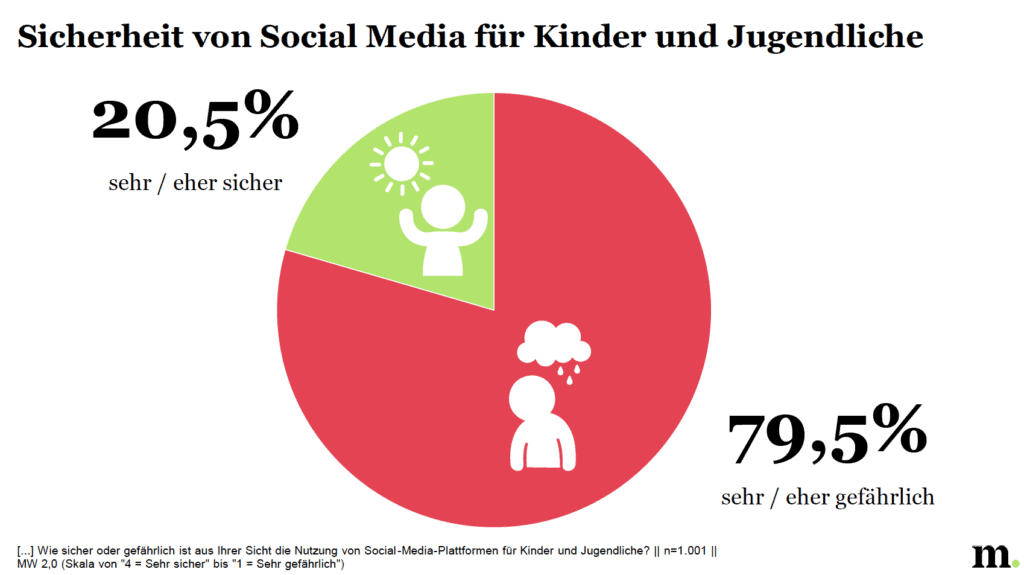
Today, children and teenagers naturally spend time on TikTok, Instagram, or Snapchat, but the Swiss public views this digital world with a critical eye. Eighty percent of those surveyed believe that social media is somewhat or very dangerous for young people, while only one-fifth consider these platforms to be safe.
The study shows that opportunities such as access to knowledge and education (37 percent), the acquisition of digital skills (35 percent), and social networking (34 percent) are certainly recognized, but they take a back seat to the perceived risks. In particular, cyberbullying (69 percent), addiction and excessive use (63 percent), and sexual harassment (62 percent) shape the public’s perception of risk.
Call for a statutory minimum age
Alongside international regulatory efforts—such as Australia’s ban on social media for children under 16 or the planned restrictions for children under 15 in France—the call for age limits is also gaining traction in Switzerland. Eighty-three percent of respondents support a legal minimum age for social media, with the desired average age being 15.
It is noteworthy that support is high across all generations: both 14- to 19-year-olds and those over 60 are equally vocal in their support for a legal age limit. For many, a minimum age is seen as a key component in better protecting children and adolescents and enabling them to use social media responsibly.
Responsibility of Parents, Platforms, and Policymakers
When considering the question of who should ensure compliance with a minimum age requirement, a nuanced picture emerges. 43 percent of respondents believe the primary responsibility lies with parents, 23 percent with the platforms themselves, and 19 percent with the government.
At the same time, a clear majority of 64 percent does not believe that social media providers can reliably verify users’ ages. The public expects parents to guide their children, set rules, and monitor their activity, while platforms and policymakers create a framework that effectively supports the protection of minors.
TikTok as the riskiest platform
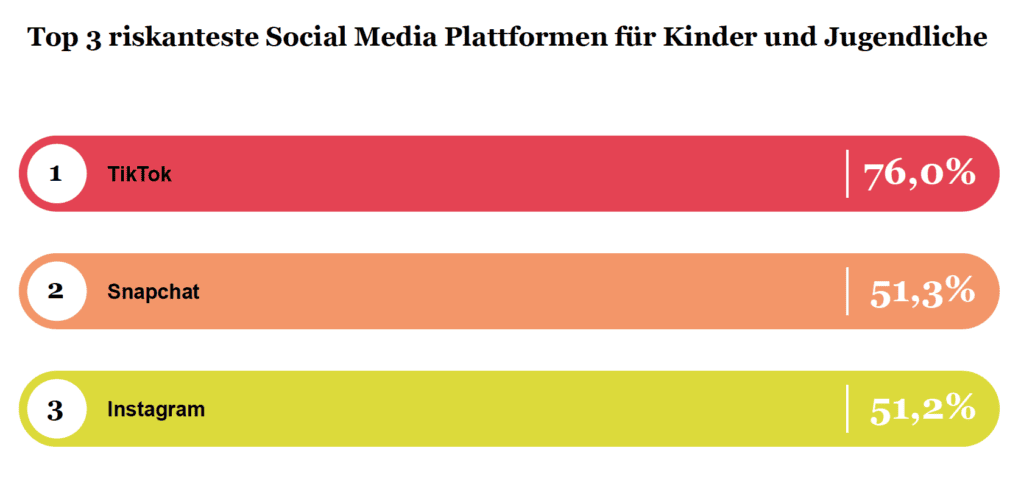
The assessment of individual platforms is also clear-cut. TikTok is rated by 76 percent of respondents as particularly risky for children and adolescents, placing it well ahead of Snapchat and Instagram, which are each classified as problematic by 51 percent of respondents.
X/Twitter and Facebook (39 percent each), as well as YouTube (24 percent), are also facing criticism, albeit to a lesser extent. It is striking that younger people in particular are more likely to perceive Instagram as risky (70 percent of 14- to 19-year-olds) than older respondents (42 percent of 60- to 69-year-olds).
]]>
Martin Nydegger, ST Director, and Damian Constantin, President of the RDK, together with other experts, presented the results of the representative population study "Tourism Acceptance" in Switzerland in Zurich on Thursday. The keyword "overtourism" is a regular concern for the public and the municipalities concerned. The study, which was conducted nationwide by the Zurich-based market research company Insight Institute AG on behalf of ST and the RDK in April/May 2024, serves to gain a deeper understanding of tourism acceptance and the importance of tourism in society. The results of the study clearly show that the Swiss population generally views tourism positively and rates its importance highly. The majority of the population is not concerned about tourism, with only a small minority (5 % of respondents) feeling worried about tourism.
Pride and recognition of the importance of the industry
Pride in the attractiveness of Switzerland as a destination for guests from all over the world is very pronounced among 78 % of respondents. In addition, people with a close professional connection to tourism, as well as the population in tourist centers and cities, attach great importance to the industry. The same applies to older respondents and respondents in French-speaking Switzerland and Ticino. The participants in the study see this importance in the positive effects on the economy and labor market, as well as in the infrastructure, cultural and leisure offerings, which are diverse and attractive thanks to tourism in the country.
Social challenges in tourism too
According to the respondents, the top five problems perceived in connection with tourism are: inflation (10.4%), pollution and littering (9.7 %), traffic problems (9.6 %), scarce living space (9.4 %) and damage to nature and the environment (8.4 %). These issues are particularly prevalent among respondents in tourist centers. The population also occasionally perceives a certain lack of respect from tourists - be it towards the interviewees, their families or towards their own country and the environment. All of these problems are generally known challenges for society as a whole, but they are not at all or only indirectly related to tourism.
industry sensitizes and informs, ST directs
There is no widespread overtourism in Switzerland. However, local and temporary bottlenecks can be observed. Both the tourism industry and ST are aware of this issue and take the concerns of the population very seriously, even if they only really affect a small minority. "We want to proactively address the issue in various ways: Information and awareness-raising together with local stakeholders, campaigns and offers specifically for locals, but also the creation of diversifying tourism offers such as the recent Glacier E-Bike Tour from Valais via Central Switzerland to Graubünden," explains Damian Constantin, President of the RDK.

ST's tourism promotion also has unique leverage directly in the markets: such as working with tour operators for programs off the beaten track (Chinese journalists and content creators on hiking trails and e-bike tours in Davos-Klosters), targeting niche target groups (Japanese bike fans in Andermatt, Vals and Villars) and clever content creator marketing (a further training camp for content creators from the USA and other countries in Saas-Fee in September with trips throughout Switzerland and Liechtenstein afterwards).
No "overtourism" in Switzerland, but serious bottlenecks
Mass or overtourism is not a new phenomenon worldwide, but it is not widespread in Switzerland. Martin Nydegger, Director of ST, emphasizes: "The phenomena in this country are temporary and local bottlenecks that are well known to the industry and ST. We are taking these local situations very seriously. We do not operate our tourism alongside the population, but with it". With this in mind, the tourism industry and tourism marketing are directing the right guests to the right places at the right time. Seasons are being extended, such as promoting the fall. The diversity of Switzerland is showcased worldwide so that travelers are better distributed, immerse themselves more deeply and stay longer. With the Swisstainable industry program, the sector is continuously promoting sustainable tourism and its social compatibility.
]]>
In the survey conducted by the JRC Bern research institute, 67% of respondents said they were definitely or somewhat against the privatization of Swisscom. 26% were definitely or somewhat in favor of selling the Confederation's stake. 9% were undecided or gave no answer. Syndicom presented the results of the survey at a media conference in Bern on Thursday.
Rejection in all camps
The survey shows "no" majorities among supporters of all parties and in all language regions, with the clearest rejection among the Green and SP base with "no" majorities of 88% and 69% respectively. Supporters of the GLP are the least skeptical, with 57% of them voting "no".
The background to this is the discussions surrounding the financial situation of the Confederation. In this context, FDP President Thierry Burkart spoke positively about privatization in an interview with the Neue Zürcher Zeitung in May.
"We should definitely look into this. Swisscom's public service is only a small part that could be maintained with service agreements," said the Councillor of States from Aargau.
"Sale of the silverware"
The Federal Council is also currently examining how to proceed with Swisscom. The Confederation currently holds 51% of Swisscom shares.
Syndicom used the media conference to counter the arguments of those in favour of privatization. If necessary, the union will call for a referendum, the union declared.
A Swisscom privatization would be a sale of silverware without necessity, Syndicom wrote in a press release. A sale would also not make financial sense, as Swisscom pays an annual dividend of over half a billion francs to the federal government, which would not be paid in the event of privatization.
"Superfluous debate"
Lucerne SP National Councillor David Roth accused the conservatives of ideological stubbornness: "If they want to keep Switzerland busy with this superfluous debate, we regret it."
Daniel Hügli, member of the Syndicom Executive Board, emphasized the importance of Swisscom for the universal service, even in peripheral regions. As the majority owner, the Confederation guarantees Swisscom the necessary stability for investments, for example in the expansion of fiber optic networks.
A look abroad shows that private, profit-oriented companies are not doing the same, said Hügli: "Unlike in Germany and Austria, fiber optic expansion is progressing rapidly in Switzerland."
For the study, JRC Bern interviewed 1007 people by telephone from April 3 to May 4. The data was then weighted so that it is representative of the entire voting population. According to the authors of the study, the sampling error is +/-3.1 percent.
]]>
dialog" is actually an almost permanent, large-scale opinion poll with a thematic breadth that has never been seen before in Switzerland. On the digital news platforms of the SRG Enterprise Units SRF, RTS, RSI, RTR and Swissinfo, as well as on the apps, Swiss people in Switzerland and abroad can answer questions about politics, culture, society and even quite simply about their everyday lives, thus contributing to a snapshot of what is currently on Switzerland's mind and how it is doing.
Interactivity, debate, dialogue
With an interactive tool, users can answer questions and find out where they stand with their attitude and their assessment compared to the rest of the population. A debate tool also makes it possible to exchange points of view and opinions on current topics across all language regions. The debates are moderated by the editorial team and translated into five languages. The cross-regional "dialog" team, made up of journalists, community managers and developers from all five SRG enterprise units, works decentrally from the Swiss language regions. The pilot project, which will run until December 31, 2025, is the responsibility of the SRG's Conference of Editors-in-Chief (CRK); the project manager is Marco Morell, Head of Service at SRF's Audio Editorial Office.
SRG Director General Gilles Marchand on the pilot project: "In addition to analyzing the priorities of the Swiss people, SRG's editorial teams are pursuing a dual goal here: On the one hand, they are providing a space for valuable, moderate discussions in the tradition of Switzerland's direct democracy. And secondly, they aim to build bridges between the language regions. In the interest of all, the project is intended to explore the possibilities that digital tools offer today as a supplement to broadcast."
The Swiss population is basically satisfied
The results of the first survey show: Switzerland is a country with a basically very satisfied population. The majority of respondents, 61 percent, are doing well to very well and only five percent describe themselves as dissatisfied. This general satisfaction is due in particular to private life, although most of the time spent on a daily basis is spent at work. However, there are also less positive aspects: Just under a third find themselves in a "rather or very stressful" financial situation - especially in Italian and Romansh-speaking Switzerland. This and the increasing pressure to perform are the factors that most affect the respondents' personal sense of happiness.
Further findings from the survey, which contains over 300 questions, will be presented immediately on SRG's stations and channels. Among other things, on topics such as trust in political actors and interest in campaign issues with regard to the upcoming elections.
]]>