Those who manufacture pharmaceuticals operate in one of the most strictly regulated industries in the world. GMP—Good Manufacturing Practice—refers to the aspect of quality assurance that guarantees consistent standards in the production and testing of pharmaceuticals. In this environment, Sergej Ruppel is driving the digital transformation forward: Together with his team at QPS Engineering AG, he supports companies in the pharmaceutical, biotech, and food technology sectors—from robot-assisted visual inspection to AI-based solutions. «We came up with the idea of combining various components to create something of our own, in order to optimize processes and make them safer,» he explains.
Data, Not Gut Feelings
Simply integrating AI into a validated production process—that doesn’t work in the life sciences industry. No one here can afford the «hallucinations» associated with generative models. That’s why Ruppel relies on local, closed systems. «Patient safety is the top priority,» he says. Ruppel explains the advantage over human workers in a matter-of-fact way: In cleanroom areas, humans themselves are the most common source of particles and contamination. “That’s exactly where robotics and camera systems make much more sense and are much more efficient.”
Culture Shock in China
In Europe, Ruppel feels things are moving too slowly: We need to generate more data instead of just calling for AI. His trip to China reinforced this view. «I experienced culture shock,» he says. Robotics and AI are socially integrated there, and the fear that Europe knows has disappeared. The government and society are pulling in the same direction. In Europe, on the other hand, the debate revolves primarily around regulations. Both are important—but the balance is off: «We mustn’t limit ourselves to the point where we can no longer develop.»
Replaced or newly installed?
Are robotics and AI bad news for the workforce? Ruppel disagrees. Certainly, humans will be replaced in some areas—«but they can be deployed elsewhere.» He advises younger people to understand the technology rather than fear it; learning a trade isn’t a bad idea anyway, because it’s harder to replace than a purely computer-based job.
When People Have to Make Decisions
Despite all the enthusiasm, Ruppel draws a clear line. When safety is at stake, he says, someone needs to be the one who ultimately makes the decision. «That’s exactly where people need to take the lead.» Liability remains unchanged: the manufacturer is always responsible, and every system must be validated before it goes live. In his private capacity, Ruppel runs Agentic Engineering and places a high value on digital sovereignty—sensitive data is processed locally. In the coming weeks, QPS will release two systems: AI-based visual inspection and «Dr. Project AI,» a project management tool.
The podcast episode on Spotify
«AI and Society – Pathways to a New World» is a video podcast produced by the Swiss Text Academy Foundation and the Swiss Prompt Engineering Academy in collaboration with Science City Davos and Lab42 Davos. Hosted by Christoph Soltmannowski. Available on YouTube, Spotify, and all other major podcast platforms: tinyurl.com/5t4fyfex
]]>
In Switzerland, 6600 women are diagnosed with breast cancer every year. They are mothers, partners, daughters, sisters and friends living with breast cancer. And with them, just as many families whose everyday lives are burdened by fear, worry and helplessness.
From lone fighter to solidarity movement
At the joint creative workshop, the agency and the client identified the central starting points for the campaign development: Breast cancer triggers a high level of concern that extends far beyond the patients themselves.
In the subsequently developed concept, evoq breaks with the conventional approach of presenting cancer as an individual fate and stages an affected woman in her various life roles: as mother, partner, daughter and friend. This perspective makes the scope of the disease directly tangible and creates potential for identification far beyond those directly affected: "It could have affected me or my loved ones too."
Olivia Schmidiger, Public Fundraising Specialist at the Swiss Cancer League, says: "With this emotional closeness, evoq not only underlines the urgency of the issue, but also creates an attitude of solidarity. A solidarity that goes beyond mere pity for those affected and makes the social dimension of the disease visible."


Familiar symbolism staged independently
The visual realization of the campaign deliberately focuses on documentary authenticity and tells the story of Katharina. Katharina the mother, the partner, the friend. These different perspectives and the almost painful authenticity are brought to the point in the concise core message: Breast cancer affects us all!
The design breaks with restrained, stereotypical pink tones, instead relying confidently on rich pink. Combined with the bright Cancer League orange and the dynamic use of the solidarity loop, the result is an independent visual with a distinctly recognizable look.
Recognizable independence across all measures
The focus of the NPO campaign is on the litter throw, which is distributed to one million households throughout Switzerland and expands the existing donation base. Digital out-of-home and display ads increase visibility and reach. Social media stories, reels and paid posts are used to address less involved and younger target groups and draw attention to the urgency of the issue and the important services offered by the Cancer League.
Aline Meierhans, Marketing Specialist at the Swiss Cancer League, says: "Thanks to the integrated approach and close collaboration with evoq, we were able to achieve a consistent brand presence and high recognizability across all online and offline communication and advertising channels. This enabled us to conceive, create and play out a campaign that was integrated across all disciplines."
Responsible at Krebsliga Schweiz: Eva Helene Röse Ilardi (Head of Public Fundraising), Olivia Schmidiger (Public Fundraising Specialist), Aline Meierhans (Marketing Specialist). Responsible at evoq communications AG: Adrian Schaffner (mandate management), Susanne Pfäffli (creative direction, concept, text), Markus Wohlhüter (concept, art direction), Gianluca Flütsch (graphic design), Daniel Kuster (project management, production). Photography: Sophie Frei (Graphics & Design Specialist) Swiss Cancer League.
]]>
The project focused on realigning the brand strategy and developing a corporate design that authentically conveys the clinic's core values - empathy, experience and excellence.
The central brand message "Defining a new life" underlines the holistic approach of the SailerClinic: improving the quality of life of its patients is the focus of all treatments. This philosophy is reflected in all communication elements.
Geyst was responsible for the strategic concept and visual design of the entire brand presence. The technical implementation and SEO-optimized content development of the website was carried out in collaboration with Advance Metrics. The project included the design of the website, the development of design guidelines and the revision of various communication materials.
The result is a contemporary, high-quality brand image that optimally conveys the medical expertise and quality promise of the SailerClinic. The consistent implementation of the brand strategy at all points of contact creates trust and underlines the clinic's position as a premium address for aesthetic medicine.


 ]]>
]]>
The tower in the heart of Zurich is a memorial to Katharina von Zimmern, who played an important role in the Protestant Reformation by transferring the Fraumünster Abbey to the city of Zurich in 1524, thus supporting the city's transition to Protestantism.
Dr. Santuccione-Chadha is known worldwide for her outstanding achievements in science and medicine, especially for her contributions to women's medicine. The honor bestowed on Dr. Santuccione-Chadha is remarkable. An Italian citizen, she made Switzerland her home some time ago.
Temporary artistic installation
The 40-metre-high project tower is intended to stimulate debate about the history of the Reformation and the city of the time, including the canton, and its architecture, as well as the connections between all these elements. The installation emphasizes the productive and creative power of women and their social, economic, religious and political impact. The tower will feature a 1,000-meter "dress" of green ribbons printed with the names of the 500 women honored, selected for their past and present contributions in various fields. This temporary installation will be on display from August 20 to December 10. The St. Catherine's Tower is located in the center of Zurich between the town hall and the famous Fraumünster church, which was once a convent.
You will find a detailed portrait of Dr. Antonella Santuccione Chadha in the m&k issue of September 3.
 For the 30th anniversary of the investment company BB Biotech, the Zurich agency Hochspannung developed a campaign that asks: "What's next? A question that the responsible analysts, scientists and financial experts have been asking and answering again and again for 30 years.
Over the past decades, for example, BB Biotech has invested in numerous companies, including Actelion, Genentech and Moderna, which gained notoriety two years ago with the development of a Covid vaccine. The question of the next big trend in the development of new medicine also drives those responsible at BB Biotech with regard to future developments. And so the question "What's next?" is still anchored in the DNA of the investment company today as it has been for the past three decades.

The only thing that has changed markedly since the beginnings in 1993 is the way information is obtained, which is skilfully reflected in the visual implementation of the campaign. The campaign is based on digital media, print and posters and will run until the end of the year.
Responsible at Hochspannung Werbeagentur Zurich: Alexander Taiganidis, Matthew Katumba, Fritz Kreis, Tanja Kongolo, Monika Jagodzinski, Johannes Jordan, Sophie Graf, Nyima Weber.
]]> With its 18 locations in German-speaking Switzerland, Pallas Kliniken is one of the largest clinic groups in Switzerland. The clinic group offers a wide range of services, consisting of treatments in ophthalmology, dermatology and aesthetic medicine. Now the group has its own TV format: "Pallas TV - the magazine for ophthalmology and aesthetic medicine", which was conceived by the Fachwerk Advertising agency, reports on specific treatments in various issues over the course of a year, portraying individual clinic locations.
The relevant treatment is explained by experts from the hospital group and supplemented by the personal experiences of patients. In addition, each TV magazine focuses on the umbrella brand's guiding values of "excellent medicine" and "humane treatment" and is thus intended to convey medical excellence and emotions in equal measure. The TV magazines are accompanied by presenter Ellen Brandsma.
In addition to conception and realization, Fachwerk is responsible for the media strategy and distribution of the TV campaign. The TV magazine is broadcast on regional German-language stations such as TeleZüri, TeleBärn and TeleM1. In addition, each episode is announced in advance on regional radio stations.
Responsible at Pallas Kliniken: Daniel Junker (COO), Prof. David Goldblum (CMO), Christoph Ernst (Head of Marketing), Daliah Kremer (Project Manager Internal/External Communication), Tanja Schwaller (Project Manager Marketing Aesthetics). Responsible at Fachwerk Kommunikation: Nektarios Thanasis (CEO), Damian Wolfisberg (Head of Fachwerk Advertising), Woula Goutziomitros (Consultant Healthcare & Pharma) and Tino Heuter (Creative Director). Production (SE Media): Sven Emmenegger (CEO), Remo Marti (Creative Director), Robin Hunziker (Video Editor).
]]>
 Plastic surgeon Dr. Martina Schneider of Clinic Utoquai has scored a coup with a Tiktok video: Using a kneaded model she created herself, she demonstrates a breast reduction very precisely and without bloodshed. The video has already been viewed 17.4 million times on Tiktok.
"It is a great concern of ours to inform seriously, competently and entertainingly at the same time on social media," explains the plastic surgeon. "And since I also like to be artistic and creative, I had the idea, together with our social media expert, that we could depict the procedure of an operation in this way in a very realistic, aesthetic and at the same time bloodless way."
But she never expected the video to attract so much international attention. The clip attracted a great deal of attention in the first week after it went online, and the number of viewers skyrocketed thousands of times every day thereafter. A second video in the same style is already online, and more clips are planned.
Here go to the video.
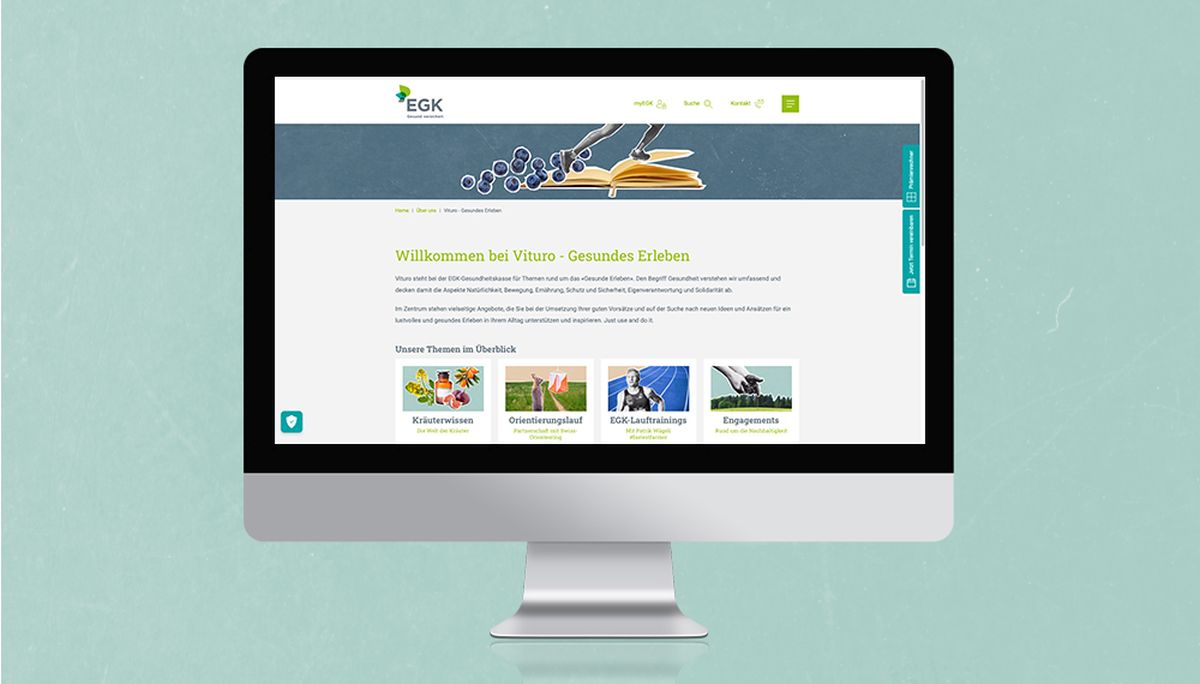
]]> The core of the new appearance is a collage style with images that emphasizes complementary medicine as the USP of the EGK: parts of the human body are used in black and white, colored objects as well as graphic elements in the colors of the extended color palette. This was supplemented with earthy, mineral natural tones.
A uniform image and word concept runs through all elements. While the previous logo bar has been dropped, the logo, typeface and claim ("Gesund versichert") remain unchanged. The result is a strong visual identity that can be easily applied to the various products and messages.
Campaign from summer
The new imagery will be used for all print and web products, as well as for the company's internal and external image, and will also be used from June onwards in a campaign aimed at raising EGK's profile. In doing so, it hopes to attract new policyholders, especially among the 25 to 40 age group, who are interested in holistic treatment methods.
The new image was designed and implemented by the Zurich-based communications agency Artischock.
Responsible at the EGK Health Insurance Fund: Roger Müller (Head of Marketing). Responsible at Artischock: Sylvia Brüggemann, Yaël Weissmann (consulting, conception, project management), Lukas Koller, Sam Loosli, Tanja Richli (graphics).
]]>
 Pharmacies are facing major challenges: new market players, digital distribution channels, and an increasing concentration of manufacturer- or retailer-linked, franchise-like structures. Pharmacies are challenged to find new digital ways and forms of distribution and to convince their customers of how forward-looking they already are. Maybaum Film took on this challenge on behalf of the Apo Sanitas and eigens pharmacy cooperations. The aim was to show that proximity means health, to put the years of know-how of local pharmacies at the center and to convey the most important facts on the subject of digitalization.
For this, the Maybaum team set out on a tour of Germany and visited four to five pharmacies per day throughout the country. In addition, one of the most modern distribution centers in the country was used for filming. The challenge: to make the best possible use of the locations in the short time available and to work with the conditions on location, because the venues could not have been modified or temporarily closed.
Humanity in local pharmacies
There was little room for realization and staging. There were also no opportunities to visit the filming locations in advance. The film equipment was reduced to a minimum. For the portraits of the employees, a single artificial light was used. This was also intended to create a uniform look throughout the entire film.
The result: a film that shows the humanity of local pharmacies by putting personal advice and expertise in the foreground, while at the same time highlighting the new ways of digitalization as a way to secure the future of independent owner-operated pharmacies. For this purpose, Maybaum Film's journey took them to Mannheim, Gotha and Berlin, among other places.
Responsible ApoSanitas: Christian Andree / Michelle Wilhelm; Production: Maybaum FilmResponsible eigens.net: Thomas Pfaff; ; Director: Michel Alraun; Camera: Sara Maag; Technique: Aline Pulver; Editing: Sara Maag; Sound design/Mastering: Tim Zumstein.
]]>
 Doetsch Grether's Neo Angin throat pastilles are getting a new concept: the Yellow agency has developed a new approach for the traditional brand, in which each product in the range is given a godfather in the animal world according to its properties. The new appearance will be used for communication with retailers and for promotion to the public.
Neo Angin covers several categories with different varieties for the treatment of dry mouth, difficulty swallowing to sore throat. Depending on the severity of the symptoms and the use in children, different active ingredients and dosages are offered. A variety that makes the brand a throat specialist for the whole family. This approach formed the basis for the positioning of the previous communication and consequently remains as the basic message. After analyzing the environment, however, the creative team at Yellow decided on a new story.
Clever strategies against cold and snow
Each product in the range of Neo Anginhat its decided area of application and is specialized in one task. For these properties Yellow has searched for analogies in the animal world. Since the neck is a concern mainly in the cold season, the search focused on animals that have developed clever strategies against cold and snow. The blue tit, snow hare, emperor penguin, arctic fox and polar bear are now the inspiration for the gentle to strong Neo Angin throat pastilles and the Protect and Dolo sprays. The winter-proof ambassadors are used in communication with retailers and in public advertising. There they can be seen as a team on counter displays, in shop windows, on screens at the POS and in online channels. They are also the stars of an advertising campaign running in selected trade magazines.
Responsible at Doetsch Grether: Uriel Frank (Head of Marketing), Stephanie Van de Velde (Senior Brand Manager).
Agency: Yellow (Creative Retouch: Lily Metzker).
]]>
The image campaign "Making a career as a human being" enters the next round. The campaign aims to strengthen careers in long-term care and support the recruitment of professionals at tertiary level. Well-trained professionals are in demand: Due to demographic developments, 222,000 professionals will be needed in the field of long-term care from 2021 to 2029, according to forecasts by the Swiss Health Observatory (Obsan).
Focus on lateral entrants
In order to meet the demand for care, the industry associations Artiset, Spitex Schweiz and OdASanté want to increasingly address career changers. Thus, the focus of the campaign this year is on people who are considering a career change. Long-term care offers numerous attractive career opportunities for career changers and many incentives that other professions do not offer. For example, the compatibility of career and family is actively practiced in part-time positions. Furthermore, many companies are increasingly offering job sharing. And the professions in long-term care have a future, because the demand for well-trained care professionals is higher than ever - regardless of the economic situation and digitization.
The campaign puts the spotlight on various career changers. In the 20-second campaign film, which is being used online and in cinemas across the country, we see Peter, portrayed as a trained EFZ computer scientist who, despite his fascination with technology and computers, has dared to switch to long-term care. "Today, I prefer to look at faces rather than screens," he says. The film was realized in collaboration with the production company zweihund. The five campaign subjects, which are distributed online and on social media, show authentic people from different professions - from hotel clerks to electricians to art directors - who have chosen a versatile training in long-term care. What stands out is this: Just as diverse as the education and training programs in long-term care are the motivations for a lateral entry. But what they all have in common is the desire for a profession in which interpersonal relationships are absolutely central. For example, Peter, an art director who is now training to become a certified nursing specialist HF, explains, "I did a lot of great things as an art director. At some point, however, I no longer found that satisfying. I wanted to be more active and see the direct impact of my work on people."
Occupation check as a guide
Access to the necessary information should be as low-threshold as possible to strengthen the motivation for a career change and show the direct path to it. And that's where the career check on the campaign website langzeit-pflege.ch comes in. Supporting guidance in the form of a questionnaire takes just a few clicks to find possible career profiles. Details such as a precise description of the activities, training duration or later further training opportunities can be found in the respective occupational profile. Once you have found a training or continuing education program, you can find the right educational institution or company on the overview map.


Responsible at Artiset: Theres Gotsch-Hinden (Project Manager, Head of Education Projects). Responsible at Spitex: Francesca Heiniger (Head of Communications/Marketing). Responsible at OdaSanté: Luca D'Alessandro (Communications Manager). Responsible at CRK: Caroline Hulliger (Project Manager), Filip Wolfensberger (Creative Director), Andrea Schmid, Gina Messerli (Consulting, Social Media), Jessica Gomilsek, Sarah Gabele (Creation, Multimedia Production). Film production: Zweihund GmbH (production company), Niels Vije (producer), Jonas Meier (director), Simon Bitterli (camera), Gabi Morales (equipment), Daniela Glarner (styling), Nora-Li Hess (hair & make-up), Jonas Meier, Mike Raths (editing), Som Sommer (color grading), Mile Raths (visual effects), Christoph Benz / Jingle Jungle AG (sound design). Website: Localmedia GmbH. Media: Mediaschneider Bern.
]]>Many things are possible in medicine today. However, people fail to realize that not everything that is possible necessarily makes sense in a specific case. There is therefore a risk that treatments and investigations are carried out that are either of no use to those being treated or are even more likely to cause harm. For this reason, the supporting association smarter medicine - Choosing Wisely Switzerland is launching a national awareness-raising campaign to make the general public aware of the problem of overuse and misuse. Send Kommunikation has developed four different videos with simple messages. Patients are shown coming out of a consultation room with disproportionately large items that indicate overuse in an exaggerated manner. At the end, the slogan "Less is sometimes more" appears with the claim "Against over- and mistreatment in medicine". The campaign will be played out online in social media, Google Display Ads as well as on public transport screens and in waiting areas of medical service providers. The latter also have the option of ordering cardboard displays and flyers as well as customized visuals and videos.
Responsible at Send Kommunikation: Xenia Hediger (project management), Eric Send (concept). In collaboration with Polarstern AG, Fotomtina, Querform GmbH and salzmannmedia. Client: Office smarter medicine - Choosing Wisely Switzerland.
]]>