
On Tuesday, the new Media Monitor Switzerland was published by the Federal Office of Communications Bakom. The 2018 study shows for the first time what potential YouTube and Co. have for shaping opinion in Switzerland.
In French-speaking Switzerland, social media accounted for a full 16 percent of regional opinion power, only slightly behind print (18 percent). Nationwide and in the German-speaking part of Switzerland, social media accounted for around 10 percent of total opinion power, and slightly more in Ticino.
In general, however, these figures should be interpreted with caution, writes Bakom, as no official reach data is available for social media. The overall influence of social media thus continues to lag well behind the traditional media offerings of TV (28%), radio (24%), print (20%) and online (18%).
The assessment, which is based among other things on a representative survey of the population, relates to general information usage. In addition to politics, it also includes business, society, culture and sports. However, the Media Monitor does not provide any information on selective use during political events such as votes and elections.
TV is the most important medium
In general, television continues to dominate opinion-forming in Switzerland. The dominance of television is particularly pronounced in Latin Switzerland. In French- and Italian-speaking Switzerland, it has a significantly greater power to shape opinion than radio and the press.
The Media Monitor Switzerland is published for the second time. In terms of media offerings, the changes between 2017 and 2018 were minor overall. The ratings of television and radio are almost unchanged. Print lost some of its influence in all parts of the country, while online offerings became more important for opinion-forming.
Despite concentrations in the industry, Medienmonitor does not see any acute danger to the free formation of opinion. There is no medium that enjoys nationwide supremacy. The individual groups are not in a position to unduly shape national, linguistic-regional or local-regional opinion-forming, the report says.
"Duopoly" with Tamedia and SRG
In many areas, however, a "duopoly" is forming with the Swiss radio and television company SRG and the Zurich publishing house Tamedia. The two largest media companies, which are active in all regions with their own offerings, together already accounted for slightly more than half of national opinion power in 2018.
SRG comes to 35 percent, Tamedia recorded 16 percent of the Swiss opinion market. Numbers 3 and 4 are the NZZ Media Group (6%) and AZ Medien (5%), followed by Ringier (also 5%) and the regional groups Gruppo Corriere del Ticino, ESH Médias and Somedia, which together account for a further 3 percent of national opinion power.
In Latin Switzerland, the first public TV stations come close to the opinion power threshold of 50 index points. This means they reach just under half the population with their information every day.
The study concludes that SRG is benefiting the most from the general strengthening of online and, with srf.ch, is also presenting the opinion power climber of the year. The multilingual free commuter newspaper 20 minutes of Tamedia, meanwhile, continued to be considered number 1 for opinion power among the most important titles. (SDA/pd)
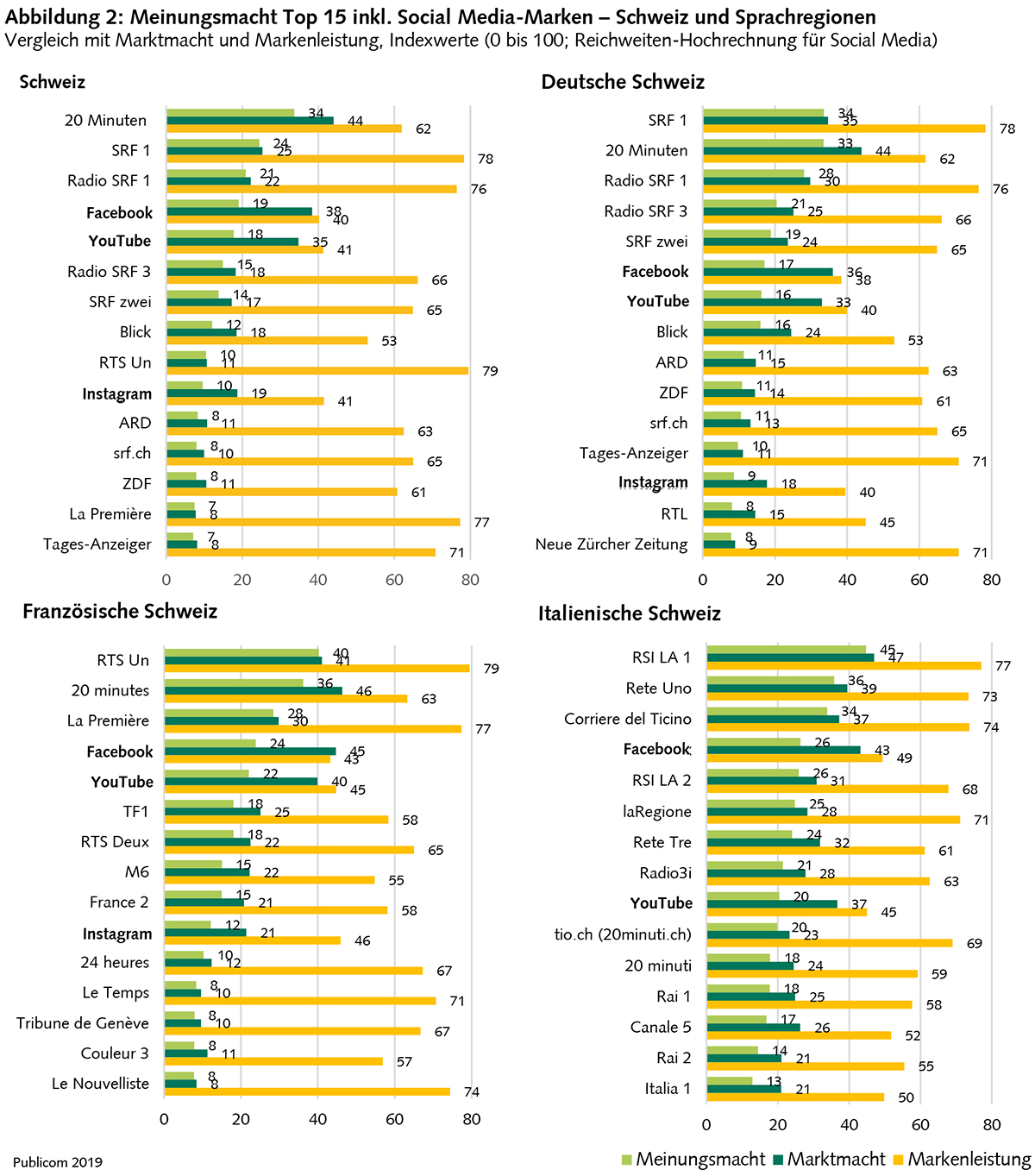

The study shows that television has the greatest influence on opinion-forming, ahead of the press, radio and online media. The Media Monitor Switzerland also provides information about ownership structures and corporate interrelationships in the Swiss media market.
On the trilingual Website of the Media Monitor Switzerland, the opinion-forming potential can be displayed for the whole of Switzerland and various regions. Also visible are the ownership and participation ratios of the major Swiss media companies. The website also includes a scientific report containing an overall interpretation of the numerous detailed results.
As the results for the 2017 survey year show, television dominates opinion-forming, especially in Latin Switzerland: In French-speaking Switzerland, it has significantly greater opinion-forming power than the press, whose influence potential in this part of the country is about the same as that of radio. In Italian-speaking Switzerland, the leading role of television is even greater. Here, the press ranks third behind radio among the most influential opinion-forming media. Online offerings are in last place in all three parts of the country, according to the study. In German-speaking Switzerland, too, television as a genre has the greatest influence potential overall, but print is stronger in this part of the country than in the Latin language regions.
This data relates to general information usage. It is understood broadly and includes not only politics but also business, society, culture and sports. The Media Monitor does not provide any information on the selective use of information during political events, such as before and about votes and elections.
The Media Monitor Switzerland is based on data derived from three coordinated research modules. In the first module, the role of the various media in shaping the individual opinions of the Swiss population was surveyed by means of a representative poll. In the second module, the researchers evaluated data from established studies of applied media research to determine the weight of the various media in the audience market. Finally, in a third module, the ownership and participation ratios in the Swiss media market were collected on the basis of annual reports, industry studies and ongoing market monitoring and presented in a database. This is updated on an ongoing basis.
The Media Monitor Switzerland is part of OFCOM's media research, which in particular examines the programming performance and audience acceptance of Swiss radio and television stations with a performance mandate. The Media Monitor Switzerland was put out to public tender by OFCOM in an open procedure in accordance with WTO. The Publicom research office in Kilchberg was awarded the contract for the first four years of the study.
Medienmonitor, a press review for the communications industry, offers specialists and managers from the fields of communications, media and marketing a broad overview of what is happening in the industry on a weekly basis. The subject area "Profession & Work" is being expanded and will now be edited by the HR magazine "HR Today". HR managers will find a wide range of specialist information in various topic dossiers such as Leadership & Management, Employer Branding, Recruiting & Applying, Health Management, Employment Law and Organizational Development.
HR Today is a specialist magazine for human resources in Switzerland. The publisher also operates an online platform and various themed blogs and reports on current trends and news from the world of work. With "HR Today Academy", the magazine offers a series of conferences with high-profile specialist speakers on hot HR topics such as HR marketing, recruiting, employment law and leadership.
]]>
The editorial team summarizes under Mediamonitor.ch The website brings together substantial, factual and opinionated articles from specialist and consumer media. The service was launched on Tuesday and can be subscribed to by e-mail. Specialists and managers receive an overview of the changes in the communications industry in the areas of "Media", "Journalism", "Social Media", "Communication", "Production/IT" and "Working World/Jobs". The editorial team focuses primarily on author contributions and journalistic texts that help to better understand media change and the effects on their own specialist area.

The dossier structure clearly bundles topics such as "e-marketing", "digital printing" and "media on the social web". This results in consistent collections of articles for interest groups in the media and communications industry. The new industry service is updated daily and subscribers receive a weekly overview of topics by e-mail. The Medienmonitor can also be followed via Medienwoche's social media channels on Facebook or Twitter or via RSS feeds at topic or dossier level.

Medienmonitor is not only based on Medienwoche in terms of its appearance, its editors Nick Lüthi and Ronnie Grob will also curate the platform for the subject areas "Media" and "Journalism" in future. With Dominik Allemann, Irène Messerli (Bernetblog.ch) and Nicole Schnell (Schnellkraft.ch), further expert support has been gained in the specialist areas of "Communication" and "Social Media". Readers also shape the editorial program, and specialist articles worth reading can be submitted directly via the platform as a link tip.
The new platform in responsive web design was created by Marco Leisi from The Band, while Markus Böniger from Weblotion was responsible for the IT.