A peculiar tension hangs in the air at SOHO Zurich this evening. Outside, a storm is raging over the city; inside, the room is filled with a different kind of pressure. The topic is finding one’s bearings in a media landscape increasingly shaped by algorithms, artificial intelligence, and a nearly unmanageable number of platforms.
Advertising has always been a business of attention. But attention alone is no longer enough. Nor is reach. The question that keeps coming up this evening is therefore: How do you create an impact in a world where machines have long since been helping to decide what content people even get to see?
A glance around the room is enough to show that this issue now extends far beyond advertising agencies. Publishers meet platforms. Marketers meet advertisers. Researchers meet practitioners. With Tamedia Advertising, Admeira, Meta, TikTok, Migros Bank, and Emmi, the room is filled with representatives from organizations that handle millions of advertising francs every day.

The Architect of Dialogue
Marjan Iglesias plays an important role this evening. As Director of Client Services at Webrepublic, he not only guides the audience through the program but also articulates the vision behind Media Now. He is convinced that research must find its way from studies and datasets into practical application. That is precisely why Webrepublic has deliberately brought together representatives from platforms, publishers, marketers, advertisers, and academia on the same stage.

The event is not intended to be a product showcase, nor is it a platform for the same old industry clichés. Rather, it aims to highlight different perspectives and spark discussions in areas where the industry has not yet reached a consensus. This is exactly what happens several times throughout the evening.
The stage first belongs to Tobias Zehnder, co-founder and managing director of Webrepublic. And he doesn’t start with a success story about digital advertising. Instead, he tells the story of a YouTube channel that transformed from a harmless travel channel into a platform for crypto scams. It’s a story about trust, deception, and the difficulty of distinguishing truth from illusion in digital environments.
Six trucks full of VHS tapes
To put the scale of the challenge into perspective, Zehnder draws on an image from a different media era. Every minute, around 500 hours of video are uploaded to YouTube worldwide. Extrapolated over a single day, this amounts to six truckloads of VHS tapes. It would take about 82 years to watch all of this material.

The metaphor elicits a chuckle from the audience, but it highlights the real problem. What sounds like unlimited reach is, for advertisers, one thing above all else: a gigantic black box.
That is precisely why Webrepublic, in collaboration with GfK, conducted a comprehensive study on YouTube usage in Switzerland. The platform is now one of the country’s most important video channels and generates significant advertising revenue. At the same time, it often remains unclear in what context ads actually appear and what impact they have there.
The results are surprising. YouTube’s actual prime time isn’t in the evening, but in the afternoon. The platform is primarily used on smartphones. Above all, however, it becomes clear that YouTube is not a uniform channel, but rather a melting pot of completely different reasons for use—ranging from focused learning to entertainment to pure distraction.

The YouTube Black Box
The deeper Zehnder and his team delve into the data, the clearer it becomes that technical reach and actual advertising impact are not the same thing. A music mix that plays in the background for hours generates views. An ASMR video to help you fall asleep generates views. Kids’ channels generate views. But that doesn’t automatically translate to attention.

Perhaps the most provocative finding of the evening is therefore that about half of all advertising spending on YouTube ends up in contexts that generate very little ad recall.
In an exclusive interview with m&k, Zehnder speaks of a «data illusion» from which the industry suffers. Engagement doesn’t mean the same thing everywhere, and reach certainly doesn’t. Platforms provide enormous amounts of metrics, but not every metric actually says anything about impact.
The audible murmur from the audience shows that this statement strikes a chord.
The Quest for Attention
At first glance, the question posed by Damian Chandler and Kevin Haab seems surprisingly simple: How can the context of a YouTube channel be reliably determined in the first place?

For years, advertising has been evaluated based on metrics such as impressions, views, and reach. But there is one crucial variable that lies between successful ad delivery and actual advertising impact: context. That’s exactly where the YouTube Impact Engine comes in.
Chandler describes the challenge as the interplay of four factors: media KPIs, quality, context, and impact. While the industry has a relatively large amount of data available for the first two factors, context often remains a black box. Those who rely on platform automation may achieve reach, but they often have only limited insight into the actual environment in which their ads appear.

The search for answers took the team deep into YouTube’s structure. What at first glance looks like a straightforward category such as «Gaming» branches out into dozens of subcategories—from battle royale games to simulations and strategy games, all the way to chess and educational content. Although the platform itself provides categorizations, according to Chandler, these are often insufficient for drawing conclusions about advertising effectiveness.
That is why Webrepublic developed its own logic. Using artificial intelligence, channels were first analyzed based on relevance, language, semantics, and context. This process resulted in 21—and later 22—transparent Webrepublic Impact categories that are based not on platform logic but on usage scenarios.
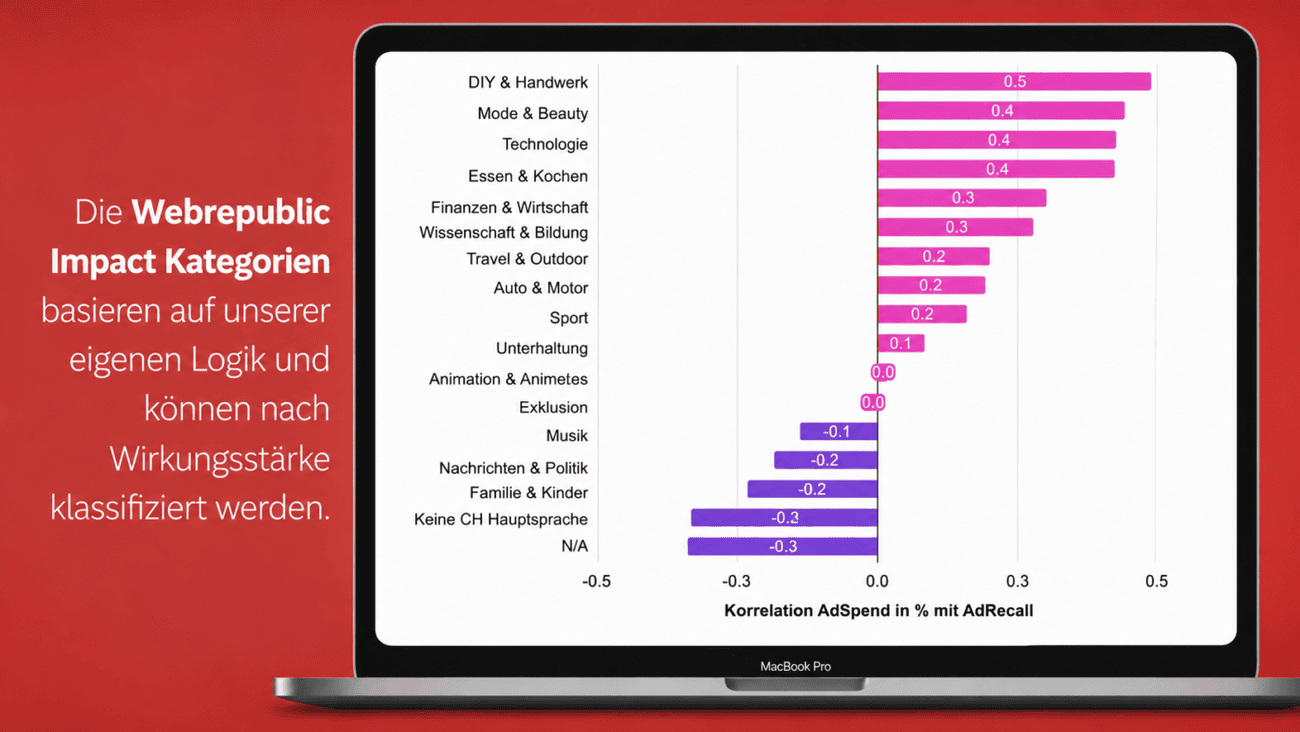
The crucial step came only after that. The new categories were cross-referenced with data on ad recall. The results show clear differences. Categories such as DIY & Crafts, Fashion & Beauty, Technology, Food & Cooking, and Finance & Business exhibit an above-average correlation with ad recall. While other categories generate reach, they achieve significantly lower recall rates.
This is precisely what led to the project’s key finding: Good delivery metrics do not automatically translate into high advertising impact. Or, as one of the slides presented states: «Media KPIs are the foundation, but they are no guarantee of impact.»

For Chandler and Haab, this is where the true value of the YouTube Impact Engine lies. It is not meant to replace automation, but rather to scrutinize the algorithms. Those who better understand user behavior can allocate budgets more effectively, reduce wasted spending, and increase the likelihood that ads will actually stick in viewers’ minds.

Ultimately, the two see their development less as a new planning tool and more as a new perspective on Switzerland’s largest video platform. The YouTube Impact Engine is designed to enable audits, benchmarking, and new setups—and thereby reveal why two campaigns with identical reach can have completely different impacts.

The Big Debate
After the break, the evening shifts its focus. The discussion is no longer just about YouTube, but about how different stakeholders understand impact in the first place.

Konstanze Fichtner makes it clear that while attention is important, it explains only part of the impact. For the Meta manager, the actual business results remain the decisive factor. Brand impact, ROI, or ROAS are ultimately more relevant than individual media metrics. She finds Webrepublic’s attempt to link context and impact particularly exciting. At the same time, she points to another key factor: creative. In her view, creative quality accounts for about half of engagement and thus remains one of the strongest influencing factors of all.
Philipp Mankowski argues from the perspective of high-quality journalism. For him, quality means not only content but also engagement. Those who are willing to pay for content tend to consume it more mindfully. On average, articles on Tamedia are read for about four minutes, while commercial content is still read for about two minutes. For Mankowski, this time invested is a form of attention that differs fundamentally from the logic of quickly scrolling feeds.

Stefanie Fritze articulates what is probably the most pointed customer perspective of the evening. After the study results were presented, she said, half-jokingly, half-seriously, «I want my money back.» Behind this, however, lies a serious concern. Today, advertisers must not only buy media but also invest additional money in measurement, analysis, and channel-specific creative work. The number of platforms is increasing, usage scenarios are becoming more diverse, and it’s getting harder and harder to keep track of everything. At the same time, pressure from senior management is mounting to directly link marketing spending to business success.

Marie-Theres Schramm points out that the industry has been discussing common measurement standards for over ten years. For a long time, it had been impossible to bring all relevant market participants to the table. Only now are the first initiatives for cross-platform measurement emerging in the U.S. and the U.K. At the same time, she warns against making overly simplistic comparisons. Not every platform serves the same function, and not every KPI is equally relevant for every brand. E-commerce providers focus on different metrics than brands that are primarily seeking to build brand awareness.

Frank Zelger ultimately takes up Zehnder’s VHS metaphor and expands on it with a historical analogy. In the past, VHS, Betamax, and Video 2000 competed for market share. In the end, one standard prevailed. That is precisely what is missing today in advertising effectiveness measurement. As long as every provider measures according to its own criteria, the market will remain fragmented. The challenge is not the measurement standard alone, but rather a common reporting standard that CFOs, marketing directors, agencies, and media companies can all understand equally.
The view from the outside
Perhaps the clearest perspective on the evening is provided by Marcus Schögel,
In an exclusive interview with m&k, he expressly praises Webrepublic’s approach. Global platforms would be hard-pressed to achieve this level of localization and regionalization. The question of which platforms are actually effective will become even more important in the future—and not just on YouTube.

Even more intriguing, however, is its fundamental classification.
«What I take away above all else is that we’re once again having a discussion about effectiveness, not just efficiency,» says Schögel. For him, this is precisely what makes the evening so significant. The industry is once again focusing more closely on the question of whether advertising actually reaches its intended audience.
Schögel pays particular attention to what advertisers have to say. Their expectations, he notes, are clearly articulated and entirely justified. At the same time, he has gained the impression that clients’ demands are sometimes formulated more precisely than the answers the industry is able to provide.
When AI Becomes a Customer
But Schögel is thinking even further ahead.
He does not see the next major change coming from platforms or channels, but rather from the recipients of communication themselves. In the future, advertising will have to convince not only people, but also their digital assistants and AI agents.
These systems would evaluate information based on different criteria than their human users. Purchasing decisions would increasingly result from a collaboration between humans and machines. For marketing professionals, this means a new level of complexity that is only beginning to emerge today.
All of a sudden, the discussion about YouTube almost seems like a preview of something bigger.

The Winkelried Moment
The most significant innovation of the evening was not just the YouTube Impact Engine, but the willingness to even open up their own “black box” for discussion. Platforms, publishers, marketers, advertisers, and academics were all in the same room—stakeholders who view impact from different perspectives and do not always pursue the same interests.
The discussion wasn’t about reach records, click counts, or the next technological sensation, but rather about the fundamentals of the business: attention, impact, and trust. While a summer storm swept through Zurich outside, it became clear inside just how paradoxical the industry’s situation has become. Never before have we had access to more data, more technology, and more artificial intelligence. At the same time, there is more uncertainty than ever about what actually works in advertising.
This is precisely where the true value of Media Now lies. Not because all the answers are already known, but because someone is taking the first step to ask the right questions. In Swiss history, this is known as the “Winkelried moment”: someone steps forward, opens a path, and thereby paves the way for a movement that is greater than themselves.
The YouTube Impact Engine thus remains not only the most visible outcome of this evening, but also the spear that was deliberately thrust into the black box of advertising effectiveness. The industry will now have to figure out together what comes of this.
]]>