AI Content Labeling: What the Swiss Public Really Wants
Artificial intelligence has long been part of everyday life in Switzerland—but calls for clear labeling of AI-generated content are growing. A representative study by the digital research institute Marketagent Switzerland, conducted among 1,000 respondents from German- and French-speaking Switzerland, reveals a clear tension: While AI as a technology is widely accepted, skepticism toward the content it produces is growing at the same time. The survey took place between July 29 and August 7, 2026.

Widespread use, ambivalent attitude
The majority of respondents say they actively use AI (89 percent), with 63 percent of them doing so at least once a week. Younger generations, in particular, are driving this trend: More than three-quarters of Generation Z (77 percent) and Millennials (75 percent) regularly use AI applications. Across Switzerland, ChatGPT and similar tools are primarily used for quick research and information gathering (56 percent).
Attitudes toward the technology, however, remain divided: While 41 percent of the population has a generally positive view of AI—a figure that rises to 50 percent among Generation Z and 53 percent among millennials—one in five people express clear opposition (22 percent).

Quantity Over Quality: AI-Generated Content Falls Short in Terms of Quality
As usage increases, so does the prevalence of AI-generated content: Six out of ten Swiss people say they encounter such content regularly (62 percent). But growing visibility does not automatically lead to acceptance. Four in ten respondents view the growing volume of AI-generated images and text negatively (43 percent), and just as many are somewhat reluctant to consume such content (43 percent). The perceived quality also falls short of expectations and is rated as only average on average (mean: 3.3).

Uncertainty in recognition—and a strong desire for AI-labeled content
The lack of confidence in identifying AI-generated content has emerged as a key issue: Only about one-third of the population feels capable of reliably identifying AI-generated content (34 percent). Even among young people, who engage particularly intensively with digital technologies, this confidence remains limited (49 percent among Generation Z).
To identify AI-generated content, users primarily look for elements that seem unnatural (47 percent), explicit labeling (40 percent), or inconsistencies in the content (39 percent). Thirty percent become suspicious when the content seems too polished or perfect. Against this backdrop, an overwhelming majority of 83 percent supports mandatory labeling of AI-generated content.
«AI Slop»: When Content Becomes Low-Quality Mass-Produced Goods
Seven out of ten Swiss people already perceive an increase in trivial or interchangeable content (73 percent), and six out of ten fear that high-quality, human-created content will be displaced as a result. «A growing phenomenon is the so-called »content flood’ caused by AI,” says Andrea Berger, Research & Communications Manager at Marketagent.
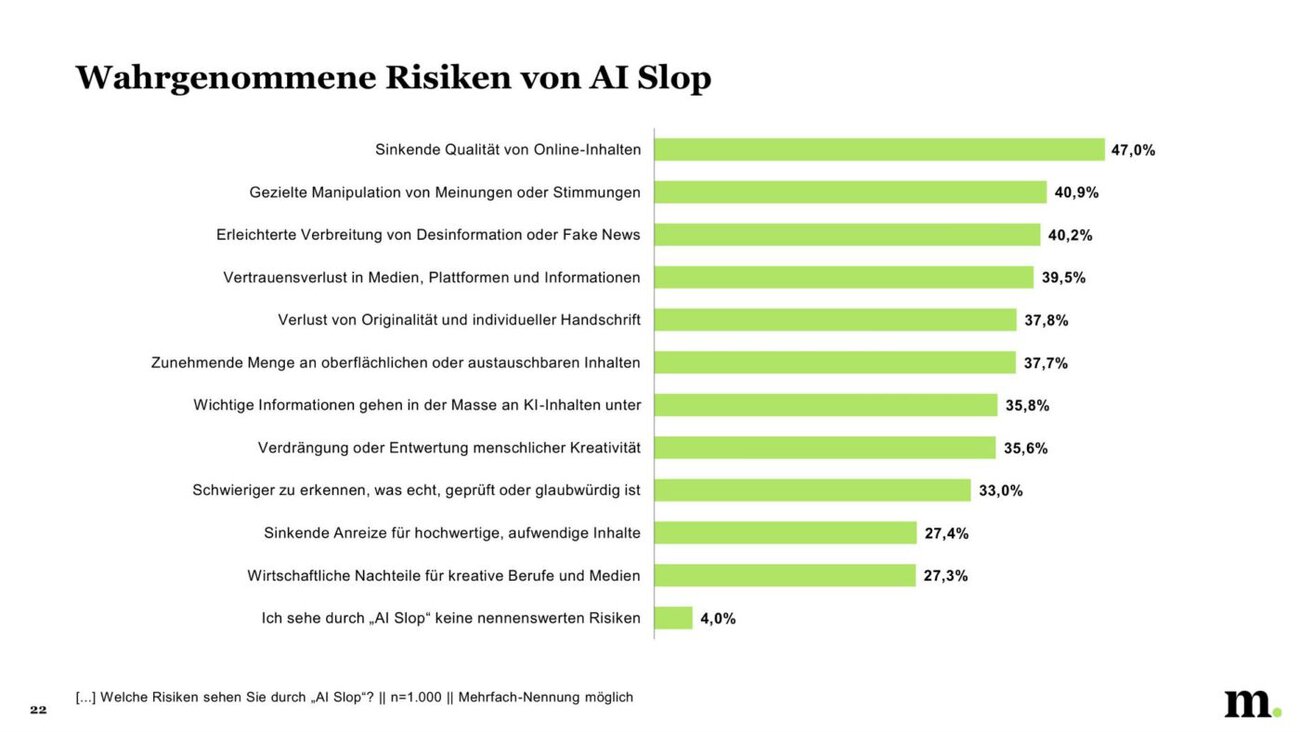
The term «AI slop»—mass-produced, often superficial AI-generated content—is not yet widely known in this country (33 percent are familiar with it; among Gen Z, the figure is 54 percent). However, 73 percent are already actively aware of the phenomenon behind it. The greatest risks are considered to be a decline in the quality of online content (47 percent), targeted manipulation (41 percent), and the spread of disinformation (40 percent). Three-quarters of respondents expect this trend to continue to grow in the future (74 percent).

The study was conducted as an online survey (CAWI) via the Marketagent reSEARCH platform. A total of 1,000 people between the ages of 14 and 75 were surveyed; the sample was representative of the Swiss population in German-speaking and French-speaking Switzerland.
More information about the study and Marketagent Switzerland's services is available at https://www.marketagent-schweiz.ch.
]]>
Vacant retail spaces, changing consumer habits, and the desire for flexible shopping options are transforming the Swiss retail sector. A representative study by the market and opinion research institute Marketagent shows that vending machine shops are widely known among the Swiss population and are being used more and more—especially by Generation Z.
Concerns About Vacancies in City Centers
The development of many town centers is a growing source of concern for the public. Sixty-three percent of Swiss people feel that the number of vacant storefronts is increasing, and 72 percent view this trend as generally worrisome. Finding new uses for vacant retail spaces is therefore becoming increasingly important.
For the study, 1,000 people aged 14 to 75 who were representative of the Swiss population were surveyed. The survey was conducted between April 30 and May 11, 2026, via online interviews on the Marketagent reSEARCH platform.
High brand awareness, growing interest among vending machine shops in Switzerland
88 percent of respondents have already heard of vending machine stores—unstaffed stores where products can be purchased from vending machines around the clock. 29 percent have already shopped at such a store themselves. The younger generation is particularly open to this concept: among Generation Z, the proportion of people who have used these stores so far is already around 40 percent. By comparison, among baby boomers, this figure is only 14 percent.
Flexible and practical—but not without its critics
The biggest perceived advantage is their round-the-clock availability: 64 percent appreciate that vending machine stores are open 24/7. 57 percent see them as a practical solution for emergencies, such as when a product is needed urgently and traditional stores are already closed. One in four also appreciates the time savings: 25 percent see this as a way to get their shopping done quickly. Other benefits mentioned include the ability to access products even outside of regular business hours (about 38 percent) and the potential to offer regional products (about 21 percent).
On the other hand, there are significant concerns: 46 percent cite the threat of job losses in the retail sector as the biggest drawback. Possible technical glitches and a limited product selection are each cited by 41 percent of respondents, while 40 percent also mention price markups on products.
A complement to, rather than a replacement for, retail
According to the study, train stations and bus stops (56 percent) as well as rural areas (36 percent) are considered particularly suitable locations—that is, places where there is demand for flexible shopping options or where there are gaps in local services.
Overall, a majority does not view vending machine stores as a replacement for existing retail outlets, but rather as a complement to them. Nearly two-thirds—62 percent—see them as a useful addition to brick-and-mortar retail. Fifty percent believe that vending machine stores could help fill vacant storefronts and revitalize streets. At the same time, half the population advocates for clear rules: one in two supports restrictions at night or in residential areas. Only 14 percent completely reject shopping at a vending machine store—though among baby boomers, that figure rises to 29 percent.
Roland Zeindler, Managing Director of Marketagent Switzerland, summarizes the findings: «Vending machine stores are also tapping into the spirit of the times in Switzerland. The concept is particularly popular with Generation Z: For them, flexibility, speed, and round-the-clock availability are clearly the top priorities. Older consumers, on the other hand, are significantly more cautious about vending machine stores. This shows that, as a complement to traditional retail, vending machine stores have potential—but they must build trust, operate in a way that’s easy to understand, and clearly communicate their added value. Especially in areas where local supply chains have gaps or where vacant spaces call for new usage concepts, they can be an exciting building block.»
For more information about the study and Marketagent Switzerland's research opportunities, please visit https://www.marketagent-schweiz.ch.
]]>
When the opening whistle blows in June 2026 in Canada, the U.S., and Mexico to kick off the 2026 World Cup in Switzerland, many TV screens in living rooms will light up—though not without some critical commentary. The digital research institute Marketagent conducted a representative survey of 1,000 Swiss residents to gauge just how much anticipation there really is—and where that enthusiasm reaches its limits.
Majority Wants to Get Involved – National Team as the Deciding Factor
47 percent of those surveyed say they are generally interested in the World Cup. Despite the match times being inconvenient for Europe, 58 percent plan to watch at least a few games, and 15 percent even want to watch as many games as possible. At the same time, the idea of a boycott is present: 11 percent say they intend to deliberately ignore the World Cup.
Interest in the tournament clearly varies by gender and age. Men (57 percent) show significantly more enthusiasm than women (38 percent), and Generation Z (56 percent) remains particularly engaged with the tournament.
The biggest draw is the Swiss national team: Among World Cup viewers, 73 percent are particularly interested in the Nati’s games. This is followed by semifinal and final matches (58 percent) and games featuring popular soccer nations (52 percent). The living room remains the World Cup hub—82 percent will watch the games at home on TV. Just under a quarter plan to visit public viewing areas (24 percent), and about a third want to watch the matches with friends or family (31 percent).
For many people, a typical World Cup evening goes beyond simply watching the games: snacks (39 percent), watching together (39 percent), and joining in the discussion (33 percent) are an integral part of the experience.
Cautious Optimism for the Swiss National Team
When it comes to sports, the Swiss remain realistic. Most respondents expect the Swiss national team to be eliminated in the round of 16 (35 percent) or the quarterfinals (31 percent). At the same time, one in ten people believes that the Swiss national team could pull off a major upset in 2026. Spain is considered to have the best chance of winning the title (20 percent).
2026 World Cup in Switzerland: Unifying, but Under Increasing Strain
More than three-quarters of those surveyed agree that the World Cup brings people together across borders (78 percent). Two-thirds generally see potential for positive social impact and greater social cohesion (66 percent). At the same time, expectations are clear: 87 percent believe that major sporting events should be apolitical.
This expectation is met with a critical view of the situation: 65 percent say the World Cup distracts from more important issues. More than six in ten respondents disapprove of corruption and a lack of transparency (64 percent) as well as political influence (62 percent). Fifty-four percent specifically criticize FIFA, the world soccer governing body; more than half criticize the high level of commercialization (52 percent); and nearly one in two people point to the environmental and climate impact (45 percent).
The choice of host countries is also not entirely convincing: Only 39 percent approve of holding the tournament in Canada, the U.S., and Mexico. More than half of respondents (55 percent) say that the political situation in the United States affects their personal interest in the World Cup.
«The World Cup remains an emotional gathering that brings people together, but at the same time, our study clearly shows that enthusiasm today is more contingent than it used to be. People want to experience great moments, but at the same time they expect more transparency, less political posturing, and more credibility from those in charge,» says Roland Zeindler, managing director of Marketagent Switzerland.
About the study
The 2026 World Cup Radar was conducted by Marketagent as an in-house study. During the survey period from April 30 to May 11, 2026, 1,000 people between the ages of 14 and 75 in German-speaking and French-speaking Switzerland were surveyed online. The sample is representative of the Swiss population.
For more information about the study and Marketagent's research offerings, visit https://www.marketagent-schweiz.ch.
]]>
Disinformation as a central problem in the industry
The Journalist:innenbarometer 2026 of the digital research institute Marketagent shows: The world of information is changing rapidly. More than 550 media professionals from Switzerland, Austria and Germany were surveyed for the latest edition - and the results are clear. 90% of respondents see algorithmic bias in social networks as a relevant factor influencing public opinion. 88% cited fake news and 84% AI-generated content as significant factors. There is almost unanimous concern about the audience: 97% of the journalists surveyed believe that it is becoming increasingly difficult for people to distinguish reliable information from manipulated content. 96% also observe that the disinformation problem has become more acute over the past five years.
Media brands as orientation anchors in the information chaos
According to the experts, traditional media brands are becoming more important again in this increasingly confusing information landscape. According to the study, 77% believe that the brand of a medium will become more important for the audience in the future. More than two thirds - 69% to be precise - are already observing that media brands are increasingly perceived as a signal of trust in journalistic practice. Among deputy editors-in-chief, the figure is as high as 79%.
When people have to decide in future whether information is credible or not, the journalists surveyed expect to be guided primarily by well-known and established media brands (63%), individual journalistic or publishing personalities (50%), their own media expertise and experience (48%) and transparent sources (47%). Recommendations and reviews from personal contacts follow with 42%.
From the journalists' point of view, strong media brands fulfill several functions at the same time: they serve as classification and provide context (62%), offer orientation in an information overload (55%) and help to distinguish disinformation from journalistic content (53%). They could also be perceived as a signal of quality and a guarantee of trust - 52% of respondents see it this way.
«Especially in a world full of AI content and disinformation, quality journalism can play to its greatest strength: Trust. If media consistently focus on transparency, classification and journalistic standards, strong media brands can become the most important points of reference in the digital information society,» says Thomas Schwabl, founder of Marketagent.
Marketagent: Hope and skepticism among industry insiders
However, the Marketagent study reveals a remarkable ambivalence within the industry. On the one hand, many journalists are already observing an increasing importance of media brands as a signal of trust. On the other hand, the future of traditional media remains uncertain from the perspective of many insiders: although almost one in two believe in a renaissance of traditional media brands, 66% consider this idea to be at least partly wishful thinking.
The view of AI is also critical: 72% believe that AI will undermine the credibility of journalistic content in the long term. 68% expect media brands to differentiate themselves more strongly in an AI-dominated information world.
Quality journalism as a niche offering?
Probably the most sobering finding concerns the future role of quality journalism. Many respondents assume that it will become more important, but for a smaller audience. 33% believe that the most likely scenario is that professional quality journalism will primarily be a niche offering for an informed minority in the future. The respondents see the following core tasks as particularly relevant for the future of journalism itself: Orientation in information overload (49 percent), transparency about sources and working methods (47 percent), investigative journalism (45 percent) and in-depth classification instead of fast news (43 percent).
«The industry continues to believe in the importance of trust, credibility and journalistic quality, but doubts whether these values will still reach a broad public in the digital platform age,» says Schwabl.
The Journalist:innenbarometer 2026 is based on 579 online interviews (CAWI) conducted between March 18 and April 7, 2026 via the Marketagent reSEARCH platform. The core target group was journalists from Austria, Germany and Switzerland.
]]>

The economic mood in Switzerland has deteriorated. This is shown by the current Champagne Index Switzerland, published by Marketagent in April 2026. For the study, 103 companies were asked how full they would pour the champagne glass of the current economic situation. The result: the fill level is 62.7 percent - a drop of 5.6 percentage points compared to the previous year (68.3 percent).
Geopolitical tensions weigh on sentiment
Roland Zeindler, Managing Director of Marketagent Switzerland, puts the decline in context: «The decline is primarily a reflection of a challenging international environment. Geopolitical tensions, fragile supply chains, the interest rate and inflation environment and technological change are currently putting companies under pressure on several levels simultaneously. The somewhat more subdued mood should therefore be read less as a slump and more as a normalization following the more optimistic expectations of previous years.»
Compared to Austria, however, Switzerland is much more optimistic: while Swiss companies would fill the glass 62.7 percent of the time, the figure in Austria is only 46.7 percent.
Cautious expectations for the next twelve months
When asked about the most suitable drink for the overall economic development of the next twelve months, only 9.7% of respondents chose champagne - significantly less than in the previous year (12%). The majority opted for sparkling wine or wine (39.8%) and fruit juice (31.1%). As many as 12.6% opted for still water and 6.8% for vodka - they want to forget.
Despite the subdued overall mood, many companies are self-confident: 16.5% see themselves in the competitive arena, where they set the tone. A further 24.3% place themselves in the VIP box and are among the best. A total of 25.2% play in the front row in front of the stage.
Majority would invest in their own company
A strong signal of confidence in their own performance: 73.8% of respondents would buy shares in their own company - with 35.9% «definitely» doing so. In the previous year, this figure was 82%. In terms of performance expectations for the next twelve months, 49.5% gave a rating of between 61 and 80 points on a scale of 0 to 100, with 100 corresponding to an Oscar.
The study also shows that decisions are made in Swiss companies at an average speed of 171 kilometers per hour - slightly slower than in the previous year (177 km/h). The quality of these decisions is rated by 68 percent with four or five stars in a fictitious Google review.
Michelle Obama as advisor of choice
When asked which personality the respondents would include on an advisory board, Michelle Obama was the clear leader with 30.1%, ahead of Bill Gates and Jeff Bezos (8.7% each). The Dalai Lama follows with 7.8 percent, Carsten Maschmeyer and Elon Musk achieve 6.8 percent and 4.9 percent respectively.
For the Champagne Index Switzerland, Marketagent surveyed a total of 103 companies via online interviews between December 31, 2025 and March 25, 2026. The sample covers various industries and company sizes, with 62.1% coming from the service sector. 33 percent of respondents work in large companies or groups with 250 or more employees.
]]>
On average, respondents would like to see an age limit of 15, but at the same time doubt that platforms can reliably verify the ages of their users.
Majority Sees Social Media as a Threat
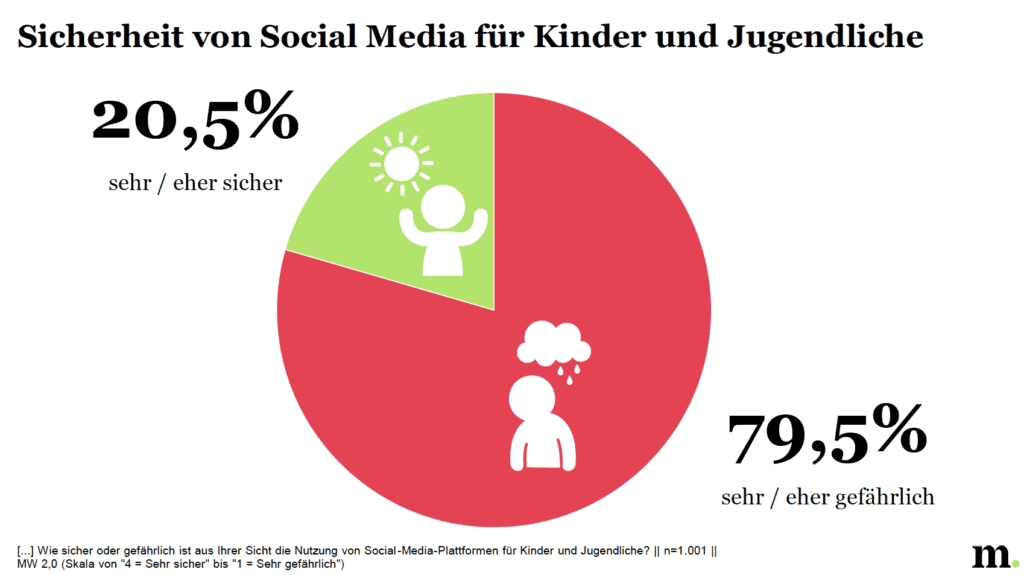
Today, children and teenagers naturally spend time on TikTok, Instagram, or Snapchat, but the Swiss public views this digital world with a critical eye. Eighty percent of those surveyed believe that social media is somewhat or very dangerous for young people, while only one-fifth consider these platforms to be safe.
The study shows that opportunities such as access to knowledge and education (37 percent), the acquisition of digital skills (35 percent), and social networking (34 percent) are certainly recognized, but they take a back seat to the perceived risks. In particular, cyberbullying (69 percent), addiction and excessive use (63 percent), and sexual harassment (62 percent) shape the public’s perception of risk.
Call for a statutory minimum age
Alongside international regulatory efforts—such as Australia’s ban on social media for children under 16 or the planned restrictions for children under 15 in France—the call for age limits is also gaining traction in Switzerland. Eighty-three percent of respondents support a legal minimum age for social media, with the desired average age being 15.
It is noteworthy that support is high across all generations: both 14- to 19-year-olds and those over 60 are equally vocal in their support for a legal age limit. For many, a minimum age is seen as a key component in better protecting children and adolescents and enabling them to use social media responsibly.
Responsibility of Parents, Platforms, and Policymakers
When considering the question of who should ensure compliance with a minimum age requirement, a nuanced picture emerges. 43 percent of respondents believe the primary responsibility lies with parents, 23 percent with the platforms themselves, and 19 percent with the government.
At the same time, a clear majority of 64 percent does not believe that social media providers can reliably verify users’ ages. The public expects parents to guide their children, set rules, and monitor their activity, while platforms and policymakers create a framework that effectively supports the protection of minors.
TikTok as the riskiest platform
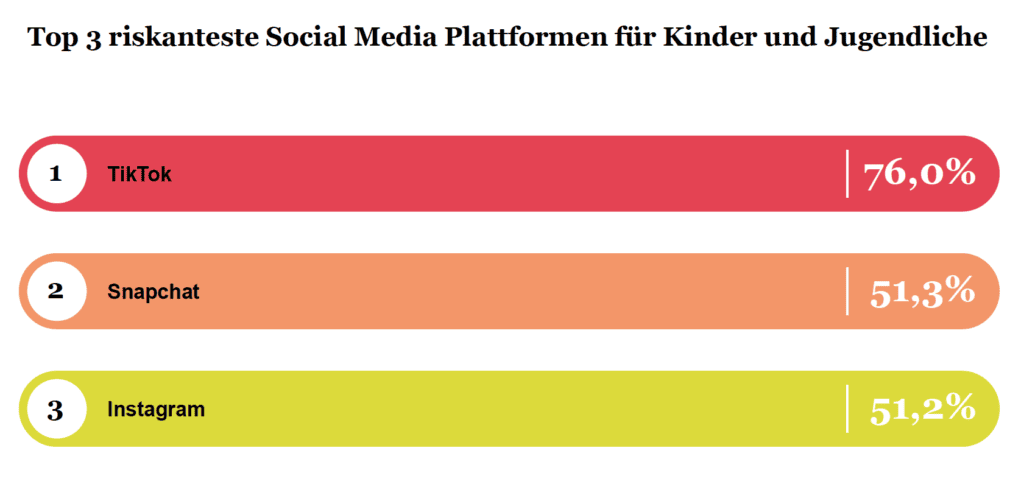
The assessment of individual platforms is also clear-cut. TikTok is rated by 76 percent of respondents as particularly risky for children and adolescents, placing it well ahead of Snapchat and Instagram, which are each classified as problematic by 51 percent of respondents.
X/Twitter and Facebook (39 percent each), as well as YouTube (24 percent), are also facing criticism, albeit to a lesser extent. It is striking that younger people in particular are more likely to perceive Instagram as risky (70 percent of 14- to 19-year-olds) than older respondents (42 percent of 60- to 69-year-olds).
]]>
Around a third of respondents state that they often only read headlines. This proportion is highest in Switzerland at 39 %. The "pragmatic news type" dominates (36 %), while a quarter describe themselves as "news junkies". Only 2.7 % show no interest in current events.
Television remains the leading medium - social media is catching up
Despite digital alternatives, TV (49 %) remains the most important news channel, followed by radio (41 %) and social media (34 %). Among 18 to 29-year-olds, social platforms clearly lead the ranking with 52 %. The study thus shows a clear generational difference in media behavior.
Objectivity and free access count more than brand
For 46 % of respondents, independence is the most important criterion when choosing a news source, closely followed by free of charge (45 %). Quality (37 %) and comprehensibility (36 %) are in second place.
News frustration due to negativity and excessive demands
67 % of respondents are occasionally annoyed by news coverage, particularly on topics such as domestic politics, war and the climate crisis. Over half feel overwhelmed by the flood of news. Positive feelings such as joy or inspiration remain the exception with 14 % and 18 % respectively.
Constructive journalism as a counterweight
The majority would like to see more perspectives (59 %), context (48 %) and less cynicism (47 %). 37 % call for the media to report in a more solution-oriented way. According to Market Agent founder Thomas Schwabl, the study shows "a clear longing for journalism that not only describes problems, but also shows ways forward".
AI in the newsroom: use yes, trust no
More than a third (37 %) believe that AI is already used in around half of all posts. However, 73 % have less trust in AI-generated content, 81 % demand clear labeling. For Roland Zeindler, Managing Director of Marketagent Switzerland, it is clear: "The desire for transparency is enormous - trust remains the most important currency in journalism."
About the study
Marketagent surveyed a total of 3,000 people in Switzerland, Germany and Austria online in February 2025 for its own study.

The Journalist Barometer 2025 by Marketagent and Farner | Team asked more than 500 media makers from the DACH region how they personally experience the changes in the media world.
In response to the socially relevant question of what the Swiss media could do to combat increasing polarization, for example, over 85% cited objective and fact-based reporting and the exposure of fake news. Three out of four are in favor of avoiding sensationalist journalism. However, respondents across the DACH region describe their everyday reality differently: 77% of all journalists surveyed complained that the cost-cutting measures did not allow them to maintain journalistic standards. And one in three Swiss journalists admits that the importance of seriousness in the way they work has diminished.


Media influence social trends
The majority of those surveyed see its power as great. Almost 95% describe journalism as a force that can consciously or unconsciously influence social trends. An overwhelming majority (92%) also believe that it can contribute to the cohesion of society. When asked the critical question of whether journalists in Switzerland should consciously influence trends, respondents are cautious: 65% say "rather not" or "no, definitely not". Just over half (58%) believe that facts should be the main focus, but that personal viewpoints should be allowed to resonate depending on the situation.

Dwindling influence of print and radio
Over 90 percent of Swiss journalists say that print media have lost relevance. Around 70 percent see a loss of importance for television and almost 60 percent for radio. In contrast, journalists believe that social media (almost 85%), online and digital platforms (more than 75%) and podcasts (almost 80%) are gaining in importance. The loss of importance of traditional media is also reflected in the shaping of public opinion. 77% see social media as the top opinion-forming media today and 70% the digital platforms.

Television continues to have a formative influence on public opinion in the view of almost half of respondents (48%), while print media only has a formative influence in the view of around 40%. Radio is clearly lagging behind, with only 25% still believing it has the power to shape public opinion. "What we are seeing is a clear paradigm shift: what used to be the leading medium is losing its appeal," explains Marketagent founder Thomas Schwabl. "Social media and digital news formats have become the most powerful opinion leaders, while traditional media have lost ground. This is not only changing the reach, but also the rules of journalism."

Still a dream job for many
Despite all the challenges: More than one in two Swiss respondents are optimistic that their jobs are very or fairly secure. And those who are still in the profession are passionate about their work, according to the Journalist Barometer. 63 percent describe their job as their dream job.
"Swiss journalists reflect on their role in society with great care," comments Farner Partner Toby Felder on the responses collected by Barometer 2025. "However, the results also confirm that journalists are finding it increasingly difficult to fulfill this role due to economic pressure."
In collaboration with Farner | Team Farner, the digital market and opinion research institute Marketagent surveyed over 500 media professionals in the DACH region, including 168 journalists from Switzerland, from March 3 to 16, 2025 using CAWI (Computer Assisted Web Interviews).
]]>
Influencer marketing is at a turning point: while younger industry insiders and large companies continue to see potential, the general appeal of this form of advertising is declining. This is shown by a recent study by Marketagent in cooperation with the Austrian Marketing Association (ÖMG) and the Public Relations Association Austria (PRVA), in which 600 marketing and communication experts from Switzerland and Austria were surveyed.
Have we had enough of content creators?
In the attractiveness ranking of digital forms of advertising, influencer marketing is in last place - in Switzerland, only 37% of advertising professionals find it attractive, in Austria 41%. Older communication professionals are particularly critical: only 26% of experts aged 50+ still find this form of advertising attractive (under 30s: 70%). Influencer marketing is also only viewed positively by 2 out of 10 Swiss respondents.

Nevertheless, around 4 in 10 (39%) domestic industry insiders expect influencer marketing to become increasingly important in the coming years - paradoxically, in an environment that is increasingly showing signs of "influencer fatigue".
"Hardly any other topic is currently being discussed as controversially as influencer marketing," explains Thomas Schwabl, founder of Marketagent Switzerland. "While large corporations such as Unilever want to massively increase their use, we are hearing more and more about influencer fatigue and declining importance. And our study results are just as dualistic: While influencer marketing is rated the least attractive of all digital advertising formats, more than half of the communication experts surveyed expect it to become more important in the future."
Content creator in transition: attitude instead of glossy
The biggest challenges in connection with influencer marketing are the oversaturation of consumers (49%), the loss of authenticity (48%) and the problems surrounding fake followers and bots (48%). Around two thirds of those surveyed are experiencing the first signs of fatigue, with 24% already talking about very pronounced fatigue. When selecting content creators, the focus should therefore be on authenticity (87%), content quality (86%) and thematic relevance (82%). Marketing professionals consider reach to be of secondary importance. On the contrary: micro-influencers in particular (10,000-100,000 followers) are considered the most effective option according to 32% of respondents.

"In an increasingly oversaturated digital world, it is not the size of the reach that determines success, but the credibility of the message," says Roland Zeindler, Managing Director of Marketagent Switzerland. "Authentic, relevant content is more important today than ever before - and it is micro-influencers in particular that marketing and communication professionals believe have the greatest potential here."

Despite criticism, many industry insiders appreciate the advantages of influencer marketing: addressing specific target groups (39%), reach (38%) and setting trends (31%) are cited as key strengths. The use of influencers appears to be most suitable for addressing new target groups (42%), increasing awareness (40%) and promoting impulse purchases (39%).


The realignment of Marketagent Switzerland focuses on speed, new research tools and in-depth methodological expertise. An interdisciplinary team of psychologists, sociologists and business economists is available for consumer research studies. With an ISO-certified online panel of over 3.2 million people and around 1,000 study projects per year, the institute aims to continue to provide well-founded market insights. The portfolio includes ad-hoc studies, multi-client analyses and AI-supported in-depth interviews, which are intended to more closely interlink quantitative and qualitative research.
The tried-and-tested Omnibus will be continued in 2025, supplemented by new research tools such as the Labor Market Compass, the Cryptobarometer and the "Brand.Diamonds" brand ranking. A key innovation is the AI-based method "Glaut", which supplements open questions in questionnaires with in-depth qualitative analyses. "Simple open questions are about to be replaced by an AI upgrade," says Roland Zeindler, the new Managing Director of Marketagent Switzerland.
Marketagent sees the realignment as a clear signal for future-oriented research. Founder Thomas Schwabl emphasizes the optimistic view of the future: "Roland is an experienced colleague who will leave the beaten track with us and lead Marketagent Switzerland into the future."
]]>
Whether a romantic highlight or exaggerated marketing hype - Valentine's Day polarizes opinion. A recent study by Marketagent Switzerland of more than 1,000 respondents shows that enthusiasm for February 14 is rather muted. "Only a quarter of German-speaking and French-speaking Swiss people think it is important to celebrate Valentine's Day," says Roland Zeindler, Managing Director of Marketagent Switzerland.
There is a clear age difference here: while the day hardly plays a role for older generations, Generation Z, at 39 %, attaches the most importance to celebrating. Surprisingly, more men (30 %) than women (19 %) attach importance to Valentine's Day.
Romance or commerce?
Despite its long tradition, Valentine's Day remains a day with an ambivalent perception for many. The majority of respondents see it as commercial, exaggerated and kitschy - yet two thirds recognize its romantic character. At the same time, only a small proportion know where the custom actually comes from: Only 14 % of respondents know the historical background in detail, while 40 % know at least some details.
Gifts and expectations
Although many are skeptical about the day, almost half (45 %) plan to give a gift on February 14. Flowers (24 %), love letters (22 %) and chocolate (19 %) are particularly popular. The Swiss are generous: the median amount spent on gifts is CHF 50. It is striking that men (40 %) are more likely to give gifts to their partner than women (30 %).
While 17 % of respondents would be disappointed if their partner ignored the day, this figure is significantly higher among Generation Z at 48 %. At the same time, 12 % feel relieved if they don't have to celebrate Valentine's Day. Particularly explosive: 36 % of respondents report that a gesture meant to be friendly on Valentine's Day has been misunderstood as a romantic signal - proof of how differently this day can be perceived.
]]>
The average stress level in German-speaking Switzerland is 3.7 on a scale of 1 (very low) to 7 (very high). While 12% of respondents rate their stress level as high, one in five (24%) feel little to no stress. Everyday life is particularly challenging for people with care responsibilities: Both parents and people who look after relatives in need of care report significantly higher stress levels. "Care tasks are among the often invisible but enormously stressful stress factors that urgently deserve more social attention," says Andrea Berger, Research & Communications Manager at Marketagent.
Work, time pressure and finances as stress triggers
At 37% and 33% respectively, time pressure and financial worries are among the biggest stress factors in German-speaking Switzerland. More than three in ten people (32% in each case) are also stressed by the work survey and work, career and education in general. Teenagers and young adults feel the pressure of school, studies and the like particularly strongly: with 48% agreeing, this is by far the biggest stress trigger in the 14 to 29 age group.

Social media is stressful
The study clearly shows that a healthy lifestyle can help to alleviate stress. Participants with lower stress levels reported better eating, sleeping and exercise habits. People who pay attention to a healthy daily routine therefore benefit both physically and mentally. In contrast, constant digital accessibility appears to be a risk factor for mental health. People with higher stress levels are more likely to use their smartphone to check messages or calls. Intensive social media use also correlates with increased feelings of stress.
Reactions to stress
Stress leaves clear traces: irritability and impatience (55%) as well as sleep problems (45%) are the most common immediate reactions. It is particularly alarming that more than six out of ten respondents report long-term physical complaints such as sleep disorders, headaches or back pain (64%). This highlights the need for preventive measures.

Burnout: one in four feels at risk
One in five respondents (20%) had already experienced burnout themselves, and three in ten know someone affected in their own environment. "It is particularly worrying that 26% of the survey participants classify themselves as (rather) at risk of burnout - in the group with a high stress level, this figure is as high as 63%. These figures show how urgently society needs to change towards more prevention and support," emphasizes Thomas Schwabl, founder of Marketagent Switzerland.
Learn stress management
Almost one in two (49%) have already actively informed themselves about stress management. At the same time, around three quarters (73%) demand that stress management should be an integral part of schools and vocational training programs. "This is an opportunity to take a preventative approach and promote stress competence. The results clearly show that young people in particular are under enormous pressure due to the demands of school and work. Overall, more support and attention is needed to help them cope with these pressures," explains study director Silke Hirschberger.
Nature as the key to relaxation
Only just under half of German-speaking Swiss manage to maintain their composure in stressful situations (49%). Relaxation is also a challenge: Only 52% are able to relax very or fairly well, with only 18% managing to do so very well.
The most effective measures for coping with stress are spending time in nature and getting enough sleep - a good six out of ten respondents find these strategies particularly helpful. 45% also consciously use time out in nature in their everyday lives. 42% get enough sleep.

One in five people consciously make time for relaxation exercises every day. People with a low stress level are particularly successful at this - a third of them (33%) have firmly integrated these relaxation breaks into their daily routine. On the other hand, there is a worrying vicious circle: precisely those who need relaxation most urgently are unable to find space for it. In the group with a high stress level, 41% state that they would like to do relaxation exercises regularly, but are currently unable to incorporate them into their everyday lives.
]]>