A misunderstanding between him and his investor Georges Bindschedler proved to be the young entrepreneur's undoing. Bucheli assumed that the Bernese lawyer would support Mag20 in the longer term after presenting him with a business plan for the period up to the end of 2013. However, Bindschedler only wanted to help the project get off the ground with a loan. "I personally never intended to provide long-term or temporary financing," Bindschedler told Werbewoche when asked. He also said that he was prepared to present the project to the Board of Directors of Medien Vielfalt Holding, in which Bindschedler is the second largest investor after Tito Tettamanti, "and, if approved, to have it partially financed". It is questionable whether the application already submitted to the holding company, which also finances the Basler Zeitung BaZ, will be dealt with at all.
But how could there have been a misunderstanding on such a fundamental point? "We talked past each other," Bucheli explains to Werbewoche. In his euphoria, the qualified auditor did not insist on a written agreement, which would presumably have clarified the misunderstanding. "I take the blame for that. The fact that I didn't clarify the financing better is my fault." He does not want to accuse Bindschedler of anything. "It's not a matter of course that someone would give such start-up support in the first place."
Barely started, already finished?
What happens next is still up in the air. The crowd-sourcing project has few financial obligations. There was no long-term agreement with the print shop. The contracts with the distributors, which Bucheli had initially hired with a three-month notice period, were terminated soon after the launch and new ones were drawn up via the distribution company Promokant.
Mag20 is currently at a standstill. Bucheli is not (yet) looking for new investors. He wants to use the shutdown to go over the books. Nevertheless, Bucheli has not lost his optimism: "I can well imagine that we will relaunch. However, until we have a clean solution, it makes no sense to restart." Bucheli sees particular potential for improvement in the rating system on the website. The fact that users could only express their sympathy for an article by recommending it on social media platforms led to a low level of participation. Apparently, not everyone wanted to let their friends on Facebook, Twitter or Google+ know that they had read a Mag20 article. (imp)
]]>
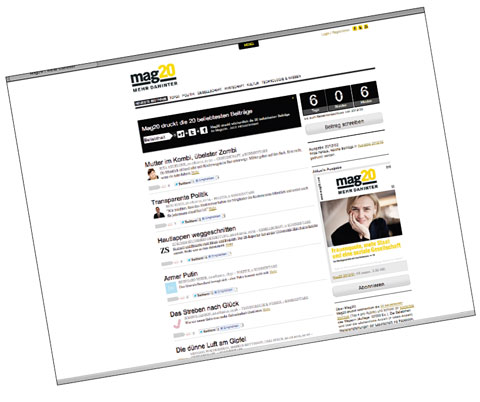
Mag20 is a crowdsourcing magazine in which readers, by means of referrals, refer to Mag20.com choose a total of 20 articles to be printed in the magazine. The magazine is published weekly with a circulation of 50,000 copies. Mag20 is intended to serve as an alternative to free newspapers, ZS Werbe AG said in a statement on Thursday.
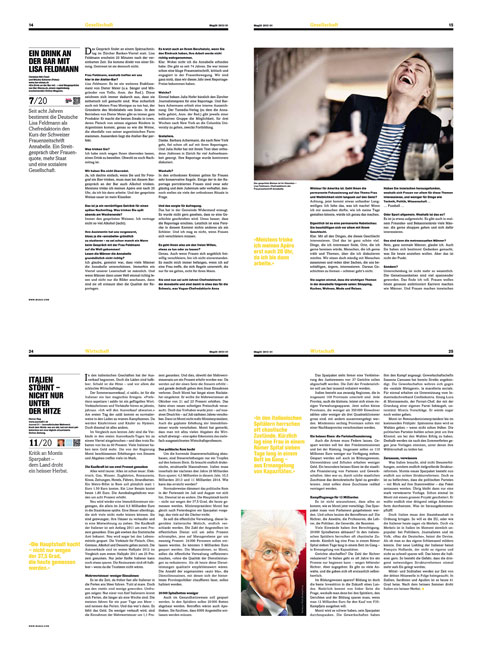
Last Friday was the first time. In addition to the familiar free titles that commuters encounter at train stations, there was a new magazine. A 46-page magazine with articles on politics, society, business, culture and knowledge. The cover reads "Mag20 - More behind it". A title that already reveals a lot about the new media project of former auditor Markus Bucheli. "20" stands for the number of articles in the weekly magazine, "Mag" for magazine. "More behind it" indicates that there is no editorial team behind Mag20, but an entire community. Unlike most print products, it is not journalists who contribute the content here, but the users themselves. The core of the experiment is the platform Mag20. com. This is where the authors upload their articles. At the same time, the website lays the foundation for the print product, because on Mag20.com the community decides which texts are printed in Mag20. The criterion is the number of recommendations an article receives on Facebook, Twitter or Google+. In this sense, the "Mag" in the title is equally to be understood as an allusion to "I like" or more aptly "I like".
As a crowdsourcing project, the magazine experiment stands and falls with the community, the number of authors and users who actively participate on the platform. At the start, Bucheli is primarily concerned with attracting as many authors as possible. Bloggers, scientists, politicians, students, professionals, but also journalists who publish their articles on Mag20.com. In addition, Mag20 receives articles from media partners who gain a wider reach through their presence on Mag20 - including Blogwerk, dieperspektive, Journal21, Politnetz, Schweizer Monat, The Brander and Transhelvetica. To make Mag20 known to a wide audience, the print magazine will be distributed at train stations on Fridays. In addition, advertisements are running on media partner Radio 105 until the end of the year, enticing listeners to the website with the prospect of a voucher from the online bookshop Storyworld.
On the one hand, the project is financed by advertisements in the print magazine. On the other hand, the young entrepreneur was able to convince the Bernese lawyer Georges Bindschedler, who is also an investor in the Basler Zeitung BaZ, of his project. The magazine experiment should be secured by the end of 2013 and the operating, printing and distribution costs covered for the time being. Subscribers currently represent an unsecured source of income. The majority of the 50,000-copy circulation reaches readers free of charge via distribution. Likewise, no money comes in when users order an e-paper subscription on the website. Readers only have to pay to have the print magazine delivered by post. However, the profit margin - if any - is likely to be minimal. After the postal subscription was announced at CHF 119 in an early phase of the project, the price for 52 issues is now set at CHF 52.
Bucheli explains the both-and strategy for the payment model and other specifics of the project in an interview.
Isabel Imper
"We rely completely on the reader"
Interview with Markus Bucheli (28), founder and publisher of Mag20.
WW: Mag20 does not offer exclusive texts, but uses contributions from the Mag20 website. Why should anyone pay for texts that are available for free?
Markus Bucheli: I think there are still people who appreciate the haptic experience and like to read something on paper - without this backlighting. That's why it's worth ordering a subscription. Another advantage is that, unlike the website, all the articles in the magazine are proofread, beautifully edited and supplemented with a series of pictures by an artist.
However, I also have these advantages when I use the free e-Paper subscribe and print ...
Absolutely. That is also allowed. But anyone who appreciates the added value of receiving the magazine printed out and beautifully presented every week should be prepared to pay for it. The Post subscription is a classic premium model. The number of e-paper subscribers will probably always exceed the number of Post subscribers. However, we already have a surprisingly high number of Post subscriptions.
How many?
At the moment there are around 61, and we currently have a total of around 545 subscribers - just a few days after the website went live. I'm looking forward to seeing how it develops.
Which target group do you want to reach with the print product?
At the moment, the majority of copies are distributed free of charge at train stations. We reach active people there - including students and working people. Our target group is between 18 and 49 years old. Men and women should each make up 50 percent of our readership. We are aimed at people who appreciate having something of high quality in their hands. Mag20 offers content that I don't see every day.
Do the distribution campaigns only take place at the launch or are they continued afterwards?
The distributions will be carried out until further notice. All 20 or so distribution lists are fixed - with a three-month notice period. The reason behind the campaign is a promotional effect. We want to get people onto the platform as quickly as possible - and gain subscribers.
So you have two target groups in mind: those who read the magazine and those who actively participate on the platform, right?
Absolutely. We follow Jakob Nielsen's 90-9-1 rule for user behavior on websites. It states that 90% of users read and watch, 9% interact from time to time and only 1 % contribute content. In our case, that would be 90% who read the magazine, 9% who comment from time to time or recommend something via Google+, Twitter or Facebook. And finally the 1% who write articles. With the last two groups, we will maintain communication that is as personal and direct as possible. In my opinion, this is central to this magazine experiment, as Mag20 needs a large and high-quality community.
Otherwise, you have a few users who determine how the magazine looks ...
Exactly ...
What is the goal: How big should the community be?
We have not defined a number. The aim is to gain as many users as possible...
You have not set a minimum?
No, there is no limit. However, I am optimistic due to the interest that already exists - the many contributions that have been written.
Mag20 does not have a content focus. Are there guidelines as to what kind of contributions are accepted?
In terms of content, we rely entirely on the reader. We print what the reader likes. There is a certain amount of channeling through the sections - classic newspaper sections such as politics, society, business, culture and knowledge. These are designed to optimize reading behavior. This means that the reader reaches the content that interests them relatively quickly.
Mag20 wants to differentiate itself from titles like 20 Minuten. But perhaps users like what they find in the free papers. The article "The snoring of men", for example, was very well received on Mag20.com...
I find the article about snoring interesting. It's a problem we've all had to deal with at some point. Even in established magazines, you can always find articles that make you smile. I think it's important to have interesting articles. But they can certainly be entertaining. It doesn't always have to be the pure seriousness of life.
As an editor, don't you wish you had more say in the content?
No. This is precisely the core of the experiment and the exciting thing about the concept. I deliberately don't want to interfere. However, it is important to me not to have anything unlawful and to comply with the media ethics guidelines of the Press Council. If an article does not comply with the author guidelines - because it is too PR-heavy, for example - we pull the lever.
In what way?
The articles will not remain on Mag20.com. Instead, we publish them on Dismag20.wordpress.com - including the reasons why they contradict the guidelines. Our decisions are transparent.
Back to the magazine: If Mag20 is largely available free of charge, is the magazine mainly financed by advertising?
The hope is to be able to strengthen the subscriber base in the medium term and thus reduce dependence on the advertising market. Advertisements alone do not bring in enough money. However, the authors should receive remuneration for printed articles and be compensated for their time and expenses, which is why we give them a 50% share of our annual profit. I believe that offering a purely free product in the long term is not conducive to quality.
A bold strategy: Publishers also initially offered their news online for free and are now hoping to make money. Once readers have become accustomed to a free product, will they spend money on it later?
We operate a different model to the current providers. The media companies initially released all their content. Now they're scaling back a bit. They are creating pay walls with the effect that users are not prepared to pay for the added value and even leave the platform if possible. With Mag20, on the other hand, the content is accessible everywhere. People who want the added value of a physical magazine, the haptic experience, buy a subscription. But they get the same content.
If you focus on the feel, wouldn't a glossy magazine be appropriate?
Of course, we thought about which direction to take. First we went for ordinary newsprint. Then we had the idea of going for a glossy magazine. But we decided against it because it would not have been financially viable with the current model - free distribution. We chose a middle way with the improved newsprint. I like it a lot. But who knows: it's an experiment. And as with any experiment, there may be adjustments from time to time.
Where does Mag20 stand at the end of 2013?
My aim with Mag20 is to contribute to more media diversity. The magazine should be a tool that allows society to have a say in the public debate. Users can already do this on the web - on blogs, for example. With Mag20, they should also have the opportunity to do so outside of the Internet. Print still has a good reach.
Have you set yourself a target in terms of circulation?
Absolutely not. That will develop. For me, the reader is at the center of it all. They can tell us what they think is relevant - and we will continuously optimize. I believe that if something is right at its core and is continuously optimized, circulation and reach will come naturally.
Interview: Isabel Imper

The owner and editor of Mag20 is Markus Bucheli. Mag20 is a free platform for media partners, students in the media sector and people with interesting articles who would like to benefit from the attention of the readership. This is what Markus Bucheli writes about the planned project. Compliance with the author guidelines, which are based on the specifications of the Swiss Press Council, will be monitored on an ongoing basis, as in a traditional media operation. The publication is intended to offer advertising partners a high-quality and attractively priced alternative to existing print products. The magazine relies on the social networks Facebook, Twitter and Google+.
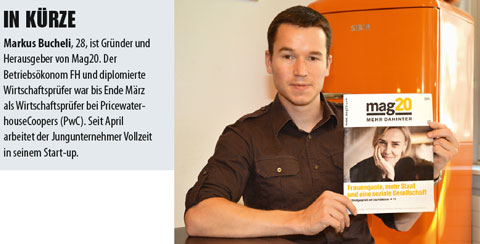
Markus Bucheli, the owner and editor of Mag20, is a business economist FH and qualified auditor. He has been working as an auditor in the financial industry for around 5 years and has been fully dedicated to the Mag20 magazine experiment since the beginning of April 2012. With Mag20, he wants to make a contribution to greater media diversity.