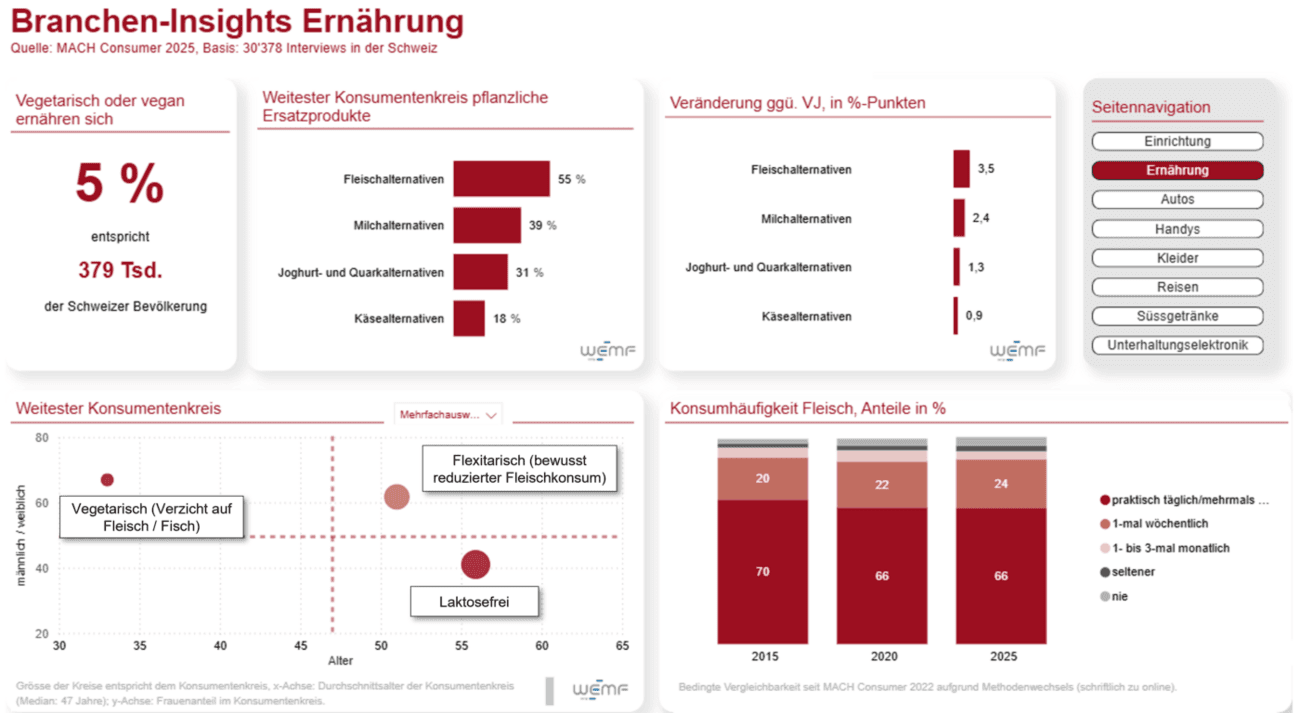
January is all about plant-based nutrition with Veganuary. In keeping with this, WEMF for Advertising Media Research is expanding its industry dashboard to include the food sector, among others. Based on MACH Consumer, Switzerland's largest consumer media study, the interactive tool provides both a quick overview and an individual analysis of current figures and developments in eight different consumer sectors.
Vegan diet still at a low level
A vegan diet is increasingly coming into focus in January with the Veganuary Challenge. But how widespread is the renunciation of animal products really in Switzerland? The WEMF industry dashboard shows the different diets over time: The number of vegetarians and vegans in Switzerland is still at a low level of around 5% over the last three years. Just under one in four people describe themselves as flexitarians and consciously reduce their meat consumption. This has decreased slightly over the last ten years. People who follow a vegetarian or vegan diet are on average 32 years old and 70 percent of them are female.
Insights into eight consumer sectors
With the expansion of the interactive dashboard to include the food and furnishings sectors, WEMF now offers insights into eight consumer sectors: Cars, cell phones, soft drinks, clothing, travel, consumer electronics and, as a new addition, food and furnishings. The dashboard provides representatives of the respective sectors with a compact overview of consumer behavior in each submarket, including market structures, target groups and market potential. Clear visualizations provide an overview of the customer potential of the most important market segments and the positioning of the relevant brands in the respective sector.
The data is based on MACH Consumer, the largest consumer media study in Switzerland, which is conducted annually by WEMF. The dashboard is an ideal introduction to an industry analysis and can supplement internal data sources and market research studies thanks to the diverse portfolio of segments and brands depicted. This content is available free of charge and offers companies a valuable basis for the continuous optimization of their marketing and media strategies. For flexible, in-depth and customized analyses, interested parties can make use of WEMF's Product Consulting service at any time or obtain the MACH consumer dataset with full access and analysis tool.
]]> With today's publication of the new figures, the gaming (incl. gaming genres) and POS (point of sale) categories were published for the first time. New messenger services, additional social media platforms, a streaming network and expanded podcast genres have also been integrated. These complement the previous genres of the study: press, cinema, TV, streaming, radio, podcasts, websites / apps, social media, messenger services, out-of-home / digital out-of-home, digital signage, public transport, direct mail and e-mail marketing.
The ongoing expansion of Mach Strategy is reflected in record-high usage figures among media agencies and underlines its increasing importance for the Swiss advertising market. In the last four years, access to the "Next>Level" data portal has increased significantly. In September 2025, they reached a new record with over 8,000 hits from agencies (rolling annual total) (see chart).
Valérie Goridis, Co-Head of Media Strategy at Webrepublic AG, says of the study: "The Mach Strategy is indispensable for us. It provides the basis for our integrated media strategies and helps us to optimize marketing budgets."
Wemf's Mach Strategy is the central tool for campaign planning and the evaluation of media strategies. All Swiss media agencies use the study as a basis for strategic media planning. The national media study combines socio-demographic information and consumption data with media usage data. This makes it possible to precisely analyze which channels or channel combinations have the highest reach potential for a target group.
Benefits for the advertising market and media market For the advertising market, MACH Strategy offers the possibility of creating cross-genre reach scenarios for advertising planning and thus supports the optimization of marketing strategy, media planning and budget deployment. For the media market, MACH Strategy makes it possible to present multimedia media brands and their usage profiles across the board and to locate them in the advertising market across genre boundaries.
]]>
The intermedia media study Mach Total Audience 2025-1 shows that cross-media strategies of media brands contribute significantly to increasing reach. The study published by Wemf AG für Werbemedienforschung combines data from the Mach Basic print study with online usage data from Mediapulse and thus enables statements to be made about the group of people that a media brand reaches cross-media.
The latest figures show that only 13% of users use both the print and online offerings of a media brand every day. A significantly larger proportion consume content exclusively via one of the two channels. The increase in reach by combining both channels is particularly striking: The daily newspapers in the study increase their overall reach by an average of 58 percent by combining them with the digital offering. Conversely, the digital platforms also benefit: Their reach even increases by an average of 127 percent when print offerings are taken into account.
For media companies, this means that coordinated distribution via print and online makes it possible to reach different user segments and substantially increase overall reach.
The underlying data for the current evaluation is based on Wemf's Mach Basic 2025-1 and Mediapulse's online content audience data for the second half of 2024. As Mediapulse has stopped collecting this online data at the end of 2024, the next edition of the total audience study will be based on a new methodological foundation. Wemf is currently developing a corresponding concept to provide the market with combined reach data in the future. The next edition is scheduled for publication in the fall.
]]>
The aim of Mach Strategy is to cover all relevant media types in the analog and digital sectors. Since last year, the study has also included podcasts as a media category.
Tech-savvy and urban
The proportion of regular podcast users is highest in the 14 to 29 age group at 21%, compared to the population as a whole (12.8 %). This means that every third person who listens to podcasts is under 30 years old. This generation is characterized by a high affinity for new technologies and intensive use of smartphones and consumer electronics.

Podcasts are a firmly established part of digital media usage behavior, particularly among urban dwellers. There are also differences between the language regions in terms of podcast usage. At 13.3 percent, German-speaking Switzerland has a slightly higher proportion of regular users than French-speaking (11.5 %) and Italian-speaking (10.8 %) Switzerland (see Figure 2). Regular podcast users are interested in topics such as science and technology, art and culture and psychology.

New opportunities for the advertising industry and media companies
In general, the results of Mach Strategy 2024 show that podcast use overlaps disproportionately with the use of other digital channels, such as websites, social media and streaming. For traditional media, there is therefore an opportunity to tap into new customer segments via podcasts. For digital media channels, it makes sense to focus more on supplementing and expanding existing content with podcast content.
When planning advertising campaigns with Mach Strategy, the integration of podcasts as an independent media category can provide an even more comprehensive overview of the Swiss media landscape. This supports both the reach and the efficiency of cross-media advertising campaigns. With regular use by 12.8 % of the Swiss population, compared to 11.9 % in 2023, the study underlines the potential of podcasts for the advertising industry.
As a tool for strategic planning, Mach Strategy enables a targeted analysis and implementation of the optimal media mix of press, cinema, TV, radio, Internet in general, websites / apps, social media, streaming (audio / video), podcasts, out-of-home, DOOH, digital signage, public transportation, direct mail and e-mail marketing. For some social media platforms, a distinction can now be made between paid and free versions in the analysis. The category of messenger services has been expanded.
]]>
Sustainability is becoming increasingly important, and buying second-hand clothing can make a valuable contribution to this. The latest data from the Wemf study shows who is interested in sustainable fashion in Switzerland.
Second-hand is popular with the young
According to the study, 15 percent of the Swiss population bought second-hand clothing, thereby contributing to the circular economy. Of these, 41 percent are aged between 14 and 34. The majority of these people are in education and/or have children.

The "MACH Values" psychographic study shows that these people also often belong to the value types of politically committed and unconventional "cosmopolitans". People who buy second-hand clothes are fashion-conscious and also enjoy buying clothes. They like to wear eye-catching and unusual fashions and attach great importance to accessories. They also often advise other people on fashion matters.

Sustainability in focus
Sustainability plays a central role for this group of buyers when buying clothes. They pay above-average attention to the fact that their clothing is made from ecologically produced, natural materials and has been produced according to ethical principles. The above-average willingness to spend on clothing in this target group is also surprising: on average, they spend more than CHF 2,000 on clothing in a twelve-month period. Second-hand fashion is therefore not in demand for economic reasons, but for reasons of sustainability and ethical considerations.
MACH Consumer is the largest continuous consumer media study in Switzerland. It determines the needs, preferences and habits of Swiss consumers. The MACH Values study links consumer data with psychographic information and values. This enables the psychographic positioning of products, brands, services, shopping channels and press media.
]]>
The aim of Mach Strategy is to map all relevant media types in the analog and digital sectors. The two new media categories of podcasts and e-mail marketing complement the inter-media comparison in the digital sector.
Podcasts particularly popular with young people
Since the coronavirus pandemic at the latest, the range of podcasts has been steadily expanding and a wide variety of formats are reaching their listeners. In addition to streaming groups in the audio sector, the use of podcasts can now also be analyzed in Mach Strategy. While the digital market is otherwise dominated by images, podcasts often position themselves with a broad audience through longer formats.
Overall, podcasts reach around 11.9% of the Swiss population on a regular basis. People aged 14 to 34 in particular state that they listen to podcasts at least several times a week. These people have a high level of education and have a high affinity for using audio contributions as a source of information for vacations, entertainment electronics or further education.
Newsletter as a source of information
Email marketing offers the possibility of personalized communication of information and advertising to individuals or groups of people. Mach Strategy now collects the four forms of business emails, newsletters from media offers, newsletters with offers or promotional emails and advertisements.
The two newsletter forms in particular are regularly followed by at least half of the over 35s in their age group. This genre can also be compared as a source of information for different product categories. Accordingly, addressed advertising emails about clothes and shoes attract the most attention among users of both newsletters from media offers and newsletters with offers.
Diverse intermedia comparison
As a tool for strategic planning, Mach Strategy enables a targeted analysis and implementation of the optimal media mix of press, cinema, TV, radio, web offerings, social media, streaming (audio / video), podcasts, out-of-home, DOOH, digital signage, public transportation, direct mail and e-mail marketing.
The Mach Strategy 2023 was published on Thursday with the innovations mentioned above. These are part of the Intermedia Study and can be analyzed using the established Wemf data portal. The Mach Strategy Upgrade Social Media can be purchased for an additional charge.
Another new feature concerns the definition of the population of the Mach universe. This has been adjusted slightly. Since the autumn 2023 publication, this has included the population group of non-linguistically assimilated persons. The purpose of this adjustment is to harmonize the Mach universe with that of other Swiss currency studies, making the inter-media comparison simpler and fairer.
]]>
As always at the beginning of fall, the latest "MACH Basic" figures from Wemf AG für Werbemedienforschung were published last week. Among the printed newspapers, "Schweiz am Wochenende" tops the podium with over one million readers, ahead of the German-language edition of the commuter newspaper "20 Minuten" (with 864,000 readers) and "Nordwestschweiz" (320,000).
Due to a new study method, a comparison with the previous year's figures is only possible to a limited extent. Wemf AG für Werbemedienforschung" has redefined the "basic population". The total mass of readers has increased by 6 percent. This is because people who do not speak the language of their district of residence have now been included.
The second "MACH Basic" figures this year show that newspapers continue to struggle to retain their print readership. "20 Minuten", "Blick" / "SonntagsBlick" and also the "Tages-Anzeiger" have felt the brunt of the print decline this year. On the other hand, the trend at the "Neue Zürcher Zeitung" is upward; the "NZZ" was able to gain new print readers.
The results in detail
Let's look at the results of the "MACH Total Audience" study. This is a measurement that publishers have to choose to participate in. Of the media companies that participate, a total of 4.6 million people in Switzerland consume a news brand (online and print) every day. The latest "MACH Total Audience" figures show that on average only 10 percent of Swiss people use both the print and online offerings of their title every day. Most of them consume their media brand only online or only on paper.
It's obvious that most users have a favorite channel that appeals to them much more and is their first choice. "It is often the case that people also use the other channel from time to time, but not with the same frequency as their favorite channel," explains Finn Stein, Director of Research and Development at Wemf.
The data is based on the two currency studies "MACH Basic" and "Mediapulse Online Content Audience Data. The current figures show that "newsbrands gain significantly in reach if they offer their publication both as a print newspaper and online. Combined brand reach of Swiss media is significantly higher than the reach of the individual print or online channels.
According to Stein, the composition of brand reach shows "a plausible picture with a high exclusive share for print and online offerings and a deep overlap in daily usage."
20 Minuten is the online / print stag
"The fact that we once again occupy the top spot in the 'Total Audience' for Switzerland as a whole pleases us and speaks for the quality of our product," says Eliane Loum-Gräser, Head of Communications at "20 Minuten. With all three national titles and online, the news platform reaches over 2.2 million people every day. "20 Minuten" has been involved in the study since its launch.
Werbewoche.ch wanted to know from "20 Minuten" why the TX Group company is taking part in "MACH Total Audience": "The study provides the value by which we measure ourselves," says Loum-Gräser. He adds that distribution channels are changing significantly over time. "There are steadily fewer newspaper readers, but we already reach over 65,000 people with the WhatsApp channel launched in September, for example." What is really relevant for 20 Minuten is not the channel, but how many people the brand reaches overall.
In May, "20 Minuten" once again invested in its print newspaper with the print refresh (new contemporary design, minimum size, daily lifestyle). This has been well received in the market, says the "20Minuten" woman. However, this refresh has not yet been included in the current "MACH" survey.
Wemf" researcher Finn Stein finds it very interesting that the print channel plays an extremely important role, especially for regional media brands. "That is, here the printed publication still contributes far more to brand reach than the digital offering."
"We are pleased to see that our locally and regionally oriented daily newspapers, including for example "24heures", "Basler Zeitung" as well as our Zurich regional newspapers have achieved good results in the current MACH-Basis assessment," says Philip Kuhn, Head of Communications at "Tamedia". Nevertheless, Kuhn maintains that readership figures for print continue to be influenced by increasing digital usage and the accompanying erosion of print subscriptions. "Especially for titles that already have a significant share of purely digital subscriptions, such as 'Tages-Anzeiger', 'Finanz und Wirtschaft' and 'Tribune de Genève', this effect is already clearly evident."
"Print remains important"
As "MACH Total Audience 2023-2" shows, "Migusto," Migros' cooking magazine, now reaches 1.36 million readers throughout Switzerland. "The figures in the magazine market and also in the cooking magazine market are going in a different direction - accordingly, we are always pleased to see the positive development of 'Migusto' readership," says Bettina Bendiner, Head of Media at the "Migros-Genossenschafts-Bund".
The most important current finding from the study is that, despite advanced digitization, a print title is still very important for reaching a large audience. The "Migusto" magazines (d/f/i) are currently read exclusively by 1,059,000 people. This is a readership that "Migusto" reaches only with the print magazine and not with the web presence. "The dual strategy of print and online is therefore currently still an important prerequisite for a high reach," explains Bendiner.
Ringier" also participated in the "WEMF" study. With their print titles and online access, "Blick" and "SonntagsBlick" reach more than 1.1 million readers per day. "We are thus the strongest brand for whose content customers are willing to pay," says the media spokesman for the "Blick Group," Daniel Riedel. In addition, the latest traffic figures for "Blick" Romandie show that Ringier is also clearly gaining relevance in French-speaking Switzerland. Riedel also describes the adjustments to the methodology as positive. "The 'MACH' figures will thus be even more comparable with other Swiss media usage studies in the future."
The idea of adapting the definition of the universe arose at WEMF in close consultation with the market. In the interests of fairness and convergence of media currencies, both the Research Commission, the User Commission and the Board of Directors of "WEMF" as well as the associations "LeadingSwiss Agencies" (LSA) and "Schweizer Werbe-Auftraggeberverband" (SWA) supported the harmonization.
NZZ" and "CH Media" are not included in the "MACH Total Audience". The Mediapulse measurement does not reflect the market needs of "NZZ," according to the Falkenstrasse. The "NZZ" marketing organization "Audienzz" plans to publish its own figures in the future. "CH Media" is focusing on expanding its digital offerings and bundling its digital expertise to best meet the needs of its readers and viewers, according to reports from Aarau. At present, the company is not participating in the "MACH Total Audience" and is instead working with internal metrics and analyses.
]]>
In Switzerland, 93.9 percent of the population aged 14 and over are now online. That is a good seven percentage points more than ten years ago. The over-65s made a significant contribution to this growth: Of them, 77.6 percent are active on the Internet. These are the findings of the latest edition of the basic study on Internet use, MA Net.
The study enables evaluations of the penetration and usage intensity of the Internet in Switzerland. The usage data can be cross-referenced with various sociodemographic and geographic data. The latest figures show that the proportion of Internet users has risen steadily in recent years: in 2013, 86.7 percent of the Swiss population aged 14 and over used the Internet, compared with 93.9 percent today. Internet use has increased significantly among the over-65s in particular. In 2023, 77.6 percent of retirees will be active on the Internet. Two years ago, the figure was just 72.5 percent.

At 93.6 percent, the most popular device for surfing is the smartphone, according to Wemf. A gender comparison showed that overall, more men used the Internet than women. Meanwhile, women caught up and their use increased from 90.4 percent two years ago to 92 percent in 2023. After the smartphone, the laptop or notebook ranks with 75.4 in the ranking of devices used. 50.2 percent use a tablet for surfing.

In addition to overall Internet usage intensity, MA Net also provides information on Internet usage by location and device. As of this year, usage via smartwatch and game console is also reported for the first time. Another innovation concerns the definition of the population (universe), which has been slightly adjusted. As of publication 2023-2 of MA Net, the population group of non-language-assimilated persons is included in the universe. The purpose of this adjustment is to harmonize the MACH universe with that of other Swiss currency studies, making intermedia comparisons easier and fairer. (jg/ SDA)
]]> MACH Total Audience 2023-1 shows what role print and digital play for Swiss newsbrands. After a two-year break, it was published again today at the same time as the national MACH Basic readership study - for the first time in collaboration with Mediapulse. The intermedia study combines press and online reach of media brands.
The intermedia media study by Wemf für Werbemedienforschung combines for media brands their readership of the printed edition with the user base of the associated online offerings. It provides information about the group of people a media brand reaches cross-medially. The current figures show that the print and digital offerings of the Swiss media brands identified complement each other very well. Most users of the media brands surveyed prefer either the print or the digital offering. Therefore, the overlaps or double uses within a media brand are at a relatively low level.
As a result, the combined brand reach is significantly higher than the reach of their individual media channels. If the readers of the printed daily newspaper are defined as the starting point for the newsbrands shown in the current publication and the users of the relevant online offerings are added, the daily reach of the media brand increases by an average of 66 percent. If the readership of the corresponding print product is added to the users of an online offering, this results in an average 88 percent higher reach of the media brand.
However, there are also clear differences between the individual media brands: For the large national brands, digital contributes half or more of the net brand reach. In contrast, for many of the news brands with regional content, the majority of the brand user base is reached by print.
]]>
 The aim of the "MACH Strategy" study is to cover all relevant media genres. This year's innovations represent a significant step in this direction.
Expansion in the digital out-of-home segment
The digital out-of-home (DOOH) segment was greatly expanded. In cooperation with SPR+, the research institute for OOH media and mobility, DOOH screens of 55 inches and larger were integrated. This means that, in addition to OOH analog, DOOH can now also be evaluated separately and in combination for the first time. "For the benefit of advertising clients and media planners, DOOH now represents another relevant communication channel for moving images in MACH Strategy," says Felix H. Mende, Managing Director of SPR+. "Our future data foundation deliveries will keep pace with the rapid expansion of DOOH."
In addition, Livesystems' digital signage offering, which includes post office and gas station stores equipped with screens, has also been included in the MACH Strategy. "We are pleased that in addition to Public Transport, Retail and Gas Station are now also represented in the MACH Strategy," says Philipp Wild, CCOof Livesystems.
Digital out-of-home advertising reaches a large part of the Swiss population
Figures from MACH Strategy 2022 show that almost 70 percent of the Swiss population is regularly reached by digital advertising screens (≥ 55 inches). In highly urbanized areas in particular, digital outdoor advertising is almost on a par with analog billboards.
Digital signage offerings - screens in gas stations, post offices and public transport - reach a total of around 24 percent of the Swiss population. Young people between the ages of 14 and 35 who have a high level of education or are in training are reached particularly strongly with DOOH and digital signage compared to the entire Swiss population.
14- to 29-year-olds are particularly affine for streaming
The second major innovation in "MACH Strategy" concerns the integration of streaming. This means that six streaming groups - audio, video, international, Switzerland, free and paid - can now be evaluated. These groups are based on net totals of 16 individual offers. Just under 63 percent of the Swiss population regularly streams videos, while 30 percent use audio streaming. People who regularly use streaming offers tend to be young. The 14- to 29-year-olds have a particularly high affinity. They are more likely than average to be in education or work full-time. Compared to the Swiss average, they live in larger households with a higher gross household income.


National Intermediate Study MACH Strategy
As a tool for strategic planning, MACH Strategy enables targeted analysis and implementation of the optimal media mix of press, cinema, TV, radio, Internet / web offerings, social media, streaming (audio / video), out-of-home, DOOH, transport and direct mail. The cross-media study shows with which media strategy a target group can be reached most efficiently.
The current "MACH Strategy 2022" was published on Thursday.
]]> A large proportion of Swiss people use the Internet not only at work, but also in their leisure time. 64 percent say they surf the Internet several times a week as a hobby.
This is not always about simply obtaining information. Young people up to the age of 34 in particular use the Internet for social networking. Whereby the proportion of women and men talking on Facebook and Co. is roughly balanced.
Cliché not confirmed
The widespread assumption that Internet freaks tend to be introverts is not confirmed by the Wemf data. In fact, respondents who surf the Internet several times a week or daily in their free time tend to be more extroverted. This is particularly true of those who like to spend time in social networks and on community platforms. The possibility of exchanging ideas with others online seems to be exciting for extroverted characters. A large proportion of respondents who like to spend their free time on the Internet are definitely inclined toward material values. These people tend toward a generous consumption style and high media consumption.
The data can be found in the Mach Consumer and Mach Radar 2014 studies by Wemf AG für Werbemedienforschung. Mach Consumer is the largest continuous consumer media study in Switzerland. It determines the needs, inclinations and habits of Swiss consumers. The Mach Radar study links consumer data with psychographic information and value attitudes. This enables psychographic positioning of products, brands, services, shopping channels and press media.
Image: Keystone
]]>
With MACH Basic 2014-2, comparative figures from two completely independent surveys are now available for the first time. After all, the results of MACH Basic 2014-1 still consisted of 50 percent of the same figures as those of MACH Basic 2013-2 (see also box "The MACH Basic 2014-1"). And in exactly the same way, around half of the data in the latest study is already represented in the 2014-1 evaluation. For this reason, the emphasis in this number is on the previous year's comparisons. And these now show that a total of more than 2.5 million contacts have been lost across all titles covered by Media Trend Journal during this period. That corresponds to a drop of 5.9 percent.
All title groups lose
As the chart "Changes in contact totals" shows, the most striking swings are in southern Switzerland. Here, the daily press gained 5.0 percent, while the Sunday press lost 13.6 percent. However, the increase in the daily press is not due to significant deviations from individual titles and is therefore rather random. Underlying the loss of the Sunday press, however, is a significant drop in the reach of Caffè della Domenica. However, this is the only title in Ticino with a significant change. In French-speaking Switzerland, there are nine titles with significant and all negative changes: two dailies, the only Sunday newspaper, five titles in the general-interest press and one in the special-interest press. In German-speaking Switzerland, on the other hand, no fewer than 43 publications have lost significant ground. 7 in the daily press, 3 in the Sunday press, 23 in the general-interest press and 12 in the special-interest press. In contrast, only two titles made significant gains: the St. Galler Tagblatt, due to the "bought-in" readers of head papers, and the high-flyer Landliebe from Ringier.

Unchanged free shares
The contact totals of free titles have declined in all title groups, but less sharply than for paid publications. Therefore, with the exception of the Sunday press, the free share has generally increased slightly and now stands at 47.2 percent across all language areas and title groups.
As the chart "Free shares by title group and language region" shows, only Ticino has free contacts on Sunday. In this case, it is 100 percent - exactly the same as for the general-interest and special-interest press. Overall and in the two other language regions, however, the free share is still highest in the general-interest press. As a general rule, the smaller the language area, the higher the proportion of free copies. However, there are also major differences depending on the title segment. For example, in the "national topics" segment with the illustrated magazines, consumer topics and large-scale distributors in French-speaking Switzerland, it is almost 90 percent, which comes exclusively from the two cooperative titles of Coop and Migros.

Combinazione reaches 50 percent
In at least two language regions, six offerings each achieve at least five percent reach. They are listed in the "National Offerings" chart in order of national reach. With the exception of Ringier's KombiNation SwissWomen with Schweizer Illustrierte, Glückspost, L'Illustré and TV8, and the NZZ Business Combi from NZZ and Le Temps, all these offerings are represented in all three language regions. Ringier's third-place CombiNation Swiss- Family, with SonntagsBlick, Schweizer Illustrierte, L'Illustré, L'Hebdo, TV8 and Il Caffè della Domenica, achieved the second-highest reach in French-speaking Switzerland. The leading offer, Kombinazione, with all three Migros weeklies, shows a marked difference between the three language regions. In Switzerland as a whole, however, it still reaches just under half of the language-assimilated population aged 14 and over. Ringier's two CombiNation offerings are both significantly stronger in French-speaking Switzerland than in the other language areas and the Swiss average. Two of the national combinations are offered by Migros and Ringier, and one each by Tamedia and NZZ/Ringier.

Migros and Coop dominate
The "Reach hunter German-speaking Switzerland" chart now lists all sites that reach at least 25 percent of the population in the language area. The minimum threshold of 30 percent set a year ago is now exceeded by only three publications. In both major language regions, the titles from Migros and Coop continue to occupy the top positions. This is followed in German-speaking Switzerland by 20 Minuten, which leaves all combinations of paid titles behind and is also the only offering whose reach is currently not significantly lower than a year ago. In French-speaking Switzerland, where the minimum threshold for inclusion is 30 percent, the weekday/Sunday combination of Le Matin and RomandieMAX with the same Ringier magazines as the CombiNation SwissFamily are ahead of the commuter paper, but must be occupied across all language regions. Here, all offerings with the exception of 20 minutes and Coopération have lost significant reach compared to the previous year.


Ringier dominates paid
In any case, paid-for single titles have no place in the concert of the big combinations and free titles. Le Matin Dimanche in French-speaking Switzerland is the exception here, confirming the rule - even though, according to the latest certification, over a quarter of the circulation is distributed free of charge or at a discount of over 50 percent. The Sunday edition of Le Matin is still the leader among paid-for top titles (see chart). Here, the lower limit had to be lowered to 15 percent, as the previous limit of 20 percent is now only exceeded by four titles. The order has not changed. The dominant publisher is Ringier with the four titles L'Illustré, SonntagsBlick, Schweizer Illustrierte and TV8. Tamedia, with the two Le Matin titles, has the same number of publications in this ranking as Konsumenteninfo with Bon à savoir and K-Tipp. Finally, Axel Springer is also represented with the Beobachter. Only the French titles Bon à savoir, L'Illustré and TV8 have not lost any significant ground compared with the previous year.

Ueli Custer
Basic information
The analyses are based on the tables from the report volume, which were made available by WEMF in advance with a blocking period. All daily newspapers published at least five times a week (excluding large circulation titles), all general-interest, financial, business and special-interest press titles were evaluated. Local and regional weekly titles are not included. In the case of daily newspapers, only the largest unit is included. Header pages and partial editions are not listed, regardless of ownership.
Also not included in the WEMF tables are the results of newspaper supplements Z - the beautiful pages as a supplement to NZZ and NZZ on Sunday and the Vista-The figures for the newspaper combination were calculated as a supplement to a whole series of daily newspapers. This is because their values were not surveyed separately, but only shown as a calculated combination of the carrier titles. They can therefore in no way be compared with those of separately surveyed supplements such as Das Magazin, NZZ Folio, Télétop Matin, Femina or the evening supplement Extra of Corriere del Ticino. As the results of these titles show, their usage is significantly lower than that of the carrier titles in each case. The values reported in MACH Basic for Z - die schönen Seiten and Vista-Zeitungombi are therefore certainly inflated.
Extrapolation basis
It is based on the statistics on population and households of the Swiss Federal Statistical Office (STAT-POP) and the structural survey of the Swiss Federal Office. The population of MACH Basic 2014-2 is identical to that of MACH Basic 2014-1 and is structured as follows:
- German language group: 4,631,000 (+38,000 or 0.8%)
- French language group: 1 503 000 (+10 000 or 0.7%)
- Italian language group: 288 000 (+3000 or 1.1%)
- Total population: 6 422 000 (+52 000 or 0.8%)
The increase relates to the comparison with MACH Basic 2013-2.
Sampling
It includes not only registered landline numbers, but also people in households without a registered number (15 % of all households) or without a landline (5 % of all households).
Sample size
It is 19,276. Survey Procedure In a first call, the target person is recruited and then interviewed either by telephone or online with a second call.
Survey period
The results of the MACH Basic 2014-2 were surveyed between April 10, 2013 and April 5, 2014. Around half of the values are identical to those of MACH Basic 2014-1, which was collected between October 1, 2012 and October 6, 2013.
Pointing material
Respondents are provided with pointing material (title logo and possible response specifications) for both the telephone interview and the online questionnaire.
Incentivization
Participants in the interview receive a small gift worth ten francs, which increases the willingness to participate.
Communication spaces
52 combined communication areas (zKommR) fill the gap between economic areas and counties, which often have very small caseloads.
Coverage of newspapers with a circulation of less than 20,000 copies
In the 2014-2 evaluation, the values are based on the average readership over the entire 24 months, which were collected using the new method. This enlarges the data basis and reduces the range of variation. Further details can be found in the report volume or on Wemf.ch to find.
