
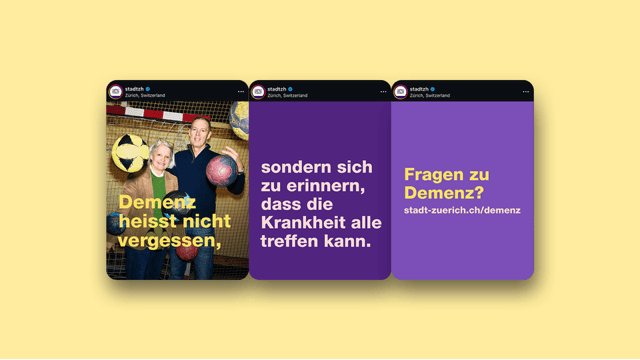
The Zurich-based communications agency Lumina Health has developed a comprehensive dementia awareness campaign for the City of Zurich's Department of Health and the Environment. The campaign focuses on real people affected by dementia and their relatives as well as the question of what we as a society need to remember when dealing with dementia. The campaign bears the claim «Dementia does not mean forgetting ...» and draws attention to central support services and the new website stadt-zuerich.ch/dementia attentive.
An issue that affects society as a whole
Around 8,000 people with dementia live in the city of Zurich alone. Directly or indirectly, almost everyone knows someone who is affected. Nevertheless, dementia is often associated with uncertainty, fear of contact and misconceptions in the public sphere. The campaign is aimed at the general public, relatives and those affected, as well as multipliers who are confronted with the topic in everyday life.
With this campaign, the city of Zurich is showing what it means for those affected and their relatives to live with dementia. It raises public awareness of realities that otherwise often remain invisible: Dementia is not just a medical diagnosis, but a growing social challenge, according to the press release.
Real people with a clear message
At the heart of the campaign are the stories of those affected and their relatives. The claim «Dementia does not mean forgetting, but remembering ...» is continued in several messages and makes it clear that behind every diagnosis is a person with relationships, needs and a life that goes on. All the protagonists come from the city of Zurich and are affected themselves or accompany people with dementia. They made a conscious decision to share their stories publicly - with the aim of breaking down inhibitions and initiating conversations. The visual language was chosen to be honest and approachable, the messages clear and understandable.
City Councillor Andreas Hauri, Head of the Health and Environment Department, puts it in a nutshell: «A dementia-friendly city offers easily accessible advice and respite services and strong medical care. However, dementia-friendliness also comes from the way we treat people with dementia - namely in a way that makes them feel at home in society. This requires knowledge, openness and understanding in everyday life.»
Dementia awareness campaign with strategic broad impact
The campaign was launched on April 30, 2026 and is present throughout the city: on posters, in streetcars and on digital channels. It is supplemented by social media, videos, explanatory formats, flyers and multilingual information. Dozens of organizations are involved as multipliers and disseminate the content in their networks.
The campaign is to be gradually intensified over the coming months - from awareness-raising and activation to concrete guidance on the use of services. Tarja Zingg, CEO of Lumina Health, describes the strategic task as follows: «Communication becomes the link between those affected, services and the public.»
Further information on the campaign and the support services can be found at lumina-health.ch.
Responsible at the City of Zurich (Department of Health and Environment): Ivo Bähni, Franziska Rosenmund. Responsible at Lumina Health: Tarja Zingg (strategy, art direction), Fabienne Albrecht (media concept, campaigning, coordination), Corinne Dietziker (design, animation), Jorina Kessler (videography), Steph Kohler (proofreading), Gisela Heim (multiplication), Dan Cermak (photography), Martin Fuchs (concept), JBW Media (media planning paid), Druckerei Sieber (print production).
]]>
The current «Air – Lungs – Life» campaign by the Aarau Cantonal Hospital (KSA) aims to raise awareness of the importance of healthy airways and comprehensive care for lung and thoracic diseases. «With this omnichannel campaign, we’re setting a new standard in communication about lung health—it’s innovative, eye-catching, and present across all channels,» says Tarja Zingg, campaign director and managing director of Lumina Health. «It was important to us to convey the complexity of pulmonary and thoracic surgical conditions from the perspective of both patients and the medical community.»

Informative and approachable at the same time
At the heart of the campaign is an informative magazine that combines expert insights, patient stories, useful tips for everyday life, and playful elements such as a comic strip and a puzzle page. Alongside this, the campaign is being rolled out across various channels—from social media to bike racks to animated in-house screens.

The campaign visual combines rationality with emotion—two seemingly opposing concepts that are closely intertwined in medicine. The blend of AI-generated lung visualizations and playful illustrations is intended to reflect this tension.


Responsible at KSA: Julien Buro, Ralph Schröder, Claudia Morach, Johanna Häseli; Contact at Lumina Health: Tarja Zingg (Strategy, Concept), Corinne Dietziker (Design), Lena Rauh (Project Management), Steph Kohler (Editing); Photography: Phil Wenger.
]]>
With the "I care" employer branding concept from Lumina Health, the Zurzach Care Group wants to counteract the shortage of skilled workers and strengthen its employer positioning. In the campaign, the rehabilitation provider uses cleverly worded messages under the slogan "I care, because..." to appeal to hard-to-find specialists from the four professional groups of nursing, therapy, medicine and hospitality.
In terms of content and visuals, the campaign deliberately distances itself from common hospital and nursing clichés and images that are not suitable for differentiating perception. Human and emotional aspects such as team cohesion and the joy of meaningful professions in the healthcare sector are placed in the foreground.
A portrait image is combined with a duo image, which is intended to show the result of the messages: interdisciplinary cooperation, team spirit, but also a satisfied and trusting relationship between employees and patients. Real Zurzach Care employees stood in front of the camera for the campaign visuals.

The employer branding campaign is played out with a mix of organic and paid content, primarily on the careers page and social media channels selected for specific professional groups. Stories, reels and videos are set to a soundtrack composed specifically for the employer branding campaign. In addition to digital applications, posters, postcards and a trade fair stand were also developed.

 ]]>

In the latest hospital magazine, the KSA wants to show that neuromedicine is more than just a matter of the head. Diseases of the brain, nervous system and spine occur frequently. Last year, 1,294 people with a stroke, 315 with a slipped disc and 321 with a brain tumor were treated at the KSA. This makes it all the more important to raise awareness in the field of neuromedical diseases.
The topics of strokes, slipped discs, dementia and brain tumors are the focus of the new issue of the magazine. The clinical pictures are examined in detail through stories from those affected as well as well-founded, informative articles.
"The KSA magazine shows the diversity of neuromedicine and not only explains technical aspects, but also touches on an emotional level," explains Julien Buro, Head of Marketing and Communication at the KSA Group.


The latest edition of the magazine builds on previous editions and fills the existing sections with new topics. But there is also new content. In keeping with the theme, the current issue of the KSA magazine features a puzzle page with a competition for the first time, where readers can "brainstorm" for themselves.
The careful graphic design of the magazine supports the thematic focus with suitable illustrations in appealing, bright colors.
The content from the print magazine was also used in a digital version for the landing page Neuro.ksa.ch prepared. Selected articles are also picked up again on social media thematically and in the graphic style of the magazine.


Responsible at the KSA Group: Julien Buro, Ralph Schröder, Claudia Morach, Johanna Häseli. Responsible at Lumina Health: Tarja Zingg (strategy, concept), Debi Balmer (design, animation), Tarja Zingg, Stefan Zingg (text). Photography: Phil Wenger. Google Ads: Click workshop.
]]>
According to a press release, the concept was based on a comprehensive analysis of the social media activities of the largest Swiss hospitals in 2023, which provided valuable insights into their strengths and potential for improvement.


Responsible at Lumina Health: Tarja Zingg (strategy), Lena Rauh (concept), Debi Balmer (design), Fabienne Albrecht (project management). Responsible at KSBLLiliane Frei, Jacqueline Waldmeier.
 It is no secret that women in this country have a higher life expectancy than men. There are several reasons for this. One of the main reasons is the reluctance to undergo preventive medical checkups, which is probably more typical of men. After all, with many diseases, the earlier they are detected, the better the chances of recovery. "Men are less used to talking about illnesses and taking care of their preventive health care than women. With this campaign, we want to specifically motivate men to deal with health and illness. We also reveal what men can do for their own health," explains Ralph Schröder, Head of Content and Campaign Management KSA.

In the campaign, the agency therefore ventures into male taboo topics and wants to motivate men to treat themselves with care. The themed magazine is flanked by various digital measures such as a campaign website, digital ads and social media activities. A wide range of articles, posts, and videos provide information and tips on men's health and allow those affected and experts to have their say.

Responsible at KSA: Julien Buro, Ralph Schröder, Claudia Morach. Responsible at Lumina Health: Tarja Zingg (strategy, concept), Debi Balmer (design, animation), Lena Rauh (project management), Stefan Zingg (text); photography: Phil Wenger; Google Ads: Klickwerkstatt; media planning: JBW Media.
]]> Lumina Health was commissioned by the Lucerne Cantonal Hospital to develop a strategy and brand for a gastroenterology center in the center of Lucerne. The result is "Inolux", the new gastroenterology center that offers the entire spectrum of gastroenterological examinations and therapies in close cooperation with the Lucerne Cantonal Hospital.
Lumina Health developed the brand strategy and a corporate design that comes with minimalism and a bit of humor. For the positioning, a new brand promise was created in close collaboration with the client team: "For a good gut feeling." This promise is intended to get to the heart of the claim regarding medical expertise paired with emphatic care. A multichannel brand presence is to reach different target groups and make the brand image a consistent analog and digital experience.
Responsible at Lumina Health: Tarja Zingg (CEO | Creative Director), Sarafina Eckert (Project Management), Daniela Eberle, Debi Balmer (Design). Responsible at the Lucerne Cantonal Hospital: Karin Hodler, Patrick Aepli, Stephan Baumeler, Oliver Annen.
]]> The results are intended to give hospitals clues for their social media strategies and their implementation. All of the organizations studied are active on social networks; some with a mature presence on Facebook, Instagram, YouTube, Twitter, Linkedin and Tiktok, others more selectively and with potential for optimization. With a good understanding of the online behavior of the target groups, a strategy with clear targeting and a targeted media mix, the potential of social media can also be exploited by hospitals. The Hospital Report 2023 - Social Media Benchmarking shows the strengths and weaknesses, frontrunners and laggards.
Social media marketing has gained importance as a form of advertising - also in the healthcare sector. As opinion leaders and expert organizations, hospitals assume an important function in the rapid dissemination of reliable health information. Studies indicate that more than one million people in Switzerland follow at least one hospital on social media and use them as important sources on health topics, facilities and offers, as well as for entertainment. Social media has also become an important tool for professionals to collaborate and share knowledge. With around 232,000 employees (BAG, 2021), Switzerland's 276 hospitals are among the largest employers, and with well over a million hospitalized patients annually, they have a huge direct customer base. The majority of hospitals use social media for communication, information and interaction with patients, employees, relatives, the general public and other interested parties.
The channels of Les Hôpitaux Universitaires de Genève (HUG), Inselspital Bern (ISB), Centre Hospitalier Universitaire Vaudois (CHUV), Luzerner Kantonsspital (LUKS), Universitätsspital Basel (USB), Universitätsspital Zürich (USZ), Ente ospedaliero cantonale (EOC), Kantonsspital St. Gallen (KSSG) were included in the benchmarking.

Own rating system
To do this, Lumina Health has developed its own rating system with 17 quality indicators weighted by relevance on the following four core social media topics:
1. reach, measured by followers/subscribers, views, posting cadence and frequency of posts, tweets, videos, and cross- and re-postings.
2. identity, evaluated in terms of corporate identity implemented across channels, consistent corporate design, and channel-specific characteristics.
3. experience, derived from the content, formal and technical quality of the user experience and content.
4. community, measured by the interactions between hospital, target groups and internal and external influencers.
Social media platforms are being used more and more widely, also to attract new professionals. Of the eight largest hospitals, three are represented on all six, three on five and two on four social media platforms. The University Hospital Zurich and Les Hôpitaux Universitaires de Genève are frontrunners: Both university hospitals achieve remarkable reach and are extremely experienced in using the six social media channels studied. The frequency of posts is very high, with up to ten posts per day. The quality of the content and formats is also reflected in the fact that they are most frequently liked and shared.
French-speaking Switzerland seems to have a greater affinity for social media than German-speaking Switzerland An analysis by language region shows differences: Hospitals in French-speaking Switzerland have the most followers and subscribers relative to their size. Their posts are viewed most frequently.
Proximity to employees
All hospitals offer a rather good to very good user experience. The content is characterized above all by proximity to the employees. The USZ and Les Hôpitaux Universitaires de Genève are again leaders with above-average target group relevance in the channel in terms of diversity, formats, authenticity, functionality, interaction and inclusion. Building an active community is one of the most difficult tasks in social media marketing, which is why there are also the greatest differences here. Once again, the USZ takes first place, followed by Les Hôpitaux Universitaires de Genève and the University Hospital Basel. These hospitals involve employees and external influencers on all channels and formats and thus generate many likes, shares and comments.
In terms of social media identity, the Cantonal Hospital St. Gallen and the USZ secure first and second place across all channels, but for them, as for all hospitals, social media corporate identity and corporate design are among the topics with the greatest need for action.
]]> The understanding of what health means has changed radically in recent years. On a personal level, health no longer only encompasses the absence of illness, but also the ongoing examination of performance and physical and mental well-being. At the societal and economic level, new challenges such as security of supply, digitalization and cost pressure are pressing. In this context, the importance of strategic healthcare brands is constantly increasing, because standing still here means taking a step backwards.

Lumina Health therefore decided on a comprehensive re-branding with the expansion of its team and offerings. The agency has been combining consulting, marketing and digital solutions since 2006. Vision and values are to be authentically experienced throughout the entire customer journey on all channels. In this way, healthcare brands generate the necessary trust to simplify the demanding decisions that customers, patients, referring physicians and political decision-makers are confronted with today.
"Illness is something immensely personal. Healthcare is not a 'business'. It is about the most important human need for well-being of body and mind. That's why being close to our customers and having a deep understanding of their stakeholders is absolutely central to us," says Lumina Health founder and CEO Tarja Zingg.
The re-branding includes a new digital presence and the new Healthcare Marketing Inisghts newsletter published 3 times a year.
]]> The company Max Zeller Söhne is engaged in the development and production of herbal medicines. The herbal medicine Ginsana, which is available without prescription, can be used for physical and mental performance enhancement. This is still too little known among health professionals as well as younger customers.
In order to communicate awareness of the product and its effects more effectively and to position itself more strongly in the market, also among younger target groups, Zeller wants to promote the drug with the differentiated campaign "I'm so tired my tired is tired" advertise. Instead of just promoting the active ingredient, the campaign turns the perspective around and humorously shows, in meme style, various states of exhaustion familiar to everyone.
The campaign uses dynamic display ads, social media and a landing page. The new look is young, fresh and dynamic with a visual reference to the classic Zeller corporate identity. Post-production effects transform the static subjects into dynamic videos to attract additional attention. 

Responsible at Zeller: Kathrin Borner, Sarah Bussenius. Responsible at Lumina Health (strategy, creation and production): Tarja Zingg, Debi Balmer, Lena Rauh. Media Planning: Nina Rolle, JBW Media.
]]> The campaign focuses primarily on authenticity and highlights the emotional side of cancer from the perspective of affected patients. "The campaign was realized with the active participation of patients with cancer and their relatives, which creates a high degree of authenticity in all our contributions," explains Ralph Schröder, Head of Content and Campaign Management at KSA.


About Living with Cancer
Cancer is complex in terms of cause, progression and therapy, but for those affected it is always a stroke of fate. With this core message, the KSA is addressing the general public and the medical profession as part of its new health and education campaign. The focus of all contributions, whether in the accompanying magazine, on the campaign website Cancer.ksa.chPatients are featured on social media and in movies and videos. They tell their illness and life stories, report on fear and hope and the psychological handling of the disease. After all, those affected by cancer and long-term survivors are challenged above all mentally. For them, "healing" or "improving the quality of life" means above all psychologically coming to terms with the disease in order to preserve or regain the courage to face life. The campaign concept symbolizes precisely this important dimension of the disease.


"Communicating about cancer was a multifaceted challenge. The only way to convince patients and doctors alike was to use words, images and sound to make the emotional life of those affected visible, audible and tangible," explains Tarja Zingg, Managing Director and Campaign Manager of the Lumina Health agency.
The campaign website, via social media, ads, on billboards, with videos and cinema advertising, as well as in the forthcoming patient magazine, will focus on various aspects of cancer, treatment options and the recovery process.
Responsible at KSA: Julien Buro, Ralph Schröder, Claudia Morach. Responsible at Lumina Health: Tarja Zingg (Strategy & Concept), Debi Balmer (Design), Lena Rauh (Digital Campaign Management), Stefan Zingg (Concept & Text). Photography: Phil Wenger. Google Ads: Click workshop. Media Planning: JBW Media. Video: Maybaum Film.
]]>
 After the successful campaign "Around the belly" last fall, the new campaign of the Clinic for Orthopedics and Traumatology of the KSA is all about the human musculoskeletal system.
Life means staying in motion, as unrestrictedly and pain-free as possible. A quality of life that is by no means a matter of course for everyone. Many people suffer from shoulder, back, hip or knee pain or are restricted in their freedom due to deformities, an accident or an injury. The cross-media health campaign launched today by the Clinic for Orthopedics and Traumatology of the KSA is aimed at the region's broad public and offers a wide range of information on the topic of exercise through various channels. It is intended to provide exciting insights into the comprehensive range of treatments and the broad expertise of the clinic.
Cross-media and target group-specific
On the theme website movement.ksa.ch, via social media, on posters and with videos, as well as in the soon to be published magazine, various aspects are in the foreground. "The claim of our campaign - 'We do something against stagnation' - is to be understood literally," says PD Dr. Dieter Cadosch, Chief Physician and Head of the Clinic for Orthopedics and Traumatology. "We see ourselves as surgeons of the musculoskeletal system. With the campaign, we want to introduce the general public to our range of services, our expertise and surgical expertise, but we definitely want to do this in an entertaining way. And we also want to show the people behind this offering, as well as the patients we have successfully treated and helped." The spectrum on display ranges from classic orthopedics to pediatric orthopedics to trauma surgery and the treatment of sports injuries. In addition, a lot of interesting and entertaining information about the human musculoskeletal system as well as numerous prevention tips will be presented.
Dynamic moving image motifs
The campaign is currently being visualized on various channels with five expressive, dynamic and moving images, appealing to young and old alike. The campaign was conceived and launched by the Marketing and Communications Department of the Aarau Cantonal Hospital in collaboration with Lumina Health, an agency specializing in health topics, and the Orthopedics and Traumatology Clinic of the KSA.


]]>