 In their first year together, the collaboration will focus on Globetrotter's 50th anniversary - with specially developed activations and two new formats that specifically expand the Hofkino program. The weekend of Saturday, 27 and Sunday, June 2026 is a central point in the partnership's program. With an Explora live show on Saturday evening and a family format on Sunday morning, new program items will be created that specifically complement and expand the Hofkino.
On Saturday evening, June 27, 2026, Globetrotter, in collaboration with Explora, will present an evening at the Hofkino to celebrate Globetrotter's 50th anniversary. An Explora live show with Louis Palmer will be shown as an exclusive summer premiere. Explora stands for staged live reports in which travelers, adventurers and photographers bring their stories to the stage with pictures, videos and personal storytelling. In his show, Palmer combines personal adventures from all over the world with impressive images, humor and surprising perspectives on our relationship with the world. The Explora live show also marks the start of a larger Explora tour: at least 16 further dates with Louis Palmer are planned for winter 2026/27.
Sunday morning is all about families and encounters: with the "Rendez-Vous with the World": Family Brunch, Globetrotter is bringing one of its well-known formats to the Hofkino in a new form. Travel reports and entertainment for young and old will provide low-threshold access to the world of travel. In addition, Louis Palmer will bring his Solar Butterfly, the largest solar-powered vehicle in the world, which has just circumnavigated the globe in four years and visited 48 countries, including an interactive climate museum, to the courtyard of the National Museum - as a walk-in experience.
Sven Ziörjen, Head of Marketing at Globetrotter, says: "As an important part of Globetrotter's 50th anniversary celebrations, we not only want to look back, but also create new experiences together with a strong partner. The Hofkino offers an ideal stage for this - urban, open and close to the people."
Daniel Frischknecht Knörr, co-founder and organizer of Hofkino, is also delighted: "Globetrotter is a perfect fit for Hofkino with its thirst for adventure, its curiosity about the world and its ability to bring stories to life. This partnership enables us to create new formats that offer our audience real added value - and further open up the content of Hofkino."


Switzerland, with all the languages that are spoken here, is complex. Not only today, but always. For example, the various Swiss German dialects shape everyday life from Basel to Appenzell to Brig. The linguistic composition in French-speaking Switzerland is completely different.
There are historical reasons for this. For example, in a statement on Wednesday, the Landesmuseum Zurich refers to the Reformation, which had a decisive influence on the development of languages. In Zurich during Zwingli's time, the Bible was written in 1524 in a written language that remained close to the spoken dialects of the region.
The reformers in western Switzerland, on the other hand, preferred the French of the upper classes in northern France for their writings, and precisely not the patois that people spoke in the streets. One result of this: In French-speaking Switzerland, regional dialects have largely disappeared; in German-speaking Switzerland, they are cherished.
More than just a means of communication
Or people who have come to Switzerland from countries like Portugal or Kosovo: They bring their languages with them, which sometimes become a hurdle in their new home. Or people who communicate via sign language: They run the risk of not being heard at all.
These examples show that languages are constantly changing, influencing each other and repeatedly becoming the subject of "repression, prohibition, romanticization, demarcation and mythicization," according to the communication. Keywords in this context are the Röstigraben, the Jura question, school English or youth language. The National Museum in Zurich has taken on this complex situation and invites visitors on a journey through the language country of Switzerland.
Visitors equipped with headphones move through the sound scenography. They are accompanied by the exhibition designer Julia Leitmeyer and Gérald, who is played by the comedian Vincent Kucholl from French-speaking Switzerland. In dialogues, the two convey the contents of the exhibition. On the tour, the audience also meets Patti Basler, Flavio Sala and Claudio Spescha, who make guest appearances.
The exhibition "Language Country Switzerland" can be experienced until January 14. The sound scenography was developed on the basis of game technology. And the script for the audio tour was written by Vincent Kucholl. (SDA)
]]>
The basis for this is the permanent exhibition "Simply Zurich" in the National Museum - opened at the beginning of 2019 and conceived by Holzer Kobler Architekturen together with Expo.02 maker Martin Heller, in close collaboration with Maria Tschudi Bebié. The exhibition continues to meet with great interest and is able to inspire. The Tages-Anzeiger, for example, speaks of "veritable deep drilling": "You've never seen Zurich like this before. You should definitely see Zurich like this. The Züri-Tipp also enjoyed the "overwhelming spatial experience" in which "one experiences the city in a completely new way," and the Tagesschau predicted a "crowd puller.
The fact that the exhibition is not finished has a concept: Just as history constantly updates itself, so will the exhibition - curated by Wannaz and Tschudi Bebié. The next update is planned for spring 2023.
In addition, "Simply Zurich" was conceived from the outset as a participatory project: since fall 2019, the exhibition has been flanked by a broad supporting program that links various partners in the city and canton and launches new cultural history activities. The former program director Walter Bersorger, who will be joined by Maria Tschudi Bebié from spring 2021, has done a valuable job in setting up the program. Due to the pandemic, however, their previous range of events could only be utilized to a very limited extent. "We are pleased," says Tschudi Bebié, "that more is now possible again. And of course we hope with all our hearts that it will stay that way."
It is important to the new co-leaders to address different target groups. In the future, there will be more offerings for children and young people. And there will also be a wide range of content: "From the development of our forms of housing to the history of banks, psychiatry or prostitution to family memory in the sense of the German sociology study 'Grandpa wasn't a Nazi', a lot is possible," says Michèle Wannaz, "whereby the relevance of the topics for today is always a central criterion.
The two co-leaders want to focus on a wide variety of formats that make history tangible and allow the senses to experience it. The goal is to make the brand "Simply Zurich" even more visible and to establish it as an organizer with its own signature.
The advantage of this is that Wannaz and Tschudi complement each other ideally. The latter is a cultural manager through and through: After training as a culture and marketing manager, she assisted Martin Heller for 17 years in the realization of exhibitions in Switzerland and abroad, as well as major projects such as the celebrations for the 500th anniversary of the Zurich Reformation or "Linz - European Capital of Culture" with over 3.4 million visitors. Michèle Wannaz, on the other hand, comes more from the content and conceptual side: after studying journalism, film studies and literature, and starting out in journalism - for the NZZ, Tages-Anzeiger and WOZ, among others - she helped conceive a historical arte documentary series, curated exhibitions for the Vögele Kultur Zentrum, worked as a feature film dramaturge for Xavier Koller, among others.She has worked as a feature film dramaturg for Xavier Koller, Markus Imhoof and Pipilotti Rist, among others, and has produced documentaries and animated films with her own company Cinéma Copain, the last of which qualified for the Oscar longlist in 2021 after winning numerous prestigious awards.
What Wannaz and Tschudi Bebié have in common is that they want to convey cultural history in a low-threshold, fun and playful way: "You should realize that it has something to do with all of us. That we wouldn't be who we are without it." At the same time, the past should always be linked to today and tomorrow: "Where are we aiming and why? Why do we see certain paths but are blind to others? How does cultural history shape our perception and keep us trapped in patterns that perhaps should have been broken long ago?"
In addition to collaborating with local actors, the project also aims to collaborate with renowned exponents from the worlds of film, theater, and art who have a connection to Zurich and deal with history in an inspiring way.
About the history of "Simply Zurich
Although the canton has numerous institutions that convey cultural history, for a long time there was no place that could present this knowledge in a bundled form and make it accessible to a broad public: The city and canton of Zurich do not have a central museum of their own - partly because Zurich's cultural history holdings were integrated into the Landesmuseum's collections when it was founded in 1898. The long-discussed idea of a "Zürich Museum" materialized in 2008 in a concept commissioned by the city of Zürich and in the launch of the project in 2011: the expansion of the Landesmuseum offered the spatial opportunity to implement an exhibition on the history of the city and canton of Zürich in the museum itself. In 2019, the permanent exhibition "Simply Zurich" opened, which is regularly expanded and accompanied by a rich program of events. The sponsors are the city, the canton and the National Museum.
]]>
"Late" is the name of the nightly cultural event at the National Museum, where on the last Thursday of every month from 7 to 11 p.m. there is culture and history in an after-work atmosphere. With music, performance, drinks and guided tours, Late aims to serve up a unique cultural treat - for night owls and anyone who doesn't have time during the day or prefers to stroll through the exhibition in the evening.
Pop was commissioned with the branding for the relaunch of the cultural bedtime mumbo jumbo. Late's new brand identity combines museum-like reduction with nightlife aesthetics, presenting high culture with urban verve.
The opening campaign can be seen on posters, e-panels, print ads and display banners, as well as on-site installations.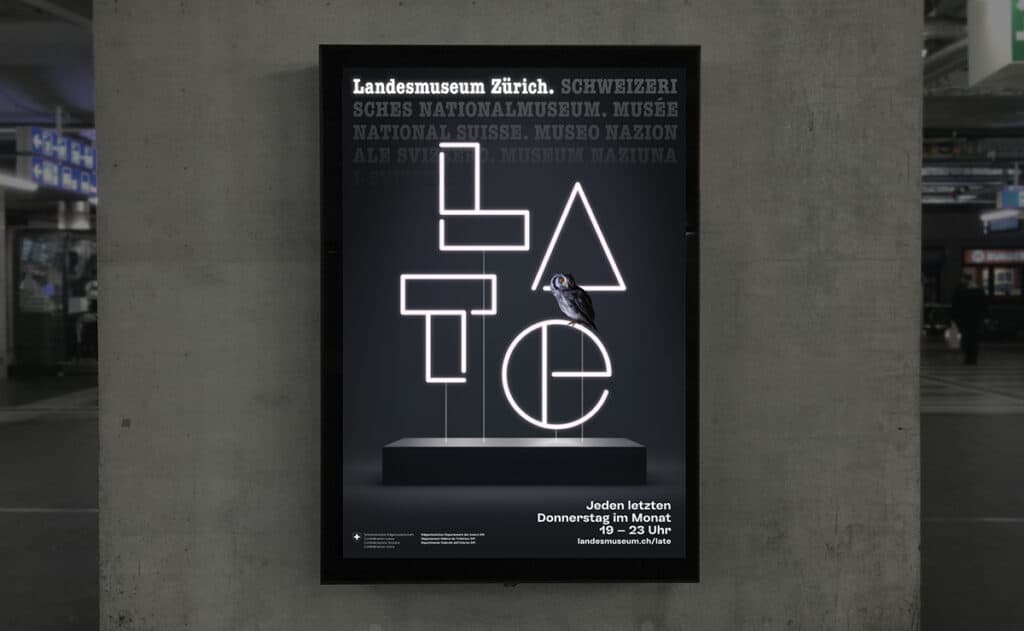
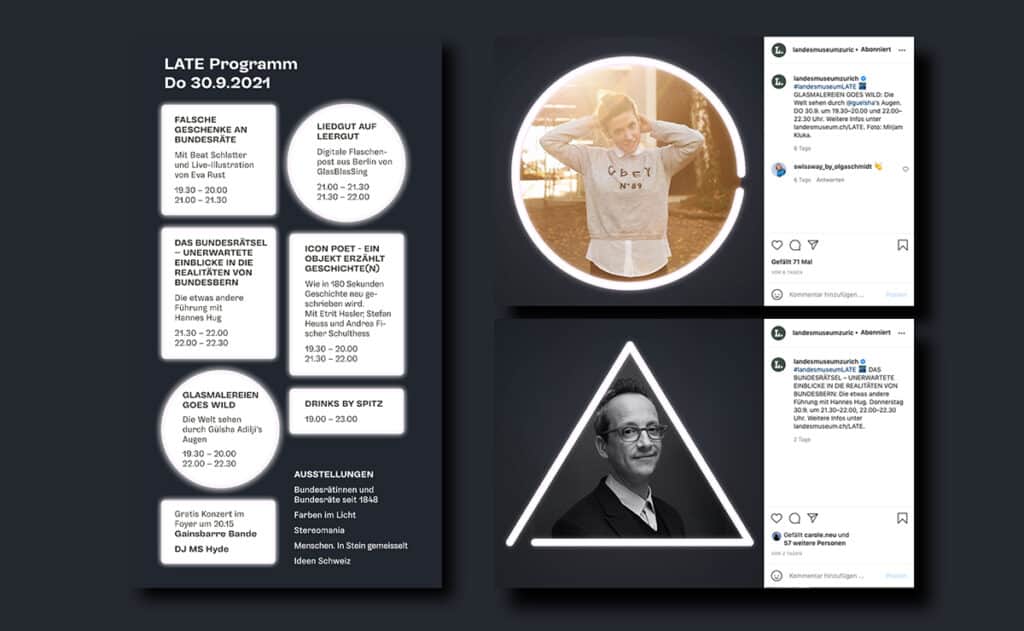
Responsible at the Landesmuseum Zurich: Denise Tonella (Management), Andrej Abplanalp (Head of Marketing & Communication), Carole Neuenschwander (Marketing Manager), Andrea Disch (Event Manager). Conception and creation: Pop Creative Services. Motion design: Elio Lüthi.
]]>
For a long time, Swiss women remained excluded from civil and political rights. Their path to the introduction of women's suffrage in 1971 and the Equality Article in 1981 was rocky and hotly contested. 50 years after the introduction of women's suffrage, the exhibition at the National Museum sheds light on the struggle for women's rights in Switzerland that has lasted for over 200 years.
The visual, penned by Pop Creative Services, is a tribute to perseverance and opens the eye to the long struggle for equality behind the paragraph rides. The campaign can be seen on posters and print ads as well as e-boards and panels, banners and screens. The special exhibition at the Landesmuseum Zurich runs until July 18.
State Museum - Women.Rights from POP Creative Services on Vimeo.
Responsible at Landesmuseum Zurich: Andreas Spillmann (Overall Management), Andrej Abplanalp (Marketing Manager), Carole Neuenschwander (Marketing Manager); Conception and creation: Pop Creative Services. Motion design: Florian Heger (Supermotional).
]]>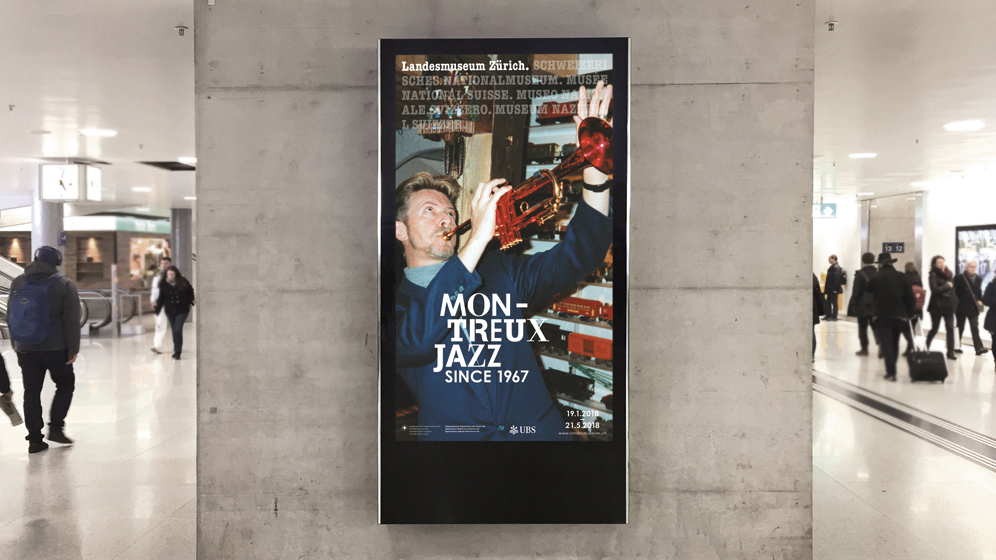
David Bowie, Miles Davis and Deep Purple have all left their mark on the Montreux Jazz Festival. Founded in 1967 by Claude Nobs as an attraction for tourists, it is now one of the most renowned music events in Europe and the world. An exhibition at the National Museum Zurich takes a look at the eventful history of the festival.
For 50 years, the who's who of the music business has met annually in July on the shores of Lac Léman. According to a press release, it is thanks to the great Claude Nobs in particular that the festival has lost none of its appeal to this day and has retained its intimate character. Montreux Jazz has written history - and countless stories to tell. The key visual of the advertising campaign is intended to express this aura: David Bowie blowing Miles Davis' trumpet in the chalet of "Funky" Claude Nobs.

The exhibition "Montreux. Jazz since 1967" can be seen at the National Museum until May 20, 2018. The POP agency orchestrated the campaign with posters, public transport advertising, print ads, e-boards/panels, banners and screens.
Responsible at the Landesmuseum Zurich: Andreas Spillmann (Overall Management), Peter Krebs (Head of Marketing), Carole Neuenschwander (Project Management Marketing). POP Creative Services: Roli Hofer (concept, art direction), Michi Benz (consulting). Motion design: Oiler/Elio Lüthi. Sound Design: UKO/Jeffrey Baumann.

Switzerland enjoys an excellent reputation when it comes to design and typography, writes the National Museum on Wednesday. Many of the creative designers are not only good, but also versatile. They move back and forth between art and commissioned work, change styles and formats and constantly reinvent themselves.

A good example of the flexibility of graphic designers is Celestino Piatti. He not only designed stamps and posters, but also shaped the appearance of Deutscher Taschenbuchverlag for decades with his book covers.
Paul Brühwiler not only made a name for himself with his posters for the Zurich Filmpodium, but was also active in the USA, where he designed record covers for the Beach Boys and Janis Joplin.

In the middle of the last century, Hans Tomamichel created the Knorrli, "a likeable advertising figure that still has a firm place in the collective memory of the Swiss in the 21st century", as the National Museum writes. (SDA)
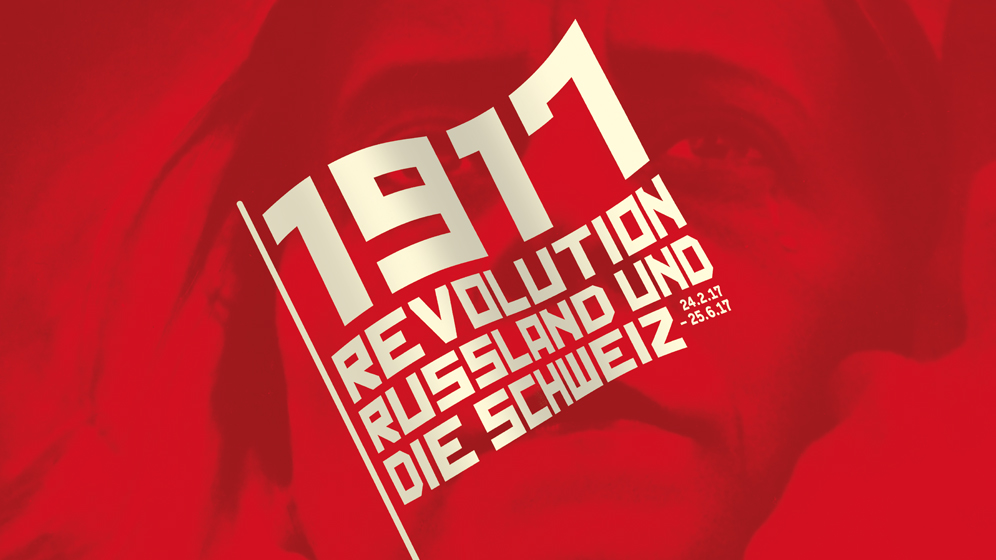
To mark the 100th anniversary of the Russian Revolution, a special exhibition in the extension building of the National Museum Zurich sheds light on relations between Switzerland and Russia at a time of upheaval. The exhibition uses photographs, documents, art objects and paintings to tell the story of Russia in this era and its impact on Switzerland. It is a story of astonishingly close ties between two very different countries.
The key visual stages this turning point in time in a powerful typographic realization with archaic symbolism. The show can be seen in the new extension to the Landesmuseum until June 25.

Responsible at the Landesmuseum Zurich: Andreas Spillmann (Overall Management), Peter Krebs (Head of Marketing), Carole Neuenschwander (Project Management Marketing); Creative Direction & Artwork: Roli Hofer. Motion design: Florian Heger.

This was created in cooperation with the Federal Office of Meteorology and Climatology MeteoSwiss. Bürograf developed the advertising for the exhibition. The key visual plays with an attention-grabbing "W" made of ice, which slowly melts away and thus simultaneously points to the change in the climate. The exhibition "The Weather. Sun, Lightning and Cloudburst" is on display at the National Museum until May 21, 2017. The subject is used as posters (F4, F200, megaposters, streetcar posters), as advertisements in newspapers and magazines and digitally.

Responsible at the Landesmuseum Zurich: Andreas Spillmann (Overall Management), Peter Krebs (Head of Marketing), Carole Neuenschwander (Project Management Marketing). Responsible at Bürograf: Philipp Graf (Consulting Director), Martin Stillhart (Art Direction).
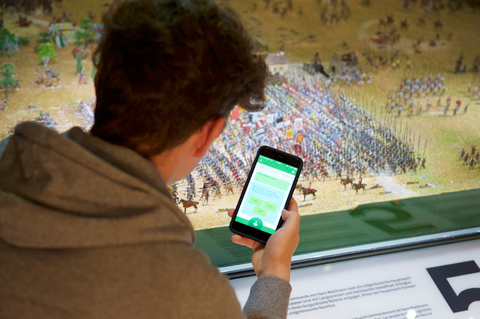
Instructive, entertaining and challenging: With its new digital quiz, the Landesmuseum Zurich is focusing on interaction. Interesting facts are conveyed in a playful way. The makers are relying on everything that makes a game: you answer questions, look for pictures, you have to guess or estimate and, in the best case, collect points. At the end, perhaps a diploma beckons. The quiz is presented in the form of an interactive chat and can be played on the user's own smartphone. Tiny transmitters called beacons locate the museum guests and send targeted questions. Once started, the quiz works without a telecommunications connection. A digital revolution that enables location-based notifications and can further enrich the museum's educational offerings in the future. The new digital quiz "Drallo" is available for free download in the Apple App Store and Google Play Store for smartphones.

The National Museum in Zurich closed 2014 successfully with around 227,000 visitors. This is more than 30,000 people more than in the previous year (2013: 196,228). The museum owes the great interest on the one hand to the thematically broad exhibition program: from fairy tales to the current Press photography to historical focal points, which the house was able to set with exhibitions such as "1900-1914. Expedition to Happiness". The Zurich agency Studio Marie Lusa designed the advertising materials for this exhibition (Werbewoche.ch reported). At the beginning of 2014, the successful exhibition "Good to Print - Art and Advertising at Wolfensberger" was extended by months (Werbewoche.ch reported). For the exhibition "Great Cinema," curator Walter Keller searched through 300 Swiss feature films for the most telling scenes possible from everyday Swiss life (Advertising Week Print reported).

On the other hand, the Landesmuseum strengthened its presence with a new website also online, thus opening the virtual gateway to the museum with more images and a better overview of events and exhibitions. Finally, the National Museum Zurich is always exploring new visitor groups with potential. Guided tours are now offered in Russian, as this group of visitors is also increasingly visiting the National Museum individually. In addition, the structural engineering work on the extension was completed on schedule in 2014 and work began on the interior, according to a statement.

Feature films are a means of expression of their time. What was meant by "Switzerland" at a certain time? How do the Swiss live and think? The exhibition "Great Cinema" at the National Museum has sought answers to these questions in Swiss feature films. Walter Keller and his team analyzed around 300 films. "This was not about cinematic art or film-scientific criteria. We were interested in the question: could it smell like Switzerland in this film?" the curator explained at the opening. Out of 900 sequences of the "Helvetia" scent mark, 115 finally made it into the final selection from 111 films.

These moving moments of 1 to 3 minutes brevity have been assembled into 10 new thematic strips. The editing plan for these statements on the "soul image of the country" was not chronology, but creative association. In the questioning clips, films from all epochs and genres mix to form a new dialogue. This is to be perceived by the audience as a matter of course. In the exhibition, which is intended to stimulate reflection, any commentary was deliberately dispensed with. Keller only made a brief comment at the opening: "Old Swiss film is far from being conservative, and today's color films are not automatically critical either."
The exhibition organizers have unearthed their puzzle pieces of the national soul "in a thankful way" from Swiss film distributors and to a large extent also from the archives of Swiss television. Nathalie Wappler, head of the culture department at SRF, said in her introduction that many of these films "contrast life with stories " and thus also explore the boundary between fiction and reality. Switzerland between dream and reality. Refugees also experienced this separation in several films. It is striking that works from this genre seem to be among the most impressive that Swiss film artists know how to tell. The refugee drama "The Last Chance" by Leopold Lindtberg was honored with the Golden Globe in 1946 as well as the main prize in Cannes. "Das Boot ist voll" by Markus Imhoof was nominated for an Oscar in 1982. "The Voyage of Hope" by Xavier Koller won one in 1991. These three works support the memory of Switzerland in the "Great Cinema". Others also engage in intellectual national defense. Or they unmask our character in comedies like "Taxi Driver Bänz", "Uli the Servant" or "Les petites fugues" to "Grounding". The films shown date from 1920 to the present. In the individual cinemas they are arranged according to 10 themes.

Freedom and neutrality: Freedom means being able to choose and decide between different options. Citizens should participate in the decisions of the general public. Democracy against the inside and armed neutrality against the outside are to secure freedom. To defend this good, every Swiss is obliged to serve in the militia army.
Lifetime - Season: Rituals of the course of life and the year are popular in feature films. They foster a sense of community in independent regions and communities. Life events - birth, baptism, wedding, folk festivals, processions, death - are occasions to consolidate the community or to set oneself apart from it.
You and us: For centuries, Switzerland is a barren and poor country. Then it recognizes the opportunities offered by the mountains, valleys and lakes. Their industrial and touristic use becomes possible with increasing mobility and contributes to the prosperity of Switzerland since then. But are the strangers who want to visit or live in the country lucky or unlucky for Switzerland?
In need: Abortion, moonlighting, child abuse, hunger, theft, rape, disruption, loneliness, suicide: tension arises when people and their loved ones are in distress. Through their own fault or the fault of others. Power and money are popular elements of film scripts. They are leitmotifs that drive stirring narratives of distress and strife. Love: Physical lust and desire are a rather rare commodity in Swiss feature films. Intentional or coincidence? Cupid's arrows buzz briskly through the air, but they rarely hit the right ones. Thus, love is not always completely voluntary, entirely befitting one's status or happy. And not always legally.
Generations: Films rarely tell stories of intact families. Rather, they find material in endangered, tragic or unhappy life circumstances. Films about tensions between parents, children and relatives - in rural-traditional or urban-modern settings - search for a sense of cohesion. Or they tell of the coldness of contemporary society.
Work - departure: Classic depictions of industrial work are rare in Swiss feature films. Scenes of farm work and glimpses of everyday office life are the rule. The financial center, livestock and agriculture seem more suitable as film material. The historical change in the world of work takes place without crises of modernization, such as can be found in English films.
Faith: Christian rituals such as baptism, marriage and burial or table, evening and intercessory prayer are deeply rooted in the lives of people in early films. Conquering the mountains to use them for water and pasture, to open up the peaks for tourism, and to bore through the Alps require daring construction and engineering skills.
Origin - Myth: Feature films have a hard time with complexity. They need heroes and antagonists. The figure of the crossbowman William Tell plays an important role in Swiss feature films. How he shoots the apple off his son's head on the orders of the authorities is first portrayed full of pathos and - in later films - ironically or satirically. The same happens to historical loyalty oaths and battles.
Nature - Culture: Nature is the only resource of our country. Its existential significance finds its counterpart in a rich tradition of moving productions. For modern man, nature serves as a counter-world to the "city" and stands for health, freedom and ecology - or for backwardness. There are numerous depictions of destructive natural forces: rockfalls, avalanches, glacial fractures, floods.
Those who wish can also rediscover 29 films in their entire length in parallel events. There is also a DVD store and a lunch cinema at the Landesmuseum.
Andreas Panzeri
