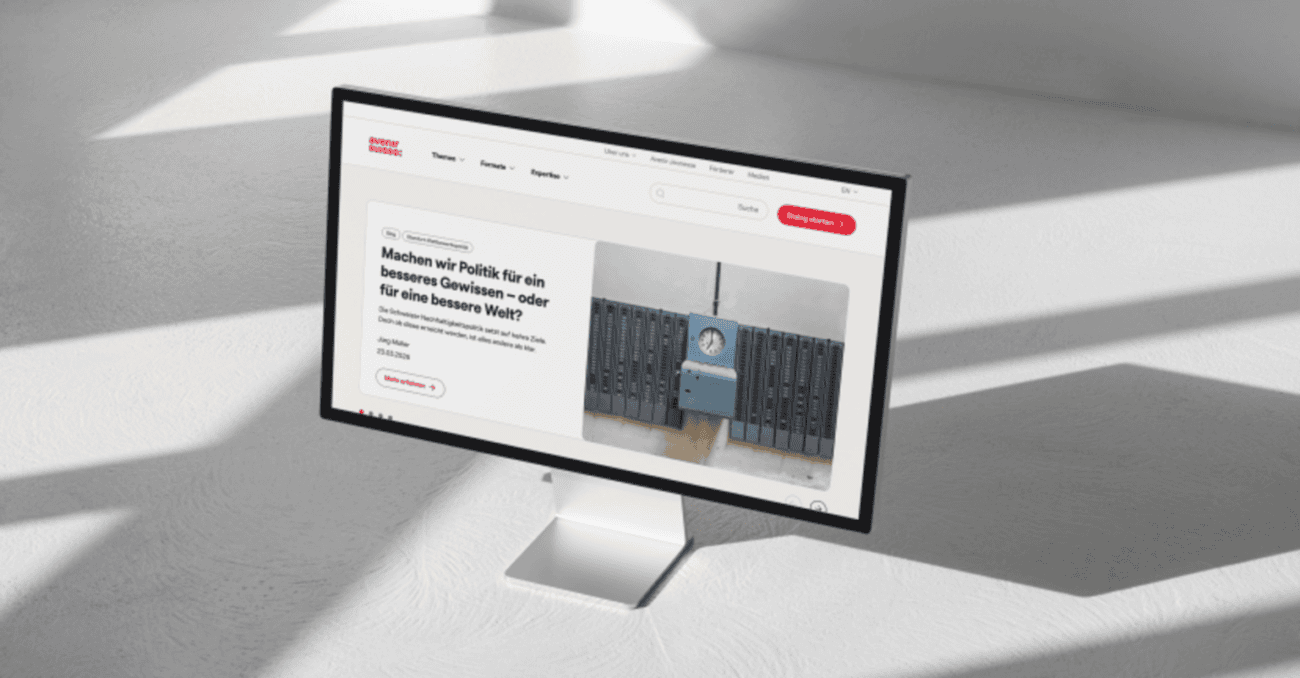
Sergeant hat die Website des unabhängigen Think-Tanks Avenir Suisse neu konzipiert und umgesetzt. Die Zürcher Branding-Agentur verantwortete nach eigenen Angaben UX, digitales Branding und Entwicklung. Herzstück ist ein Content-Hub, der Wissen und Menschen zusammenbringen soll. Die neue Website ist seit dem 19. Oktober online.
Eine Analyse finden, einen Podcast entdecken oder die passende Fachperson für eine Medienanfrage erreichen: Die Website muss unterschiedliche Bedürfnisse bedienen. Im Zuge der strategischen Neuausrichtung des Think-Tanks hat Sergeant die Zugänge zu dessen Inhalten grundlegend überarbeitet.
Von der Strategie zum Auftritt
Im UX-Prozess übersetzte Sergeant den neuen strategischen Fokus auf Expertise und Dialog ins Digitale: Inhalte thematisch bündeln, die Kompetenz der Forschenden sichtbar machen und den Kontakt zu ihnen erleichtern. Auf Basis von Personas entwickelte die Agentur Nutzerprofile und User-Journeys. In zwei Workshops erarbeitete sie gemeinsam mit Avenir Suisse die Inhalts- und Navigationslogik der Website.
Drei Zugänge zum Content-Hub von Avenir Suisse
Der Content-Hub bietet drei Zugänge: über Themen, über Formate wie Studien und Podcasts oder über die Expert:innen selbst. Kombinierbare Filter sollen die Suche nach passenden Inhalten erleichtern, während Personenprofile zeigen, wer dahintersteht und zu welchen Themen die Forschenden arbeiten. Eine KI-gestützte Suche ergänzt die Navigation.
Die Marke digital gestaltet
Die Arbeit an der Website begann parallel zum laufenden Rebranding. Auf Basis des von Scholtysik entwickelten Brandings und Website-Look-and-Feels verantwortete Sergeant die digitale Ausgestaltung, von der Benutzeroberfläche über digitale Gestaltungselemente bis zu den Interaktionen.
Vier Sprachen, mehr als 10’000 URLs
Die neue Plattform umfasst vier Sprachen und insgesamt mehr als 10’000 URLs. Sergeant löste das bisherige WordPress-System durch Drupal ab und überführte die bestehenden Inhalte mit einer automatisierten Migration in die neue Struktur.
]]>
The Zurich-based communications agency Contcept Communication has revamped its brand identity, refined its positioning, and consolidated its service offerings. Under the tagline «Relevance That Lasts,» the agency combines PR & Corporate Communications with Thought Leadership, Strategy & Consulting, Reputation & Crisis, AI Solutions, Events, Creator, and Social & Content. Its guiding principles are: Think like a journalist. Provide strategic advice. Implement pragmatically. Visually, the brand now stands out with a red color scheme instead of blue.
PR Remains the Cornerstone at Contcept Communication
«Our roots are clearly in PR. At the same time, the way brands gain visibility and relevance has changed significantly,» says Barbara Ryter, founder and co-managing director. According to the agency, traditional media relations, proprietary channels, social media, and generative search are increasingly intertwined. «Attention alone isn’t enough. What matters is credibly establishing a presence on key topics, building expertise, and maintaining a consistent presence across various channels,» adds co-founder and co-managing director Andreas Messerli.
Expanding Thought Leadership and AI Visibility
Contcept places a special emphasis on thought leadership. The goal is to support companies, CEOs, and experts in addressing relevant topics, developing clear positions, and being recognized as authoritative voices over the long term. This area was strengthened in 2026 with the addition of Stefan Mair, a former business journalist and senior thought leadership consultant.
At the same time, the agency is expanding its consulting services related to AI visibility. The focus is on how companies and brands are perceived in generative search and AI systems, and how their visibility can be strategically enhanced through positioning, PR, relevant third-party sources, and content. «AI doesn’t diminish the importance of PR—if anything, it increases it,» says Ryter. «Credible media presence, relevant expertise, and strong third-party sources are also becoming increasingly crucial for digital visibility.»
Integrated Communication Instead of Silos
According to the company, Concept takes an integrated consulting approach. The process begins with strategic positioning. Depending on the assignment, this leads to the appropriate combination of media relations, CEO positioning, social media, creator relations, content production, events, and AI visibility.

«Communication no longer operates in silos,» says Messerli. «Our job is to identify which topics are truly relevant to a brand—and to develop the right combination of strategy, earned media, content, and other channels based on that.»
New Brand Identity and Online Presence
This evolution is accompanied by a new brand identity and online presence. Ralph Halder, Senior Consultant and Creative Director, is responsible for the design. «The new identity reflects the agency’s evolution: less of a traditional disciplinary approach, and more of an interplay between strategy, media relations, content, creativity, and technology,» says Halder.
Contcept Communication is an owner-managed communications agency based in Zurich with operations in French-speaking Switzerland and Germany.
More information: www.contcept.ch
]]>
The Zurich-based startup Underheard has made its AI interviewer available to all companies. The platform conducts customer interviews at any time of the day or night and processes the responses into structured insights. This is intended to enable organizations to gather qualitative feedback from far more people than a research team could reach on its own.
Survey Instead of Simulate
According to the report, interviews remain one of the most reliable ways to understand customers. However, conducting them on a large scale is time-consuming and expensive. As a result, more and more companies are using AI models to simulate how customers or the public might respond. The Pew Research Center examined this approach in a study published on September 30, based on its own surveys. According to the study, the responses generated by two AI models deviated on average by about 12 percentage points from the responses of real respondents.
«Some companies now rely on AI to guess what their customers would say. We prefer to ask them ourselves,» says Navid Mani, co-founder and CEO of Underheard.
How the AI Interviewer Underheard Works
Underheard uses AI during the interview itself, not as a substitute for the people being interviewed. A team describes what it wants to learn, and the platform creates the interview. This can range from a brief feedback session to a full-scale market research study. The AI conducts each conversation and asks follow-up questions based on the respondent’s answers. It then groups the answers by topic and links each insight to the underlying quotes. The results are expected to be available within minutes.
27 organizations in three months
According to Underheard, in its first three months, the company conducted interviews for 27 organizations, ranging from hotels to multinational brands. Among them was a marathon organizer that invited runners to share their race stories after the event. Most of the conversations on the first night took place after 10 p.m., when no human team would have been available.
According to the press release, the willingness to speak with an AI is consistent with recent research. In a field experiment conducted by researchers at Chicago Booth and Erasmus University, 78 percent of applicants who had the choice preferred an AI interviewer to a human recruiter. Other studies have shown that people give longer answers when they speak than when they type.
Anyone can at underheard.ai/start Talk to Lina, Underheard’s AI guide, right in your browser without having to sign up. Companies can also start their two-week free trial there. Underheard is supported by SFF Studio, the venture studio of the Swiss Founders Fund.
]]>
Under the term “Generative Engine Optimization” (GEO), companies measure how often they appear in responses from ChatGPT, Gemini, and similar AI systems. Less attention is paid to what is actually said about them in those responses. A brand’s image often shifts unnoticed in AI responses. This phenomenon can be described as semantic drift. Miriam Schwellnus, managing director of the Berlin-based agency Mashup Communications, explores this topic in this guest post.
Just like in «Chinese Whispers»: Information gets distorted
In the children’s game «Chinese Whispers,» what was said at the beginning rarely ends up being what’s said at the end. No one is lying; everyone just passes on what they understood in a slightly different way. The same thing happens with information that AI assistants summarize and categorize. A study by the European Broadcasting Union (EBU) and the BBC shows just how often things get distorted in the process. Specialized journalists reviewed more than 3,000 responses from ChatGPT, Copilot, Gemini, and Perplexity across 18 countries and 14 languages. Forty-five percent contained at least one significant comprehension error (EBU/BBC, October 2025).
The study focused on news content. However, the mechanism is the same when an assistant describes a company: it condenses, weights, and omits information. Monitoring tools show how often a brand is mentioned, which sources appear, and whether the tone is generally positive or negative. They do not indicate whether the information is accurate.
Semantic Drift: Meaning Shifts Unnoticed
In linguistics, semantic drift describes how the meaning of words shifts over time. When applied to brands, the term refers to a shift in reputation resulting from AI’s tendency to interpret context only approximately. One aspect is overemphasized, another is missing, and outdated information persists. Individual responses may not seem wrong, but the overall picture is no longer accurate.
Additional figures from the same study: 31 percent of the responses had serious sourcing issues because evidence was missing, misleading, or incorrectly attributed. 20 percent contained significant inaccuracies, such as outdated information or fabricated details (EBU/BBC, October 2025).
Why GEO metrics don't capture the drift
According to Schwellnus, the visibility rate depends on which questions a tool tests. These are typically sample questions predetermined by a marketing team, not what people actually type in. Since assistants are increasingly familiar with users from previous conversations, a real-world question is more likely to be «Which agency is right for me?» than «What agencies are there in Berlin?».
Cited sources only indicate what a response explicitly refers to. What a language model «knows» from its training data never appears as evidence. While tone can be measured, it says nothing about whether a statement is true. What matters most is attribution: Does this statement actually come from this company, in this context? That is precisely where trust is built among applicants, customers, and business partners.

What Companies Should Do Now
First: read, don’t just count. If you regularly review what AI systems say about your own company, you’ll spot shifts long before they become entrenched. This includes questions that applicants, customers, or partners would actually ask—not just those that are easy to measure.
Second: Sharpen your positioning and scrutinize every word. Is a claim substantiated or merely asserted? A statement like «We offer flexible work hours» remains interchangeable as long as it isn’t backed up by real numbers, voices from within the company, and external validation. The more topics a company addresses that aren’t part of its core positioning, the easier it is to miscategorize it.
Third: Patience. A reputation built up over years cannot be corrected in just a few weeks. Those who focus solely on short-term spikes in visibility miss out on the opportunity to continuously build up their own and external sources. Visibility in AI responses is then a byproduct of a reputation that is already solid. Reputation is infrastructure, not a one-time campaign.
About the author
Miriam Schwellnus is the founder and managing director of the Berlin-based agency Mashup Communications. She is the author of the bestseller *Storytelling for Businesses* and, by her own account, has been combining public relations with content marketing and narrative strategies for nearly 20 years.
]]>
The Swiss Media Publishers Association (VSM) is calling for improvements to Switzerland’s platform regulation. The association welcomes the Federal Council’s efforts to advance the regulation of large platforms. However, the bill must also effectively protect media diversity and freedom of opinion. The VSM is calling for binding measures against systemic risks, greater transparency regarding algorithms, and consistent enforcement of the law against illegal advertising.
«International platforms have a significant influence on what news people actually see. This power to shape public opinion and their enormous economic market power must not go unchecked. Those who shape the public debate must also limit the risks to media diversity and democracy,» says VSM President Andrea Masüger.
On October 14, 2026, the Federal Council decided to proceed with the Federal Act on Communication Platforms and Search Engines (KomPG). The DETEC is to draft a message by the end of June 2027. According to the VSM, the bill contains important transparency and complaint-handling requirements but still has significant gaps.
Platform Regulation in Switzerland: Identifying Risks Is Not Enough
The VSM demands that large platforms not only assess systemic risks but also implement effective risk mitigation measures. These include risks to media diversity, the formation of public opinion, and democratic processes. In its consultation response, the association had already called for Article 20 to be amended accordingly. Platforms should also be required to mitigate identified risks through appropriate measures and to report on their effectiveness. According to the VSM, 65 consultation participants supported the risk mitigation requirement.
The European Digital Services Act (DSA) goes a step further in this regard. It requires very large platforms and search engines to assess systemic risks—including those to media freedom and media pluralism (Art. 34)—and to effectively mitigate them (Art. 35). According to the VSM, Switzerland should also follow this approach.
Limiting the Influence of Opinion, Combating Disinformation
The platforms’ algorithms help determine which journalistic content is visible and what reach it achieves. These decisions are often difficult for media companies and the public to understand. The VSM therefore calls for greater transparency in recommendation systems, genuine choices for users, and transparent decisions regarding the restriction of journalistic content. At the same time, platforms must counter the spread of disinformation, while safeguarding freedom of expression and information as well as editorial independence.
Enforce Existing Law
The association also sees a need for action regarding illegal advertising. Deceptive ads and identity theft are already prohibited. While Swiss media companies are legally responsible for their content and advertising, enforcement against international platforms is often difficult. The VSM calls for clear responsibilities, effective reporting and complaint procedures, transparent advertising archives, and legal representation for the platforms in Switzerland that is capable of taking effective action. Standards for Swiss media should not be lowered.
Protection of Minors, AI, and Copyright Law
The VSM expressly welcomes the planned expansion of child and youth protection. It views the risk mitigation measures for minors, the ban on profile-based advertising targeting minors, and the expansion of the reporting procedure to cover all allegedly illegal content in a positive light. However, media literacy is also essential. «Young people must learn to distinguish reliable news from disinformation and manipulated content. To do so, they need media literacy and access to independent journalism,» says VSM Director Pia Guggenbühl.
The association welcomes the fact that AI search engines are also to be covered by the KomPG. Clarification is needed regarding generative AI applications that select, process, and directly convey information. Copyright issues must be addressed in parallel as part of the implementation of the Gössi motion. The VSM calls for effective protection of journalistic content as well as fair licensing and remuneration models.
In light of the message, the VSM expects regulations that go beyond transparency requirements and effectively hold large technology companies accountable.
]]>
How can government institutions continue to provide guidance, build trust, and foster dialogue with the public? The comm.focus government communications conference aims to provide answers to these questions. It will take place on October 29, 2026, at the Kongresshaus Zürich and will bring together perspectives from the worlds of politics, academia, the media, and government administration.
New Framework Conditions for Government Agencies
According to the press release, government communication faces new challenges. Changing information habits, digital platforms, artificial intelligence, and increasingly polarized debates are making it more difficult to reach the public and build trust. At the same time, expectations regarding transparency and credibility are rising.
«Government communication today takes place in a fundamentally changed environment. Information alone is becoming less and less sufficient. What matters most is whether communication is understandable, provides guidance, and builds trust,» says Daniel Camenisch of Commsummit.
comm.focus Government Communications: A Dialogue Between Research and Practice
At comm.focus, Prof. Dr. Mark Eisenegger of the University of Zurich and Prof. Dr. Julia Krasselt of the ZHAW will shed light on current trends in media use and public debates. Additional perspectives will be provided by, among others, Martin Bühler, member of the Graubünden Cantonal Government; Roger de Weck; Michael Hermann; Peter Stücheli-Herlach and Stephan Rösli; Dario Wellinger; Paul Meyrat; and Christoph Caviezel. Annina Campell will host the program.
Questions from Everyday Communication
The focus is on questions that directly concern communications officials at the federal, cantonal, city, and municipal levels, as well as those at public institutions: How can trust be maintained under changing social conditions? How do public authorities deal with disinformation and polarization? What role do digital channels and new technologies play? And how can communication be designed to truly reach people? Current research findings, concrete practical experience, and mutual exchange are intended to contribute to these discussions.
According to its own statements, Commsummit develops formats for the communication of tomorrow. The comm.focus 2026 will be followed in the spring of 2027 by a comm.focus on the topic of effective crisis communication. On October 7 and 8, 2027, it will also host the comm.summit, a two-day Swiss conference on communication in Davos.
Information about speakers and the program: https://commsummit.ch/forum
]]>
AI-generated content and the algorithms of digital platforms are increasingly shaping which information becomes visible and receives attention. As a result, traditional media are coming under greater pressure, while at the same time it is becoming more difficult to identify the sources of information and the interests behind them. On November 9, 2026, pr suisse will host a roundtable in Bern to address the question of what responsibility professional communication bears under these conditions. The focus will be on the role of PR in democratic opinion-forming.
Declining Trust in the News
The Reuters Institute’s Digital News Report 2026 shows that in Switzerland, only 42 percent of respondents still trust the news in general. Internationally, social media and video platforms continue to gain importance as sources of information. According to the report, personalized information spaces can reinforce existing beliefs and make it more difficult to exchange different perspectives. This raises the question of who shapes public opinion and on what basis people evaluate information.
The Role of Public Relations: Between Impact and Responsibility
PR and communications professionals are also taking advantage of these new digital opportunities, as their goal is to generate interest in specific topics and encourage desired behavior. This raises several questions: Where is the line between legitimate advocacy and manipulation? How can trust be built in an increasingly fragmented information landscape? And how can professional PR contribute to an informed, diverse, and constructive public debate?
pr suisse will discuss these questions at the second roundtable, «The Role of PR in Democratic Opinion-Forming,» about three weeks before the next federal referendum Sunday.
Experts and Framework Conditions
Participants in the discussion include Prof. Dr. Diana Ingenhoff, professor of organizational communication and public diplomacy at the University of Freiburg, and Dr. Angela Müller, executive director of AlgorithmWatch CH. They will be joined by Urs Wiedmer, Head of Communications at the Federal Department of Education, Research, and Innovation (WBF) and spokesperson for Federal Councilor Guy Parmelin, as well as Mikis Graf, Managing Director of Bertakomm. The event will be moderated by Véronique Haller, co-founder of Momentum Strategists and member of the Société Romande de Relations Publiques (SRRP).
The roundtable will take place on Monday, November 9, 2026, from 5:00 p.m. to 7:30 p.m. at the Raiffeisen Forum, located at Schauplatzgasse 11 in Bern. Participation is free for members of pr suisse. Space is limited to 50 people; the registration deadline is November 1, 2026.
About pr suisse
According to its own information, pr suisse (Swiss Public Relations Association, SPRV) is the nationwide professional association for PR and communications specialists, with approximately 1,200 members. With seven regional chapters, the association has a presence throughout Switzerland. It connects communications professionals from agencies, companies, organizations, and government agencies; represents the interests of the industry; and is committed to quality standards, professional education and training, and the societal recognition of public relations.
]]>
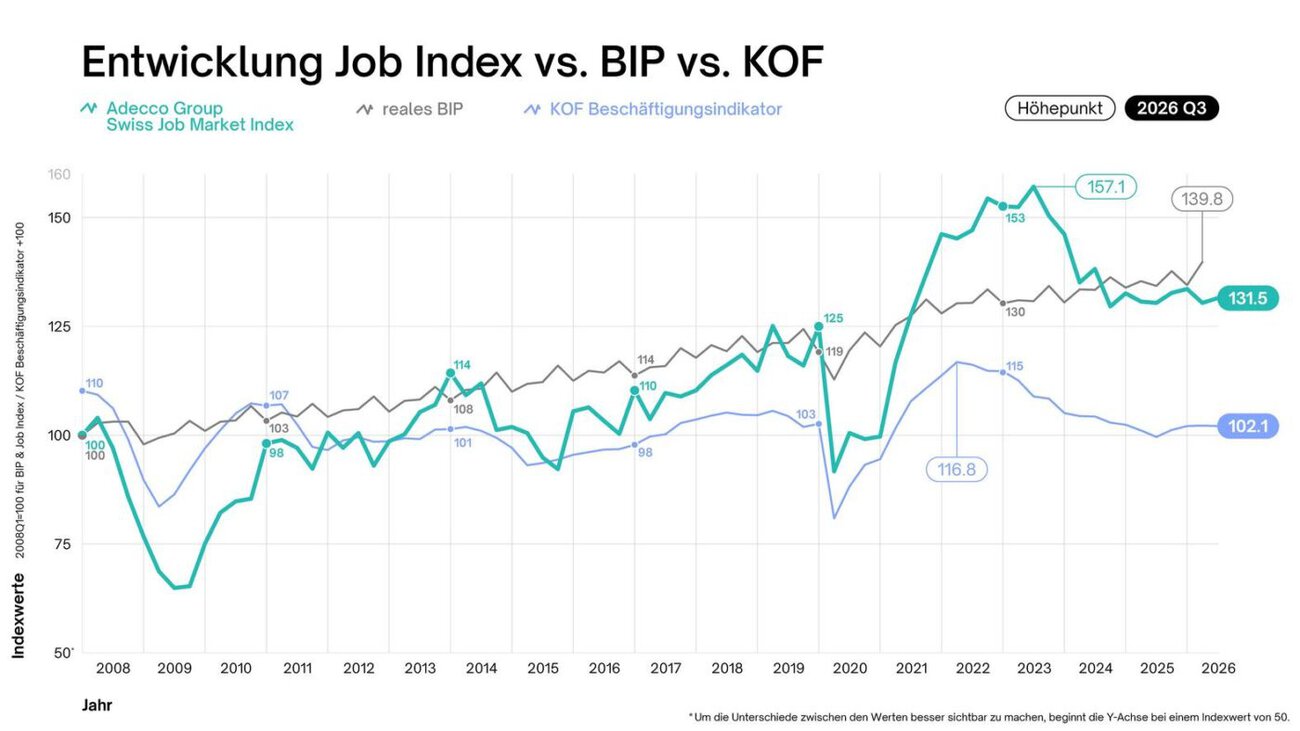
Die Zahl der offenen Stellen in der Schweiz steigt im dritten Quartal 2026 um 0.8 Prozent, sowohl gegenüber dem Vorquartal als auch im Vorjahresvergleich. Das zeigt der Swiss Job Market Index, den die Adecco Gruppe Schweiz gemeinsam mit dem Stellenmarkt-Monitor Schweiz der Universität Zürich erhebt. Im Berufsfokus weisen Handwerks- und technische Berufe ein überdurchschnittliches Stellenwachstum aus.
Swiss Job Market Index: leichte Erholung am Stellenmarkt
Der KOF-Beschäftigungsindikator deutet laut Mitteilung zudem auf eine leicht gestiegene Einstellungsbereitschaft der Unternehmen hin. Die saisonbereinigte Arbeitslosenquote blieb im August mit 3.1 Prozent praktisch unverändert gegenüber dem Vormonat. Das SECO korrigierte seine Wachstumsprognose für 2026 von 0.9 auf 1.7 Prozent. Grund sei das ausserordentlich starke zweite Quartal, das von der exportorientierten chemisch-pharmazeutischen Industrie geprägt war. Begünstigt wurde diese Entwicklung durch die konjunkturelle Erholung des weltwirtschaftlichen Umfelds.
Handwerk wächst mehr als viermal so stark wie der Gesamtmarkt
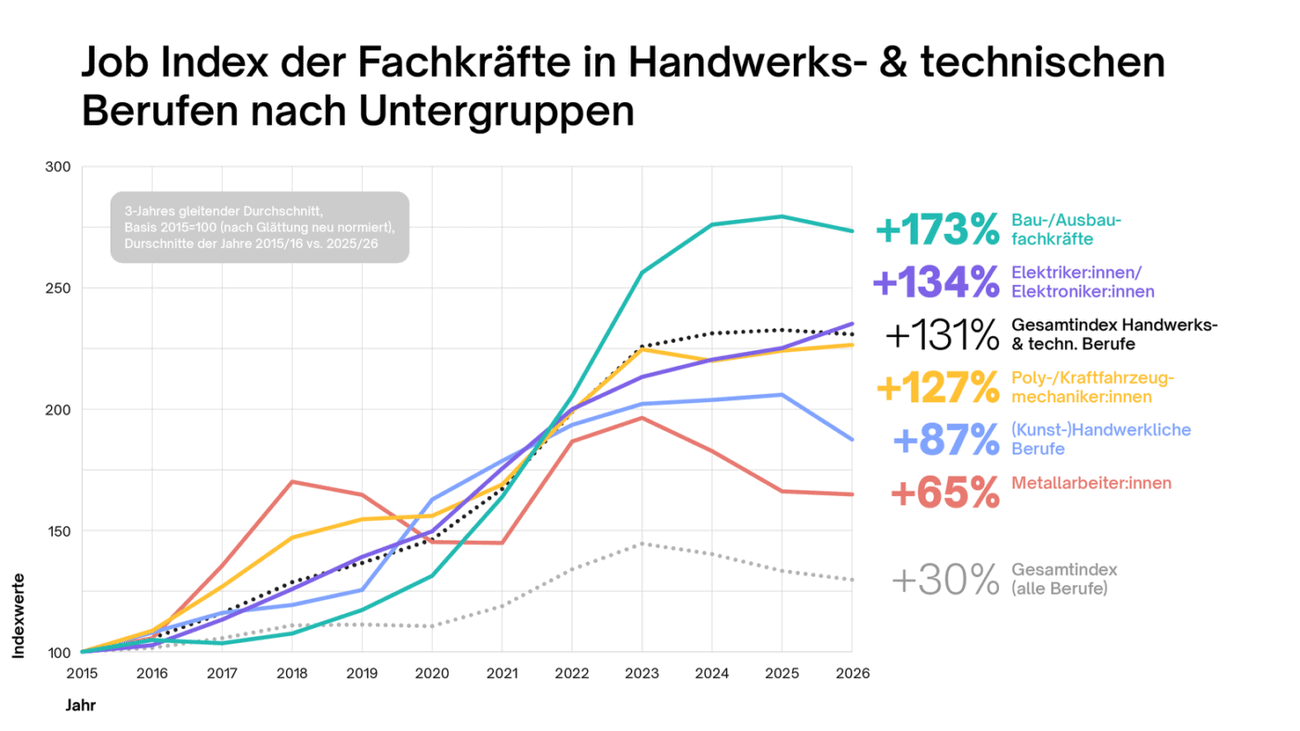
Die offenen Stellen in Handwerks- und technischen Berufen haben seit 2015/16 um 131 Prozent zugenommen. Das ist mehr als viermal so stark wie der Gesamtindex aller offenen Stellen mit plus 30 Prozent. Den stärksten Zuwachs verzeichnen die Bau- und Ausbaufachkräfte mit plus 173 Prozent, darunter Bauspengler:innen, Sanitär- und Heizungsinstallateur:innen sowie Zimmerleute und Bautischler:innen. Bei den Elektriker:innen und Elektroniker:innen beträgt das Plus 134 Prozent.
Das Wachstum konzentriert sich in allen fünf Untergruppen grösstenteils auf wenige Einzelberufe, etwa Bauspengler, Sanitär- und Heizungsinstallateure sowie Kraftfahrzeugmechaniker:innen. Getrieben sein könnte es teils durch die gute Baukonjunktur, teils durch andere Faktoren wie die demografische Alterung und den damit verbundenen Ersatzbedarf.
Fachkräftemangel entspannt sich, KI-Risiko gering
Der Fachkräftemangel in Handwerks- und technischen Berufen entspannt sich seit 2023 trotz weiterhin hoher Nachfrage. Nur die Untergruppen Elektriker:innen und Elektroniker:innen (Rang vier) sowie Polymechaniker:innen und Kraftfahrzeugmechaniker:innen (Rang fünf) bleiben knapp im Mangel- beziehungsweise im neutralen Bereich.
Zudem gilt nur rund ein Viertel der Handwerks- und technischen Berufe als moderat automatisierungsgefährdet durch Künstliche Intelligenz, gerade noch 2 Prozent als hoch gefährdet. Die Ergebnisse zeigten, dass diese Berufe trotz konjunktureller Unsicherheiten robuste Beschäftigungsperspektiven böten, heisst es in der Mitteilung.
Marcel Keller, Country President der Adecco Gruppe Schweiz, sagt: «Handwerks- und technische Berufe bieten auch in einem anspruchsvollen wirtschaftlichen Umfeld gute Perspektiven.» Gleichzeitig müssten sich Unternehmen und Arbeitnehmende darauf einstellen, dass technologischer Wandel, geopolitische Entwicklungen und wirtschaftliche Umbrüche die Rahmenbedingungen am Arbeitsmarkt laufend verändern.
Der Index erscheint jeweils im Januar, April, Juli und Oktober. Er beruht auf repräsentativen Quartalserhebungen der Stellenangebote in der Presse, auf Online-Stellenportalen sowie auf Websites von Unternehmen.
More information: https://www.adeccogroup.com
]]>
For the third time, swissreputation.group and pressrelations Switzerland have examined the media reputation of Swiss industrial and technology companies. The analysis covered media coverage of 65 companies from September 1, 2025, through August 31, 2026. Siemens, Dormakaba, Dätwyler, and Sensirion achieved the highest reputation scores in their respective categories. According to the press release, strong overall rankings sometimes mask significant differences between individual reputation dimensions.
How the Study Measures Switzerland's Media Reputation
The analysis focused on Swiss online and print media. With the help of AI, statements relevant to reputation are identified, evaluated based on tone, and categorized into six dimensions: products and services, innovation, economic performance, management and leadership, workplace, and ESG and sustainability. The Reputation Score ranges from 0 to 100 and takes into account media presence, tone, as well as the reach and significance of the media sources. Companies are divided into four presence groups based on media reach, with each group comprising 15 to 17 companies. This classification is recalculated for each issue.
A Leader with a Strong Presence and a Pacesetter
Among the top-ranked companies, Siemens leads with 84 points and achieves the highest score in ESG and sustainability. ABB follows with 78 points, while Stadler Rail ranks third with 66 points. Stadler Rail leads in Products and Services, Innovation, and Workplace, but scores significantly lower in Management and Leadership as well as ESG. Pilatus Flugzeugwerke (56) and Logitech (51) round out the top five.
In the "Pacesetters" category, Dormakaba leads with 79 points. Hitachi Energy follows with 68 points and leads in the Workplace category. V-Zug scored 63 points and achieved the highest ESG score in the group. Huber+Suhner (61) and Georg Fischer (59) round out the top five.
Pioneers and Hidden Champions
Among the trailblazers, Dätwyler, with 79 points, is just ahead of the Bühler Group, with 78 points. Dätwyler leads in products and services, while the Bühler Group leads in management and leadership as well as workplace. Novelis follows with 67 points, Belimo with 64, and Temenos with 58 points.
Sensirion leads the Hidden Champions with 83 points, confirming its top position from the previous year. Zehnder scored 73 points, Schneider Electric 69, Liebherr 67, and Endress+Hauser 58 points.
Changes Compared to the Previous Year
Siemens has replaced Stadler Rail at the top of the “Presence Leaders” category. ABB has moved up one spot, while Pilatus Flugzeugwerke and Logitech have entered the top five. Dormakaba also leads the new comparison group following its move from the “Pioneers” to the “Pacesetters.” The number of articles on Hitachi Energy has more than tripled, and the coverage has become more positive. Coverage is also significantly more positive for ABB, Pilatus Flugzeugwerke, Dormakaba, Dätwyler, and Zehnder. Sensirion reports a much more positive tone despite the number of articles being cut in half.
Different Strengths, Different Profiles
The leading companies base their position on various dimensions; top scores in individual dimensions do not necessarily translate into an overall victory. «A good overall score is the starting point. To manage their reputation, companies need to understand which issues strengthen their reputation and where critical perceptions arise,» says Lukas Zihlmann, CEO of swissreputation.group.
Many industrial and technology companies primarily do business with other companies; the general public is largely unfamiliar with their products from personal experience. Media coverage therefore plays a key role in shaping how these companies are perceived as employers, drivers of innovation, or in terms of their social responsibility. Zihlmann: «Consistent coverage of a company’s various achievements can help build a broad reputation profile. If, on the other hand, a company is perceived almost exclusively in connection with financial results or individual controversies, its public image remains correspondingly one-sided.»
More information: https://www.swissreputation.group
]]>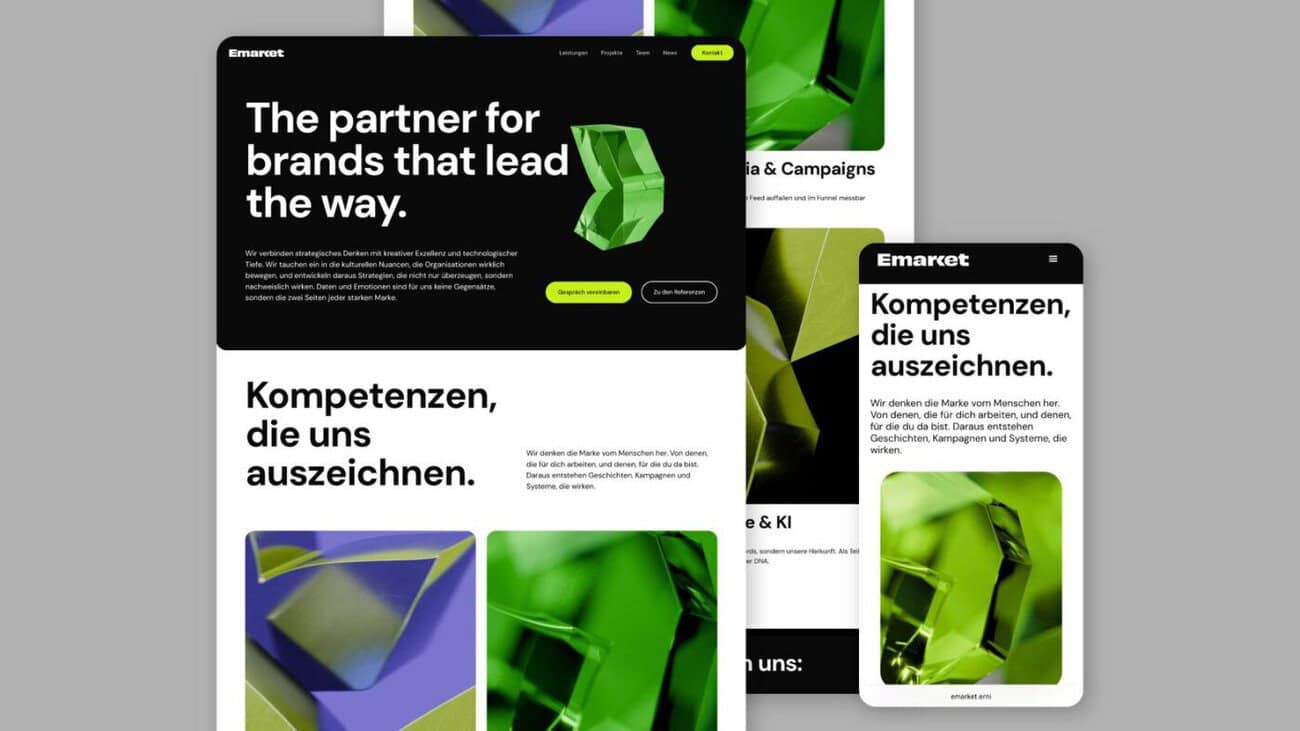
Die Agentur Emarket tritt zu ihrem zehnjährigen Bestehen mit einem neuen Erscheinungsbild auf und baut ihr Angebot in Technologie und KI aus. Der Emarket neuer Auftritt richtet sich nach eigenen Angaben an Marketing- und HR-Teams, die mit KI mehr aus ihren Kampagnen und Prozessen herausholen wollen. Dafür bündelt Emarket die eigene Expertise in Employer Branding, Social Media und Content mit den Technologiekompetenzen der ERNI Gruppe.
Emarket neuer Auftritt: Agentur für Daten und Emotionen
Emarket wurde 2016 gegründet und hat sich in den vergangenen zehn Jahren als Spezialistin für Employer Branding und digitale Kommunikation etabliert. Zu den Kunden zählen internationale Grossunternehmen, die Emarket aus der Schweiz oder von der Slowakei aus betreut. Mit der Neupositionierung bediene die Agentur die zunehmende Nachfrage nach Spezialisten für die Transformation von Marketing- und HR-Teams im Zuge von KI, heisst es in der Mitteilung.
«Der Markt verlangt von Agenturen, dass sie Kommunikation nicht nur noch gestalten, sondern auch intelligent machen und mit KI skalieren. Als Teil der ERNI Gruppe waren Daten und Emotionen für uns schon immer die zwei Seiten jeder starken Marke. Das machen wir nun explizit zum Angebot.», sagt Roy Müller, CEO von Emarket.
Technologie und KI mit eigenen Produkten
Im Bereich Technologie und KI bündelt Emarket KI-Enablement für Marketing-, Kommunikations- und HR-Teams, Plattformen und Systemintegrationen sowie Data und Intelligence. Dazu gehören auch eigenentwickelte Produkte, die Marketing- und HR-Kampagnen smarter machen sollen. Ein Beispiel ist das Schnellbewerbungs-Tool Quapply, das conversionoptimierte Bewerbungsfunnels an bestehende Bewerbermanagementsysteme wie SAP, Workday oder Teamtailor anbindet. Für die technische Umsetzung greift die Agentur auf die Engineering-Kompetenz der ERNI Gruppe mit mehr als 800 Expertinnen und Experten für Software, Data und AI zurück.
Neuer Auftritt, gleiche DNA
Die Entwicklung zeigt Emarket nun auch nach aussen. Der neue Auftritt sei moderner und zeitgemässer und baue auf der Erfahrung aus zehn Jahren Agenturarbeit auf. Die neue Website ist unter emarket.erni live.
Die Emarket Gruppe ist eine international tätige Agentur für Marketing und Kommunikation mit Standorten in Bern, Zürich und Bratislava. Emarket ist Teil der ERNI Gruppe, eines Schweizer Software-Engineering-Unternehmens mit weltweit mehr als 800 Mitarbeitenden.
]]>
Die 36. gfm Trendtagung 2027 steht unter dem Titel «Only Human?! – Der Faktor Mensch im Zeitalter der KI». Je leistungsfähiger die Maschinen werden, desto wertvoller werde das Menschliche, heisst es in der Ankündigung. KI optimiere Kampagnen, personalisiere Botschaften und beschleunige die Content-Produktion. Damit schaffe sie paradoxerweise Raum für das, was Marken stark mache: echte Werte, glaubwürdige Nähe zum Kunden und die Fähigkeit, Menschen nicht nur zu erreichen, sondern zu berühren.
Human Factor als Führungsaufgabe
Die gfm Trendtagung stellt den «Human Factor» als strategische Erfolgsposition im Marketing ins Zentrum. Er gilt zugleich als Führungsaufgabe für CMOs und Teams und als Kern eines Markenversprechens, das in einer automatisierten Welt einlösen soll, was es verspricht. Während Algorithmen über Sichtbarkeit entscheiden und KI-generierte Inhalte die Kanäle fluten, gewinnen laut den Veranstaltenden Vertrauen, Urteilsvermögen und menschliche Kreativität eine neue Schlagkraft. Sie würden zum Differenzierungsmerkmal, das sich nicht kopieren lasse.
Fragen an Marketingverantwortliche
Die Tagung greift mehrere Fragen auf: Welche Skills brauchen Marketingverantwortliche, wenn KI die Routinen übernimmt? Wie entsteht Markenvertrauen, wenn Authentizität zur raren Ressource wird? Und was verlangt diese neue Realität von Führungskräften und Teams?
Dazu bringt die 36. gfm Trendtagung Vordenkerinnen und Vordenker aus Wissenschaft, Wirtschaft und Praxis zusammen. Geboten werden soll ein Tag voller konkreter Impulse, ehrlicher Debatten und mutiger Perspektiven. Es gehe nicht darum, was KI alles kann, sondern darum zu zeigen, was nur der Mensch kann und warum das im Marketing von morgen mehr zähle denn je.
Tagungsgebühr und Anmeldung
Die Tagungsgebühr beträgt für gfm-Mitglieder 690 Franken, für Nicht-Mitglieder 990 Franken. Sie wird pro Teilnehmer nach Eingang der Anmeldung in Rechnung gestellt und ist nicht mehrwertsteuerpflichtig. Anmelden kann man sich online unter https://www.gfm.ch oder per Mail an [email protected].
More information: https://www.gfm.ch

SHAPE is expanding its leadership team and strengthening its strategic consulting capabilities: Arne Kochanski is taking on the newly created role of Director of Value Creation & Transformation at SHAPE. The hybrid digital agency, which operates at the intersection of AI, design, and software development, supports companies throughout the entire customer experience.
Focus on AI Transformation and Digital Trust
Kochanski focuses on AI transformation as well as growth and retention, from strategic prioritization through implementation to measurable impact. This also includes strengthening offerings related to digital trust, ensuring that compliance is an integral part of digital products and services from the very beginning.
«Our clients don’t need yet more strategy papers or isolated technology projects. What matters is identifying the right levers and consistently translating them into effective products, processes, and experiences,» says Lasse Gruner-Lüders, founder and CEO of SHAPE. «With Arne on board, we’re strengthening precisely this connection between strategic consulting, technological implementation, and measurable business success.»
Kochanski brings more than 15 years of experience in operations and product management. Before joining SHAPE, he gained experience on both sides of the spectrum: at the digital agencies Swipe Studio and SinnerSchrader, at the creative group Accenture Song, and most recently at a scale-up in the e-mobility division of an energy company. Automation, he says, merely makes a bad process bad faster: If you don’t understand the root cause, new technology will only entrench the existing problem.
Growth That Pays Off
According to the press release, many “hidden champions” and medium-sized companies in the DACH region still operate with structures that have evolved over decades and are barely able to meet today’s demands. A new tool alone won’t solve this problem: Change can only be effective through innovation consulting that addresses the root causes rather than just the surface symptoms.
Kochanski observes that companies tend to launch many parallel initiatives, but in the end, rarely does one of them become established and see completion. This is where SHAPE steps in, according to the company: Through its AI Supercharger program, the agency supports companies with a maturity analysis to identify which levers drive value creation. This ranges from strategy and prototyping to the implementation of both small and complex applications. SHAPE takes the same approach to Growth & Retention, whether it involves converting new target audiences, increasing revenue, or implementing loyalty programs. Ultimately, the measurable impact is what matters most.
«To me, value creation means that we’re measured by the impact we make, not by the number of features we deliver. It’s just as important to consider AI and compliance together from the very beginning: Anyone who wants to build something meaningful with AI today needs both at the same time; otherwise, the product will come to a standstill before its first release,» says Kochanski.
About SHAPE
SHAPE is a hybrid digital agency headquartered in Hamburg that combines AI engineering, product design, and software development. According to the agency, it has implemented more than 750 digital projects across the entire customer experience—from innovation consulting to growth and retention—over the past 15 years. Today, 140 specialists work across six locations in Germany, Switzerland, and Croatia. SHAPE is certified to ISO 27001 and ISO 9001 and is part of the international MYTY Group.
]]>