
IKEA is now also present at events like Fashion Weeks. How do you decide whether that really fits the brand?
Belén: For me, the question is never, „Does this attract attention?“ but rather, „Does this mean something to people?“ Being present at events like Fashion Weeks or in the heart of cities only works if you bring your own DNA to the table. Otherwise, you’re just using someone else’s stage.
There are three criteria I always apply. They are relevance, authenticity, and value creation. Relevance: Is this campaign connected to people’s lives today, or is it just a brand moment? Authenticity: Does it truly reflect what IKEA stands for—our values, our perspective on home life, accessibility, and design? And value creation: Does this experience leave a lasting impact—such as a stronger connection, a new audience, or genuine business insights?
The goal isn't to be everywhere. It's to be relevant in the right places, in a way that feels genuine and useful to people.
Many brands want to be culturally relevant. What is the most common mistake?
The most common mistake is to confuse visibility with relevance.
Cultural relevance doesn’t mean reacting to trends faster or louder. It’s about saying something meaningful. Too often, brands jump on trends without a clear connection to their purpose or to genuine customer needs. And people notice that. Cultural relevance isn’t created by individual campaigns. It’s earned over time—through consistent action, a deep understanding of people, and initiatives that offer real added value to their lives.
In my view, brands that get it right don’t ask, „What’s trending right now?“ but rather, „What matters to people, and what role do we play in that?“
How do you measure whether such initiatives are actually effective?
Attention is easy to measure. Impact is more complex—and far more interesting. Of course, we look at reach, engagement, traffic, and conversion. But what really matters is whether we’re making a difference in our relationship with the customer.
Are we reaching new target audiences? Are we strengthening the emotional connection? Are we increasing usage frequency, loyalty, or the share of the consumer budget in the long term?
Qualitative findings are often among the most valuable results: new insights, observed behaviors, or signals of what people expect next. Pop-ups or pre-opening activations, for example, are not just communication initiatives, but real-time learning labs.
For me, an engagement initiative is successful when it generates both short-term energy and long-term value for the company.
AI as a Team Member: Where Does It Help, and Where Is Human Judgment Still Indispensable?
AI is incredibly powerful when it comes to scalability and speed. It helps us listen more effectively across channels, markets, and conversations, and identify patterns or new signals that we might otherwise overlook. It also helps us personalize experiences more effectively and respond in a more relevant way.
However, when it comes to understanding culture, emotions, and meaning, human judgment remains indispensable. After all, cultural moments are not simply data points. They thrive on context, sensitivity, timing, and intuition. Knowing how and why to be present requires empathy and a clear stance.
That is why I do not see AI as a substitute for judgment, but rather as a way to sharpen it.
The real opportunity lies in combining these two worlds: technology to understand things on a large scale, and human insight to create what truly matters to people.
Belén Frau is a guest at the 2026 Swiss Brand Congress
On June 10, she will speak on the Strategy Stage on the topic «„Leave the Building“: How Brands Gain Cultural Acceptance.» The Swiss Brand Congress is the largest industry gathering for brand decision-makers, service providers, and media representatives. The industry will gather at The Dolder Grand Hotel in Zurich. Discussions, presentations, and interviews on two main stages will feature a wide range of tangible and practical case studies. For more information, visit: https://www.marken-kongress.ch/
]]>

After two years of decline, the M&A market for Swiss SMEs recovered significantly in 2025. A total of 208 mergers and acquisitions were completed, an increase of 16% compared to the previous year. The Swiss SME market is thus following the global trend of a noticeable upturn in M&A activity, as the latest study by auditing and consulting firm Deloitte shows.
Foreign buyers drive the market
Foreign buyers were responsible for half of all transactions: the number of inbound transactions, i.e. takeovers of Swiss SMEs by foreign companies, rose by 65% to a new high of 104 completed transactions. This is the highest figure since Deloitte began its survey in 2013.
"In an uncertain global environment, Switzerland benefits from its economic stability, its innovative strength and its strong position in specialized niche markets," says Kristina Faddoul, Head of Strategy, Risk & Transactions Advisory at Deloitte Switzerland. "International investors are specifically looking for resilient companies and innovative products with long-term growth potential - and are increasingly finding these in Swiss SMEs."
Purely domestic transactions also recovered slightly in 2025. The number of takeovers between Swiss SMEs rose by 10% to 53 deals. Although this figure remains below the highs of previous years, it signals that companies continue to have confidence in the domestic market.
Swiss SMEs are more cautious abroad
In contrast to the otherwise positive trend, the number of outbound transactions, i.e. mergers and acquisitions abroad in which Swiss SMEs act as buyers, fell significantly. At 51 transactions, the volume was 25% down on the previous year. The life sciences sector, where not a single acquisition was recorded in 2025, was particularly hard hit, as was the manufacturing industry with a decline of 50%.
This development reflects the increased caution of many Swiss companies. In view of geopolitical tensions, trade policy uncertainties and a very challenging investment environment, many SMEs focused more strongly on their core activities and existing markets. Acquisitions abroad mainly took place where targeted bolt-on acquisitions - often in the consumer goods and services sector - appeared to make strategic sense.
IT and consumer sector as the main target
The main driver of the recovery in the Swiss SME market was the IT and software sector, which alone accounted for 56% of the growth in inbound transactions. Overall, the IT sector accounted for over a quarter (28%) of all takeovers of Swiss SMEs - twice as much as in the previous year. This underlines the attractiveness and innovative strength of Swiss technology companies for international buyers. The consumer goods sector also developed positively: with 13 transactions, it recorded the strongest growth among purely domestic transactions.
Europe dominates, USA slumps
European investors are particularly interested in Swiss SMEs: they are responsible for more than four out of five (83%) inbound transactions. There were noticeable shifts in 2025: French buyers made up the largest group of foreign investors for the first time at 27 percent, ahead of Germany (19 percent). Investments from the rest of Europe also increased significantly, particularly from the Nordic countries, whose share rose to 13%.
In contrast, the proportion of US buyers fell by more than half from 17% to just 8%. "The decline in American buyers by more than half is remarkable. The weak US dollar against the Swiss franc and the US customs policy made transactions more expensive and more uncertain. European investors have filled this gap with conviction," says Kristina Faddoul.
Private equity as a key growth driver
Private equity has become the most important driver of the Swiss M&A market and played a key role in 2025. In total, financial investors were involved in 116 transactions - an increase of 45% compared to 2024. 56% of all transactions were therefore private equity-driven investments. The increase is mainly due to targeted add-on acquisitions, which increased fivefold in 2025: Foreign PE firms are specifically buying Swiss SMEs to strengthen their portfolios.
Positive prospects for 2026
M&A activities are expected to pick up further in the near future with an even stronger focus on Europe. "The signs for 2026 are good: a low interest rate environment, a lot of investment capital in private equity and intra-European investments speak for even more transactions. However, geopolitical risks and trade barriers remain major uncertainty factors. What our study clearly shows is that Swiss SMEs enjoy an excellent reputation. They will continue to be attractive partners or acquisition targets in 2026," concludes Kristina Faddoul.
The Deloitte study on M&A activities of Swiss SMEs examines merger and acquisition transactions of small and medium-sized Swiss companies between January 1 and December 31, 2025. Deloitte defines SMEs as companies with a turnover of more than 10 million Swiss francs, fewer than 250 employees and an enterprise value of between 5 and 500 million Swiss francs.
]]>
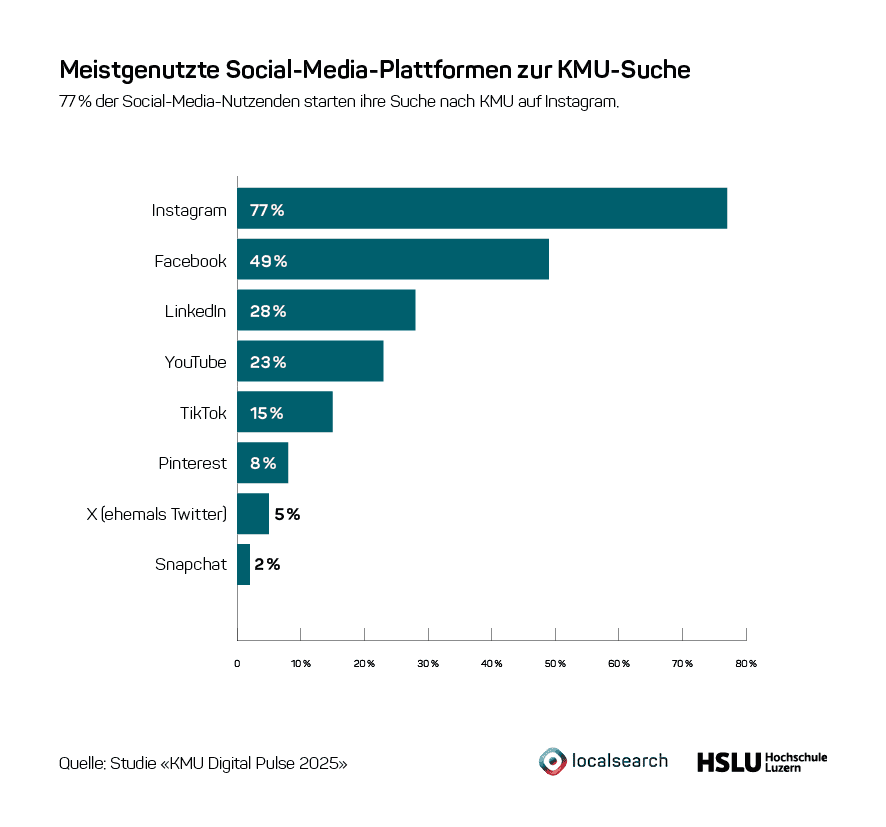
77% of social media users search for SME services via Instagram. Facebook follows well behind with 49%, LinkedIn in third place with 28%. These are the findings of the "SME Digital Pulse 2025" study by Localsearch and Lucerne University of Applied Sciences and Arts.
Generational difference shapes search behavior
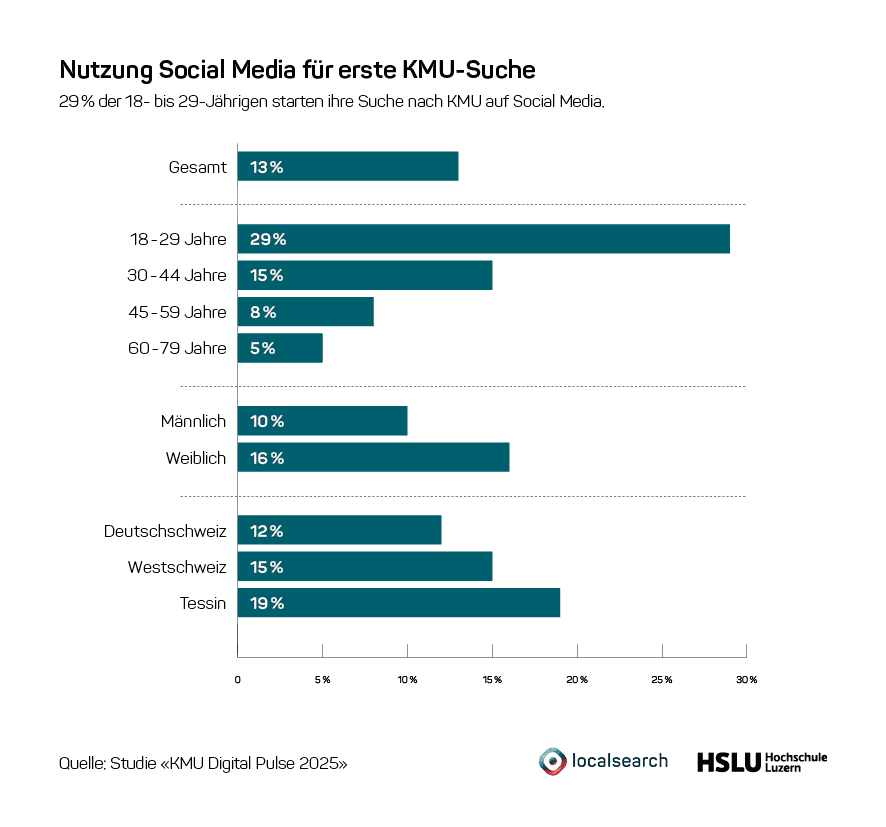
Almost one in three people under the age of 30 (29%) start their SME search on social media first - more than twice as many as the average (13%). Among the over-60s, the figure is only 5 percent. The younger a person is, the more often they search for SME services via social media first.
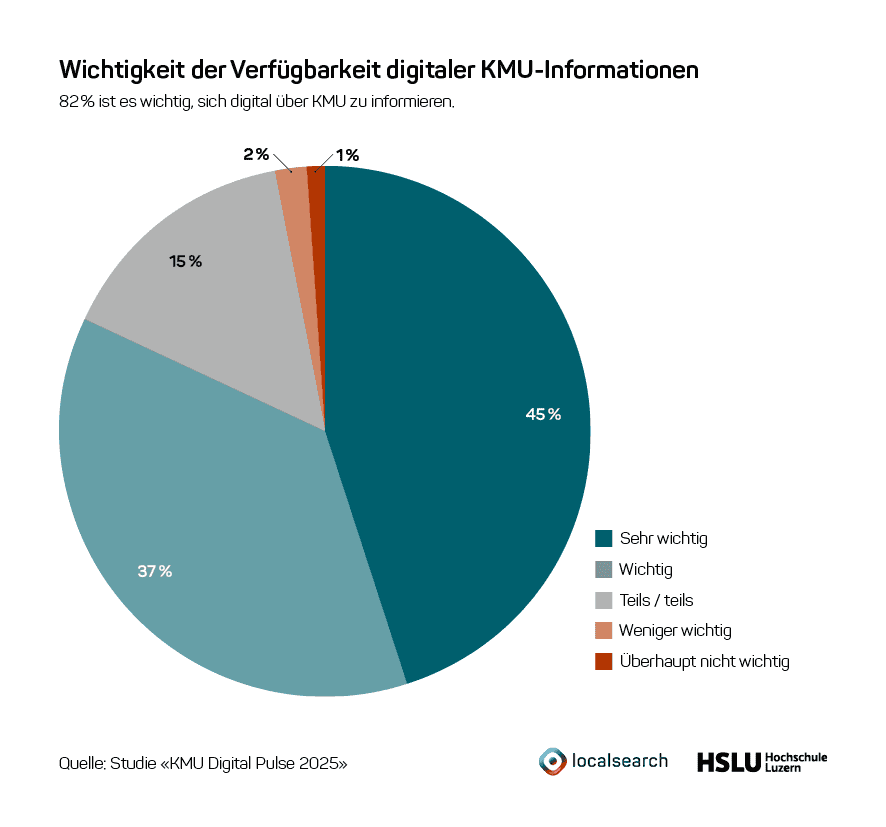
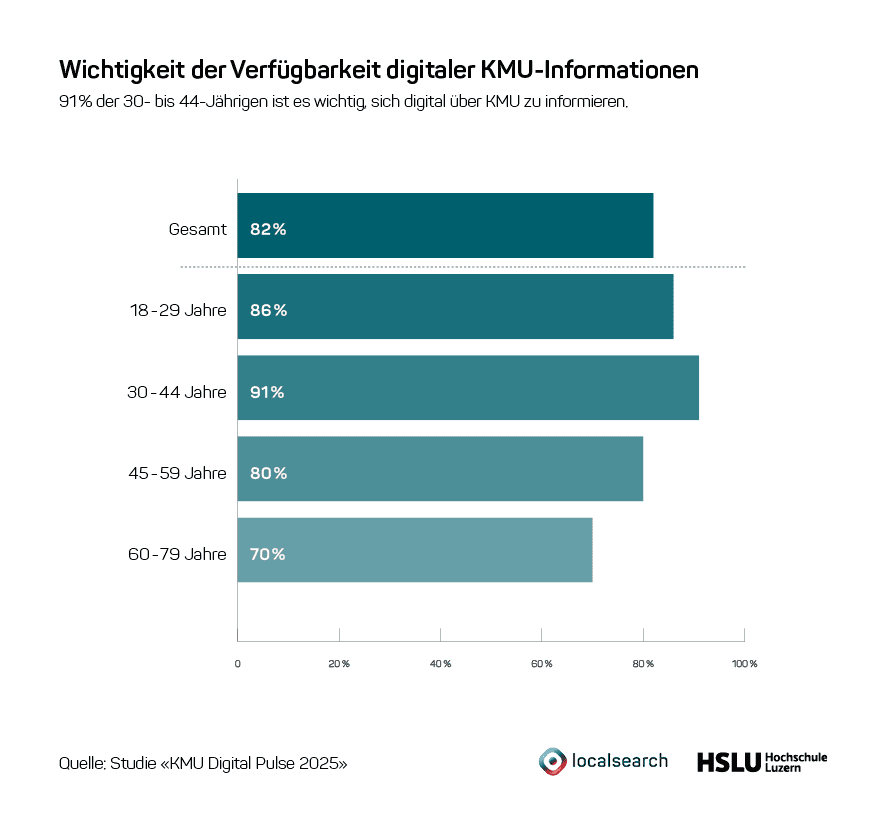
"Younger people use social media as a matter of course, which also shapes their search behavior," says Stefano Santinelli, CEO of Localsearch. Digital information about SME services is important for the vast majority of the population (82%). This need is particularly pronounced among 30 to 44-year-olds: In this age group, 91 percent would like to be able to obtain information about SMEs digitally.
TikTok on the podium for boys
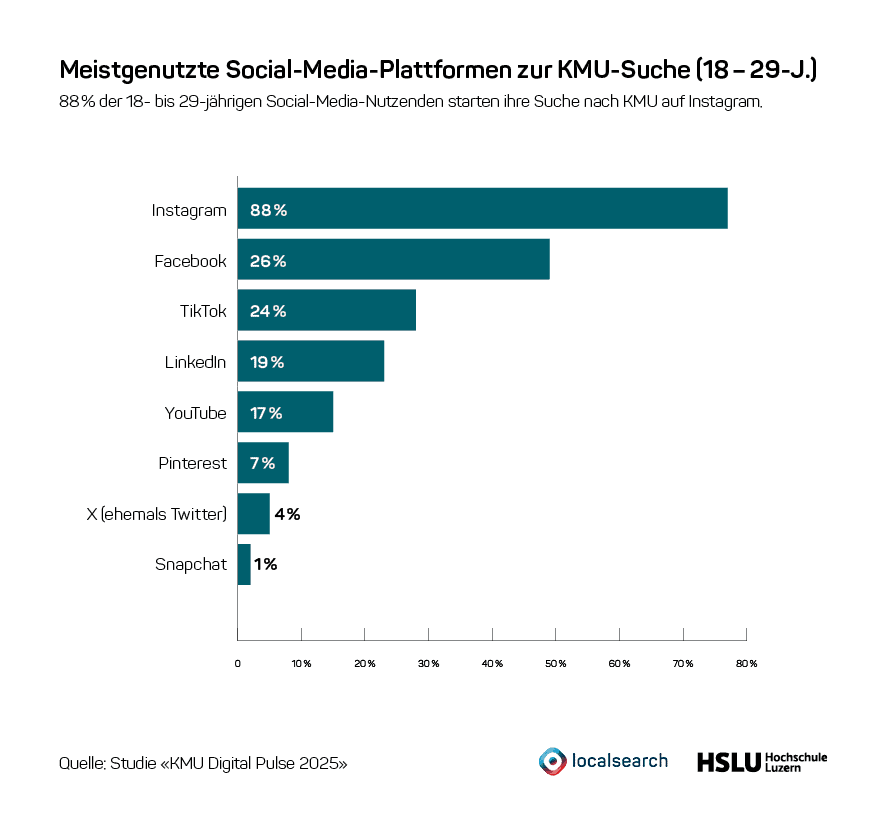
Among 18 to 29-year-olds who use social media to search for SMEs, almost one in four (24%) use TikTok. This puts the platform in third place among the under-30s, directly behind Instagram (88%) and Facebook (26%). The overall average for TikTok is significantly lower at 15%.
Instagram's dominance is even more evident among 18 to 29-year-old social media users: 88% of this age group use the platform to search for SME services. Facebook follows a long way behind in second place (26%). Even among 44 to 59-year-olds, more than 70% still use Instagram to search for SME services.
Gender and regional differences
Women (16%) use social media more frequently to search for SMEs than men (10%). There are also regional differences: 19 percent of respondents in Ticino use social media for this purpose - more than in French-speaking Switzerland (15 percent) and German-speaking Switzerland (12 percent).
Across all age groups, women (82%) use Instagram significantly more often than men (70%). The situation is similar with Pinterest, which tends to be used more by women (11%) than men (4%) for SME searches. The picture is reversed for LinkedIn: men use the platform more frequently (38 percent men, 22 percent women), as well as YouTube (31 percent vs. 18 percent) and X (10 percent vs. 2 percent).
Social media also relevant for maintaining contacts
Social media is not only relevant for searching for SME services, but is also becoming increasingly important as a channel for maintaining digital contacts, according to the study. For 65% of respondents, it is important that SMEs offer digital options for maintaining contacts - even among the over-60s, this figure is a remarkable 62%. 13% of respondents would like to use social media specifically to stay in contact with an SME.
"SMEs that are neither present nor active on social media are giving away valuable visibility and therefore digital market potential. They risk losing competitiveness in the digital world," concludes Stefano Santinelli. The new version of Localsearch's digitalONE product makes it even easier for SMEs to be present on social media, publish professional posts on Instagram, Facebook and the like and respond quickly and competently to reviews and customer feedback.
Further information on the "SME Digital Pulse 2025" study and the white paper can be found at this link available.
]]>
Artificial intelligence is developing rapidly and bringing with it far-reaching changes. This digital transformation does not stop at small and medium-sized enterprises, as the current study "KMU Digital Pulse 2025" by Localsearch and Lucerne University of Applied Sciences and Arts shows. "The way in which people search for services from SMEs is changing fundamentally. AI-based systems are increasingly becoming the SME search engine," concludes Stefano Santinelli, CEO of Localsearch.
AI at the same level as social media
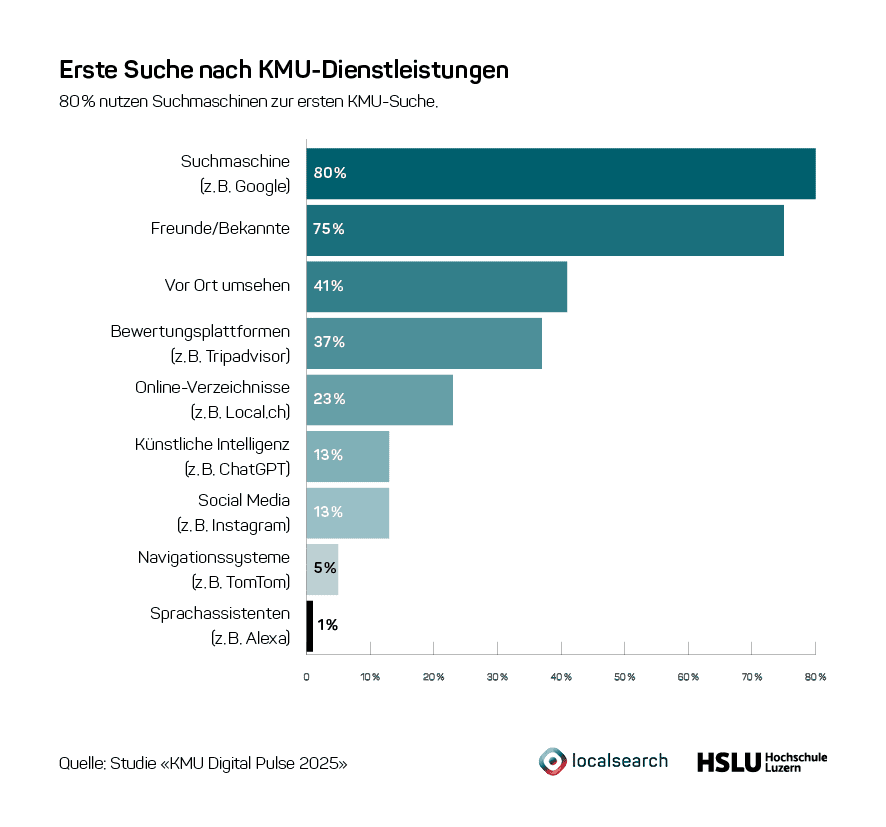
When the Swiss population is looking for an SME and does not yet know a provider, the vast majority still turn to search engines first (80%). However, 13% of respondents start their SME search directly with AI tools such as ChatGPT or Copilot - bypassing traditional search engines. This puts AI on the same level as social media. The use of AI to search for SMEs for the first time is particularly pronounced among 18 to 29-year-olds, with an above-average share of 21%.
According to the study, over three quarters of the population (77%) are open to new digital technologies such as AI-supported applications. But this openness does not stop there: in the past twelve months, almost 20 percent of the Swiss population have already used such applications to find out about SME services. This confirms the trend already observed that younger generations are using AI much more frequently.
Every second person wants to use AI to search for SMEs in the future
The increasing importance of AI is most evident in the planned future use: of the current users who have already used AI for this purpose, almost eight in ten (78%) say they want to do so more often in the future. This high level of willingness is similar across all age groups.
There is also a high level of willingness among current AI non-users: 40% of them would like to use AI to search for and obtain information about SME services in the future. Based on these results, it can be assumed that around half of the Swiss population (50 percent) will use AI in the near future to find out about SME services.
The study illustrates that SMEs must now also be found via AI assistants if they do not want to lose valuable customer potential. A complete company profile on various platforms in combination with optimized content is not only crucial for classic search engine searches - it also improves visibility in search queries via AI tools such as ChatGPT or Copilot.
AI is also changing the booking process
In addition to searching for information, there is also a growing interest in AI-supported booking processes: 39% of respondents can imagine making appointments in the future using voice-based AI assistants such as Siri, Alexa or ChatGPT. The age-specific analysis shows constant values of around 40 percent up to the 59-year-olds. Only among 60- to 79-year-olds does the proportion fall significantly to 29%.
"Customer expectations are clear: services must be bookable online. SMEs that don't take this step will lose visibility, trust and ultimately sales - in favor of digitally better positioned competitors," says Localsearch CEO Stefano Santinelli and concludes: "The future is digital, search is AI-driven - and the time to act is now. SMEs that do not actively shape their online presence will not only lose market share, but also access to digital customers. Those who are not visible today will be forgotten tomorrow."
With the new version of the DigitalOne product, Localsearch is responding to the digital shift towards AI: SMEs can now ensure their visibility not only on over 50 relevant search engines, directories and social media platforms, but also on the most important AI platforms such as ChatGPT and Copilot.
]]>
Behind the name is Mirjam Birrer, an experienced advertiser with over 20 years of professional experience. After working for major agencies such as Wirz, Leo Burnett and thjnk, she set up her own network. Her goal: to ground the often theoretically overloaded advertising discourse and refocus advertising on the essentials - impact and understanding.
"Where others talk about communication at eye level, I prefer to ask: Where are the shoes?" says Birrer. This credo runs through her offering: tailor-made campaigns for local SMEs that have little time for long briefings but have high demands on quality.
Frau Birrer GmbH sees itself less as a traditional agency and more as an agile communications workshop. With a network of creatives, designers and copywriters, Birrer realizes projects for start-ups, craft businesses and service providers from the region - from brand development to traditional advertising and social media.
The Lucerne native thus sets a counter-accent to the urban advertising scene: locally anchored, pragmatic in tone, professional in implementation. Or, as she puts it herself: "Good advertising is not art, but honest work - and it can be fun."
For more information www.fraubirrer.ch.
]]>
Behind Numbers are marketing and online specialists Jean-Claude Zulauf and René Linder as well as entrepreneurs and tech professionals Arben Lekaj and Hans Oury. Their services are aimed at SMEs that want to use digital marketing but do not have the internal resources to set up their own team.
"SMEs have an enormous need for comprehensive digital marketing expertise," says Co-Managing Director Jean-Claude Zulauf. "However, recruiting, building and managing a suitable team is often not financially viable or logistically feasible. Added to this are the challenges posed by rapid technological change, a shortage of skilled workers and fluctuating workloads."
Numbers analyzes existing campaigns, websites and systems and develops individual strategies. Automation and AI-supported tools are used to provide transparency about key figures and progress.
The company relies on a subscription model and two entry-level packages with all-inclusive prices to make access to professional digital marketing plannable. Further information can be found at Numbers.ch.
]]>
Based on the question of how far the introduction of AI has effectively progressed in Swiss SMEs, the study results show that 38% of the companies surveyed have already introduced generative AI or are actively considering its use. According to the study, typical areas of application for GenAI applications are HWZ Report content creation, marketing and process automation. Generative AI is followed by the use of data analysis at 35%, while machine learning lags behind at just 12%, according to the results. The reasons for this: a lack of understanding of the potential of machine learning and its perceived complexity.
Challenges in AI adoption
According to the results, companies consider the shortage of skilled workers in the AI sector and a lack of understanding of the technology to be key challenges. Regulatory requirements - particularly in terms of data protection - would make the introduction of artificial intelligence even more difficult. Many SMEs want transparent and reliable solutions as they want to validate AI outputs and clarify liability issues. Generative AI services such as ChatGPT are constantly evolving, but according to the study results, companies often lack customized solutions based on self-trained models and their own data.

"The technology is making progress, but without targeted investment in employee training and the creation of transparent processes, sustainable adoption cannot take place. Human and organizational factors are crucial to fully exploiting the potential of AI," says Evangelos Xevelonakis, Head of the Center for Data Science & Technology at the HWZ.
"The results show that Swiss companies are very interested in data-driven management, but that the development of specialized AI solutions is often hindered by a lack of expertise and uncertainty about the ROI," adds Matthias Mohler, Head of Data & AI Consulting at Swisscom.
Chandler Robinson, a student of the MAS Applied Data Science at the HWZ, conducted the study as part of his Master's thesis. According to the report, he received support from Evangelos Xevelonakis from the HWZ and Matthias Mohler from Swisscom. The survey was conducted in fall 2024 and provides insights into the use of AI by 123 Swiss SMEs and 5 large companies. In addition to the survey, Robinson conducted seven personal interviews with senior IT executives. (Dylan Wildhaber/jor/swi)
]]>

In the information and communication sector, where the study suggests AI is likely to provide the greatest time savings, only 7% of SMEs expect job savings. "Even though AI applications are primarily used in communication today, AI tasks such as translations or correspondence management appear to be used more as a support than a replacement," Kathrin Braunwarth, Head of Data, Technology & Innovation at Axa Switzerland, was quoted as saying in the press release published on Thursday.
Employees would hand over "tedious and sometimes tedious tasks" to AI applications. This simplifies work and saves time, but not jobs.
In other sectors, the fear of job cuts is greater. For example, 22% of companies in manufacturing, 18% in trade and 14% in industry expect job cuts. "In these sectors, there is a relatively large amount of standardizable work, such as production, sorting or logistics tasks, which explains the high potential for job cuts," Axa explains.
Larger companies tend to be more positive
However, the differences in the assessment of AI applications in terms of company development depend not only on the sector, but also in particular on the size of the SME. According to the press release, over half of the companies surveyed with more than 50 employees see artificial intelligence as a positive development.
Among medium-sized companies with up to 49 employees, this figure drops to 41%. Among SMEs with five to nine employees, only 27% of respondents still think that AI is useful to them. A quarter of respondents from small companies even consider AI to be a threat. This fear is far less prevalent among medium-sized (15%) and large companies (6%).
"A sensible implementation of AI often requires resources, such as technology and employees who know how to use it. Larger SMEs are more likely to have these resources at their disposal than smaller SMEs," says Braunwarth, categorizing the results. (SDA/swi)
]]> SMEs know that IT is crucial if they are to remain competitive in the future. However, they often do not have the necessary capacities, resources and skills in this area. It is also obvious that SMEs prefer to focus their attention and passion on their core business. As a result, IT is neglected - and therefore a lot of potential is not used, which can even put the company's existence at risk.
Swisscom wants to make SMEs more productive and secure with its IT solutions. To convey this, the House of Communication Zurich has taken up essential SME topics in the third communication wave and "enriched them with a lot of love" in line with the campaign motto.
The result is two eye-catching and striking visuals that can be seen throughout Switzerland as digital out-of-home, display ads, social media ads and also as classic posters and advertisements.

Client: Swisscom Switzerland. Responsible at the House of Communication Zurich: Günter Zumbach, Thomas Lüber (Text), Luca di Francesco, Carina Kienzle, Mila Lu, Michael Winnicki (Art Direction), Marcin Baba, Micha Seger (Executive Creative Direction), Philip Zsifkovis (Strategy) Edi Walker, Nicole Grogg (Consulting), Barbara Meier (Realization) Carmen Aebischer (Production Management) Nathalie Diethelm, Raul Serrat (Overall Responsibility). Production: Post Office Amsterdam.
]]>
Today, successful online advertising is almost impossible without programmatic advertising: the advantages include precise targeting, wide reach, effective budget control, automated real-time optimization and measurability. The crux of the matter, however, is access to this technology and the real-time bidding marketplaces where publishers' free advertising space is auctioned off. Only media agencies or advertisers with high budgets, specialist know-how and the appropriate ad technology have access to this.
However, according to Ewa Solutions, small and medium-sized companies with a regional reach and small budgets are particularly reliant on affordable and effective online advertising. With "Easy Digital Marketing" The aim is to democratize digital advertising, giving SMEs more opportunities to fight for awareness and sales.

In terms of applicability, the "Easy" in the name says it all. According to Sascha Knauer, advertising is still a matter for the boss at most SMEs and the campaigns are created directly by the advertising client in the self-service software. However, there are also some creative agencies that use "Easy Digital Marketing" for their customers.
This means that campaigns can be started easily and very quickly. The settings are said to take a maximum of ten minutes. Over 150 HTML5 banner templates are available as creatives, which can be adapted to the individual requirements of a campaign in just a few simple steps. White/publisher lists, remarketing options and third-party audiences are also available for experienced users.
"The positive feedback from international customers speaks for the success of 'Easy Digital Marketing'," says Knauer. The solution is available from 500 francs or euros per month.
]]>
Companies are confronted with increasing competitive pressure, new business areas, unstable supply chains and the battle for talent on a daily basis. With "SME IT Solution", Swisscom offers a one-stop shop for IT, network, Internet and telephony to help SMEs better meet these challenges.
The Zurich agency Bühler&Bühler translated the jointly developed value proposition quickly and comprehensibly into various subjects. In addition, the campaign was customized for Swisscom's partner marketing in order to maximize reach and inform customers personally. The campaign for the new B2B solution is primarily played out via social media and dialog marketing channels.


Bühler & Bühler has developed an independent moving image concept with the help of AI. Initially, the videos show a glitch that quickly dissolves and is intended to illustrate the advantages of "SME IT Solutions". The visuals represent the entire spectrum of the SME landscape.
"Bühler & Bühler succeeded in getting to the heart of the strengths of the service in a striking campaign. The fact that the visuals were generated with AI fits in with the zeitgeist - just like the new overall solution," says Roger Rietmann, Marketing Manager at Swisscom.
Responsible at Swisscom: Roger Rietmann (Marketing Manager ); Esin Emanetoglu (Marketing Manager). Responsible at Bühler & Bühler: Doris Bühler (Creative Direction); Vasco Bickel (Art Direction); Sofia Hornung (Design & Concept); Ronda Miller (Consultant); Joséphine Rohrer (Text & Concept); Clemens Fachinger (Text & Concept).
]]>
The new Goldbach Regional" area is designed to meet the needs of Swiss SMEs and enable them to run effective advertising campaigns with advertising budgets from as little as 500 francs and "without extensive experience in this area", according to a press release.
"Branding and, above all, sales measures through targeted communication are also extremely important for SMEs," says Thierry Furrer (photo), Managing Director of Goldbach Regional, "but many companies have neither the time nor the resources to take care of this." Goldbach Regional is therefore keen to offer SMEs cross-media advertising solutions tailored to the region from a single source at the lowest possible cost and in the shortest possible time.
Goldbach Regional can draw on the TX Group's analog and digital media brands, social media platforms, the programmatically bookable DOOH inventory of all relevant Swiss providers and all standard video formats. Goldbach Regional also plans to integrate additional formats such as digital audio and replay ads into its range this year and make them bookable for SMEs.
Customers - or their agencies, if applicable - would also benefit from "technologically supported services such as the creation of advertising material, fully automated campaign optimization or proof of performance in the form of live reporting". Customers will be offered "transparent and personalized advice", concludes Furrer.
]]>