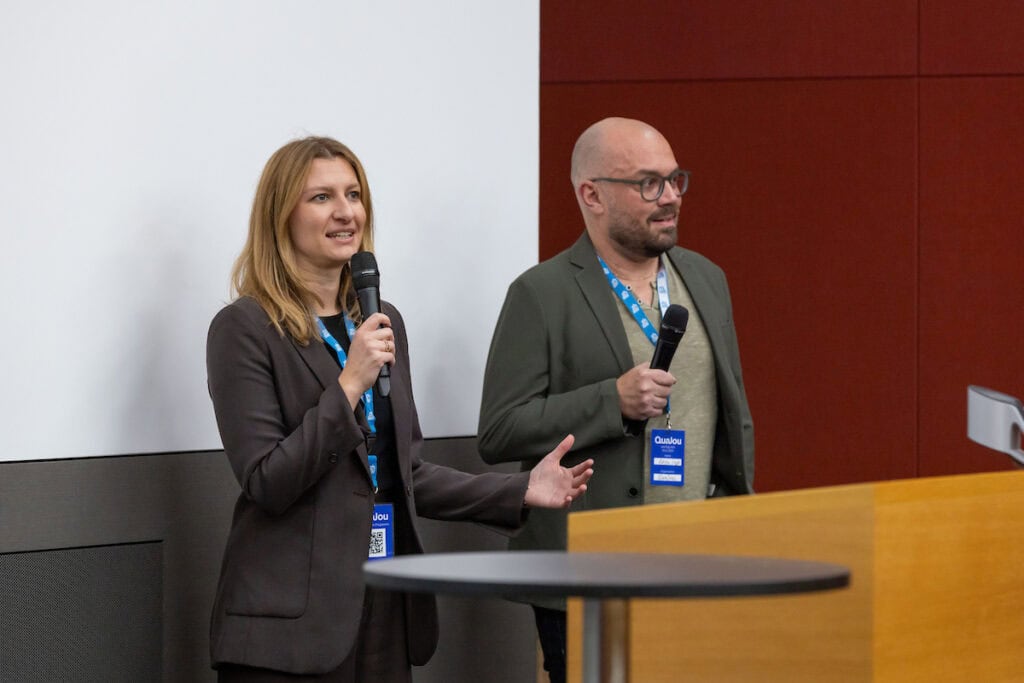
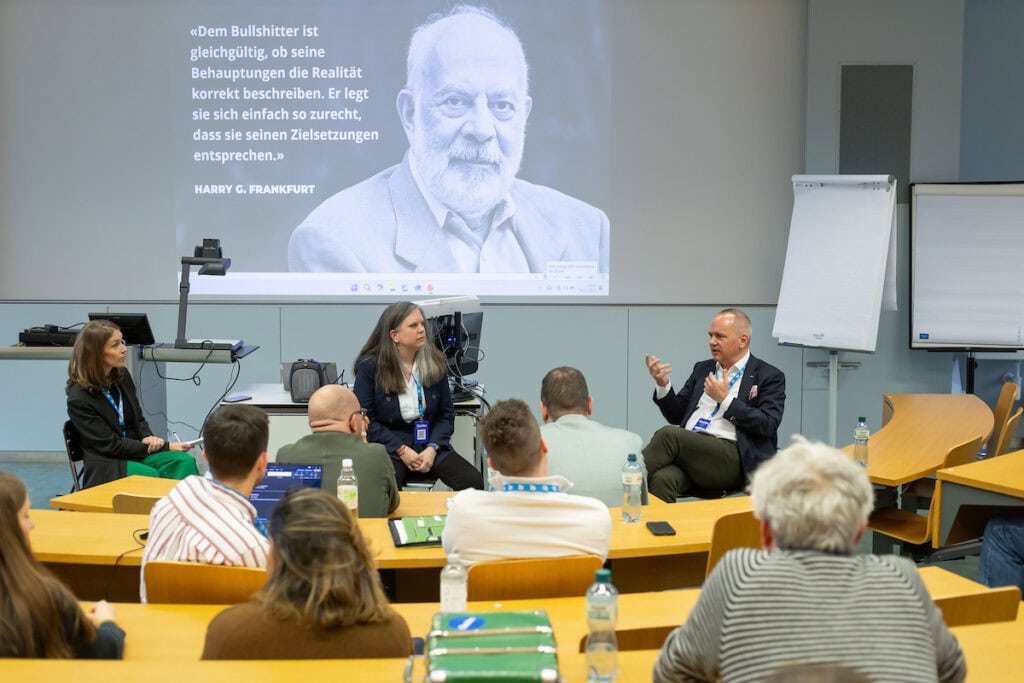
Bullshit in media releases is a nuisance that all journalists have to deal with. "Why is that?" asked TEDx speaker Ivana Leiseder during a panel at JourTag 2025, where she crossed swords with Andreas Hugi, founder and CEO of the Furrerhugi consulting agency.
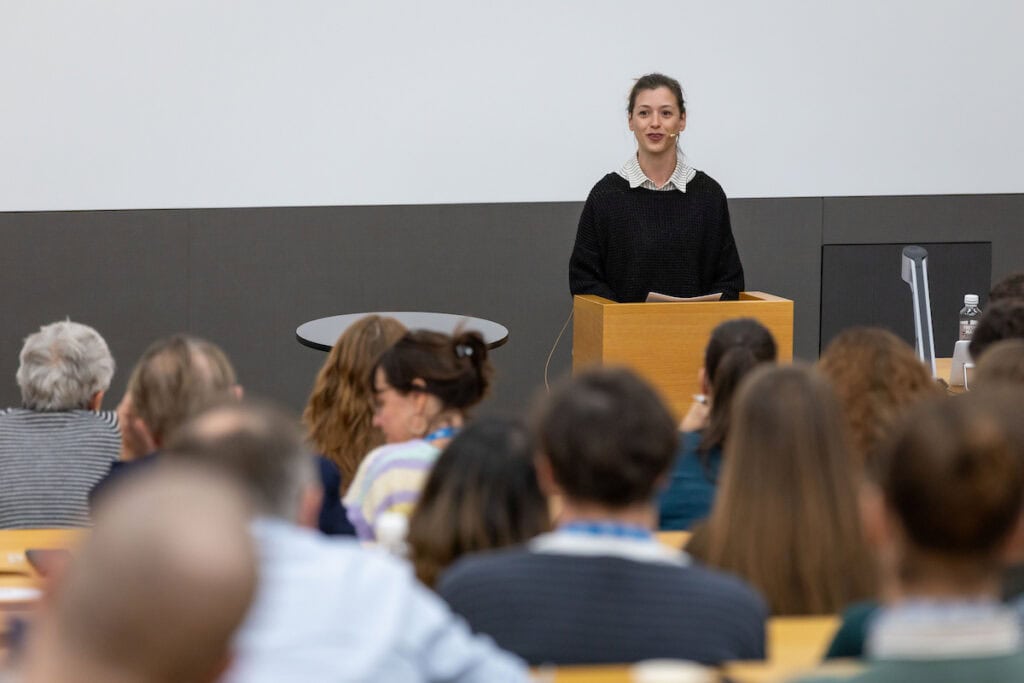
That was funny, but not entirely wrong. And yet the following panels showed a very different picture of the industry: exponents from different companies and with different tasks agreed that quality journalism is the only way out of the crisis, precisely because of AI.
Proximity still helps
For example, the youth: Simona Boscardin (On fire) and Tizian Schöni (WNTI) explained that traditional journalism is not bad. However, while Boscardin wants to do the translation work for the young and produce "cool shit" from serious topics, Schöni explained frankly: "We don't do anything new or crazy. But we do it, that's the difference." The two then also formulated things that are feasible for everyone as recipes for success: The joy of doing and trying things out, and proximity to customers.
Tina Huber (Tamedia), Leo Helfenberger (Watson) and Flavio Razzino (Blick) nevertheless agreed that preparing for a world without Google can only work with good content. "Writing articles just for Google makes no sense," said Helfenberger, for example. It's about reaching people via Google. And that happens through good content. "Surprising approaches to a topic" is Tina Huber's recipe for success. And all three agreed: for all the importance of SEO, there are also topics that need to be addressed, even if they don't achieve optimal figures. There are topics and formats with which
The best is at the end
Christoph Zimmer is Head of Product at Spiegel in Hamburg. He also emphasized in his closing keynote: "We are not in competition with any chatbot, but with arbitrariness." And from this he generated his learnings for the future of media companies. It is about sharpening the profile and offering classification. Media must also become more approachable and recognize the importance of communities. And that can be understood both digitally and physically.
Incidentally, the discussion between Andreas Hugi and Ivana Leiseder did not provide any real answers as to why media releases are the way they are. However, the two did find a few things in common. One of them was that the best content can always be found at the end of a media release.
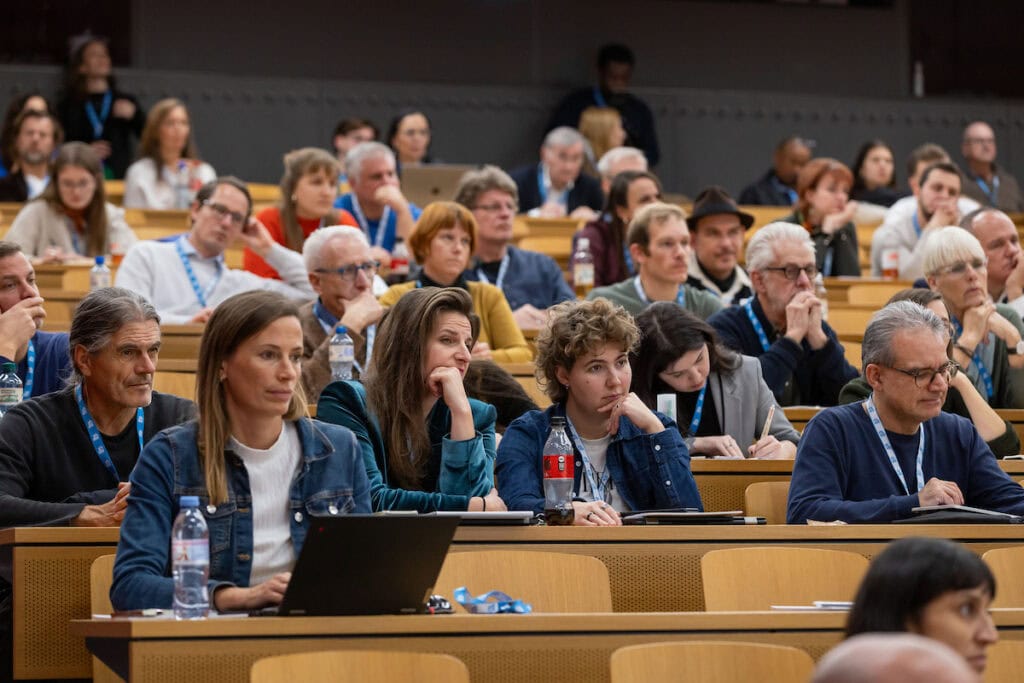
The JourTag is organized by the Quality in Journalism Association (QuaJour). The association is co-chaired by Alexandra Pavlović and Reto Vogt.

With 170 participants, the Journalism Day 2024 organized by the QuaJou Quality in Journalism Association on Thursday in Winterthur met with great interest. To mark its 25th anniversary, the association offered the event free of charge for the first time - a deliberate signal in economically challenging times.
Keynote speaker Silvia Princigalli, who was one of the founding editors of "Izzy", opened the day with a forward-looking analysis: How can crises promote innovation in journalism? "I've cried so many times and been devastated. The important thing is: don't lose hope, stay agile and don't be afraid to be different," said Princigalli. "Stay open and curious about possibilities, stay humble and hardworking and look for like-minded people and talent."

The program focused on current challenges facing the industry: ZHAW media professor Vinzenz Wyss presented the results of the latest ZHAW occupational field study on political orientation in editorial offices for the first time (Markt-kom.com reported). This shows: There is a threat of precarization in Swiss journalism - and Swiss journalism is not very diverse. "If we could get people without a university degree into the editorial offices, there would probably be more political diversity in reporting," said panel participant Camille Lothe (NebelspalterSVP). The statement by freelance journalist Eva Hirschi is worrying: "I know journalists who also work in a bar on the side - and it's often not voluntary."

"As a journalist, you shouldn't deceive"
Simon Bärtschi, Head of Journalism at Tamedia, answered critical questions on the reduction of regional online presences in a panel discussion. Matthias Ackeret, publisher and editor-in-chief of Personal, assessed the development as an independent media expert. At the start of the panel, it was agreed that all information should remain in the room in order to facilitate as open a discussion as possible.
The other panels opened up new perspectives: Thomas Benkö from the Blick Group presented the opportunities and limitations of AI tools in journalism in a workshop. However, it is important: "As a journalist, you should not deceive - not even with the new possibilities that are available." Three award-winning young media professionals - Livia Fischer (CH Media), Deniz Kurtogullari (SRF News) and Ernst Field (Bajour) - showed how the profession can remain attractive despite austerity programs. Their common message: "Opportunities for further development, support when things go wrong and good leaders."
During the discussion on the US presidential election, SRF presenter Arthur Honegger and Isabelle Stadelmann-Steffen, Professor of Comparative Politics at the University of Bern, analyzed the role of traditional and social media. Honegger said that we need to think about why we no longer reach the public: "Many people no longer believe an elite - and journalists are part of this elite. This has to do with the strong academization of our profession."
Among others, Press Council President Susan Boos and Hansi Voigt (founder of Watson, now Bajour) debated journalistic self-responsibility and its impact on media freedom. Among other things, they discussed the pending court ruling in the Spiess Hegglin case. Boos said that the View had clearly behaved wrongly - but: "It has become clear that the View has changed a lot. Stories like this are no longer made today." Voigt also agreed with this.

"Forced to focus on journalism"
The event concluded with a panel discussion on quality assurance in times of scarce resources. SRF presenter Sandro Brotz discussed with Stefan Ryser (Blue News), Sabine Eva Wittwer (Migros Magazine) and Marcello Odermatt (The Covenant) discussed the challenges and solutions from the perspective of the editorial offices. Odermatt said: "The fact that the lemon has been squeezed further and further has forced us to focus our journalism over the last ten years." Wittwer said: "We have much less time in which we are basically unproductive." But it is precisely in this "dead time" that ideas and thus diverse reporting are created. Ryser added: "What bothers me is that the whole discussion is often just about saving money and not about how to reach young people."

"The intensive discussions show how important the exchange of ideas and new perspectives are in the industry," summarize Fabienne Kinzelmann and Franz Fischlin, co-presidents of QuaJou. "Especially in times of upheaval, platforms like Journalism Day are needed where we media professionals can talk openly about challenges and develop solutions together. The high number of participants confirms our commitment to quality in journalism."
Free admission to Journalism Day, which traditionally takes place at the IAM Institute of Applied Media Studies at the ZHAW, was made possible by sponsors and the association's financial reserves. This decision was made against the backdrop of the current cost-cutting programs at almost all major publishing houses as well as SRG and Keystone-SDA.

The next JournalismDay will take place on November 20, 2025.
]]>
The prelude to the JournalismDay.24 will make the keynote speech by Silvia Princigalli, who draws on her many years of experience in various editorial offices such as 20 minutes, Annabelle and Izzy reports. In her presentation, she shows how journalists have to constantly reinvent themselves in the digital transformation. Princigalli makes it clear that crises can also be seen as opportunities for innovation and provides concrete insights into how media professionals can overcome these challenges.
The results of the ZHAW's current occupational field study will be presented at the event for the first time. The study raises various questions: How does political orientation relate to diversity in editorial offices? What role does gender-equitable language play in different types of media? Media professor Vinzenz Wyss discusses the findings with journalists Camille Lothe from the Nebelspalter and Eva Hirschi from the NZZ.
Panels and workshops will continue to focus on hot topics such as the financial situation of the media industry, non-discriminatory reporting and the role of the media in the US presidential election campaign. The panelists include Simon Bärtschi from Tamedia and Arthur Honegger from SRF. In a workshop, Thomas Benkö from Ringier will demonstrate the possible uses and limits of AI applications in everyday editorial work.
A special focus is on the next generation of media professionals. Three journalists under 30 discuss the future prospects of the industry. Finally, new editors-in-chief from various Swiss media, led by Sandro Brotz, will debate quality journalism in times of scarce resources, including Sabine Eva Wittwer from the Migros Magazine or Marcello Odermatt from the Confederation.
JournalismDay.24 will take place on November 21, 2024 and will begin at 12 noon with a networking opportunity. After an intensive program, the event will end in the evening with an aperitif riche. The venue is the IAM Institute for Applied Media Studies of the ZHAW at Theaterstrasse 15c in Winterthur.
]]>
How do we remain independent in times of artificial intelligence (AI) and automation? A playbook for journalists was provided by keynote speaker Uli Köppen at Journalism Day.23. She heads the AI + Automation Lab at Bayerischer Rundfunk. Köppen showed examples of how journalists can use AI technology and automation to achieve their goals. On the way there, editorial teams should first review and improve their own workflows instead of relying on "technological solutionism". "Ask questions and don't just provide answers," Köppen advises. It is also important that journalists take an interest in the technologies behind their own products.
AI is Janus-faced. This is particularly evident in its ability to create visual subjects in a matter of seconds: on the one hand, this opens up completely new opportunities, but on the other hand, it creates unexpected dangers, especially in times of deepfake. Illustrator and cartoonist Ruedi Widmer and satirist Karpi have already experimented with the new methods, while picture editors such as Lea Truffer from NZZ am Sonntag are confronted with new questions in their day-to-day editorial work. "As a creator, I am completely enthusiastic about AI," said Karpi. "AI makes me spiritual: it enables 'guided hallucination'."
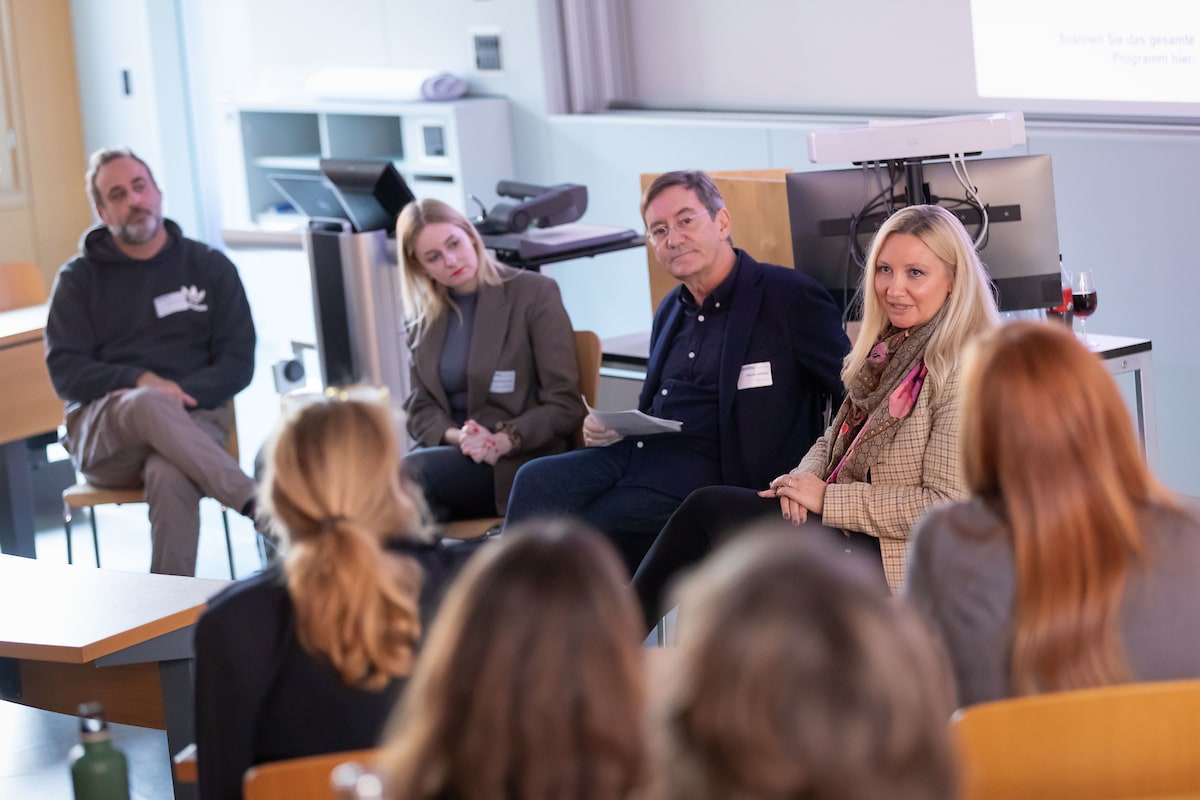
Picture: QuaJou/Raphael Hünerfauth
Boundless horror
The war in the Middle East was also discussed in a workshop. Specifically, the question was: How can impartiality be guaranteed and manipulation and falsification ruled out? Sophie Timmermann, deputy head of the Correctiv fact-checking team, and Daniel Egli, Head of Newsroom Coordination at Blick, were also present. This program item was moderated by Karina Rierola, foreign editor at SRF. Freelance journalist Inga Rogg also joined in from Jerusalem: "Both sides are going through a trauma, we have to listen to both - we must not play off the different suffering against each other." Egli asked: "What is a source? Hamas? The IDF? They all have a bias. Since October 7, we have had to use the subjunctive in an inflationary way."
Salvador Atasoy, journalist at SRF, Simona Boscardin, Co-President of Young Journalists Switzerland, and Monika Hirzel, Managing Director of the law firm BeTrieb, discussed with presenter Hannes Britschgi why media companies find it so difficult to deal with #MediaToo. "We breed such cases ourselves. The 'ruthless' prototype is promoted in journalism," said Atasoy. Boscardin had a theory as to why specific cases are often "only" open secrets: "Due to the cult of personality in the industry, it is sometimes difficult to rebel against a person."
Another workshop dealt with the question of why so many media professionals are fed up with journalism. Hanna Wick (ex-SRF), Janosch Tröhler (ex-Ringier) and Markus Dütschler (ex-SDA and Tamedia) reported on their reasons for leaving journalism. "Journalists are self-exploitative and glorify their profession far too much. And that is an invitation to be exploited," said Tröhler. Wick added: "I've met so many people in journalism who have absolutely no idea about leadership."
Credit Suisse was sailing towards its end and for months hardly anything got through to the Swiss media. International financial media dominated the reporting. Things were very different when UBS was rescued or Swissair was grounded: Swiss media were right in the middle of it. The top management stood up and explained. This change was discussed on #JourTag23 with Glencore Head of Communications Sarah Antenore, Allianz Head of Communications Hans-Peter Nehmer and SRF business journalist Reto Lipp. The latter said: "Whenever possible, I bypass communications departments. The direct line is simply better."
Tricky research
Investigating the mafia is a delicate and time-consuming task. After the death of mafia boss Matteo Messina Denaro, experienced investigative journalist Maria Roselli (RSI) traveled to Sicily to trace the Cosa Nostra's threads back to Switzerland. On Journalism Day, she talked about how the "modern" mafia operates, the dicey situations she has already found herself in and how she manages to keep an overview during several months of research. Stefano Stillitano also presented the "Osservatorio ticinese sulla criminalità organizzata", which was founded almost three years ago.
Tiktok, Instagram, YouTube and the like are taking over from traditional media. More and more people are getting their information primarily from these channels. However, as machines set the tone on social media and traditional gatekeeping by journalists is practically a thing of the past, the public's timelines are flooded with fake news and shallow entertainment. Cedric Schild (Izzy Projects) and Fee Anabelle Riebeling (20 Minuten) spoke to Franz Fischlin, Co-President of QuaJou, about how to communicate relevant content and, above all, arouse interest among young people.
Quality in journalism
How can the next generation be encouraged to consume media without the offerings drifting into ingratiating infotainment? The final panel with three editors-in-chief appointed this year took up these and other questions and threads, some of which had already been discussed at other events on the day. Nadine Sommerhalder (Watson), Steffi Buchli (Blick) and Desirée Pomper (20 Minuten) discussed, among other things, what they understand by quality in journalism. "The reliability of the information we provide to people determines our raison d'être," said Buchli on behalf of all media representatives. Fact-checking will therefore become increasingly important.
QuaJou draws a positive balance after JournalismDay.23. "With AI, the Middle East conflict and the working climate in journalism, we covered all the current topics. We are really proud of this year's program and the team behind it. The JourTag was a content-rich and inspiring day. We hope that we were able to make a contribution to the quality of journalism in Switzerland and to networking within the industry," says Co-President Fabienne Kinzelmann.
]]>

Ticket sales for the JournalismDay.23 is open as of now. Organized by the association Quality in Journalism QuaJou, the industry meeting will take place at the IAM Institute for Applied Media Science at the ZHAW in Winterthur on Thursday, November 23, 2023, from 12 to 8 pm.
Keynote speaker Uli Köppen heads the AI + Automation Lab at Bayerischer Rundfunk. At JournalismusTag.23, she will show ways out of dependence on tech companies and examples of how journalists can use AI technology and automation for their goals.
AI-generated images in journalism are also a topic at #JourTag23. This will be explored in depth at a workshop with author and satirist Patrick "Karpi" Karpiczenko, among others. Other workshops and panels will deal with toxic work environments, journalism on social media, the balancing act between journalistic practice and science, and the question of whether Swiss media still play a role for major Swiss corporations.
The final round takes place with the new editors-in-chief Steffi Buchli of View, Désirée Pomper from 20 minutes and Nadine Sommerhalder from Watson takes place. The program is currently being continuously supplemented.
]]>