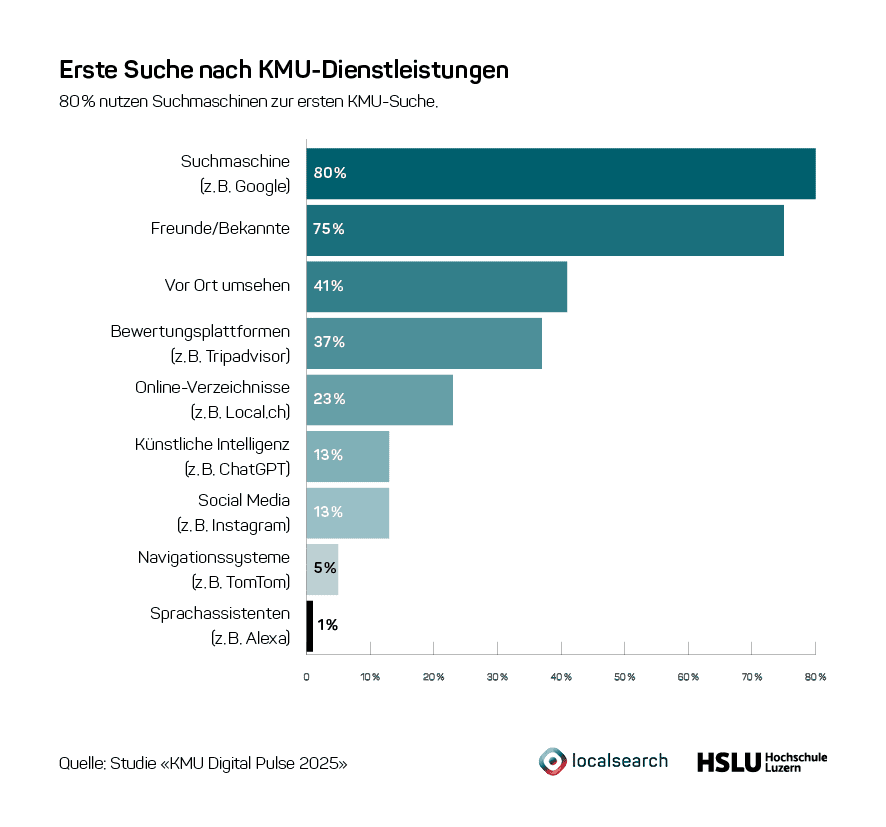
Artificial intelligence is developing rapidly and bringing with it far-reaching changes. This digital transformation does not stop at small and medium-sized enterprises, as the current study "KMU Digital Pulse 2025" by Localsearch and Lucerne University of Applied Sciences and Arts shows. "The way in which people search for services from SMEs is changing fundamentally. AI-based systems are increasingly becoming the SME search engine," concludes Stefano Santinelli, CEO of Localsearch.
AI at the same level as social media
When the Swiss population is looking for an SME and does not yet know a provider, the vast majority still turn to search engines first (80%). However, 13% of respondents start their SME search directly with AI tools such as ChatGPT or Copilot - bypassing traditional search engines. This puts AI on the same level as social media. The use of AI to search for SMEs for the first time is particularly pronounced among 18 to 29-year-olds, with an above-average share of 21%.
According to the study, over three quarters of the population (77%) are open to new digital technologies such as AI-supported applications. But this openness does not stop there: in the past twelve months, almost 20 percent of the Swiss population have already used such applications to find out about SME services. This confirms the trend already observed that younger generations are using AI much more frequently.
Every second person wants to use AI to search for SMEs in the future
The increasing importance of AI is most evident in the planned future use: of the current users who have already used AI for this purpose, almost eight in ten (78%) say they want to do so more often in the future. This high level of willingness is similar across all age groups.
There is also a high level of willingness among current AI non-users: 40% of them would like to use AI to search for and obtain information about SME services in the future. Based on these results, it can be assumed that around half of the Swiss population (50 percent) will use AI in the near future to find out about SME services.
The study illustrates that SMEs must now also be found via AI assistants if they do not want to lose valuable customer potential. A complete company profile on various platforms in combination with optimized content is not only crucial for classic search engine searches - it also improves visibility in search queries via AI tools such as ChatGPT or Copilot.
AI is also changing the booking process
In addition to searching for information, there is also a growing interest in AI-supported booking processes: 39% of respondents can imagine making appointments in the future using voice-based AI assistants such as Siri, Alexa or ChatGPT. The age-specific analysis shows constant values of around 40 percent up to the 59-year-olds. Only among 60- to 79-year-olds does the proportion fall significantly to 29%.
"Customer expectations are clear: services must be bookable online. SMEs that don't take this step will lose visibility, trust and ultimately sales - in favor of digitally better positioned competitors," says Localsearch CEO Stefano Santinelli and concludes: "The future is digital, search is AI-driven - and the time to act is now. SMEs that do not actively shape their online presence will not only lose market share, but also access to digital customers. Those who are not visible today will be forgotten tomorrow."
With the new version of the DigitalOne product, Localsearch is responding to the digital shift towards AI: SMEs can now ensure their visibility not only on over 50 relevant search engines, directories and social media platforms, but also on the most important AI platforms such as ChatGPT and Copilot.
]]> After a multi-stage evaluation process, the Lucerne University of Applied Sciences and Arts Board has elected Jacqueline Holzer as the new Director of the Department of Design & Art. On March 1, 2022, she will succeed Gabriela Christen, who wishes to take on new challenges.
Holzer studied German linguistics and literature, economics and philosophy at the University of Zurich. After her licentiate, she worked as a research assistant at the German Seminar and as a fellow at the Collegium Helveticum at ETH Zurich. This was followed by research stays in Berlin, London and Chicago, during which she dealt with questions of linguistic anthropology in the history of science and sociology. Research always remained an important field of interest in the further course of her career. She investigated the conditions for success in the field of "innovation organizations" and dealt with "gamification" in theaters.
Since 2003, Holzer has been a lecturer at various universities of applied sciences. At the Lucerne University of Applied Sciences and Arts, she was a lecturer in cultural sociology in the CAS Cultural Management & Practice, and at the ZHAW she taught philosophy of science.
She demonstrated her management skills as coordinator of the newly conceived MA Cultural Analysis at the University of Zurich. From 2013 to 2020, she was also responsible for the Department of Theater at the Zurich University of the Arts as program director.
For the past year, she has been responsible for interdisciplinarity and transformation at the Lucerne School of Art & Design as Vice Director. In addition, she is in charge of the further development of the preliminary course, the Bachelor of Art & Communication, and the Master of Fine Arts, as well as in the interdisciplinary teaching area and in continuing education.
]]>