
Like already in the previous year Twint leads the reputation ranking of Swiss companies. The company is particularly highly regarded in French-speaking Switzerland and among women and young people under the age of 30. "Twint is seen as an absolute top company that offers better services than other companies in the sector and stands out positively," explains Anja Reimer from NIQ GfK. "No other company enjoys such strong identification among the Swiss population."
Twint CMO Jens Plath is delighted with the result: "The trust of our more than five million users is of central importance to us. We are particularly pleased to be recognized together with other Swiss Love Brands."

Changes in the ranking
Zweifel remains in second place, scoring particularly highly in German-speaking Switzerland and among younger consumers. Ricola rises to third place, pushing Migros down to fourth place. Lindt & Sprüngli moves up four places to fifth place, followed by Coop, which climbs two places and - like Zweifel - is particularly popular with young consumers.
Digitec Galaxus makes it into the top 10 for the first time after the company is now one of the 50 most important Swiss companies due to increased awareness. The cantonal banks moved up five places to eighth place, while SBB dropped four places to ninth - although it received the best rating in terms of environmental sustainability. Geberit remains unchanged in tenth place.
Demographic differences in ranking
The results show clear regional and demographic differences. In French-speaking Switzerland, Migros is in second place, followed by Lindt & Sprüngli. Rolex, Nespresso and Logitech are among the ten most valued companies here.
Among women, Migros is just ahead of Ricola in third place, while Landi is also in the top 10. The men rate Ricola best, followed by Zweifel and Migros. Mobiliar and Logitech are among the most highly rated companies.
In terms of age, Twint clearly leads the ranking for young people under 30, followed by Zweifel, Coop and Migros. Ricola, Zweifel and Lindt & Sprüngli occupy the top three places among the over-50s.
Rega dominates the NPO ranking for the eighth time in a row
Swiss Air-Rescue Rega remains the undisputed leader among non-profit organizations. "This award is thanks to our employees, who give their all around the clock to help people in distress," says Rega CEO Ernst Kohler.
The Swiss Paraplegic Foundation and the Swiss Red Cross follow in second and third place. They are followed by Médecins Sans Frontières, Spitex Switzerland, Fairtrade Max Havelaar and WWF Switzerland, which moved up three positions. The Cancer League, Swiss Mountain Aid and Bio Suisse complete the top 10.

The NIQ GfK Business Reflector measures the reputation of the 50 leading Swiss companies and 20 best-known non-profit organizations. The representative survey is based on 3,800 interviews conducted between mid-January and mid-February 2025. The aim of the study is to provide precise reputation monitoring for companies and NPOs.
]]>
The GfK Market Monitor Switzerland, published by GfK Switzerland AG in collaboration with over 40 leading retailers, documents an overall subdued picture in the Swiss retail sector for the first three quarters of 2024. With a slight decline of 0.2%, the market as a whole fell just short of the previous year's figure. A differentiated view shows that the food/nearfood sector is performing robustly with growth of 1.3%, while the non-food sector is down 2.8%.
The consumer mood remains subdued and consumers increasingly prefer to make purchasing decisions on promotional days such as Black Friday. Despite the popularity of premium products, restraint and recourse to discounted offers still seem to dominate. The home electronics sector in particular is saturated, which explains the decline in this segment. Only niche products such as hair styling appliances and electric toothbrushes are showing positive trends.
Only the leisure segment recorded a slight increase. Sports products such as e-bikes, treadmills and sports nutrition are in particular demand and are supporting the segment. The fashion sector also benefited from an early fall and rising demand for warmer clothing, although this was unable to compensate for the summer's losses.
The online business, on the other hand, recorded solid growth of 4% and continues to demonstrate stability in the market. Despite the subdued economic forecasts, the growth potential of the online segment remains unbroken.
The expert group's forecasts for Swiss GDP adjusted for sporting events in 2024 are for expected growth of 1.2%, followed by 1.6% in 2025.
GfK Market Monitor Switzerland is a service provided by GfK Switzerland AG in cooperation with over 40 major Swiss retailers. These generate around 40-50 percent of total retail sales. Specialty retailers are not included. The GfK Market Monitor does not claim to be representative of the market as a whole. GfK makes various overall market estimates for this purpose.
]]>
The GfK study on European purchasing power in 2024 illustrates the sometimes considerable differences in income within Europe: while Liechtenstein's per capita purchasing power of 70,180 euros is more than 3.7 times the average, Switzerland and Luxembourg take second and third place in the ranking with 52,566 and 41,785 euros per capita respectively. Switzerland in particular shows an impressively constant purchasing power and is positioned well above the European average. Austria also ranks sixth among the top 10 countries with an increase.

A country comparison reveals a regional disparity that appears to be less pronounced in the Netherlands, Germany and Austria, but shows considerable differences between wealthier and lower-income regions, particularly in France, Italy and Spain. In France, purchasing power in the capital region Île-de-France is well above the national average and remains the economic center of the country. Italy, on the other hand, shows a clear north-south divide: while the province of Bolzano, the new leader, represents the wealthier northern Italian regions, southern Italy lags well behind the national average.
The UK and the Netherlands both move up in the overall European rankings this year: The UK rises three places to reach seventh place with a purchasing power of EUR 28,086 per capita, while the Netherlands moves up to tenth place with an average value of EUR 27,558, showing a relatively balanced distribution of purchasing power across the provinces.
Overall, 16 of the 42 countries surveyed are above the European average. Despite nominal growth in purchasing power of 3.9%, the regional and cross-national income gap remains striking, particularly in Eastern and Southern European countries such as Poland, Hungary and Romania, where net disposable income remains comparatively low. However, there is a noticeable trend towards a convergence of incomes in less affluent regions. The "Purchasing Power Europe 2024" study is available now and contains detailed data at local authority and zip code level.
About the study:
The "GfK Purchasing Power Europe 2024" study is available for 42 European countries at detailed levels such as municipalities and zip codes, as well as corresponding data on inhabitants and households and digital maps.
Purchasing power refers to disposable income excluding taxes and social security contributions including transfer payments and is shown per capita and year in euros as an index. GfK Purchasing Power refers to nominal disposable income. This means that the values are not adjusted for inflation. The calculation is based on data from income tax statistics, relevant statistics for calculating transfer payments and forecasts from economic institutes.
Consumers use their general purchasing power to cover all expenses for food, housing, services, energy costs, private pensions and insurance, as well as other expenses such as vacations, mobility and consumer wishes.
]]> Retail sales in terms of value increased slightly again at a high level and amounted to CHF 103 billion. In total, Swiss retail sales rose by around half a billion Swiss francs to 103 billion Swiss francs in 2023. This corresponds to an increase of 0.5% compared to the previous year. Population growth and the positive trend in the food sector in particular contributed to this development.

In 2023, Swiss consumers purchased 14.4 billion Swiss francs worth of goods and merchandise online. This corresponds to an increase of 0.4 billion Swiss francs or 3% compared to the previous year. Online consumption will increase by 0.2 billion in 2023 compared to the previous year. Online purchases abroad have reached a new high of CHF 2.2 billion and are up 10% on 2022. This is driven by small parcels from Asia. These are mainly delivered directly to Zurich and Geneva by air freight by the major platforms. Moderate overall sales growth of up to 1% is expected by the end of the year. This means that the 104 billion Swiss franc mark will be exceeded for the first time.

This year, Twint leads the reputation ranking and, according to GfK Switzerland, is now one of the 50 most important companies in Switzerland due to its increased awareness among the Swiss population. "The company is seen as an absolute top company that offers better services than other companies in the sector and stands out positively from other companies. The under-30s in particular rate Twint extremely highly," says Dr. Anja Reimer from GfK Switzerland.
Second place in the ranking was taken by Zweifel, which improved by one place. Migros is in third place this year. According to Anja Reimer, although Swiss people continue to identify most strongly with the retailer, Migros scored less highly this year in terms of social and moral appreciation.
Ricola and SBB occupy the next places. The latter improved by five places and achieved the highest scores in terms of environmental sustainability.
Rivella, in sixth place, improved its ranking by three places, while Mobiliar (ranked seventh) moved up seven places. Coop, Lindt & Sprüngli and Geberit follow in 8th to 10th place.

Demographic differences in ranking
Men rate Zweifel slightly better than Twint and also rate Ricola slightly better than Migros. Women, on the other hand, rate Twint best, followed by Migros.
German-speaking Swiss rate Rivella, Mobiliar, Zweifel, Geberit, Ricola and SBB better than French-speaking Swiss, whereas Coop and Lindt & Sprüngli score better in French-speaking Switzerland.
Migros is in second place in French-speaking Switzerland, ahead of Zweifel, while Coop is in fourth place. For the French-speaking Swiss, the cantonal banks, Logitech and ABB are also among the top 10 - whereas Mobiliar, Geberit and Rivella are not among the ten best companies here.
NPO ranking: Rega in first place for the seventh time
Swiss Air-Rescue Rega topped the ranking of non-profit organizations for the seventh time in a row. "Rega enjoys a high level of popularity among the Swiss population. The Swiss identify with Rega and attest that it is successful and stands out positively from other organizations," comments Anja Reimer.
The Swiss Paraplegic Foundation is in second place in the ranking, followed by the Swiss Red Cross, which improved by three places. Spitex Switzerland, in fourth place, also improved by one place. It is followed by Médecins Sans Frontières, Fairtrade Max Havelaar and, in seventh place, TCS, which moved up seven places. The Cancer League remains in eighth place, followed by Bio Suisse and WWF Switzerland.
The GfK Business Reflector measures the reputation of the 50 leading Swiss companies and 20 best-known NPOs on the basis of a population-representative survey, compares them and thus provides an annual cross-sector seismograph of the Swiss corporate and non-profit landscape. Together with the Research Institute for the Public Sphere and Society (Fög) at the University of Zurich, a scientifically sound measurement tool was developed to provide Swiss marketers, CSR managers, companies and NPOs with a representative reputation index. The results are based on over 3,500 interviews conducted throughout Switzerland, which are collected from mid-January to mid-February. The aim of the study is to provide objective and precise reputation monitoring.
]]>
Concerns about inflation, rising healthcare costs and general economic uncertainty are having a negative impact on consumer behavior this year. Overall, over 40% of respondents plan to spend less on gifts and a third plan to donate less to charitable organizations than in previous years.
Restraint is also observed in spending on toys: The annual increase in spending on toys, which reached a record level of 500 Swiss francs last year, is down on the previous year at 411 Swiss francs. The proportion of consumers who prefer to buy gifts for toys online has remained at the previous year's level. The trend in stationary shopping is down on the previous year (-8%).
Overall, shopping behavior for toys remains hybrid: 69% of people shop online and in-store, 22% only in-store and 9% only online. The proportion of respondents who have not made any toy purchases two weeks before Christmas - and are then also prepared to pay the full price - is 25% and has remained unchanged for five years. Men tend to take it easy (30 percent), while a larger proportion of women (19 percent) have already stocked up ahead of time.
Consumer behavior outlook for the coming year
Consumer restraint will continue in the coming year. Almost half of Swiss consumers say they want to consume more consciously and spend less in the new year. More than a quarter of consumers are therefore also considering buying more second-hand products in the new year than before - especially women and younger consumers. 22% can imagine buying a refurbished product instead of a new electronic device (e.g. smartphone, tablet, PC, etc.). (refurbished = devices that have been refurbished, cleaned and tested by a manufacturer or retailer). That is 6 percent more than in the previous year.
]]>
The Christmas season is approaching and with it the so-called "shopping days". The most prominent of these is Black Friday. Together with the market research institute GfK Discount corner, Switzerland's most widely used and best-known cashback platform, researched the behavior of consumers in German-speaking Switzerland. The results are highly encouraging for e-commerce platform operators.
Remarkably, 96 percent of the online population in German-speaking Switzerland is familiar with Black Friday. The study shows that an overwhelming majority, namely 91 percent, of the German-speaking Swiss online population was satisfied with their past Black Friday purchases. This underscores the importance of high-quality offers and attractive discounts for consumers.

In addition, the German-speaking Swiss online population indicates that they not only want to keep their spending on Black Friday this year, but even increase it. A proud 86% of respondents plan to spend the same or even more than last year, with the oldest demographic in particular showing an increased propensity to spend compared to last year. On average, each consumer plans to spend a remarkable CHF 238 on this year's Black Friday.

Meanwhile, the study shows that an offer with a price reduction of 50 percent or more is particularly attractive to 37 percent of the German-speaking Swiss online population, while 23 percent are hoping for even higher discounts. The electronic product category is the clear favorite for Black Friday shopping. An interesting gender difference is also evident in the use of Black Friday for Christmas shopping. According to the study, women are more likely to use the day for their Christmas shopping than men.
"The results confirm the importance of high-quality offers for consumers of all ages. At Rabattcorner, this year's Shopping Days special will be expanded accordingly. We additionally offer additional cashback on Black Friday offers at over 790 stores," says Denise Eggenberger, CEO of Rabattcorner AG.
]]>

In contrast to other non-food markets, the Swiss sports market was able to maintain its very high post-pandemic level. The hard goods ( e.g. skis, backpacks, helmets, fitness equipment) and footwear segments each increased by 2 percent. Textiles declined by 2 percent. Outdoor remained the most important segment with sales of just under 500 million Swiss francs. This corresponds to around 20 percent of the total sports market. Here, the camping segment grew strongly, particularly in hardware.
There was also a positive development in the Leisure segment, i.e. a trend that was particularly evident in sporty and comfortable footwear. Sales in the Snow segment declined by 22 percent in 2022. The sales trend for Fitness and Running was also down, at minus 3 percent. For the first time in years, the importance of online shopping in the sports market declined, from 28 to 27 percent. GfK is also observing this negative trend in other sectors, such as fashion. In-store shopping is valued by customers with all the benefits around advice, service and experience. In general, online sales are likely to rise again in the next few years, and not just for the sports market, the market research company expects.
Velomarket also with high sales
The bicycle market has stabilized at a high level: According to Velosuisse, just under 500 thousand bikes were sold in 2022, which is slightly below the previous year. The number of e-bikes increased again sharply by almost 20 percent: 45 percent of all bikes sold had an electric drive. This has also increased the average price per bike and contributed to the fact that the market turnover remains high. According to industry information, the warehouses are now very full and too many ordered two-wheelers will probably flood the market in 2023 or can only be sold at a discount.
The sports market proved to be very robust after the pandemic and, contrary to expectations, did not lose any sales. However, there is still uncertainty regarding consumer sentiment, inflation and the consequences of the Ukraine war. It is also possible that sales from the sports market will flow into the traditional areas such as travel or leisure, etc. If it can be assumed from the following scenarios that online will develop positively again, winter conditions will play along, the availability of goods will be better again, the leisure and outdoor sectors will continue to boom and prices will tend to be slightly higher, it is not unrealistic that the market can reach the high level of 2022 again.
]]> Migros leads the Swiss Reputation Ranking again this year, after being pushed down to second place by Victorinox last year. Dr. Anja Reimer of GfK Switzerland explains Migros' success: "Migros is the company with which the Swiss population can identify most strongly, and which achieves top scores in terms of socio-moral reputation. Here, Migros is more than four percentage points ahead of the next best company."
Young people in particular identify with Migros
Migros owes its top position primarily to younger people under 30. They rate Migros significantly better than the older population group. "The topic of sustainability is very important to young consumers. They care about the environment and the climate. Migros is strongly committed to these areas," says Martin Nellen, Head of Communications & Media. "I'm pleased that we are obviously also succeeding in communicating this broad commitment in a way that is credible and appropriate to the target group."

Victorinox follows with a slight gap in second place. Victorinox holds its own in particular with regard to the rational dimension and is regarded as the absolute top company in its market, offering better products and services than other companies.
As in the previous year, Zweifel is in third place. Ricola, Lindt & Sprüngli and Geberit remain unchanged in fourth to sixth place. In 7th place is Coop, which moved up four places. Logitech also improved its ranking and now occupies 8th place. Rivella and SBB follow in 9th and 10th place.
Non-profit organizations: Here Rega leads
Among the non-profit organizations, Swiss Air-Rescue Rega leads the ranking for the sixth year in a row, followed by the Swiss Paraplegic Foundation and Doctors Without Borders, which moved up one place.
]]>

Last September, the market research institute GfK Switzerland conducted the so-called shopping basket study on behalf of Admeira. In order to map the economic relevance of media target groups in German- and French-speaking Switzerland, the study combines two golden standards: the household expenditure of the basket of goods from the Federal Statistical Office (BfS Household Budget Survey) and TV data from Mediapulse. Results of this study, which is unique in Switzerland, are now available for the first time.
"Best Agers" of particular importance
The target group of "best agers" (50-74 years old) is proving to be of particular importance for advertisers. They have high purchasing power and great relevance for consumption. It can therefore be promising to take them into account in media planning, instead of running the risk of unrealized scatter gains with too narrow targeting.

The "Best Agers" influence just under half (46%) of the total shopping basket volume* of the 13 BfS shopping baskets studied in German- and French-speaking Switzerland - they therefore spend above average overall - an enormous potential compared to other target groups. The young target group (15-29 years) performs significantly worse with only 14%, while the target group 20-49 years (household conventional) represents 40% of the population but influences only 18% of the basket spending.
The proportion of "best agers" is growing steadily with demographic change and today already accounts for 31% of the total population (2.7 million inhabitants:in). This group is very open to new developments, lives an individualized lifestyle with high wealth and spends a lot of money.
Highest weekly expenditure per person
In most baskets of goods, "Best Agers" have the highest weekly spending per person: In the total of the 13 baskets of goods examined, they spend 20% more money per person than the representatives of the basic target group 15-74 and more than twice as much as the average representatives of the young target group 15-29. In everyday household spending (food, cosmetics, clothing, but also furniture and package tours) and in the automotive sector, "Best Agers" are clearly ahead in terms of spending volume.

High-quality TV environments are the best way to reach "best agers. In German-speaking Switzerland, the greatest shopping cart potential for this target group - 83% - is reached on SRF 1, which is +41% more than on RTL. In French-speaking Switzerland, 87% of the "Best Ager" shopping cart potential is reached on RTS 1. RTS 2 and TF1 also prove to be the best choice.
Overall, the Admeira shopping basket study shows that it is important for successful media planning to take into account the economic advertising relevance of the target groups, especially for the 50+ media target group newly offered by Admeira with a performance guarantee.
*Cart volume = average weekly reach (number of people) of a media target group x average weekly spend, influenced by one person.
The publication "Purchasing Power-Oriented Media Planning," which provides insights for advertisers, introduces Admeira available for download free of charge.
]]>
The GfK Market Monitor Swiss Retail Trade closes the year 2022 with a decline of 2.9%. Nonfood recorded a decline of minus 1.7 percent and food/nearfood declined somewhat more sharply with minus 3.7 percent. Compared with the result before the pandemic, Swiss retail trade will be up by a significant 5 percent at the end of December 2022.
The pandemic-related influences on stores and products for non-daily needs have a weaker impact on the nonfood result of the GfK Markt Monitor in Q4 2022 than in the previous quarter, and the flattening continues. Newer influencing factors such as the energy crisis, the war in Ukraine, sustainability awareness or even inflation have been added. Swiss people are spending money in all areas, but demand is restrained for very large investments. In the fashion market, the recovery continues in all areas. Dressing in new trends for office, leisure and, above all, vacation travel continues. Nevertheless, the pre-Corona level is far from being reached.
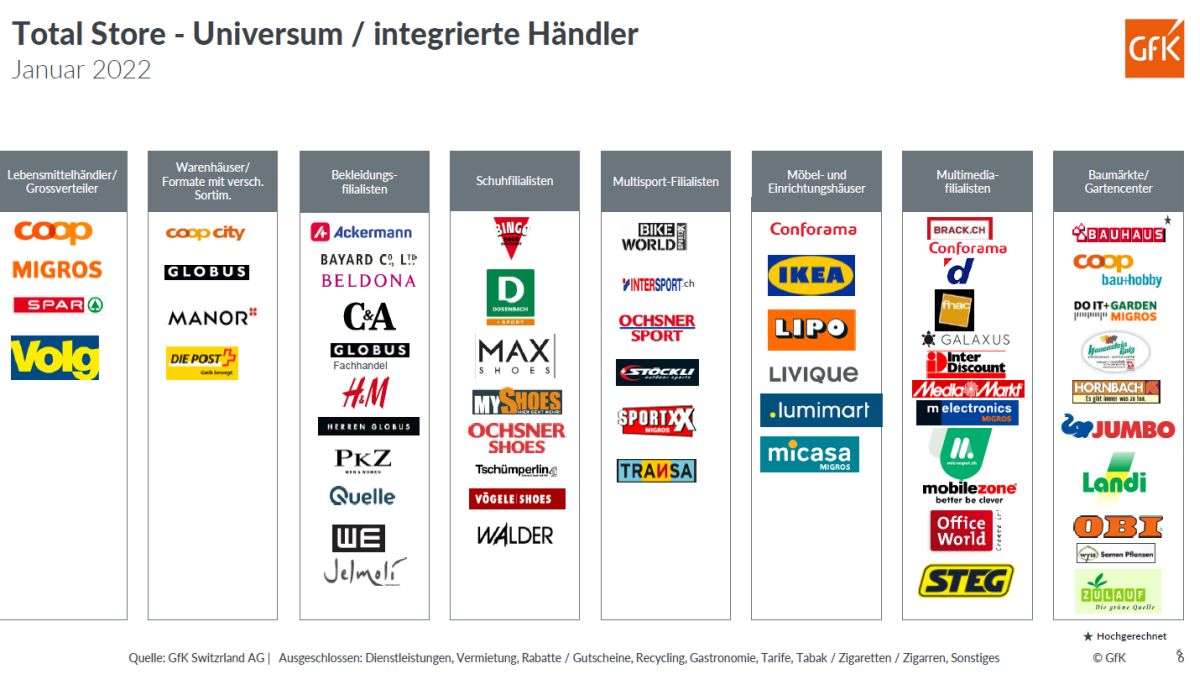
Little demand for winter sports equipment
Leisure is also performing positively as of the end of the year. This is mainly attributable to the ongoing recovery in the travel and luggage sector. According to a survey on toys, consumers planned to spend more budget on Christmas gifts. Now, in the end, these sales are clearly below the previous year, also because enormously high sales were generated in the 4th quarter of 2021 and therefore the previous year's forecast is very high. Sports is developing rather flat. Fitness equipment is not able to reach the high templates and the lack of snowfall leads to lower demand for winter sports hardware. The soccer category, on the other hand, benefited from the 2022 World Cup in the fourth quarter.
Firewood on the rise
The furnishings market and DIY, on the other hand, are largely in decline. Due to the uncertainties surrounding energy, DIY product groups such as firewood, compressors/generators and solar installations are nevertheless experiencing stronger demand. In the area of furnishings, the main declines in the 4th quarter were in Christmas lighting and fireworks. Home electronics also shows a decline. This continues to be due to very full inventories and intensification of the already increased price pressure, especially on premium products.
In Q4 2022, November performed better than December for the first time in comparison with the respective months of the previous year. Online shopping remains a consistently strong trend, the enormous growth rates of recent years are unattainable for 2022 and the online market is stagnating just below the previous year.
]]>
 On behalf of Admeira, the market research institute GfK Switzerland conducted a representative online survey of over 1,500 people in German- and French-speaking Switzerland in September 2022. The aim of this study was to record TV usage and household spending in 13 different baskets of goods at person level, in order to ultimately map the economic relevance of target groups. The economic potential of viewers of the various TV stations was also surveyed.
Two standards combined
The study thus combines two standards: household spending from the Federal Statistical Office's basket of goods (household budget survey) and TV data from Mediapulse. This link enables strategic TV planning to be optimized. For the first time in Switzerland, it is possible to determine which TV target groups determine which spending budgets and how they are reached via advertising. In this way, it is already possible in the planning phase of a campaign to ensure that the advertising reaches the desired target group, which is willing and able to spend the desired amount on the advertiser's products and brands.
In the 13 shopping baskets analyzed, which include food, non-alcoholic beverages, package tours, health insurance, clothing and new cars, the Swiss population in the 15-74 age group spends CHF 1,258 million per week. The study shows how high the potential shopping cart shares of the various media target groups are in the respective shopping carts.
]]>