
The Swiss sports market is apparently no longer flying high: according to a survey by GfK Switzerland, the Swiss sports market (excluding bikes) declined by 1.5% in 2023, although it did increase by 2% in 2022 and 14% two years ago. The sales volume amounts to around 2.17 billion Swiss francs.
The outdoor submarket remains significant, with sales of around 450 million Swiss francs, which corresponds to just under 20% of the entire sports market. Sales in the textiles segment remained constant at a high level, while the hardware segment lost sales, particularly in the camping segment, which had increased significantly in the previous year. Sales of outdoor footwear also declined, although this was partially offset by the trend in trail running shoes. In general, "running" remains on trend and recorded growth of 4 percent.
The Leisure segment, which includes everything for leisure time and is sporty, comfortable and casual, continues to grow. This is particularly evident in footwear, where sales increased by 5 percent. However, the line between leisure shoes and regular street shoes is becoming increasingly blurred.
In the 2023 calendar year, sales for snow fell by 2%, despite a mild "non-winter" in 2022. Nevertheless, the demand for winter sports remains unbroken, as the booking figures in winter sports resorts show. Sales in the fitness sector also continued to decline (-3%). Fitness equipment purchased during the coronavirus pandemic appears to have reached its maximum useful life.
Online sales in the sports market are on the rise again - are the turbo years over?
After a breather in 2022, when the importance of online sales declined for the first time, sales increased again: 28% (+1%) of all sports sales were made online in 2023. Shopping behavior is becoming increasingly digital: a GfK study shows that in 2023, sporting goods were increasingly purchased both "hybrid" (i.e. both online and stationary) and exclusively online (71% in total). Before the pandemic, this figure was 62%.
Massive overstocking leading to price reductions and market saturation led to a significant decline in sales in the bicycle market in 2023. In contrast, sales of bicycle accessories, servicing and repairs increased. The market for used bikes should not be underestimated either, as many used bikes came onto the market during the pandemic. While some cyclists may have lost interest, others have upgraded after buying an entry-level model.start of form
Forecast for 2024
Poor consumer sentiment, rising costs in various areas and the resulting reluctance to buy as well as increased search for promotions indicate that the market will tend to decline in 2024. Although a growing population and online business as a driver will probably not be able to fully compensate for this.
]]>

Consumer Panel Services GfK is expanding its portfolio of services. The Consumer Panel is already active in 16 countries and collects data from around 132,000 households and 1,500 retailers. By investing in and significantly expanding the panel in Germany, the company now intends to offer its clients even more options and benefits. These include, for example, a deeper analysis of specific target groups or personas as well as a more detailed view of specific insights, such as information on retailers or brand ratings. In addition, CPS GfK wants to support FCMG brands in Switzerland with its expertise and decades of experience in their decision making and strengthens its DACH offering with this expansion. For the expansion into Switzerland, CPS GfK has entered into a strategic partnership with Bitsaboutme.
Innovative data partnership with Bitsaboutme
Bitsaboutme is an app that allows consumers to optimize their shopping habits and benefit from rewards at the same time. With the app, consumers can scan their receipts when buying groceries and link loyalty programs from retailers in Switzerland. This provides them with automated analytics regarding the health and sustainability of their purchases. In addition, users also receive cashback rewards for sharing their shopping data. To do this, they either upload electronic receipts or photograph their paper receipts from retailers that do not support electronic programs. The information shared by users is continuously aggregated and forwarded to CPS GfK: the products purchased, including item price, as well as the demographics of the shoppers. This enables CPS GfK to monitor the shopping behavior of Swiss consumers over time at various points of sale. Based on this information, the experts offer FMCG brands and retailers already active in Switzerland or looking to expand there a comprehensive and in-depth view of the motivations, behaviors and patterns of Swiss consumers.
Clear goals for the Swiss market
For CPS GfK, the focus in the coming months will be on further scaling the panel size - supported by the partnership with Bitsaboutme. At the same time, the company is working intensively on preparing data processing and extrapolation to ensure the industry-leading quality level of CPS GfK's data on shopping behavior. In addition, a comprehensive product portfolio is being developed in close cooperation with FMCG brands and retailers to meet the specific requirements of the market.
By 2025, the panel in Switzerland is expected to expand to 5,000 monthly active panel members.
]]>

Fear of inflation is leading the worry barometer this year. Accordingly, the Swiss are also increasingly concerned about rising healthcare costs and having enough money to pay their bills. These worries are in second and third place, pushing concerns about climate change down to fourth place.
Compared with neighboring Germany, the Swiss are more optimistic about the future. Despite concerns about inflation and rising prices, just under 60 percent of Swiss people are optimistic about the future and expect their own economic future to improve in the coming year.
Younger people and men in particular are very confident in this respect. In Germany, only 46 percent expect their own economic situation to develop positively. Regardless of the economic situation, climate change remains an important issue for the Swiss, even if it falls from first to fourth place. For those who are very worried about inflation and price increases or are afraid they will no longer be able to pay their bills, climate change is currently a lower priority. For the young generation of 15- to 29-year-olds, however, climate change is the second most important concern.
Trend toward conscious and sophisticated consumption
Current concerns are having an impact on current consumer trends. Conscious and discerning consumption is a trend that is currently gaining in importance. Around a third of the Swiss prefer to own fewer, but high-quality products. However, quality is not the only decisive factor. Consistency with one's own values also plays a role: Around a quarter of Swiss consumers only buy products and services that correspond to their beliefs, values or ideals.
At the same time, the need for experiences is growing again at the moment. Already during the Corona pandemic, many consumers became aware of how valuable experiences are for well-being. Back then, it was partly simple things like spending time in nature or meeting up with friends. Today, it is the experiences that were not possible for a long time: Trips abroad or even major events. 36 percent of the Swiss currently think that experiences are more important than possessions.
]]>
 In year one after the pandemic, retail trade sales by value again rose slightly at a high level to 102.6 billion Swiss francs. This is shown in the GfK publication "Retail Trade Switzerland", which examines the development of the retail trade in 2022. According to this, Swiss retail sales in 2022 increased by 300 million Swiss francs to a new 102.6 billion Swiss francs; this corresponds to an increase of 0.3 percent compared with the previous year.
Inflation is likely to have been a factor here, according to GfK. Influenced by the Ukraine conflict, input costs for energy, transport, packaging and logistics rose, in some cases massively, which also impacted consumer prices in stores and at gas stations.
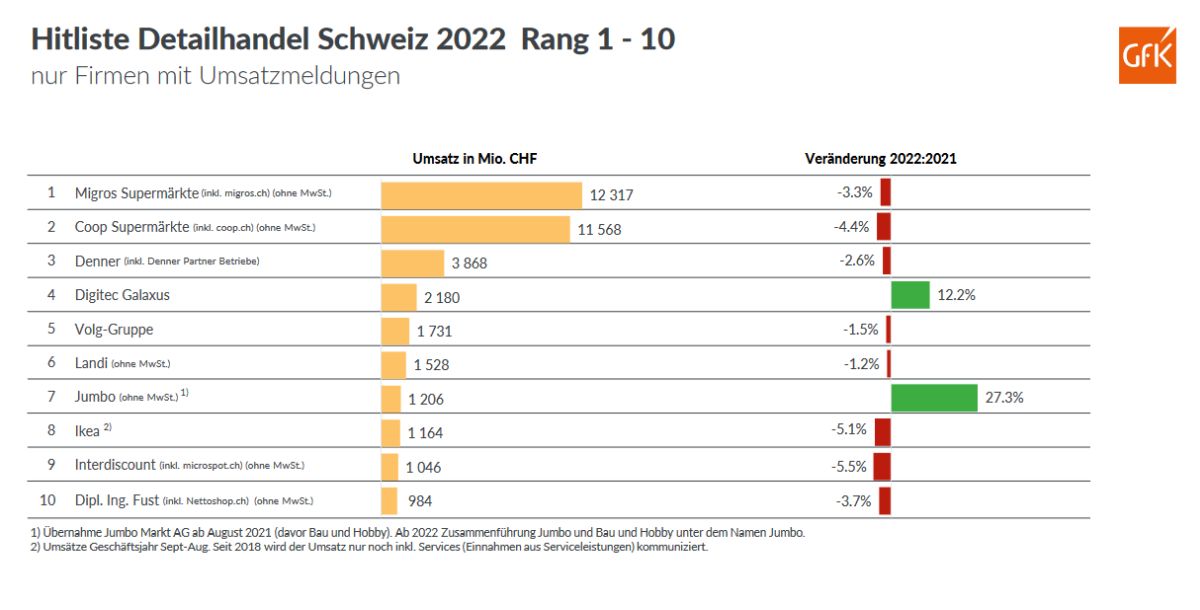 In 2022, Swiss consumers purchased goods and merchandise online for 14 billion Swiss francs. This corresponds to a decrease of 0.4 billion Swiss francs or 2.8 percent compared with the previous year. In 2022, online consumption is down 2.4 percent on the previous year, while online purchases from abroad are down 5 percent. Online purchases from Swiss online stores (.ch domains) increased by 44 percent compared to 2019. In the home electronics/household appliances segment, every second franc is spent online.
The global economic environment remains challenging. On a positive note, the situation regarding energy prices has eased and the risk of severe recessionary scenarios such as interruptions in energy supply has decreased significantly. However, the outlook for the coming quarters and 2024 remains cautious.
]]>
According to the GfK forecast, the total purchasing power of Switzerland's more than 8.7 million inhabitants will amount to 433.4 billion euros in 2023 (excluding Liechtenstein). The nearly 9 million Austrians, on the other hand, will have a total purchasing power of around 239.5 billion euros in 2023, while the total purchasing power of the more than 83.2 million Germans will amount to 2,186.7 billion euros. These are the findings of the new GfK Purchasing Power Studies 2023.
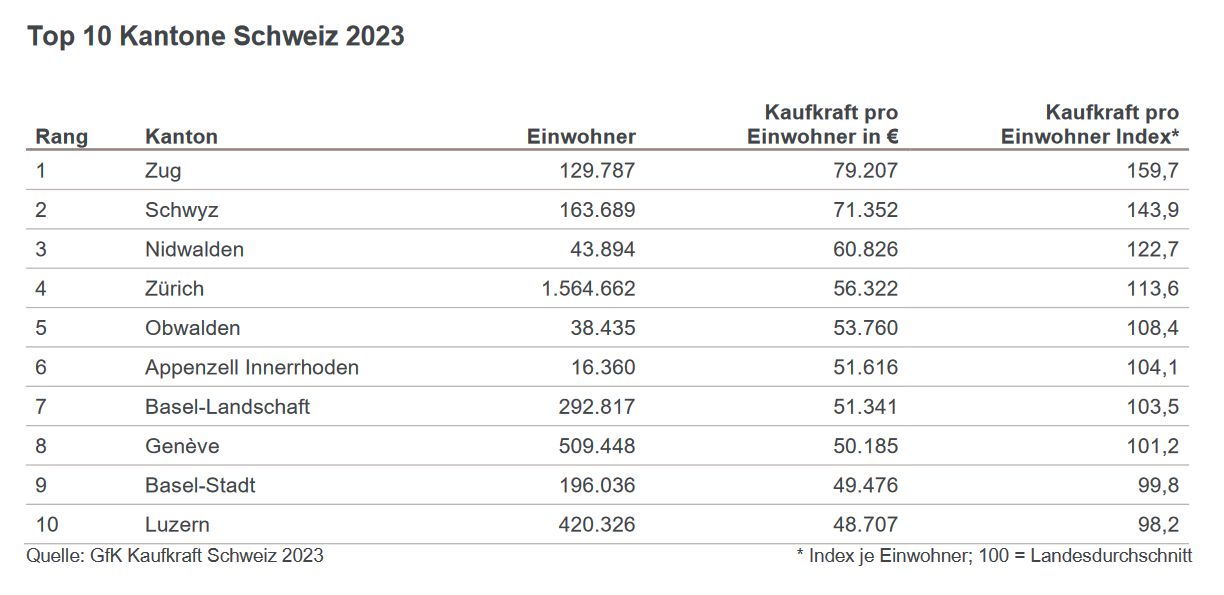
A look at the regional distribution of purchasing power in Switzerland offers insights into where people with particularly high spending potential live. Among the Swiss cantons, Zug, Schwyz and Nidwalden lead the ranking, as in previous years. With 79,207 euros per capita, the canton of Zug is clearly in first place. This means that people there have almost 60 percent more available for their spending than the average Swiss.
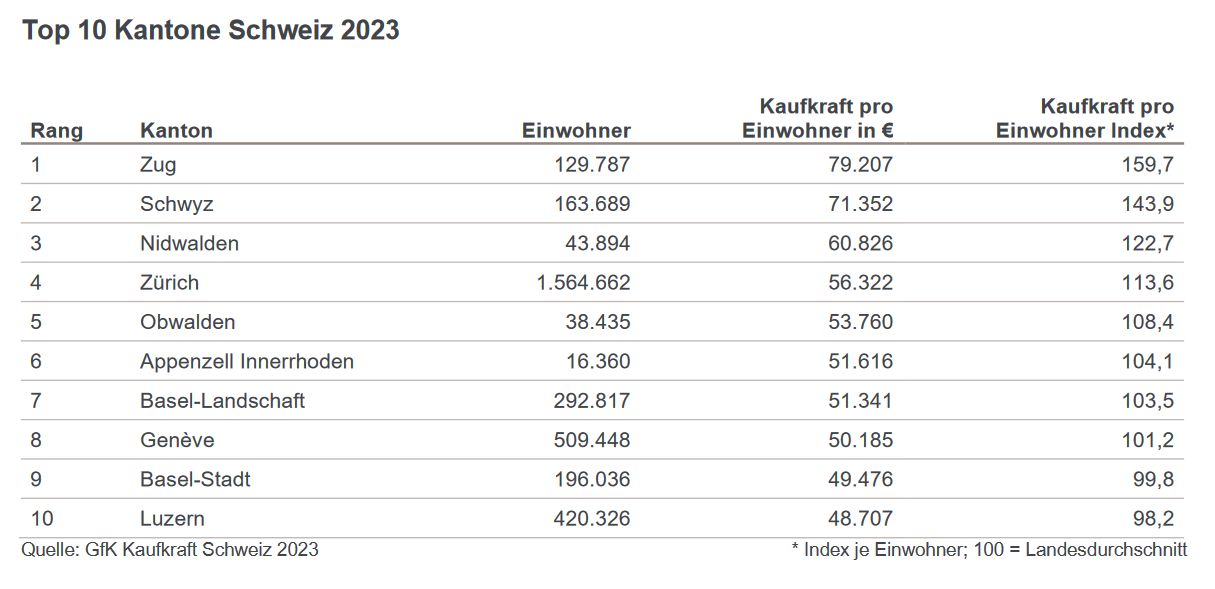
Overall, eight of the 26 Swiss cantons have above-average per capita purchasing power, while spending potential is below average in more than two-thirds of the cantons. In the last-placed canton of Jura, people have a per capita purchasing power of 42,928 euros, which is more than 13 percent below the national average.
Compared to last year, there are changes in the ranking of the top 10 cantons: Appenzell Innerrhoden moves up two ranks to sixth place, and Genève also improves by one rank and occupies eighth place this year. Basel-Landschaft, on the other hand, slips down one place to seventh, and Basel-Stadt even drops two places to ninth.
At the more detailed district level, the large regional differences in purchasing power become even more apparent. The leader among the Swiss districts is Höfe, where residents have 121,314 euros per capita at their disposal, almost 145 percent more than the national average. It is followed in second and third place by the Meilen district and the canton of Zug, whose per capita purchasing power is almost 61 percent and 60 percent above the Swiss average respectively. At the other end of the ranking, as in previous years, is the Bernina region: here, residents have a spending potential of 35,987 euros per capita, which is more than 27 percent below the national average. Thus, per capita spending power in the Höfe district is almost 3.4 times higher than in the Bernina region.
]]>
This was announced by the Federal Office of Communications Bakom on Friday. This means that digital radio usage has risen by 28 percentage points in the past seven years up to the fall of 2022. At the same time, the FM share fell from 51 to 23 percent.
Only eleven percent of respondents said they listen to the radio exclusively via FM. Radio listening via the Internet had a share of 36 percent, and DAB+ 41 percent.
With 63 percent usage, most Swiss listened to the radio most often at home, followed by the workplace with 18 percent.
With a 51 percent share, DAB+ was also on the rise in cars. Together with the Internet, 63 percent of radio listening at the wheel is digital, according to Bakom. 99 percent of all new passenger cars have had a DAB+ radio as standard for several years. (SDA)
]]>
As a rule, there are plenty of books under the Christmas trees. For the book trade, December is traditionally the month that brightens the annual balance sheets. But in 2022, that was not the case: Compared to December 2021, sales in bookstores as well as in online stores fell by a total of 9.8 percent, according to the Swiss Booksellers and Publishers Association (SBVV) on Thursday.
The balance sheet for December looks even bleaker when price increases are factored out. The volume of books sold slumped by 11.7 percent. This is "drastic" for the industry, wrote the SBCV.
The association highlights sales of non-fiction books, which were low throughout the year and even fell by 13.1 percent in December. The most important product group, fiction, also recorded a drop of 8.9 percent in December.
Increase in paper, energy and transport prices
The industry is being squeezed by inflation, it said. Publishers in particular are "burdened by the enormous increase in paper, energy and transport prices. Book prices rose by an average of 0.4 percent throughout last year, and by as much as 2.2 percent in December compared to the same month last year. But the annual inflation of just under three percent in Switzerland only partially compensates for the higher book prices.
GfK Entertertainment collected the figures as part of its industry monitor book, which is commissioned by SBCV. SBCV plans to publish the detailed market report at the end of February.
]]>

In a recent study, GfK examined this year's Christmas consumer behavior. When it comes to gifts for toys, the Swiss plan to spend an average of CHF 500. Nevertheless, there is a discernible trend toward cutting back on consumption. Overall, 42 percent of respondents plan to spend less on gifts than in other years. A certain trend toward cutting back on consumption is discernible, but this does not apply equally to all Swiss people. Many, especially those who can afford it, will spend the holidays in the same or similar way as in other years.
However, people on low incomes in particular are watching their Christmas budgets: 37 percent want to eat out less in the run-up to Christmas or during the holidays, and 33 percent are trying to save on Christmas dinner at home. About the same number want to forgo sports activities such as skiing during or after the holidays, or do so less frequently than in other years. Just under 20 percent are also considering giving used, i.e. second-hand, products as gifts this year - this seems to be a trend among younger people in particular - here it is a good third.
The annual increase in spending on toys, which reached a record 500 Swiss francs this year, contradicts general plans to save money. Yet 67 percent of people shop online and in-store. The proportion of consumers who prefer to buy gifts for toys online has fallen year-on-year to 10 percent (2021: 12 percent), as has the proportion who only buy stationary in stores (2022: 23 percent, 2021: 26 percent).
]]>
 GfK highlights the most important results of Black Week in the area of technical consumer goods. With a sales volume of CHF 114.2 million and an increase of +11.5 percent, Black Week 2022 was within the forecast range. Thus, even the record mark of two years ago (CHF 110.2 million) was exceeded.
The individual product groups developed as follows in terms of value compared with the previous year:
- The highest sales (CHF 38.2 million) this year were generated by far by the high demand for smartphones. Compared to the previous year, this was an increase of almost CHF 12.0 million. It should be noted that the availability of smartphones was very limited a year ago due to bottlenecks in components and interrupted supply chains.
- Mobile computers again recorded the second highest demand. At CHF 28.4 million, sales were CHF 2.1 million higher than in the previous year.
- TVs, which have always been the main sales driver during Black Week, were in third place. The volume declined from CHF 29.8 million in the previous year to CHF 26.7 million. Sales were brought forward by the promotions in the weeks before the World Cup.
- The gaming theme cooled down somewhat and had a negative impact on sales of desk computers. In terms of value, the volume declined from CHF 9.2 million to CHF 8.0 million.
- Tablets, on the other hand, were high on the list this year, with sales increasing from CHF 7.4 million to CHF 8.5 million compared to the previous year.
- The post-pandemic pent-up demand for photo cameras also showed a positive trend during Black Week. Sales of CHF 4.4 million were around 1.0 million up on the previous year.
]]>
 Based on the GfK Campaign Performance Analysis (CPA) method, which is now also available in Switzerland after other European markets, the study provides novel insights into the contributions of different media to campaign performance.
For example, what reach and contact frequency TV and meta platforms (Facebook & Instagram) and in some cases YouTube contributed to the overall reach. Or what incremental reach was achieved by individual channels in cross-media campaigns, which target groups were addressed by the various media, and how cost-efficient the various channels were in building reach.
More reach in relation to the budget
The most significant findings from the study: The budget share of meta is still quite low compared to TV; meta budgets averaged CHF 128,000 net, while TV budgets averaged CHF 3 million gross. Despite the low budget share, Facebook and Instagram achieved high net reach. With the given budgets, Meta achieved an average reach of 35 percent among 15-74 year olds, TV reached 61 percent. At its peak, Meta achieved 54 percent reach, TV 67 percent.
TV and meta platforms complement each other well, and both media have a high proportion of exclusive reach compared to the other medium; on average, 44 percent of the people reached via meta were not reached on TV. In comparable studies in Germany, this figure was 37 percent. Meta delivers a very efficient cost per Gross Rating Point (GRP), averaging CHF 425 net.
Meta platforms are scalable: The share of exclusive reach remains high, even with increasing total reach. The costs per GRP remain relatively low at 100 to 750 Swiss francs in the measured budget spectrum of 25,000 Swiss francs to 340,000 Swiss francs as the total reach increases....
Meta reaches attractive target groups for advertisers: Both Facebook and Instagram reach a disproportionate number of 15- to 34-year-olds, while the share of over-55s is only 9 percent (TV: 29 percent). The proportion of unemployed/retired people is 47 percent lower in the meta audience than on TV.
Basis: 12 studies on campaigns from 2021 to 2022
The reach study comprises 12 studies on campaigns that were played out on meta platforms and on TV from 2021 to 2022 and is based on GfK's Campaign Performance Analysis solution, which measures contacts between individual members and campaigns in various media in a single-source panel with 6,200 members. Both on the meta platforms and on TV, the campaigns ran for an average of just under seven weeks. Campaigns of different sizes were measured - the TV campaigns had gross budgets of CHF 1.2 - 7.8 million.
]]> Non-food stores posted a 3.7 percent gain in 2021, GfK reported Thursday. Food and near-food sales, on the other hand, were down 1.0 percent. This was also due to strong comparative figures.
In the previous year, 2020, retail sales - despite Corona and the spring store closures - had grown 7.8 percent, the best performance in several decades, according to GfK. Back then, grocery stores had boomed thanks to hoarding purchases, with food and near-food sales shooting up 10.9 percent.
In terms of cumulative growth at the end of 2021, the do-it-yourself sector was in the lead. The leisure segment also performed extremely well: fitness equipment, everything to do with cycling, winter sports supplies, and e-bikes would have continued to be in vogue in 2021. Furthermore, demand in most toy sub-segments increased significantly, with demand for toys in the high-priced segment also rising at Christmas.
Increase according to FSO higher
GfK's findings thus differ from those of the Swiss Federal Statistical Office (SFSO). On Tuesday, the latter had communicated a nominal sales increase of 4.2 percent on the basis of provisional figures for the retail trade. (Werbewoche.ch reported). In real terms, i.e. excluding inflation, the figure was 4.7 percent. All sectors that had suffered losses in 2020 due in part to the coronal pandemic had largely made up for them, the FSO said.
The difference in the data can be explained by the type of survey. The retail trade turnover statistics of the FSO are based on a random sample of around 3,000 companies. It is collected on a monthly basis, with small businesses being surveyed on a quarterly basis for monthly sales figures.
At GFK, the figures are based on actual sales figures that the service provider receives from over 40 major Swiss retailers. According to the data, these account for around 40 to 50 percent of total sales in the industry. Specialty retailers are not included here. (SDA)
]]>
Since April 2020, GfK Switzerland has been continuously surveying consumers, aged 16 to 74, about their biggest concerns, including now in September. According to GfK studies, many of the effects on consumer behavior triggered by the pandemic are attributable to changes in consumers' needs, expectations and hopes. These include, for example, the importance of being "at home" and more conscious and responsible consumption.
One-third of the Swiss surveyed are currently rather worried or very worried about their own economic future. However, this is significantly fewer than in May, when the figure was still 44 percent. The vast majority of Swiss people are quite optimistic about their job situation, but around one-fifth are still worried that their own job situation could be negatively affected (e.g. in the form of redundancy). The under-30s and the French-speaking Swiss in particular are more worried in this regard. However, the majority of Swiss are fairly confident that their economic situation will be better in 12 months than it is today.
Return to normality in everyday life and at work
Many consumers continue to be very cautious, avoiding air travel, for example, but also restaurant visits or fitness centers to some extent. Working from home continues to be an issue. According to GfK surveys, just under 35 percent of professionals with a basic home office option said they currently work exclusively or mainly from home. 26 percent expect to work mostly or even only from their home office even after the pandemic has subsided. However, only 3 percent of the professionals surveyed expect to work exclusively from home. The majority, i.e. over 80 percent of professionals, are satisfied with their current work situation, regardless of whether they work exclusively or predominantly in a home office or in an office.
Change in lunch catering
Current GfK studies show that the shift to the home office has led to a change in eating habits at the lunch table. Two-thirds (66 percent) of working people eat a freshly prepared, home-cooked lunch at home at least once a week. 16 percent even eat it every day during the work week. However, people often simply have reheated food, leftovers or a cold lunch such as salad or sandwiches at home. Delivery services or take-away are rarely used for lunch at home. At the place of work, the most common lunch consumed is food brought from home, with takeaways being eaten only occasionally.18 percent of employees eat in a canteen at least once a week, 31 percent in a restaurant at least once a week.
Responsible consumption behavior
Sustainable health awareness is not only reflected in changes in eating habits, but also in consumption. Anja Reimer, an expert in consumer intelligence, observes: "It's also exciting that more than half of the Swiss want to buy more from smaller suppliers and local producers in the future. So responsible shopping is a topic of great importance." Even ahead of the upcoming Black Friday sales promotion, just under 20 percent of Swiss respondents say they will deliberately not take advantage of Black Friday offers. Again, this shows an effort to consume responsibly, mainly among older consumers as well. 33 percent of respondents say they prefer to own fewer but higher-quality items, especially clothing and technology.
]]>