
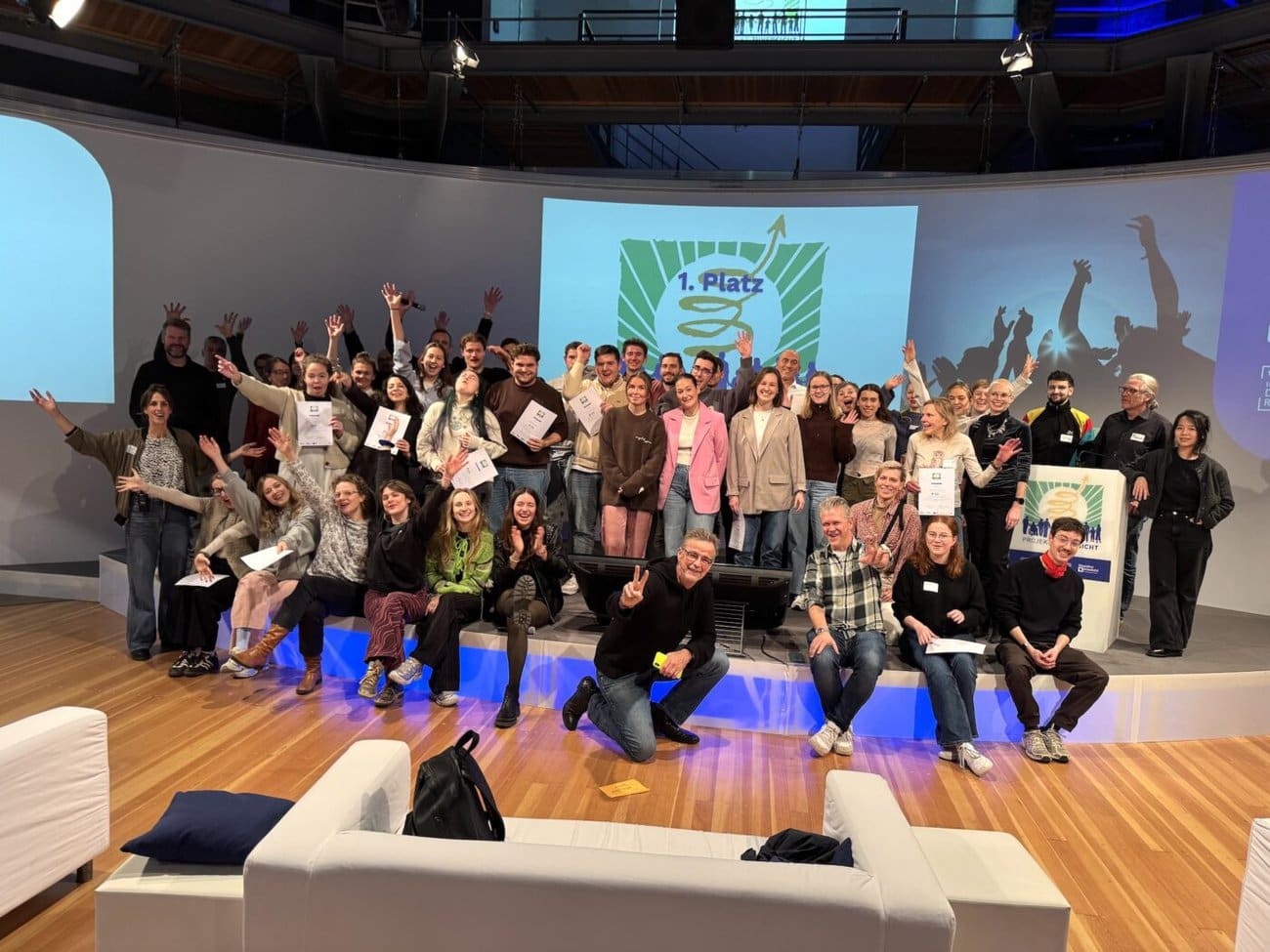
The Project Confidence, an industry initiative involving media outlets, associations, and the advertising industry, aims to restore a sense of confidence in society—and is now moving forward with its implementation: More than 250 participants—primarily young people from politics, civil society, academia, the media, and the business sector—came together as part of the second phase of the “Zuversicht” project at the end of last year to explore the following questions: How can we strengthen political participation and trust in institutions? How can journalism help people regain a sense of self-efficacy? And how can companies promote social participation and confidence? The participants were supported by experienced coaches and experts. After three so-called “ideathons” filled with energy, pitches, ideas—some discarded, others implemented—and intensive work sessions, the finalists have been selected.
The finalists in detail:
Journalism & Media
1st place
Media Buddies: A matching format that connects citizens and journalists - for joint research, more perspectives and real dialog
2nd place
Überbrücke!: An intergenerational video format that aims to present the lives of older and younger people in a completely new way.
3rd place
Check Doo: A playful app along the lines of "Tinder meets Duolingo" that enables young people to recognize AI images and fake news.
Brands & Company
1st place
Zuvertising: The neologism combines "confidence" and the English word for advertising - "advertsing". The idea: retailers are persuaded to make five percent of the advertising space in their stores available for confidence and community content.
2nd place
Society Connect: Trainees from a real estate company are developing a virtual and physical platform that brings the residents of 160,000 apartments out of anonymity and connects them with each other, creating a sense of community and confidence.
3rd place
Responsibility is the concept for a platform that connects people in such a way that they can come together at specific locations for a wide variety of projects and make a difference together.
Politics & Parties
1st place
Reversed Politics: The stage belongs to the youth, the politicians listen: Reversed Politics turns the classic panel discussion on its head. In this project, pupils develop concrete ideas for improving their everyday lives in the districts through surveys and project days. Together with politicians, they then analyze how these local projects can actually be implemented.
2nd place
Social map: Who still knows their neighbors? Social Map poses the question of cohesion in the neighborhood and provides the answer at the same time. The platform breaks down filter bubbles, makes community togetherness in the immediate vicinity tangible and gives citizens the opportunity to document shortcomings in their living environment and report them directly to the administration.
3rd place
How EU is your city?: Europe is far away in Brussels? Not at all! "How EU is your city?" brings the European Union to life right on your doorstep. With creative campaigns and poster campaigns, the project shows what positive things the EU is doing in everyday life: from subsidized cultural cafés to modernized school canteens.
The program is accompanied by a creative contest. The industry association GWA and the media company Weischer are jointly calling on young creatives to design an accompanying campaign for the „Project Zuversicht.“ They are looking for campaign ideas that can rekindle young audiences’ enthusiasm for reliable news.
]]>

 The current issue of Annabelle negotiates the topic of "solo" in a variety of ways: from a scientific text about animals that don't like community, to a touching essay by Claudia Senn, who has lived for decades in fear of becoming a widow because her husband suffers from a life-threatening illness, to praise for the - often stigmatized - existence as an only child, to the question of what role political Switzerland can play internationally.
Alone - that's what we all are, sometimes more and sometimes less voluntarily. On the Annabelle editorial team, it quickly became clear how differently the word can have connotations. The mothers among us wanted nothing more than a wellness weekend or a walk in the woods all by themselves, the main thing being silence, the main thing not having to fulfill any needs, while the singles pointed out that they sometimes feel lonely, that organizing their private lives requires strength, and that as single people - unlike families - they have no political lobby. The articles in the magazine have become as diverse as the perspectives on the editorial board.
One thing, however, runs through the entire issue: Annabelle illuminates the topic of "solo" from a woman's perspective. "Women have always been understood as social beings, and in their singularity they are - at least historically - as threatened as they are menacing," writes Annabelle editor-in-chief Barbara Loop in the editorial. "Women are pioneers, adventurers and, as bosses, make decisions on their own. They are modern observers, self-determined and independent like Carrie Bradshaw. But isn't this single character also destined to find Mr. Big at some point? This issue is about the desire and compulsion to stand on your own."
While members of the Annabelle editorial team tell of their very personal "ego trips," the fashion team gave artist Isabelle Wenzel, who always realizes her projects alone, carte blanche to realize the fashion spread. 12 singles tell of the ups and
The depths of everyday life without a partner, dating experiences and the feeling of freedom. An astrophysicist has her say, as does Silvia Locher, president of the Pro Single Schweiz association. In a picture story, we show pioneering women among men, explore the question of whether children need boyfriends and what you can do to combat loneliness. Our beauty team presents products with only one active ingredient, and singer Róisín Murphy tells us how she stood up for herself and became an icon.
]]>
 Climate crisis, Corona pandemic, war in Europe: society is facing a crucial test. Current world events are once again casting a strong light on the social responsibility of companies. One thing is certain, companies that ignore this reality today and do not care about society will be irrelevant to that same society tomorrow, or even ostracized by it. No wonder that the reflection on one's own "purpose" has recently emerged as one of the most important topics of the past years. While much is already being done in brand communication, companies are finding it difficult to systematically translate responsibility into the business model and the product/service experience.
User obsession can quickly become a boomerang
Even companies with strong, purpose-driven mission statements are facing challenges: While AirBnB wants to enable everyone to experience cities authentically with "Anyone can belong anywhere," the service ensures that there is less living space for locals, especially in big cities, and that they can no longer afford to rent. Gorillas is changing the way we do spontaneous shopping. However, by delivering in just ten minutes, they are causing blocked sidewalks and noise around their micro-fulfillment centers, which many residents complain about. Even the best service can fall out of favor if it has a negative impact on society.

Passive users are part of every customer journey
What these examples have in common: All offerings have a passive influence on the lives of third parties. In the current thinking of user-centered design, the active user is at the top of the list - i.e., the person who uses the product and generates sales. Rarely are passive "users" included in the context of the social and ecological perspective. Yet almost every product and every service along the customer journey always has an influence on others. This is exactly where we come in: Society-Centered Design forms the framework to integrate these perspectives into product development from the beginning.
The method case: Society-Centered Design

In order to systematically work on the social impact of products and services, the Mutabor developed a set of methods and tools under the term "Society-Centered Design" that combine classic user-centered design methods with the social perspective of the brand and its target groups. The framework is intended to support both the establishment of the right mindset in the company and the rapid initiation of action, while involving the most important decision-makers and stakeholders. The complex topic of ecological and social responsibility is thus easy to apply and can be approached with clear, comprehensible steps.
Social added value is tomorrow's entrepreneurial success
The basic premise of the concept is that those who treat responsibility for society and economic success as interrelated will be more successful in the long term. But why take the first step before everyone else, as long as the pressure from laws and customers is not yet compelling? The answer: because now is the chance to test and validate concepts with the group of early adopters, in order to immediately catch the critical mass of the mainstream later and not be overrun by it. Because just as the user perspective is a hygiene factor for product success today, it will be the same with the social and ecological perspective in the future. So if you want to win and retain customers in the future, you should start now to align your business model, products and services with social relevance. Bank Tomorrow is setting a good example: by investing its customers' money only in sustainable projects, it provides strong incentives to choose its model over that of a traditional bank.
Steps in Society-Centered Design

Implementing society-centered attitudes in product/service experiences, whether new or existing, requires a holistic approach. The following outlines the broad steps of the Society-Centered Design approach:
- Establish a responsibility-oriented mindset across all hierarchical levels
- Analyze the customer journey and identify active/passive users
- Derive recommendations for action in an expert review
- Derivation of measurable KPIs and formulation of guidelines for product teams
- Build, Test & Learn: Development and/or optimization with focus on early market
How do you convince the decision-makers?
Especially with digitalized products and services, most decisions are made on the basis of KPIs. Just like branding or design, social impact and its influence on the company's success is rarely measured. At Mutabor, we define KPIs right from the start that can be measured, tracked sustainably and successively optimized. In this way, supposed idealism becomes quantifiable for the business - and thus a competitive advantage for tomorrow.
* Burkhard Müller is Chief Digital Officer at Mutabor. Over the past 20 years, he has led transformation projects for companies such as Bosch, Migros, Swatch and Vodafone.

Roger de Weck was editor-in-chief at the Tages-Anzeiger and at the Time and Director General of SRG from 2011 to 2017. He has just published his book "The power of democracy - a response to authoritarian reactionaries" also in paperback with a new preface. He wrote the book before Corona, feeling vindicated by the crisis: Populists, de Weck writes, have shown in the crisis that - once in power - they have nothing to offer and make the problems even worse.
But isn't the author and publicist too naive? Isn't society divided by Corona - also in Switzerland - as never before? Has the power of enlightenment and reason faded? And can democracy renew itself at all and come back stronger? Reto Lipp discusses this with him in the latest episode.
In the monthly Comsumcast, SRF journalist and presenter Reto Lipp talks to pioneering minds from the media and communications industry. The topic: How is the Corona pandemic affecting the industry?
The Comsumcast is the replacement for the Communication Summit of the ZPRG (Zurich PR Society) and the ZPV (Zurich Press Association). The annual event at ETH Zurich was cancelled this year. A new episode appears every month, and nine have already been produced. It is created in the tablecast studio of Christoph Soltmannowski, where also the in-house video podcast of m&k and Advertising Week "Off The Record" is recorded.
Here go to the Comsumcast with Roger de Weck.
]]> The Covid 19 pandemic, with its impact on health, the economy and society, has accelerated an "erosion of trust" worldwide, according to the latest Edelman Trust Barometer, to which the Farner agency has detailed access as a Swiss affiliate.
This is reflected, for example, in the significant loss of confidence in the two largest economies, the USA and China. The governments of the USA and China are viewed with great distrust by respondents in 26 other markets surveyed worldwide. Only 40 percent (USA) and 30 percent (China) of respondents said they had confidence in the leadership of the two superpowers.
Most notable, however, is the decline in confidence among its own citizens: the U.S., already in the lowest quartile of the confidence scale, has seen a further 5-point drop since the November 2020 presidential election, while in China, confidence has fallen 18 points since May 2020.
Crisis of leadership, infodemia and loss of trust
This development of the crisis of confidence over the course of the last year is evident in governments worldwide: they were temporarily the most trusted institution in May 2020, when people trusted them to fight Covid-19 and bring about an economic recovery. However, they failed the test in the eyes of the respondents and gambled away the "leap of faith" again. Governments are therefore the institution that lost the most ground in the Edelman Trust Barometer 2020 in the second half of 2020 (minus 8 points worldwide).
In the face of declining trust, people are looking for leadership and solutions, while rejecting personalities they don't find credible. In fact, none of the social leaders Edelman studied - government officials, CEOs, journalists or religious leaders - are trusted to do the right thing. Trust scores for all of them are dropping.
Without trust in reliable sources of information, "infodemia," the chaotic flood of disinformation, false claims and rumors, is rampant. This global phenomenon has driven trust in all news sources to all-time lows, with social media (35 percent) and owned media (41 percent) receiving the lowest trust ratings. Traditional media (53 percent) saw the biggest drop in trust globally, down eight points.
Misinformation also hinders the fight against the pandemic, as mistrust of vaccines remains high. In fact, the survey shows that among those practicing poor information hygiene (not verifying sources and/or not ensuring that credible, factual information is shared), willingness to vaccinate within one year of availability is significantly lower (59 %) than among those with good information hygiene (70 %).
Pandemic fears also make it difficult to return to work. 58 percent of employees who opted to work from home did so in 2020 out of fear of infection.
Great opportunity with high commitment to the economy
Hope for a recovery in trust comes from the business community. The Trust Barometer 2021 shows that it is not only the most trusted of the four institutions surveyed (61 %; NGO: 57; governments: 53; media: 51), but also the only entity that is seen as both ethical and competent.
So when there is a trust gap around governments, people expect business to step in and fill the gap. This high expectation for business to address and solve current challenges has never been more evident.
Along with the increased expectations of business comes the demand for CEOs to focus with equal determination, prudence and energy on the social engagement with which companies pursue their own business success.
But not only have expectations of business increased, new requirements are also emerging. For example, the most important trust-building measure for companies is ensuring the quality of information so that reliable and trustworthy information is passed on to employees and thus also to society.
In fact, more than half of respondents (53 percent) believe companies even have a responsibility to fill the information gap created by mistrust in news media.
Roman Geiser, Managing Partner of Farner Consulting AG, which represents Edelman in Switzerland as the exclusive Swiss affiliate of the world's largest agency network, explains the relevance of the data: "Trust remains the most important currency for lasting relationships between the four institutions studied by Edelman and their various stakeholders. Especially in times of turbulence and volatility, trust is what holds society together and where growth rebuilds and recovers."
On the importance of communication, he adds, "Business must embrace its expanded mandate and corresponding expectations, with CEOs taking the lead on a number of unfamiliar issues. The important thing is to take meaningful action first, then communicate about it. Leadership ambition must be accompanied by empathy. It takes courage to speak plainly. But people's fears must also be reflected."
"In Switzerland, we are in the fortunate situation of having generally stable institutions, a robust economy and still functioning social compensation systems. But even here, weaknesses in the system are becoming apparent and there is a need for reform. Swiss entrepreneurial personalities now have a great opportunity to position themselves and their companies sustainably on central social or political issues and thus show people a way out of the crisis of confidence."
Steve Heywood, EMEA Head of Affiliates at Edelman, adds, "In the 21 years of the Edelman Trust Barometer, 2020 trust has arguably been tested as never before. While people expect their leaders to provide answers and solutions to unprecedented social, political and health challenges, the Trust Barometer results show that leadership is failing to meet these demands."
]]>