On average, 18 to 27-year-olds in Switzerland make 82 online purchases per year. That is 44 percent more than all age groups between 18 and 70. On average, they only shop online 57 times. This is according to the E-Shopper Barometer from DPD and Geopost, Europe's largest survey on online shopping.
Generation Z also surpasses the older generation when it comes to selling online: Over 90 percent of young adults are active on platforms where private individuals trade second-hand products in particular.
Higher expectations of providers and technology
Generation Z expects more from suppliers and delivery companies than older e-shoppers. Only a third describe the last order they received as uncomplicated. Three out of five young adults use services that are supported by artificial intelligence. Just as many rely on collaborative, sharing and community functions.
Over half of Generation Z trusts the advice of social media influencers when shopping online, and they appreciate it when technology remembers them and makes personalized recommendations. According to the survey in a total of 22 countries, in which 1,092 people took part in Switzerland, Generation Z also has a greater affinity for brands and discount campaigns. They also place a higher priority on sustainability.
Social media as an important purchasing channel
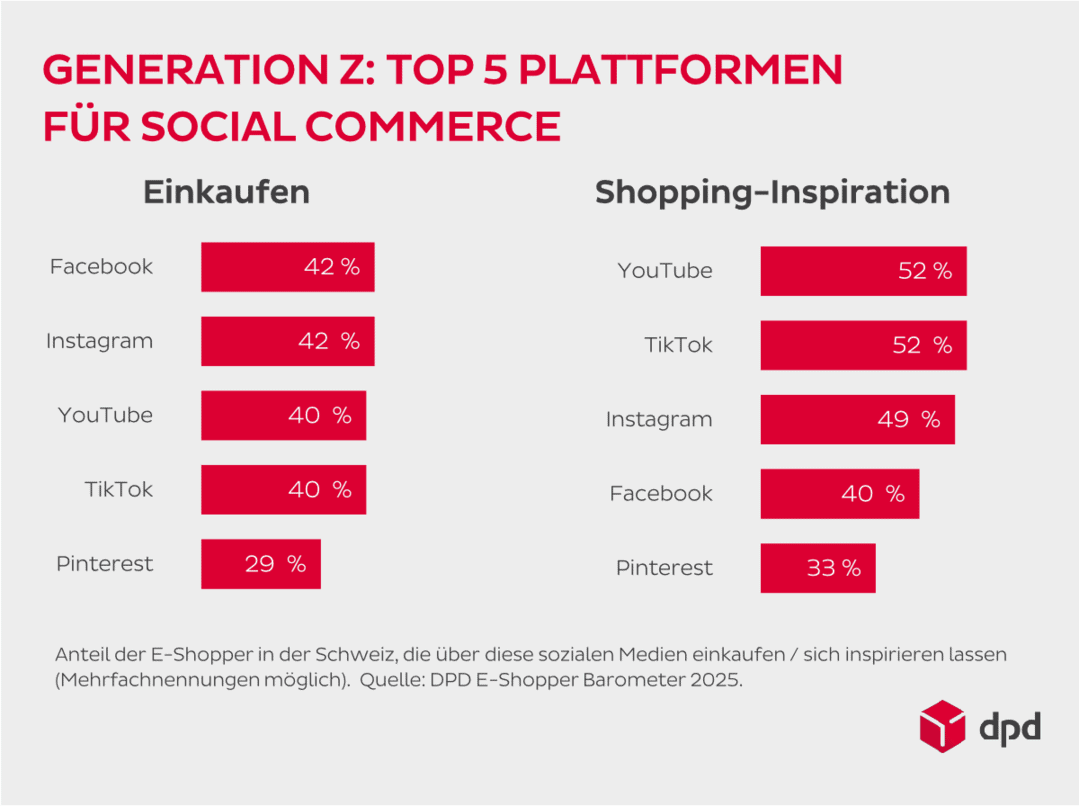
Shopping via social media platforms is a matter of course for Generation Z. 80 percent use this option. Across all age groups, the figure is only 59%. Facebook, Instagram and YouTube are named as the most important social media platforms for purchases - by all age groups. However, Generation Z uses other social media to find inspiration. TikTok and Pinterest are particularly popular.
"For the youngest generation of e-shoppers, the focus is on flexibility in terms of time and location and control over their own orders and sales. Out-of-home delivery options such as parcel stores are becoming increasingly important. Thanks to our network of over 1,000 DPD Pickup parcelshops throughout Switzerland and over 130,000 out-of-home locations across Europe, we at DPD reach Generation Z wherever they are on the move," says Tilmann Schultze, CEO of DPD Switzerland.
Significant differences in purchasing behavior
The survey shows clear differences between Generation Z and older e-shoppers. 60 percent of 18 to 27-year-olds attach importance to trendy brands, compared to only 41 percent of 18 to 70-year-olds. 57% of young adults use AI-supported functions when shopping online, compared to 41% across all age groups.
Generation Z is also more committed to sustainability: 65% say they make sacrifices for the good of the planet and 64% are willing to pay more for environmentally friendly products and services. 56% buy more second-hand products today than in the past.
76% of Generation Z actively search online for reviews and recommendations before making a purchase, and 71% look forward to big discount promotions. 64% are concerned about the impact of e-commerce on society.
]]>
Capri-Sun is targeting Generation Z with a new campaign. The focus is on the 330ml format of the drink, which is now being charged with a new brand promise: Instead of exclusively evoking childhood memories, the brand is to be anchored in the reality of young adults' lives.
The campaign picks up on contrasts that, according to Capri-Sun, characterize the everyday life of Gen Z - between pressure to perform and self-realization, between responsibility and light-heartedness. The resealable drinking bag becomes a symbol for a small, carefree break in the transition to adulthood.

Typical everyday situations from the lives of young people are shown - whether in the office, at a festival or before going out. "Our 330ml campaign expresses exactly what moves Gen Z: the feeling of having to grow up, but not quite being ready for it yet," explains Renee Oostdam, Head of Global Innovation at Capri-Sun.
To reach Gen Z where they are, Capri-Sun is taking a social-first approach and playing out the campaign on channels such as Instagram and TikTok, supplemented by classic and digital out-of-home measures. In terms of content, the campaign focuses on authenticity and closeness to the target group - with a tongue-in-cheek look at growing up.


41 % of Swiss Gen Z already prefer ChatGPT to Google when it comes to searching for information. This is the result of a representative study by the Swiss web agency Beyondweb. The study on the use of AI by Gen Z in Switzerland reveals that search behavior, trust in artificial intelligence and the future prospects of the younger generation are changing rapidly. This is also having a demonstrable impact on how Swiss students learn and work - with direct consequences for their professional lives.
How long will Google remain the most popular research tool?
Just over half of the respondents in the study stated that they use Google more often than ChatGPT. On the other hand, 31 % of Gen Z use ChatGPT primarily because it provides them with precise answers immediately - without a flood of advertising and tedious source searches. "Google is like a huge library where you have to search for a long time to find the right book. ChatGPT, on the other hand, is like a personal assistant that has the answer ready and waiting," explains study author Ato Herzig from Beyondweb. "There is a tendency for ChatGPT to become more popular as a research tool than Google."
Noticeable digital gender gap in AI
There are also differences between the genders: men rely on AI more often: 58 % prefer ChatGPT to search for information, while women continue to trust Google with 51 %. The frequency of use also differs - 52 % of men use ChatGPT daily, compared to only 34 % of women. "Studies by Harvard Business School and the Bank for International Settlements show that there is up to 40 % less AI adoption among women worldwide," explains Herzig. "Possible reasons could be that women more often express ethical concerns and fear that AI will be interpreted as an 'unfair advantage' in the workplace," he estimates.
Of the women who use AI, 12 % have full confidence in the technology. The figure for men is only 2 %. It remains unclear why this is the case - whether it is due to different communication patterns or more targeted use.
Is a machine really creative?
While 45 % of non-academics surveyed believe that AI can replicate human creativity, only 31 % of students do. You can see an educational divide here: People with university degrees tend to view creativity as a deeply rooted human process. "It's like modern art - some see it as pure technique, others as something unique," explains co-author Kim von Däniken. "Gen Z is divided on whether AI is more the painter or just the brush."
Looking for answers instead of finding them
The study shows that search engine optimization (SEO), marketing strategies and educational offers must adapt to this development. Those who rely solely on Google for marketing today could be overtaken by an AI-based strategy tomorrow.
At the same time, the education system must respond to the fact that students are increasingly using AI as a research tool as a matter of course: Instead of strict prohibitions, new concepts are needed to integrate its use into the learning process in a meaningful way. The next generations will grow up in a world in which knowledge is no longer sought, but delivered. According to Kim von Däniken, the study on AI use in Switzerland underlines the fact that Web 4.0 is not far off: "Google was the compass - ChatGPT will become the navigator of the future."
In March 2025, a standardized online survey was conducted in Switzerland with 204 people from Generation Z (born between 1995 and 2010). The sample was segmented according to gender and level of education. The survey was conducted using an online questionnaire with closed and supplementary open questions. Quality assurance was ensured via a market research platform, which ensured a targeted selection of participants and the verification of the data. After the survey was completed, the closed questions were statistically evaluated and the open answers were analyzed thematically. More information on the methodology and the complete study can be found on the Website of Beyondweb.
]]>
As part of an exclusive collaboration with Forbes, Neoviso conducted a cross-national study on the consumer behavior of Generation Z for the second time. The aim of the study was to better understand the needs and preferences of this young and relevant target group.
The study focused on the consumer world of Generation Z in Germany, Austria and Switzerland, which was surveyed online over several weeks at the end of 2024. Clear trends emerged that offer brands and companies valuable starting points for designing their strategies and offers in a targeted manner.
What counts for Generation Z? The study clearly shows that value for money is the top priority for Generation Z. Despite their digital affinity, personal interaction with friends and family remains an important factor in purchasing decisions.
Information channel Tiktok
Across the entire DACH region, a third of respondents check Tiktok at least once a month before making a purchase, but the use of this platform varies between countries. Brands need to adapt their communication to the younger target group and thus also the regional differences in order to remain relevant.
Generation Z is characterized by its digital competence and in-depth research. Before making a purchase, they compare information extensively, especially on price. This happens both on site and online. Companies must adapt to the fact that this target group is demanding and well informed.
Just under 40% of respondents stated that their consumer behavior is too high and that they should buy less. The information on personal consumption is also reflected in the level of debt, as more than 25% of respondents stated that they were in debt in at least one form.
]]>

We all know that traveling to other countries is cool. However, it becomes really enriching when we become part of local life while traveling, when we really immerse ourselves in local life. This is especially true for young adults at Swiss universities, to whom the new campaign is specifically aimed.
The iconic, visual world of Movetia sneakers, symbols of mobility, remains the same, but it has been given new superpowers. Like modern seven-league boots, the sneakers now carry students to new destinations. Together with a 3D specialist, Franz&René created a flying sneaker that passes by three Swiss universities and surprises influencers.

The result is a digital 360° campaign that is being disseminated via social networks and the wider internet, as well as at Swiss universities via posters, flyers and giveaways. Fortunately, a total of 33 universities are participating with great motivation. The message: a stay abroad enriches you, boosts your CV and promotes cultural exchange. Acting as influencers: From the German-speaking part of Switzerland: @christinarubies, from French-speaking Switzerland: @thomaasjqt and from Ticino @papadoc_7.
]]>
Swiss Radio Day 2024, the largest gathering of the Swiss radio industry, was all about transformation. The traditional radio landscape is under enormous pressure, particularly due to the media consumption habits of Generation Z. Steven Goldstein, CEO of Amplifi Media and a renowned audio strategist, who joined the event via videoconference, made it impressively clear in his presentation that radio in its current form is under scrutiny.
Right at the start of his presentation, Goldstein showed a chart illustrating the average age of users of various media. While traditional media such as television and conventional radio are dominated by older generations, younger people’s interests are increasingly shifting toward podcasts and streaming platforms. «The average age of radio listeners is around 50—30 years older than that of podcast listeners,» Goldstein emphasized, adding, «This isn’t just a statistic—it’s a warning.»
Generation Z as a Driver of Change
Generation Z—that is, those aged 12 to 27 today—exhibits fundamentally different usage patterns than previous generations. According to Goldstein, this age group consumes media very selectively; they often decide within six seconds whether a piece of content is relevant. One particularly interesting detail: YouTube Shorts, the counterpart to TikTok, recently celebrated its fourth anniversary and reaches an impressive 70 billion views daily. «TikTok has over a billion users worldwide, and the engagement rates there are just as staggering,» says Goldstein.

This appetite for short, concise content—known as «snacking»—is essential for young users. «Gen Z expects authenticity and innovation,» Goldstein continued. «If radio wants to remain relevant, it must urgently address these needs.»
The Pressure for Innovation in the Radio Industry
For the radio industry, this shift is creating enormous pressure to innovate. New formats that meet these changing information and entertainment needs are urgently needed. Goldstein pointed to the declining use of AM/FM radio among 13- to 24-year-olds, which is significantly lower than among older age groups. While people aged 55 and older in the U.S. still spend an average of over 50 percent of their audio time listening to the radio, this figure is less than 20 percent for 13- to 24-year-olds.
This shift becomes even more apparent when you consider the rising popularity of podcasts. Among 13- to 24-year-olds, the share of spoken content has now risen to over 30 percent—a significant shift, considering that just a few years ago, 80 percent of audio time was spent listening to music.
Challenges and opportunities
Ralf Brachat, CEO of Swiss Radioworld, confirmed this trend and, in an interview with m&k at Radio Night on August 28, pointed out that while 99 percent of the Swiss population is reached through radio and audio formats, advertising spending on radio accounts for only four percent of the total advertising market. This discrepancy shows that the industry needs to wake up so as not to fall behind. The goal is to strengthen radio’s innovative power and revitalize the advertising market.

One particularly interesting point that Goldstein highlighted is the way the younger generation consumes audio content. «The students told me that they »watch« podcasts,» Goldstein reported. This statement underscores that for Generation Z, podcasts are no longer just an auditory experience but increasingly incorporate visual elements as well. “75 percent of consumers say that a podcast can be both audio and video,” he continued. Radio must therefore think beyond purely audio content and develop new, multimodal approaches to reach this target audience.

Goldstein urged radio producers to recognize the gravity of the situation and have the courage to explore innovative approaches: «Mediocre content no longer stands a chance. Only those who manage to adapt to the needs of Generation Z will survive in the long run.» In an increasingly competitive environment, radio producers must stop relying on outdated formats and instead offer fresh, relevant content to captivate the younger generation.
]]>
 The so-called hyperdigitalization confronts us with various challenges and opportunities. The younger generations, the so-called hyperconnected customers, were born into this era and are facing up to the ongoing changes. But what makes today's consumers tick and what basic behavioral patterns or needs must a brand pay attention to?
A new study by Jim & Jim and 20 Minuten provides answers. According to the study, the young generation seems to be going through life with a confident attitude, although this youthful optimism appears to be very superficial. Issues such as the current inflationary economic situation, expensive housing or the difficulty of securing financial security cause young people everyday stomach aches and fears about the future. More than half of the study participants stated that, in addition to personal development, work should primarily serve to secure their livelihood. Despite some factors that worry young Swiss people, the mood barometer appears to be more positive than that of their German and Austrian neighbors. The young people were also asked about sustainability:

Instagram remains the most popular social media platform
The younger generation is increasingly consuming news via social media. Instagram is the absolute favorite with a share of 37% of all respondents, followed by the classic news apps with 22% and Snapchat with 15%. The uncomplicated consumption of content is a prerequisite. It can therefore be concluded that an omnipresence on social media platforms or other digital channels is expected nowadays. Although traditional formats such as newspapers or radio are consumed less frequently than social media, the young target group considers them to be more informative or more serious channels.


No other generation is currently influencing our society as strongly as Gen Z, none is so loved by marketers and courted by employers, none is researched as frequently as they are. Nevertheless, there are many myths, individual facts and a lot of contradictory information circulating about those born between 1997 and 2010. They are said to be work-shy or unable to have relationships, go on strike for the climate and walk around in designer clothes.
We at the Rheingold Salon market research institute wanted to know: Isn't there something consistent, something coherent, a kind of basic psychological structure that characterizes this young generation? And is it a real generation at all - or is it just the birth years of an age cohort?
Of course, a generation should never be completely lumped together. There are always subcultures. However, a group can be described as a generation if it deals differently with growing up than previous generations and at the same time reacts differently to current issues such as digitalization or crises that affect everyone else.
With a total of five representative in-depth psychological studies that we conducted from 2016 to 2023, we can show that there is a basic psychological structure that characterizes this generation. During this period, we conducted over 150 in-depth interviews and surveyed panels of more than 4,100 people.
Gen Z itself does not feel like it is in the "driver's seat" despite its seemingly great influence. Youthful words such as "lost" (2020) and "bottomless" (2022) reflect the basic feeling. One 17-year-old puts it in a nutshell: "The worst thing that can happen to me in my life? If I lose control of my life."
The feeling of loss of control on various levels can be identified as the core of the basic psychological structure. A distinction can be made between the physical-personal level and the cultural-social level.
- Feeling of loss of control on a physical and personal level: Growing up has always been difficult, because physical changes such as pimples, greasy hair or the smell of sweat, as well as burgeoning sexuality, convey a sense of loss of control. In addition, young people today do not simply become men or women, their search for identity is made more difficult by the discussion surrounding gender identities: "Am I perhaps a lesbian or trans after all?" Despite the greater tolerance that can be seen as positive, such questions tend to represent an additional uncertainty for most young people that is difficult to control.
- Feeling of loss of control on a cultural and social level: Gen Z has grown up in perceived crisis mode: financial crisis, refugee crisis, climate crisis, corona, wars and inflation. Although they live in a comparatively safe country, the feeling of a constant threat of loss of control is omnipresent.
How do young people deal with this core problem? Because: nobody can bear a feeling of powerlessness so fundamentally. Two mechanisms in particular can be highlighted here:
The feeling of powerlessness becomes a personal fantasy of omnipotence:
Gen Z turns the feeling of loss of control into big life plans, often with almost megalomaniacal expectations. For example: "I want to study biology, work in cancer research and win the Nobel Prize." Nevertheless, many young people do not believe that they can make a difference on a social level.
When it comes to climate, war and crisis, there is almost a no-future mentality. Gen Z is not very politically active, and movements such as "Fridays for Future" tend to be media hypes. Gen Z is also the least sustainable. Millennials, for example, are already more involved in recycling efforts and are more likely to reduce their single-use plastic consumption - and they also do this less than the even older groups in comparison. (Waste avoidance is the main topic when thinking about sustainability in all target groups, at over 80%).
Your own body becomes a control zone
So if the big picture can't be dealt with, what could be more obvious than devoting oneself to one's own body in order to regain control? Gen Z is very focused on "shaping" their own bodies in order to regain control. Beauty treatments and gyms give them a sense of security and control. Two thirds are extremely interested in beauty and cosmetics, and 42 percent of young men wear make-up. Cosmetic surgery is also widespread among 18 to 19-year-olds. Accordingly, over 60 percent of Gen Z also believe that you can tell a person's character from their appearance. This is because it shows the same attitude and desire for control.
In addition to body control, Gen Z seeks happiness above all else. They are constantly checking whether something is fun. Everything has to be immediately funny or touching, which is why video formats are getting shorter and shorter. "Instant happiness" is in demand, and Gen Z breaks off if something doesn't make them instantly happy. Nevertheless, they are rarely happy. Last year, the happiness index fell the most among Gen Z. An above-average number of young people are undergoing psychotherapy for anxiety and depression or would like to.
Parents and employers are not doing Gen Z any favors by constantly catching them. This prevents them from acting on their own responsibility and growing up. Less of a safety net could be a first step. Understanding yes, but also letting things slide sometimes and not always being the best friend. Allow real mistakes and failure, let young people experience consequences. This is the only way Gen Z can grow up and become a generation that feels truly self-confident.
* Ines Imdahl is a qualified psychologist, entrepreneur, speaker, book author and TV presenter. The mother of four researches, advises and speaks on topics such as Gen Z, media and advertising impact psychology and brand experience. At Screenforce Day 2024, she gave insights into facts, prejudices and the psychological structure of Gen Z.
]]>
The claim of the current campaign "Safe, whatever comes" is tailored to the young target group and is intended to show that Mobiliar also understands and insures the special needs of young people.
The campaign is divided into several levels, with an important component being the "Gen Swap" social campaign: older Mobiliar employees immerse themselves in the world of young people together with young influencers and get to know the needs of Gen Z better. Each experience is illuminated from both sides.
"With this campaign, we are showing that we are also a reliable companion for young people on the threshold to adulthood and that we know their needs. We do this not least by listening to them carefully and taking them seriously," explains Sarah Pittet from Mobiliar.


The campaign uses a dynamic mix of two levels to appeal directly to young people via the visual world. The main subject shows Gen Z in authentic, everyday moments of their lives. The picture-within-a-picture shows a situation, a dream, a world in which they would prefer to be at the moment, thus creating a contrast to the real world.
The application starts with a positioning campaign characterized by a dynamic mix of above-the-line measures, performance and social campaigns. At the same time, "Gen Swap" is running with three experiences in German-speaking and French-speaking Switzerland, followed by a second wave in late summer.
Order: the furniture. Responsible Agency: Jung von Matt Limmat, Blish. External partners:inside: Sebahat Film + Foto (Production & Photo), Mediaschneider (Media), Nathistyle, Teodoranct (Creators).
]]>
Emmentaler AOP's international campaign is aimed at the younger generation. The newly developed brand promise "Share a piece of you" appeals to millennials and their values, needs and lifestyles. The new, long-running campaign can currently be seen in Switzerland and selected European countries such as Italy, Germany, France and the Benelux countries as well as in the USA/Canada.
Whether passion, indulgence or sustainability - the traditional Swiss brand from Emmental shares many values with the Gen-Y target group, creating a valuable connection between its product and its consumers. This can also be seen in the films, in which Emmentaler AOP plays the leading role in every conceivable situation in the lives of millennials as a fine source of enjoyment.
Common values of Gen-Y and Emmentaler AOP
In close cooperation with Emmentaler Switzerland, the Milan-based creative agency Child The Agency carried out a target group analysis. The results: The consumer behavior of millennials is closely linked to their lifestyle. As digital natives, they travel a lot, are very health-conscious and are also discerning, sociable foodies. Emmentaler AOP therefore fits perfectly with every menu and lifestyle. And: Millennials love to share.
This is why the campaign focuses on transparency, quality, origin and regionality, animal welfare and sustainability. Incidentally, these are all values that Emmentaler AOP has always stood for.


An Italian agency with a strong connection to Switzerland
The new positioning and campaign was developed by the Italian creative agency Child The Agency, which came out on top in a multi-stage international pitch. The fact that an Italian agency took the lead for Emmentaler AOP makes sense for two reasons: Italy is one of the largest export markets for Emmentaler AOP in Europe. The agency also has strong connections in Switzerland. With Nadine Bachmann as a partner, Child Switzerland was recently established so that customers from Switzerland have a direct contact person in Switzerland. "We are delighted to have Nadine on board. She is a proven communications professional and played a key role in the development and implementation of the Emmentaler AOP campaign," explains Child founder and partner Giovanni Chiarelli.
Sometimes it takes an outside perspective to strengthen a Swiss brand on the international market. Alessandro Egro, founder and partner of Child, knows this too: "Child now combines the best of both worlds, especially for Swiss brands: The valuable view from the outside and the connection with Switzerland and its values. With Child Switzerland, we have now created a win-win situation. For our Swiss customers and for us with Child Switzerland."
Responsible at Emmentaler AOP: Urs Schlüchter (Director), Cornelia Brechbühl (Senior Manager Brand, Marketing & Communication), Sandra Wiedmer (Manager Marketing & Communication Market CH), Deborah Ackermann (Manager Marketing & Communication Market CH). Responsible at Child The Agency: Giovanni Chiarelli (Creative Direction), Alessandro Egro (Creative Direction), Andrea Betti (Strategy), Nadine Bachmann (Account Direction).
]]>
Despite good arguments, it is not easy for the construction industry to find the right young talent. In order to arouse the interest of GenZ, the focus of the communication was therefore not on career benefits, but on humor.
To target young people, Ogilvy designed a recruitment campaign for Fien Bauunternehmen that humorously addresses a nuisance in the construction industry: Teenagers who, out of youthful recklessness, steal construction site equipment late at night. Instead of getting upset about it, Fien uses this fact as an insight - and recruits potential career entrants. Apparently, they are so interested in construction equipment in their free time that they prefer to take it straight to their "home office". In the opinion of Fien and Ogilvy, those who are so committed are a good fit for the company.
In its implementation, the campaign shows surveillance footage of young people stealing construction site equipment - a crime that Fien now sees not as theft, but as a promotional video. And as a merchandising give-away, expenses are deducted. This is followed by a call to apply directly to Fien online for open apprenticeships.
The campaign can now be seen in the German-Swiss border region: As mugshots on posters and flyers and as a surveillance video on digital posters and social media.


Responsible at Fien Bauunternehmen: Jürgen Fien. Responsible at Ogilvy: Vincent Geller, Jehmsei Keo (concept, text), Dilay Bön, Gabriel Schuster (concept, art), Denis Klook (motion design), Bruce Roberts (executive creative director), Sarah Handschin (consulting), Christine Rainford, Jonathan Schipper (overall responsibility), Christian Bobst (photographer).
]]> With the aim of promoting a culture of accident prevention that reaches apprentices and young employees in particular, the IVA and Ogilvy have launched "Safety Bars", a social-first campaign on TikTok: In music videos, content creators, comedians and artists address and interpret the twelve safety tips of "Be Smart Work Safe BSWS".
T-Ronimo kicks things off: he is one of the ambassadors: inside who are committed to communicating occupational safety - with beats and humor for a serious topic. In his songs, he raps from the perspective of an employee to draw attention to important aspects of preventing accidents at work.
The first "Safety Bars" are now available on the TikTok channels of T-Ronimo and BSWS and will be regularly updated with new songs and safety tips. Other artists such as EAZ and Lakna have already pledged their support and will follow soon.
@t_ronimo Dütschunterricht im 2025
nur so lernets richtig Dütsch
#sketch #comedy #zurich 1TP5Switzerland #tronimo #ypical #school #safetybars #besmartworksafe #werbig
@t_ronimo Wenn Buure rappet würet
welle bruef als nächsts?
@t_ronimo Wenn Fitnesstrainer rappe würet
@t_ronimo Wenn de Buur und Fitnesstrainer sich disset
#sketch #comedy #zurich 1TP5Switzerland #tronimo #ypical #builder 1TP5Agriculture #safetybars #besmartworksafe
Responsible at IVA: René Matter (Head of the Cantonal Prevention Office IVA), Martine Currat-Joye, Erika Schütz and Samy Grivet (project management). Responsible at Ogilvy: Bruce Roberts (Executive Creative Director), Jehmsei Keo (concept, text), Simon Clement (concept, art direction), Vincent Geller (text), Michela Girola, Yannic Hannover (consulting), Linnéa Lindberg, Matthias Mueller (strategy), Christine Rainford, Jonathan Schipper (overall responsibility).
]]>