 Media use in Switzerland will continue to decline until 2035, shift strongly to digital and be increasingly characterized by platforms and AI providers. At the same time, trust in professional journalism and its democratic importance will remain central. The greater trust in journalism is likely to be further accentuated in direct comparison with digital platforms. The findings of the study indicate a clear need for political action, particularly with regard to media funding, the protection of intellectual property and the promotion of media literacy.
The new study "Media Use 2035 - Study on the Future of Information Media" by the Research Center for the Public Sphere and Society (fög) at the University of Zurich, sponsored by the Swiss Media Publishers Association (VSM), analyzes international trends, empirical usage data for Switzerland and experts' assessments of the future of journalism. It sees a great need for action.
Zero-click effects will continue to increase
"Our study concludes that the demand for journalistic news is likely to continue to fall in the long term and that usage will become more fragmented," says Mark Eisenegger, Director of fög. "Digital channels dominate, while platforms and AI chatbots in particular continue to rapidly gain in importance as a means of accessing information. Journalistic content is increasingly being used commercially without media companies achieving reach or revenue, so-called "zero-click" effects."
In the view of the fög, purely market-based financing of journalism is not sufficient under these conditions. The study points to the need for effective and future-oriented media funding in order to ensure quality, diversity and regional reporting in the long term. At the same time, better protection of intellectual property is considered crucial.
Compensation models required for use by AI bots
"Platforms and AI providers systematically use journalistic services without remunerating them appropriately," says Andrea Masüger, President of VSM. The study shows that remuneration models for the use of journalistic content by AI bots are becoming increasingly important. The VSM is committed to the rapid implementation of the motion by FDP member of the Council of States Petra Gössi, which was adopted by the National Council and the Council of States and lays the foundation for this.
The study also shows that media literacy is a decisive factor for the future of journalism. "People with media literacy use news more frequently and, according to the fög, are more willing to pay for journalistic content," says VSM Director Pia Guggenbühl. The fög therefore sees the promotion of media literacy as a long-term investment in a functioning democratic public sphere. This will be a key topic for the VSM in 2026.
]]>
In its latest yearbook, *Quality of the Media 2025*, the Research Center for Public Sphere and Society (fög) presents some explosive findings: AI chatbots such as ChatGPT and Perplexity make extensive use of journalistic content as sources—without compensating the media companies.
Journalism as the Primary Source for AI Systems
When it comes to questions about current events and news, journalism is the most important type of source: ChatGPT relies on journalistic sources 73.2 percent of the time, and Perplexity 66.5 percent of the time. Local media play a central role, particularly when it comes to Swiss topics—they account for 36.7 percent of ChatGPT’s sources and as much as 47.1 percent of Perplexity’s sources.
Call for Mandatory Regulation
«The fög results are explosive and underscore our call for binding AI regulation,» emphasizes Andrea Masüger, president of the Swiss Media Publishers Association (VSM). VSM Director Pia Guggenbühl adds: «AI providers are doing this without authorization and without payment, without compensating publishers for their work.» Particularly problematic: One in ten AI responses contains incorrect information.
Increasing News Deprivation as a Social Challenge
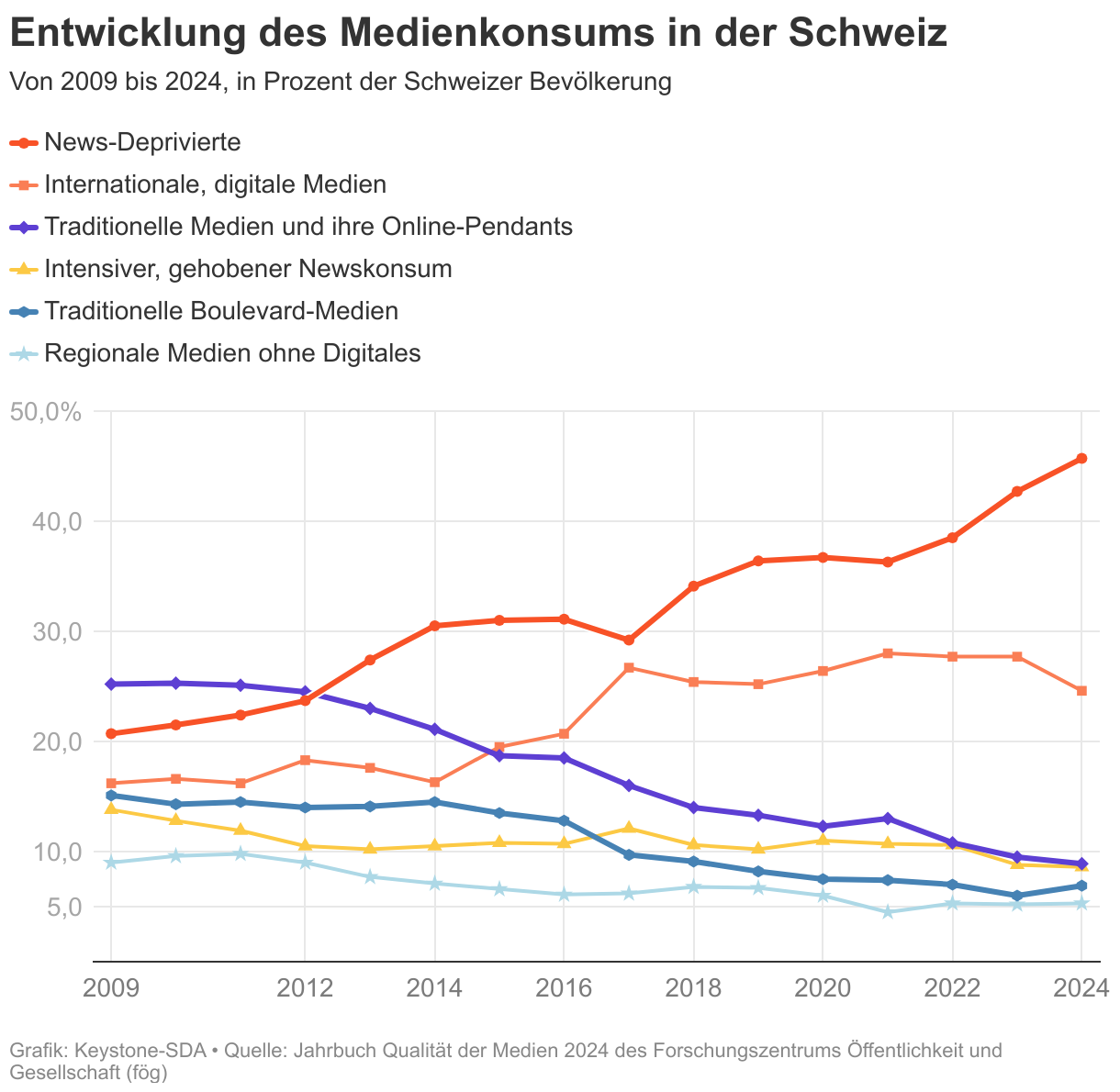
The yearbook also documents a worrying trend: The proportion of news-deprived individuals in the Swiss population has risen to 46.4 percent by 2025. VSM Vice President Ladina Heimgartner nevertheless sees reason for optimism: «The 46 percent who are news-deprived are offset by 54 percent of people who continue to use and value professional media—in other words, there are still a great many who deserve our full commitment as media professionals.»
]]>
61% of SRG users also consume private media, as reported by the Research Center for the Public Sphere and Society Fög on Monday. In contrast, only 38% of people who do not consume SRG information programs do so. Commuter and tabloid media are also consumed significantly more often across all channels by SRG users than by non-users.
According to the study, the same also applies to the online sector. Only around four percent of all respondents only consumed SRG news online. This is significantly less than the proportion of respondents who only use commuter and tabloid media online (26%) or only subscription media (8%).
"Public media obviously encourages people to continue consuming news," said Linards Udris, deputy head of research at the Fög, at the media conference on Monday. The study shows "a complementary, supplementary use" rather than a crowding out of private media. "The displacement thesis does not apply," said Fög Director Mark Eisenegger.

Media have a reach problem
However, both private and public media are reaching fewer and fewer people: The number of so-called news-deprived people in Switzerland has risen to a record 46%. Although the quality of the media is good overall, they have a reach problem. News-deprived people are most likely to use media on social media, according to research director Udris.
Due to the tight financial situation, there is also a concentration of media content, the yearbook continues. In regional reporting, for example, articles are increasingly being used more than once. The Fög considers a further loss of diversity at local and regional level due to fewer daily information offerings to be problematic.
The Fög recommends greater cooperation between public and private media. This is to counter the tech platforms that are siphoning off a large proportion of online advertising. According to Fög Director Eisenegger, these are the biggest challenge for all media - both public and private.
57 percent would not pay anything online
There is also a lack of willingness to pay, particularly in the online sector: 57% of respondents stated that they would not pay anything. A further 35% would be prepared to pay less than CHF 10 per month.
However, according to the study, the median for online subscriptions is CHF 18 per month. However, no statistical correlation was found between the use of certain types of media and the willingness to pay.
Whether online news is paid for or not depends more on the attitudes and socio-demographic characteristics of those surveyed. Men and younger people are more likely to pay. And those with a strong interest in news and politics are more willing to spend money on digital news services.
SRG scores highly for quality and trust
According to Fög, most respondents trust SRG news programs with 7 points on a scale up to 10. Le Temps and NZZ with 6.8 and 6.6 points. At the other end is the View with 5 points, on a par with GMX and Yahoo News.
On a scale of up to 10 points, the Fög attests the highest quality to SRF radio and television programs with 7.7 and 7.5 points respectively. Echo der Zeit" took first place with 8.1 points, ahead of "Rendez-vous" with 7.9 points, while private television was on a par with online subscription newspapers with 6.4 points.
Tabloid and commuter newspapers came last with 4.6 and 5 points respectively. However, the study expects long-term improvements in the areas of relevance and diversity as more hard news is published. This is thanks to journalistic changes that focus more on quality.

Great skepticism towards AI
The study also shows that the population remains skeptical about the use of artificial intelligence (AI) in journalism. Almost three quarters of Swiss people rate the risks of AI in journalism as high, even higher than in other areas of society such as politics or the military.
According to the study, the more AI intervenes directly in journalistic output, such as text or image production, the greater the skepticism. According to Fög deputy head of research Daniel Vogler, this may also be one reason why Swiss journalists are not prepared to use AI-generated news. However, the majority are in favor of using AI for translations, data analysis or research.

The Yearbook of the Media has been published since 2010. According to the Fög, the aim is to deepen the discussion about the quality of the media and to promote awareness of the achievements of information journalism in society. All types of media are examined, from press, radio and television to online and social media. The data basis is the Digital News Report of the Reuters Institute at Oxford University. (SDA/swi)
]]>
The approval rating looks slightly better for texts that were created "with the support" of AI, i.e. when AI helps with translations, research or data analysis. As many as 53.6 percent would be willing to read such texts, as shown by a study of the Research Center for the Public Sphere and Society Fög at the University of Zurich. The study was published on Thursday.

It is important to most respondents that the responsibility for content still lies with humans. "Many people probably think of text robots. They find this idea off-putting," study director Daniel Vogler is quoted as saying in a press release.

Little willingness to pay for AI texts
The study also shows that Swiss people do not have a great deal of trust in media companies when it comes to AI: Only 21.2 percent believe that the media they use the most handle it responsibly.
There is also some catching up to do in terms of declaration. Only 12.1 percent of respondents believe that the media provide sufficient information about how they use AI and which guidelines they follow.
AI also has a negative impact on readers' willingness to pay: Only 6.2 percent of respondents would pay for texts generated entirely by AI. And even for texts written with AI support, only one in four is willing to put their money where their mouth is. The highest willingness to pay is still for AI-free content.

1287 people took part in the representative online survey. (SDA/swi)
]]>
As the Fög on Monday at the presentation of the latest yearbook on the quality of the Swiss media announced, only 29 percent of the Swiss population would read articles generated entirely by AI. This is shown by the responses of 1254 people from German- and French-speaking Switzerland who took part in the Fög survey in July of this year.
For texts written by media professionals without the use of AI, on the other hand, the readiness rate is 84 percent. "For the audience, the role of journalists in reporting is still central," summarized Fög research director Daniel Vogler at the presentation of the study in Zurich.

Acceptance depends on the topic
The survey also shows that the acceptance of AI in the media depends on the topic: In the case of news about the weather, sports and stock market prices, or about well-known people, respondents can more readily imagine reading AI-generated articles. By contrast, acceptance is significantly lower for news about politics, business, science or culture.

Another finding: only around ten percent of respondents would be willing to pay for media articles written entirely with AI. A clear majority of respondents also want media entrepreneurs to be compensated by AI providers when text robots such as ChatGPT access journalistic content.
The Fög recommends that Swiss media declare when they use AI. "This is the only way journalism can distinguish itself from the growing number of dubious offers," says director Mark Eisenegger, according to the statement. The survey showed that more than 80 percent of respondents want media content generated with AI declared accordingly.
Co-study author Linards Udris from Fög explains details of the study in an interview with Werbewoche.ch.
More and more "news deprived
In its annual yearbook, the Fög also writes that the number of so-called news deprived people in Switzerland has continued to grow. It now reaches 43 percent of the population. This refers to people who hardly ever read, listen to or watch news. Asked about the type of news that interests Swiss people, many mention "positive" or "constructive" journalism, which takes up positive news or not only presents problems but also discusses possible solutions. An expansion of constructive journalism could therefore counteract increasing news deprivation.
On the other hand, the Fög also notes that the quality of reporting by the Swiss media has reached a new high since 2015. The Corona pandemic and the Ukraine war contributed to this, according to the center. According to the Fög, the top places in media quality are occupied by public radio and television, ahead of private television, online subscription newspapers and SRG online platforms.
In the current yearbook, the media researchers specifically examined the quality of news posts on social media such as TikTok and Instagram. The conclusion was that the Swiss media publish more classified articles on these platforms than on their news platforms. This is also positive, Linards Udris of the Fög told the media.

To ensure that the number of news deprived people does not increase, journalism should also include positive news. The research center recommends not only describing problems, but also pointing out possible solutions.
Since the first edition in 2010 of the "Jahrbuch Qualität der Medien" (Yearbook of Media Quality), the Research Center Public and Society (Fög) at the University of Zurich has been providing current key figures on media quality, media use, media concentration and the development of the Swiss media system on an annual basis. All media genres are examined. The researchers also classify trends and current events. The main findings of the current issue can be viewed here. (SDA/pd/swi)
]]>
In the run-up to elections and votes, the Federal Council and the authorities, parties, associations and NGOs use targeted campaigns to try to convince voters with their arguments. How politically balanced is the Swiss media's reporting on this? Answers are provided by a new study by the Research Center Public Sphere and Society (Fög) on the political positioning of journalistic media in referendums.
Accordingly, the media tend to report positively on government and parliamentary proposals, while popular initiatives tend to be rejected. Proposals with center-left support, such as "Marriage for All" or the "Care Initiative," receive more approval on average than center-right proposals, such as the "Terrorism Act" or the "Limitation Initiative. This is particularly evident in editorial comments.
Tonality of reporting
At the same time, the tone of reporting is more in line with the voting results of the electorate than with party strengths and voting ratios in the National Council. Compared with the voting population, the media give greater weight to voices critical of the majority. On average, the media also pay more attention to popular initiatives than to proposals from the authorities. In this way, they fulfill their critical and control function to a certain extent.
These patterns are evident in most of the media studied. Proposals to the authorities as concerns of the political majority have a slightly positive to positive tonality in most of the media titles studied, especially in suedostschweiz.ch (+46). Only in the SonntagsZeitung (-4), the WOZ (-10) and especially the Weltwoche (-32), criticism of government and parliamentary proposals predominates. There is a tendency toward rejection of popular initiatives, especially in the case of nzz.ch (-30), Switzerland at the weekend (-31) and the Weltwoche (-41). There is more approval than disapproval only for the SonntagsZeitung (+9), the SonntagsBlick (+20) and the WOZ (+44).
If the media examined are positioned on a left-right axis (-100 to +100), according to the study, accents to the left can be seen, for example, in the case of Le Matin Dimanche (-12), blick.ch (-14) and SonntagsBlick (-34). There is a slight accent to the right at the NZZ on Sunday (+7) and the Switzerland at the weekend (+9), further to the right is positioned nzz.ch (+17). The clear exceptions are the politically profiled media titles WOZ (-79) on the left and the Weltwoche on the right (+59). Politically neutral positioning around the zero value is shown by the high-reach media 20minuten.ch (+1), 20minutes.ch (-1), SRF (-1) and RTS (-3).#
Media response of the parties
A broad spectrum of actors have their say in the media coverage of the referendum proposals. The various parties receive the greatest response (39 %), in line with their voter shares: Of the six largest Swiss parties, the SVP accounts for the largest share at 26 percent and the Green Liberal Party the smallest at 7 percent. The executive branch accounts for 12 percent of the response, NGOs or individual citizens for 14 percent . Science (11 %) and business (8 %) are somewhat less present. Other actors such as religious organizations or associations receive 15 percent of the media response.
Swiss media balanced overall
"The study shows that most media position themselves neither on the left nor on the right pole of the political spectrum, but relatively close to the average. This is particularly true for the high-reach public media SRF and RTS and the commuter media of 20 minutes, who are profiling themselves as impartial reporters," says Linards Udris, author of the study and associate director of research at Fög.
However, the Fög also identifies shortcomings. For example, not all proposals receive the same response. The sometimes considerable differences mean that voters are not informed about all proposals to the same extent.
The study is based on manual content analyses of the coverage of 44 referendums between 2018 and 2023. 23 media titles from German-speaking and French-speaking Switzerland were analyzed.
The entire study is available here available for download.
]]>
 Although the package of measures in favor of the media receives the strongest attention, it performs poorly compared to the response to previous proposals. This is the conclusion of the Research Center Public and Society Fög of the University of Zurich.
Significantly more attention was paid, for example, to the Covid 19 law, which was voted on in November last year, or the "No Billag" initiative of 2018. In the case of the media package, the tone is slightly positive, as is the case with the initiative for a tobacco advertising ban.
In contrast, the initiative for a ban on animal and human experimentation is clearly rejected. In the case of the abolition of stamp duties, on the other hand, the tone is ambivalent. That is, the increasing and decreasing votes balance each other out.
Differences between language regions
A comparison of the two major language regions shows that the media law is more present in the German-speaking media of Switzerland. The tone of reporting is more positive in French-speaking Switzerland than on this side of the Röstigraben, the Fög continues.
There are also differences in tone regarding the abolition of stamp duty, which receives slightly more support in the media in French-speaking Switzerland than in German-speaking Switzerland. The other proposals meet with approval (tobacco advertising ban) or rejection (initiative for a ban on animal and human experimentation) in both language regions.
The media package is a special bill for the media because many media houses are affected by it. Nonetheless, a relatively "routinized" form of voting coverage can be observed here, as is typical for many votes. (SDA)
]]>
The Research Center Public and Society Fög of the University of Zurich published its yearbook "Quality of the Media 2021" on Monday. The center has been examining the development of the Swiss media annually since 2010.
According to the report, the topic of disinformation - i.e. intentionally spreading false news - has definitely arrived in Switzerland with the Corona pandemic. This is shown by the results of a representative survey conducted by Fög in Switzerland at the end of 2020.
Almost half of the respondents (49%) consider disinformation to be a "major" to "very major" problem, especially in dealing with social crises. Just under a quarter say they "often" to "very often" encounter false news. The study participants cite social media (62%), alternative media (39%), video portals (36%) or messenger apps (28%) as the main sources of disinformation. Professional journalistic media such as news sites (20%) or television (13%) are less often cited as sources of disinformation. On the contrary, the population uses information from journalistic media (61%) and from the federal government and authorities (68%) to check the content of fake news.
More classification by the media
In the second wave of the pandemic, the media also pay very high attention to the topic of Corona - but less than in the first wave, despite rising case numbers. The coronavirus is also presented explicitly as a threat less frequently (6%) than in the first wave (16%). "A "scaremongering", as the media is often accused of, can thus not be empirically determined", says media expert and Fög director Mark Eisenegger. The proportion of media reports that are very positive towards the authorities remains low (0.3%). Thus, the accusation of uncritical "court reporting" is not confirmed. Figures and statistics are classified more frequently by the media compared to the first wave (21% vs. 12% in the first wave), which is positive.
Limited diversity of experts
Another conclusion of the report is that the diversity of experts in the second wave of the pandemic remains severely limited, however. Thus, voices from medicine, virology, and epidemiology continue to dominate, despite the fact that almost all sectors of society are affected by the pandemic. Female scientists have become more visible (21% vs. 12% in the first wave), but remain significantly underrepresented compared to their male colleagues.
This underrepresentation of women persists in media coverage beyond Corona, as another Fög study on the portrayal of women in Swiss media shows. A limited diversity is also confirmed by an examination of the referendum campaign on the veiling ban of March 7, 2021. The Muslim minority concerned is not very visible on Twitter (13%) and in the media (11%). Instead of letting them have their say, there was more often only general talk about Muslims.
More quality in commuter and tabloid media online
According to the Fög report, media quality remains stable overall, but is changing in individual dimensions. The media provide more information on politics (37%, +5 percentage points year-on-year) and less on soft news such as sports (10%, -1.5 PP) and human interest (30%, -1.3 PP). The share of classified services in the form of background articles did not decline for the first time in six years.
Media types such as public broadcasting and subscription news sites continue to excel in quality. But the commuter and tabloid media online can improve their quality due to the event situation and the stronger focus on politics.
The concentration of content, i.e. the sharing of identical articles in several media, has become more pronounced in German-speaking Switzerland. In 2020, this can be seen in almost all subject areas, but especially in cultural reporting.
Media promotion is strongly accepted
The Corona pandemic has further worsened the economic situation of the media, the report says. For the first time since 2014, revenues from the online advertising market are also declining. Although willingness to pay for online news is growing slightly (17%, +4 PP). However, this is not enough to sustainably finance journalism.
According to Fög, more active media support is not rejected in principle. 37% of respondents are of the opinion that the state should support private media if they get into difficulties; 37% are against, 26% are undecided. In an international comparison, acceptance of direct media support in Switzerland is thus strikingly high.

Good journalism needs resources
The results of the Yearbook show that professional media have become even more important as a result of the pandemic. Media provide orientation, supply the population with reliable information and are also able to check and refute false news. Good journalism, which is supposed to fulfill its democratic functions, needs resources. "It is becoming increasingly apparent that high-quality journalism can only be financed through direct media funding," Eisenegger is convinced. This should also support smaller media providers and startups in particular, which contribute to a diversity of voices and to informing the population. (pd/swi)
]]>
The study, entitled "Quality of Cultural Reporting. Investigation of the Status Quo in Switzerland" was published on Monday in German and French. For their study, researcher Franziska Oehmer and her colleague Daniel Vogler from the Fög evaluated 48 leading media from all three language regions in the period - from 2015 to 2019. Specific cultural media are not included.
In addition, the author and the author have applied a very broad concept of culture, which includes "all forms of expression of human life and society". On this basis, they find that cultural coverage accounts for about 10 percent of total coverage and that this proportion has remained constant over the period under study. Among other things, this results in the statement that cultural reporting in the Swiss media is "intact."
"At risk" it is because, for example, regional newspapers such as. Basel Newspaper, Bernese Newspaper, The Covenant and the Tages-Anzeiger form an association under the umbrella of the TX Group or Aargauer newspaper, Lucerne Newspaper and St.Galler Tagblatt under CH Media. Such concentrations mean that journalistic contributions in general, and thus also cultural contributions, are increasingly identical in all of these newspapers.

The study states that "due to the tight financial situation of journalism," it can be assumed that "the concentration of cultural content will increase rather than decrease in the near future. Particularly affected by this are "opinion-driven formats, above all reviews.
According to the study, this situation poses a problem for cultural professionals. It also sees a danger that dividing lines in society as a whole could deepen further, because critical cultural reporting would "degenerate into a luxury good.

With instead of against each other
Under the heading "What to do?" Oehmer and Vogler propose more "cooperation instead of opposition" between the players, for example a common infrastructure for the various platforms or, in terms of information processing, a broad-based news agency for cultural information.
The study was co-financed by CH-intercultur, formerly Schweizer Feuilleton-Dienst, which worked with the Keystone-SDA news agency as a cultural press service until 2020. CH-intercultur is now working on a model for cultural reporting and cultural criticism.
In addition, the problems of cultural reporting will be the topic of the conference "Cultural Reporting in Crisis - How Will Culture Reach the People in the Future? The conference is being organized by Swissfoundations, the umbrella organization of Swiss funding foundations, with the Federal Office of Culture on August 26. (SDA)

 Between 2015 and 2020, the number of articles mentioning women stagnated at an average of 23 percent. This is the result of a study by the Research Center Public Sphere and Society fög in collaboration with the Institute of Communication Science and Media Research IKMZ at the University of Zurich.
Only in 2019 was a slightly higher proportion of women measured at 25 percent. The researchers attribute this to the women's strike that took place at the time and the federal elections. This indicates that the commitment to equality in society is paying off, they say in a statement accompanying the study. However, this positive change was not sustainable and had already evaporated by 2020.
Few women as experts
How often women are represented in an article depends strongly on the topic of the article. The lowest proportion of women is in sports, with an average of 13 percent, and in business news, with 17 percent. The highest proportion is in "human interest topics" with 31 percent and in cultural reporting with 27 percent. At 23 percent, reporting on politics is right in the middle.
Women are also less often portrayed in professional and public contexts compared to men. Only around 21 percent of all visible representatives of organizations and 23 percent of all experts are female in media coverage.
Women are particularly underrepresented among executives who speak in their management function. When reporting on private matters, on the other hand, the difference between women and men is smaller. Here, the proportion of women is 33 percent.
Difference between media title
The proportion of women varies greatly between the media titles. The highest proportions of women are found in Die Weekly newspaper WoZ (29%), Rts.ch (27%) and Blick.ch (26%). In the Neue Zürcher Zeitung NZZ (19%), Watson.ch (20%) and The Covenant (20%), women are the least present. These figures are also linked to the topics. Those media that report more on sports and business have a lower proportion of women.
In general, the presence of women is twice as high in editorial reporting than in media articles based on agency reports. The study authors suspect that the choice of sources or the thematization of actors can be controlled more readily in own articles than in the processing of agency reports.
Strengthening journalistic research
The study concludes that the representation of women in Swiss news media is "clearly insufficient. For a democracy, it is important that all social groups can contribute to the public discourse with their different voices, it says.
"The strong underrepresentation of women in Swiss media is a result of existing social structures and journalistic routines," study director Lisa Schwaiger of fög is quoted as saying.
According to Schwaiger, the media are called upon to ensure more balanced reporting in the future, to increasingly allow women to have their say as experts, spokespersons and leaders, and thus to contribute to a reduction in social inequalities. Above all, this requires strengthening journalistic research and the corresponding resources.
In the study, the portrayal of women in Swiss online and print media was evaluated on the basis of 106,706 media articles using an automated content analysis. (SDA)
]]>
This is the finding of the authors of the latest "Quality of the Media" yearbook. According to the study, not only the "news-deprived" are undersupplied with relevant hard news, but also the "global surfers. While the "news-deprived" generally consume little news, the "global surfers" are considered to be news-savvy, but because of their media menu they are insufficiently confronted with regional and national reporting.
However, the supply of offers from within the country is necessary in order to be able to exercise basic democratic rights on an informed basis or to participate in the public sphere of a country in which one lives, the study states.
News deprivation is problematic in several respects. It goes hand in hand with lower political knowledge and less participation in the political-democratic process. News deprivation also correlates with lower trust in government institutions.
Last but not least, the social image of the "news-deprived" is more emotionally and threateningly charged: Scandals and crises, accidents, catastrophes and attacks find their way into the news feeds of such user groups to a greater extent. And: The priority use of social media promotes news deprivation.

Decrease in old-world news repertoires and increase in new-world news repertoires: The plot shows the share trends of the six repertoire types in the period from 2009 to 2019 (n = 37,623). The dotted line represents the trend if no update of the repertoires had occurred. Legend: The share of "news deprived" increases from 21 percent in 2009 to 36 percent in 2019.
The problem of news deprivation is by no means limited to Switzerland, the report continues. This is shown by international research on news avoidance. The proportion of "news avoiders" who actively and consciously refuse to read the news is between 15 and 41 percent in Western democracies.

Frequency of use of media categories for news purposes: Shown are the proportions of respondents who indicated "often" or "very often" as frequency of use (n = 37,623; source: data based on the annual GfK/fög media usage survey). Legend: In 2019, 70% of respondents use social media often or very often for news purposes.
Trust in traditional media
Despite the growing importance of platforms such as Facebook, Google, WhatsApp, Snapchat and Instagram: In 38 countries surveyed, including Switzerland, classic information media are trusted significantly more (47 percent) than search engines (29 percent) or social media (17 percent) as sources of information.

Media trust in international comparison: The chart shows for Switzerland and the reference countries the proportion of respondents who say they trust the information media, search engines and social media predominantly or strongly (source: Reuters Institute 2019). Legend: In Switzerland, 47% of respondents say they trust the media predominantly or strongly.
The most intensive social media users, i.e., the youngest respondents, distrust the news on social media the most (62 percent). Overall, there is the remarkable finding that the increasing use of social media goes hand in hand with falling trust ratings in these platforms.
This is an important finding for Swiss information journalism, according to the yearbook: Despite the high and growing importance of social media as sources, users tend to be skeptical about social platforms and are obviously aware of the important function of professional information media as guarantors of an enlightened social discourse.
Willingness to pay for online news remains low in Switzerland and many other countries. Only 11 percent of Swiss media users say they will pay for digitally available news in 2019.

Willingness to pay for online news in international comparison The chart shows for Switzerland and the reference countries the proportion of respondents who say they have paid for online news in the last year (source: Reuters Institute 2019). Legend: In Switzerland, 11% of respondents say they have paid for online news in the past year.
For more media patriotism
The authors of the study write that platformization is weakening professional Swiss information journalism, which can be seen, among other things, in the increasing concentration of media in Switzerland. However, professional information media and editorially produced news remain indispensable for a democratic society.
What is needed, therefore, is a new media patriotism. This must be guided by the insight that local journalistic information media are indispensable for a democratic nation-state like Switzerland, but that they are primarily under pressure from outside, i.e. from global tech platforms.
The support of the national system of professional information media would have to include both state measures and measures beyond that. In the area of government measures, proposals for taxing advertising revenues generated on journalistic content by tech platforms were already made in last year's "Quality of the Media" yearbook, as was the proposal to expand direct media subsidies.
In the non-governmental sector, cooperation between media organizations should be intensified. There is a vision of a Swiss digital omnium for professional information journalism, which relies on cooperation wherever journalistic competition is not diminished as a prerequisite for an enlightened, diverse discourse.
Published for the tenth time
The yearbook "Quality of the Media" is published for the tenth time. It is written by the Research Institute Public and Society (FÖG) of the University of Zurich. It is financed by the Kurt Imhof Foundation for Media Quality and the University of Zurich.
Around 2,000 Internet users in German-speaking and French-speaking Switzerland were surveyed. In addition, survey data from an annual media usage study conducted by fög in collaboration with GfK Switzerland was included in the analyses. As part of this study, around 3400 online interviews have been conducted at the beginning of each year since 2009. (SDA)

The ninth edition of the 2018 Quality of the Media Yearbook from the University of Zurich's Research Institute Public Sphere and Society is out. One of the findings: In Switzerland, the same content is being disseminated more and more often. This is shown by an automated text comparison of Swiss media coverage. In the democratically sensitive area of national political reporting, 54 percent of articles already appear in at least two newspapers at the same time.

The automated comparison using Jaccard coefficient proves that the proportions of shared contributions between media from the same association are very high. The Tages-Anzeiger, the Confederation and the Bernese Newspaper have been part of Tamedia's newly created central editorial team for German-speaking Switzerland since this year. Following the introduction of the cooperation, the shares of shared editorial contributions in these three newspapers rose by 17 percentage points to currently 55 percent. Within opinion-driven formats such as editorials or commentaries, the proportion of identical reporting has even risen from 40 percent to 68 percent. This means that the same voting or election recommendations are increasingly being made prior to ballots, which is problematic from a democratic policy perspective, write the study authors. Editorial network systems promote a uniform setting of topics and perspectives in the media arena. The danger of journalistic mistakes increases because the control function between the media is weakened.
Reporting quality still high despite loss of diversity
Viewed across the 66 information media studied, the quality of reporting in Switzerland nevertheless remains high, the report continues. In the 2017 survey year, the 35 titles scored between 6.1 and 8.3 out of a maximum of 10 quality points. The newly included weekly newspaper (WoZ) makes it straight to fourth place in the overall ranking and equals the score of the NZZ. However, around a third of all media are unable to maintain the same level of quality as in the previous year. Losses are evident in the diversity dimension, but also in classification performance. The reduction in resources in Swiss information journalism is having an effect.
Personnel brain drain in journalism and growth in the PR sector
The growing weakness of earnings in information journalism means that the number of media professionals in the news sector is constantly declining. Between 2011 and 2016, 3,000 jobs were lost in the online and press media sector (-19 percent). In the same period, the number of employees in the PR sector increased by 16 percent. The number of self-employed journalists has also increased by 20 percent since 2011. The precarious funding situation in information journalism is fostering a trend whereby more and more journalists are either "switching sides," i.e., pursuing new employment in the PR sector, or seeking their fortunes as freelancers, mostly under precarious conditions because of long-term insecurity.

More and more inform themselves less and less
Since 2009, the number of so-called news-deprived people has been steadily increasing. The audience belonging to this media usage type consumes little news and, if it does, then in low-quality information media, primarily via social media. Of all user groups, the news-deprived have grown by far the most since 2009 (+15 percentage points). In 2018, more than one in three media users (36 percent) belong to this user type. Among 16- to 29-year-olds, the figure is 53 percent. Since willingness to pay is directly linked to interest in news, it is precisely the news-deprived group that is least willing to pay for information journalism that is growing the most.

New media law (BGeM): proposals do not go far enough
The conclusion of the study authors: In view of the fact that professional information journalism lacks a sustainable business model and continues to lose financial and human resources, the proposals for expanding media funding in the new Federal Law on Electronic Media (BGeM) do not go far enough. First, in addition to online providers that produce audiovisual content, online text media that specialize in producing background information should also be eligible for funding. Secondly, more funds must be earmarked for direct media promotion for private media providers so that the journalistic decline in diversity in Switzerland can be effectively halted. To ensure that sufficient funds are available for the SRG and direct media promotion, the absolute amount of the media levy must be set sufficiently high and must not be reduced further in subsequent years. (ank/pd)