
In the heart of Zurich, where the economic engine roars the loudest, the Kaufleuten has become a think tank for the Swiss communications scene. Under the theme «Less chance, more impact,» Swiss Post Advertising hosted an event to take stock of the current situation in uncertain times. The key message: The more AI automates, the more crucial the human touch becomes.
With great precision, energy, and palpable passion, host Sarah Andrina Schütz guided the audience through the packed program. With flawless delivery, always to the point, and a keen sense of nuance, she challenged her guests and got straight to the heart of the day’s key question: In an era where algorithms dominate content delivery, human judgment is becoming the true competitive advantage.

«Perhaps in 2026 it will make sense for us to start talking about decision-making skills—instead of always just talking about data literacy.»
Sarah Andrina Schütz
The Introduction: Why the Turkey Is Wrong and Why Less Is Often More
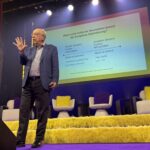
Prof. Dr. Gerd Gigerenzer, director of the Harding Center for Risk Literacy at the University of Potsdam, set the intellectual tone for the event. In his keynote address, he debunked the widespread myth that big data and AI are a panacea for complex problems. Gigerenzer drew a fundamental distinction between the stable world—where fixed rules apply, as in chess or industrial manufacturing processes—and the world of uncertainty, where markets, trends, and human behavior operate.


Anyone who, in the face of uncertainty, tries to calculate the future precisely using models from the past falls prey to the turkey illusion. The turkey is fed every day and, based on this, deduces with increasing mathematical probability that humans are its best friends—until the axe falls on the day before Thanksgiving. In real situations of uncertainty, therefore, heuristics and a well-honed gut feeling are needed. Professional intuition is not hocus-pocus, but rather experiential knowledge distilled over many years. Gigerenzer sharply criticized the rampant risk-aversion culture in corporations, where executives make second-rate decisions just so they can hide behind reports and columns of numbers in the event of failure.
«In situations of uncertainty, big data isn't much help. That's when you need heuristics and good intuition—and in those cases, less is often more.»
Prof. Dr. Gerd Gigerenzer
A Beacon in the Fog: Post-Advertising and the Search for Relevance
Dr. Oliver Egger, Managing Director of Swiss Post Advertising, made it clear in an interview that data is by no means useless, but rather provides essential guidance. For Swiss Post Advertising, it’s not just about accumulating data, but about consciously creating transparency. Data acts as a spotlight that narrows the field of view and shows where making contact really makes sense.

But true value is created only through the interplay of strong creativity, the right channel, and human intuition. Only when a message reaches the recipient at the right moment and in the right context does the advertising budget not vanish into digital oblivion, but instead have a lasting impact—both in the analog and digital worlds.
«Data is like a spotlight; it directs our focus—but the decision of what to do with it is made by intuition.»
Dr. Oliver Egger
Between the Past and the Future: Cumulus's Path of Transformation
Alexandra Brunner, Head of Customer Engagement at Migros Supermarkt AG, illustrated what this balancing act feels like on the largest scale in Switzerland. With the further development of the «Cumulus» program, the division shifted from traditional direct marketing to holistic customer engagement. Although a proprietary algorithm calculates personalized recommendations for future purchases based on the purchase history of millions of customers, the system is continuously refined through qualitative customer surveys and common sense.

Brunner emphasized that digitization must never become an end in itself. A digital process must offer customers real added value, such as convenience and simplicity. It remains noteworthy that, despite all the enthusiasm for apps, more than half of customers still value receiving physical statements in their mailboxes. The tactile experience and analog reliability remain irreplaceable anchors of trust in the retail sector.
«Data may tell us what the customer does—but it doesn't tell us why they do it or how they feel about it.»
Alexandra Brunner
Radical Transparency: The DS 8 Case and the Power of Zero-Party Data
Lino Bottani, a media consultant at mmb media agentur, demonstrated how the perfect combination of genuine customer interest, timely data analysis, and cross-media outreach works in practice. Using the national launch campaign for the new DS No 8 electric model as an example, he demonstrated the potential of «zero-party data.» Instead of relying on vague third-party cookies or statistical probabilities, the agency used verified Swiss Post opt-in data, in which consumers had explicitly and voluntarily indicated that they intended to purchase an electric vehicle within the next twelve months.


By precisely identifying genuine «purchase intenders,» the campaign could be executed with surgical precision. Through a multi-stage sequence of email campaigns, targeted reminder messages, and a high-quality physical postcard sent to 350 selected top contacts, the campaign achieved outstanding click-through and lead rates. Bottani thus impressively demonstrated that relevance isn’t achieved through a scattergun approach, but rather when the right message reaches people who are actively considering a purchase at that very moment.
«Zero-party data comes at just the right time. When customers signal what they want, the relevance of advertising increases dramatically.»
Lino Bottani
Global Platform Power vs. Local Impact: A Perspective from the Far East
From his adopted home of Taiwan, tech blogger and consultant Sascha Pallenberg offered a radically honest and refreshingly provocative perspective. He drew a connection between smart urban infrastructure and the real dangers of digital monopolies. Pallenberg strongly warned the industry against unconditional submission to the logic of Meta, Google, and TikTok.


A massive portion of global traffic and digital interactions today consists of click farms, bots, and AI-generated virtual worlds that burn through budgets without fostering genuine customer relationships. His warning to advertisers and marketers was unmistakable: Anyone who wants to remain in control in the long term must reduce their dependence on global gatekeepers, strengthen their own digital hubs—such as their company websites—and use technologies like QR codes to build a direct bridge from the physical world to the consumer.
«Stop making yourselves dependent on global platforms. Build your own channels and consistently think through solutions from a human-centered perspective.»
Sascha Pallenberg
The Four Roles of Brand Management: Breaking Down Silos
Dr. Hannah Leimert of the University of St. Gallen presented the key findings from ten years of research on holistic brand communication. In light of a fragmented media landscape—in which over seventy percent of marketing executives struggle with their existing organizational models—she introduced a holistic framework. Today, every successful brand must simultaneously fulfill four key roles: entertaining and conveying values (Edutain), moderating discourse on an equal footing (Moderate), evoking tactile and iconic desirability (Allure), and creating real spaces for connection and a sense of belonging (Bond).


In this age of digital oversaturation, the physical dimension in particular is experiencing a massive resurgence. People long for a tangible connection, which explains the success of well-designed packaging, physical brand touchpoints, and authentic community events. Modern brand management should no longer get lost in channel-specific silos but must align all initiatives toward a clear, meaningful overarching goal.
«Today, brands must master four roles simultaneously: Edutain, Moderate, Allure, and Bond. Connection isn't created through abstraction, but through touch.»
Dr. Hannah Leimert
Leadership in the Real World: Delivering When the Pressure Is at Its Highest
One of the most gripping highlights of the afternoon was the high-profile panel discussion on leadership under pressure. Three prominent female leaders spoke with brutal honesty about what happens when budgets are tight, deadlines are looming, and interests clash.


Doris Keller, sports manager and director of the 2030 European Championships Switzerland bid committee, looked back on her triumph as tournament director of the UEFA Women’s EURO 2025. When Parliament sought to slash funding, she remained undeterred, stayed focused, and—together with her team—exceeded all expectations, even filling stadiums to capacity. For her, leadership means setting the course even in the face of headwinds and inspiring the team with a clear vision.
«Leadership isn't always easy. You have to have the courage to make quick decisions and then consistently follow through on them.»
Doris Keller
Yvonne Samaritani, Chief Group Corporate Communication Officer at Weleda, highlighted the challenges of global corporate communications, which must operate simultaneously in more than fifty markets. In a culture of outrage driven by social media, she said, it is essential that management not cave in at the first sign of headwinds. Leaders must understand the full context and demonstrate resolve, rather than seeking the lowest common denominator.
«Brand management isn't a democratic process. If you're only looking for compromises, you'll end up with a boring brand.»
Yvonne Samaritani
Sabrina Wettstein, Head of Sales at Swiss Post Advertising, pointed out that transformation can only succeed if employees are given genuine autonomy and psychological safety. Leadership, she explained, means providing direction, setting boundaries, and trusting the team to act independently within those boundaries. Market relevance arises only when salespeople are passionate about their solutions and approach customer situations with genuine empathy.
«Good leadership begins when you help others improve—with a clear direction, but always allowing room for personal responsibility.»
Sabrina Wettstein
Rethinking as a Principle: The Takeaway from an Intensive Day
Before Oliver Egger delivered the official closing remarks, Roman Tschäppeler and Mikael Krogerus provided a fitting conclusion with an exclusive preview of their new book, *Umdenken*. With witty humor, they reminded the audience to regularly cast aside established patterns of thought and well-worn routines—especially when they still seem to be working.

DIRECT! 2026 at the Kaufleuten in Zurich sent a strong message to the Swiss communications industry. Artificial intelligence and big data are valuable tools for accelerating processes and gaining deeper insights into target audiences. But impact, trust, and sustainable business success arise where solid craftsmanship, professional intuition, and direct person-to-person interaction set the tone. Relevance cannot be calculated alone—you have to feel it and take responsibility for it.

The m&k DIRECT! Photo Gallery

















]]>