
The two stock corporations Radio Top and Tele Top are to be transferred to a foundation so that their independence can be preserved in the long term. Günter Heuberger is a private radio pioneer from the very beginning. Since the founding of Radio Eulach in 1984, he has been committed to strong regional reporting, first on the Winterthur site and later with the merger of Radio Eulach, Radio Thurgau and Radio Wil to form Radio Top in 1998. In 1986, Günter Heuberger was involved in the founding of Winti TV, which was expanded into Tele Top in 1999 and received a TV license in 2008. Through his many years of activity in the Association of Swiss Private Radio Stations, he has also helped shape the media landscape at the national level.
Günter Heuberger's great personal commitment in every respect has played a major role in establishing the Top media in the Winterthur, Thurgau and Schaffhausen regions as an indispensable part of a present and independent public service. Radio Top and Tele Top, for example, are among the few local media in Switzerland that are not owned by a publishing house.
Martin Model, another long-standing member of the Board of Directors, also stepped down. The well-known Thurgau entrepreneur had also played a key role in shaping the development of Top Media.
New Board of Directors Team
As of July 1, 2022, the Board of Directors will be composed of: Peter Döbeli (previously), Chairman, federally certified communications manager/founder and owner of Konnex, Agentur für Medien-Kommunikation AG, Tobias Trevisan (new), Vice Chairman, entrepreneur, former publishing manager, Andreas Widmer (previously), member, entrepreneur, cantonal councilor, and Yvonne Beutler (new), partner, consulting company. Andreas Widmer (previously), member, entrepreneur, cantonal councilor, and Yvonne Beutler (new), member, partner in a consulting firm, former SRF producer and city councilor.
The General Meeting was convinced that the new Board of Directors team, with its great expertise in the fields of media and business management as well as its strong local roots in the broadcasting area, will successfully master these challenges. "We look forward to continuing to develop Radio Top, Tele Top and Top Online together with Managing Director Philippe Pfiffner and the team, always consistently focusing on the needs of users," said Peter Döbeli, the new Chairman of the Board of Directors. At the same time, it is important to place the top media on a stable financial footing. In addition, the listeners and viewers should be able to play an active role with a support association.
]]>
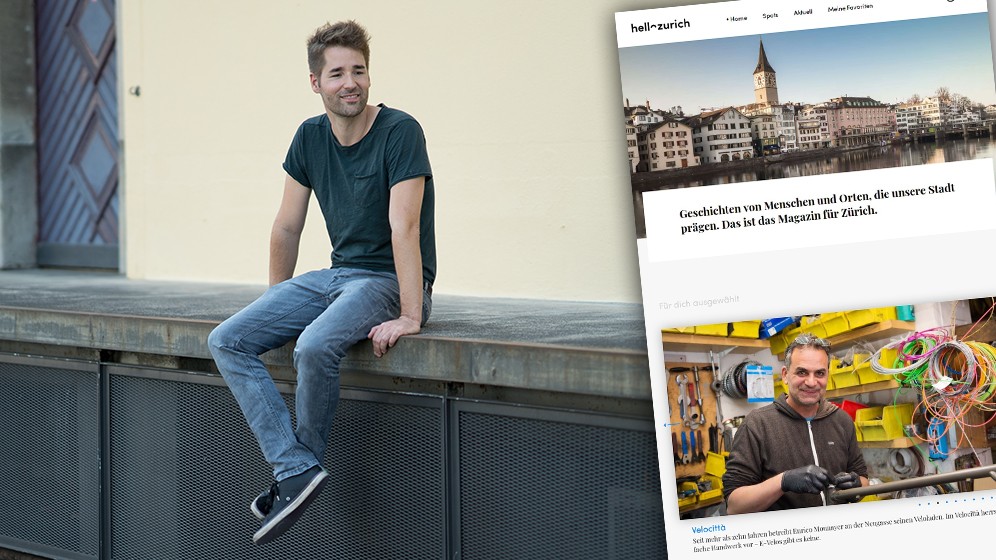
Christian Schiller (39) founded Hello Zurich in September 2017. Today, the Zurich city magazine has 26,000 to 32,000 unique visitors per month. The approach: to be independent, ad-free and not profit-oriented. The father of two works 60 percent for Hello Zurich - the same as Co-Editor-in-Chief Eva Hediger. Freelancers contribute about a third of the articles. In addition to Hello Zurich, Schiller runs his own communications agency. After starting his career at a bank, Schiller first switched to journalism and later to communications.
Werbewoche: When you currently read an article on Hellozurich.ch, a message appears saying that Hello Zurich is only possible thanks to a lot of idealism. What do you want to move with the digital city magazine?
Christian Schiller: We want to offer the city a bilingual, high-quality online magazine with strong photos that puts people and their stories in the spotlight. This gives city residents the opportunity to look behind the facade and immerse themselves in local stories. Along the lines of "Ah, really now, that's where I always walk by ...". But a quarter of our readers are also expats and tourists. That's why the most important facts are summarized briefly at the top of each article - with a photo gallery and map link.
Has the content orientation changed since the launch a year ago?
Yes, in the meantime we have the claim not only to offer a city guide, but also to be an important voice in the city in other ways. That's why we have also launched the "News" section.
Meanwhile, we have the claim to be an important voice of the city.
How did the Hello Zurich project come about?
It all started when I moved back to the Niederdorf neighborhood. I was fascinated by how the neighborhood had changed since my youth, but also how much had stayed the same. That's why I wanted to publish a magazine-like guide that revolved around Niederdorf and brought the neighborhood back into the conversation. Then one thing led to another: I published a few stories with a few freelancers and posted photos on social media. The project got bigger and bigger and we didn't limit ourselves to the Niederdorf anymore. Soon we were counting up to 32,000 unique visitors a month. I realized: Wow, what we're doing is going down well. At some point we had to think about how we could cover the costs of the project.
On the subject of financing ...
Oh yes, a difficult subject (laughs).
Initially, your strategy was to focus on native advertising. What were the reasons for this at the time and what was the strategy behind it?
After half a year, the first inquiries from companies started coming in: How does one get into the magazine with you? The website and the production of the stories cost something, of course, and I wanted to pay back the small loans from my private environment quickly. So, as an experiment, we relied on native advertising. But the stories of most of the companies that were interested in this advertising format didn't fit well into the magazine. We quickly realized that native advertising only works with a large editorial output. Then you can also run an advertising story in between. But if you only publish one story a week on average, as we did at the time, the magazine loses its charm. That's why we decided not to do it.
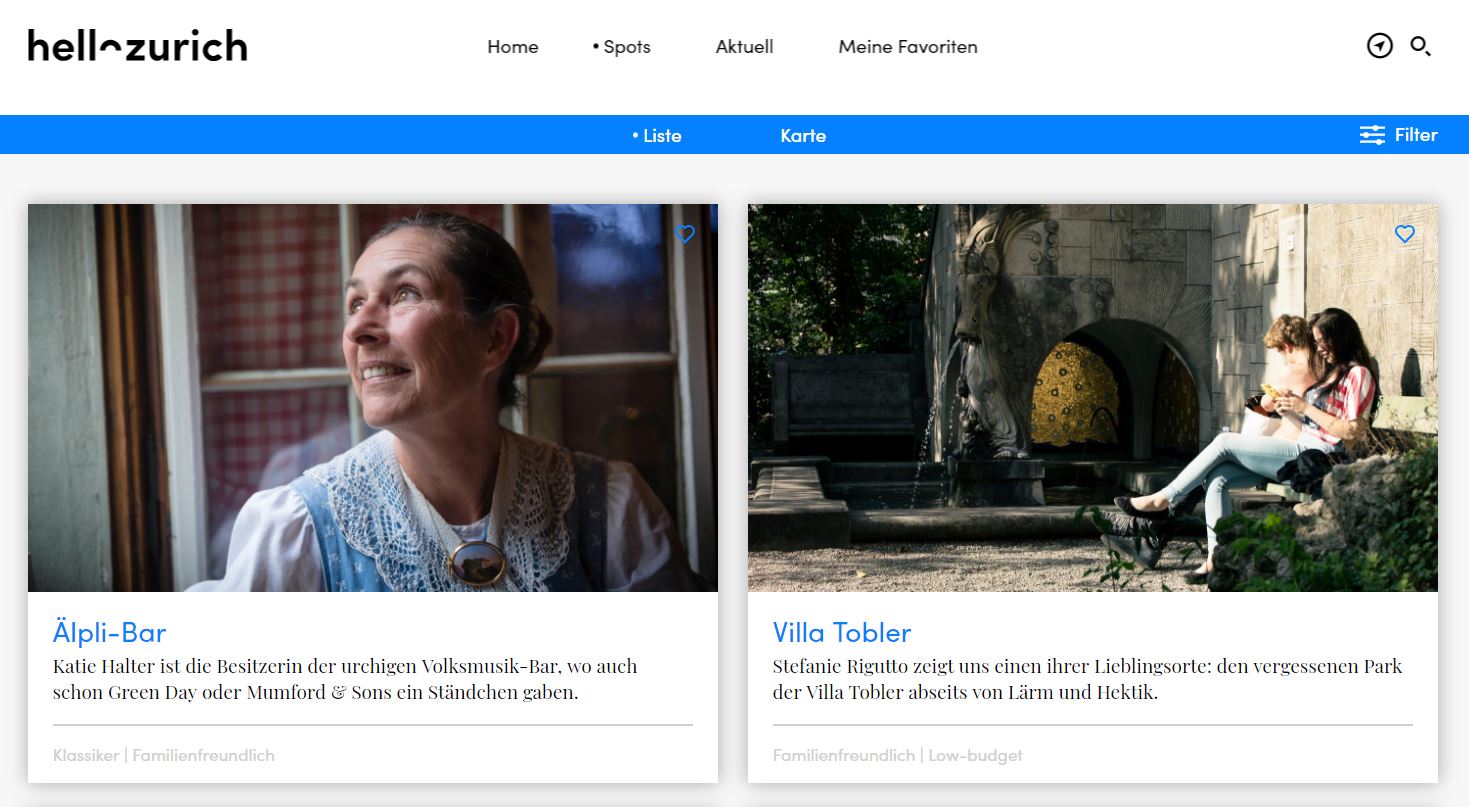
Next, you communicated that Hello Zurich is ad-free.
Yes. Instead of thinking about funding at this early stage, we wanted to get our feet on the ground and improve the magazine further first. Despite our success, we are a small city magazine that first has to prove itself. In the meantime, after a year, we are entering into our first collaborations. We are therefore no longer advertising-free, but still ad-free.
The reason why you have taken the step of no longer appearing completely free of advertising is that the magazine cannot be financed in any other way in the long term?
Yes, of course. But you have to emphasize: We've only been around for a year. We're trying out a lot of things, and not just in terms of financing. What works, we keep. In short, since the launch, no two weeks have been the same.
We are therefore no longer free of advertising, but we are still free of advertisements.
Now, in September, you are launching a new financing model in which members and supporters play a major role. What is your idea behind this model?
Private individuals can now become members of Hello Zurich for five francs a month and benefit from advantages. The same applies to small businesses and SMEs, who pay 50 francs a month. Our goal is to gain 1500 members in two years. That will be difficult. I don't think it will work from a desk. We want to be more present at events and other public places. In this regard, however, our resources are limited. We only have 120 full-time positions available - my colleague Eva Hediger and I each work 60 percent. We do almost everything ourselves: editing, production, photo shoots, social media and marketing. In addition, locations and organizations that we report on now bear half of the production costs on a partnership basis. This corresponds to 400 to 1200 Swiss francs, which can also be paid with vouchers that we raffle among the members. This is already working very well. Even if one can object that our approach is not entirely journalistic.
You say so yourself: This approach is not journalistic. In your opinion, is it still possible to report independently?
We call ourselves independent because we have no pressure from a publisher or shareholders. If we work in partnership with locations and organizations, we indicate this with a banner in the article. In addition, the editors alone are responsible for the selection of topics and the implementation. You can't buy content from us.
And the goal is not to report critically about places?
No, we want to present people and places that shape Zurich. But our next goal is to get an author on board who will report on the city in column style and illuminate it from a different angle.
The website says you want to break even by the end of 2020?
Yes, I am confident that it will work. Also because we keep getting inquiries from big companies that want to be partners. But any partners have to fit in with us. We want to take care of our brand.
Any partners must fit in with us. We want to take care of the brand.
Why is your goal to work not for profit?
We do not want to enrich ourselves. Hello Zurich is a lover's project and we want to make users aware of that. But: It would be a dream if I could pay myself an industry-standard salary in the future.
What do you think about government subsidies?
Basically, we prefer to remain independent and then have no conditions. But of course, we would also consider this option.
"Various contributors, editors and photographers have waived compensation or accommodated us in price since the launch in September 2017," the website says. Do your freelancers receive a salary at all?
Absolutely! We pay industry-standard fees. Some freelancers have come our way because they find Hello Zurich a great project. I'm mainly the one who sacrifices a lot of free time for the magazine. Although we get good feedback, we will have to put in a lot of effort ourselves to make the project self-sustaining. If it doesn't work out, we will be able to publish fewer stories and continue to run Hello Zurich as an enthusiast project. But everything indicates that we will make it. We have already come a long way in just one year.
Interview: Ann-Kathrin Kübler
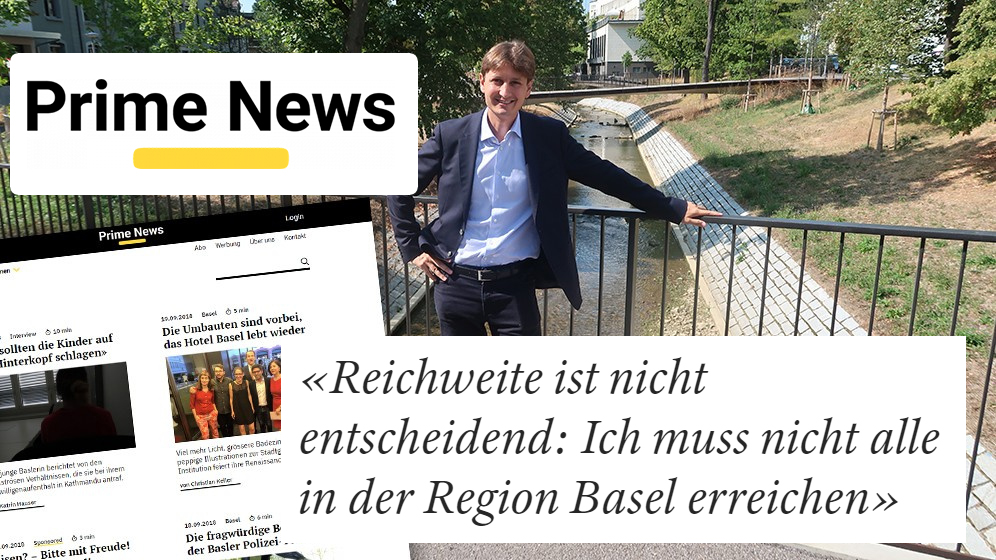

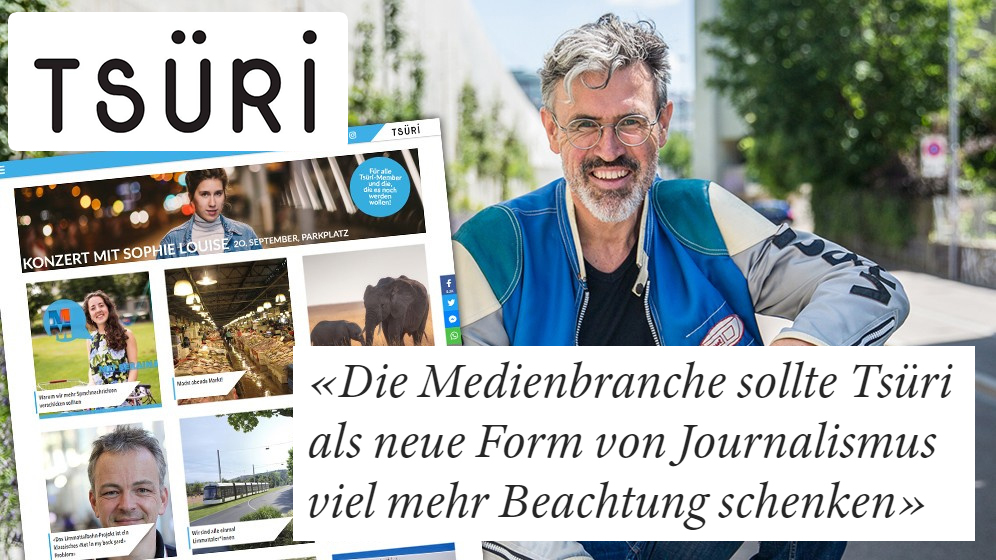

The Zurich city magazine Tsüri was founded in January 2015 by a group of young journalists. The self-declared goal: to provide critical, committed and independent journalism for Zurich residents. Roland Wagner (53) has been Managing Director of Tsüri since June 2018. He brings an outside perspective to the media start-up, having previously worked as an IBM manager, top swimmer and member of the management board of the Swiss Federation of the Deaf.
Werbewoche: Tsüri has recently expanded its team - for example, you yourself are now on board as Managing Director. How does Tsüri manage to do what other media companies that are downsizing or even closing editorial offices often only dream of at the moment?
Roland Wagner: The big difference is that Tsüri is a grassroots movement. Almost four years ago, four colleagues founded Tsüri as a blog with a small starting capital of a few thousand francs. Tsüri is growing slowly from the bottom up. A lot of it is learning by doing. Even when employees leave, they remain connected to Tsüri. This enthusiasm that emanates from the project encourages members to support us - and recently also investors.
Tsüri is growing slowly from the bottom up. A lot of it is learning by doing.
What does Tsüri want to achieve?
Our vision is for Tsüri to merge with the city. Our writing style and content are aimed at 20 to 40-year-olds. It is important to us that we are close to our readers. Anyone who wants to can interact with us. But you can also read Tsüri passively and free of charge.
How do you divide up your work in the new line-up?
It is important to understand that we work separately in two vessels: On the one hand, there is the public limited company. Here, co-founder Simon Jacoby is the strategic director, I am the managing director, the community manager and the co-editor-in-chief are permanently employed. We take care of the further development of the website, the social media channels and the brand as well as the marketing of the content. We are also responsible for the positioning of Tsüri and the member strategy. On the other hand, there is an association that brings together 20 to 30 freelance journalists. The association is now also responsible for sustainable fundraising. The editor-in-chief is the link between the association and the AG.
Why are freelancers organized in an association?
On the one hand, this is historical: The association was there first. However, when it was realized that it was not possible to develop quickly in a grassroots democratic association, the AG was founded. The association was left in place in order to create independence between publishing house management and journalists. The advantage is also that the freelancers work with more enthusiasm than employees because they have more autonomy. The long-term goal is for the editorial team to also belong to the association.
Do you pay the freelancers according to standard industry rates?
We certainly pay at the lower end of the scale. We have the bonus that many journalists are very happy to write for us because Tsüri is a special medium and offers a lot of freedom. However, we still have the difficulty that many move on after a while. We hope that we will be able to keep the team together better as soon as we become more solvent. What is special is that the AG pays the association a monthly sum, which is broken down between the authors according to a rating system. The ratings of the members of Tsüri, the rating of the editor-in-chief and the rating of an association committee each contribute one third. This means that the amount paid out varies depending on the article. However, the differences are not huge, as the total amount is not large.
We certainly pay at the lower end.
Do you cover your costs?
This is the aim of the business plan that was drawn up with the capital increase in spring 2018 and which we are currently reviewing. We made a loss in the first six months of 2018. Our goal is to be in the black in a year and a half with the new team. However, I have the feeling that we will achieve this by the beginning of 2019. It should be noted that we pay ourselves below-average salaries and work on our own laptops. We are living the start-up groove.
What is the main reason why the business plan seems to be working so well?
The project would have worked well financially from the start, but it didn't have enough resources. Two people simply can't be editor-in-chief, sell advertising, develop the platform, look for investors and manage members at the same time. In the meantime, however, each of us has a position with a clear area of responsibility so that we can work professionally. We are not reinventing the wheel, but are now implementing the strategy from the beginning in a professional manner.
I have a feeling that we will be in the black by the beginning of 2019.
What does the Tsüri financing model look like?
This is broadly based: On the one hand, we finance ourselves through membership fees, which cost 60, 120 or 180 francs a year, depending on the benefits. We also receive income from promotional items from companies. They cost 1,500 francs and are clearly marked. We also receive foundation contributions to promote journalism. Last but not least, we place banner ads.
You often hear that you can't earn enough with banner advertising ...
We place user-oriented advertising from music labels, cultural events and publishers - this really suits the target audience and benefits both advertisers and readers.
How difficult is it to attract new members?
Many media have the problem that readers are not willing to pay for online journalism. In our experience, many people are very willing to support young, local and innovative journalism with their contributions. We also give members free entry to Tsüri parties and they receive a curated event newsletter. We currently have 850 members and the number is growing. However, we have only been able to attract a small proportion of our community as paying members - we have 40,000 unique monthly visitors, 25,000 Facebook likes and 12,000 Instagram followers.

Tsüri's latest project, Civic Media, with which you want to strengthen the exchange between the editorial team and the community, is exciting. How did the first round with the topic "Smart Tsüri" go?
Civic Media offers us an additional financial foothold and has gone incredibly well. We are already over budget for the second round with the sponsorship income.
And how was the "Smart Tsüri" theme month received by users?
We have published around 25 articles on the topic of Smart City, which were only moderately read. The topic is much more technical than "The ten best pizzerias in Zurich". But the events that offer a personal exchange have worked extremely well. Workshops with experts were best received. There, people were able to take an in-depth look at the topic of urban development, for example.
What's next for Civic Media?
In November, we are planning a themed month on addiction. We are organizing participatory events that are very accessible. The plan is to set up a theme like this once a quarter. The project should be more than just a media event. We want to stimulate social discussions and help shape sustainable products. In this way, we want to reinvent local journalism.
What do you think - with this success behind it - could be a way for journalism to survive in the future?
Enormous technological changes are currently taking place that are influencing society and journalism. Some media companies have reacted to this in the wrong way. At the moment, it looks like things are going downhill. But I can't imagine that society will do without journalism. I believe in the system's ability to learn. But it's too early to say what the path will look like. With Tsüri, we now have a kind of experimental field: we can tweak things to find a solution on a small scale. The media industry should therefore pay much more attention to Tsüri as a new form of journalism.
Interview: Ann-Kathrin Kübler
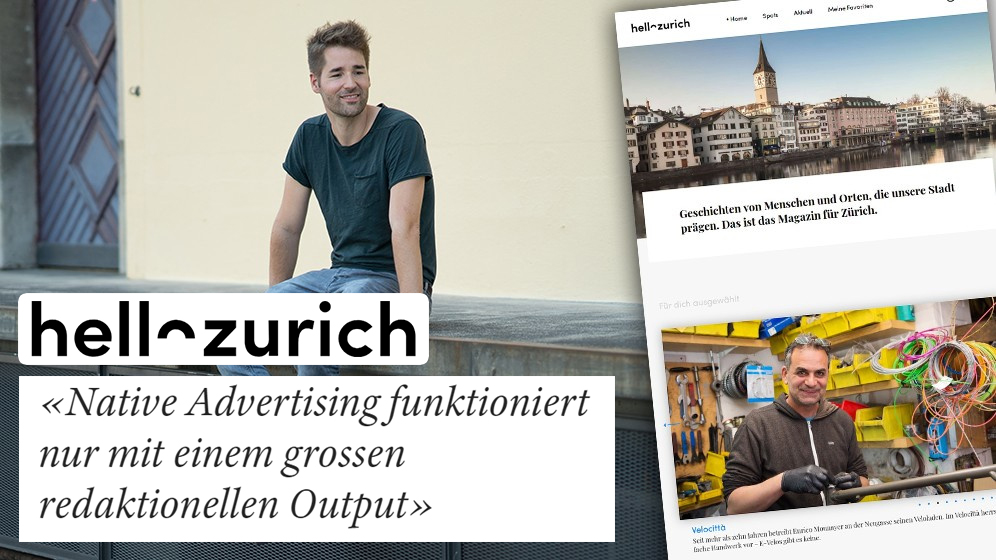

Christian Heeb (65) has founded the Basel-based online magazine Barfi Founded in 2015 - with current information and background stories about the Basel region, the "capital of the world". Barfi is named after Barfüsserplatz in the center of downtown Basel. Heeb himself is a media man with heart and soul. His professional stations led him via SRG (radio and television) early on to Südwestfunk Baden-Baden (Pop Shop/SWF 3). He was the first voice on Radio 24 and manager of its broadcasting studios in Como, before founding Radio Basilisk as an entrepreneur in his own right. After two successful decades, he sold it to Tamedia together with his business partner Ledermann, and after various other investments in the industry, the joint idea of Barfi with media professor Dr. Neumann-Braun (University of Basel) and the great journalistic veteran Hans-Jürg (Fibo) Deutsch.

Werbewoche: Barfi is closed due to empty coffers, but not buried, you communicated on August 18. Only a little later you said that since this announcement you had received possible proposals for solutions. Has anything materialized yet? Is there still hope for the online magazine after all?
Christian Heeb: Currently, to my own surprise, I am actually having serious discussions about whether the survival of our still existing company has a chance.
You can't say anything concrete yet?
No, I first have to discuss the proposals with the administrator in great detail. But this much: If it goes ahead, it will probably be in a completely new direction and without me as a person.
If it continues, it will probably be in a completely new direction and without my person.
When you look back: What went wrong?
We had enormous publishing success, but made big mistakes in acquiring regional advertisers. Clearly my own mistake. I hired two young, very well-educated media scientists. However, the decision-makers at the local SMEs were often overwhelmed by the proposals of these experts. They usually belong to a different generation and terms like unique visitors and page impressions are foreign to them. Instead, I should have relied on tried-and-true salespeople. Those who already have a long-standing relationship of trust with potential customers and convince them with a: "Let's try something". Because once you booked advertising with Barfi, you stuck with it. I trusted far too much in my dreams instead of in the professionals who advised me very early on to do things differently.
I should have relied on tried-and-true vendors.
Three years ago, you didn't have the experience you have now. Which financing model did you start with in mind?
I was spoiled throughout my professional life by being allowed to be in the black with almost all companies from day one. With the exception of my time at SRG and Südwestfunk, where financing was assured in my day anyway, regardless of performance and acceptance. But with Barfi, I simply came too early. The digital revolution had not yet arrived in the local market at that time. I'm convinced that our mix of service, local information, and self-indulgence in our own city will work well throughout Switzerland very soon.
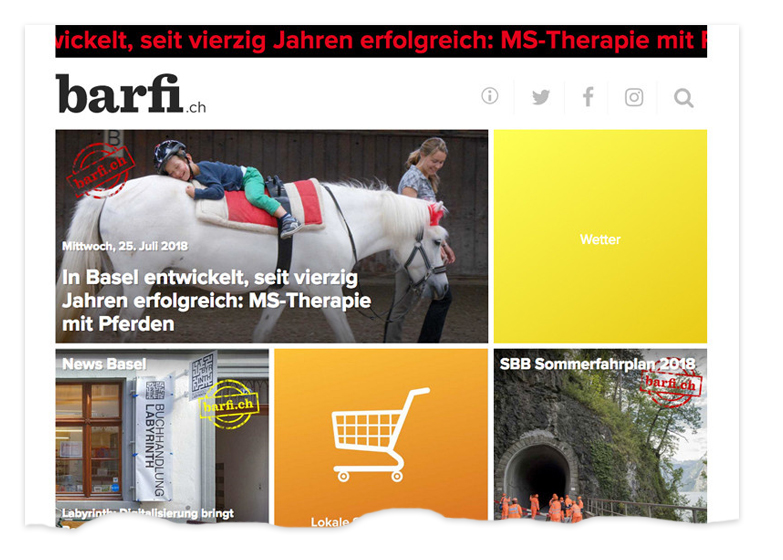
Barfi has already been very well received by readers. In the month of July alone, before the interruption, you reached over 450,000 unique visitors. What was your recipe for success in this respect?
Basel does not have an alpine panorama and lake like Zurich. But life in the Barfi region is incredibly beautiful. For example, a Basel resident can spontaneously decide where to go out to eat in the evening - whether in Switzerland, France or Germany is irrelevant. For us, there are no borders. Basel is the capital of an entire region, and it encompasses various countries and cantons: Switzerland, France, the German Markgräfler Land, and also parts of Solothurn and Aargau - in fact, everything that happens on this side of the Jura. All of them are enviously interested in what is going on around the center of Basel. Playing on this keyboard of togetherness was a key to Barfi's success. At the same time, Basel is Switzerland's cultural capital, boasts the most museums in the country, and is a never-ending source of everyday stories that go unnoticed on the other side of the Jura. But reporting on precisely this with a focus is fun and brought coverage.
What topics did you focus on in your reporting - and did you also deliberately exclude areas?
We excluded all cheap tabloid topics. We did not publish the usual people stories with cultivated celebrities and Cervelat celebrities. We also strictly excluded violent videos that were repeatedly leaked to us - including videos of someone throwing himself in front of a train. What other media sometimes broadcast without inhibition and due respect was absolutely taboo for us. And we fought against any kind of racist tendencies in the social media. Political balance in reporting was also very important to us: In the professional editorial team, all political camps were covered, with the exception of the extreme groups on the left and right. I feel - and I also demanded this of my staff - that I am committed to the ethical and craft principles of journalism. Even if this may no longer be affordable in the future in the way I was able to live it with passion for 40 years and will disappear.
What other media partly bring without inhibitions and due respect, was absolutely taboo with us.
How were you positioned most recently? How many employees were permanently employed, how many worked freelance?
We were 17 part-time employees. In total, that corresponded to nine 100-percent positions. In addition, there were five freelancers and two freelance translators. The team was a family.
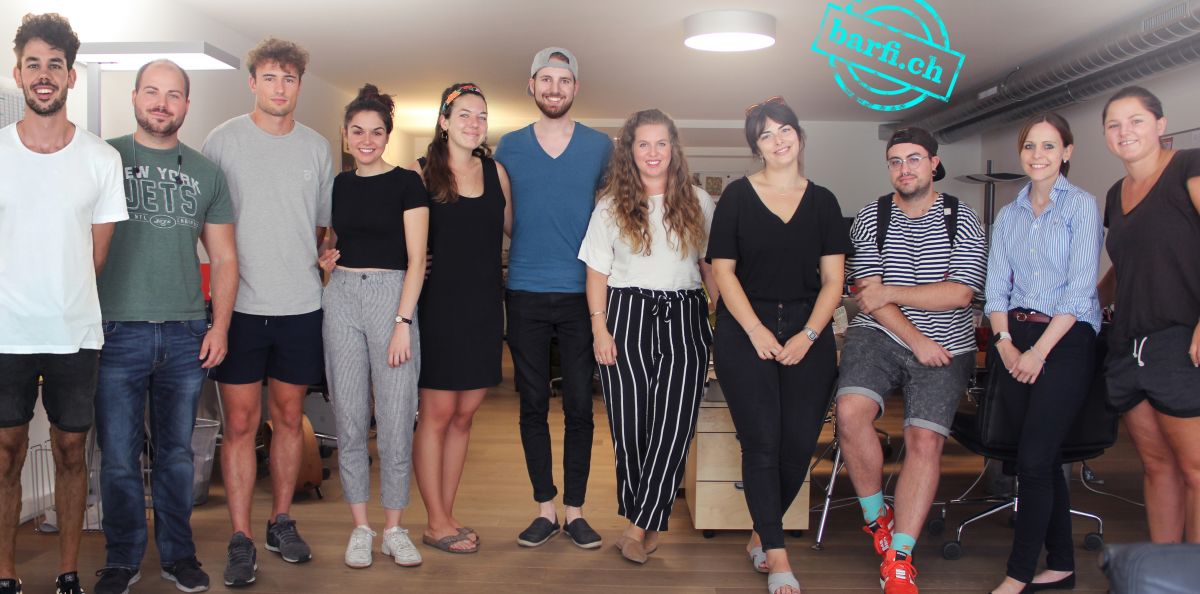
Compared to other city magazines, you were a large team. Looking back, do you think you employed too many permanent staff?
No. Measured against our journalistic output, we had too few employees rather than too many. We also strictly adhered to our cost budget of less than two million francs. But an efficient cost structure is of no use if you also overestimate your revenues to such an extent. My own personal, unforgivable mistake.
Did you pay industry standard wages or start-up wages below average?
We paid the wages customary in the industry, in some cases even significantly higher than competitors. And when we worked with students, my credo has always been: train and don't exploit.
You said that in two to three years, the market could reach the point where online magazines will be able to finance themselves. What would have to change for this to happen?
What I have heard from well-known publishers - also and especially in German-speaking countries - for years is mostly just helpless statements and no clear strategies. Users have been spoiled with free news for more than a decade because of this fact. As a result, the vast majority of two generations are no longer willing to pay for clean journalism. I am indeed an opponent of the paywall. But publishers must finally agree on a uniform system and realize that they cannot stubbornly orient themselves to their own golden age. They're never coming back. If established media companies are making a profit today thanks to the finally daring entry into the digital world, then it is primarily through revenues from real estate or vehicle portals and not with their previous core task of publishing offerings. In terms of state and media policy, this cannot be the solution for our country.
What I hear from well-known publishers are mostly just helpless statements and no clear strategies.
So your outlook for the future of digital media is rather black after all?
No, I am convinced that basic financing through advertising online will be very possible in the future. First of all, the massive costs for paper, printing and distribution will be eliminated. But it would finally have to be accepted that the same prices are not paid for advertising on mobile devices as used to be paid for double glossy pages. Those who stop simply "printing" their print offerings as e-paper on screens instead of paper have great opportunities. Barfi has proven the need with almost half a million visitors in a single region.
How do you rate the chances for the new Basel-based online magazine Prime News?
As far as I know, Prime News employs only one permanent employee and works with freelance journalists. A completely different concept than Barfi, not comparable in terms of output volume and topic setting. But of course I wish Christian Keller success and keep my fingers crossed.
What happens now for the Barfi team and for you personally?
The company is not bankrupt. Now we are in the middle of the talks mentioned at the beginning, whether it can be integrated into another company or find a partner. It's a pity that we only received this national attention because of our temporary failure. But whatever the outcome, I myself will not stop working as a journalist and publicist - the new challenges are far too exciting for that.
Interview: Ann-Kathrin Kübler

August saw the launch of the new Basel online medium Prime News to the start (Werbewoche.ch reported). Chief Christian Keller focuses on local stories and a simple payment model. The local boss left the Basel Newspaper after the Announcement of the sale to Tamedia in April. The 35-year-old focuses on local stories from the Basel region. Anyone who wants to read an article comes across the Smartwall, developed by the Lausanne-based company Swisspay: You have the choice of paying a single price, taking out an annual subscription or watching a 15-second commercial. Keller's goal is to operate profitably in the long term. Werbewoche has taken a closer look at the Prime News-We talked to the founder about his business model, his motives and his future prospects.

Advertising week: You have the Basel Newspaper after the announcement of its sale to Tamedia. What were your motives?
Christian Keller: The decision to build something of our own was made much earlier. We only learned from the newspaper in April that the Basler Zeitung was to be sold. As early as August Prime News started. It would not have been possible for me to get the portal up and running in such a short time without preliminary work.
So in addition to being employed by Basel Newspaper with Prime News started?
Yes, I have been turning the idea over in my head for a long time. After all, I've seen the media crisis at the Basel Newspaper get the message. You do a good job, get positive feedback from readers. And yet, every year the newspaper has fewer subscribers and less and less advertising revenue. You have to cut the budget. Cut back. It's a hassle. You start to doubt whether the business model can work in the future. I'm only 35 years old, and I wondered what was next for me as a journalist. My goal was always to be self-employed, and now the moment has come to try it out - with a business model that I'm convinced of and hope will work.
My goal was always to be independent
You are working with a smartwall. Many media have abolished paywalls or not even tried them. One argument that is often put forward is that readers are not willing to pay on the Internet. With you, it's true that articles can be unlocked with advertising shows instead of money. Nevertheless, why are you convinced that what established media fail to do will work for you?
On the one hand, readers have the advantage with us that they do not have to register. If they want to read a single article, they can either watch a promotional video or pay an amount of 1.50 francs. Click twice and bang, the article is available to them. On the other hand, I am not convinced by the inflationary use of advertising banners and videos. They light up everywhere unwanted and disturb the readers. We turn that around: With us, a reader deliberately clicks on the "Play commercial" function. Through a logo of the advertiser, he already knows who is advertising. We can therefore argue to advertisers: Your content is consumed voluntarily.
Is it easy for you to get to these advertisers?
The feedback from the media agencies has been very good so far. We have been able to make our first sales. That makes me feel very positive, because the concept is obviously well received. Nevertheless, we first have to convince many advertising customers.
You do this persuasion work?
No, my brother does that. I'm a journalist and a bad salesman. You charge 1.50 francs for a single article. How much do you earn with a commercial if it is clicked on? If the reader cancels, nothing. But if he watches the spot for 15 seconds, the article is released and we get 50 centimes.
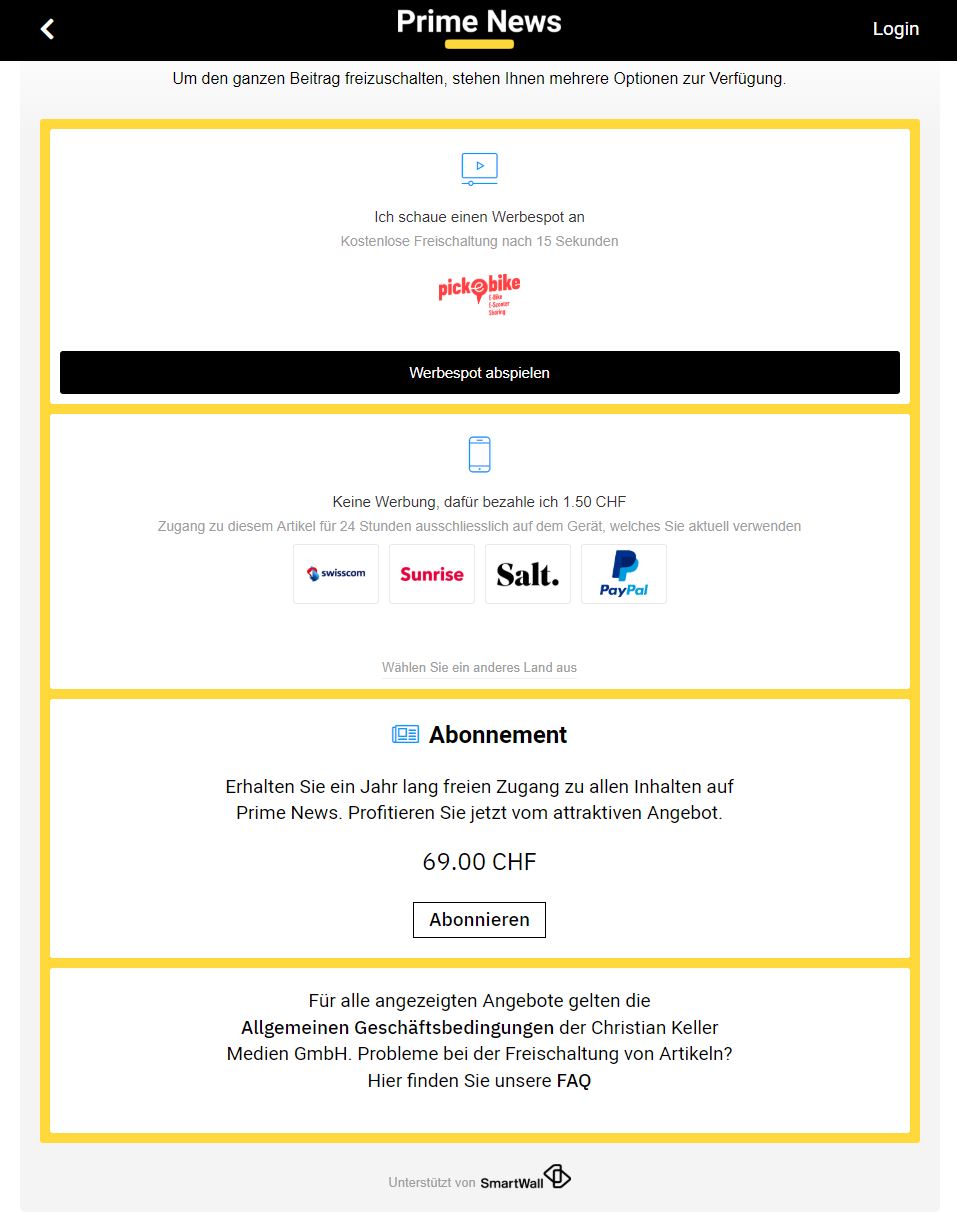
1.50 francs per article that is only activated for 24 hours seems quite a lot to me personally in comparison and to the price of print editions. How do you come up with that amount?
The experience of smartwall provider Swisspay is that it doesn't matter much whether you charge one or two francs. The decisive factor is rather that someone is specifically looking for an article and is keen to read it. If you set the price too low for individual articles, the subscription is no longer attractive. But the price is not set in stone. We're also still considering whether to make certain articles available only to subscribers. That's great about the Smartwall: We can test out what works and gain experience. For example, we could offer articles for 30 centimes for one week. Then, of course, we would have to sell five times as many articles. Would that work then?
The start-up phase is certainly exciting to follow. What do the first figures show?
In the first few days, readers often cancelled when starting an advertising video. We think this means that people are not yet familiar with the system. After all, the Smartwall is not yet available in German-speaking Switzerland. However, this observation changed a few days later: In the meantime, those who start an advertising video let it run for at least 15 seconds in over 90 percent of cases. I interpret this as a gradual build-up of a growing number of regular readers who access our latest articles daily via the video function.
What is the ratio between those who watch the ads, pay once and subscribe?
Our aim is to appeal to adults aged 28 and over who are interested in the region. For some of them, that's worth taking out a subscription for 69 francs a year. But a large proportion are used to receiving content free of charge - as is the case with the BZ Basellandschaftliche Zeitung and the Basel Newspaper. This part of the visitors is more likely to click on the promotional video.
A large proportion are used to receiving content for free - as with the BZ Basellandschaftliche Zeitung and the Basler Zeitung.
What do you think of the free culture that has been mentioned?
I am a big opponent of it. I am convinced that the free culture is destroying journalism. With banner advertising, you earn less every year, it's an inflationary business. Readers expect all articles to always be objectively and seriously researched, without errors. But they don't want to pay. That doesn't add up.
Prime News focuses on the local. It's hard to score points with reach. How do you plan to generate enough revenue in the long term?
With the Smartwall, we have a much higher thousand-contact price that we can charge advertisers. This is because we have a local reference and the advertising is viewed voluntarily. In addition, we have a lean setup; we don't have a budget in the millions.
I find it exciting that you reject government subsidies. Why would you not accept financial support?
In the online sector, where you have so many opportunities as a small number like me? You might need one or two colleagues who have an IT company and are willing to help you. But if you have so little confidence in your own product that you have to ask the government for help, yes, you're lost. With subsidies, you are implementing something into the market that will survive with tax dollars, but may be the wrong thing. Others who offer the right thing then no longer have a chance. That cannot be in the interest of the taxpayer.
If you have so little confidence in your own product that you have to ask the government for help, you're doomed.
Prime News has a lean setup. Only you and your brother are permanent employees. Do you have a plan if and when more permanent employees will join?
You can start tomorrow if you want. We just won't pay you a salary (laughs). After all, we're just getting started now. Many people say that's an incredibly bold step. I think so: Writing about the drug mafia in Colombia would be brave. We're trying something out. If it goes well and we gain subscribers and advertisers, we will hopefully soon be able to hire staff. But maybe there will be two of us. We'll see.
So you don't have a five-year plan in mind yet?
You can make big plans, but in the end reality will catch up with you. What we certainly don't do: Hiring people on the basis of fantasy figures only to go broke after a month.
How many freelancers do you currently work with? How much comes from the freelancers, how much from yourself?
We work with about ten freelancers. They write much more than they should because they are enthusiastic about it. I write three or four articles a week.
But the freelancers are paid?
Right. According to the usual approaches.
Are there any topics that you would like to Prime News consciously exclude?
We do without news reports that cover everyone else. We don't need to attend press conferences that are already attended by 50 journalists. Our unique selling point is stories, with which we offer a valuable supplement.
We don't have to attend press conferences that are already attended by 50 journalists.
What are your thematic focuses?
It's about politics, about contributions critical of the state and grievances. We report when citizens are harassed. But we also feature success stories about people who have achieved something. And we write touching stories, for example about animal welfare officers. We want to be surprising and versatile - with topics from the Basel region.
The online portal Barfi has just had to cease operations. What do you want to do better than Barfi?
Barfi has managed to reach people. That is an achievement. The tragedy of it is that it's not enough. And that's exactly what I mean. For me, reach is not decisive: I don't have to reach everyone in the Basel region. If we have a certain core audience of subscribers and people who regularly watch our content via advertising, then we will survive. Barfi would have needed an insane amount of clicks per employee to survive - you can never do that with just banner ads.
Interview: Ann-Kathrin Kübler