
Gen Z and Millennials in Switzerland Are Changing Their Life Plans
Finding housing you can actually afford—for Gen Z and Millennials in Switzerland, this is no longer a given. The 15th edition of Deloitte’s annual Generations Study, which surveyed 22,595 people from 44 countries worldwide—including 400 from Switzerland—shows that financial worries have a greater impact on young people’s life and career planning here than elsewhere.
According to the study, 78 percent of Swiss Gen Z and 67 percent of Millennials say that the availability and affordability of housing strongly influence their career decisions as well as their choice of where to work and live—significantly higher than the global average. Fifty-four percent of Gen Z and 53 percent of Millennials say they cannot afford to buy a home. This figure is also higher than the international average (51 percent of Gen Z, 40 percent of Millennials).
Nearly half of those surveyed say they live paycheck to paycheck—a figure that is slightly above the global average. Just under a third of Gen Z (31 percent) and a little over two-fifths of Millennials (41 percent) feel financially insecure.
Life Decisions Put on Hold
According to the study, 46 percent of Gen Z and 60 percent of millennials in Switzerland have postponed major life decisions—such as marriage, starting a family, or pursuing an education—due to their financial situation. This shows just how far-reaching the effects of the tight housing market are.
Michael Grampp, chief economist at Deloitte Switzerland, interprets this as a social signal: «Switzerland is an attractive business location with high wages. But even young people with a good education and a stable job are finding it increasingly difficult to afford their own home. This is not just a personal problem; it’s also a warning sign for the business environment: If we want to attract and retain talent, policymakers must take targeted action to address the strained situation in the Swiss real estate market.»
Work-Life Balance Trumps Career Ambitions
Despite financial pressures, career advancement is not a top priority for Gen Z and Millennials in Switzerland. Twenty-three percent of Gen Z and 20 percent of Millennials cite «maintaining a good work-life balance» as their primary goal—even ahead of career advancement. Nearly one-fifth of respondents in each group do not work full-time or in a permanent position.
Compared to the rest of the world, the career ambitions of young people here are significantly lower: Only 33 percent of Swiss Gen Z and 26 percent of Millennials strive for «steady career advancement»—compared to 44 percent and 45 percent globally, respectively. Forty-eight percent of Gen Z and 57 percent of Millennials would accept a leadership role—but only if the compensation is right. Flexible work arrangements, mental health support, and leadership training and coaching are also key factors for them when it comes to promotion.
Tiina Pokkinen, Human Capital Partner at Deloitte Switzerland, says: «Focusing solely on »title and salary’ is no longer enough to retain talent these days. Employers must offer purpose, flexibility, and effective support.”
Mental Health: Openness Is on the Rise
A positive trend is emerging in mental health in the workplace: 78 percent of Gen Z and 70 percent of Millennials believe their employers take mental health seriously—a significant increase compared to 2024 (59 percent of Gen Z, 58 percent of Millennials). The willingness to speak openly with supervisors about mental stress has also increased: 75 percent of Gen Z and 70 percent of Millennials feel comfortable bringing up the topic.
AI as a Tool, Not a Threat
Another key topic of the study is the use of artificial intelligence. The outlook among Gen Z and Millennials in Switzerland is overwhelmingly positive: 81 percent of Gen Z and 77 percent of Millennials view AI as having a positive impact on their work lives; and when it comes to their personal lives, this holds true for 87 percent of Gen Z and 80 percent of Millennials—in each case, well above the global average. 73 percent of Gen Z and 67 percent of Millennials already use AI in their daily work.
Michael Grampp comments: «When it comes to artificial intelligence, concerns about job losses often dominate. However, our study shows that for these generations, AI is not simply a threat to their jobs, but a tool. They see it as an opportunity to automate repetitive tasks and focus on meaningful work.»
The full study is available at: https://www.deloitte.com/ch/de/about/press-room/gen-z-millennial-survey.html
]]>
At a gala event held at The Hall in Zurich, Deloitte presented three unlisted Swiss companies with the Best Managed Companies Award 2026 Awarded. G. Bopp + Co., Habasit International, and Stallergenes Greer impressed an independent jury with their high level of agility, great resilience, and strong sense of innovation. The award is presented annually by Deloitte—with support from the private bank EFG International, the SIX Swiss Exchange, the Zurich Chamber of Commerce, and the marketing agency WillisHenry.
A Challenging Environment as a Test of Character
Geopolitical challenges, unstable supply chains, and uncertainty surrounding trade tariffs are shaping the current business environment. The three award-winning companies have not only held their own in this highly demanding context but have also continued to grow successfully. Andreas Bodenmann, program manager and head of Deloitte Private, notes: «The award-winning companies have achieved extraordinary results. In a highly volatile and challenging environment, their management teams have impressively demonstrated that they lead and develop their companies in an exemplary manner, thereby strengthening their competitiveness.»
The award is preceded by an intensive, multi-stage evaluation process. Performance is assessed in four key areas: strategy, productivity and innovation, culture and commitment, and governance and finance.
The three new recipients of the Best Managed Companies Award
G. Bopp + Co., headquartered in Zurich, is considered one of the world’s leading manufacturers of precision wire mesh. Since its founding in 1881, the company has evolved from a supplier of coarse wire mesh to a manufacturer of high-tech, ultra-fine mesh. Today, its products are essential components of complex processes in a wide range of applications—«Made in Switzerland.».
Habasit International, headquartered in Reinach, is a leading global supplier of conveyor and drive belts. With a strong focus on quality, reliability, and close collaboration with its customers, the company—founded in 1946—provides products and services that keep industry running. This year, Habasit International is celebrating its 80th anniversary.
Stallergenes Greer International, headquartered in Baar, is a leading global biopharmaceutical company specializing in allergen immunotherapy for human and veterinary medicine. The company’s services span the entire value chain, from product development and marketing to allergy diagnostics and treatment.
16 Requalifier – Gold Standard Confirmed Time and Again
In addition to the three first-time recipients, 16 companies once again qualified for the Best Managed Companies Award this year. Particularly noteworthy are those companies that have qualified for more than three consecutive years and have thus received the program’s Gold Standard: Groupe Acrotec, ATP adhesive systems, Capri Sun Group, ECSA Group, Läderach Switzerland, Teoxane Laboratories, Variosystems, Vista Group, and Wipf Group. Also receiving the gold standard are dss+ Consulting, Killer Interior, Ospelt Group, Revizto, Sowind Group, Swixx BioPharma, and Mantu.
The awards ceremony took place in front of approximately 250 business representatives. Franco Polloni, Head of the Switzerland and Italy Region at the private bank EFG International, paid tribute to the award recipients: «Entrepreneurship, innovation, and long-term thinking are of crucial importance. The Best Managed Companies program recognizes companies that stand out not only for their performance but also for their leadership, resilience, and a clear vision for the future.»
A jury composed of representatives from the business and academic communities
An independent jury consisted of Jens Breu, CEO of the SFS Group; Dr. Katharina Gasser, General Manager at Roche Pharma Switzerland; Carl Illi, owner, Chairman of the Board, and CEO of CWC Textil; Franco Polloni, Head of the Switzerland and Italy Region at the private bank EFG International; Prof. Dr. Thomas Straub, Professor of International Management at the University of Geneva; and Tanja Vainio, member of the Board of Directors of the Franke Group.
The Best Managed Companies Award is a program that recognizes privately held, unlisted companies for their organizational success. Launched in 1993 and conducted in approximately 50 countries, the program has become the most prestigious business award of its kind. Participating companies are evaluated by Deloitte using globally recognized benchmarks and receive an independent assessment of their governance practices and overall performance in comparison to a global community of more than 1,400 exemplary companies.
]]>

Swiss retail banks are lagging behind when it comes to digitalization. The gap has continued to widen in recent years, as the latest Digital Banking Maturity Study by Deloitte shows. While Switzerland still made it into the top 5 in a global comparison in the first study in 2018, it was only in 27th place in 2024. Four years ago, Switzerland was only in 18th place, and last year it was in 21st place. This shows that Swiss retail banks are losing ground in the global digital ranking over the years, writes the consulting firm.
According to the study, Swiss banks have a digital maturity level of 39 points. This puts them below the global average of 41 points, as well as far behind the digital pioneers (60+ points), among which no Swiss bank ranks.

You can wait for a quick account opening in this country
Deloitte noted an improvement in digital account opening: all but one of the 12 Swiss banks surveyed now offer this service. Nevertheless, people in this country still often have to expect waiting times of hours or even days, whereas international digital banks offer account openings with AI-supported real-time checks within seconds. "Swiss banks have made small advances in digital account openings, but compared to foreign banks, the process is still comparatively complicated and slow," says Cyrill Kiefer, Banking Consulting Lead at Deloitte Switzerland.
Global standards that Swiss banks neglect
Abroad, the smartphone is also establishing itself as the primary access channel for banking transactions. In Switzerland, however, only a third of banks support this, according to Deloitte. The differences are even more drastic when it comes to intelligent voice functions: Only a few Swiss banks use AI-supported algorithms based on usage behavior, according to the statement. In addition, Swiss mobile banking apps often lack basic functions that promote interaction and customer loyalty - for example, customers of Swiss banks often have to manage their spending manually or switch to external apps.
Furthermore, digital pioneers in the ranking are two and a half times more likely to provide value-added services such as public transport tickets, streaming subscriptions and financial management tools, while Swiss banks rarely offer such services. Retail banks in Switzerland are also unable to keep pace with the automation of administrative tasks, according to the press release. This has long been standard in many global markets.
Regulations and a conservative strategy are slowing down the digitalization of Swiss banks. However, a clear mobile-first strategy is also often lacking: Swiss banking apps often remain merely e-banking extensions, while leading digital banks use apps as a central interface. The digitalization gap could have consequences, Deloitte states in the study. On the one hand, customer loyalty is at risk, while on the other, an important source of revenue for banks remains untapped. According to the study, Swiss banks are missing out on some growth potential compared to other countries. (Dylan Windhaber/rja)
In the Study has Deloitte analyzed 349 banks in 44 countries worldwide with regard to their digital maturity. The study included 12 Swiss retail banks, which together cover over 80 percent of the market.
]]>
The majority of people now use generative artificial intelligence (AI) to simplify tasks. However, companies need more time to integrate the technology into their processes. The latest edition of Deloitte's AI study shows that the introduction is taking longer than initially expected. The euphoria expressed in earlier surveys has given way to a "healthy realism", as Deloitte writes.
In an international comparison, Swiss companies are particularly cautious in their assessment of developments. Half of the management board members surveyed expect that fundamental changes in their industry as a result of generative AI will take between one and three years. Just under a third (30%) even expect it to take more than three years. Only 8 percent assume that generative AI has already transformed the market environment. In the USA, on the other hand, 22% are of this opinion.

Switzerland brings up the rear
US companies are also pushing ahead with AI integration faster than Swiss companies: Almost half (45%) have already prepared their technical infrastructure well or very well for the introduction. In Switzerland, this is only the case for just under a third (32%). European companies are even further ahead. They are clearly ahead of the USA and Switzerland when it comes to preparing their strategy, developing employees' skills and managing data.
"Swiss companies are still reluctant to introduce generative AI. We also observe this in our work with customers. However, we are already seeing a promising use of generative AI in IT and marketing," says Marc Beierschoder, Head of AI & Data at Deloitte Switzerland. As the survey highlights, projects in the areas of IT and cyber security as well as marketing, sales and customer service are the most advanced. In contrast, most companies are only in the evaluation phase when it comes to AI tools for the legal department or HR and finance.
Low investment and little expertise
The survey provides a number of explanations for why Switzerland is lagging behind other countries. Firstly, Swiss companies invest relatively little in generative AI: half of those surveyed do not even allocate 20 percent of their total AI budget to the technology. Investments are significantly higher in the USA and Europe. Secondly, Swiss companies lack specialist knowledge. Almost a quarter (24%) of companies admit that they have little expertise in dealing with the technology. In Europe, this is only the case for 13 percent and in the USA for 7 percent.
Management interest in generative AI in Switzerland is also rather low. The majority of respondents agree that the topic needs to be given more attention internally.
Pressure on Swiss companies is growing
The lack of skills and specialists is therefore also one of the three biggest hurdles for Swiss companies when integrating technology, alongside managing risks and the complex legal requirements. In an international comparison, it is also noticeable that Swiss companies observe stronger cultural resistance among employees.

"In order to make broad use of the technology's huge potential, we need to overcome internal resistance and invest more. Time is of the essence, as the pressure on companies is increasing," Beierschoder notes. Compared to the survey a year ago, almost twice as many Swiss companies feel a strong need for action internally when it comes to the introduction of generative AI tools: while only 18% did so in the previous year, this figure has now risen to 34%.
The pressure from external sources, such as competitors or shareholders, is even higher. Within a year, this figure has risen significantly - from 18% to 46%.
The Study "State of Generative AI in the Enterprise" used quarterly surveys to investigate the status of the use of generative AI in companies. In the fourth wave of the survey, which was conducted between July and September 2024, Deloitte interviewed 2,773 AI-experienced management board members in 14 countries, including 50 from companies in Switzerland.
]]>
The award is presented to the best privately held companies in Switzerland that stand out for their outstanding management and sustainable business growth. The Swiss awards are derived from Deloitte's global "Best Managed Companies Award" program. It assesses companies based on factors such as strategy, productivity and innovation, culture and commitment as well as governance and finance.
Dynamic approach to innovation
Key achievements at Capri-Sun include its dynamic approach to product innovation, such as the introduction of new sugar-free product lines to meet changing consumer preferences. In addition, Capri-Sun has demonstrated robust operational efficiency and resilience, achieving consistent growth and profitability despite global market challenges.
Recently, the foil pouch for which the drink is known was replaced by recyclable mono-material packaging. According to Capri-Sun, it has a significantly lower CO2 footprint than any other beverage packaging.
]]>
The topic of sustainability is on people's minds in Switzerland and is a constant topic of public debate. The promotion of sustainable development requires the commitment of various stakeholders such as consumers, companies, the state, the media, non-profit organizations and NGOs. Deloitte asked 1,900 people living in Switzerland who should play a more active role in shaping a more sustainable Switzerland and what specific measures they would prefer.
For two-thirds of respondents (66%), companies are the first and foremost duty bearer for a more sustainable Switzerland. 61% cite the state and 53% see themselves as responsible as consumers. In French-speaking Switzerland, the figures for companies and the state are above average at 72% each, which expresses a higher expectation of these two groups in French-speaking Switzerland. The group of consumers is mentioned almost equally frequently by respondents in both parts of the country. There were no differences according to age or gender.

"Our survey clearly shows that people are hoping for additional commitment from companies and the state. At the same time, however, they also see themselves - i.e. consumers - as having a duty to exert their influence on more sustainable business practices," says Liza Engel, Chief Sustainability Officer at Deloitte Switzerland. "This leads to a classic dilemma, where consumers are waiting for companies and governments to act, while companies and governments are waiting for consumer demand to drive change."
Company: No clear preference
What exactly the companies should do, however, seems less clear when looking at the survey results. None of the measures surveyed are clearly at the top of the list. Most respondents think that companies should use more environmentally friendly materials (57%), emit less CO2 (51%) and offer more sustainable products or services (51%). They also want companies to pay more attention to their supply chains (48%) and consume less energy (47%).
"Some companies still view potential investments in more sustainable production purely from a cost perspective and point to current consumer behavior and any necessary regulations. However, many companies - especially in Switzerland, a high-price country - have seen consistent investment in sustainability as an opportunity for differentiation and, above all, innovation," says Marcel Meyer, Head of Sustainability Services at Deloitte Switzerland.
State: Positive incentives preferred
When it comes to government measures to promote sustainability in Switzerland, there are clearer ideas. 53% of respondents support subsidies for environmentally friendly and sustainable behavior, such as a tax deduction for commuting by bike or subsidizing vegan food. Subsidies are particularly popular in French-speaking Switzerland, where 63% of respondents agree.
There is also significant interest in investment in research and development (46%) and in education and awareness-raising (42%) for sustainable behavior through campaigns or in school lessons. Additional regulations such as stricter standards and norms (29%) for companies and consumers and the taxation of less sustainable products (27%) are less popular.
Marcel Meyer emphasizes: "People in Switzerland prefer incentives to paternalism. They want to reward sustainable behavior with positive incentives and thus send clear signals. The state has the opportunity - particularly through education - to specifically promote an understanding of the importance of sustainable action."
Consumers: Far from sustainable
Consumers in Switzerland are well aware of their crucial role in promoting sustainability. However, many are reluctant to take action themselves, especially if there are no clear initiatives from companies or no government incentives. Around three quarters (74%) plan to change their behavior in the next twelve months - especially people under 35 (89%) and people from urban areas (83%). In the area of nutrition, 57% would like to become more sustainable, for example by reducing meat consumption or buying local products.
Just over half of respondents (51%) plan to adopt more sustainable consumption behavior by using fewer goods and services. Just under half (48%) stated that energy and water-saving measures could be taken in the home.
"Each and every individual prioritizes their own needs today. The challenge for us is to recognize and take into account the demands of future generations. This makes it necessary to look beyond the current horizon. We must understand long-term growth and the regeneration of our natural resources as key elements of sustainable development," explains Engel.
]]>
According to the study, those affected are not necessarily reducing essential expenditure. They make savings where they have the costs under control, explained the consulting firm Deloitte on Tuesday.
According to the survey, a good half (52%) of respondents have eaten out less in the last 12 months and visited bars or clubs less often. And 40 percent each had saved money on clothing, vacations, travel and leisure activities. More than a third (34%) had cut back on food.
All in all, 57 percent of those surveyed would have reduced their spending on non-essential items.

Hardly any cutbacks in education
The proportion of inflation-influenced savers is lower in the areas of education (10 percent), public transport (14 percent) and telecommunications (16 percent). According to Deloitte, this suggests that these areas obviously enjoy a higher priority.
Another strategy to cope better with inflation is to shop more cheaply. According to the survey, special offers and promotions have become more important for more than half (51%). Many also deliberately bought cheaper products (44%) or switched to cheaper suppliers (37%).
However, only a small minority of people are opting for second-hand goods, making things themselves or simply borrowing them in response to inflation. There does not appear to be a fundamental change in consumer behavior, says Deloitte.

Western Switzerland suffers more
In the survey, 27% of respondents across Switzerland stated that inflation had been a major burden for them in the last 12 months. A further 38% felt that rising prices were a medium burden.
Western Switzerland seems to be particularly hard hit, with 33% of respondents saying that inflation is a high burden and 40% saying it is a medium burden. Across Switzerland as a whole, almost two thirds (65%) perceive inflation as a burden, with this figure rising to almost three quarters (73%) in French-speaking Switzerland.
Costs that cannot be influenced
But rising housing rents and health insurance premiums are also a cause for concern. However, these are politically influenced prices - it is more difficult to make savings on your own initiative.
The survey shows that public opinion is roughly split in half on this issue. One part of the population is in favor of long-term, sustainable solutions, while another part prefers measures that are effective in the short term. "This division is evidence of the complexity of these issues," concludes the consultancy firm.
In Switzerland, prices are currently six percent higher on average than at the beginning of 2021. "Pulse of Switzerland" survey by Deloitte surveyed 1900 people living in Switzerland last November. (SDA)
]]>
The Swiss watch industry is setting new records in exports and is undergoing a transformation. After an impressive result in 2022, when watch exports reached a new record of almost CHF 25 billion, the strong growth trend continued in the first eight months of this year. Core regions such as the US and China recorded healthy growth. Despite the rise in e-commerce, 62 percent of brands expect in-store sales to dominate over the next five years and plan to expand their retail activities.
This is clear from the Deloitte study 2023 on the Swiss watch industry which includes insights from industry experts and consumer surveys in key markets. The study also shows that watch industry executives see India as a market with incredible potential in the coming years. In the first eight months of the current year, India saw above-average sales growth of 18 percent. Deloitte expects India to be among the top ten Swiss export markets within a decade.
]]> The Metaverse arouses the interest of most Chief Marketing Officers (CMOs) surveyed - and this despite the fact that around one fifth of them say they do not fully understand it. The Metaverse is a network of interoperable virtual worlds where users can work, play, meet or shop using virtual or augmented reality technologies.
Metaverse begins without Switzerland
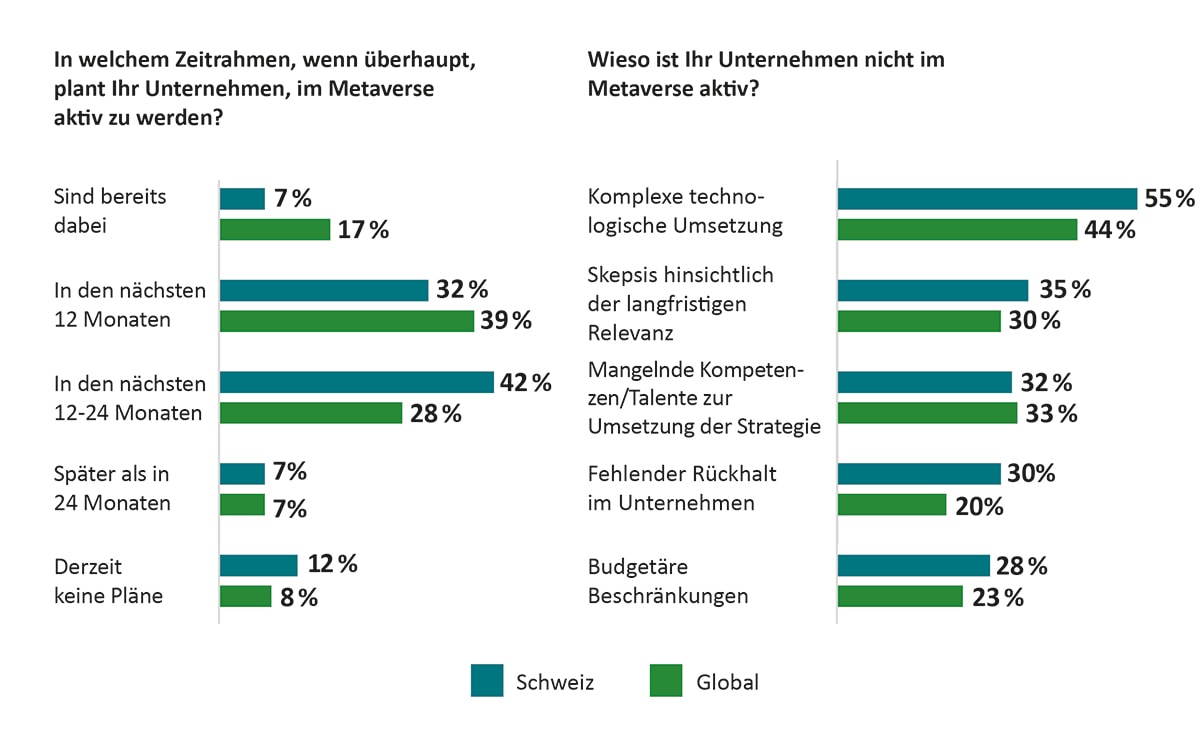
In Switzerland, however, this interest is less pronounced. Only 7 percent of Swiss respondents say their company is already active in the metaverse - compared to 17 percent globally. Swiss CMOs are more likely to observe the metaverse than to become active: While their international colleagues are either already active in the metaverse or plan to do so within the next 12 months, nearly half (42%) of the Swiss marketing executives surveyed will only do so within the next 12 to 24 months, and 12 percent have not yet engaged with it at all.
Swiss CMOs cite the complexity of technology implementation (55%) as the main reason for their non-participation in the Metaverse, followed by skepticism about long-term relevance (35%) and insufficient talent to implement such a strategy (32%). "Swiss companies are not doing themselves any favors with their wait-and-see attitude toward new Web 3.0 technologies and the metaverse," Roger Lay, head of marketing, commerce and design at Deloitte Switzerland, is convinced. "It's not yet clear, for example, how significant the metaverse will be for individual companies and industries in five or ten years. But if marketers don't take their first steps very soon, they will miss the trend."
Sustainability has come to stay
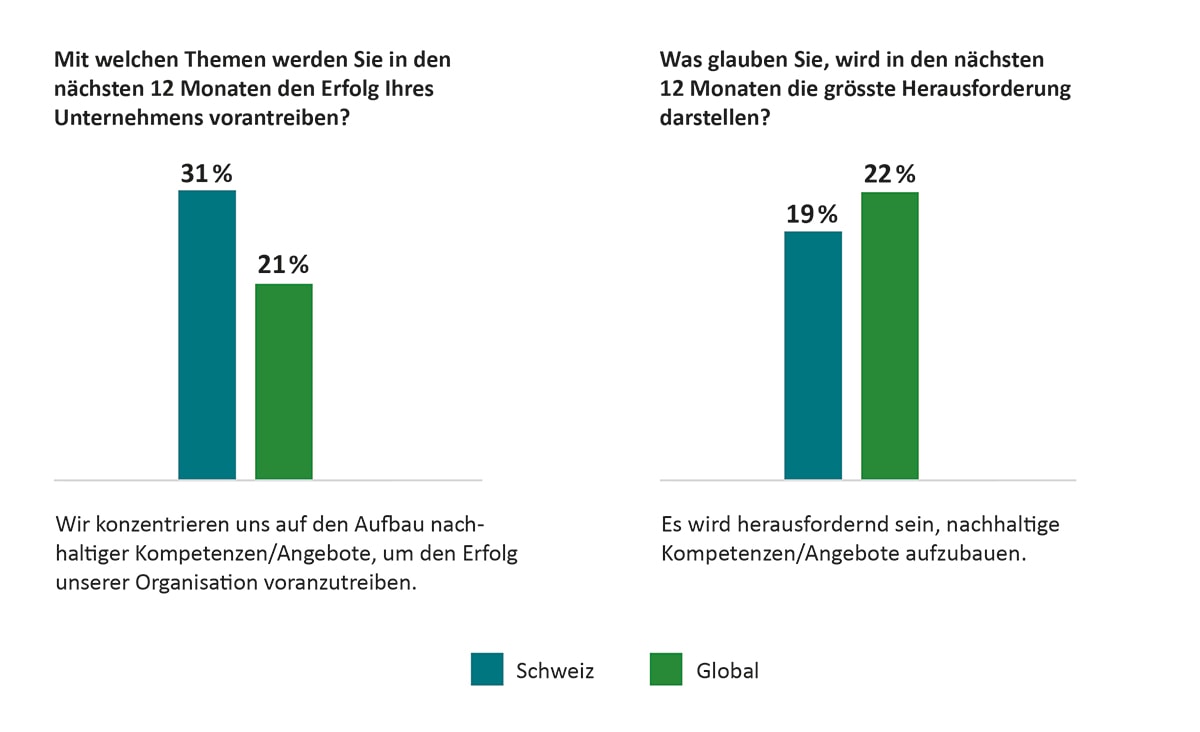
Sustainability is also increasingly seen as a growth driver and new market. Swiss CMOs have recognized this earlier than their colleagues worldwide: Swiss marketing managers give higher priority to building up competencies and offerings around sustainability (31%) than their international colleagues (21%). They also find this easier in a global comparison.
"Most chief marketing officers in this country have recognized the opportunities of sustainability when it comes to their company's reputation and as an opportunity for growth," says Liza Engel, chief sustainability officer at Deloitte Switzerland. With demographic trends and increased awareness of the impact of a purchasing decision, sustainability is taking center stage, she adds. "If companies want to be successful in their sustainability efforts, they need to be honest and transparent about concrete sustainability measures, communicate them authentically, bring their clientele along on this journey, and understand that sustainability is crucial to a company's longevity," Engel is convinced.
Creativity as a growth driver - not in Switzerland
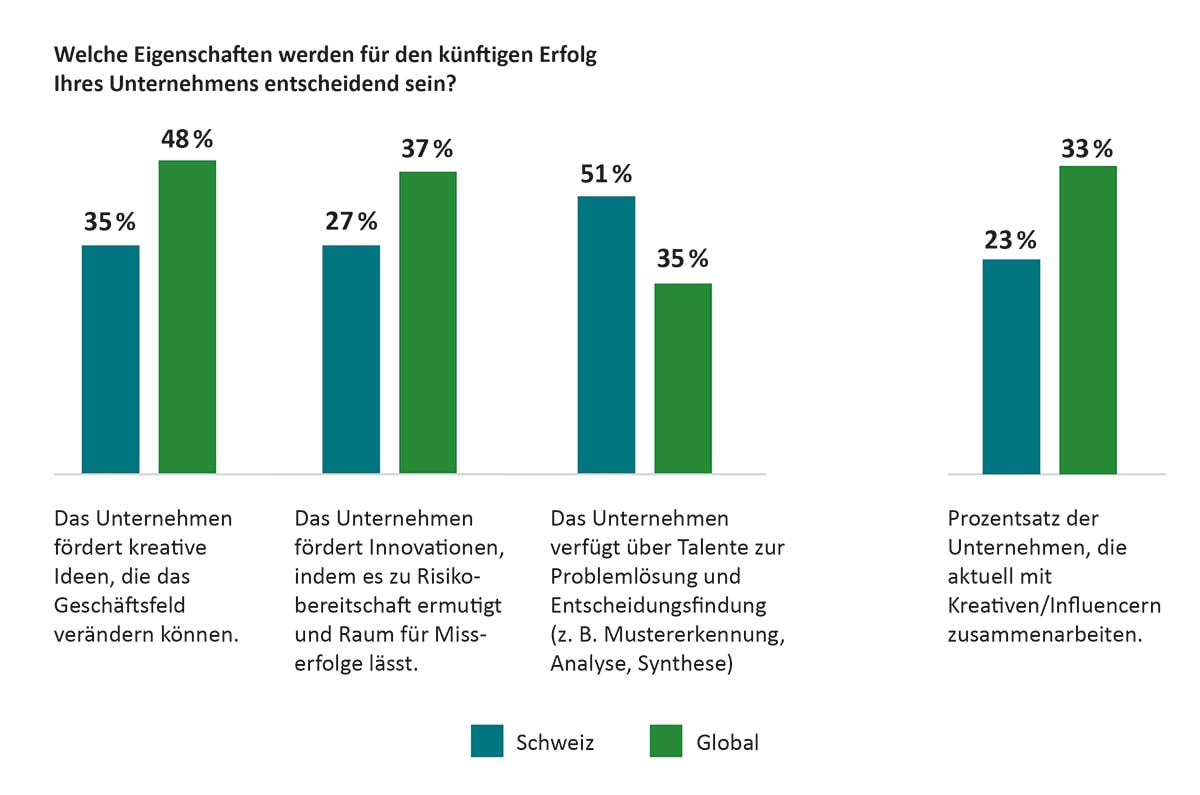
The study continues to paint a rather conservative picture of Swiss marketing departments. Only about one-third (35%) of respondents believe that the long-term success of their company depends on developing creative ideas. This conviction is more pronounced among their colleagues worldwide: 48 percent of them believe that creativity is a growth driver. By contrast, the majority in this country (51%) believe that problem-solving and decision-making will be the most relevant attributes for the success of their company - internationally, the figure is only 35 percent.
"Swiss companies still too rarely allow mistakes to be made and show too little willingness to take risks and be creative in order to encourage innovation," says Roger Lay. Only 28 percent of Swiss marketing executives (worldwide: 37%) believe that encouraging risk-taking and "failure" fosters creative thinking. "This is possibly related to the fact that a rather traditional corporate culture still prevails in Switzerland, characterized by risk avoidance and perfectionism. Many marketing managers in Switzerland complain that creativity ekes out a niche existence in their companies and is not seen as a strategic imperative," Lay continues.
It's no surprise, then, that Swiss companies also lag behind when it comes to working with external creatives and influencers. Currently, only 23 percent of Swiss marketers work with such - compared to 33 percent worldwide. "If Swiss companies don't want to lose out to their global competitors, they should encourage creativity and risk-taking, be more open to new technologies and use them more consistently," concludes Lay.
For the study Global Marketing Trends 2023 by Deloitte in 2022, a total of 1015 marketing executives from global companies across a variety of industries were surveyed in the US, UK, Switzerland, Japan, the Middle East and Australia - 100 of them in Switzerland. Respondents expressed their views on a range of topics related to the future of marketing over the next one to two years. In addition, ten in-depth interviews were conducted between July and September 2022 with executives from Switzerland who currently hold senior marketing positions. Their responses have been incorporated into the study's findings.
]]> To find out how customer service has changed, what customers want today, and what untapped potential lies in properly linking digital with physical channels, Deloitte studied more than 190 companies in 21 countries (from the banking, insurance, and telecommunications industries). The study focused on the synchronization of physical (branches, call centers) and digital channels as well as the opportunities that digitization of physical devices brings.
It became apparent: The younger generations are increasingly active and have different needs when it comes to staying in touch with companies. They appreciate customer service across multiple channels and digitization in personal contact, because they are not mutually exclusive - but function in parallel.
For example, 85 percent of Millennials and Generation Z, born after 1980, prefer to stay in touch with a company through multiple channels. However, one in two of them finds it important to be able to see a customer service representative in person when needed. One possibility, for example, is for employees to share a digital screen with customers. This is because they are also 1.5 times more likely to pre-sell cross-sell offers, collect contact details and follow up later.
Advertisingweek.ch spoke with Roger Lay, Deloitte Partner for Digital Marketing, about the key findings of the study:
Werbewoche.ch: Mr. Lay, you studied customer service in various industries in 21 countries. What surprised you most about the results of the study?
Roger Lay: The study shows how all three industries (banking, insurance & telcos) are relatively similar in certain aspects of an omni-channel proposition: Although the digitalization maturity for web and mobile is definitely different in these industries (and in many places already very mature), there is still a bigger gap when it comes to consulting with customers across all channels in a consistent and contextually relevant way. Data collected in one place just doesn't seem to be considered in the other.
How does Switzerland compare internationally - where are the biggest to-dos still?
Overall, Switzerland is quite comparable with the other European countries and often ranks in the middle. At the industry level, however, there are definitely differences: for example, in the insurance industry, quoting and the conclusion of more complex product contracts via purely digital channels is not yet as common as in England. In addition, customer centricity is very much channel-driven and not cross-channel. The biggest to-dos are probably company-dependent. In general, however, it can be said that these are located in the definition of an overarching experience strategy so that customer and marketing data from all channels can be collected, structured, processed, analyzed, and the respective insights then effectively orchestrated to all interaction channels.
What opportunities are there for companies in the evolution of customer needs toward omnichannel?
Companies can thus form a much closer relationship with customers. They can respond much better and faster to customers' needs through the insights gathered in the interaction channels. This helps to avoid drop-outs, conduct business more successfully, and make cross-selling and upselling more automated - just to name a few examples. In other words, productivity increases and transactional NPS is boosted, leading to a higher top line overall. In addition, employer attractiveness also increases and onboarding of new employees becomes more efficient. It should also be remembered that a lot of paper can also be saved in terms of environmental protection and sustainability.
Here you can download the report.
]]>

m&k: Marcin Skucz, you are the creative head of the Zurich branch and act as Executive Creative Director. What is your role?
Marcin Skucz: I consider myself first and foremost a visual designer. For more than 15 years, I've been building and leading creative teams with this perspective - and mostly in performance-oriented consulting firms. In everything I do, I always keep both sides of my brain active. At Acne, this formula helps me create that - in the words of Keith Richards - "neck-downwards" feeling people have before the head registers what's happening.
Why does Acne in particular fit so well into Deloitte's portfolio?
Where can creativity make the biggest difference?
At Acne, we firmly believe that creativity is the best answer to most of the world's problems. For us, creativity means inspiring, transformative ideas that are rooted in culture and have an impact on society. Most of the really big changes in our history have been driven by such ideas. And then we use technology, business modeling, experience design, data and insights as enablers to bring those ideas to life in smart, pragmatic and effective ways.
Where does your passion for creativity come from? Why are you in this industry?
I was born and raised on a lake in the northeast of Poland. Nature with its endless diversity has always fascinated me and serves as inspiration for many ideas. I've learned that you have to give some space to boredom and living in the moment to boost your creativity. Looking back over the last two decades of my career, I have always continued to practice this ritual. I also firmly believe that creativity needs a diversity of perspectives and ways of thinking to thrive. At Deloitte, we have access to such diversity. At the same time, of course, we must constantly prove internally that our creative output and ideas generate real value. This challenge drives us and enhances the quality of our work.
And do you know the cultural peculiarities of the Swiss?
Although Acne originates from Sweden, local talent is at the forefront in all our locations. We combine the best of two worlds: the breadth and power of a global creative network and the knowledge and empathy for the specifics of the Swiss market. These peculiarities are what attracted me personally as a creative. When I think of Switzerland, I see beauty, structure, design, nature and, on the other hand, openness to innovation and advanced technological possibilities. I believe it is a country that preserves its own tradition and culture and at the same time is extremely diverse - both are extremely important for creativity. And of course, Switzerland is a country with an incredible concentration of some of the most exciting brands in the world to work for as a creative.
Is it different as a creative to be part of a big company?
Above all, it's enriching. Being part of a global professional services organization has the advantage that we work with people with incredibly large and diverse expertise - from technology nerds to finance experts to management consultants. At the same time, Acne has the freedom within Deloitte to operate flexibly and independently almost like a start-up within a strong global network.
How do you plan to expand the Zurich office?
We are in growth mode with a strong creative team that we want to expand further. We are also massively expanding our network of partners and alliances. We are also leveraging the power of the Acne family and working very closely with other offices, for example Stockholm or London for branding and advertising, Milan where we have strong expertise in the luxury industry, or Hamburg for pioneering technologies like NFTs and the Metaverse. We can also build on a strong Content Factory, which I originally helped to develop in Poland - over 200 people providing content creation, adaptation, management and performance.
What does the future hold?
I'm cautious about making specific predictions - but my basic attitude in life is always optimistic. If you ask me about Acne's ambitions for the next few years- it's to continue to solve complex business, social and environmental challenges with creativity.
 With the new office in Zurich, Deloitte Switzerland is significantly expanding its offering for clients in Switzerland. Acne, which was acquired by Deloitte in 2017, aims to combine creative excellence with Deloitte's forward-looking business expertise. The Zurich office will strengthen the agency's pan-European network and provide further local market expertise to Deloitte's clients in Switzerland and globally.
Since its acquisition by Deloitte, Acne has steadily expanded across Europe, opening offices in Amsterdam, Milan, Rome, Lisbon and Dublin. Deloitte acquired the creative consultancy to meet its clients' needs for holistic solutions that combine creativity, technology and consulting. Acne's past and current clients include IKEA, Netflix, Instagram, Maserati and UpLink. The Zurich office, which opened in summer 2022, is the newest member of the ACNE family. "We are proud to bring ACNE to Switzerland," says Adam Stanford, Managing Partner of Deloitte Consulting Switzerland. "Switzerland is a highly inspiring and innovative place and fertile ground for a creative consultancy like Acne. With its relentless entrepreneurial spirit, Acne is expected to be a transformative force in the Swiss agency landscape and a strong addition to Deloitte Switzerland's digital and creative offering.
Expansion of Deloitte's creative offering
Acne's core offering in brand, communications and content significantly expands Deloitte's expertise in Switzerland. With its bold and creative vision, <scn will help deliver a wide range of new services to Deloitte's Swiss clients. "Acne plays an important role in Deloitte's evolution towards a comprehensive offering of digital and creative services," explains Roger Lay, Partner of Deloitte Digital in Switzerland. "Whether launching a new strategy, product or service, our clients are increasingly looking for a partner with strong multidisciplinary capabilities. By combining Deloitte's time-tested strategy, process, data and technology expertise with Acne's exceptional creative skills, we can help build stronger brands for the digital age.
Driving new developments
Thanks to its positioning at the intersection of industry and art, business and creativity, rationality and emotion, originality and transformation, Acne aims to create brand experiences that have real impact and drive change. "We need to break new ground if we want to create brands that have transformative power" , says Marcin Skucz, Executive Creative Director at Acne. "Brands must embrace what is new and unique and create what has never been seen, heard or thought of before. ACNE's entrepreneurial spirit and cultural sixth sense create modern brands and reinvent them through personal stories."
]]>