
It's hard to imagine everyday family life without social media. Take, for example, the handling of family and children's pictures and videos. Who doesn't like to share beautiful moments with their community? Many mom or dad influencers go one significant step further and commercialize part of their everyday family life. Companies and platforms have also discovered the advertising and click potential of children's or family content, but are usually afraid to face the consequences. The rights of children are often forgotten.
First and foremost, parents are responsible for their children, but social media platforms and companies should also rethink their role. The protection and well-being of children and young people should always come first. However, social media is developed by adults for adults and is still not a child-friendly place. Unfortunately, this leads to the fact that children's content is not specifically protected and can be easily redistributed. Advertising guidelines are also not clearly regulated and vary greatly from country to country.
The Conscious Influence Hub has therefore set itself the goal of promoting a respectful exchange in the digital world and discussing precisely such topics with the players and experts involved and working together on guidelines and solutions. This is exactly what he will be discussing with content creator and father Fabio Zerzuben, a company and an expert from Child Protection Switzerland on November 9, 2023 at the WebStage Masters Social Media Conference in Engelberg as part of a panel.
The WebStage Masters is the largest social media marketing conference in Switzerland. The sixth task will take place on November 8 and 9, 2023, in a breathtaking setting in the middle of the mountains of Engelberg. The village can be reached from all major Swiss cities in less than two hours. Do you also want to be there? Then secure your ticket now on www.webstage-masters.ch/tickets
"In Switzerland, legislation has not yet dealt with the topic to any great extent. This is partly because the reach of Swiss influencers is often limited due to the size of our country and the fact that it is quadrilingual. Things are different in France, for example, which was the first European country to introduce laws explicitly for influencers. In Switzerland, there are few mechanisms to effectively protect children from economic exploitation in the area of social media advertising. International agreements and guidelines, on the other hand, already provide a fairly clear direction here, and the platforms themselves are also gradually issuing rules and guidelines on this topic. We should therefore also urgently discuss children in influencer advertising in Switzerland. We definitely have some catching up to do. Exposing children on social media can bring up far-reaching discussion points. We need to think about fundamental rights (basic rights of children, also before parents), data protection law (DSGVO), labor law (child labor) and personality rights (right to one's own image)," says Isabelle Wildhaber, Professor of Private and Commercial Law at the HSG and Advisory Board Member at the Conscious Influence Hub.
Child Protection Switzerland is a partner of the Conscious Influence Hub and provides valuable tips and offers on the topic of "Children on the Net" and "Sharenting": https://www.kinderschutz.ch/eltern-und-erziehungsberechtigte/kinderbilder-im-netz
How do influencers deal with it
In the beginning, influencer marketing was mainly used in the lifestyle and beauty industry. As digital platforms have grown, so have the advertising opportunities on social media and for influencers. As the community has aged and become parents, new advertising opportunities have emerged for influencers. Thus, the phenomenon of the kidfluencer was born - managed by Mommy or Daddy. Although it's not really new, it's comparable to child stars.
Especially in the USA, "kidfluencers" represent a significant branch of industry and generate an industry value of around 8 billion dollars. It is therefore not surprising that there are four children's channels among the top ten YouTube channels and that the two Youtubers Ryan Kaji of "Ryan's World" (12 years old and earning 30 million US dollars) and Anastasia Radzinskaya of "Like Nastya" (9 years old and earning an estimated CHF 83 million) are among the top earners. In Switzerland, the business with "kidfluencers" is not (yet) booming. There are only a few children's channels. Moreover, Swiss influencers handle their children in very different ways on their feeds or in advertising collaborations. Some don't show them at all, others show them occasionally in the feed but make them unrecognizable, and still others show them deliberately and also build up their collaborations with them.
"You shouldn't just use the 'kidfluencer effect' for no reason - or just because. You see a lot of kidfluencers abroad. However, we wouldn't set up our own channel for our kids. In TV advertising, families/kids have been around for decades, so I'm convinced that advertising with kids can also have a place in the social media world. If a good set of rules and guidelines are given, this can be implemented professionally. In the meantime, there are many brands that deliberately don't want children in the picture. As a creator, you can be creative enough and have ideas to find other ways to create family content for promotional posts - without showing the kids," says Fabio Zerzuben, content creator and father, describing his experience.
How do companies deal with it
Baby food, diapers, toys or insurance, families and children are a popular target group for companies. Through social media, they have found a fast-growing sales channel. Advertising aimed at children is a huge business worldwide. It's no surprise that the fastest-growing genre on YouTube is videos for young children, which are naturally peppered with advertising. In Switzerland, companies spend millions of francs on advertising directed at families and children. (Swiss) companies have recognized influencer marketing with families as a lucrative advertising environment and are striking more and more advertising deals with parents promoting toys, food or other items. Whether or not the mom and dad influencers show their kids in these collaborations is not always left up to them. Some companies deliberately want the kids to be shown and actively involved in the content. Other companies, such as Unilever and Lindt, are consciously adapting their advertising guidelines and no longer targeting children under the age of 16.
Guideline on privacy protection with Racha from CI Hub
What does the Conscious Influence Hub do
The Conscious Influence Hub promotes respectful exchange in the digital world. The goal is to strengthen the core values of respect, empathy and transparency in the social media world together with influencers/creators. Since its founding in 2020, the association, with the support of experts from academia, media, civil society and the influencer industry, has developed a Code of Conduct developed. This provides ten easy-to-implement principles that offer Swiss influencers and social media actors a guide for responsible and respectful behavior. The Conscious Influence Hub invites all actors in the influencer marketing ecosystem to take an active role in shaping responsible behavior on social media and especially when dealing with children. To learn more, visit: www.consciousinfluencehub.org/partner
* An article from Anja Lapčević, Executive Director of the Conscious Influence Hub. The article was created in collaboration with WebStage Masters.
]]>
Constanze Fristensky, born and raised in Zurich, completed a degree in tourism with a focus on marketing at the Graubünden University of Applied Sciences in Chur. After graduating and successfully completing an internship at a marketing agency in the Lucerne area, Fristensky moved to Turin, Italy, to immerse herself in the world of influencer marketing. She later applied the international expertise she gained there to national influencer campaigns at Kingfluencers before joining the Farner team.
At Farner, Fristensky also focuses on influencer-specific projects and has been a member of the jury for the Swiss Influencer Awards since 2022. Through her involvement, a partnership between Farner and the Conscious Influence Hub was established earlier this year. Now she herself has been appointed to the board of the association.
"Through dialogue and exchange with Influencer:ins and the Advisory Board, I strive to advocate for responsible behavior on social media," Fristensky said.
The association was founded in 2020 by Anja Lapčević and Barbara Fry Henchoz and aims to promote respectful exchange in the digital world. The goal is to strengthen the basic values of respect, empathy and transparency in the social media world together with influencers and creators. With the support of experts from academia, the media, civil society, and the influencer industry, a Code of Conduct developed. This provides ten easy-to-implement principles that offer Swiss influencers a guideline for responsible and respectful behavior.
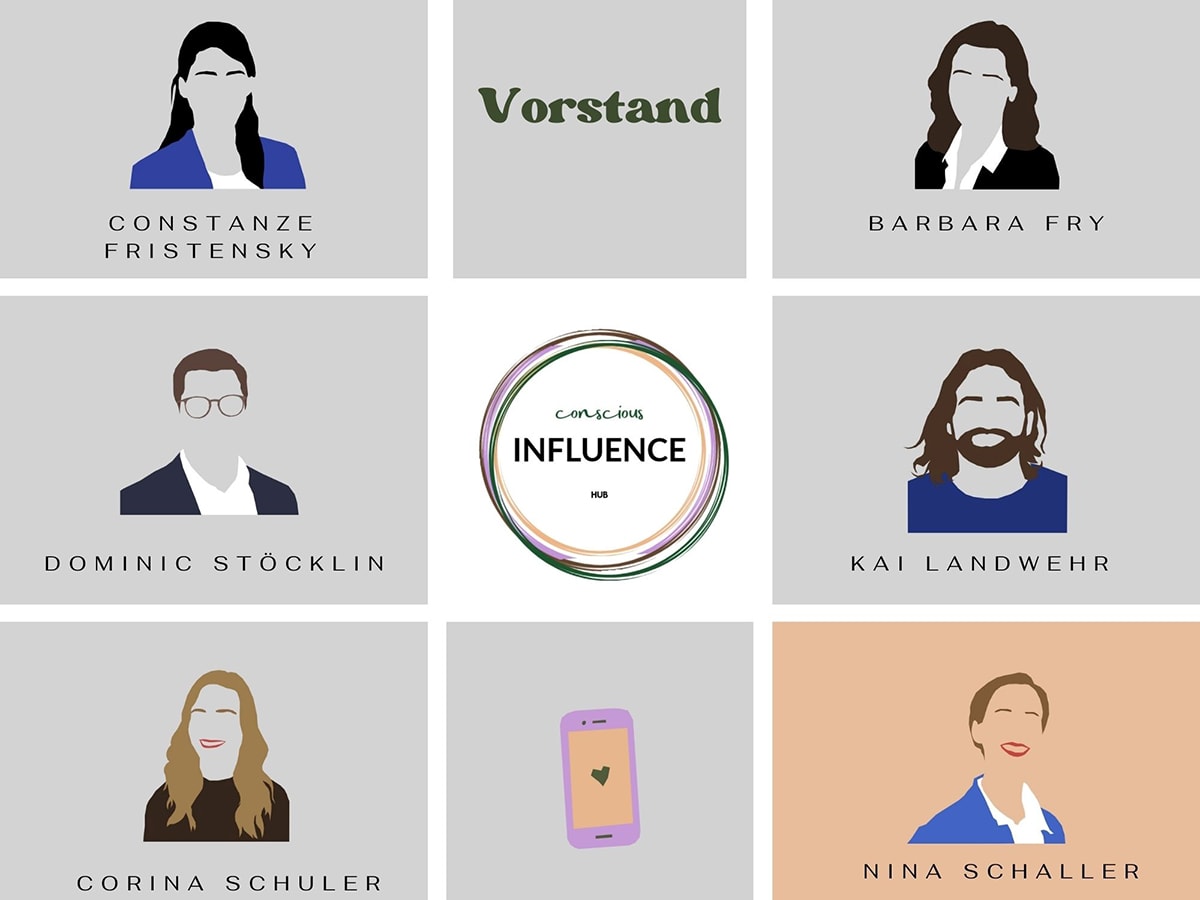
In addition to Constanze Fristensky, the following persons are members of the CIH Board of Directors:
- Barbara Fry Henchoz, Communications Consultant and Board President
- Corina Schuler, Senior Online Marketing Manager at Baloise Insurance
- Dominic Stöcklin, Head of Media at Switzerland Tourism and Head of Studies at the Institute for Digital Business at ZHAW
- Kai Landwehr, Marketing Manager at the myclimate foundation
- Nina Schaller, Partner at the Whoisnik Agency

Again and again, the agency is confronted with questions around the topic: "Do you have any advice for dealing with hate speech? How do I deal with hate comments?" According to Kingfluencers, TikToker:ins in particular would have to struggle a lot with hate comments, as anonymity is extremely present on TikTok. This anonymity - for example with the help of fake profiles - makes it easy for users to leave hate comments.
As a contact for creators and partner of the Conscious Influence Hub, Kingfluencers has made it its mission to address hate speech. As a link between brands and creators, the agency feels obligated to also create awareness for unflattering topics and to pick up where others look away. "In addition to successful campaigns, it is even more important to us to communicate the right values and guidelines and to serve as a support for creators in order to professionalize the Swiss influencer market," says Tamara Glück Gonzalez, Senior Influencer Strategist at Kingfluencers.
For this reason, Kingfluencers organized the event "Together with Kingfluencers against Hate Speech", which took place on Thursday in Zurich together with the team and creators such as Kris Grippo, Taulant Gashnjani, Sarah Leutenegger and many other influencers. A survey conducted at the event underscored the relevance of the topic: over 87 percent of the creators on site had already experienced hate speech.
Anja Lapcevic, Managing Director of the Conscious Influence Hub, presented expert tips and tricks for dealing with hate online. In addition, content creators Kris Grippo and Taulant Gashnjani shared their personal experiences and explained how they deal with hate online. Comedian Taulant also takes a humorous approach to the whole thing: "I usually send back a yawning emoji or a loving heart."
The tips Kris Grippo gave the guests were as follows:
- Don't ignore the issue of hate speech, but ignore hate comments if they bother you
- Remains polite and businesslike
- Block or report the hate comment
- Seek support
- Sets a sign


Kingfluencers' other engagements include its own initiative, "Mental-Health Check-In," which aims to raise awareness of mental health issues related to social media. In January, Kingfluencers launched "Compare yourself on social media", followed by "(un)healthy social media use" and "Role model function" in collaboration with the Conscious Influence Hub. All three themes serve to educate and increase awareness of Mental Health Issues. This month, they are now appropriately dedicating to the topic of Hate Speech.

 ]]>
]]> People who have a high reach on Swiss social media channels have so far lacked guardrails for responsible communication and awareness of critical topics such as sexism, fake news or transparency. The Conscious Influence Hub now wants to close this gap with its Code of Conduct and the accompanying new tutorial. The Code of Conduct offers Swiss influencers and social media users ten simple and practicable guidelines for responsible and respectful behavior on digital media.
"When Anja Lapčević, the co-founder of the Conscious Influence Hub, asked me for the project, it was clear to me: I want to produce this! I have experienced some tricky situations during my social media time and set them in motion myself. The Code of Conduct is a step in the right direction to make our social media lives more pleasant and respectful. The fact that I can contribute to making it more tangible and understandable for users makes me all the more happy," says Ramin Yousofzai, former presenter of SRF's "Zwei am Morge.
In the nine-minute video, Yousofzai acts as a moderator and uses examples to guide the audience through the ten topics from the Code of Conduct. For example, he interviews sustainability blogger Anina Mutter, the former managing director of the women's organization Alliance F and project manager of Stop Hate Speech Sophie Achermann, and Racha Fajjari, founder of the family network Mamalicious, on topics such as sexism, transparency, and privacy protection. Anja Lapčević, Ramin Yousofzai and Simon Reinker were responsible for the production.
With the tutorial, the association wants to make the Code of Conduct more accessible and attractive for different users on social media. The tutorial is intended to inspire and make people think.