
Alisha Lehmann, Peace Tea: First Official Brand Ambassador
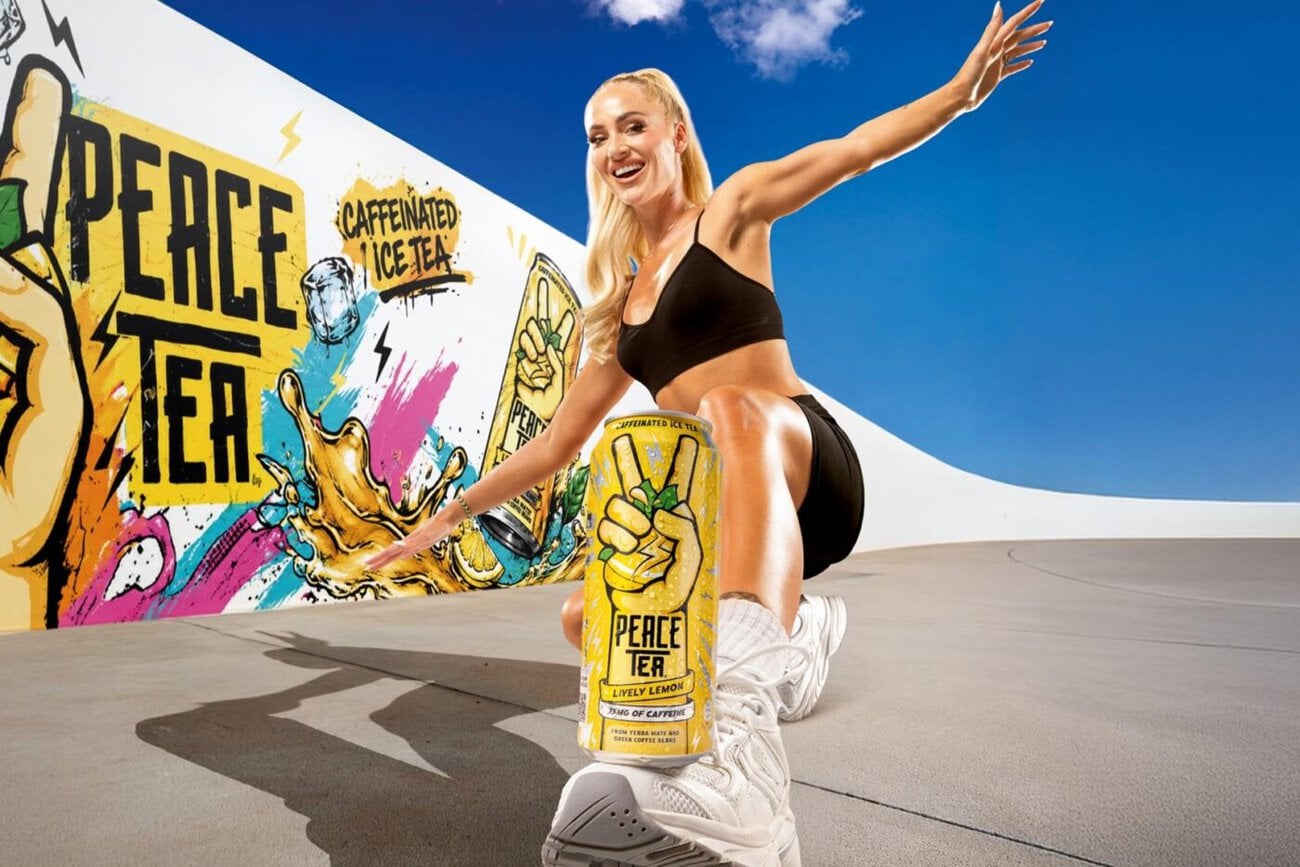
Coca-Cola is continuing to expand the presence of its caffeinated iced tea brand, Peace Tea, in Switzerland and is partnering with an official brand ambassador for the first time. The company has chosen Alisha Lehmann—a Swiss national team player, professional soccer player, and content creator. The partnership between Alisha Lehmann and Peace Tea will be rolled out across all channels starting August 24, 2026, and will include digital, social media, out-of-home advertising, influencer campaigns, and a strong presence at the point of sale.
Alisha Lehmann is one of Switzerland’s most internationally renowned sports figures. She has a total of more than 26 million followers on Instagram and TikTok. This makes her one of Switzerland’s most influential figures on social media and one of the world’s best-known female soccer players. As a professional athlete and content creator, she operates at the intersection of sports and lifestyle.
Cross-media campaign and limited-edition cans
Under the tagline «Your Refreshing Boost,» Alisha Lehmann will be featured across numerous channels throughout Switzerland. The campaign includes digital video formats, social media, out-of-home advertising, and influencer collaborations. A special feature of the collaboration is a limited-edition Peace Tea series featuring an image of Alisha Lehmann on the cans. According to the press release, this will make the partnership visible not only in communications but also directly in stores and in consumers’ everyday lives.
Dimitra Filippou, Senior Brand Manager at The Coca-Cola Company Switzerland, explains the choice as follows: «Alisha Lehmann is much more than just a successful soccer player. She reaches and inspires people all over the world and embodies self-confidence, individuality, and the freedom to forge her own path. This makes her an excellent fit for Peace Tea. With this partnership, we aim to further strengthen the brand in Switzerland and reach new target audiences.»
Peace Tea: Next Step in the Swiss Market
According to Coca-Cola, the collaboration with Alisha Lehmann marks an important milestone for Peace Tea in the Swiss market. The brand was launched in Switzerland in 2025—the first international market outside North America where Peace Tea became available. In Switzerland, the brand is building a distinct brand identity centered on creativity, urban culture, and positive inspiration in everyday life. Through projects such as the first VBZ tram designed by an urban artist, as well as other art initiatives in public spaces, Peace Tea has already made a visible impact.
Peace Tea is a line of low-calorie, caffeinated, non-carbonated iced teas from Coca-Cola. The beverages combine black tea with yerba mate, green coffee bean extract, and natural fruit flavors. Each can contains 75 milligrams of caffeine. The Swiss lineup includes the flavors Lively Lemon, Punchy Peach, and Mighty Mango.
Responsible at Coca-Cola Switzerland: Dimitra Filippou, Senior Brand Manager
]]>
Coca-Cola World Cup Campaign: Experience Switzerland Together
Anlässlich der FIFA Fussball-Weltmeisterschaft 2026 lanciert Coca-Cola Schweiz eine landesweite Multichannel-Kampagne, die die emotionale Reise der Fans ins Zentrum stellt. Unter dem Motto «Achterbahn der Gefühle» soll die Coca-Cola WM-Kampagne die Schweiz vom ersten Anpfiff bis ins Finale begleiten – mit Markenbotschafter Manuel Akanji, einem exklusiven Public-Viewing-Event in Zürich und vielfältigen Aktivierungen rund um das Turnier. Als offizieller Partner der FIFA WM 2026 setzt Coca-Cola dabei bewusst auf lokale Gesichter, vertraute Stimmen und Erlebnisse, die Fans im ganzen Land verbinden – und das im Jahr des 90-jährigen Bestehens der Marke in der Schweiz.
«During a World Cup, the whole country comes together. A team can take fans from hope to disappointment and back again in a matter of minutes, and everyone experiences it together,» says Giulio Franscini, Brand Manager at The Coca-Cola Company Switzerland. «We want our campaign to accompany this intense roller coaster of emotions and make the experience even more vivid for fans throughout Switzerland.»
TV commercial featuring well-known Swiss commentators
The fans’ emotional journey is captured in a promotional video designed to bring the highs and lows of a tournament to life. The clip is narrated by voices familiar to Swiss soccer fans: Roman Kilchsperger provides commentary in German, Massimo Miccoli in Italian, and Daniel Romano in French. The ad will air on TV and social media until the end of the tournament.
Manuel Akanji Takes Center Stage in Coca-Cola's World Cup Campaign
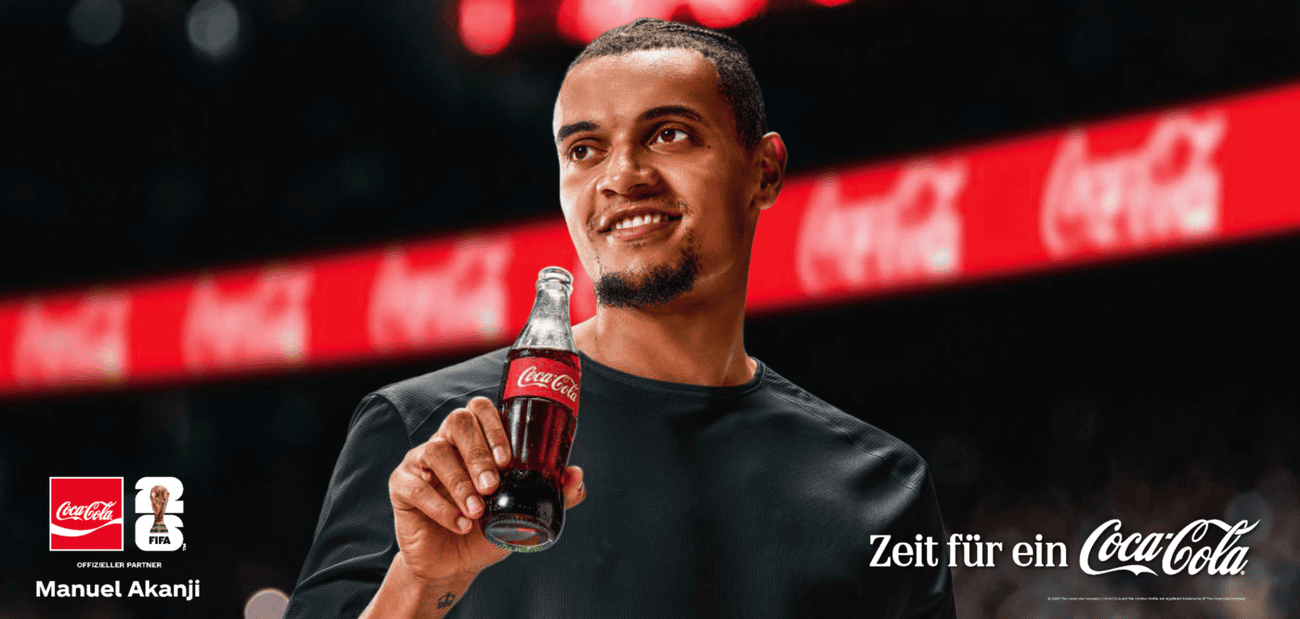
National team player Manuel Akanji was introduced as a brand ambassador for Coca-Cola Switzerland in April and will be featured in out-of-home and digital out-of-home placements, as well as on social media, throughout the tournament. The campaign’s central theme features him in a series of snapshots designed to reflect the range of emotions fans experience during a soccer match. The collaboration is rounded out by national team goalkeeper Gregor Kobel and national team players Sydney Schertenleib and Alayah Pilgrim. Other personalities featured in the campaign include Luca Hänni and Liridon Krasniqi. In total, Coca-Cola Switzerland is partnering with more than 20 creators, influencers, and brand ambassadors for the World Cup.
In retail and the restaurant industry, consumers have the chance to win exclusive World Cup prizes through Akanji promotions—including the opportunity to win an exclusive meet-and-greet with Manuel Akanji.
Limited-Edition Packaging and Panini Partnership
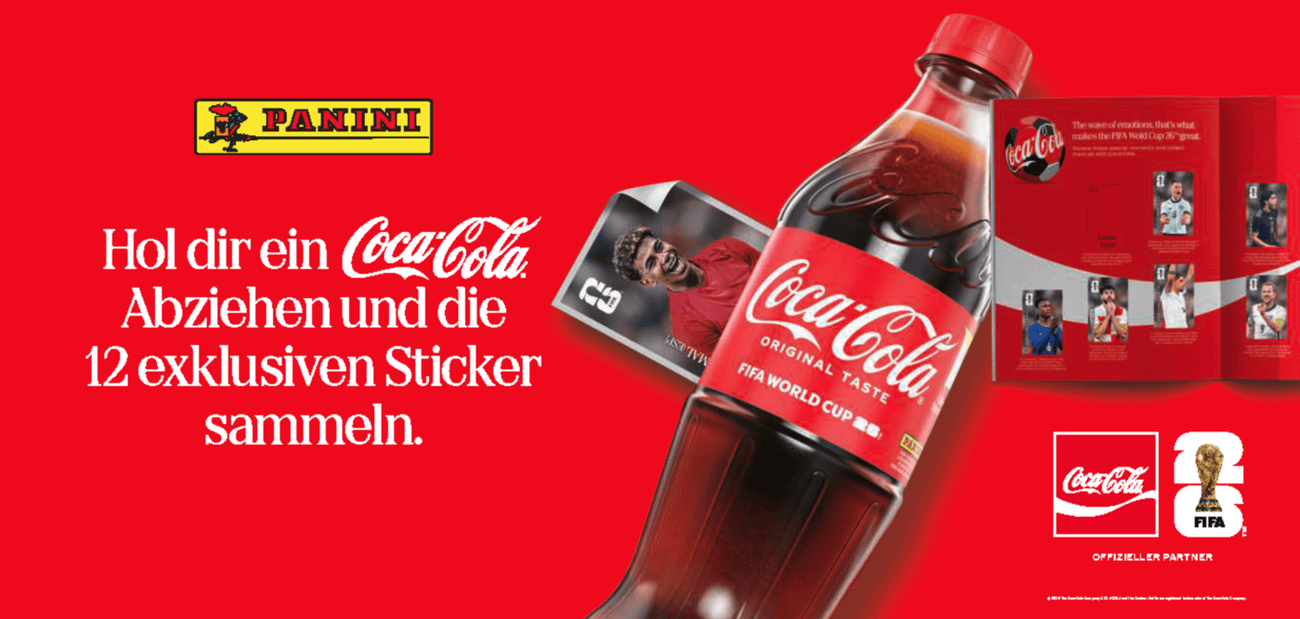
Begleitet wird die Kampagne von einem neuen Verpackungsdesign: Dosen und Flaschen erscheinen in von Länderflaggen inspirierten Sujets – darunter die Schweiz, Deutschland, Frankreich, Portugal, Spanien und weitere Teilnehmernationen der WM 2026. Zusätzlich arbeitet Coca-Cola mit Panini zusammen: Unter den Etiketten ausgewählter Coca-Cola PET-Flaschen finden sich zwölf exklusive Sticker für das offizielle Panini-Album zur FIFA WM 2026, die nicht in den regulären Panini-Paketen erhältlich sind. Das offizielle Panini-Album enthält zudem zwei Coca-Cola-gebrandete Seiten.
Public Viewing at the MAAG Halle in Zurich
On June 18, 2026, Coca-Cola is hosting a public viewing event at the MAAG Halle in Zurich. The event is being held to celebrate the Swiss national team’s group stage match against Bosnia and Herzegovina. Admission is free, and the venue has a capacity of 700 people. The event is fully themed with Coca-Cola branding and features various on-site activities, including a T-shirt factory where guests can personalize their own Coca-Cola x FIFA T-shirt. Coca-Cola will also be represented as a co-partner at existing public viewings for Switzerland’s group stage matches on June 13, 17, and 24.
For more information about the campaign and its activities, visit https://www.coca-cola.com/ch/de available.
]]>On this May evening, Zurich’s Schiffbau is lit up in Coca-Cola red. One could hardly have chosen a more fitting backdrop: When the halls were built in 1891 for the construction of steamships, Coca-Cola was five years old. It was the era of great inventors, of Bertha Benz’s first car ride, of the first view of Paris from the Eiffel Tower, and of other technological breakthroughs. And somewhere in Atlanta, pharmacist John Pemberton was experimenting with the formula that would later become the world’s most famous beverage brand. Nearly 140 years later, two children of the industrial age are reuniting at the Schiffbau. The anniversary celebration turns into a brief journey through economic history, advertising history, and pop culture.

The Discovery of Detroit
The history of Coca-Cola in Switzerland does not begin in Atlanta, nor does it begin in Zurich. It begins in Detroit. There, during the hot summer of 1934, Max Stooss, a car importer from Bern, was in Detroit negotiating the sale of American vehicles. During breaks, he was served ice-cold Coca-Cola. He was so impressed by the taste that he decided to bring the drink to Switzerland.

This encounter gave rise to a success story that now spans three centuries. Invented in the 19th century, it arrived in Switzerland in the 20th century and remains remarkably vibrant even in the 21st century. What began back then with a cold bottle has grown into a Coca-Cola system featuring local production, Swiss suppliers, thousands of jobs, and a brand that has long been a fixture of everyday life.
More Than Just a Recipe
Of course, at some point during an anniversary celebration, the question about the famous secret formula inevitably comes up. Constance Courtois-Delanoë, Marketing Director for Switzerland at The Coca-Cola Company, smiles. Naturally, she won’t reveal anything. But her answer gets to the heart of the story. «John Pemberton really wanted to create a product that is highly refreshing, but at the same time has this invigorating effect—both emotionally and physically.»

In doing so, she’s describing more than just a recipe. She’s describing a brand effect. Coca-Cola is one of those rare products that you can recognize practically by touch alone. Color, lettering, bottle, sound, taste: everything fits together. «»The secret formula that everyone has tried to replicate, but which no one has really succeeded in doing over the past 140 years,” says Courtois-Delanoë. This is exactly where the real magic begins. Coca-Cola isn’t just a beverage with a history. Coca-Cola is a brand that has created its own code.”.
The Brand That Has Always Been Coca-Cola
Many brands try to stay relevant by constantly reinventing themselves. Coca-Cola did something even more difficult: the brand kept evolving without losing its essence. New packaging, new products, new channels, new target audiences, new cultural contexts—and yet, to this day, a certain shade of red is all it takes to make the world think of Coca-Cola instantly.

That’s brand management at the highest level. Not because everything has stayed the same, but because everything contributes to the same core values: optimism, refreshment, community, and recognizability. Fabio Cella, Country Manager of Coca-Cola Switzerland, sums up this aspect: «Our story has been written by consumers.» This isn’t just a nice anniversary cliché. It describes the difference between advertising and cultural embeddedness. Advertising can buy attention. A brand like Coca-Cola earns a place in people’s memories.
The naturalized American
Anyone who views Coca-Cola solely as an American brand is overlooking an important part of its history. About 80 percent of the beverages sold in Switzerland are produced here. 95 percent of the ingredients come from Swiss suppliers. The Coca-Cola system directly employs about 800 people and generates several thousand jobs throughout its value chain.

For Zurich Cantonal President Carmen Walker Späh, that is precisely what matters. «For me, a company is Swiss if it is rooted in Switzerland—if its employees live and work here, if production takes place here, and if value is created here.» Her conclusion is correspondingly clear: «Coca-Cola Switzerland is a local company. And how!» The Coca-Cola representatives nodded happily in agreement.
And with that, the best punchline of the evening is set. One of the most American brands in the world is celebrating its Swiss birthday at Zurich’s Schiffbau—and in doing so, it doesn’t come across as a guest, but rather as a naturalized icon.
Where Life Unfolds
Numbers don’t explain why Coca-Cola is still relevant after 90 years. The brand’s true strength lies in its ability to be present wherever people experience emotions. At music events. At sporting events. At festivals. On vacation. At Christmas. Or quite simply in those moments when people come together.
«One of the secrets is to be there in a meaningful way exactly when it matters,» says Constance Courtois-Delanoë. In fact, this principle runs like a common thread through the brand’s history. Coca-Cola was never just a beverage manufacturer. Coca-Cola saw itself early on as part of pop culture—as a companion to experiences and an amplifier of emotions.
Switzerland is a good example of this. Coca-Cola currently sponsors over 40 music festivals. Manuel Akanji, one of Switzerland’s best-known soccer players, is at the center of the current FIFA campaign. At the same time, the brand maintains just as strong a presence in ski resorts, at open-air festivals, and at concert venues as it does in retail stores. «We have a global DNA rooted in optimism and joy,» says Courtois-Delanoë. «But we have a lot of freedom locally to tell our own stories.»

The Soundtrack of Memories
Some brands are remembered. Coca-Cola is heard. When the familiar Christmas melodies ring out from the orchestra pit at the Schiffbau, just a few bars are enough to conjure up images. The legendary trucks. Winter evenings. The start of the Christmas season. «Holidays Are Coming» has long been more than just an advertising jingle. It’s an auditory marker on the calendar.

Later, historic commercials are shown on the screen. Among them is «I’d Like to Buy the World a Coke» from 1971—a commercial that has long since become more than just an advertisement. People from different backgrounds sing together on a hill—decades before diversity and inclusion became integral parts of many corporate strategies.
Host Zoe Torinesi also recalls personal stories about Coca-Cola: Shakira as a brand ambassador, collectors, fan clubs, and memories that almost everyone associates with this brand. Coca-Cola sells beverages. But the brand collects memories. That’s exactly why its most powerful campaigns don’t just end up in the archives of advertising—they find their way into the memories of entire generations.
Switzerland as a Testing Ground
90 years in Switzerland and over 140 years worldwide raise a simple question: How does a brand remain relevant for so long? Fabio Cella provides a remarkably clear answer. «Our success over the past 90 years stems above all from the fact that we have stayed very close to our consumers and really listen to them.»
Switzerland plays more than just the role of a sales market in this context. It is a production hub, a hub for innovation, and a cultural testing ground. Cella points to Swiss consumers« openness to innovation, particularly in the areas of well-being and health. Zoran Bogdanovic, CEO of the Coca-Cola HBC Group, headquartered in Zug, also looks back on groundbreaking innovations: the launch of Coca-Cola Zero, developments at Valser, and projects that garnered international attention from Switzerland. »Switzerland plays a major and important role for us as a company,” he says.

This role is also evident in investments. A new high-bay warehouse is being built in Dietlikon, logistics are gradually being electrified, and Coca-Cola is embracing the circular economy for PET. This may sound less romantic than red trucks and iconic bottles, but it’s part of the modern continuation of the same story: A brand can only remain strong if the system behind it works as well.
The original
There’s a lot of talk about sustainability this evening. About the circular economy. About electric mobility. About new products. About Zero. About Zero Zero. About the next 90 years. And that’s exactly how it should be. Brands that stand still eventually disappear from the present.
Coca-Cola has continually reinvented itself. New packaging. New products. New target audiences. New channels. The brand has evolved without losing its core identity. That is precisely what sets it apart from many brands that eventually became prisoners of their time.
At the same time, this evening also tells a story of consistency. Less sugar, fewer calories, or less caffeine are responses to real needs. But not everything that’s currently out of step with the zeitgeist is necessarily a thing of the past. After all, sugar only tastes truly sweet when it’s just sugar. And caffeine still provides that little kick that sometimes makes all the difference.

The taste of the original has stood the test of time across generations. Lifestyle trends have come and gone. Today, the buzzwords are “longevity,” “reduced sugar,” and “Zero Zero.” Tomorrow, other terms will dominate the conversation. Coca-Cola will respond to these changes, just as it has for decades. But the Original remains the benchmark against which everything else is measured.
Pharmacist John Pemberton would probably have chuckled at that. His recipe has been supplemented, expanded, and modified over the decades. But it has never been replaced. Or to put it another way: Pharmacist, stick to your recipe.
Jürg Burkhalter sums it up in his own way that evening: «To me, Coca-Cola is simply the greatest beverage humanity has ever invented.» A statement that draws laughter and applause at the Schiffbau. And one that explains why, after 90 years in Switzerland, Coca-Cola doesn’t come across as a brand celebrating an anniversary, but rather as one whose story is far from over.
Always Coca-Cola.
]]>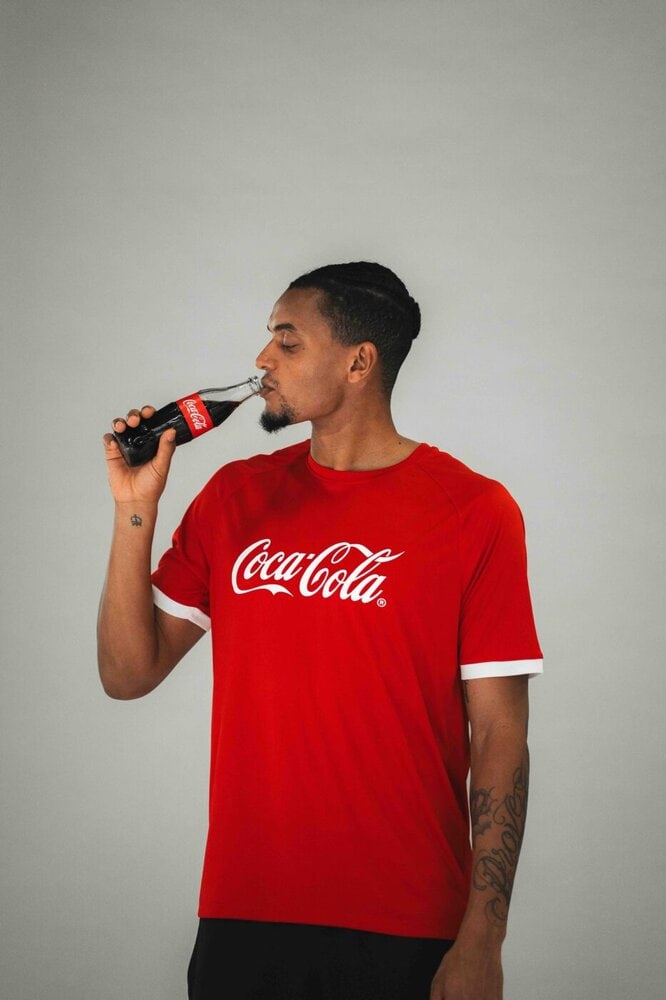
Coca-Cola Switzerland is celebrating 90 years of production in Switzerland this year and has made a conscious choice: Manuel Akanji, one of the best-known Swiss footballers of his generation, will be the new brand ambassador. The defender of the Swiss national football team combines sporting excellence with approachability and down-to-earthness - qualities that are deeply rooted in everyday Swiss culture and that have characterized Coca-Cola for decades.
Football as a unifying element
«Football has the special power to bring people together,» says Giulio Franscini, Brand Manager at The Coca-Cola Company Switzerland. «Especially in a year in which Coca-Cola is celebrating its 90th anniversary in Switzerland, we wanted to work with a personality who embodies this feeling in a credible way. Manuel Akanji stands for team spirit, reliability and closeness to the fans - values that fit perfectly with Coca-Cola. Together we create moments that connect people in everyday life.»
Personal connection to the brand
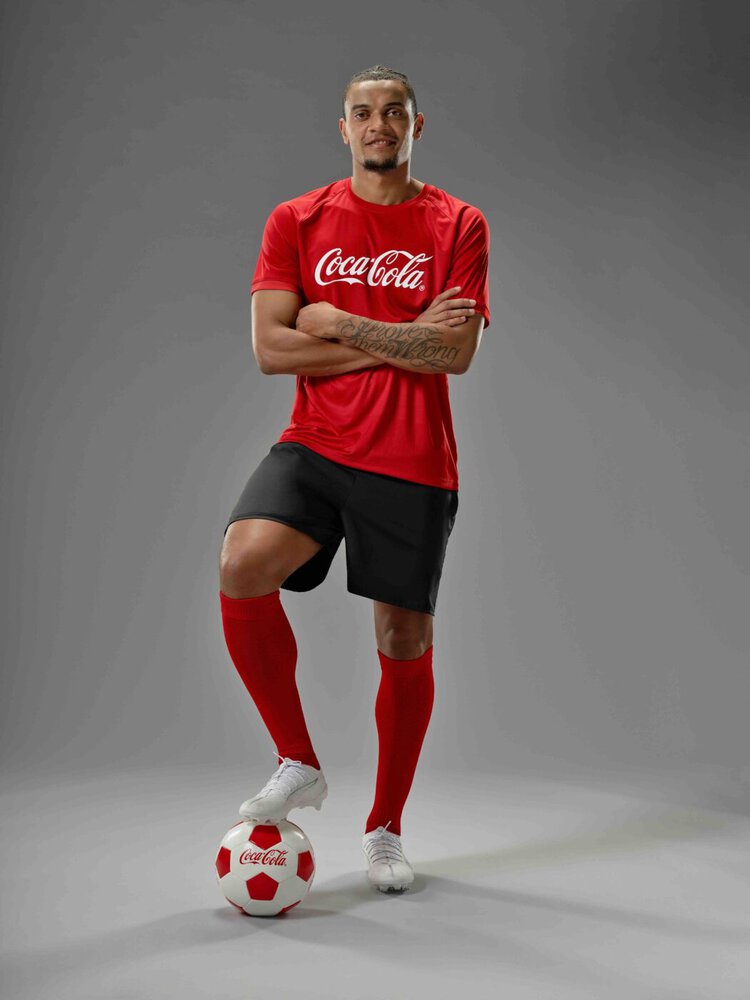
For Manuel Akanji, the decision to work together was a personal one: «Coca-Cola has been with me for a long time - especially when it comes to football. When you sit down with your colleagues after the game, review the match and spend time together, a Coke is simply part of it. Those are the moments that stay in your memory. That's why this partnership feels real and appropriate to me. I'm delighted to be working with the brand that I've associated with these moments for so long.»
Campaign for the 2026 FIFA World Cup
The partnership is embedded in Coca-Cola's global activities surrounding the 2026 FIFA World Cup. Various activations are also planned in Switzerland in this context, which will be gradually brought to life over the coming months.
The campaign will be played out across various channels and includes digital content, social media formats, out-of-home and digital out-of-home placements as well as activations in retail and gastronomy. It is supplemented by competitions and fan experiences - including signed jerseys, an exclusive meet & greet with Manuel Akanji and other activations in public spaces. Initial content and placements will be visible from mid-April, with comprehensive activations following in May.
More information: https://www.coca-cola.com/at/de/offerings/fifa-world-cup-2026
]]>
From February 9, Coca-Cola Switzerland is launching a national campaign in collaboration with Swiss chef, author and content creator Noah Bachofen. The collaboration will be played out via a broad multi-channel approach and includes TV advertising, an out-of-home and digital out-of-home campaign, social media content, influencer collaborations as well as social and YouTube advertising.
The idea is to combine everyday moments of pleasure with Coca-Cola - inspired by Swiss food culture and regional diversity. The collaboration is based on a personal story from Noah Bachofen: "We had a tradition in our family where we were allowed to choose what we wanted to eat on our birthday. Something different every year - schnitzel, burgers or rösti. But what always remained the same was the drink to go with it: 'Coci'. This memory from my childhood still stands for special moments, joy and enjoyment for me today," says Noah Bachofen.
90 years of Coca-Cola in Switzerland
The campaign coincides with a special year for Coca-Cola Switzerland: Coca-Cola has been produced in Switzerland since 1936. The 90th anniversary was also the occasion to focus on Swiss food culture. Together with Noah Bachofen, dishes were created that take regional classics and interpret them in a contemporary way. These dishes are part of the campaign and appear in the visuals and moving images.
Anna Cremer, Senior Marketing Manager at Coca-Cola Switzerland: "In Noah Bachofen, we have found a partner who is very close to everyday life in Switzerland and shows enjoyment as it actually happens - uncomplicated, personal and genuine. In our anniversary year, we are building on our long-standing connection to Swiss food culture and making this visible in the campaign."
Culinary kick-off with a regional twist
To launch the collaboration, Coca-Cola Switzerland and Noah Bachofen invited media representatives and influencers to an exclusive dinner event. Noah Bachofen personally cooked for the guests and put together a multi-course menu that combined culinary specialties from different cantons.
As a starter, he served Bernese onion tart with Glarus Schabziger and Glarus Alpine cheese - a culinary meeting of Glarus and Bern. The main course united Graubünden and Vaud: capuns with Vaudois saucisson and sauerkraut. Dessert was a sweet greeting from Aargau - a new interpretation of the Aargau Rüeblitorte.
The menu reflected Noah Bachofen's playful approach to Swiss cuisine and embodied the central idea of the campaign: to bring together diversity, Swiss origins and enjoyment in a contemporary way.
Coca-Cola Switzerland has been producing locally for Swiss consumers since 1936 and employs around 700 people. 95 percent of all ingredients come from Swiss suppliers, mostly partners from the region. In addition, for every job created directly, Coca-Cola creates eight more jobs in Switzerland.
]]>
Coca-Cola has been produced in Switzerland since 1936. To mark its 90th anniversary, the company is making visible who is behind the global brand: with the new multichannel campaign "Made by", Coca-Cola is portraying employees from different regions of Switzerland, thereby demonstrating the local roots of the globally renowned beverage manufacturer.
Real people instead of models
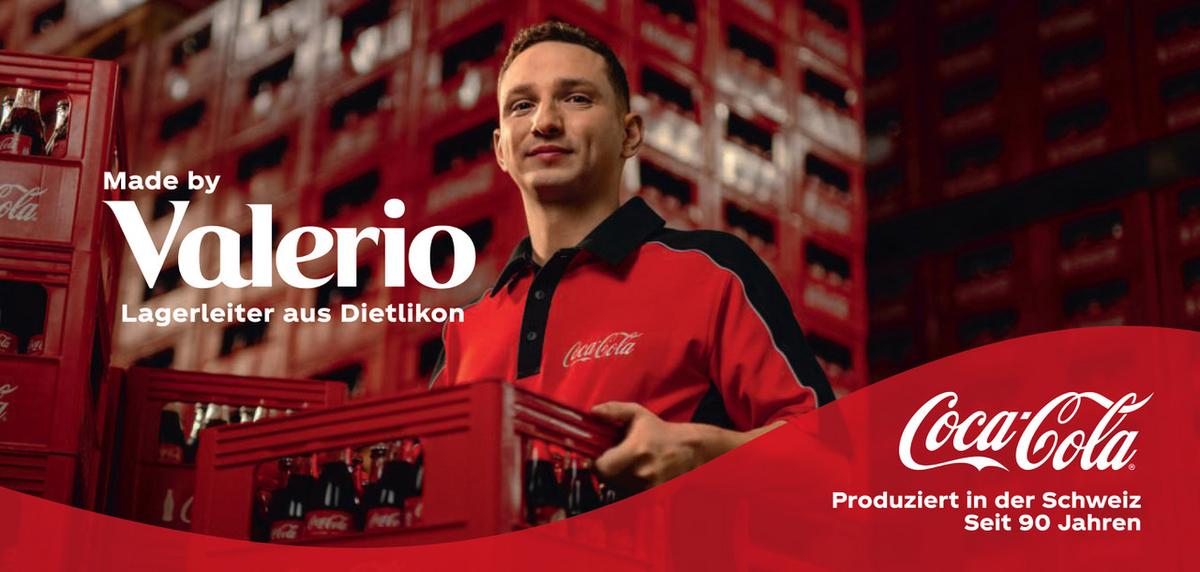
The campaign does not focus on famous testimonials, but on real employees of Coca-Cola HBC Switzerland. The portraits include Reto, Plant Manager from Schänis, Seraina, Quality Manager from Bärteswil, Valerio, Warehouse Manager from Dietlikon, Christine, Sales Manager from Geneva, Walter, Sales Consultant from Lucerne, and Tina, Head of Event & Activation from Zurich.
The campaign material shows the protagonists in their real working environment. First name, function and origin highlight the diversity and regional roots of the people who have shaped Coca-Cola in Switzerland for nine decades.
90 years of local value creation
Coca-Cola HBC Switzerland, a subsidiary of the Coca-Cola Hellenic Beverage Company based in Zug, employs around 650 people and supports more than 7,700 jobs along the entire value chain throughout the country. Around 80 percent of the beverages consumed in Switzerland are produced here, and around 95 percent of the ingredients used come from Swiss suppliers. In total, the company contributes around CHF 833 million to the Swiss economy every year.
"These 90 years stand for continuity and responsibility," says Jürg Burkhalter, General Manager of Coca-Cola HBC Switzerland. "Local production, reliable jobs and targeted investments, such as the recent construction of our new high-bay warehouse in Brüttisellen, are an expression of our long-term commitment to Switzerland as a business location."
Multichannel campaign throughout the country
The campaign is being rolled out across Switzerland as an integrated multichannel campaign. It comprises key visuals for DOOH, OOH and print, photo and video content, including short moving image formats for social media, digital banners for online implementations and static assets for social media.
The content was produced at the Coca-Cola HBC Switzerland production facility in Brüttisellen, in logistics and work environments and in a restaurant setting in Opfikon. The campaign was created in collaboration with Ogilvy Zurich and Swiss photographer Yves Bachmann.
"For 90 years, Coca-Cola has been produced in Switzerland by people for people. With 'Made by', we are showing the faces that shape our brand here in Switzerland every day - and making visible how strongly Coca-Cola is anchored locally," says Anna Cremer, Senior Marketing Manager, The Coca-Cola Company Switzerland.
From Max Stooss to today
The story begins in the mid-1930s, when the young car importer Max Stooss brought Coca-Cola to Switzerland. In 1937, the first bottling plant went into operation at Letzigraben in Zurich. Over the following decades, further production sites were built, gradually supplying the whole of Switzerland.
Coca-Cola will be present with various initiatives throughout the anniversary year. Among other things, partnerships and appearances at national events such as the Special Olympics National Summer Games in Zug are planned. With commitments in music, sport and inclusion, such as the CokeSTUDIO Soundcheck or the partnership with Special Olympics Switzerland, Coca-Cola has become an integral part of Swiss society and pop culture.
"This anniversary is more than just a birthday," says Fabio Cella, Country Manager Coca-Cola Switzerland. "It shows how much Coca-Cola in Switzerland is shaped by the local people and how important it is to continue to take responsibility and remain relevant, both for society and for culture."
Responsible at Coca-Cola: Anna Cremer, Senior Marketing Manager. Responsible at Ogilvy Zurich: Creation and realization (no further names mentioned). Photography: Yves Bachmann.
]]>
The Accademia Vergnano opened at the EHL Hospitality Business School on November 5, 2025. The partnership between Coca-Cola HBC Switzerland, Caffè Vergnano 1882 and EHL creates a new competence center for coffee excellence in Switzerland that combines traditional coffee craftsmanship with innovation and sets a new, practice-oriented standard in the training of future hospitality executives.
The Accademia establishes coffee as a strategic element in the hospitality sector and combines academic knowledge, practical training and global expertise to create a dynamic learning environment. Students learn about all stages of the coffee value chain: from cultivation and roasting to taste and preparation. The space combines a café, a training center and a boutique, creating a lively place where students, professionals and coffee experts can come together, exchange ideas and jointly provide impetus for the further development of coffee quality.

Markus Venzin, CEO of EHL Hospitality Business School, explains: "The Accademia Vergnano strengthens our educational offering specifically in the area of coffee. It combines scientific principles with practical application and meets our aim of preparing students for their future management tasks with real industry practice."
Coffee as a strategic factor in the hospitality sector
In Switzerland, around eight kilograms of green coffee are consumed per capita every year - that is equivalent to around three cups a day and is one of the highest figures in the world. Coffee is therefore an integral part of Swiss culinary culture and the hospitality industry. The increasing demand for quality, sustainability and transparency of origin makes it an important differentiator in the catering and hotel industry.

Carolina Vergnano, CEO of Caffè Vergnano 1882, explains: "With the Accademia, we are bringing our 140-year coffee heritage to Switzerland and making it possible to pass on and develop Italian coffee culture in an international environment."
Alain Mettler, Coffee Business Manager at Coca-Cola HBC Switzerland and EHL alumnus, adds: "The Accademia creates a place where specialist knowledge is pooled. In this way, we are contributing to the professionalization of the coffee market and promoting the exchange between education and practice."
Platform for knowledge, practice and passion
Together, EHL, Caffè Vergnano and Coca-Cola HBC Switzerland are setting standards in terms of quality, sustainability and the next generation of leaders in the hospitality industry. The Accademia Vergnano is more than just a training center - it is a platform that combines knowledge, practice and a shared passion for coffee. These efforts are helping to shape the future of the hospitality industry and coffee culture in Switzerland.
]]>
With Peace Tea, Coca-Cola is launching a strikingly designed, caffeinated iced tea product for the first time outside North America - exclusively in Switzerland (Markt-kom.com reported). The target group: young adults with an affinity for design and functional added value. But is a strong look enough to score points with Gen Z?
A concept test from Deeptrue with 200 people between the ages of 16 and 29 shows what really matters to this generation. And why early, well-structured feedback should be part of the basic strategic equipment of every market launch today.
Gen Z - selective, but responsive
Generation Z has grown up with an oversupply of messages, products and platforms. They move confidently through digital spaces, deal with social issues and expect more from brands than just product promises. For many, concepts such as attitude, consistency and meaningfulness are not peripheral, but at the heart of the decision.
It is not possible to draw a uniform profile of values. What is noticeable, however, is that superficiality is quickly seen through. Those who are too loud, too smooth or too vague lose out. Those who communicate cleverly and clearly, on the other hand, gain interest. Brands that listen to this generation (keyword consumer listening) instead of just courting them create a basis - not just for consumption, but for relationships.

A sober look at peace tea
As part of a concept test on the DIY market research platform Deeptrue In mid-May 2025 - before the launch in Switzerland - 200 people aged 16 to 29 from German-speaking and French-speaking Switzerland were invited to evaluate the "Peace Tea" product based on the visual concept. The focus was on the design, the communicated product promise - caffeine as an additional functional benefit - and the perceived fit with the target group. Both standardized assessments, such as purchase interest or credibility, and open comments were recorded in order to understand likes, dislikes and spontaneous associations with the product.
The aim of the survey was not confirmation, but honest feedback: Which elements are convincing - whether in terms of design, value proposition or brand fit? Where do doubts arise? And where does Peace Tea remain too interchangeable despite its eye-catching look?

Good first impression
The concept was convincing at first glance: 73% of respondents gave the product idea a positive rating. The eye-catching, colorful design in particular was perceived as suitable for the target group. The language was described as youthful, playful and "different from classic drinks". Peace Tea hit a nerve - at least superficially.

But what sticks - apart from the look?
As soon as it came to the core content, a more differentiated picture emerged: although the promise - iced tea with caffeine - was understood, the functional benefits remained abstract for many. For some respondents, the brand was visually attractive, but the narrative was unclear.
This tension was particularly evident in the open comments. Two interviewees put it this way:
"I can see where it's going, but I don't see the thinking behind it."
"I like the design - but somehow the product doesn't tell me anything about itself."
Attraction yes, connection missing
The results show: Peace Tea is a good example of how design opens doors - but does not yet lay a foundation. The concept appeals, stands out, attracts attention. But for it to become relevant, it needs more than style. It needs a story that sticks - and substance that delivers what it promises.
What brands can learn from the test case
The results show that new products need more than originality - they need connectivity. An honest narrative, recognizable values, a connection to the reality of the target group's life. Anyone who thinks this can be delivered later has often already lost.
This is precisely why early, structured testing is worthwhile: a simple concept test, set up correctly, not only shows whether a product is appealing - but also where it is not yet understood. This is not a weakness, but a strategic advantage. Because such feedback allows adjustments to be made before major investments are made. They make consumer centricity concrete - not as a buzzword, but as an approach.
The DIY market research tools available today, such as those from Deeptrue massively lower the threshold for carrying out such tests. Valid consumer insights can be gained without a long lead time - quickly, comprehensibly and in a way that can be integrated into the development teams. This means that empirical consumer research is not an obstacle, but an accelerator of smart decisions.
Conditional dispute
Generation Z is ready to engage with new products - but not unconditionally. If you take Gen Z seriously, you will not encounter arbitrariness, but clarity. The Peace Tea study shows: Good design is a start, but not an argument.
If you want to launch successfully today, you need more: real listening, early feedback, clear adjustment. Brands that follow this path not only win customers - they win people who feel understood. And that is more than just market success. It is relevance.
]]>
Peace Tea was first launched in North America in 2009 and is reportedly very popular there - especially with a young, active audience. Switzerland is now the first international market in which the brand is available.
The new product line combines black tea with yerba mate, green coffee bean extract and natural fruit flavors, with each flavor containing 75 mg of caffeine. With four flavors - Lively Lemon, Mighty Mango, Berry Boost and Punchy Peach - the drink is designed to meet the needs of an active, trend-conscious target group.
Accompanying multichannel campaign
The market launch will be accompanied by a comprehensive marketing campaign. National POS activations, online and social media campaigns, influencer collaborations and targeted sampling campaigns are planned. The launch will be complemented by digital content and an eye-catching presence in urban areas. The aim is to draw the attention of a young, trendy target group in particular to the new drink.
An exclusive launch event on May 22 with local partners from the creative and fashion scene also promises various surprises.
]]>
The "Share a Coke" campaign, first launched in 2011, is returning to Switzerland in 2025 with an expanded scope. Instead of the brand logo, first names will appear on Coca-Cola bottles and cans, which are now available in stores. The campaign is aimed at greater personalization and will be communicated via a broad-based marketing mix.


In Switzerland, Coca-Cola is relying on a multi-channel approach: in addition to OOH measures, the campaign includes TV spots, social media formats, POS promotions, influencer cooperations and sampling. A nationwide roadshow with ten stops is also planned. At the respective event locations, visitors can design their own can and have it digitally visualized on site and take and share photos in a photobooth. Coca-Cola will also be present with the campaign at several major Swiss festivals.
A central element of the campaign is the official launch event on May 8 in Zurich. Luca Hänni, Kings Elliot and Loco Escrito will be performing at the Acrush event location. The event will be supported by various Coca-Cola influencers, including Noemi Nikita, Kris Grippo, Kevin Lütolf and Chiara Castelli. Event tickets will be raffled off via the Coca-Cola app.


Under the slogan "Play with the color you want", Fanta is launching colorful Xbox Series X consoles and wireless controllers inspired by the flavors Fanta Orange, Fanta Orange Zero, Fanta Exotic and Fanta Shokata. Fans can win the exclusive devices by scanning the QR code on Fanta packs and entering the prize draw via the Coke app. In addition, thousands of trial codes for Xbox Game Pass Ultimate will be raffled off.
Fanta and Xbox are also hosting a gaming event at "The Hall" in Dübendorf on February 28 as part of their collaboration. The winners of an online prize draw will compete against each other in Xbox games together with well-known Fanta influencers and Swiss gaming celebrities. Interested parties can register free of charge on the Coca-Cola website and choose their favorite influencer as a team member. The 80 winners will be notified two weeks before the event.
]]>
The aim of the campaign was to emphasize the position of business developers (BD) as key players in the company. A modular Storyworld framework was used for this purpose.
In order to meet the high demands of Coca-Cola HBC's international network and at the same time reach employees throughout Switzerland, a modular feature-length film was created. This was provided with versatile "predetermined breaking points" that allow targeted adaptations for different channels and target groups.
For the production, Corpmedia used the Sony Burano cinema camera, which shot in 8.6K resolution and thus ensured the highest image quality. The focus was on dynamic transitions and fresh locations in and around Zurich to give the campaign an unmistakable aesthetic.
According to the agency, the reactions to the campaign were consistently positive. The quality of the images and the dramaturgical implementation were particularly well received. Thanks to the modular structure and high resolution, the material can be used for both digital channels and print campaigns.
]]>