CNN's outstanding ratings and website traffic in the US confirm this result, according to a CNN statement. To understand the global impact and interest in the US election, CNN commissioned independent market research firm Toluna to study the opinions, viewing and usage habits of adults from over 23 countries in Europe, the Middle East, Africa, South America, Canada and the Asia-Pacific region on the race for the White House.
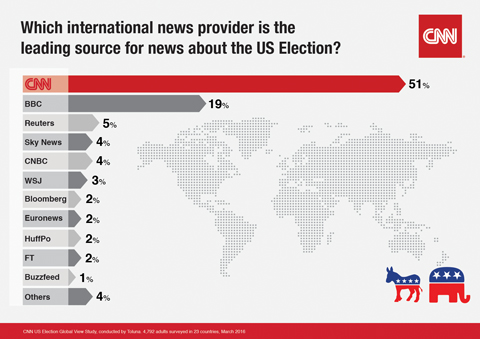
The results of the "CNN US Election Global View" study show that 51 percent of respondents watch or use CNN to find out about the current status and results of the US election. This means that CNN performs better than all other international news providers combined: BBC comes in at 19 percent, Reuters at five percent and Sky News at four percent. 78 percent of respondents watch or follow CNN regularly. 83 percent of them have used the CNN Politics service in the past week. The majority of respondents get their information linearly on CNN - 50 percent via TV, 31 percent via CNN.com, 14 percent via CNN's social media channels and eight percent via the CNN app. Commenting on CNN's coverage of the US election, 66 percent found the international news channel's information to be knowledgeable and intelligent, 64 percent considered it to be technically competent, 64 percent comprehensive, 62 percent engaging and 60 percent standard-setting.
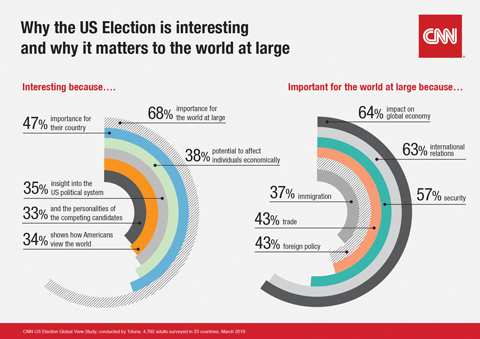
In addition to examining user behavior, the personal interest of the respondents in the US election also plays a role in the survey. The main reasons for this are:
- General international importance (68 percent)
- Importance for their own country (47 percent)
- Possible individual economic impact (38 percent)
- Insight into the US political system (35 percent)
- Indication of Americans' world view (34 percent)
- Interest in the incumbent presidential candidates (33 percent)
Respondents gave the following reasons for the global relevance of the presidential election:
- Important role of the USA in the global economy (64 percent)
- Impact on international relations (63 percent)
- Role of the USA in global security and the fight against terrorism (57 percent)
- Trade policy and a shift to a tougher US foreign policy stance (both 43%).
Why the US election is captivating the world...
A commentary by Petra Malenicka, Senior Vice President, Western Europe & The Americas, Advertising Sales, CNN International
It's a topic that everyone has an opinion on. Whether in meetings, on the plane or talking to my children - everyone is talking about the presidential election campaign in America, which seems to be heading towards a duel between Clinton and Trump. There is still some time until the final election in November, but the most diverse people I come into contact with are already captivated. This is reflected not least in CNN US's impressive ratings and website hits. But the question remains: beyond my personal experience, how relevant is the election for the international audience?
As a company that prefers to base its decisions on facts rather than intuition, we commissioned a study to understand how the world is following one of the biggest news events of 2016. Independent market research company Toluna analyzed the opinions, viewing and usage habits of adults from almost 5,000 interviews from over 23 countries in Europe, the Middle East, Africa, South America, Canada and the Asia-Pacific region. The results show such a high level of interest that even I was surprised: 85% of respondents consider the US election to be important for world events and 73% are personally interested in the race for the White House.
The main reasons for this are:
- General international importance (68 percent)
- Importance for their own country (47 percent)
- Possible individual economic impact (38 percent)
- Insight into the US political system (35 percent)
- Indication of Americans' world view (34 percent)
- Interest in the incumbent presidential candidates (33 percent)
The last point in particular piqued my interest. With all the discussions about the so-called "Trump effect", interest in the incumbent presidential candidate is only in sixth place.
Respondents gave the following reasons for the global relevance of the presidential election:
- Important role of the USA in the global economy (64 percent)
- Impact on international relations (63 percent)
- Role of the USA in global security and the fight against terrorism (57 percent)
- Trade policy and a shift to a tougher US foreign policy stance (both 43 percent)
It is clear that respondents around the world see this election as a defining moment in American foreign policy.
In addition to the global interest in the election, we were also interested in finding out how and through which channels respondents obtain information on the topic. The results of the study speak for themselves: more than half of those surveyed, namely 51%, use CNN to follow the current status and results of the US election. This means that CNN performs better than all other international news providers combined: BBC comes in at 19 percent, Reuters at five percent and Sky News at four percent. Even though we had hoped for this result, confirmation from an independent study is important for us. With so much on offer in the media landscape, the battle for attention and viewers is fierce. Another interesting aspect is which channels the respondents use to obtain information. The majority inform themselves linearly on CNN - 50 percent via TV, 31 percent via CNN.com, 14 percent via CNN's social media channels and eight percent via the CNN app. Contrary to the pessimism - linear television is alive and well, although it is being expanded to include digital offerings.
This study is an important tool to provide marketers and media professionals with a quantitative assessment of how engaged the world is with the current US election campaign. It is often said that the money follows the audience and with our advertising strategies we offer the opportunity to do just that. Now we have tangible proof of the public's thirst for knowledge about the presidential election, which we want to satisfy with the new show "State of the Race" on CNN International. My tip to national advertisers: Be part of what the world is talking about. Regardless of regional political developments and the upcoming election results in November - the US election cannot be ignored because the world is watching with great interest.
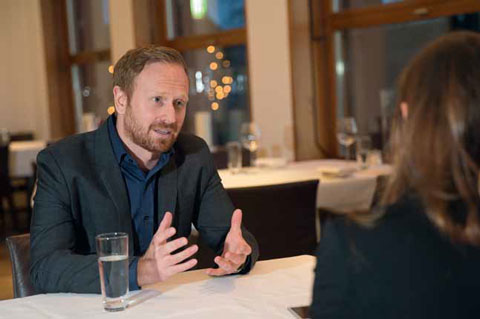
At the fifth CNN Davos Debrief, Alain Dehaze, CEO Adecco Group, Urs Rüegsegger, Group SEO Six, John Defterios, Emerging Markets Editor CNN with moderator Richard Quest, CNN International Business Correspondent, assessed current world events and took a look into the future. Also on site was Rob Bradley, Head of Digital Advertising Revenue and Data at CNN International. Advertising Week had the opportunity to talk to him about the new programmatic advertising department at CNN International and current trends in digital advertising.
Could you quickly explain why CNN International established the section Digital Advertising?
Rob Bradley: CNN has done digital for many years. I suppose now it's ramping up its presence digitally, even further, mainly because we're moving towards thinking about audience first not individual platforms. Our audience views our content on TV on the phone on their tablet or desktop, at work on the train, when they're traveling. So we try to make sure, when we're presenting that content, it's in the right platform where people are actually consuming it. What I mean is, our advertising needs to represent this too. So we're moving to where the majority of our campaigns are cross-platform.
What is nice for me to see is that we're sometimes getting bigger digital spends as we are on TV. So combining the two is very unique for us.
So you're saying, digital is even more important than TV nowadays?
I wouldn't say digital is more important. TV is still the biggest platform we have. I'd say it's as important. What digital does is allow you to be incredibly targeted. Digital allows you to understand a lot of what is going on in a campaign, which you can't always do on TV. So it's a kind of harvesting the information you get from digital and that allows to give the client personalized information on that campaign. So the combination of the two is what's powerful.
Would you say, targeting and reporting is gonna be the main topic this year?
I'd say targeting is the first thing people look for in campaigning. But more and more with digital, it's branded content or sponsored content. We have a creative agency in the house, spread around the world in four different cities and they create content for the clients. This content is video-led normally. The client can have feature-pages, social-communities. So it's about getting targeting in place, yes, but also about delivering messages in a creative way.
How do you see Ad-Blocker - problem or chance?
I think it's a problem for the whole industry, a big education-piece needs to happen. Look at it this way: incredibly quality content, that comes at cost, right. And then we get to help fund that content. So internet-users need to understand that if they want that content they're gonna have to be shown adverts that allows us to sort of pay for the content. I think it's that way also to deliver the messages. Our user experience is paramount, so we're not showing ads to everyone in their face left right and center and doing this incredibly high-impact full amounts. So actually the thing is that people need to understand that if they're not gonna see ads they're gonna start getting less quality content, or content which didn't necessarily have the proper research into it.
Luckily for us, we have a huge scale, so the ad-blocker problems ar not hitting us massively. But we're definitely having a very close eye on and we'll create a strategy in place.
Don't you think people would rather pay more for the content than being forced to pay by watching a lot of not necessarily quality adverts?
Lots of companies are now doing that. But their subscription based model doesn't go so far though. I think their subscription is not enough to pay for the content, they still need advertisement. That's just part of it. So yes, people can start paying for content, like via micropayment. But I always think, people would still prefer to gain that content for free and put up with the adverts as long as they're not too intrusive or follow around too much.
You are concentrating on programmatic strategies and implementing data-oriented strategies, like integrating social media. What solutions for programmatic advertising are you developing right now?
Data's been around in the industry for a while now and we're very careful how we manage that data. People are interested in certain areas of content so we're showing adverts based on that interest.
One thing we're really pioneering is reporting. Reporting is basically trying to understand how deep we can go when it comes to clients campaigns and understanding how the campaigns performed. So moving away from just the CTR. I think the industries relied on the CTR for too long. So we're moving towards the point of reporting: the number of hours that ads had been viewed, the engagement, so the amount of time people consume that video or being on that page which has ad-features, the types of people being on that page. Reporting is also based on people's interest, like if they are reading sports for example, business, finance or news.
So reporting really is about to kick in to the industry. But very few media-owners do well at the moment. Most clients normally get a spread-sheet which says about the CTR and has the different ad-impressions and clicks and so on. So the reporting side, what people looking at, is gonna come into this year quite heavily - for the smart publishers anyway.
Do you see big differences in the US and Europe when it comes to reporting?
My role is very global so I see the differences in the markets very well. From that perspective I'd say London is not behind New York. It has advanced and sometimes even more advanced technology than NY. Well, NY leads the slight majority, but London is not far behind and Western Europe is the second most advanced market in the world. There are pockets, like Holland or France which are incredibly advanced.
Places like Asia, Africa, Middle East and South America are still quite far behind. A lot of things like programmatic or data-management, reporting - we can go there and influence the market. Meanwhile, in Western Europe there are many big media-owners trying to win the budget.
How about China?
We class China as a very key market. We have good reach in China, and it is advanced. If you look at some of the advertisement that comes out of Hong Kong, that leads the way, Shanghai and Beijing as well. Its got almost 650 million internet users. We see China as a big opportunity for us and they can be advanced, they are very good technical, so they're not far behind.
If you look at India and Africa: it's this new generation of millennials and young people, they may not even have a computer, but they've got a smartphone. And that smartphone is where they're reading all of their news, all of their content and keeping up to date. As a brand we need to ensure that we are delivering the right content and in the way they want to consume it. The way you deliver that content needs to be different and the way you actually deliver the advertisement needs to be different.
So, you're strategy for 2016 is mainly concentrated on mobile?
If you look at my strategy for 2016, half of it has to do with mobile. If you compare our desktop users to our mobile users, over 50 percent of our audience is now mobile, which is a huge amount. And if there are big stories, such as the Paris attack, it went up to 80 percent consumption on mobile. We need to make sure to deliver the information on mobile now as much as we are desktop.
We're living in a digital world now. Turner, who owns CNN, is in the state to moving away from traditional advertising on TV, even moving towards more long form native advertising. So that 30 seconds spot may start changing over the next few years. You will see more and more creative solutions on TV, just like you're seeing online right now.
What is your vision for the future for digital advertising?
I think what's gonna happen is; we need to get these personalized advertisements, but doing it in a way they trust the media-providers and then moving away from standard advertisement. There are very smart ways of delivering advertisement.
The future will be much more video when it comes to advertising, and much more mobile. Mainly it goes into the direction of being more creative. You know, an advert could be an information based video to be about the moon sponsored by one of the technical brands, like Microsoft. That would still be delivering a message, that Microsoft are doing technology but then also giving people kind of information, like who landed on the mars. That's the kind of thing I'd like to see more.
Interview: Ursina Maurer

CNN International created the new Digital Advertising Revenue and Data department in spring 2015.Rob Bradley joined CNN International in May 2015 as Head of Digital Advertising Revenue and Data. In this role, he oversees the global optimization of CNN International's reach, the international expansion of the company's programmatic strategy and the implementation of modern, data-driven strategies, including social media integration. Bradley also leads a new team of experts working with CNN International's regional sales leaders to develop new digital components for integrated advertising and sponsorship solutions.