"Film Commission Switzerland" is called SonntagsBlick the organization with which the industry, under the auspices of the umbrella association Cinésuisse, wants to put Switzerland back on the map of international film productions. What used to be commonplace - for example, with the James Bond classics "On Her Majesty's Secret Service" (1969) or "Goldfinger" (1964, pictured above) shot in Switzerland - has become rare today: Switzerland as a location for blockbusters. The last Bond, for example, was shot in Austria, as Vienna had helped out with targeted subsidies. The psychological thriller "A Cure for Wellness" is set in Switzerland, but was not filmed here at all, but in Germany.
Switzerland has so far lagged behind in terms of audiovisual location promotion, as Thomas Tribolet of the Swiss Film Producers Association (SFP) told the SonntagsBlick elaborates: "Today, every country in Europe has a Film Commission - except Switzerland." That is about to change - the new organization is intended to attract more major foreign film productions to Switzerland.
There are many reasons to choose Switzerland. Not only can the country offer "the best film technology and film organization services," says Tribolet, but also a suitable hotel industry and general infrastructure.
If Cinésuisse has its way, the new organization should be financed by federal funds. According to Thomas Tribolet, producers are pursuing the goal that Seco would also provide funding for audiovisual. BDP Council of States member Werner Luginbühl is convinced that the investment would pay off: A four-week production, for example, costs foreign production companies four million francs.
There is also a marketing effect for Swiss tourism. The Schilthorn, for example, where "On Her Majesty's Secret Service" was filmed, still benefits from the worldwide fame of the Bond film and is still a popular destination for foreign guests 50 years after filming ended.

The wording of the "No Billag" initiative is misleading: the initiative does not abolish Billag, but Swiss radio and television. The text of the initiative makes this clear: at the beginning of next year, the fees will be abolished and the licenses (broadcasting rights) of Swiss radio and television will be auctioned off to the highest bidder. The popular initiative "Yes to the abolition of radio and television fees" would deprive Swiss radio and television of its financial basis. The operation of SRG would have to be discontinued. The Federal Council has clearly communicated this.
In one fell swoop, Switzerland would lose one of its most important independent quality media houses. And with it a piece of identity that foreign media and social media could never replace. The popularity and importance of Swiss radio and television is reflected in the high audience ratings and high reach - the market share of radio programs is around two thirds and that of television programs around one third. Without Swiss radio and television, there would no longer be a medium that reaches 94% of all households every week.
This would be expensive for the Swiss: The Swiss population would be at the mercy of commercial providers and would be asked to pay extra for many services. Most of the current advertising revenue would flow abroad. In addition, accepting the initiative would also be a miserable business in other respects: around 15,000 people would lose their jobs. Including many filmmakers. This is another reason why Cinésuisse, the umbrella organization of the Swiss film and audiovisual industry, and its members, as well as numerous other associations from the communications industry, are firmly opposed to this damaging initiative. They are receiving support in the form of strategy and creation from the Havas agency, for whose CEO Frank Bodin this commitment is a matter close to his heart.
Bruno Ganz:
Joel Basman:
Seven:
Stefan Gubser:
Stefanie Heinzmann:
Tonia Maria Zindel:
The shortest movie spots in Switzerland from January 11
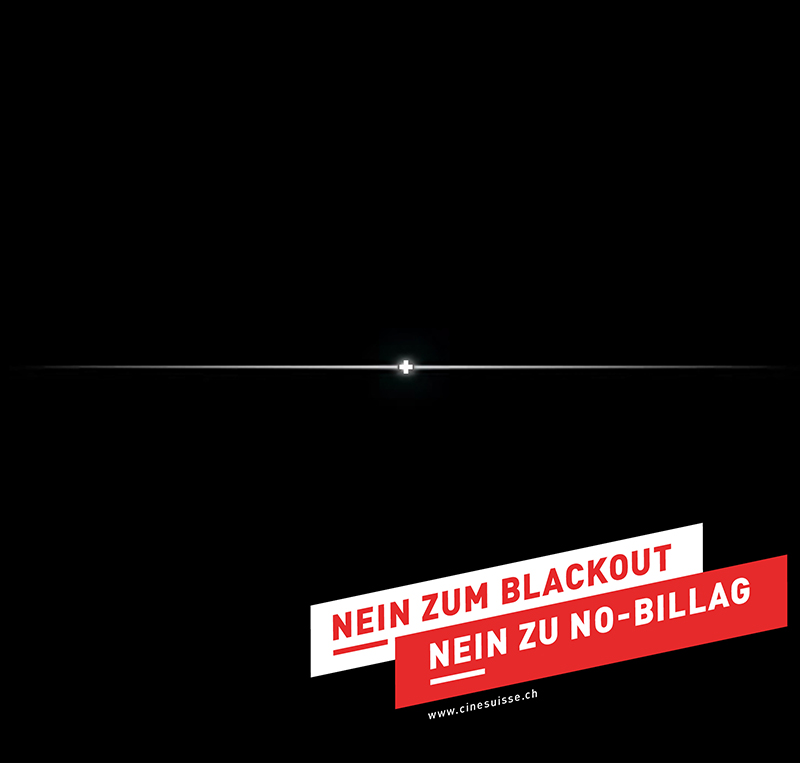
If Swiss radio and television were to stop broadcasting, it would mean a blackout in two senses: A blackout for the SRG and a blackout for Switzerland. The campaign designed by Havas for Cinésuisse addresses precisely this: In short spots featuring popular Swiss personalities, the audience is shown what a blackout means.
Numerous Swiss personalities immediately made themselves available for the campaign. These include actors Bruno Ganz, Joel Basman, Stefan Gubser and actress Tonia Maria Zindel. Musicians such as Stefanie Heinzmann and Seven can also be seen. The commercials were produced by members of Cinésuisse. The spots will be shown in most cinemas in German-speaking Switzerland from January 11. On social media, the commercials will be supplemented with additional arguments against the initiative, such as a chart featuring Graubünden native Tonia Maria Zindel: "Without Swiss radio and television, our four national languages would no longer be on the program anywhere." Or Stefanie Heinzmann: "Without Swiss radio and television, a piece of Switzerland would be lost." Or Bruno Ganz: "Without Swiss radio and television, the free formation of opinion would suffer. And with it democracy."
A campaign involving the entire Swiss population
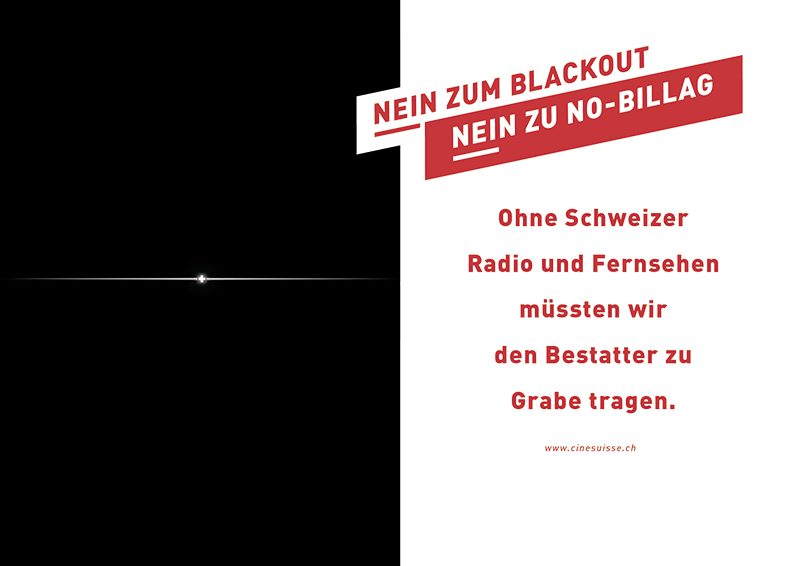
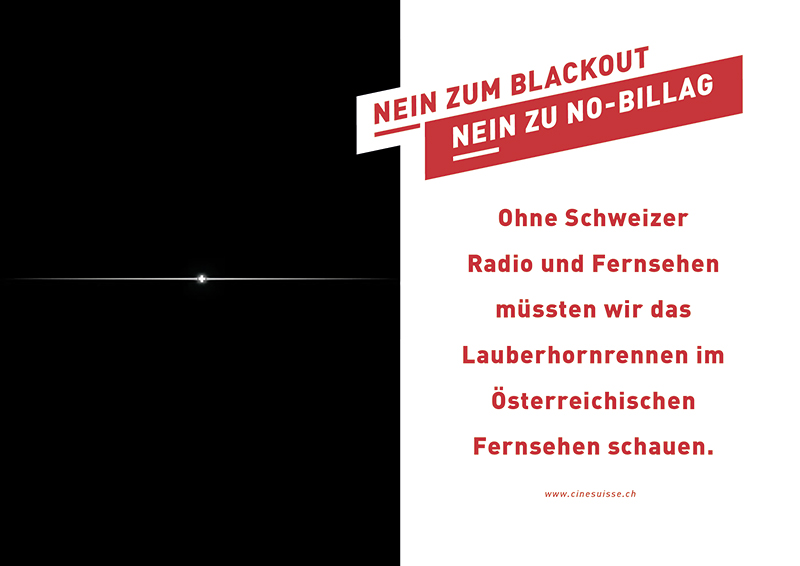
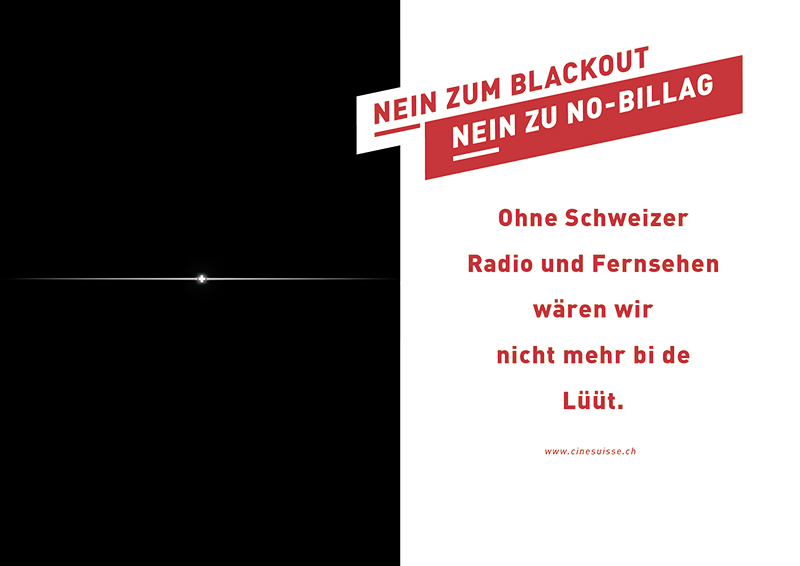
The well-known protagonists are just the start of the campaign. After all, the Swiss radio and television channels belong to all of us and the entire Swiss population plays a role in them. That's why people are being asked via social media to make their own blackout spots. In addition, the blackout key visual - the small white dot in the middle turns out to be a Swiss cross on closer inspection - is available as well as numerous small ads and banners with sometimes biting texts such as "Without Swiss radio and television, we would have to watch the Lauberhorn race on Austrian television" or "Without Swiss radio and television, we would have to carry the mortician to the grave." (pd)