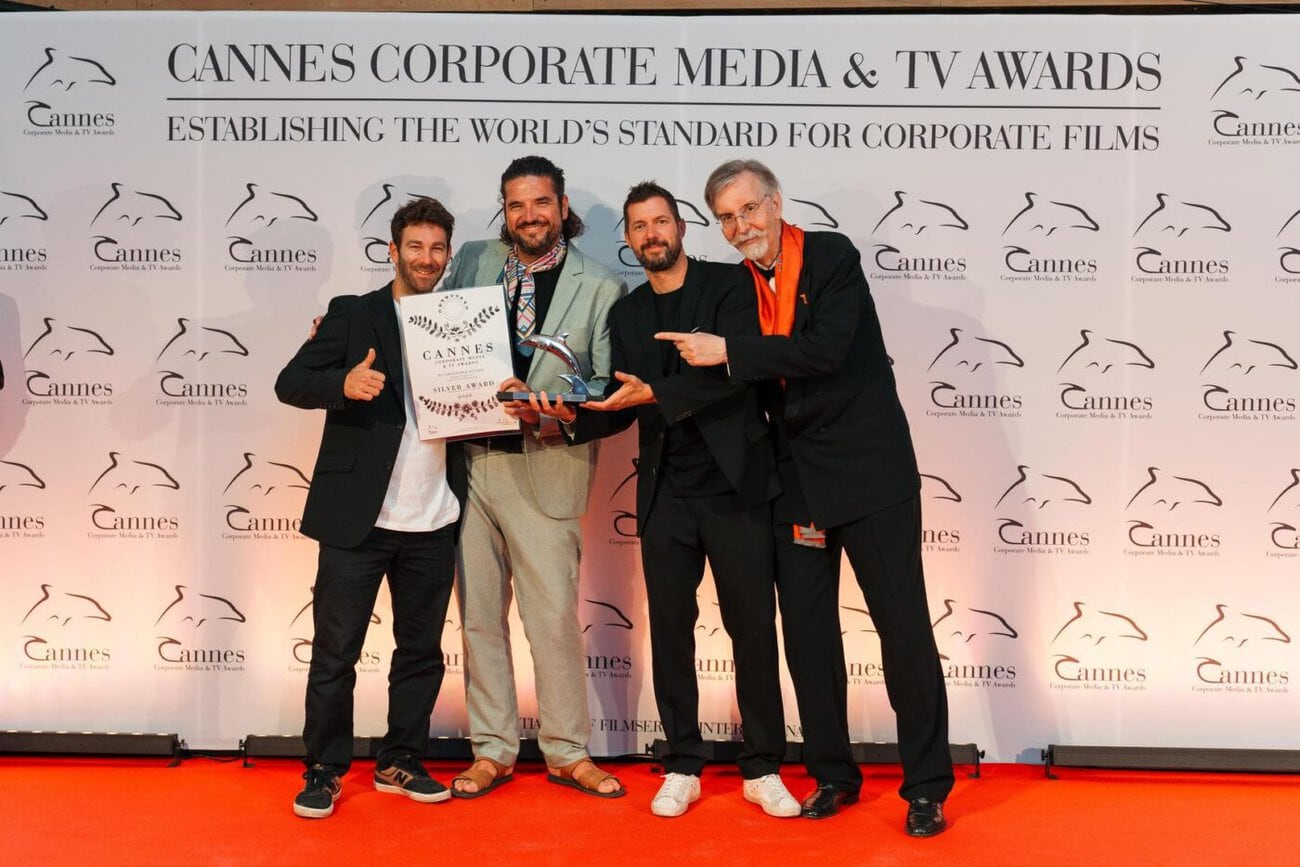
The video production company Maybaum Film received two awards at this year’s Cannes Corporate Awards. The Cannes Corporate Media & TV Awards took place on September 24, 2026, and honored two productions by the Baden-based company.
Silver for Wohlwend Transport AG's promotional video
The promotional film «We care for what we carry» for Wohlwend Transport AG won a silver award in the «Marketing Communication – B2B» category. The film shows how the Liechtenstein-based logistics company handles complex transportation and customs processes with a high degree of precision and responsibility.
Black Dolphin for Drone Operations at the Itris Group
The Itris Group’s Christmas film «Weihnachtsgrüsse» also received an award. The production won the Black Dolphin for best use of drones. The film combines continuous drone footage with a Christmas message and puts the Itris Group’s employees front and center.
]]>
B2B Marketing Study Shows: Trust Is the Deciding Factor in Purchases
A new B2B marketing study by Warc, LinkedIn, and Lions Advisory takes a close look at the emotional factors that shape B2B purchasing decisions today. B2B purchasing processes have changed: buying cycles now last 272 days and involve 22 stakeholders, with social and emotional factors playing an increasingly important role. In addition, artificial intelligence is changing how B2B buyers discover, research, and validate brands: According to the study, 94 percent of B2B buyers will use LLMs during their buying journey by 2025.
An analysis of more than 700 award-winning B2B campaigns shows that the most effective creative work not only captures attention but also strategically helps build confidence in decision-making. According to the press release, the most impactful campaigns consistently helped buyers feel more confident in their brand choices.
The Three Rs of Purchase Readiness: Recommendations, Relationships, Relatability
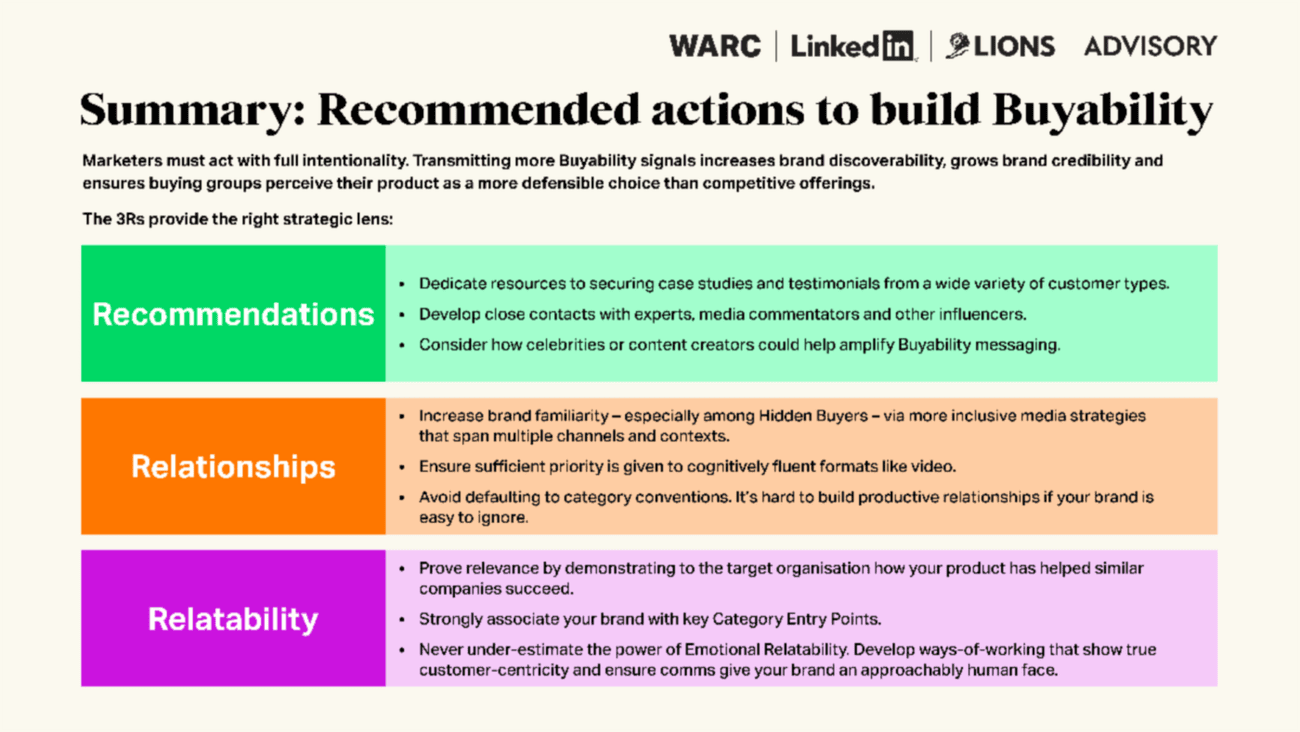
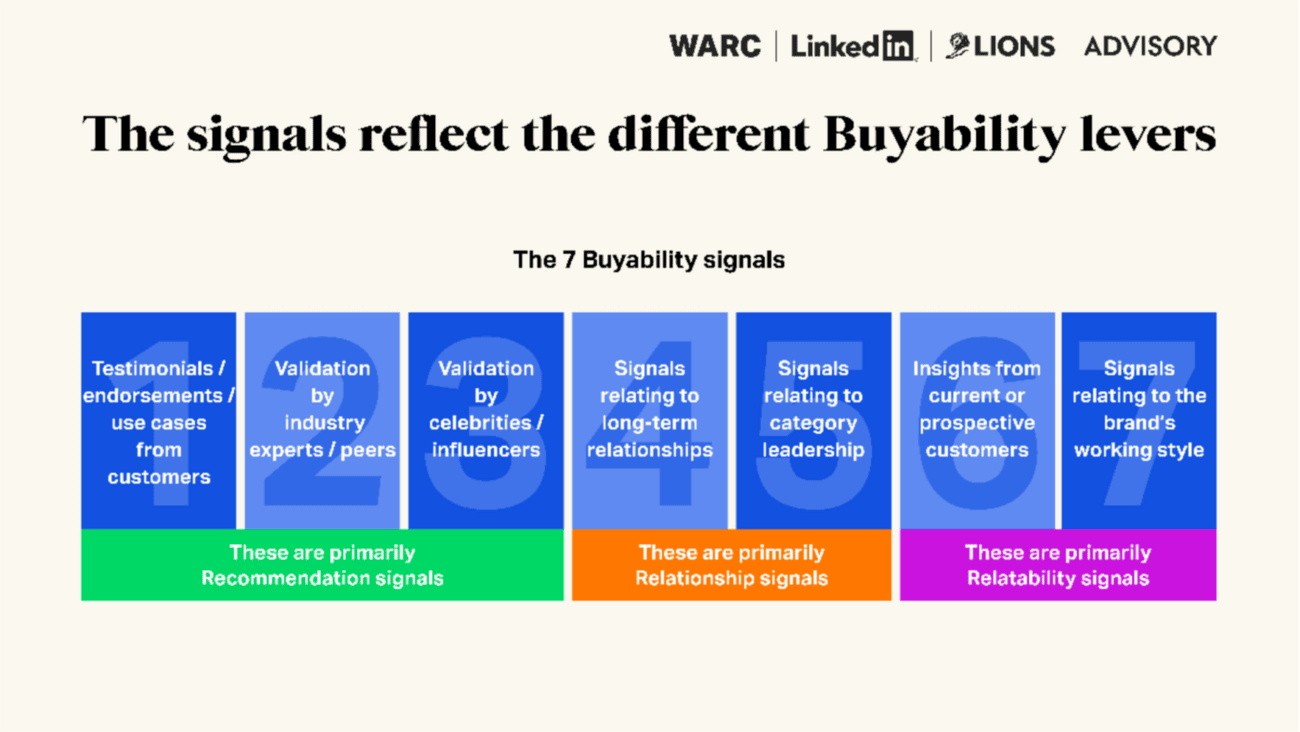
The study builds on existing research by LinkedIn and Bain & Company on the concept of «buyability» and identifies seven signals that boost buyer confidence. At the heart of the study are the so-called 3Rs: Recommendations, Relationships, and Relatability.
Recommendations include evidence and validation from customers, peers, experts, or trusted voices. Relationships signify long-term partnerships and existing familiarity. Relatability refers to real customer situations, use cases, and experiences that buyers can relate to. According to the study, personal experiences and trustworthy recommendations drive vendor selection more than performance or price, and messages referencing «similar customers» are said to outperform «market leader» claims.
Imaad Ahmed, Thought Leadership Director at Lions Advisory and Warc, is quoted in the press release as saying: «The Buyability model has been very well received throughout the B2B industry. This new study aims to demonstrate the impact of Buyability using real-world case studies. The goal of our research was to measure how frequently buyability signals appear in B2B campaigns and whether more signals lead to better results.»
Mimi Turner, Head of Marketplace Innovation at LinkedIn, adds: «Buyability provides us with a framework of seven signals that marketers can use to strategically improve campaign results, because it’s based on insights into what gives buyer groups confidence when making a purchase. The campaigns that succeed are those that make purchasing decisions easy to justify.»
Seven Signals as a Framework for Marketing Professionals
The Buyability Framework describes seven signals for future campaigns, each of which is assigned to one of the 3Rs. These signals are intended to make brands discoverable in AI models, make them appear credible to various stakeholders, and position them as a justifiable, low-risk option. According to the study, it is no longer enough for B2B marketing to increase awareness and consideration—it must demonstrate that it directly generates sales.
The key findings of the study: Buyability signals are clearly underutilized, with an average of just 1.6 signals per campaign. Nearly one-third (30 percent) of campaigns use only a single signal, while 22 percent use none at all. Less than one-quarter of all campaigns use three or more signals.
According to the study, campaigns with stronger buyability signals improve relevant brand metrics significantly more often: High-buyability campaigns are reported to show improvements in brand awareness 24 percent more often and improvements in mid-funnel metrics—such as consideration, preference, and purchase intent—91 percent more often. There are also commercial benefits: Compared to low-buyability campaigns, high-buyability campaigns are 63 percent more likely to result in increased ROI and 110 percent more likely to result in increased incremental revenue.
For the study, 700 B2B campaigns from the Warc database spanning the years 2010 through 2025 were analyzed, including entries and winners from the Cannes Lions B2B category, the Effies, and the Warc Effectiveness Awards, across various regions and industries. The dataset was independently classified using the B2B Effectiveness Ladder developed by Warc, Lions, and the B2B Institute, and evaluated for buyability signals. High-buyability campaigns (three to seven signals) were compared with low-buyability campaigns (zero to two signals).
The full report, «How to Build More Buyable Brands: How Recommendations, Relatability, and Relationships Drive Campaign Success,» is available online at https://www.warc.com/en/article/how-to-build-more-buyable-brands-0c41b00d9bd14e189955507d7b6b7c76.
]]>On a hot and humid late-summer evening, Publicis brought together the Swiss communications community for «Cannes Unpacked.» The trio on stage—Samuel Wicki (ECD at Leo Burnett), Robert van den Heuvel (ECD at Leo Lausanne), and Arnaud Debia (Global Creative Development Director at Ipsos)—offered far more than just a retrospective. The focus was on the pressing question of the future role of humans in an advertising universe shaped by algorithms.
While technology seemed to be everywhere at first glance, the award-winning campaigns and the latest market research data revealed a remarkable shift: humanity is emerging as a decisive competitive advantage.

The Backlash Against the Perfection of Machines
More than 40 percent of this year’s submissions used artificial intelligence to speed up processes or generate new visual worlds. At the same time, skepticism among the public is growing. According to the Ipsos AI Monitor, 65 percent of people worldwide view these rapid technological advances with some concern.
As a counterpoint to the perfect—but often soulless—AI output, the juries praised works that celebrated the imperfect, the real, and the deeply human. The Film Grand Prix winner, Claude, provided a prime example: Instead of blindly extolling the possibilities of technology, the platform humorously warned of the dangers of subtly placed advertising in large language models—a clear statement that technology must serve humanity, and not the other way around.
Polaroid put it even more radically, under the guiding principle that, after years of taking refuge in technology, it was now time to use reality to escape digital sensory overload.

Even tech giants took a surprisingly analog approach: Coinbase’s Film Craft Grand Prix entry depicted a break from virtual constraints toward real, unpredictable life—completely without CGI, shot with real actors and physical sets.
Trust as the Most Valuable Currency
In times of geopolitical tensions, disinformation, and AI-generated fake content, consumers are looking for guidance. An exclusive Ipsos study for Nestlé shows that established brands rank higher than chatbots and influencers in terms of credibility. However, trust is not built through technical features, but through genuine empathy.

Data from the Ipsos study «The Misfits Way» shows that campaigns that actively foster genuine brand resonance, credibility, and relevance achieve up to 32 percent greater impact. When creativity and empathy go hand in hand, effectiveness increases even more significantly.
AXA Insurance demonstrated this impressively with its «3 Words» campaign: By adding three crucial words to insurance policies—coverage for domestic violence—the brand secured the Grand Prix in Creative Effectiveness this year, following its Titanium award the previous year, accompanied by a 9 percent increase in new business. A relevant brand purpose drives measurable growth when it delivers on the industry’s core promise. AXA continued this thread with the support of Afghan rapper Sonita to draw attention to the plight of women under the Taliban.
Tell Stories Instead of Lecturing
A striking finding from the Ipsos analyses: Only 49 percent of all advertising materials tested still tell a coherent story. Yet narrative storytelling has been shown to double short-term brand awareness.
Works such as those by Heinz demonstrated that storytelling can resonate even with the simplest of means: The agency discovered that the outline of the familiar French fry bags exactly matches the shape of its own brand logo—a purely visual connection that sparked a global response without any high-tech elements.

OREO also used a seemingly absurd story about cows with belt patterns for a nationwide campaign in Mexico that scaled directly at the point of sale.
The closing message: Be Bold, Be Human, Keep Thinking
To wrap up «Cannes Unpacked,» the trio of speakers distilled the essence of the roughly one-hour event into three concise calls to action: «Be Bold,» «Be Human,» «Keep Thinking.» These form a strategic counterbalance to an industry that, in its fascination with algorithms, sometimes loses sight of common sense.

Be Bold: A call for radical courage and conviction. Analyses of this year’s Cannes entries show unequivocally that run-of-the-mill caution gets lost in the background noise of social media feeds. Effective communication requires a clear profile, surprising ideas, and a willingness to take a genuine stand—even if it means ruffling a few feathers.
«Please, be bold.»
— Samuel Wicki, Executive Creative Director at Leo Burnett
Be Human: A return to empathy as the most powerful driver of advertising impact. While machines can analyze data and generate content every second, an intuitive understanding of social nuances, pain points, and genuine emotions remains the undisputed domain of humans. Technology must not be an end in itself, but must serve human needs.
«The other one, of course: be human.»
— Arnaud Debia, Global Creative Development Director at Ipsos
Keep Thinking: Arguably the most urgent message of the presentation: Despite sophisticated AI tools and automated campaign processes, one must not delegate one’s own critical thinking to algorithms. As Robert van den Heuvel noted with a smile: Anyone who blindly follows the system’s instructions will inevitably end up in a creative dead end. Independent critical thinking, strategic foresight, and sound judgment remain indispensable.
«And I think one of the most important things—if you ask me—as we move forward together is: please, keep thinking. Don't just blindly follow Google Maps.»
— Robert van den Heuvel, Executive Creative Director at Leo Lausanne
]]>

The lights in the Pathé Spreitenbach auditorium dim, and the soft rustling falls silent. A compilation of award-winning international films begins on the monumental screen. No push notifications, no thumb swiping reflexively upward, no second screen that reduces the action to background noise.

It was precisely this magic of the silver screen that provided the perfect setting for the traditional Cannes trend report by marketing agency Weischer. Christof Kaufmann, CEO of Weischer.Cinema Switzerland, opened the event with a clear statement: Cinema remains the leading medium for uncompromising impact and reach. Director of Sales Juliane Fankhauser-Merz took the stage with enthusiasm and introduced the keynote speaker: Clara Katharina Wesselhoeft, Director of Creative Platforms & Partnerships at Weischer Hamburg. Together with Weischer CMO Moritz Weischer, she has officially represented the festival in Switzerland and Germany for years.
Before moving on to the trends, Wesselhoeft provided an overview of the 2026 Cannes Festival: 93 countries, 20,000 entries—a decline in volume due to stricter integrity rules against fraudulent AI cases (’scam scandals«) and Omnicom budget cuts, but the event’s prestige remains unchanged. With a rigorous award rate of just 3.2 percent, the Cannes Lion remains the most coveted accolade in the advertising world. And Switzerland had reason to be proud: Four Lions went to the Swiss Confederation in 2026—three for On (»Shape of Dreams« in Film Craft) and one Lion for the IOC’s »Olympic Wing Pasta.«.

Wesselhoeft organized the lessons learned from the Croisette into a precise three-part structure: What brands TODAY moves her, what she TOMORROW will challenge—and what a look into the GLASS BALL holds promise for the future of consumer behavior.

1. TODAY: The Foundation of Credibility
Trust – The New Hard Currency
In an age of algorithmic information overload, AI-generated disinformation, and endless interchangeability, trust is becoming the key driver of growth. Recent Edelman figures underscore this point: For 88 percent of consumers, trust in a brand is a key factor in purchasing decisions—on par with quality and value for money.
Craft as a sign of trust: Trust is built through genuine craftsmanship (Craft), attention to design detail, and verifiable integrity.
Case «Results with Venezuela»: After the 2024 presidential election, the opposition set up a parallel verification system using QR codes on the ballots. 600,000 volunteers secretly recorded and scanned the ballots. Eighty-five percent of the election results were published transparently, refuting the regime’s narrative—campaigning as a tool for democracy and unshakable truth.
Mercado Libre Case Study («Scratch Your Data»): Latin America's e-commerce giant is fighting identity theft through packaging waste (Dumpster Diving). Customers are rewarded with discount coupons if they scratch off the address labels on their packages before disposing of them, thereby destroying their personal information themselves.
Human Creativity – The Luxury Good of the AI Era
The faster, cheaper, and more automated the production of content via generative AI becomes, the more interchangeable the noise becomes. Relevance doesn’t come from endless output, but from substance, attitude, and empathy. Marcel Marcondes, Global CMO of AB InBev, summed it up:
«Technology is a great enabler, but everything has to begin and end with people.»
Apple TV+ Case (Rebranding): For the rebranding, Apple didn't rely on generative prompts, but rather on classic, tactile craftsmanship: glass art, handcrafted light sculptures, cinematography, and custom music by Finneas. An analog masterpiece that stands out unmistakably in the digital space.
Case Claude (Anthropic): During the Super Bowl, the AI platform promoted its ad-free model with—of all things—humorous and absurd commercials in which chatbots offer bizarre advice («Find an emotional connection with roaring cougars on Golden Encounters») —human storytelling at its best, explaining technology in a way that’s likable and relatable.
Fandom First – From Target Audience to Fan Culture
Sports and live events are the last remaining campfires of our culture. Scott Galloway put it aptly in Cannes: Sports have taken on the status of a modern cultural religion. For advertisers, this means that those who limit themselves to logo sponsorship on perimeter boards will remain interchangeable. Brands must become an active part of fan culture.
Case KFC («Kyle Connor» / «KFC»): KFC seamlessly tapped into the excitement of Winnipeg’s NHL fans, who were chanting for their hockey star Kyle Connor—and turned that adoration into branded chicken buckets and viral stadium moments.
Uber Eats Case Study (Super Bowl): Instead of spending millions on a traditional 30-second commercial, Uber Eats transformed the entire app into an interactive Super Bowl experience. Users could «order» their own commercials using cinematic elements and unlock exclusive deals—which led to 3.7 million new app visits and over $36 million in additional revenue.
A Shift in Roles—Brands Become Communities
Creators and consumers are no longer merely distribution channels. They are media entrepreneurs and co-creators. Any brand seeking relevance must relinquish control and engage with them as equals.
Case Study: McDonald’s («The Filet-O-Fish Facebook Society»): McDonald’s UK discovered a Facebook group founded in 2012 with just six die-hard fans of the often-ridiculed Filet-O-Fish. Instead of launching its own campaign, the brand joined the group, interacted with members on an equal footing, and responded to the community’s request: The «Double Filet-O-Fish» was permanently added to the menu at 1,400 locations nationwide—a triumph of organic fan culture.
Case Tecate («The Fandom Comeback»): After the brand Tecate Titanium After it had been discontinued six years earlier, its loyal customer base persistently demanded its return. Tecate heeded their wishes, staged the comeback as a tribute to its fans, and sold 1.2 million cans in just three weeks.
2. TOMORROW: Strategic Leverage for the Coming Years
Brand Building Is Back – Prioritizing Brand Substance
Pure performance hacks and short-term social buzz campaigns have run their course. Cannes introduced the «Creative Brand Lion,» a category that recognizes brand strategy and long-term business growth. The credo is: First, build an unshakable brand identity; then, capitalize on cultural moments.
Case Study: Burger King («The Bite»): BK CEO Tom Curtis responded radically to the accusations that the burgers were cold and subpar: He published his cell phone number for customer complaints, tweaked the Whopper recipe, and, as part of a wide-ranging campaign, demonstratively took a bite out of the new product himself.
Case Columbia Sportswear («Expedition Impossible»): Columbia issued a challenge to flat-earthers: Anyone who could prove that the Earth is flat and photograph its «edge» would receive ownership of the entire company. CEO Tim Boyle was standing by with the keys. The campaign generated 80 million in earned audience reach—with the unmistakable message that Columbia outdoor clothing can withstand any extreme conditions.
B&B Together to C – The Power of Ecosystems
Channels, target audiences, and platforms are converging. Lone players are losing out; collaborative platform ecosystems are winning. Brands are joining forces to collectively gain cultural authority.
Case Brahma x Zé Delivery («Unwatched Goals Cashback»): The Brazilian beer brand Brahma and the delivery app Zé Delivery created an automated system: If a fan missed a goal scored by his team while the delivery person was at the front door, Brahma would refund the entire order amount. The risk became a purchasing incentive.
Case Study: Maple Leaf Foods («Look for the Leaf»): In response to U.S. tariff threats and annexation rhetoric, 50 Canadian food brands joined forces under the leadership of Maple Leaf Foods to specifically promote the purchase of domestic products during the NHL playoffs.
3. THE GLASS BALL: The Post-Scroll Brand Trend
What's happening the day after tomorrow? The phenomenon of «Scroll Fatigue» is growing rapidly. Between AI-generated junk content (AI Slop), digital fatigue, and algorithmic arbitrariness, the impact of passive social media feeds is declining dramatically.
Consumers long for authentic, social, undivided moments. The brands of the future don’t just buy «impressions» in the feed—they become enablers of physical and communal rituals.
Heineken Case («Could Have Been a Heineken» / «The Boring Phone»): Heineken rewarded users for putting away their smartphones and enjoying the moment with friends over a beer—for example, by exposing endless voice messages as a reason to meet up in person.
A Movie Theater Instead of Scrolling with Your Thumb: The Return of Undivided Attention
After the flurry of trends, Ismail Wicki, Senior Manager of National Sales at Weischer.Cinema Switzerland, brought the discussion back down to earth with a focus on advertising planning. His message to the marketers and agency representatives in attendance was clear: Cinema is not a “winter” medium, but a year-round stage for emotional brand storytelling.

With an increase of +24 percent Compared to the previous year, the Swiss movie market in 2026 continues to show unflagging vitality. Whether it's a record-breaking summer or major events, phenomena such as «Barbenheimer» or blockbusters like «The Odyssey», «Spider-Man: Brand New Day» or the Michael Jackson biography «Michael» demonstrate that audiences are willing to invest time and money in compelling stories.

Whereas content on social media is swiped away after three seconds, moviegoers willingly sit in front of a 100-square-meter screen for over two hours—without a second screen, without a skip button, but with measurable recall rates and shared emotions within the community.

During the concluding Q&A session, a conversation between the audience and Clara Katharina Wesselhoeft summed it up: Topics like sustainability and diversity haven’t disappeared from the trends at Cannes—they’ve simply become a conditio sine qua non. The focus is now on how brands can once again create meaning, build trust, and tell authentic stories in a world shaped by AI. And there’s no better place for that than a darkened theater when the projector kicks in.


Dept Strengthens Its DACH Leadership Team with Two New VP of Delivery Positions
Dept, the self-proclaimed "Growth Invention Company," is expanding its leadership in the DACH region with two key appointments. Franzis Heusel has already joined as VP of Delivery for Creative & Media, and René Dalock will officially assume the role of VP of Delivery for Experience & Engineering on September 1. According to the company, the two will work together to ensure that Dept’s operations in the region run smoothly and deliver tangible results for clients.
Franzis Heusel: Creative Expertise from the Advertising World
Heusel has had a long career in the creative and media industries. Most recently, he served as VP of Content at Statista, where he was responsible for the platform’s content. Prior to that, he served as CEO of the detailM Group and was managing director at C3 Creative Code and Content in Berlin. For eight years, he served as Managing Director at BBDO Berlin, where he expanded the agency to more than 130 employees. He also served on the executive board at Jung von Matt.
His client portfolio included brands such as VW, Deutsche Bahn, Sparkasse, Audi, and BSH. A recipient of Effie, bcm, ADC, and Cannes Lions awards, Heusel says he combines bold creative ideas with the ability to bring them to life on a large scale. «Good creative work only really counts when it resonates with customers. That has always been my measure of success,» says Franzis Heusel. «That’s why I focus on the close connection between creative and media, because communicative impact only unfolds when both work together from the very beginning.»
René Dalock: Digital Transformation and Technology Proficiency
Dalock brings more than 20 years of experience in digital transformation, including in retail and technology companies. Most recently, he served as Managing Director and Chief Delivery Officer at nexamind, a boutique agency specializing in the practical implementation of AI solutions. Prior to that, as Managing Director at Scayle, the e-commerce subsidiary of About You, he built the business from scratch to more than 50 million euros in revenue and led it until its acquisition by Zalando. In this role, he developed commerce experiences for brands such as Deichmann, Fielmann, Harrods, Manchester United, and FC Bayern Munich. Prior to that, he spent several years working at the IT strategy consulting firm BCG Platinion and at IBM.
«I’ve known Dept for years—first as a client, then as a partner. What won me over was the quality of the work and the people I have the privilege of working with here,» says René Dalock. «For me, it’s all about bringing the right people and the right technology together to solve our clients» problems in a sustainable way.”
Additional Perspective from the DACH Team
Natalie Martens, VP of Clients at Dept DACH, commented on the appointments as follows: «René and Franzis understand delivery from different perspectives—one focused on technology, the other on creativity. For our clients, this means greater speed, greater reliability, and teams that contribute ideas right from the start.»
These two appointments are part of Dept's ongoing investments in leadership for the DACH region. Most recently, the company appointed Christina Kutschinski as VP of People for DACH and Käthe Lisson as Executive Creative Director & VP of Creative for DACH.
]]>
Gold for Traumspot
When a campaign wins gold in Cannes, that’s already a major honor. But anyone holding a Lion in their hands inevitably starts dreaming of the Grand Prix. That’s exactly what happened with On. The Swiss sports brand won gold for «Shape of Dreams» in the Film Craft category—and remained a frontrunner in the race for the top prize right up until the very end.
«We all loved On’s work. We watched it over and over again,» jury president Pip Smart revealed to m&k editor-in-chief Anna Kohler at the press conference. Along with the German entry «No Project without Drama» and the eventual Grand Prix winner «Your Way Out,» «Shape of Dreams» was among the jury’s absolute favorites. «There’s so much love and dedication in this film. In the end, the jury makes the decision, and sometimes it’s just a very close call.»

A brand with Cannes potential
Perhaps this narrow miss (Grand Prix) actually fits the story the film tells. After all, «Shape of Dreams» is about the birth of great ideas, about constant refinement and further development. A little room for improvement can also be an incentive. After all, there are brands in Cannes that have been on a real winning streak for years. Coca-Cola, Heinz, Nike, and Apple have shown how creative excellence can become second nature.
On certainly has the potential to join this ranks. The brand combines Swiss precision with an almost magical sense of elevation. What once began as an innovation in running shoes has long since evolved into a global lifestyle brand. Collaborations with personalities like Zendaya and Roger Federer show that On doesn’t just sell products—it tells stories. Stories that inspire people while exuding a certain lightheartedness. It’s precisely this blend of ambition and enchantment that seems to be resonating in Cannes as well.
More a work of art than a sports advertisement
But what is «Shape of Dreams» really about? Directed by Spike Jonze, the film was created as part of a collaboration between On, actress Zendaya, and her longtime creative partner Law Roach. Instead of a traditional sports commercial, the three-minute piece takes viewers into the fictional «Dream Lab,» a surreal dream laboratory where ideas, fabrics, and silhouettes are constantly changing.
Clothing isn’t created on a drawing board; rather, it seems to develop organically before the audience’s eyes. Fabrics stretch and shift, and silhouettes change shape as Zendaya wanders through a world that is constantly reinventing itself. The result is less of a commercial and more of a visual art installation—a poetic exploration of creativity, design, and movement.
Director Spike Jonze, known for films such as «Her» and «Being John Malkovich,» drew inspiration from classic stop-motion works. Despite its elaborate visual effects, the film feels surprisingly tactile and tangible. Every scene gives the viewer the feeling of witnessing a creative process unfolding in real time.
It’s therefore hardly surprising that the work was nominated four times in the Film Craft category at Cannes. This category doesn’t evaluate strategy or brand impact, but rather technical skill—direction, editing, visual effects, sound design, and production. These are precisely the elements that give great films their soul.
In the end, it wasn’t enough to win the Grand Prix. Still, the Gold in Film Craft remains a remarkable achievement. Above all, it confirms that On is no longer perceived merely as a sports brand, but as a creative force that’s competing at the very top on the world’s biggest advertising stage. Perhaps this is the start of the very Cannes run that will turn a strong brand into a legend.
Back to the Human
Anyone who attended the various press conferences throughout the day heard the same terms over and over again: humanity. Craftsmanship. Love. Culture. Dedication. One might have expected that Cannes 2026 would be all about artificial intelligence. Yet here on the Croisette, of all places, a counter-movement seems to have emerged. «Every trend generates a countertrend,» as one of the jury presidents aptly put it. While AI certainly played a role—particularly in the Entertainment for Music and Entertainment for Sport categories—it was used solely as a tool. The focus was on real people, real stories, and real emotions.

This trend was particularly evident at the Design Lions. The Grand Prix was won by TBWA Los Angeles for its redesign of Apple TV. Here, too, one phrase came up repeatedly: «Made by hand, not by AI.» A similar sentiment was evident in the Digital Craft Lions. Technology may be ubiquitous, but the award-winning entries had one thing in common above all else: a strong human idea behind the technology.
Grand Prix for «Your Way Out»
A total of 1,429 entries were submitted in the Film Craft category. The jury noted trends such as nostalgia, classic camerawork, vivid color palettes, music, and emotional stories. The Grand Prix went to «Your Way Out» for Coinbase from the United States.
The Industry Craft Lions were also all about craftsmanship and dedication. The Grand Prix went to the Spanish campaign «Tiny Coffee Shops» for De’Longhi. Small coffee shops were built by hand to show that café-quality coffee is possible at home, too.
It’s striking how often culture has been discussed this year. Craftsmanship is not simply production, but an expression of culture. Perhaps that is precisely what explains the current longing for the human touch. As AI becomes increasingly powerful, creative professionals are rediscovering the value of what machines cannot provide: personal experiences, cultural influences, genuine emotions, and a passion for craftsmanship.
A Relaxing Evening on the Beach
While the final jury discussions were winding down at the Palais and the first Lions were making their way into display cases, hotel rooms, and social media feeds, m&k once again headed away from the main stage. Or rather, to one of those places where Cannes often becomes just as interesting after sunset as it is during the day.
The Swiss delegation gathered at O’Key Beach for an informal wrap-up of the festival’s second day. Amid the sand, the sound of the sea, and conversations about campaigns, juries, and winning entries, it became clear that Cannes thrives not only on awards, but above all on connections. It is precisely in these settings—where creatives, agency heads, brand managers, and industry representatives exchange ideas away from the official stages—that the conversations often take place that continue to resonate long after the festival has ended.

The evening was organized by the IAA Swiss Chapter. President Matthias Kiess and Director Chantal Landis, who have helped shape Switzerland’s presence in Cannes for years, were cheerful hosts. Amid Lions, lessons learned, and mild temperatures, the evening provided an opportunity to reflect on the first day’s highlights and look ahead to the upcoming award shows.

Or to put it another way: After «Your Way Out,» m&k simply moved on to «Anna’s Way to the Beach.» On this second day in Cannes, that path led not so much away from the festival as right into the heart of what makes the Cannes Lions special—beyond the awards: people, conversations, and a shared passion for creativity.


Julia Goldin, Chief Product & Marketing Officer of the Lego Group, is the first recipient of the newly created «European CMO of the Year» award. The award was presented on June 22, 2026, as part of the Cannes Lions festival—one of the most important international gatherings for the creative and marketing industries.
Widespread support within the European marketing community
The «European CMO of the Year» award was presented for the first time in 2026. It was initiated by the Serviceplan Group, Samsung Ads, The Trade Desk, Seven.One Media, and the University of St. Gallen. The award is supported by partners such as Euronews, LinkedIn, FEDMA, Horizont, LBBonline, and MarketingDirecto.com. The award honors Chief Marketing Officers who set the standard for cross-border marketing leadership in Europe.
More than 800 marketing executives from 15 European countries and regions initially nominated CMOs who, in their view, embody modern marketing leadership. From the resulting shortlist, the CMOs participating in the «CMO Barometer» ultimately selected Julia Goldin as the first recipient of the award. The selection process is scientifically monitored and validated by the University of St. Gallen.
Prof. Dr. Sven Reinecke, Director of the Institute for Marketing and Customer Insight at the University of St. Gallen and academic partner of the award, explains the selection: «Julia Goldin sets the standard for modern marketing leadership in Europe: strategic, creative, and culturally relevant. She has developed the Lego brand into a cultural icon far beyond its product category, thereby demonstrating how brands today can drive both growth and relevance in equal measure.»
Lego is positioned far beyond the toy category
Under Goldin’s leadership, the Lego Group is said to have consistently expanded its presence in the entertainment, sports, and gaming sectors. Collaborations with brands such as Star Wars, Marvel, Harry Potter, and Fortnite, as well as global campaigns centered on Formula 1 and soccer, have expanded the brand’s reach and appealed to new target audiences, according to the press release. Campaigns such as «She Built That» also exemplify the company’s commitment to combining creativity and inclusion.
Julia Goldin commented on the award, saying, «This award is a wonderful recognition of the brand and its importance in the lives of so many people. My thanks go to the many teams, partners, and everyone involved around the world who help make this possible every day—this award belongs to them just as much.»
Event with more than 100 guests and an AI keynote
The awards ceremony brought together more than 100 leading marketing executives from across Europe, including representatives from business, media, and academia, as well as partners of the awards. Another highlight of the evening was the keynote address by AI strategist and author Nina Schick. The British-German expert is considered one of the world’s leading voices on generative artificial intelligence and spoke about the impact of AI on creativity, brand management, and innovation.
Florian Haller, CEO of the Serviceplan Group, explains the significance of the award: «Marketing is one of the most important drivers of growth and business success. Today, it influences the entire customer journey, from initial awareness to the purchase decision. As a result, marketing contributes more directly and measurably to a company’s business success than ever before. With the European CMO of the Year Award, we want to recognize the achievements of the people who play a key role in shaping this impact.»
The CMO Barometer, which served as the basis for the nominations and the election, is an annual survey of top marketers at leading companies in 14 European countries and the Middle East. In 2026, it was conducted for the seventh time by the Serviceplan Group—in collaboration with the University of St. Gallen and the executive search firm Heidrick & Struggles.
For more information about the Serviceplan Group and the «European CMO of the Year» award, please visit: https://www.serviceplan.com
]]>
The Swiss creative industry got off to a strong start at the 73rd Cannes Lions International Festival of Creativity. Five entries from Swiss companies and agencies made it onto the first published Cannes Lions shortlists, earning a total of ten nominations across seven competition categories—and thus a chance to win an award.
«Shape of Dreams» Tops the Cannes Lions Shortlist
«Shape of Dreams» for the On x Zendaya Collection received the most nominations. The entry submitted by On was shortlisted four times in the Film Craft category and once in the Entertainment Lions category—accounting for five of Switzerland’s ten shortlist spots.
Also in the running is «The Idea That Never Had a Break» for KitKat. The campaign was submitted by Nestlé and is nominated in the Creative Brand category. For Abbott Established Pharmaceuticals, «Voodoo Dolls» made the shortlist in the Pharma category.
TBWA Zurich and the IOC Receive Direct Nominations
TBWA\Zurich submitted «The Coupon Coup» for McDonald’s—the campaign is nominated in the Direct category. Rounding out the Swiss entries is «Olympic Rings Pasta,» a campaign for the International Olympic Committee that is nominated in both the Entertainment Lions for Sport and Social & Creator categories.
In categories that had already been announced—such as Audio & Radio, Outdoor, PR, Media, Design, and Health & Wellness—Switzerland, however, failed to secure a spot on the shortlist. Nor were there any Swiss entries in the previously announced categories of Innovation, Titanium, and Glass.
164 submissions from Switzerland
For this year's edition of the festival, 164 entries were submitted from Switzerland—more than in either of the previous two years. The winners of the Cannes Lions will be announced during the festival week, from June 22 to 26.
]]>
Gerety Awards 2026 Shortlist: Global Creativity from 36 Countries
The 2026 Gerety Awards shortlist has been officially announced. Following executive jury sessions held around the world, the finalists have been selected—and the list reflects a broad spectrum of creative excellence from 36 countries. The United States tops the shortlist with 41 entries, followed by Germany with 39 and France with 33 entries. The United Kingdom follows with 27 nominated campaigns. Spain, Mexico, Sweden, Thailand, the Philippines, Italy, Argentina, and Canada also delivered strong results.
Highlights of the 2026 Gerety Awards Shortlist
Among the nominated campaigns are «KitKat Heist» by VML UK, «Rooftop Revival» by LePub Singapore, «Full Check Up» by BETC Havas Brazil, «No Project Without Drama» by HeimatTBWA Germany, as well as «Who’s Waiting for You?» for AB InBev by Wieden+Kennedy Mexico, and «If You Can Take It, It’s Yours» for Selleys by Howatson+Company Australia. The most-nominated campaign on the entire shortlist is «Covert Recruiter» by Dentsu Creative France for the French Army’s Personnel Directorate.
The shortlist covers a wide range of topics: entertainment, innovation, humor, socially relevant work, craftsmanship, strategy, and effectiveness are all represented. Global brands stand alongside local challengers, and independent agencies compete side by side with international networks.
First-time shortlist entries: Bulgaria and Tunisia
A notable first for this edition: Bulgaria and Tunisia are represented on the Gerety Shortlist for the first time—a sign of the competition’s increasingly global reach. In total, more than 250 jurors from more than 50 countries participated in the evaluations.
The jury sessions were held in person in London, Auckland, Toronto, New York, Paris, Stockholm, Hong Kong, Dubai, Madrid, Milan, Mexico City, Bangkok, Los Angeles, Berlin, and São Paulo. These sessions determine the shortlist before the Grand Jury meets online to select the final winners.
Craft CUT and the Next Steps
The Craft CUT category has the most shortlist entries. It includes work from all areas of craftsmanship: animation, art direction, cinematography, copywriting, directing, editing, illustration, music, sound design, photography, typography, production design, and visual effects.
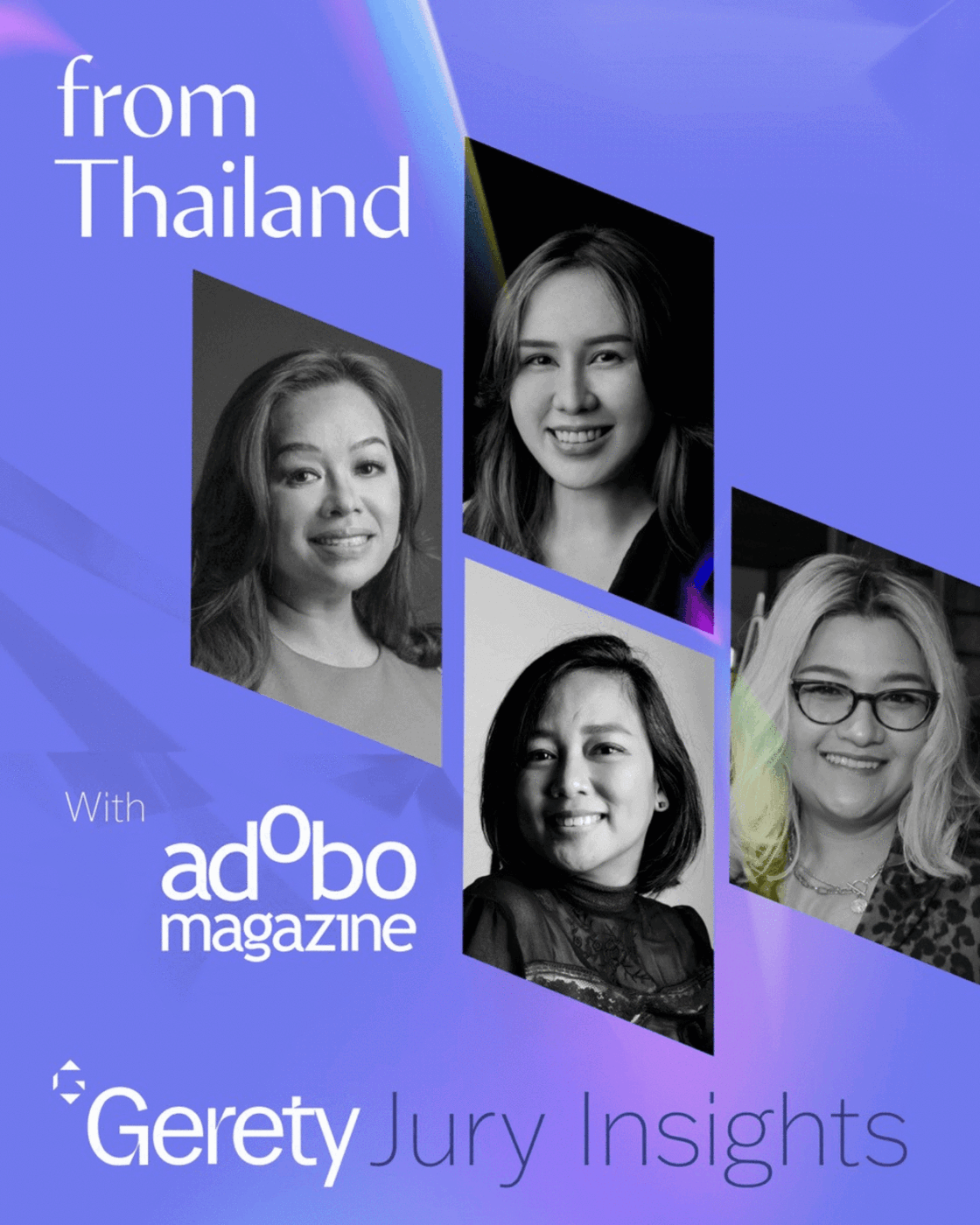
The Grand Jury will now select the final winners, who will be announced in the first week of September—including Bronze, Silver, Gold, Grand Prix, and regional winners. Accompanying Shortlist Week are the Global Jury Insights Panels, where jury members discuss campaigns, creative trends, and outstanding work with trade media outlets. In addition, Gerety will release its Shortlist Reel—a curated compilation of the highest-rated shortlisted entries.
As is the case every year, finalists and jurors will be honored at the Gerety VIP Diamond BBQ in Cannes, which will be attended by invited guests from among the entrants, jurors, partners, and friends of Gerety.
The complete shortlist is available at: https://www.geretyawards.com
]]>
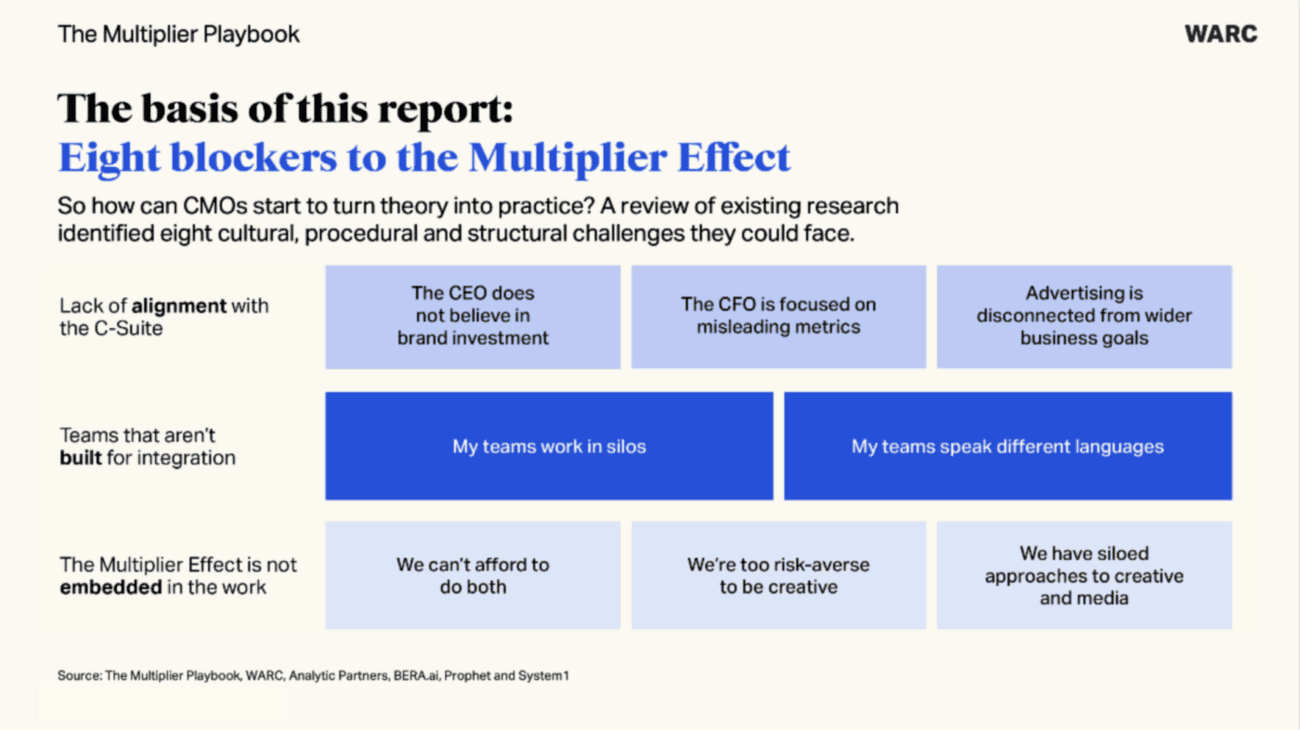
Most marketing professionals are familiar with the theory of advertising effectiveness—but there is a wide gap between knowledge and implementation. This «say-do gap» is the starting point of the new report The Multiplier Playbook, published by Warc in collaboration with Analytic Partners, Bera.ai, Prophet, and System1. The report focuses on why the integration of brand and performance fails in so many organizations—and how CMOs can overcome the biggest obstacles.
Eight Obstacles to Brand and Performance
The report builds on the findings of the study published last year The Multiplier Effect At the time, Analytic Partners used the ROI Genome to demonstrate that brands that shifted from a pure performance approach to a blended strategy combining brand and performance achieved an average uplift of 90 percent in revenue return on investment. Nevertheless, implementation in practice regularly fails due to cultural, procedural, and structural misalignments.
For the Playbook, more than 200 senior marketers were surveyed in a joint study conducted by Warc and the Association of National Advertisers (ANA) between December 2025 and March 2026 in the United States. The results were combined with existing data and frameworks from the partner organizations.
David Tiltman, Chief Content Officer at Warc and SVP of Content at Lions Intelligence, sums it up: «What’s needed is a playbook—a combination of data, frameworks, and real-world examples that help marketing professionals identify the key obstacles and take concrete steps.»
C-suite executives have little understanding of brand and performance
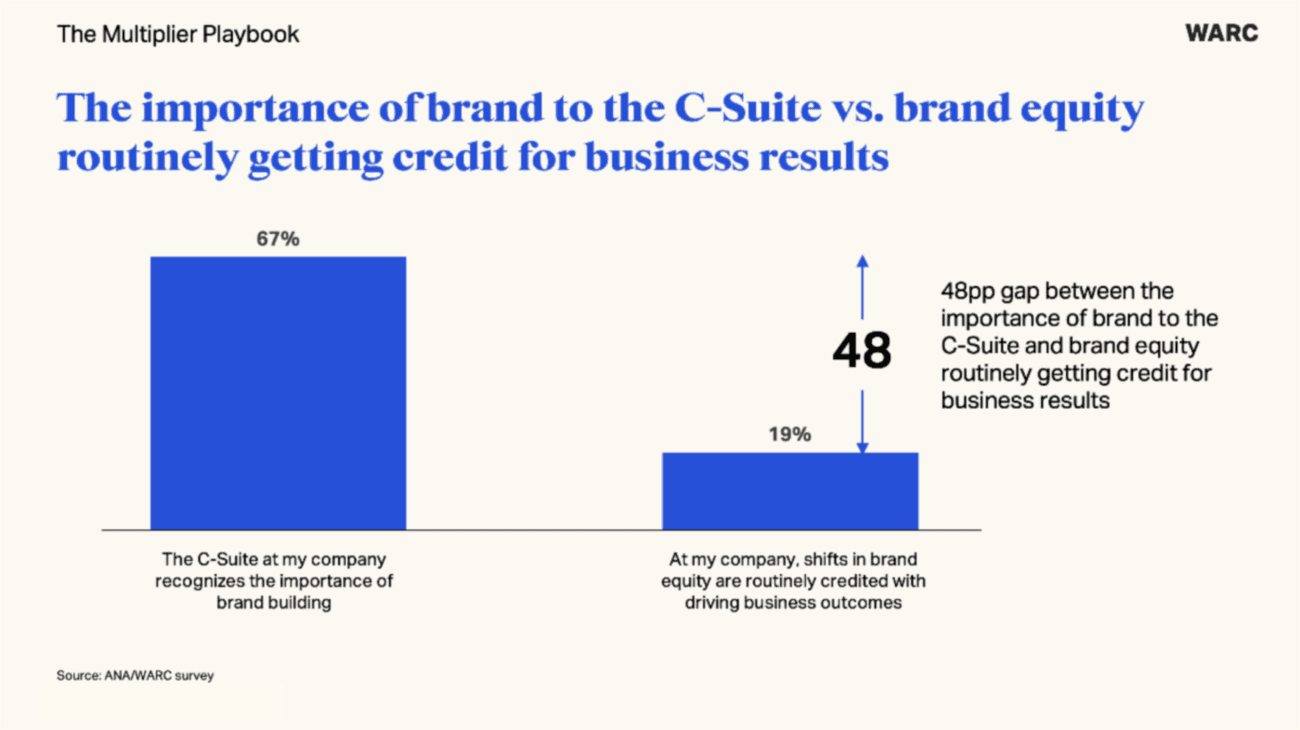
One key finding concerns alignment with senior management. While about two-thirds (67 percent) of the marketers surveyed agree that their CEO considers the brand to be important, However, only 19 percent said that the C-suite regularly demonstrates the connection between brand strength and concrete business results. Even more concerning: Only 21 percent of respondents strongly agreed that their advertising goals are aligned with the C-suite’s objectives.
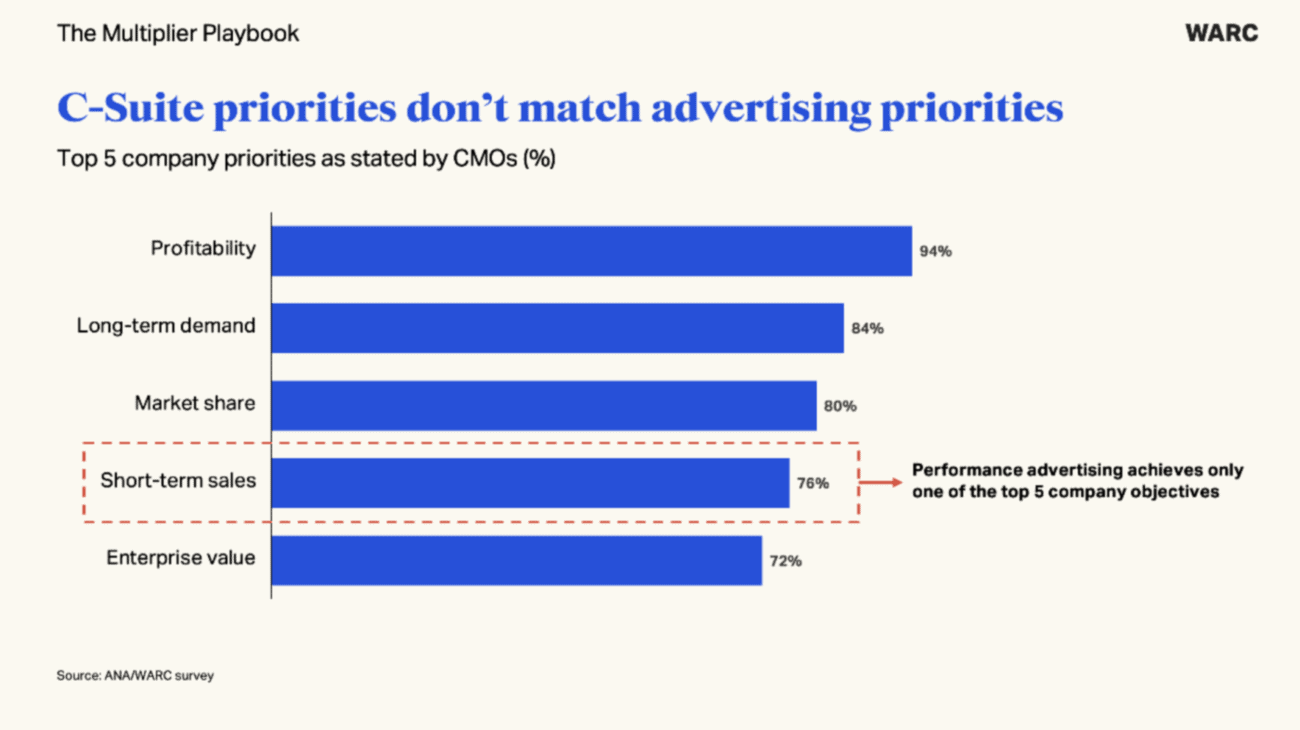
In addition, 60 percent of respondents feel that the C-suite does not fully understand the role of advertising in achieving commercial goals. The report states that the dominance of efficiency-based metrics such as platform-specific ROAS exacerbates this problem. As a result, advertising is viewed as a cost center rather than a value-creating investment.
Silos hinder integrated thinking
The survey also reveals significant structural shortcomings within marketing departments. In 49 percent of the organizations surveyed, brand and performance teams operate separately; only 25 percent have fully integrated teams. 65 percent maintain separate budgets for brand and performance. Only 44 percent of respondents say their teams share a common language or a common understanding of which target audiences offer the greatest growth potential.
The report recommends developing shared goals based on specific behavioral changes among consumers and deliberately creating moments in the annual calendar that require cross-team collaboration. Laura Jones, Chief Marketing Officer at Instacart, is quoted in the report as saying: «We have to »make our own weather.’ We need to create events and campaigns where we’re all rowing in the same direction and getting more out of our collective efforts.”
Creativity as an Underestimated Lever
Another finding from the Playbook concerns the approach to creativity. According to a survey by System1 and Effie Worldwide, 41 percent of marketers view creative advertising strategies as a risk. More than half (52 percent) stated that they do not have sufficient confidence in the effectiveness of advertising. Compounding this issue is the fact that, according to data from Analytic Partners’ ROI Genome, 90 percent of advertising materials are not used long enough to achieve their full impact.
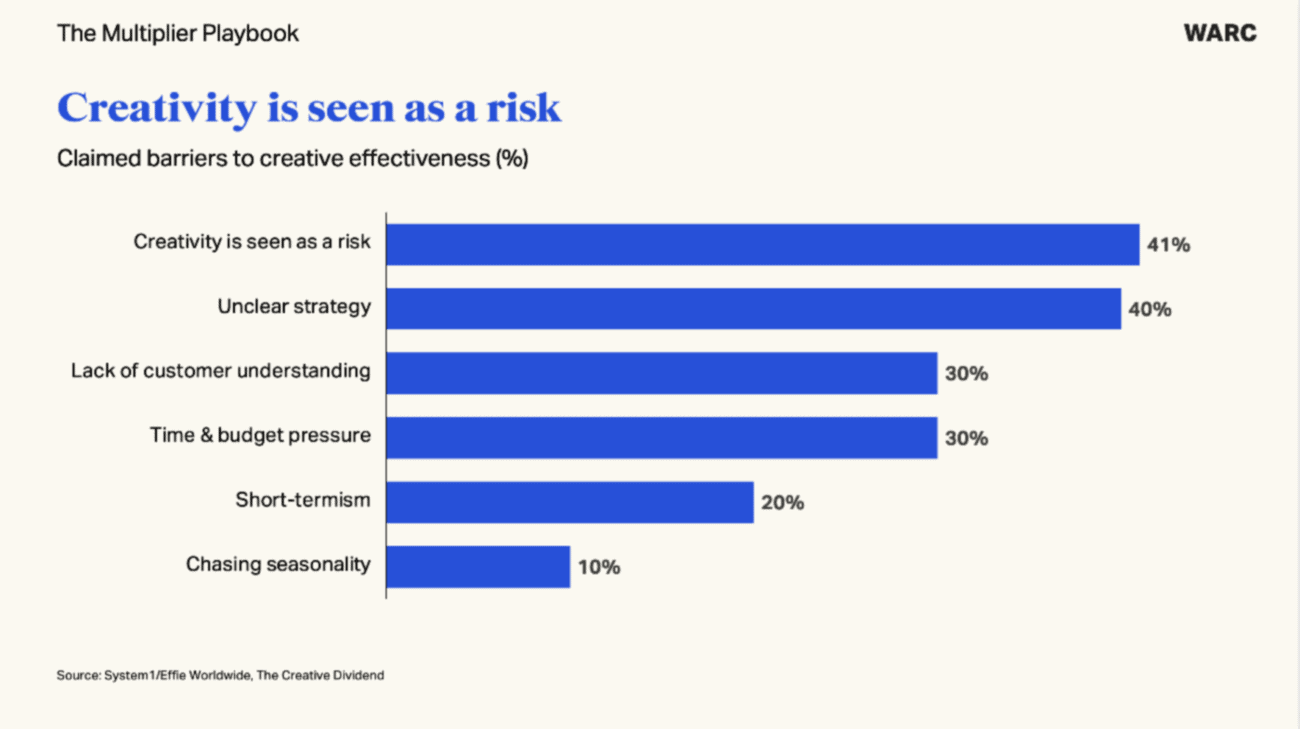
The report recommends a «Fewer, bigger, longer» approach to creation, as well as closer integration of media, creative development, and measurement. To minimize risk, the Playbook proposes a four-tier «Creativity Stack»: Consistency, showmanship, distinctiveness, and emotion. Mike Cessario, founder and CEO of Liquid Death, is quoted in the report as saying that creativity is particularly crucial for smaller brands: «If you’re a small business, it’s literally reckless to play it safe.»
The full report is available free of charge at: https://bit.ly/4eOaWxP
For more information about Warc and its studies, visit www.warc.com.
]]>
Gerety Awards 2026: Jury Meets on Five Continents
The 2026 Gerety Awards are entering their decisive phase: With the start of jury sessions in 15 cities worldwide, the global creative industry is looking forward to the announcement of the shortlist and the reunion at the exclusive Gerety VIP Diamond BBQ in Cannes. More than 260 jury members from over 50 countries are participating in the judging this year—including renowned creative leaders from advertising, marketing, production, design, and media.
The Executive Jury Sessions will take place at 15 international locations: London, Auckland, Toronto, New York, Paris, Stockholm, Hong Kong, Dubai, Madrid, Milan, Mexico City, Bangkok, Los Angeles, Berlin, and São Paulo. These sessions will produce the shortlist, after which the Grand Jury will convene online to select the final winners.
Jury Insights Panels and Shortlist Reel
Following the conclusion of the sessions, Gerety’s Global Jury Insights Panels bring together jury members and leading trade media representatives to discuss the submitted campaigns, creative trends, and outstanding work that define this year’s shortlist. In conjunction with this, Gerety is once again releasing its “Shortlist Reel”—a curated compilation of the highest-rated shortlisted entries from the Executive Jury Sessions. The reel will be distributed to agencies, production companies, brands, and industry leaders worldwide during Shortlist Week.
VIP Diamond BBQ in Cannes with Tantor Films
A special highlight of the 2026 Gerety Awards remains the Gerety VIP Diamond BBQ in Cannes, which takes place in collaboration with Tantor Films and is one of the most anticipated gatherings of the festival week. The guest list is exclusively limited to invited entrants, jury members, former jury members, partners, and friends of Gerety. This year’s event is also supported by partners Mastercard, SheSays, and Insider Latam.
The shortlist for the 2026 Gerety Awards will be announced on Tuesday, June 16.
For more information on the 2026 Gerety Awards, visit https://www.geretyawards.com.
]]>
From June 22 to 26, the world’s top creative minds will gather in Cannes for the International Festival of Creativity. The lineup for Cannes Lions 2026 Switzerland is complete: Five up-and-coming teams will represent Switzerland in the Young Lions Competition, and two jury members will evaluate the best international creative work as part of the shortlist jury.
Five teams, courtesy of Weischer.Cinema Switzerland and ADC
Weischer.Cinema Switzerland will continue its partnership with the ADC in 2026. This year, the cinema advertising agency is enabling five teams to participate in the Cannes Lions Young Creatives competition. The teams qualified through the ADC Young Creatives Awards. The teams are competing in the Digital, Film, Media, Print, and PR categories.
The Media category has now been integrated into the ADC Young Creatives Award. Christof Kaufmann, CEO of Weischer.Cinema Switzerland, comments on this move: «The integration of the Media category reflects the reality of modern communication: today, media and creativity are inextricably linked. At the same time, talented individuals benefit from a strong, centralized platform—an important signal for the industry and for fostering the next generation of talent.»
The Swiss Young Lions 2026 at a Glance
In the Digital category, Michael Winnicki of Serviceplan Suisse and Noam Josué Dal Bosco of Family are competing. Josephine Jeanguenin of Wirz Group and Patricia Schneider of thjnk are representing the Film category. Šejla Husić and Nadina Tharuman, both from Sir Mary Media, are competing in the Media category. The Print category features Ioana Marinescu and Lea Scherz, also both from thjnk. The PR duo consists of Corinne Bischof and Elhan Abduli, also from thjnk.
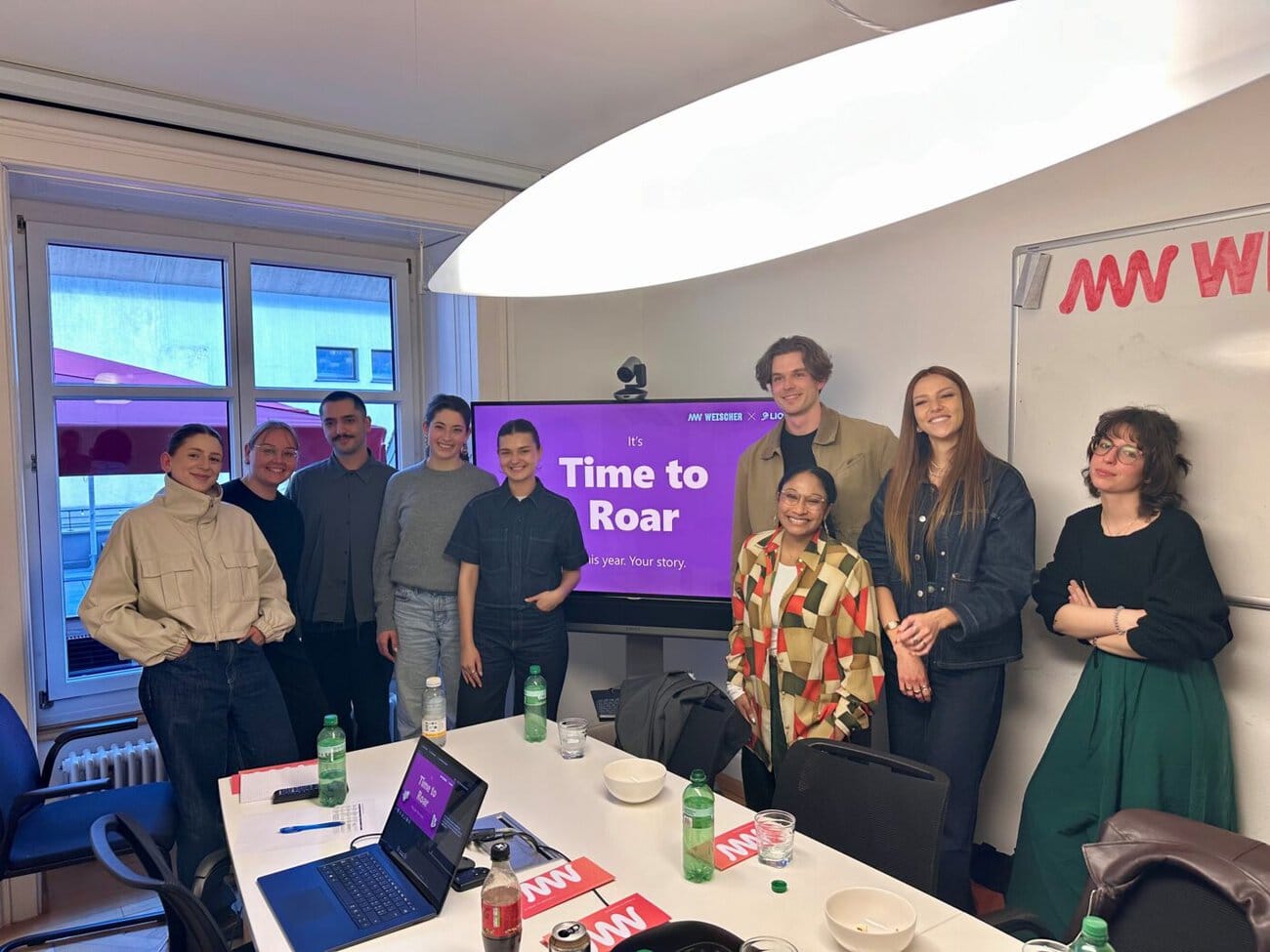
In the run-up to their trip to Cannes, the Young Lions gathered at the Weischer.Cinema Switzerland offices for their traditional roundtable discussion. The meeting served as an opportunity to get to know one another, warm up on the topic at hand, and get a first taste of the Cannes Lions atmosphere. The participants were particularly excited about networking internationally, meeting new industry colleagues from around the world, and drawing inspiration from ideas, work, and people.
Swiss Jurors for the 2026 Cannes Lions Switzerland
Two Swiss nationals were selected this year to serve on the shortlist jury at the Cannes Lions International Festival of Creativity. David Fischer of Scholz & Friends will serve on the jury for the Design category, while Silvia Lenberger of Nestlé will judge the PR category. The jury members will evaluate the submitted entries from home over a period of five to six weeks leading up to the festival and will then be invited to attend the festival. There will be no on-site representation on the awards jury this year.
The Cannes Lions jury consists of the Shortlist Jury and the Awarding Jury and evaluates the best international creative work in various phases. The jury members are selected by the festival management based on nominations from the national representatives and each country’s creative track record from the previous year.
168 Swiss submissions—up 19 percent from 2025
A total of 168 Swiss entries were submitted to the Cannes Lions International Festival of Creativity this year. Compared to 141 entries in 2025, this represents an increase of about 19 percent. «We are very pleased with the increase in submissions, which demonstrates the consistently high level of creativity and commitment of Swiss agencies and advertisers in international competition,» said Christof Kaufmann.
Halfway through the festival, Weischer.Cinema Schweiz is organizing the traditional Swiss BBQ to foster personal interaction among members of the Swiss delegation. The event will take place on Wednesday, June 24, at 12 p.m. at O’Key Beach in Cannes.
]]>