
Willem Haen, 98 % of the Swiss population are familiar with your company. Could you describe Betty Bossi to the remaining 2 %?
Lars Feldmann Betty Bossi makes cooking and enjoying food easier. That is our core mission and the driving force behind everything we do: from inspiring recipes to kitchen appliances that bring joy to the kitchen, all the way to our food products.
Let's go back to 1956: How did Betty Bossi come to be, and what were the company's early days like?
Lars Betty Bossi was created as part of a commission from the Astra company to an advertising agency to market its products, such as cooking oils and fats. Copywriter Emmi Creola-Maag came up with the idea of doing this not through the newspaper ads that were common at the time, but through a cooking and advice magazine. Essentially, this was what we would call content marketing today. It took a great deal of persuasion on Emmi Creola-Maag’s part to get the agency to embrace this idea. This form of marketing, which was novel for its time, was initially met with skepticism. In hindsight, the success had many fathers—although, if you will, it was actually one mother.
Were there any defining or critical moments in the company's history? And even more interesting: How did you overcome them?
LARS There have certainly been several defining and groundbreaking developments in the history of Betty Bossi. One of these was the decision in the 1970s to transform what had been purely an advertising contract into an independent service. With the founding of a publishing house and corresponding business models—such as paid subscriptions and cookbooks—something entirely new emerged. That was certainly the first major shift. Then came the 1980s, which were also very exciting. That’s when the first kitchen appliances developed by Betty Bossi were introduced—initially through a separate company. The idea behind this was that people don’t just need products; they need solutions to the challenges of their everyday lives. This way of thinking also led us to begin developing fresh convenience products in 2001 in collaboration with Coop.

Is tradition generally seen as an advantage in your community?
Catherine Crowden Tradition is very important. If you grew up in Switzerland, Betty Bossi is part of the culture. Many people learned to cook with Betty Bossi and discovered the culinary world through her. Betty Bossi stands alongside many people in the kitchen. At the same time, she’s a fictional character. Many people think of her as: She’s my friend, my colleague, someone who’s there for me. That’s exactly what gives the brand its authenticity. She’s not just a made-up brand, but a personality with whom a genuine relationship has developed over decades. This credibility is a decisive competitive advantage for us, especially today, in the age of AI. We have a very high level of authority—not only in traditional SEO but also in GEO. This creates the conditions for our content to be visible in AI overviews and generative search systems and to be cited as a trustworthy source. There is so much content out there today—and so much of it is mediocre—when it comes to culinary topics. We, on the other hand, offer a credible and reliable anchor in everyday life. Tradition should never be merely a look back, but something we carry forward into the future. It’s like a vote of confidence.

How do you strike the right balance between heritage and innovation to ensure that Betty Bossi remains relevant and exciting to your audience?
Lars In fact, our heritage is the driving force behind our innovation. A close connection to people has been part of our DNA from the very beginning. Even Emmi Creola-Maag wanted to understand what matters to people in their everyday lives—when cooking, eating, shopping, and enjoying food. And that’s exactly what’s constantly changing. That’s why we, too, must continually reinvent ourselves. We’re constantly challenged to develop innovative new offerings—especially when it comes to food. Our task is not only to understand what’s happening in Swiss households today, but also to recognize what might become relevant next. That’s why our teams travel internationally throughout the year. They observe culinary trends, discover new products, and draw inspiration from markets, restaurants, and cooking schools—from Seoul to Copenhagen.
Are there situations where you're almost too early to the game when it comes to a trend in Switzerland?
Catherine Yes, there are many wonderful anecdotes from the history of Betty Bossi. The tiramisu recipe, for example, is well known. When we first published this recipe in the Betty Bossi magazine, mascarpone sold out everywhere within a short time. LARS A major trend in recent years has been the air fryer. It was similar to when the microwave first came out: At first, many people weren’t quite sure what to do with it. That’s where Betty Bossi came in: with content, foolproof recipes, and, of course, the right kitchen appliances. That’s how we helped many people take the plunge into this new way of cooking.
Is Betty Bossi now «just» a name, or is there still a person behind it? If so, how do you use that in your communications?
Catherine Betty Bossi was, after all, a fictional character from the very beginning. Behind her was always a team of experts. Emmi Creola-Maag had three children and understood the struggles of her time: cooking was complicated. There were huge cookbooks with lots of text and few pictures. So her idea was: Let’s bundle easy-to-understand knowledge under the guise of a fictional character who stands by people like a friend. I think, fundamentally, it’s no different today. Our employees are passionate about solving our customers’ problems. Together, they embody Betty Bossi. In our communications, we rely on corporate influencers. We support employees from across the company in sharing their tips, tricks, and recipes in short videos for social media. This makes it clear that Betty Bossi is made up of many smart and creative minds.
Is the brand name preventing you from appealing to male customers as well? Or does it perhaps convey a message that you no longer want to communicate today?
Catherine Our mission isn’t to promote a specific role model, but to help everyone make their daily lives easier and more enjoyable. There are many different lifestyles and needs. What matters most to us is that we can say: It’s simple and guaranteed to work. This applies to everyone—regardless of who does the cooking. LARS I think that because the brand is so well-known and has been present in Switzerland for decades, it inspires a deep sense of trust. This trust is an incredibly valuable asset for us. It transcends generations and is independent of gender.
In an age when recipes are available everywhere, it's probably not easy to successfully market cookbooks. How do you handle that?
Catherine Trust plays a central role today, which is reflected in a quote from Greg Brockman of OpenAI: «Taste is the new core skill.» The word ’taste” refers not only to culinary taste but also to good judgment. And that’s exactly what it’s all about: the ability to select the right options from countless possibilities. That’s our job. We develop up to 3,000 recipes a year—and each one is cooked and tested multiple times before it’s published. When I look at a recipe on social media, on the other hand, I often have no idea if it even works. That’s exactly where the difference lies. LARS We critically evaluate every recipe: Does it really need all these ingredients? Can the recipe be simplified? We’re convinced that, even in the future, there will be people willing to pay for exactly this kind of high-quality recipe—in whatever form that may take.
Last November, the movie «Hallo Betty,» which tells the story of how Betty Bossi came to be, was released. What opportunities did it open up for you?
Lars The feature film is an independent production. The idea was brought to us by the Swiss film production company C-Films. We were thrilled. It quickly became clear to us: This is a once-in-a-lifetime opportunity. Virtually none of us were around 70 years ago. Exploring the story of Betty Bossi and Emmi Creola-Maag in this way was a real eye-opener for many of our employees. CATHERINE We all know the challenge: How do I balance work, family, and everyday life? That’s exactly the story the film tells in a very honest and touching way. That’s why we saw the film as an opportunity to introduce Betty Bossi to a younger generation. To that end, we pulled off an incredible amount: from a major brand campaign—in which we were even allowed to use scenes from the film—to very special experiences for our community: We were able to take customers to the film set, offer exclusive behind-the-scenes glimpses, and even raffle off extra roles among our fans. This created entirely new ways of engaging with the brand and many emotional touchpoints.
Let's look ahead: What should we definitely preserve? And where do you see a need to evolve or reinvent yourselves?
Catherine What we absolutely want to preserve is a genuine interest in people’s everyday lives. What do people like to eat? How can we bring that home in a simple way? Or how can we develop products from that which are accessible to as many people as possible? The challenge lies in consistently finding the right business models for these solutions. Throughout its history, Betty Bossi has repeatedly proven that it can reinvent itself.
What will be the key approaches and themes in marketing in the coming years?
Catherine What’s particularly on our minds right now is the topic of relationships. Further strengthening these customer relationships is at the top of our agenda. The key question is: How do we build genuine relationships in a digital world that’s becoming increasingly interchangeable? Topics such as community and personalization will play a crucial role in this. Our goal is to be a trusted companion in everyday life. We don’t want to sell individual products or services; rather, we want to offer an entire ecosystem of inspiration, knowledge, services, and products. Ultimately, trust is the foundation of everything. Only when people trust us are they willing to share information with us, accept our recommendations, and see us as a long-term companion in their daily lives. It is precisely this trust that we strive to earn anew every day.
1956 – One Year, Many Stories
What do an orchestra, a culinary company, and a watchmaker have in common?
They were all founded in 1956—and they remain relevant to this day. We at Swiss Marketing are also celebrating our 70th anniversary this year. For seven decades, we have served as a platform for professionals—a place for exchange, inspiration, and continuing education. Encounters, ideas, and experiences from the business world have shaped us and brought us to where we are today. But rather than celebrating ourselves, we’d like to turn our attention outward—to organizations that were founded in the same year and have, over seven decades, overcome challenges, continued to evolve, and maintained their relevance.
]]>The Swiss Brand Congress has always been a place where the industry takes stock of itself. Anyone who wanted to know what issues were on the minds of marketing executives need only walk through the halls of the Dolder Grand Hotel and listen in on the conversations. But the 2026 edition felt different. Perhaps it was due to the record attendance of 700 guests. Perhaps it was the speed at which artificial intelligence is currently transforming entire value chains. Or perhaps it was because many sense that the industry is at a turning point.

Host Hans-Willy Brockes described the conference’s goal as providing as comprehensive a picture as possible of the challenges facing marketing in 2026. That’s why the program included AI, data, and digital innovations as well as experience marketing, live experiences, and brand staging. This duality proved to be the central theme of the day. On the one hand, new technologies that automate processes and accelerate decision-making. On the other hand, the realization that trust, identity, and human relevance do not lose their importance as a result, but rather become even more important.

Anyone who listened closely quickly realized that a common question lay behind the wide variety of presentations. How does a brand remain relevant in a world where content is produced at an ever-faster pace, purchasing decisions are increasingly influenced by algorithms, and consumers are confronted with thousands of messages every day? The answers varied. The overall direction, however, was surprisingly consistent.

Why AI Is Destroying the Middle Ground
Pascal Kreder and Patrick Seitter provided the analytical framework for this discussion with their «Strategic Marketing Navigator 2027.» Their central thesis was as simple as it was uncomfortable: The next three years will determine how marketing will function over the next two decades. They attribute this to the convergence of several trends. AI is already producing vast amounts of synthetic content, new brands are emerging faster than ever before, and digital assistants are changing the way consumers find and select products. At the same time, companies are facing increasing pressure to demonstrate the effectiveness of their marketing with ever-greater precision.

Particularly striking was their analysis of that large segment of the market where many brands had, until now, settled quite comfortably. Well-known, properly positioned, but not truly distinctive. According to the two speakers, it is precisely this middle ground that is coming under pressure. As AI consolidates answers and consumers increasingly rely on recommendations from platforms, search engines, or agent systems, mediocrity is becoming increasingly invisible. Brands must therefore either offer a clear price advantage or occupy a distinctive place in people’s minds.

The real significance of this statement lies in the fact that it extends far beyond the current AI debate. It describes a shift in the rules of the game. Technology makes many things more efficient. It democratizes knowledge, production, and distribution. And that is why those factors that cannot be automated become more valuable: trust, credibility. Identity. Relevance. Or, to put it more simply: brand.
This idea came up again and again throughout the day—sometimes explicitly, sometimes between the lines. It served as the backdrop for discussions about communities, credibility, cultural resonance, and the question of how companies can set themselves apart in the future.
Brand as a Driver of Returns
The discussion became particularly engaging when Jan De Schepper shifted the perspective. The president of SWA, CEO of Yuh, and CMO of Swissquote did not focus on technology, but rather on the impact of brand investments. In his view, the discussion in many companies starts with the wrong question. All too often, the conversation starts with channels. How much of the budget goes to social media? How much to search engines? How much to print or TV? Yet the real discussion needs to begin much earlier—namely, with the goals.

Is it about brand awareness? Credibility? Engagement? Loyalty? Only once these questions have been answered can the right media mix be determined.
De Schepper thus also provided an explanation for why strong brands are currently experiencing a renaissance. After all, a brand doesn’t just have an impact on the level of perception; it also influences the effectiveness of all marketing efforts. People are more likely to click on well-known brands. They trust them more. They engage with their content for longer. They are more likely to buy their products.
It is therefore clear that a brand is far more than just an emotional add-on. It is a driver of efficiency. It makes performance marketing more effective and reduces friction throughout the entire customer journey. What was long considered a cost center that was difficult to measure suddenly appears to be a driver of returns.
That is the real point of the 2026 Swiss Brand Congress. The brand is not making a comeback in spite of artificial intelligence. It is making a comeback because artificial intelligence levels the playing field in many ways, thereby rewarding those companies that already have a firm place in people’s minds—or are working toward one. The congress provided exciting insights into this, and we at m&k will be hot on the heels of those who are successfully charting the brand’s course…
The Return of the Authentic
While Pascal Kreder and Patrick Sitter described the tectonic shifts in marketing and Jan De Schepper explained why brands are regaining economic importance, Ladina Heimgartner highlighted an aspect that came up repeatedly throughout the day: the longing for authenticity.
The CEO of Ringier Medien Schweiz and president of the World Association of Newspapers and News Publishers (WAN-IFRA) had returned just a few days earlier from the World Publishers Congress in Marseille. About 1,300 media representatives from around the world gathered there. The topics discussed there differed surprisingly little from those at the Dolder.

One key focus was the relationship between media companies and AI providers. In particular, the question of how content is used without its creators receiving fair compensation. Heimgartner described how the publisher of The New York Times, A.G. Sulzberger, addressed the issue in a passionate speech, striking a chord with the international media industry. At the same time, however, she also observes another trend: the once-sharp distinction between professional media and creators is beginning to blur. The two worlds are increasingly converging and developing new forms of collaboration.
Even more interesting, however, was another insight from Marseille. Information alone is no longer enough. «Utility beats information,» as Heimgartner put it. Today, information must provide concrete value. It must help people make decisions, provide guidance, or solve problems. Simply conveying information is losing its value.
This is exactly where the circle closes with marketing.
Brands, too, can no longer rely on simply being visible. Attention is more abundant than ever before. Relevance, on the other hand, is becoming increasingly scarce. Anyone who wants to build a relationship with people today must offer more than just reach.
That is why a term that had long been viewed as a “soft” factor gained increasing importance at the brand conference: experience.
For Heimgartner, experiences are among the things that neither bots nor agents can replace. Whether it’s a high-quality print publication, an inspiring digital platform, or an event like the Brand Congress itself—whenever people come together to share an experience, a form of value is created that goes far beyond mere information. This is likely what explains the record attendance of 700 guests. Despite video calls, podcasts, webinars, and AI summaries, face-to-face interaction remains irreplaceable.

It was remarkable how often these ideas overlapped with the remarks of other speakers. Kreder spoke of authenticity as a new luxury. Heimgartner spoke of experiences that cannot be automated. Ultimately, both were describing the same trend: the more digital the world becomes, the more valuable those moments that cannot be digitized become.
Cultural Resonance Instead of Reach
Anyone who wanted to know what all these developments look like in practice had to listen to Alma Lipa.
L’Oréal DACH’s CDMO is responsible for the digital development of 37 brands—a task that has not become any easier in recent years. Target audiences are becoming increasingly fragmented, new platforms are emerging at a rapid pace, and according to a study cited by L’Oréal, the average attention span on a smartphone is now just 1.7 seconds. The question, therefore, is no longer just how to reach people, but how to even be noticed in a sea of content.

Lipa's response to this can be boiled down to three concepts: performance, long-term impact, and cultural resonance. Today, successful brands must master all three disciplines simultaneously.
She illustrated exactly how L’Oréal is tackling this transformation using numerous examples. Artificial intelligence is no longer used solely for analysis; it now supports the creation of advertising materials, virtual product testing, and the optimization of content for generative search engines. At the same time, the company sets clear boundaries. At L’Oréal, AI is not used to alter skin, hair, or the body. The goal is to leverage the efficiency of new technologies without promoting unrealistic beauty ideals.

Her remarks on the creator economy were particularly insightful. In Germany, Austria, and Switzerland alone, L’Oréal counts around 180,000 relevant creators with at least 1,000 followers. While major influencers have often plateaued by now, Lipa observes tremendous momentum among nano- and micro-creators. It is there that a large part of the credibility and connection that brands can hardly establish on their own is now being fostered. With the ’L’Oréalista« platform, the company is therefore building its own ecosystem for this community and rewarding creators not only with products but also with exclusive experiences—from attending Fashion Week to the Cannes Film Festival.

Even more exciting, however, was how consistently L’Oréal views culture as part of its brand strategy. Whether it’s Wimbledon with La Roche-Posay, Coachella with Maybelline, or the Geneva Marathon for a sun care brand: the company specifically seeks out cultural moments that already hold emotional significance for certain communities. In doing so, the brand doesn’t just act as a sponsor; it strives to become part of the story itself. Reach is thus a result of relevance—not the other way around.

Alma Lipa later expanded on some of these ideas during a spontaneous conversation with Anna Kohler on the stairs in the Dolder’s foyer. While the next round of conversations and networking sessions was already underway all around them, it became clear just how rapidly marketing is changing right now. Data, platforms, and AI are helping us understand people better. However, whether a brand connects culturally is still determined where people talk to one another, exchange recommendations, and want to become part of communities. Culture can be analyzed. Resonance only arises when brands learn to become part of it.
The Return of the Brand
Tobias Zehnder chose one of the most apt titles of the day. His presentation at Webrepublic was titled «Return of the Brand,» striking a chord that ran through many of the discussions at the Swiss Brand Congress.
The situation is paradoxical. Never before have marketing professionals had access to so much data, metrics, and measurement tools. At the same time, it’s becoming increasingly difficult to assess what impact is actually being generated. Reach can be measured, clicks can be counted, and engagement metrics can be reported. Whether a message sticks, builds trust, or contributes to brand-building is much harder to determine.

That’s exactly where the «YouTube Impact Engine,» developed by Webrepublic, comes in. The starting point was the realization that a significant portion of advertising budgets ends up in environments that generate little recall. Zehnder’s goal, therefore, is not to reduce performance, but to achieve more effective performance. Or to put it another way: to achieve more with the same budget, or to allocate funds where they make a greater contribution to the overall impact. This is not only more efficient, but ultimately more cost-effective as well.
It was striking how strongly this perspective resonated with the participants. Many companies are currently grappling with the same challenge: Marketing often still speaks a different language than senior management. While marketing departments discuss reach, engagement, and campaign metrics, CEOs and CFOs are interested in impact, growth, and business success. In this context, Zehnder spoke of a disconnect that still exists in many places.

The title «Return of the Brand» therefore describes less a return to old marketing virtues than a shift in perspective. Brand management and performance are no longer at odds with one another. Strong brands amplify the impact of marketing investments, improve the efficiency of campaigns, and create the kind of relevance that cannot be derived from data alone. In this sense, Zehnder’s presentation served as an operational complement to what Jan De Schepper had previously explained from a corporate perspective: The brand is not a cost center. It is a value driver.
Relevance starts on the commute to work
As a long-standing title sponsor, Post Advertising has been supporting the Swiss Brand Congress for many years. However, Sabrina Wettstein did not use the stage for self-promotion, but rather to share an observation that fit the overall mood of the day surprisingly well: Reach alone is no longer enough.
The marketing professional made it clear just how much the demands on communication have changed. Visibility remains important. However, the context in which people encounter a message—and the meaning they ascribe to it—is becoming increasingly crucial.

Public spaces, in particular, offer an exciting arena for this. Every day, people move through train stations, city centers, neighborhoods, and transportation hubs. They wait, find their way around, make decisions, and are open to new impressions. As a result, advertising spaces become touchpoints in everyday life.
Wettstein demonstrated how data, behavioral patterns, and intelligent planning help us understand these moments more precisely and respond to them in a more relevant way. Technology provides the foundation; the creative idea determines the impact. In doing so, she echoed a theme that ran through many of the presentations: It is not the technology itself that creates relevance, but rather the way it is used.

In a sense, Post Advertising served as a bridge between broad strategies and people’s everyday lives. After all, whether cultural resonance is created, whether brands build trust, or whether they remain in people’s memories is ultimately always determined by specific interactions.
How Rausch Is Revitalizing a 135-Year-Old Brand
While Alma Lipa demonstrated how global brands create cultural resonance, Birgit Schäfer told the story of a brand that found its future in its own past.
When the current CMO joined Rausch in 2023, the major relaunch was already in the works. The design, brand identity, and positioning were all in place. Much of the groundwork for the relaunch had been laid. But instead of rushing headlong into it, Schäfer began to listen—not to his own teams, but to the market.
The responses were surprisingly similar. Many congratulated her on the move. Almost as many added, «But you’ve still got a lot of dust to wipe off there.»

That statement stuck with me. It quickly became clear that Rausch didn’t have an identity problem. The brand had a strong history, high name recognition, and a high level of trust. What it lacked was a contemporary image.
The company sought answers where many brands rarely look: among former customers, non-customers, and people who were familiar with Rausch but hadn’t used its products in a long time. A comprehensive study of 800 people brought some surprising insights to light. Although Rausch was perceived as an effective solution to hair problems, it lost many customers once their specific hair issue had been resolved. At the same time, many consumers were unaware that the products were silicone-free or vegan. Most significant, however, was the perception of Rausch as a somewhat outdated, traditional brand.
Many companies would have responded to such results with a new campaign. Rausch chose a different path. The data served not as a control mechanism, but as a compass. It helped him question assumptions and reassess certainties.

For example, it became clear that the brand’s previously rather cautious approach to communicating about naturalness was unnecessary. Today, the brand confidently combines natural ingredients with scientific efficacy and well-being. This insight led to a refined understanding of the brand, one that views tradition not as a burden but as a strength.
The brand’s foundation continues to be rooted in knowledge of herbs that dates back to Josef Wilhelm Rausch and historic monastic recipes. What’s new is the way this story is told. It isn’t preserved as is, but rather adapted to the present day.
That is precisely where Rausch’s true strength lies. The brand isn’t reinventing itself; it’s redefining itself. While in many places transformation is equated with radical change, Rausch shows a different path: the future isn’t created by breaking with one’s own history, but by having a clear understanding of what a brand truly stands for.
To me, this sounds much more like a major magazine feature than a keynote speech manuscript.
The Award for Roman Reichelt
Of course, an award was a must. Roman Reichelt, CMO of Brack.Alltron, was honored with the 2026 Marketing Thought Leader Award. The choice comes as no surprise. Hardly anyone else currently embodies more fully a mindset that ran like a common thread through the entire conference: Successful brands aren’t built on “either/or,” but on “both/and.” Not brand or performance. Not creativity or data. Not long-term brand management or short-term results. But rather on the ability to bring these disciplines together.

In this sense, Reichelt’s award also stood as a symbol for many other thought leaders who shaped the day. For Birgit Schäfer, who is revitalizing a traditional brand without severing its roots. For Alma Lipa, who describes cultural resonance as a key factor in modern brand management. For Tobias Zehnder, who wants to make impact more measurable. Or for Jan De Schepper, who persistently reminds us that strong brands don’t slow down performance—they accelerate it.
Seen in this light, it wasn’t just one person who was honored that evening. What was celebrated was an attitude that is regaining importance in an age of AI, data overload, and automation: the belief that sustainable brand success arises where analytical precision and human relevance come together.
The Return of the Brand
To wrap up the day, m&k spoke with Roland Ehrler. As the long-time director of the SWA, he has followed the development of the Swiss marketing industry for many years. This made his observation all the more remarkable: at the 2026 Swiss Brand Congress, branding and performance were once again viewed more strongly as a unified whole. He noted in particular that the brand had regained more prominence than the mere “last click.”.
This observation ran like a common thread throughout the entire conference. Of course, there was discussion of artificial intelligence, data, automation, and new measurement methods. Behind all these topics, however, lay another question: How do companies remain relevant in a world where technology standardizes and accelerates so many things?
Surprisingly often, the answers led to the same point. Pascal Kreder and Patrick Sitter warned of the danger of interchangeability. Jan De Schepper explained why strong brands increase the effectiveness of marketing investments. Ladina Heimgartner spoke about the growing value of trust and experiences. Alma Lipa demonstrated how cultural resonance is created. Tobias Zehnder advocated for a stronger focus on actual impact rather than isolated metrics. And Birgit Schäfer used the example of Rausch to demonstrate how a 135-year-old heritage brand can use its history to reshape its future.
From different perspectives, they described the same trend. The AI revolution is transforming tools, processes, search behavior, and business models at a pace that impresses even seasoned industry professionals. At the same time, it does not change the fundamental purpose of a brand. Brands are meant to provide guidance, build trust, create relevance, and help people make decisions. The more complex the world becomes, the more important these very functions become.
The future will therefore not automatically belong to the loudest, most technologically advanced, or data-richest brands. The companies that succeed will be those that manage to remain humanly relevant in an increasingly artificial world. The 2026 Swiss Brand Congress impressively demonstrated why brands are currently experiencing a remarkable comeback.
Precisely because technology makes so many things easier, the things that cannot be automated become all the more valuable: trust, identity, cultural significance, and genuine relationships with people. That is where the strength of great brands lies—and their greatest competitive advantage.
m&k Gallery


On this May evening, Zurich’s Schiffbau is lit up in Coca-Cola red. One could hardly have chosen a more fitting backdrop: When the halls were built in 1891 for the construction of steamships, Coca-Cola was five years old. It was the era of great inventors, of Bertha Benz’s first car ride, of the first view of Paris from the Eiffel Tower, and of other technological breakthroughs. And somewhere in Atlanta, pharmacist John Pemberton was experimenting with the formula that would later become the world’s most famous beverage brand. Nearly 140 years later, two children of the industrial age are reuniting at the Schiffbau. The anniversary celebration turns into a brief journey through economic history, advertising history, and pop culture.

The Discovery of Detroit
The history of Coca-Cola in Switzerland does not begin in Atlanta, nor does it begin in Zurich. It begins in Detroit. There, during the hot summer of 1934, Max Stooss, a car importer from Bern, was in Detroit negotiating the sale of American vehicles. During breaks, he was served ice-cold Coca-Cola. He was so impressed by the taste that he decided to bring the drink to Switzerland.

This encounter gave rise to a success story that now spans three centuries. Invented in the 19th century, it arrived in Switzerland in the 20th century and remains remarkably vibrant even in the 21st century. What began back then with a cold bottle has grown into a Coca-Cola system featuring local production, Swiss suppliers, thousands of jobs, and a brand that has long been a fixture of everyday life.
More Than Just a Recipe
Of course, at some point during an anniversary celebration, the question about the famous secret formula inevitably comes up. Constance Courtois-Delanoë, Marketing Director for Switzerland at The Coca-Cola Company, smiles. Naturally, she won’t reveal anything. But her answer gets to the heart of the story. «John Pemberton really wanted to create a product that is highly refreshing, but at the same time has this invigorating effect—both emotionally and physically.»

In doing so, she’s describing more than just a recipe. She’s describing a brand effect. Coca-Cola is one of those rare products that you can recognize practically by touch alone. Color, lettering, bottle, sound, taste: everything fits together. «»The secret formula that everyone has tried to replicate, but which no one has really succeeded in doing over the past 140 years,” says Courtois-Delanoë. This is exactly where the real magic begins. Coca-Cola isn’t just a beverage with a history. Coca-Cola is a brand that has created its own code.”.
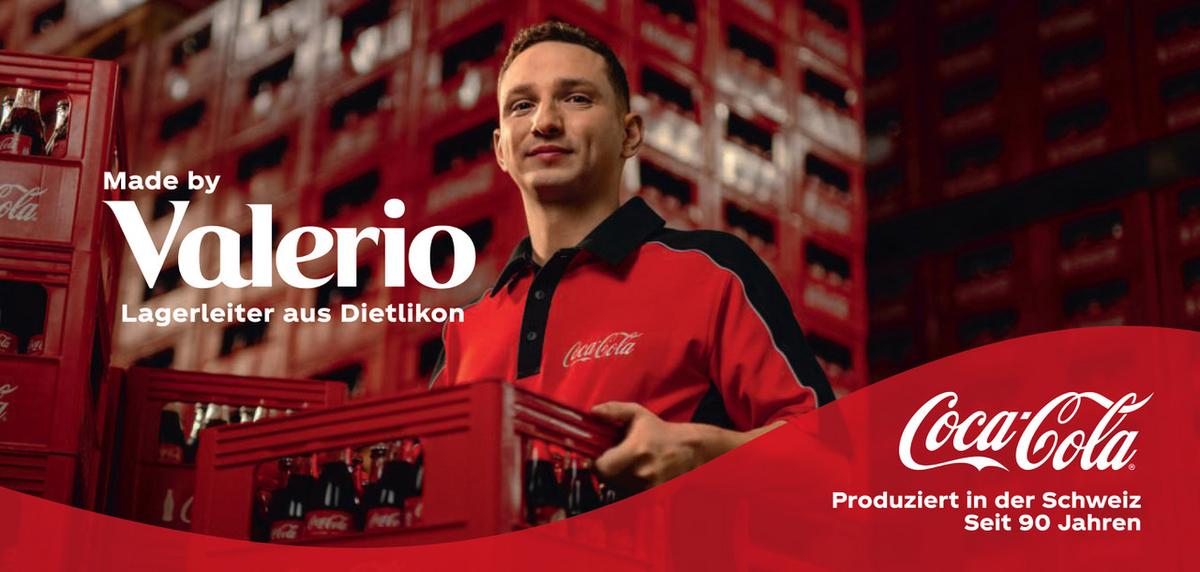
The Brand That Has Always Been Coca-Cola
Many brands try to stay relevant by constantly reinventing themselves. Coca-Cola did something even more difficult: the brand kept evolving without losing its essence. New packaging, new products, new channels, new target audiences, new cultural contexts—and yet, to this day, a certain shade of red is all it takes to make the world think of Coca-Cola instantly.

That’s brand management at the highest level. Not because everything has stayed the same, but because everything contributes to the same core values: optimism, refreshment, community, and recognizability. Fabio Cella, Country Manager of Coca-Cola Switzerland, sums up this aspect: «Our story has been written by consumers.» This isn’t just a nice anniversary cliché. It describes the difference between advertising and cultural embeddedness. Advertising can buy attention. A brand like Coca-Cola earns a place in people’s memories.
The naturalized American
Anyone who views Coca-Cola solely as an American brand is overlooking an important part of its history. About 80 percent of the beverages sold in Switzerland are produced here. 95 percent of the ingredients come from Swiss suppliers. The Coca-Cola system directly employs about 800 people and generates several thousand jobs throughout its value chain.

For Zurich Cantonal President Carmen Walker Späh, that is precisely what matters. «For me, a company is Swiss if it is rooted in Switzerland—if its employees live and work here, if production takes place here, and if value is created here.» Her conclusion is correspondingly clear: «Coca-Cola Switzerland is a local company. And how!» The Coca-Cola representatives nodded happily in agreement.
And with that, the best punchline of the evening is set. One of the most American brands in the world is celebrating its Swiss birthday at Zurich’s Schiffbau—and in doing so, it doesn’t come across as a guest, but rather as a naturalized icon.
Where Life Unfolds
Numbers don’t explain why Coca-Cola is still relevant after 90 years. The brand’s true strength lies in its ability to be present wherever people experience emotions. At music events. At sporting events. At festivals. On vacation. At Christmas. Or quite simply in those moments when people come together.
«One of the secrets is to be there in a meaningful way exactly when it matters,» says Constance Courtois-Delanoë. In fact, this principle runs like a common thread through the brand’s history. Coca-Cola was never just a beverage manufacturer. Coca-Cola saw itself early on as part of pop culture—as a companion to experiences and an amplifier of emotions.
Switzerland is a good example of this. Coca-Cola currently sponsors over 40 music festivals. Manuel Akanji, one of Switzerland’s best-known soccer players, is at the center of the current FIFA campaign. At the same time, the brand maintains just as strong a presence in ski resorts, at open-air festivals, and at concert venues as it does in retail stores. «We have a global DNA rooted in optimism and joy,» says Courtois-Delanoë. «But we have a lot of freedom locally to tell our own stories.»

The Soundtrack of Memories
Some brands are remembered. Coca-Cola is heard. When the familiar Christmas melodies ring out from the orchestra pit at the Schiffbau, just a few bars are enough to conjure up images. The legendary trucks. Winter evenings. The start of the Christmas season. «Holidays Are Coming» has long been more than just an advertising jingle. It’s an auditory marker on the calendar.

Later, historic commercials are shown on the screen. Among them is «I’d Like to Buy the World a Coke» from 1971—a commercial that has long since become more than just an advertisement. People from different backgrounds sing together on a hill—decades before diversity and inclusion became integral parts of many corporate strategies.
Host Zoe Torinesi also recalls personal stories about Coca-Cola: Shakira as a brand ambassador, collectors, fan clubs, and memories that almost everyone associates with this brand. Coca-Cola sells beverages. But the brand collects memories. That’s exactly why its most powerful campaigns don’t just end up in the archives of advertising—they find their way into the memories of entire generations.
Switzerland as a Testing Ground
90 years in Switzerland and over 140 years worldwide raise a simple question: How does a brand remain relevant for so long? Fabio Cella provides a remarkably clear answer. «Our success over the past 90 years stems above all from the fact that we have stayed very close to our consumers and really listen to them.»
Switzerland plays more than just the role of a sales market in this context. It is a production hub, a hub for innovation, and a cultural testing ground. Cella points to Swiss consumers« openness to innovation, particularly in the areas of well-being and health. Zoran Bogdanovic, CEO of the Coca-Cola HBC Group, headquartered in Zug, also looks back on groundbreaking innovations: the launch of Coca-Cola Zero, developments at Valser, and projects that garnered international attention from Switzerland. »Switzerland plays a major and important role for us as a company,” he says.

This role is also evident in investments. A new high-bay warehouse is being built in Dietlikon, logistics are gradually being electrified, and Coca-Cola is embracing the circular economy for PET. This may sound less romantic than red trucks and iconic bottles, but it’s part of the modern continuation of the same story: A brand can only remain strong if the system behind it works as well.
The original
There’s a lot of talk about sustainability this evening. About the circular economy. About electric mobility. About new products. About Zero. About Zero Zero. About the next 90 years. And that’s exactly how it should be. Brands that stand still eventually disappear from the present.
Coca-Cola has continually reinvented itself. New packaging. New products. New target audiences. New channels. The brand has evolved without losing its core identity. That is precisely what sets it apart from many brands that eventually became prisoners of their time.
At the same time, this evening also tells a story of consistency. Less sugar, fewer calories, or less caffeine are responses to real needs. But not everything that’s currently out of step with the zeitgeist is necessarily a thing of the past. After all, sugar only tastes truly sweet when it’s just sugar. And caffeine still provides that little kick that sometimes makes all the difference.

The taste of the original has stood the test of time across generations. Lifestyle trends have come and gone. Today, the buzzwords are “longevity,” “reduced sugar,” and “Zero Zero.” Tomorrow, other terms will dominate the conversation. Coca-Cola will respond to these changes, just as it has for decades. But the Original remains the benchmark against which everything else is measured.
Pharmacist John Pemberton would probably have chuckled at that. His recipe has been supplemented, expanded, and modified over the decades. But it has never been replaced. Or to put it another way: Pharmacist, stick to your recipe.
Jürg Burkhalter sums it up in his own way that evening: «To me, Coca-Cola is simply the greatest beverage humanity has ever invented.» A statement that draws laughter and applause at the Schiffbau. And one that explains why, after 90 years in Switzerland, Coca-Cola doesn’t come across as a brand celebrating an anniversary, but rather as one whose story is far from over.
Always Coca-Cola.
]]>
Sodastream Switzerland is starting 2026 with a new brand identity and a strong message: "Drink Better". From February, the new visual identity with fresh colors, modern imagery and a concise claim will be visible as part of a comprehensive media campaign. The visual refresh marks an important step in the further development of the brand, while values and commitment remain consistent.
From sparkling water maker to beverage brand
With "Drink Better", Sodastream is underlining its transformation from a sparkling water manufacturer to a holistic beverage brand. The new image combines the logo, color scheme, visual language and symbols to create a clear, contemporary look that reinterprets modern drinking culture and inspires consumers to make drinks more individual, more conscious and more sustainable.
The new "Drink Better" campaign will go live in Switzerland from February via digital channels, including CTV, online video, YouTube, social media and online advertising. It shows how the beverage experience can be rethought with Sodastream: more individual, more flexible and more conscious. At its heart is the idea that the world has moved on in many areas, but not when it comes to drinks. Sodastream wants to change this and offers a versatile solution for different needs with its ecosystem of sparkling water makers, beverage syrups, juice concentrates, CO₂ cylinders and accessories.

Largest product offensive in the company's history
Following the launch of the new brand identity, Sodastream will start the biggest product offensive in the company's history from the middle of the year. Sonja Hennecke, Marketing Lead Sodastream Switzerland: "2026 is the year in which Sodastream not only inspires with a new brand identity, but also consistently launches innovative products that revolutionize the beverage experience at home and on-the-go. Consumers and our retail partners can look forward to a new range of sparkling water makers, numerous innovative products across the entire ecosystem and Sodastream's most significant new product to date. In this way, we are bringing our brand promise 'Drink Better' to life for everyone who wants to make their drinking moments smarter, more sustainable and simply better."
As the first visible sign of the new brand identity, Sodastream will be presenting its "Fizz&Go" on-the-go bottle for self-fizzing drinks in seven new colors from March 1.
Continuity in climate protection
Sodastream Switzerland is consistently continuing its commitment to climate protection. The initiative, which was launched in 2023, will continue until 2026, with the company offsetting 115% of the emissions caused by its CO₂ cylinders. By continuously supporting global and local climate protection projects, Sodastream Switzerland is taking long-term responsibility for a more sustainable future.
]]>
To mark AEK Bank’s 200th anniversary, the Triebhaus agency has developed a brand experience concept that combines tradition and modernity in an unexpectedly vivid way. At the heart of the anniversary campaign is an object that ranks among the world’s oldest calculating tools: the abacus.
This calculating tool, which was already in use in ancient civilizations such as Babylon and China, symbolizes precision, durability, and quality craftsmanship. At the same time, even in our digital age, it conveys a clear message: True values stand the test of time. For AEK Bank, which has been rooted in the region since 1826, the abacus is thus a fitting symbol for its 200th anniversary.
Oversized abacuses as interactive elements
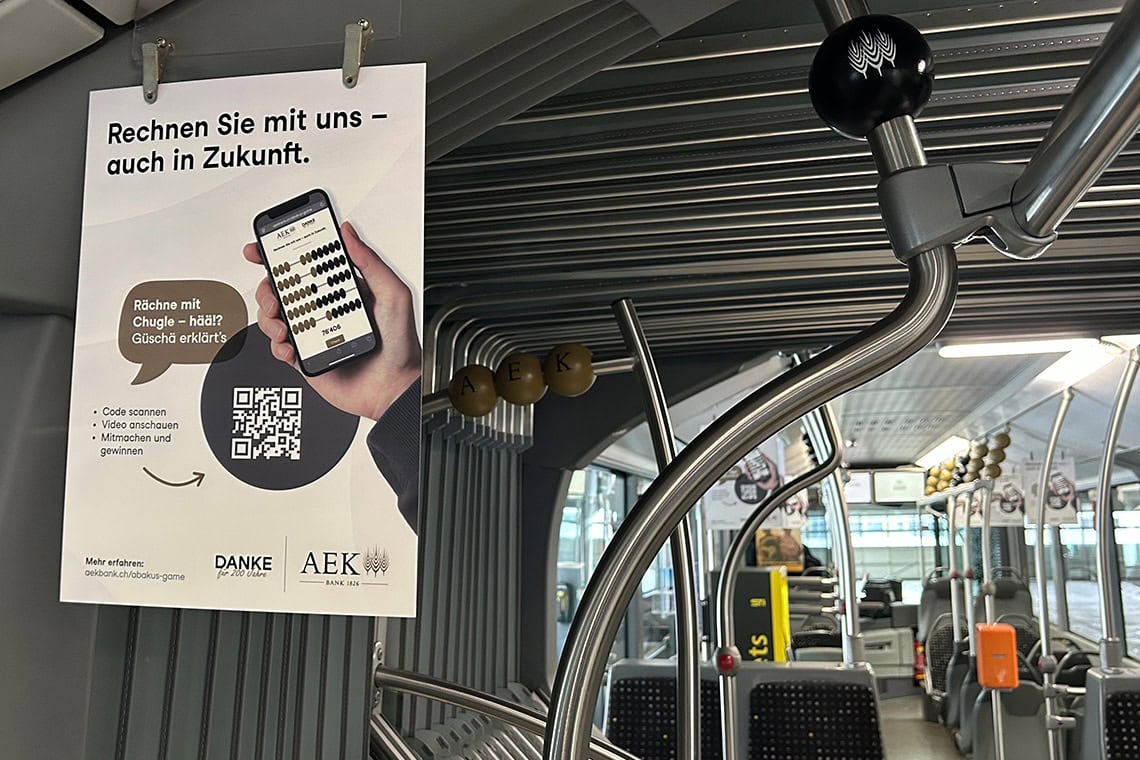
Triebhaus designed and produced oversized abacuses for AEK Bank’s 13 branches as well as for trade show appearances. The designs stand out for their high-quality materials—among other things, chrome steel balls were powder-coated and cut and engraved using laser technology. The objects feature the campaign slogan «Count on us—now and in the future» and serve as central engagement elements.
For the numerous events at which AEK performs, an event activation strategy was developed to align with the campaign. Using a web app, participants are presented with math problems, which they must solve on the abacus as quickly as possible. Once the problem is solved, the correct arrangement of the beads is displayed on the digital abacus. The combination of the analog abacus and the digital web app further highlights the theme of «Tradition Meets Modernity.».
A video and a game round out the campaign
Also part of the campaign is a video created in collaboration with language artist and podcaster Marco «Güschä» Gurtner. Using a humorous and accessible approach, he explains how the abacus works—and demonstrates how to use it for calculations. Through the abacuses placed at the point of sale (POS) and in the teller areas, customers can access not only the video but also a Online Game.
In addition, an AEK bus will be operating on the STI route network throughout the 2026 anniversary year, raising public awareness of the anniversary. Triebhaus handled the interior branding of the bus, where the abacus theme was once again incorporated in the form of spheres.
Person in charge at AEK Bank 1826: Simon Sutter (Head of Marketing and PR), Fabio Morgenthaler (Media Designer), Ramon Stettler (Media Specialist). Contact at Triebhaus: Adrian Kiener (Consulting, Concept, Direction), Bastian Siegenthaler (Concept, Production), Nina Hostettler (Project Management), Esther Zimmermann (3D, Graphic and UX Design), Marika Nygren (Art Direction), Marco Gurtner (Copy, Testimonial), Martina Kiener (Administration), Marcel Hadorn (Web Development), Mathieu Gabi (Director of Photography, Post-Production).
]]>
On Wednesday, March 18, 2026, GoodAir invites you to the third Scentis Summit on the Säntis. At an altitude of 2,502 meters, the focus will be on a sense that has long been underestimated in the brand design of many industries - and is now a strategic success factor: the sense of smell. Under the guiding theme "Scent as a booster for your brand", experts from business, research and practice will discuss how scent creates orientation and makes brands tangible.
Emotional impact beyond consciousness
The Scentis Summit brings together decision-makers, marketing managers and brand strategists to shed light on a phenomenon that works faster than human consciousness. Fragrances are not filtered rationally. They are deeply anchored in our memory and emotions - where traditional communication is increasingly reaching its limits.
The event will focus on in-depth insights into the impact of scent in brand work. Benjamin Baumli, Head of Expos and Stores at V-ZUG, will show how scent creates orientation, directs paths and makes brands tangible. Prof. Dr. Johanna Gollnhofer from the Institute for Marketing and Customer Insight at the University of St. Gallen will scientifically classify the effect of scent and explain why it influences our decisions before we consciously make them.
From theory to practice
Richard Illi, CEO and owner of Escentina, explains how concrete brand profiles are created from this effect. He gives an insight into the composition of corporate fragrances - and shows why recognizability is not only visible, but can also be smelled. Marcel Hetzel, CEO and partner of GoodAir, makes the link to practice: scent marketing as a precisely placed stimulus that activates neuronal processes and clearly positions brands.
The event will conclude with a panel discussion with the speakers, open to questions and perspectives from the audience. The entertaining afternoon will end with a relaxed networking session, providing an opportunity to exchange ideas and make valuable contacts.
]]>
Good live and field marketing is decided where brands meet people. In direct contact. Promokant has been developing personalized brand activations at precisely these crucial touchpoints for 20 years. But expectations have changed, for brands and brand managers as well as for promoters. Today, it's all about clear responsibilities, professional support, flexible deployment models and genuine appreciation.
Clear focus on core competencies
Promokant draws a clear conclusion from this: an agency cannot do everything equally well at the same time. This is why Promokant will focus entirely on strategy, conception, project management and excellent implementation of live and field marketing activations in future.
Kyo is taking over the entire pool of promoters, sales consultants and hostesses with immediate effect and will continue to develop it independently. As a specialized agency for recruitment, support and deployment quality, Kyo is positioning itself as the first port of call for promotion, event and trade fair personnel. Kyo works for Promokant as well as directly for brands, event organizers and agencies that require professionally managed, high-quality personnel. All necessary licenses are available, the processes are fully compliant, transparent and can be audited at any time.
Modern technology in personnel management
This model is complemented by modern technology in personnel management. The KyoX Board, developed in-house, provides real-time transparency on deployments, personnel and relevant key figures, thereby creating a new quality of controllability and reliability.
With this further development, Promokant and Kyo are making themselves fit for the next generation of brand managers and project managers on the client side as well as for current and future brand ambassadors of their brands. The new Promokant and Kyo websites went live on January 1.
]]>
In its 20th anniversary year, the group of companies previously known as Aqua Spa Resorts is now operating under the simplified umbrella brand Aqua Spa. With this step, the company is looking back on two decades of experience, quality and innovative strength in the Swiss wellness and spa sector, while at the same time clearly aligning its brand structure for the future.
The new, concise Aqua Spa umbrella brand strengthens the visual and communicative connection between the six spa worlds and makes it even clearer that they belong together. The individual locations will retain their established names and individual profiles, but will be managed more consistently and clearly under the common umbrella brand in future. The repositioning will take place gradually over the course of 2026.
Six established locations under one roof
The Aqua Spa Group includes the Hürlimannbad Zurich, the Solbad Schönbühl, the Hammam Oktogon Bern, the Mineralbad Rigi Kaltbad, the Mineralbad Samedan and the Termali Salini Locarno.
"The stronger visual and communicative integration of the umbrella brand will make the togetherness of these unique spa worlds more visible and tangible in future," says J. Molnar. "It strengthens recognition, sharpens the brand identity and underlines the common quality and value basis of all aqua spa operations."
With its new identity as Aqua Spa, the company based in Sursee (LU) is consistently developing its brand strategy. Building on 20 years of successful company history, Aqua Spa is thus creating a strong basis for sustainable growth and clear, comprehensible communication with guests, partners and the public.
]]>
This year sees the launch of the state electronic identity (e-ID). Developed by Mutoco in close collaboration with the Federal Office of Information Technology and the Federal Office of Justice, the brand lays the foundation for a secure, digital identity presence for Switzerland. Together with the associated swiyu-Wallet app, it will simplify the everyday lives of the population, companies and authorities by digitally bundling documents and reducing administrative procedures.
Making trust visible through design
The design combines the official federal design guidelines with modern digital principles. The color scheme is derived from the security features of physical ID cards and at the same time conveys dynamism and diversity. The color palette complements the official Swiss colors with vibrant elements derived from the holographic effects of the physical ID. Strict contrasts that ensure accessibility are maintained at all times. The typography is clear, accessible and optimized for digital use and ensures the best readability on all devices.
In order to strengthen confidence in the future brand, the Swiss population was involved at an early stage through surveys and interviews in all language regions.
As individual as every personality
A special feature is the dynamic color gradient. Two levels allow an infinite number of variations, so that each e-ID has an individual look. By touching the e-ID in the app or tilting the cell phone, the ID card moves with it. The possibility of interaction also visually conveys the security of the e-ID.
The logo also reflects diversity. The central "i" in the name stands for "I", identity and innovation and forms a Swiss cross multiplied nine times.
"With swiyu branding, we want to establish a trustworthy, modern digital identity among the Swiss population. It is an important milestone on the path to digital sovereignty," says Rolf Rauschenbach, Deputy Head of the e-ID Division at the Federal Office of Justice.
Daniel Steffen, Design Lead at Mutoco, adds: "The design combines functionality and identity: it is not only aesthetically pleasing, but also strengthens users' trust in Switzerland's digital identity."
Consistency through a comprehensive design system
The swiyu wallet is an application for iOS and Android. In order to offer users the best possible user experience, the decision was made to use native apps. A comprehensive UI kit in Figma combines platform standards (Apple Human Interface / Google Material Design) with the swiyu brand. These were supplemented with basic design elements, design tokens, icons and documentation. This facilitates collaboration with developers, increases consistency and ensures scalability for further applications.
The design of the e-ID, wallet and other user interfaces conveys trust and security thanks to the precision and quality of the visual design and clear user guidance. The positive and visionary appearance creates trust and strengthens Switzerland's digital sovereignty.
Further information on the launch process: https://www.eid.admin.ch/de/e-id
]]>
Milos Malenovic's departure was loud and ultimately inevitable. And yet it only explains part of what FC Zurich is dealing with in the winter of the 2026/2025 season. Because the real question is not why this collaboration failed - but why it was able to develop in this form in the first place.
This is where the story behind the image crisis begins. It is less about a person and more about a system in which management, organization and communication increasingly drifted apart. About a club that wanted to function in sporting terms without thinking about its brand. And about an open flank that did not arise on the pitch, but in the interplay of power, expectation and a lack of classification.
When trust becomes a currency
The transfer of Benjamin Mendy has accelerated this fragile situation. He acted as an accelerant in an environment that was already under tension. Not because football has to be moral - but because brands are based on trust. And trust is not built in fundamental debates, but in everyday life: with fans, partners, sponsors and employees.
To understand the significance of this decision, it is important to understand the context: French footballer Benjamin Mendy was charged with several counts of rape and sexual assault in England. The allegations related to alleged acts between October 2018 and August 2021, brought forward by several women. In court proceedings, Mendy was acquitted of all charges by a jury in 2023. The defense successfully argued that all sexual contact had been consensual. Mendy is therefore legally considered innocent.
However, this was precisely the communication challenge for FCZ. The club was not signing a player with sporting question marks, but a player with a highly charged public history. This meant that a sporting decision inevitably became a brand issue. Not because of the verdict, but because of the perception. And because FCZ did not succeed in clearly and credibly embedding this transfer in its own stance at an early stage, the club fell into a defensive explanation mode.
At a time when the club was already looking for direction, the Mendy transfer reinforced the feeling that sporting ambition, organizational culture and public image were no longer in harmony. The open flank was therefore less in the penalty area than in the club's self-image.
Behind the event: Why failure is systemic
The break with Malenovic was inevitable. But it doesn't explain anything. Because the real question is: why could a style that polarizes both internally and externally become so effective in the first place?
This is where the look behind the scenes begins. For years, FCZ has been strongly supported by individual figures - both financially and operationally. This has provided stability, but also created dependencies. Decisions were possible without necessarily being embedded in an overarching narrative. In such constellations, leadership quickly becomes power - and communication becomes justification. This is precisely where the flank opens up. Not on the left, not on the right in the square, but where claim and explanation are no longer congruent.
Leadership today means: being able to explain
Modern football clubs no longer function as one-man operations centers. They are complex organizations in which sporting, economic and communicative decisions interact. If you don't separate internally, you can't explain externally.
That's why FCZ is not just about new heads, but about architecture. It's about a management model that distributes responsibility, clearly assigns competencies - and thus creates calm. International role models have long relied on leadership teams instead of all-powerful sports directors. Not for reasons of fashion, but out of necessity. For a club with the charisma of FCZ, this is not a management gimmick, but brand work. A club that can explain why it does what it does becomes more accessible. For sponsors. For fans. For talents.
The Tararache moment - why experience makes talent better
Mihai Tararache joined FC Zurich in 2004. On a free transfer from Grasshoppers. An unspectacular transfer on paper - a stroke of luck in practice. Tararache was not a loudspeaker, not a symbolic player, not a marketing moment. He was something much rarer: a midfielder with a sense of order who not only stabilized a team, but made it better.
His strength lay less in individual moments than in the in-between: in positioning, in timing, in the clarity of his decisions. A high level of ball security, uncompromising ball recovery, game intelligence, authority - and an aggressiveness that never seemed hectic, but rather structured. Tararache took time out of the game when it needed it. And released the tempo when others were still sorting things out.
Above all, however, he created reliability. Players like Blermin Dzemaili and Xavier Margairaz were able to develop alongside him because they knew that there was someone playing behind and next to them who closed spaces, cushioned risks and took on responsibility. Tararache was not a mentor in the pedagogical sense - he was a point of reference on the pitch. Someone to whom the intelligence of the game could orient itself.
It was no coincidence that FCZ not only became champions during this phase, but also developed players who went on to have international careers. It was the result of an axis that saw experience not as a counterweight to talent, but as its amplifier.
The parallels to the present are obvious - not out of nostalgia, but out of logic. Today, FCZ once again has a remarkable generation of young players at its disposal. They take on responsibility early on, shape games and are the focus of attention. That's exactly why we need players who don't look for things themselves, but make decisions. They know when a risk is necessary - and when not. Tararache was not an effect. He was a player who made other players better. And it is precisely this type of player who decides whether talent grows or stagnates.
Squad planning begins in winter
In this light, squad planning becomes a question of leadership. Not just in the summer, when markets are overheated and options are shrinking, but in the winter, when direction is set. If you really want to promote youth, you have to give them a foothold. Not on the bench, but in the center of the game. The fact that under Milos Malenovic all talented players were given contracts for two to four years at an early stage is part of a fair balance. This planning security is a value - both in sporting and economic terms. It buys time. But time alone does not solve structural issues.
Data, AI - and the new sobriety in football
When budgets come under pressure, bad decisions become expensive. That's why technology is no longer an innovation toy in the modern club, but risk management. AI in scouting, in load management, in analysis - all of this serves one goal: less chance, more precision. Clubs such as Sevilla and Ajax show how data-based systems can help to objectify decisions. For FCZ, this would not be a break with its DNA, but rather a further development of it: recognizing, protecting and developing talent - systemically instead of intuitively.
Brand is not a claim, but behavior
In the end, everything leads back to the brand. FC Zurich is more than just a sports club. It is a city club, a projection surface, a place of identification. This is precisely why ambiguity has a stronger effect here than anywhere else.
Today, brands are not believed because they claim something, but because they act consistently. Reward logics, sustainability strategies, women's football - all these topics only pay off if they are not seen as an add-on, but as an expression of an attitude.
Women's football in particular shows the potential that lies here. The FCZ was a pioneer. Now it needs to professionalize. Not for image reasons - but because credibility comes from consistency.
Close the flank
The failure with Milos Malenovic was not an industrial accident. It was a warning signal. FC Zurich's open flank is not a tactical detail. It is the result of a lack of clarity between management, communication and the sporting axis. If you want to close it, you need more than new names. They need clarity and finally a shirt sponsor again...
]]>

In a time of constant change, it takes more than just adaptability - it takes courage, foresight and real innovative strength. The graubünden 2025 brand day is dedicated to precisely these qualities and will bring together leading minds at the Fabrik event location in Chur on November 27.
The well-known SRF philosopher and author Barbara Bleisch as well as Rémy Müller and Frédéric Zürcher from MIGROS will deliver top-class keynotes. The pioneering spirit of Graubünden will be presented by RhB Director Renato Fasciati, top physician Prof. Dr. Roger von Moos with his lecture on "Translational Medicine at Interfaces" and Remo Frei and Christian Binkert from the innovative outdoor clothing company ROTAUF in Chur.
Cultural highlights will be provided by theater director Giovanni Netzer and his Origen ensemble, while host Gieri Spescha is looking forward to a visit from President of the Government Marcus Caduff.
The public networking event is aimed at all those interested in brands and the Grisons. Participation is free of charge, but registration is required.
]]>A Decade of Innovation and Change: Bring! Labs Celebrates Its Anniversary and Rebranding
Bring! Labs, a Swiss mobile technology company, recently celebrated its 10th anniversary. Known for its successful apps such as the Bring! App, which has been in use in Switzerland and throughout Europe for over a decade, as well as the Profital App, Bring! Labs has been working closely with advertising partners in the retail and consumer goods industries for years.
The anniversary was celebrated on August 28 in the exclusive setting of SOHO Zurich, where industry professionals gathered to exchange ideas and discuss new concepts. Under the theme «»Context Meets Impact" The morning featured in-depth discussions and a joint look back at the past ten years and ahead to the future.


To mark the anniversary and the change in management, Bring! Labs has launched a comprehensive rebranding carried out. After a decade and with new, ambitious plans, it was high time to take this step. Previously, the B2C brands Bring! and Profital operated together, which was not always clearly understood in the advertising industry. The rebranding is a logical step toward establishing Bring! Labs as an independent brand and introducing it to the world. This includes a complete visual redesign, a new website, and a revamped presence at events and trade shows—all Developed entirely in-house.

«Context Meets Impact»: Scientific Findings and Industry Perspectives
One of the highlights of the event was the keynote address by the neuromarketing expert Philipp Zutt. Under the title „How Offers Resonate in the Brain—and Why Context Is Crucial“Zutt presented neuropsychological findings, which he brought to life through a practical chocolate test. He emphasized that purchasing decisions are mostly made on an emotional basis and that the Context has an incredible influence on these emotions Factors such as seasonality, weather, the platform itself, surrounding brands, and location have a significant influence on our mood and consumer behavior. For brands, this means making greater use of context and understanding it on an emotional level in order to have the greatest impact at the right moment.

Bring! Labs leverages its expertise in data analysis to achieve this. The company can work with a wealth of data, both at the aggregate level and at the retailer level. By combining this data with contextual information—such as weather data—it can fascinating insights into purchasing behavior that are of great interest to advertisers. This ability to connect the context is a unique selling point of Bring! Labs.


The panel discussion that followed brought together three different industry perspectives: Žanet Žabarac (Head of Marketing at Dosenbach) shed light on the Retailer's Perspective, Stephanie Dirscherl (Managing Director of EssenceMediacom Switzerland) the Agency Perspective and Juan-Pablo Schmid (CCO of Bring! Labs) the Publisher Page. The host and editor-in-chief of the business magazine m&k, Anna Kohler, gave a charming and confident presentation on the various aspects of the Contextual Advertising.
The Strength of Bring! Labs: Contextual Relevance in the Shopper Journey
Bring! Labs is strategically positioning itself in the the crucial moment in purchasing planning. Users who are planning, seeking inspiration, and discovering products are on the verge of making a purchase and are deciding not only on a platform but also on what they will ultimately buy. Bring! Labs accompanies these users throughout their entire shopping journey, from the planning stage to adding the product to their cart.
The unique selling point (USP) Bring! Labs„ goal is to reach users who don't yet have a specific “favorite store" or a specific favorite brand. This users who are not tied to a specific platform They find inspiration while shopping and decide spontaneously what to buy and where. In contrast, traditional retailer apps often target clearly defined audiences.
The platform boasts an impressive reach: In Switzerland, Bring! Labs reaches approximately 800,000 monthly active users 10 to 15 percent of the population. Usage is exceptionally high: Bring! app users record an average of ten sessions per month, which are spread out over dedicated planning sessions and large weekly grocery runs.
The effectiveness of contextual advertising at Bring! Labs is evident in very high conversion rates and good store visit rates. This is because users are very open to supportive ads during the planning phase, as these help them plan efficiently. Feedback from users who appreciate an „ad-free app“ underscores that the ads are perceived as helpful rather than disruptive.
Bring! Labs offers a wide variety of Opportunities for collaboration throughout the entire shopper funnel. This ranges from inspirational content such as recipes and branding formats to non-food offerings, since people’s needs extend beyond food and drink—whether it’s a new vacuum cleaner, gardening supplies, or beautiful flowers. The goal is always to support users, not to interrupt them.
Digital Transformation as a Driving Force: Successes and Outlook for the Next 10 Years
If we look back ten years, print advertising still strongly dominated the advertising market, particularly in the consumer goods sector. Bring! Labs, however, was able to benefit enormously from the digital transformation benefit. Crises such as the COVID-19 pandemic have triggered a massive surge in digitalization, which has provided the platform with lasting „momentum.“ This development confirms the relevance and growth of Bring! Labs, which has now established itself as a major player in the digital market.
Armed with the insights gained from the anniversary event and a clear understanding of the importance of context, Bring! Labs looks ahead to the next ten years with optimism and ambition.
]]>