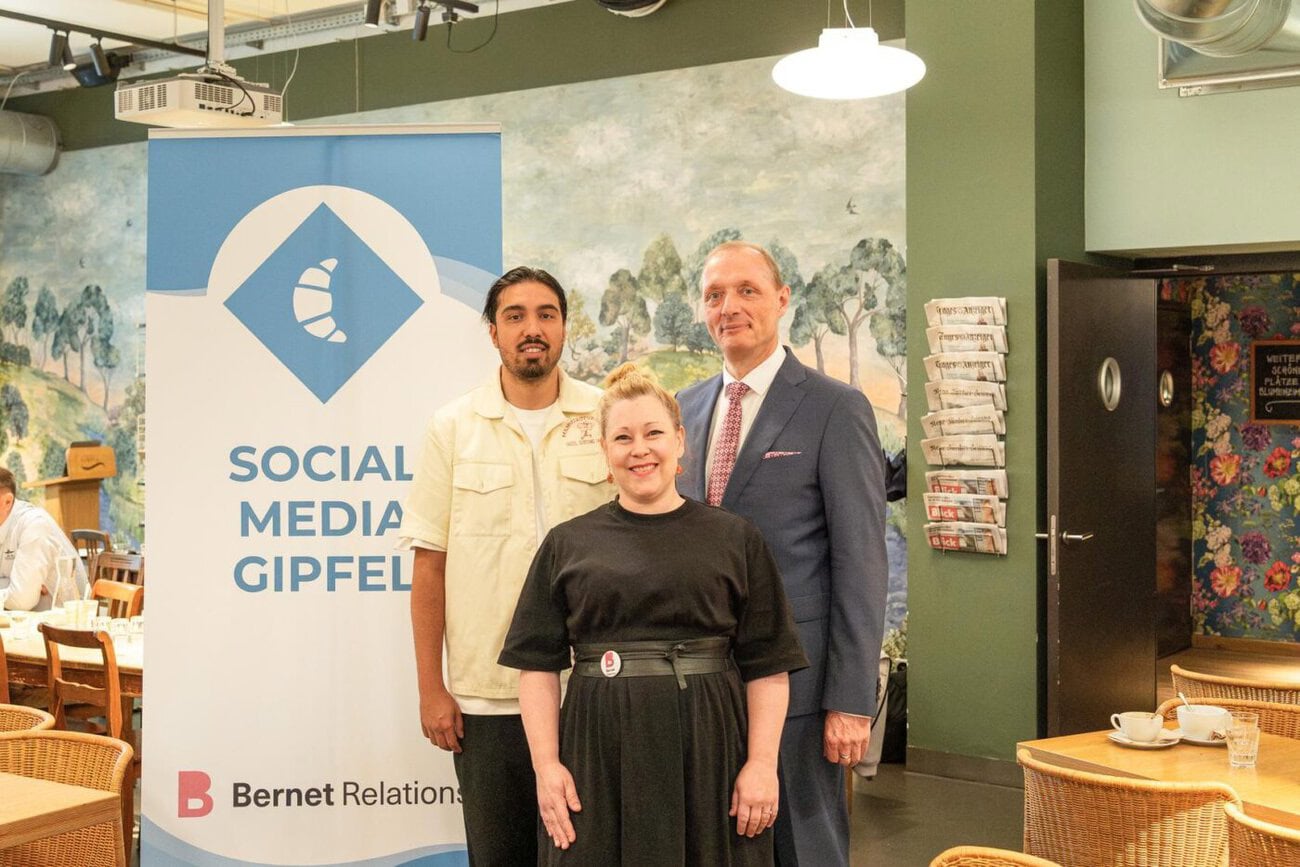
The 83rd Social Media Summit took place on June 3, 2026, at the fully booked tibits in Zurich. More than 120 participants from the Swiss communications and social media community gathered early in the morning to discuss the topic: Creating Content with AI—Between a Creative Boost and Legal Guidelines. Bernet Relations is responsible for organizing this community event.
Even a failure can be an opportunity
Sharuch Shabbir, Migros« social media manager, rose to fame in December 2025 as the rapper behind the song »Grittibänz im Benz” under the pseudonym Sha38. The AI-generated TikTok video went viral and sparked a craze. At the Social Media Summit, he provided insight into how AI is used to create content for Migros’ social media channels.
In addition to the success story of «Grittibänz,» he also touched on an AI glitch from late fall 2025: the five-legged reindeer on a cookie tin. Migros’ social media team responded with a giveaway and a touch of self-deprecating humor—thus turning the mistake into an opportunity.

AI output never comes without human input
Markus Näf, a partner at Eversheds Sutherland and an adjunct lecturer in computer science law, drew on the example of the rapping Grittibänz in his brief presentation. He asked: Who owns this content? And who can assert legal claims, and on what grounds?
After an introduction to copyright law—only human creations are protected—and a discussion of a liability case involving misinformation provided by a chatbot, Näf offered the communications professionals in attendance specific practical tips. The human contribution to AI output should be documented, and he recommended checking the licenses of the tools used, since not every license version permits commercial use.

Checklist and Upcoming Social Media Summits
In anticipation of the 83rd Social Media Summit, Bernet Relations has updated its checklist titled «Using Generative AI Effectively in Communications.» In addition, Bernet Relations is offering AI workshops and shorter “coffee sessions” on this topic.
The next events will take place on Wednesday, September 2, 2026, in Bern, and on Wednesday, November 4, 2026, in Zurich.
For more information and to register for upcoming events: https://bernet.ch
]]>
Bernet Relations is strengthening its team with an experienced communicator: Oliver Lutz will take over the management of the agency in the summer, bringing with him around 15 years of experience in communication and marketing. The 39-year-old studied "Communication and Journalism" at the ZHAW and is an expert in digital trends. He was already responsible for online communication and social media at Veloplus and was in charge of marketing and communication for MySports at Sunrise. He also supports the AI transformation studio CPLTS.
Lutz has been in close professional contact with Bernet Relations for many years and has been a guest on stage at the "Social Media Summit" on several occasions. In his new role, he will further develop existing formats and open up new business areas. His focus is on combining human communication expertise with current technologies such as AI and communication tech.
"We plan, build, train, coach and operate corporate communication hubs for companies and organizations of all sizes," says owner Dominik Allemann. "Oliver Lutz not only has the know-how, but also the human qualities to complement our team perfectly."
]]>
Since 2015, Swiss media professionals have been providing information about the use of the social web in their day-to-day work as part of the "Journalists on the Web" study. In the second half of 2023, Bernet Relations and the Institute of Applied Media Studies IAM at the ZHAW conducted the fourth round of qualitative interviews with 20 selected Swiss journalists. The focus was on the activities of researching, publishing and discussing. They were also asked about the organization of their social media activities.
As in previous surveys, the ambivalent attitude of media professionals is striking in the current results. "Journalists appreciate the benefits of social media and are fascinated by its possibilities. At the same time, they would like to be less reliant on it," explains Guido Keel, Head of Research at IAM ZHAW.
Media professionals find the dependence on platforms, the time required and the sometimes questionable quality of the content annoying and stressful. At the same time, they appreciate the new opportunities that social media opens up, be it in finding topics, researching or communicating with specialist communities and the audience. Journalists also use social media to build their own brand, regardless of their editorial affiliation.
Differentiated assessment of credibility in searches
In previous surveys, journalists were skeptical about the credibility of research on the social web. A change can be observed here: Journalists differentiate strongly in terms of credibility according to sender and adopt content from social media for their work if they know the sender and are sure that it is an authentic statement.
More reach, unknown recipe for success
The study also reveals that media professionals use social media channels specifically to draw attention to articles and contributions. In addition, the social web expands the audience both geographically and demographically. It remains difficult to know why a story is particularly well received online. "I have the feeling that you can read a lot into the question of what works on social media," says one interviewee.
In addition, journalists are among the most avid followers of other professional colleagues. This fact contributes to a certain bubble phenomenon. Recently, the changes on Twitter/X (troll flood, X development) have also led to a certain melancholy and homelessness; some journalists have turned away and have not yet found an equivalent platform.
Discuss: Between phone and troll
Whether and how a journalist uses social media for dialog with the readership differs from medium to medium. For some interviewees, discussions with the audience lead to a follow-up story; others, on the other hand, see online dialog as a one-way street.
There is a consensus that the really relevant dialogs do not take place on social media. "An exchange begins on Facebook or Twitter. As soon as the research becomes more in-depth, journalists switch to face-to-face conversations," says Irène Messerli, co-editor at Bernet Relations. All interviewees are familiar with the unpleasant phenomenon of trolls and hate comments. Ignoring them is the most frequently chosen strategy. Nevertheless, it turns out that if you take the time and seek out digital exchange, the dialogue normalizes.
New opportunities for media professionals and communicators
Communication professionals and journalists alike appreciate using social media for uncomplicated, fast and time-delayed dialog. However, this is no substitute for a face-to-face meeting. With increasing time pressure and the abundance of digital offerings, the popularity of media conferences and events is dwindling.
Instead, media professionals are very open to new online sources and forms of information. Specialist experts and corporate influencers are becoming increasingly important as new sources for journalists. "Journalists rarely leave their editorial offices due to time and cost-cutting pressures - social media quickly brings them exciting, relevant contextual knowledge or opens up useful sources of information," explains Dominik Allemann, co-editor at Bernet Relations. This gives communication managers and experts from companies the opportunity to stand out with innovative information and exchange formats.

After 2015, 2017 and 2019, Bernet Relations and the Institute of Applied Media Studies at the ZHAW are publishing the "Journalists on the Web" study for the fourth time. The study can be can be downloaded here.
]]>
Nine out of ten Swiss organizations and companies are active on social media. Social networks have thus established themselves more and more clearly as a central communication tool. Two-thirds of the respondents have a social media strategy for the entire organization. In doing so, they pursue goals such as image enhancement, trust building, visibility and reach.
YouTube remains at the top in terms of use, newly ahead of Twitter and the booming LinkedIn. For the first time, Facebook did not make it onto the podium with 4th place (2018: 2, 2016: 1). The trend toward image-based, fast dialog and content via streaming or chats did not hold despite generally higher engagement triggered by the Corona pandemic: More than half of the organizations increased dialog and contact maintenance with social media.

"The new study shows the great and growing importance of social media in organizational communication. More emphasis is being placed on strategic foundations and integration into communications, and more resources are being devoted to this," explains scientific study director Guido Keel.
Irène Messerli, author Bernet Relations, adds: "More than two thirds of organizations and companies work with corporate influencers. The use has increased, administrations and political organizations mainly rely on internal influencers, companies on internal and external ones. LinkedIn plays an important role here: this is where internal influencers express themselves about their organization or the offerings and services."

The trend toward higher social media budgets continues to grow. 85 percent of all responding organizations have a budget or plan to budget soon. Already, the majority of companies and organizations pay for reach. A third pay for ad placements at least weekly. Facebook Ads are even more widespread than Google Ads, which are just ahead of Instagram Ads.
Important internal influencers - little investment in further training
As before, personnel resources flow primarily into creating and managing content, followed by conception and strategic development. Surprisingly, even in 2020, little is being invested in internal training and development. Yet internal and external influencers are becoming increasingly important: 67 percent have implemented corresponding measures or are planning to do so.
Awareness of listening is high - concern about security, outrage, escalation.
Swiss organizations and companies are increasingly working with paid monitoring tools. Among other things, popularity and reach, visitor numbers, engagement and dialog are measured. The respondents still see the greatest challenges in data security and the risk of shitstorms.
Fewer and fewer respondents expect the trend toward offline communication. For the future, they see that the importance of social media for personnel marketing, image and reputation will increase. And that social media strategies will increasingly be developed across all departments and divisions.

The most important findings at a glance
Commitment rises slightly - no newcomers
At 92 percent, the proportion of organizations involved in social media is slightly higher than in 2018 (89 percent). There has been a significant increase in those already highly experienced users who have been using the channels for more than six years (54 percent). Not a single organization reported being active for less than a year. The few who were absent stated that social media did not fit in with their organizational culture or that the interest of the target group was too low (two mentions each). Also mentioned were loss of control, legal uncertainties and the great effort involved.

Strategy remains constant
Strategic planning had already caught up significantly in the 2018 study, and this trend is now continuing in 2020. 88% have a social media strategy, 57% of which are for the organization as a whole (2018: 51%), while 31% have a strategy for individual areas, departments or projects. Across companies, social media is mainly integrated into marketing processes (79%) and brand communications (68%), and social media activities are also significant in HR (46%). They are less significant in the areas of customer service, internal collaboration or sales.

Trust, image, visibility
The most important goal in the use of social media is to create trust and maintain the image and reputation (75%). Almost equally important is to increase the visibility (73%) of one's own company or organization, followed by reach, web traffic and providing information about products and services. Companies and other organizations differ in only one respect: Companies are much more likely to use social media to appear as an innovative employer (53%) and to recruit new employees (26%) than public authorities, associations and NPOs (20% and 9%, respectively). It is striking that administrations (74%) primarily strive for direct contact with citizens via social media. For companies, no goal achieves such a high value - the reasons for being active on social media are more varied.

Strongest growth: LinkedIn and blogs
YouTube has been leading since 2016 and remains the most important platform for many organizations and companies. The trend toward image-based and immediately tangible and fast-paced content via live streaming and chat networks, which was visible in 2018, could not be maintained. LinkedIn and Twitter have gained in importance. For the first time, 16% of the responding organizations and companies said they used TikTok. Respondents also want to learn more about the TikTok, Instagram and LinkedIn platforms.
Paid presence: Ads placement remains constant
Before 2018, people were experimenting with ads - today, a majority of companies and organizations already pay for their reach. Compared to 2018, the intensity has remained the same - around a third said they pay for ad placements at least weekly. Facebook remains the most popular platform to place ads. Facebook Ads are even more widespread than Google Ads, which are only very slightly ahead of Instagram Ads. Ads on LinkedIn, YouTube and Twitter are also widespread. Ads are rarely placed on the other platforms. However, purchasing reach on social media is much more common among companies than among government agencies, associations and NPOs: while 47% of companies said they run social media ads at least weekly, the figure for other organizations is just 5%. By contrast, more than a third of these organizations said they never buy ads on social media.

Engagement: strategy, content and contact management
As in 2018, the respondents rated the creation and management of content as the most important activity related to social media use, followed by conception and strategic development as well as dialog maintenance. Slightly less attention is paid to monitoring and success control. According to the survey, the least investment is made in technology and design, as well as in internal training and continuing education.
Resources: Own budget and external support increase
By 2016, organizations often expected social media activities to occur within existing budgets. Today, 78% of all responding organizations and companies have specific budgets, up from 30% in 2013, with resources also being outsourced to external partners, including primarily social media and PR/communications agencies. Content editing is outsourced the most, ahead of ad placements and technology. This was already the case in 2018 and is surprising. One might assume that people prefer to be responsible for content in-house if their primary goal is reputation management.

Internal and external opinion leaders become more important
Two-thirds of the organizations surveyed (2018: 50%) work with influencers (personalities who express themselves as internal employees or external opinion leaders on an organization or its offerings and services). Administrations and political organizations tend to rely more on internal employees as influencers, companies on internal and external ones - and overall, the use of influencers is higher among companies than among administrative units and political organizations.
Monitoring professional, measuring the image significant
Organizations and companies track social media systematically and increasingly work with paid monitoring tools. Awareness of the importance of listening remains high: Only 7% still state that they do not conduct systematic monitoring. Popularity and reach, visitor numbers, engagement and dialog, comments and other user activities are measured.
Challenges and future
The respondents still see the biggest challenge in data security, followed by concerns about shitstorms, collective outrage and escalating situations. Fewer and fewer respondents expect the likelihood of offline becoming more of a trend again. For the future, the responding organizations and companies estimate that its importance for personnel marketing, image and reputation will increase. And that social media strategies will increasingly be developed across all departments and divisions.

Social media engagement in the age of Corona
The year 2020 was marked by massive cuts due to the global spread of Covid-19. The pandemic had an impact on the engagement and intensity of dialog on social media for half of the respondents: A close half of the respondents stated that they increased social media activities, on the other hand, only just 4% were less active during the pandemic. However, half of the respondents indicated that Corona had not changed anything.


Over the next four weeks, 32 countries will play for the World Cup trophy. Portugal can already celebrate a victory: the footballers of the current European champions have a total of over 360 million followers on the three major platforms Facebook, Twitter and Instagram. Cristiano Ronaldo is in first place among the individual players. The Portuguese superstar has 320 million fans and followers on Facebook, Instagram and Twitter.

Thanks to Ronaldo, Portugal is in first place in the ranking, followed by Brazil and Spain with 350 million and 333 million followers respectively. The Swiss team has a total of 11 million followers, putting it in 19th place, while Iceland comes last in the overall ranking. The players from the Nordic island nation have less than one million followers.
Instagram is the number one
The World Cup players have a total of 2.5 billion followers on Facebook, Twitter and Instagram. 89% of all players are active on social networks and have at least one account. On Instagram alone, the players have a total of around 1.1 billion followers. This corresponds to a share of 43 percent. Instagram is therefore the number one platform used, well ahead of Facebook and Twitter. 81% of the 736 players have an Instagram account.

World Cup stars as influencers
Each team has its own social media star. The top 32 teams have a combined total of around 1.2 billion followers. This means that 32 players account for 47% of the total number of followers. Top players turn their own name into a brand and are among the most important influencers in the digital world. Almost all professional footballers worldwide now use social networks; only 10% are not officially active on social media.
Shaqiri at the top
The number of followers of Swiss footballers varies. Mario Gavranović is at the bottom of the Swiss list with just over 8,600 followers on Instagram. The number one Swiss player is Xherdan Shaqiri with 4 million followers. However, this means he has 80 times fewer followers than Christiano Ronaldo.

About the studyThe social media study was conducted by the international PR network Ecco and Bernet Relations. For the study, the companies analyzed the social media activities of all football players from the 32 World Cup participants. A total of 736 players worldwide. The number of followers and fans on the social platforms Facebook, Instagram and Twitter were added together for the analysis.

Bern has often been suspected as the source of the agency name Bernet. The false assumption now gets new plausibility: Bernet Relations is represented with a branch office in Bern as of January 2018. As at Zurich's Stadelhofen train station, the Bernet Relations team also works here in a building steeped in history: in the main building of the Zunftgesellschaft zu Schmieden at Schmiedenplatz 5. Behind the Kornhaus and opposite the French Church, the Bernet office is located a few minutes' walk from Bern train station.
Bernet Relations has always been active in Bern, according to the press release: with work for the state players for transport, telecommunications and postal services, the Swiss Confederation, the canton and city of Bern and the local economy. Bernese co-owner/CEO Irène Messerli worked here herself for several years: as head of communications for the Bern Cantonal Police and the Bern University of Applied Sciences. "The idea is not new. Our desire is very great to work here and strengthen local relationships. We are building on a good foundation here," Messerli says. The community event "Social Media Summit" founded by Bernet Relations has also been a guest in Bern several times.
The agency, which is owner-managed by Irène Messerli and Dominik Allemann, is anchored in the German-speaking part of Switzerland and is committed to the communications industry: Via Bernetblog, cooperations in research, teaching, with studies on online media relations and social media and as the founder of the established "Social Media Summit", the Bernet team is known as experts and as implementers with a broad client portfolio. Since November, the agency has been rebranded as Bernet Relations (Werbewoche.ch reported). The agency has been active throughout Switzerland since it was founded in 1991, but this is the first time it has opened a branch outside Zurich.

All communication tools, the website, the professional blog Bernetblog as well as the offer were refreshed and restructured. The focus of the Bernet offering is on cultivating relationships between organizations, opinion leaders and all reference groups as well as on shaping dialog and content.
The owner-managed agency by Irène Messerli and Dominik Allemann has a broad commitment: Via Bernetblog, cooperations in research, teaching, with studies on online media work and social media and as founder of the established "Social Media Summit", the Bernet team is known as an expert and as an implementer with a broad client portfolio. Now the Swiss agency is comprehensively refreshing its appearance and brand core. Irène Messerli, Co-Owner/CEO says: "Relationships lie at the core of every being. They drive our world. As social beings, organizations and communities we need interaction, without it we are isolated. That's what drives us. Shaping these relationships is what we see as our mission."
"Our relations are much more than just public"
Bernet Relations is a member of the Federation of Swiss PR Agencies and has been part of the global ECCO network of 32 owner-managed partner agencies in over 40 countries since 2015. Dominik Allemann, Co-Owner/CEO: "The public relations term is no longer sufficient for us as a description of activities. From analysis to strategy and analog or digital implementation to client support and empowerment - our offering has evolved massively in recent years and will continue to do so. With the new branding, we are opening a new chapter in our 27-year agency history." Bernet Relations was founded in 1991 as a sole proprietorship by Marcel Bernet and was taken over by Irène Messerli and Dominik Allemann in 2013.