
Newspapers in Switzerland used to be politically positioned. Only over time did more and more so-called independent press products appear. This was because reach played an increasingly important role. Today, the mainstream media try to reach as many people as possible - regardless of whether they are on the right or the left. The weekly newspaper WOZ or the Weltwoche of SVP National Councillor Roger Köppel. Among the relevant press titles today, however, there is no paper with a party-political orientation. "That wouldn't be possible because it wouldn't be commercially successful as the customer base would be too narrow," says media journalist Rainer Stadler.
"There are sheets with an explicit ideological basso continuo, such as the NZZ or The Weltwoche." According to Stadler, the orientation of the Tamedia titles and the CH-Media newspapers is more diffuse. But with regard to the selection, processing and commentary of topics and events, trends can still be recognized: "The Tages-Anzeiger is to the left of the center, the SonntagsZeitung to the right of it." Quite left-wing orthodox The Weekly Newspaper on the road, which is not bound by party politics. As the ex-NZZ-However, as Mr. Mann goes on to say, it is already the case that newspaper offers in this country must be made in such a way that they reach across all political camps.
Sozi writes for The Weltwoche
However, it is not so easy to determine which medium has which political color. SVP National Councillor Roger Köppel denies to m&kthat his weekly magazine has a politically right-wing orientation: "That would mean that we only publish articles that can be classified as politically right-wing." And that's actually not true, if you think of former SP President Peter Bodenmann, for example, who has been working for The Weltwoche writes. "There is no general political line that our authors have to obey," continued publisher and editor-in-chief Köppel. "Anything that is interesting is allowed."
The Basel Newspaper under the aegis of Markus Somm was said to have had a right-wing bias. "Somm's journalistic attitude still lives on in the local section today, as far as I can tell from Zurich," says Rainer Stadler. But Markus Somm, like Roger Köppel, waves it away. He has repeatedly been accused of this, but it's not true: "We were at the BaZ quite broadly positioned politically."
In March, Somm will launch the new Nebelspalterwhich he took over at the end of 2020 (Werbewoche.ch reported). First, the digital platform will be relaunched, then the print magazine will be taken care of. The idea of the future editor-in-chief is a completely new profile for the traditional brand: "We will not only bring satire, but above all news, research and information." The new Swiss news platform will have a clear center-right positioning.
Digital media with a clear profile have good cards today, says Markus Somm. This is particularly evident in the USA. Today's SonntagsZeitung-columnist cites the US digital media as an example Huffington Post, Daily Wire or Politico on. "Even with the New York Times there are no surprises for the readers. You actually know what you can expect from every author." Markus Kramer, Managing Partner at Brand Affairs, sees the danger of private individuals or institutions in Switzerland buying more and more media titles and then influencing what is published and what is not. "This loss of objectivity in the media could gradually become more and more of a reality in this country."
"There is no general political line that our authors have to obey" - Roger Köppel
The right target audience
The political thrust of a newspaper or news portal apparently no longer matters to the advertising industry today. "Good journalism should scrutinize and critically examine economic, social and ecological issues," says Nathalie Diethelm, CEO of Havas.
The Weltwoche as an example, deliberately works via "counter positions" and likes to break the mainstream mindset of the otherwise center-left media landscape. WOZ and Republic on the other hand, deliberately presented a more left-wing perspective, while the major titles aimed for a "more balanced presentation". Diethelm's conclusion: "There is no magic formula - but in my opinion, politically exposed titles are still justified and definitely enliven the media landscape."
For the majority of Havas' customers, it doesn't matter whether they find their target audience in a left-wing or right-wing medium. "There are relatively few customers who express clear preferences here," says Diethelm. The fear of contact with consumer magazines is more pronounced. The media agency does not plan one title or another for its clients. First and foremost, they address the relevant target group, the end consumer. Nathalie Diethelm also sees no danger that a brand itself could be perceived politically if it presents itself in a certain medium. "As long as it is not a pure 'party paper' - which in my eyes neither the WOZ still The Weltwoche I consider a brand presence in a somewhat politically tinged title to be unproblematic," continues the Havas boss.
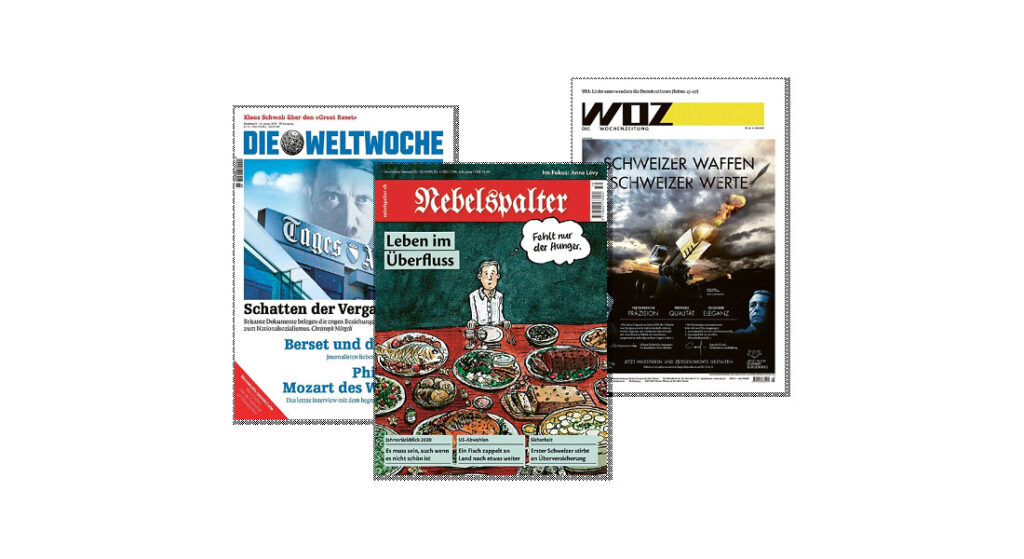
That the WOZ is a left-wing newspaper is no secret, says Camille Roseau, who works at the Weekly newspaper is responsible for marketing and advertising. "However, this is certainly a driving force behind our work, in addition to the high journalistic quality of our newspaper." It is central that the WOZ independent of parties, associations and patrons. "The WOZ is never partisan, but it is definitely partisan: it takes sides where it deems it necessary and remains skeptical of all political programs," explains Roseau.
Customers are politically neutral
"Interest in products and the resulting purchases are not driven by party affiliation," says Benjamin Moser, Head of MediaCom Switzerland. In the vast majority of cases, his customers would also remain politically neutral unless they were obviously pursuing political goals, such as a political party. "To find the right target group, we use much more effective consumer data, which is based not only on demographic data but also on attitudes, interests, etc." According to Moser, differentiating between political camps would be counterproductive.
"Customers don't want to work in extreme environments, such as at Breitbart... emerge." - Benjamin Moser
However, almost all of the media agency's clients would attach great importance to not working in extreme environments, such as with Breitbartto appear. In some cases, however, customers do have preferences for individual newspapers. "Here, however, we should differentiate between the preference of the advertising brand and that of the decision-maker on the customer side," explains Benjamin Moser. "Ultimately, a person always makes the final decision about the environments, so there can be a personal decision bias here, even if it is not in the interests of the brand."
]]>
m&k: Sir John Hegarty - as we speak, there is a strict Corona lockdown in London. On top of that, the UK has just left the European Union. How would you describe the general mood in the City?
Sir John Hegarty: First of all, it's quite difficult for me to comment because I'm not "in town"; I hardly go out at the moment. However, there is a feeling among my friends that we have a government that doesn't understand how to actually handle a situation like this. Boris Johnson has been late in virtually everything he has done. That's why we had so many Covid casualties last year. People understand the need for lockdowns, but they want a government that is up to such a monumental task.
And then there's the whole Brexit thing, which is probably the stupidest thing any government has ever done. But that's where we get to a bigger question, which is how populism has affected the world and how the views of a minority can take over the majority, so to speak.
So, all in all, it's not a good time. I'm sad about it. Personally, I'm doing very well, but I feel very, very sorry for young people. For people who are now flooding into the labor market.
You've navigated companies through national labor strikes, financial crises and political turmoil. What advice do you have for people trying to get their companies through the current pandemic?
What you need to do in times of stagnation or economic downturn is you need to invest more in your product; invest more in what you want to offer. The number of companies that stop doing just that when they see a recession coming is just amazing. It's actually insanity because it just makes the recession worse. There's empirical evidence that shows that the companies that continue to act, continue to be positive, continue to communicate with their audience, come out of recessions, pandemics, whatever it may be, much stronger than those who don't.
How many times in my career have I seen that when a recession hits, everyone reduces their advertising spend. It's a self-fulfilling prophecy. If you stop communicating with people, they will stop responding to your messages. The argument is always, "Well, customers don't have any money right now anyway." Somebody out there always has money. Companies may just have to rethink what they offer.
To be quite frank: I believe anyway that most companies are run by very stupid people. A few people start a company, they are very good entrepreneurs, then at some point they hand over responsibility - and managers come to the helm who are very insecure. They don't want to go out in a crisis and try something new; they batten down the hatches, duck down and hope that they will survive.
In your 2011 bestseller "Hegarty on Advertising," you commented on the opportunities presented by digitization. But you also wrote that you wonder if companies will hire people who are able to take advantage of these opportunities. Since we are currently experiencing an incredible digital push due to the pandemic - how would you comment on your statements from nine years ago?
I think my fear has come true. We really don't have enough people in the companies to take advantage of these opportunities. In the past, if you wanted to make a brand big in analog communications, you had to go out with it and sometimes take some risks. You couldn't measure everything. Of course you tried to do research, but ultimately you had to go out and take a risk. And by and large, those experiments paid off. What's happening with digitization and the whole evolution of social media and measurement is that all these marketing directors have been told, "We've removed the risk from marketing. You don't have to carry that anymore. You can know exactly what's going to happen with your money and what you're going to get back for your investment."
And as a result, we see a very, very monotonous, a very uneventful marketing landscape where people are struggling to build brands - but it doesn't really want to work. To be honest, I'm still waiting for someone to tell me what brand has been built in the last fifteen years in the digital marketplace. There are a few digital ideas that have been implemented, but there's not much else. And that's because people have forgotten that advertising is not just about increasing sales, it's about seduction. In the digital world, short-term sales may be boosted, but no one is seduced (laughs).

This, of course, makes me think of Sir Martin Sorrell, whom I interviewed in our last issue. His new digital advertising holding company, S4Capital, is growing rapidly. But at a panel in Cannes 2018, you publicly doubted that he will leave a legacy.
The disagreement between Martin Sorrell and me is... fundamental. I think he's actually hurt our industry. I mean, just look at the way he talks about his old company [advertising holding company WPP, editor's note]. Now it's supposedly the worst thing in the world. Well, Martin, you built the company yourself (laughs).
I question his morals: What he's doing is basically simple - he has access to enormous financial resources, he can buy up companies and thus their philosophy. So he buys a number of companies and then manages to convey to customers, "Hey, I can create content for you. And I have a great AI that sends it to the right audience" But look at what he produces. Ask him sometime to show you five things he's done that are great from a creative standpoint. And then you'll be very, very disappointed in what he's actually created.
Why did I say he won't leave a legacy? Because I think that in a creative industry - and ultimately that's the communications industry - the creative people are the ones who will be remembered. People remember David Ogilvy, they remember Bill Bernbach. But they don't remember Marion Harper [founder of Interpublic, the first major advertising holding company, editor's note]. Sorrell made a huge amount of money, and if you measure his life by financial wealth, he's been successful. I, on the other hand, don't measure my life by the money I've made. I measure my life by what I hope I've contributed to the development of the industry.
But if digital advertising is designed to minimize risk - is it the fault of the agencies that provide it, or the CMOs that demand it? Who would have to break this vicious circle?
Well, I think, first of all, all revolutions start small. They don't start in the center, they start at the edges. Somebody does something, somebody else sees it and says, "Wow, that was interesting." And suddenly you have a revolution.
I remember how the creative revolution in advertising began. In New York, in the very early 1960s. Some agencies were working on smaller accounts at the time, but those clients were willing to listen to them - unlike General Motors, or unlike Proctor and Gamble, or whoever was considered big business at the time. The smaller clients allowed the agencies to create fantastic work. And with that, they started these little fires that became bigger fires - and people started noticing. And then, of course, the big companies took one look and suddenly thought, "My God, this stuff seems to be working," and adopted the principles.
I think that's where we need to go back to if we're going to create a new beginning in the industry. It's going to be small companies working with other small companies, and they're going to create campaigns that get noticed.
That would be the agency side - what about the CMO side? Would you say that CMOs are less creative today than they used to be? Or has too much of their power simply been taken away in modern organizations?
You're right, CMOs no longer have any real power in many companies, and those who get to decide instead see their CMO's job as a technocratic task. It is enough for the management if the CMO can read the numbers that any tools spit out. But I think the "C" in CMO should also stand for Creativity - because great brands are always built by great marketing people. I mean, Steve Jobs was - whether you liked him or not - a marketing genius. The best marketing directors I've ever worked with were people who understood that their job involved, at least in part, a creative process. Sure, you can take all that data and analyze it, but your competitors are going to get to the same point with the same data at some point. And then... how do you differentiate yourself?
Speaking of differentiation: That was, after all, one of BBH's first tasks in the 1980s - to bring Levi's jeans back into the consciousness of young people, to make them distinguishable. Do you still remember how you were able to win Levi's for your agency?
Yes, that was in 1982. We had just founded BBH. At that time we were sitting in rented offices. In the days before WeWork, those were terrible places (laughs). And we got this letter from Levi's saying they wanted us to pre-pitch for their account. At first we thought it was a joke. That one of our friends was playing a prank on us. So we tentatively contacted Levi's and said, "Look, we think this is a mistake, but you know, we got this letter..." And they actually replied, "Oh, no, it's all true! We would love to meet with you guys. If we hit it off, we'll let you guys pitch."
And so the Levi's team came to us for the first time - to the rented offices. So what did we do? We took down the disgusting pictures from the wall that were hanging there - English hunting scenes (laughs loudly). They were always pictures of hunting scenes, you know, people in red coats and horses and foxes. What do you think that was all about? Why were some people so interested in hunting scenes back then? Anyway, we took it all down and hung up our work. Levi's came, decided that we would be shortlisted. Mixed in with all the joy was a bit of regret that we had torn down the hunting scenes (laughs), because we had to have the room re-wallpapered, even though we barely had any money.
Anyway, by the time the final pitch came in, we already had an office, but it wasn't finished yet. That's why we proposed to Levi's to present in their premises - which was rejected. We were able to get a few desks and Italian chairs, but nothing more. And then this wonderful guy named Lee Smith, who worked for Levi's in San Francisco and represented the head office, came in. Think of Lee as a six-foot-tall, tanned businessman from California - the kind of guy who jogs 20 miles a day and crushes your hand when he shakes it.
When I made the pitch to him and his colleagues, I thought, "This is never going to work." So I decided to just tell Lee what I really thought about Levi's. I said, "Your brand is not in a good place. It was once part of the American dream, part of youth culture, part of music culture... So why don't you go and try to recapture that spirit?"
After we expressed our opinions, the team turned to Lee Smith and someone said, "Lee, what do you think?" He responded, "I just want to say one thing." To which I thought, "That's it, everything's run its course." Lee paused artfully and said, "These are the most comfortable chairs I've ever sat in." (laughs) And we won the pitch.
I mean, Lee basically said, "I agree with everything you said. And by the way, those chairs are really comfortable." The point of this story is: be true to yourself. Stay true to what you believe in and what you want to tell people. And that's what they got from us; what they didn't get from anyone else. Levi's became our customer - the rest is history.

Since you're talking about creativity, allow me to ask: Where did you, one of the most decorated advertising creatives of all time, look for inspiration?
I've always believed that you can only be successful as a creative person if you're very, very "connected" - connected to the culture, connected to what's going on in the world. I've always had an open mind, been inquisitive. I've always loved trying different things, reading different books, visiting different exhibitions, talking to interesting people. I think a fascination with the world around you transfers to you, so that when someone comes to you with a problem, you already have your own point of view on it. Working on our famous Levi's campaign in 1982 was actually pretty easy for me because I was born in 1944. I witnessed the birth of rock and roll. I understood how emotionally charged it can be to wear a pair of jeans.
As a creative in advertising, you need the ability to do things - and just feel that they will work. It's like any other creative person in any other profession. Look at Picasso when he painted Dora Maar. He just wanted to create a portrait in a different way than had been done before. He had to have confidence in himself that it would turn out well. Or when James Cameron did Avatar (laughs) and said to those who worked with him, "Well, the avatars are going to be about six feet tall and they're going to be blue." So I'm sure somebody replied, "James, why can't they be green?" And he simply said, "We trust my intuition." That's the way it is in our industry.
However, when I talk to agencies and their CEOs, they claim that the ideal of the "creative genius" is a thing of the past - and that collaboration is much more conducive to the creative process.
Oh, what a load of crap people come up with (laughs). I mean, that's said by CEOs in agencies who aren't in a creative field themselves - because they think that's what their clients want to hear. These CEOs don't understand how to create an idea. They don't understand that it's very, very difficult to have great ideas. Yes: they think that you can do it in a kind of group: "You can co-create with ten other people and we will all have a happy idea together. And it will all be wonderful and we will all end up singing a beautiful song." Trust me on this: no great idea has ever come out of a brainstorming session.
Would you elaborate on that?
For me, creativity is an expression of myself - I use it to express what I feel and what I believe in. So when people say to me, "Oh, I don't want creative people with an ego," I say, "Really? I want creative people with an ego!" With ego, you get great work. But of course, these stupid CEOs of these stupid companies that produce nothing but mediocrity think it's a collaborative process. That's what's wrong with the industry right now - it's completely run by people who don't understand anything about creativity. They don't understand how to do creative work. They don't understand that running a creative organization is madness. It's a wonderful madness, but madness nonetheless.
And because you're still an agent of change in the industry - a change for the better, a change toward more creativity - you keep working. You have a vineyard, which sounds like a cliché for a successful advertiser (laughs). But you only do that part-time, right?
Yes. And even at the winery, it's more about bringing my belief systems into the way we farm as a business. I'm a farmer, that's essentially what I am. I just happen to grow grapes as opposed to cabbage or potatoes or whatever else it might be.
One last question: Here in Switzerland, we are seeing the rise of a few independent agencies - and on the other hand, consolidation with large companies buying up competitors. Who will prevail?
Well, I think the future lies with the independent creative companies that focus on the work and not on how much money they can make. When we started BBH, we never talked about money. We talked about opportunities. We talked about doing great work. We wanted to make a difference. And I think that's where I see the future, that's what fills me with excitement. When I hear that there are young, creative companies in Switzerland that are going their own way - well, God bless them! (laughs) And I have to say that the opportunities to do interesting work in interesting ways are, after all, much greater today than they were when we started BBH in 1982. How to do things, how to use social media, how to have much more fun on different stages and platforms. And that's why I never get tired of saying that now is the most exciting time to be in advertising. If you realize that and you bring that into your professional life, weave it into every fiber of what you do - then you're building a wonderful, wonderful agency today, too.
Sir John Hegarty began his career in advertising as a junior art director at Benton and Bowles London in 1965. Two years later, he joined the consulting firm Cramer Saatchi, before co-founding TBWA London as creative director in 1973. Finally, in 1982, he founded his company Barton Bogle Hegarty, with which he realized numerous internationally acclaimed campaigns in the decades to come, including for Levi's, Audi, and Lego.