
There is an almost painful irony in the air: While smart algorithms and artificial intelligence are permeating our everyday lives at record speed, a quiet unease is growing in offices and living rooms—the fear of losing control over our own digital tools. It has long been evident that mastery of hardware and software ranks on the same fundamental level as the classic cultural skills of reading, writing, and arithmetic. Anyone who falls behind technologically today finds themselves left behind in the digital world. The global Logitech study «Ctrl Tomorrow» brings this to light: there is a measurable correlation between digital competence and personal well-being that noticeably accelerates the pulse of our society..
The New Everyday Classroom: Between Control Dividends and Control Taxes
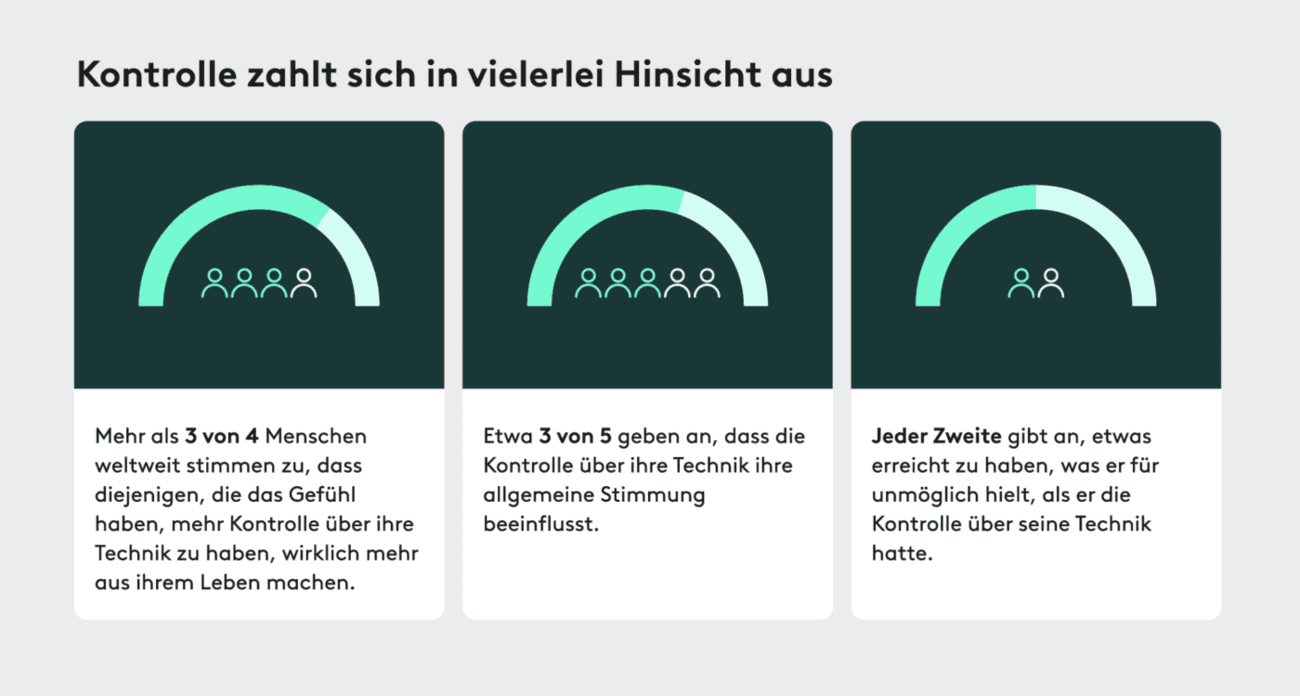
The global study conducted by the communications agency Burson in May and June 2026—based on over 9,000 respondents in nine countries as well as a special survey of IT decision-makers—examines the relationship between humans and machines in an exemplary manner. At the heart of it all is a fascinating phenomenon: the so-called "control dividend". Those who have mastered their tools—especially physical devices—intuitively benefit from tangible psychological and physical advantages. Self-confidence, productivity, creativity, concentration, inner peace, and physical well-being are the rewards of digital sovereignty.
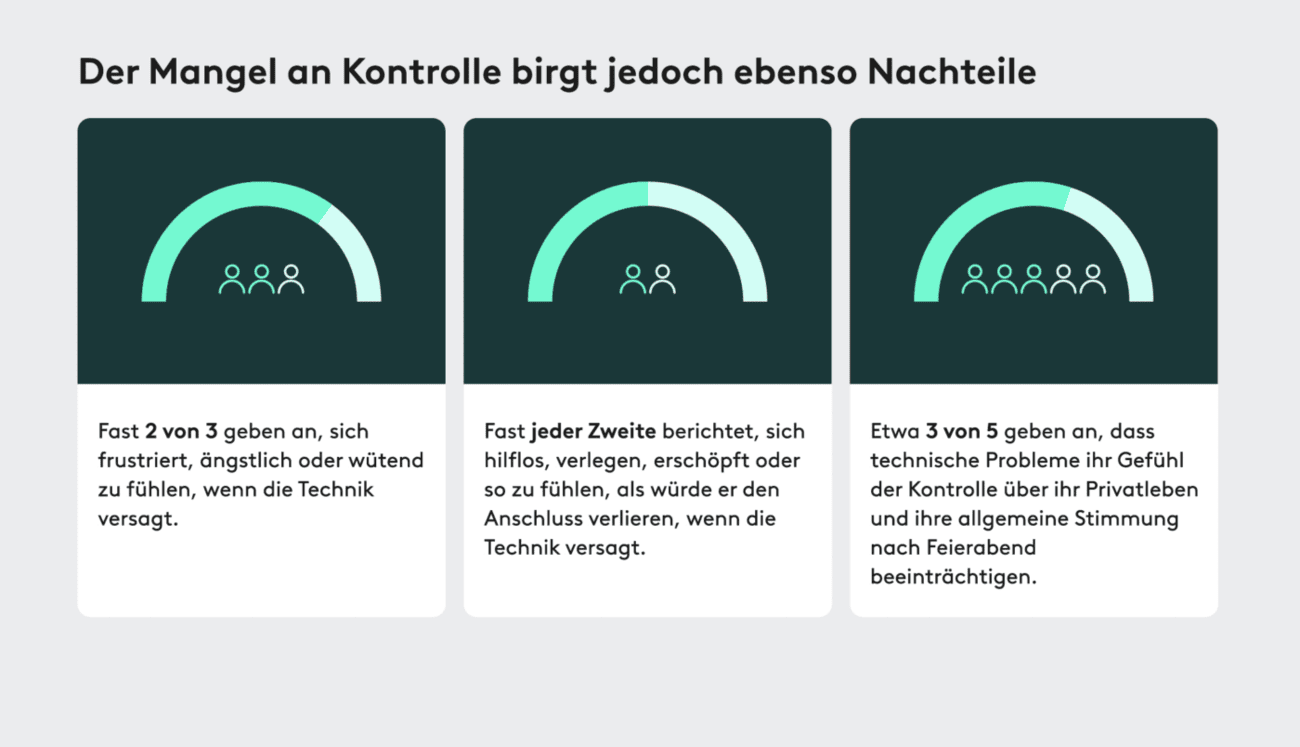
But there is a drastic downside to this, which is treated as a control tax. When technology fails, frustration strikes mercilessly: On a global average, 64 percent of respondents say that technical glitches have a massive negative impact on their overall mood after work and their sense of control over their personal lives. Almost as many (64 percent) feel overwhelmed by frustration, fear, or anger when their computer malfunctions. About 46 percent even report feelings of helplessness, shame, exhaustion, or the painful sense of being left behind.
The New Tech Currency: The «Ctrl Score» and the Anatomy of a Loss of Control
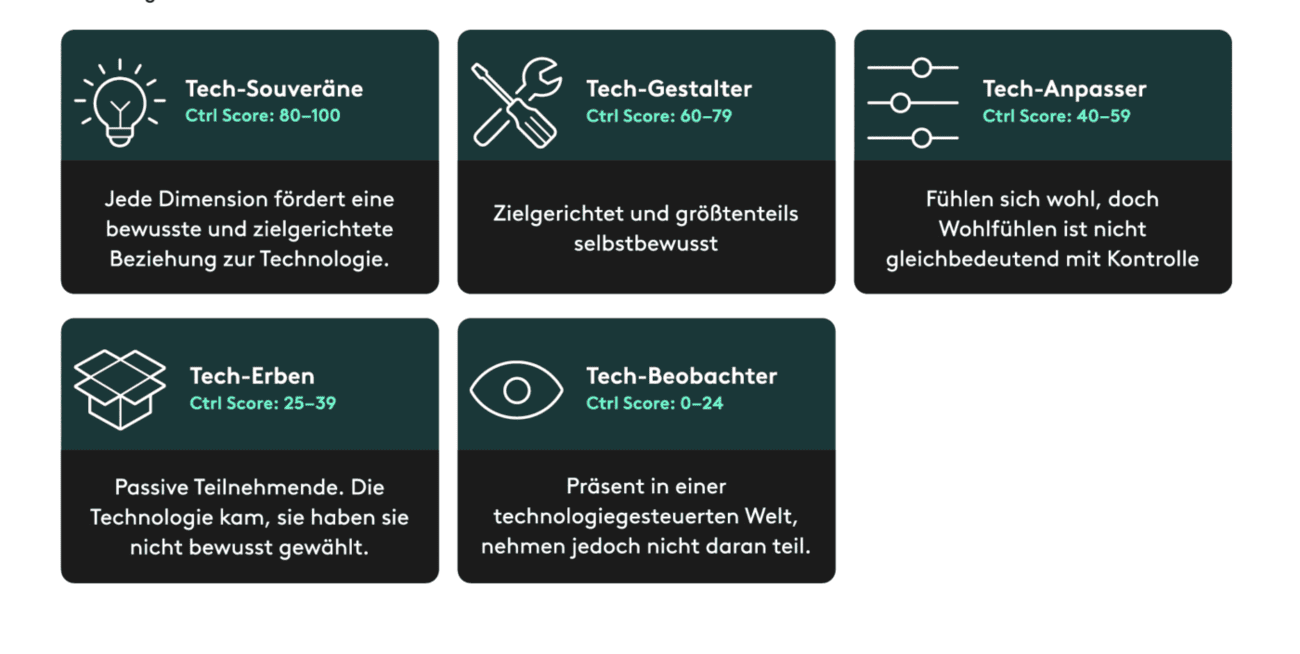
To make this phenomenon more tangible, Logitech has developed the «Ctrl Score»—the world’s first composite index that makes technological agency measurable and improvable. The score is based on three dimensions: conscious technical proficiency (intentionality), personal attitude and openness toward new tools, and one's perspective on one's own potential.
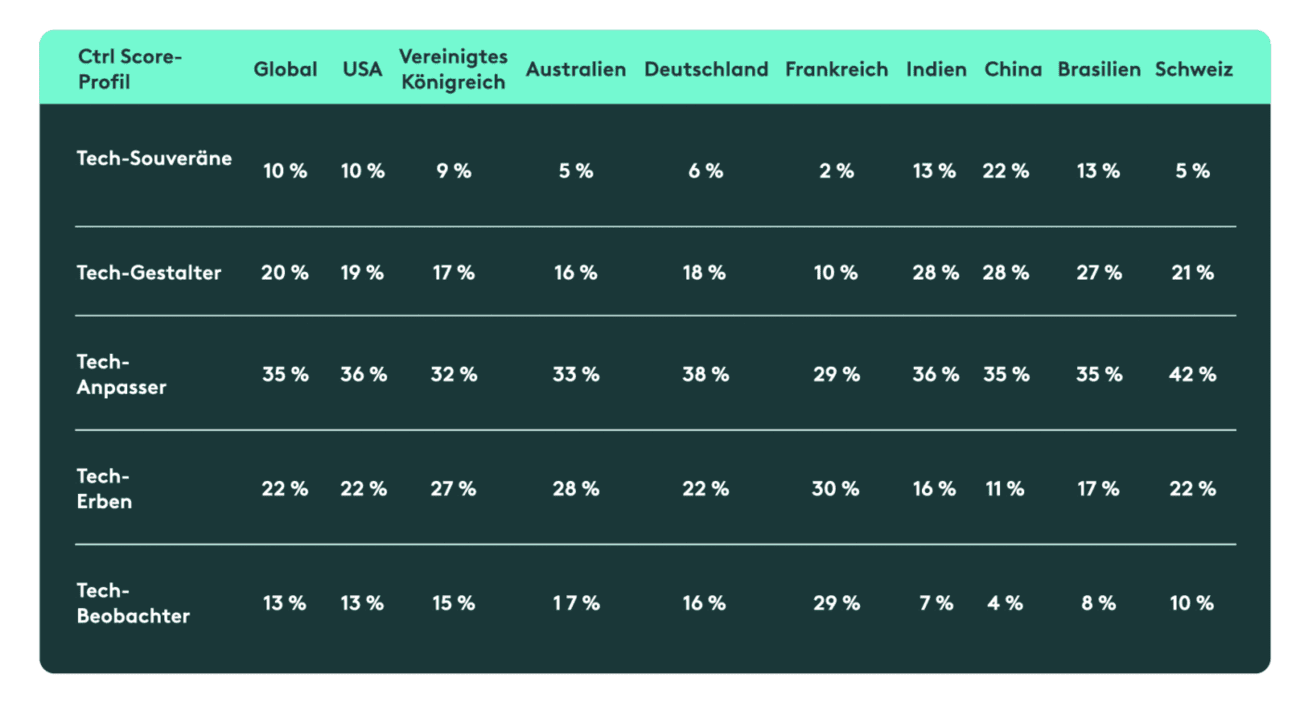
The global survey categorizes people into five distinct profiles, ranging from the 10 percent who are “tech sovereigns,” to the 20 percent who are “tech shapers,” and the broad group of 35 percent who are “tech adapters,” all the way to the remaining 35 percent who are “tech heirs” and “tech observers.”. Worldwide, this amounts to approximately 4.2 billion people who, as passive participants, are at risk of being left behind. It is particularly revealing to examine the "money fallacy": Contrary to popular belief, control cannot simply be bought. Only 21 percent believe that the wealthy have the most control, while 44 percent are convinced instead that people with genuine technical expertise hold the reins.
Haptic Anchors in an Abstract World: Why Hardware Saves the Day
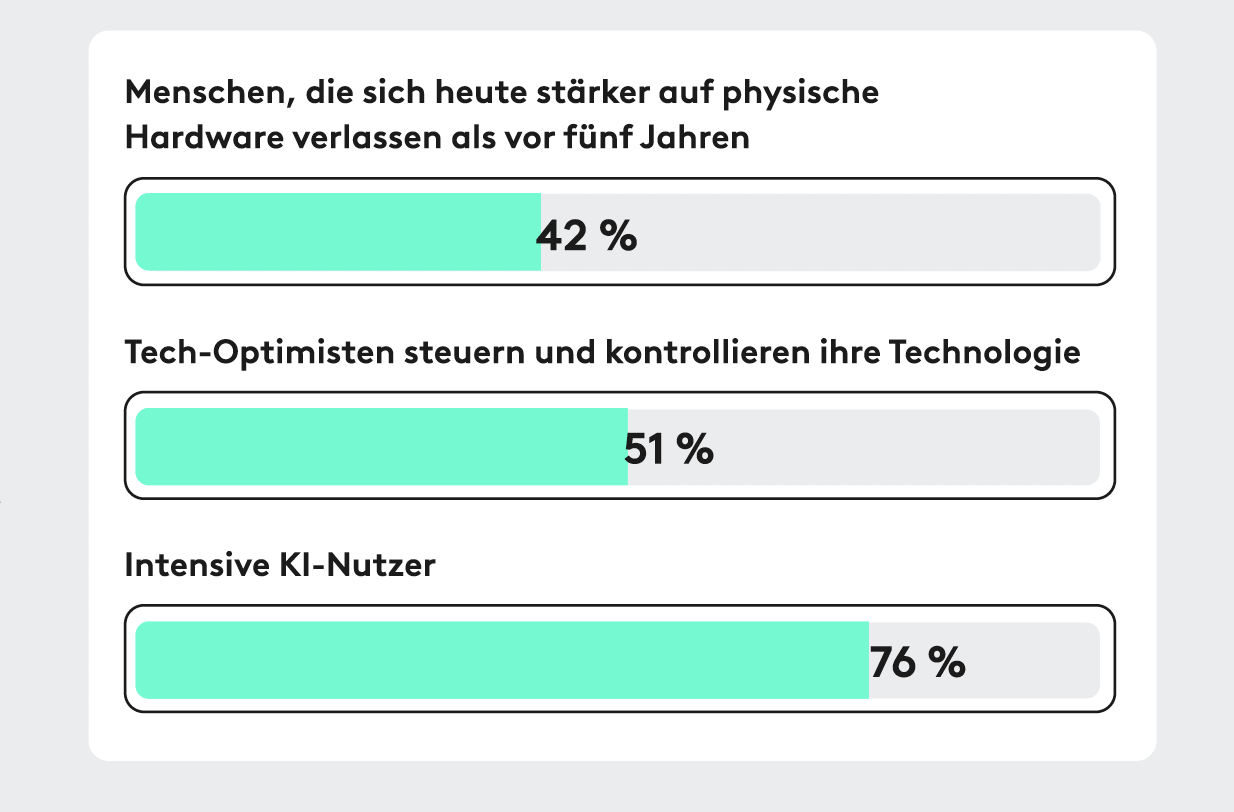
The more abstract software, cloud computing, and artificial intelligence become, the more people cling to the tangible. Nearly two-thirds say they feel the greatest sense of control when interacting with physical hardware. Today, 42 percent of all respondents rely more heavily on physical devices than they did five years ago—among heavy AI users, this figure soars to a staggering 76 percent.
This also highlights the phenomenon of gamers as role models: Gamers spend an above-average amount of time optimizing their environments. 81 percent of them confirm that gaming boosts their self-confidence in everyday life, reduces anxiety, and helps them keep their cool in high-pressure and chaotic situations. The confidence gained through gaming directly carries over into everyday work life.
Office vs. Home: The Workplace as a Control Desert
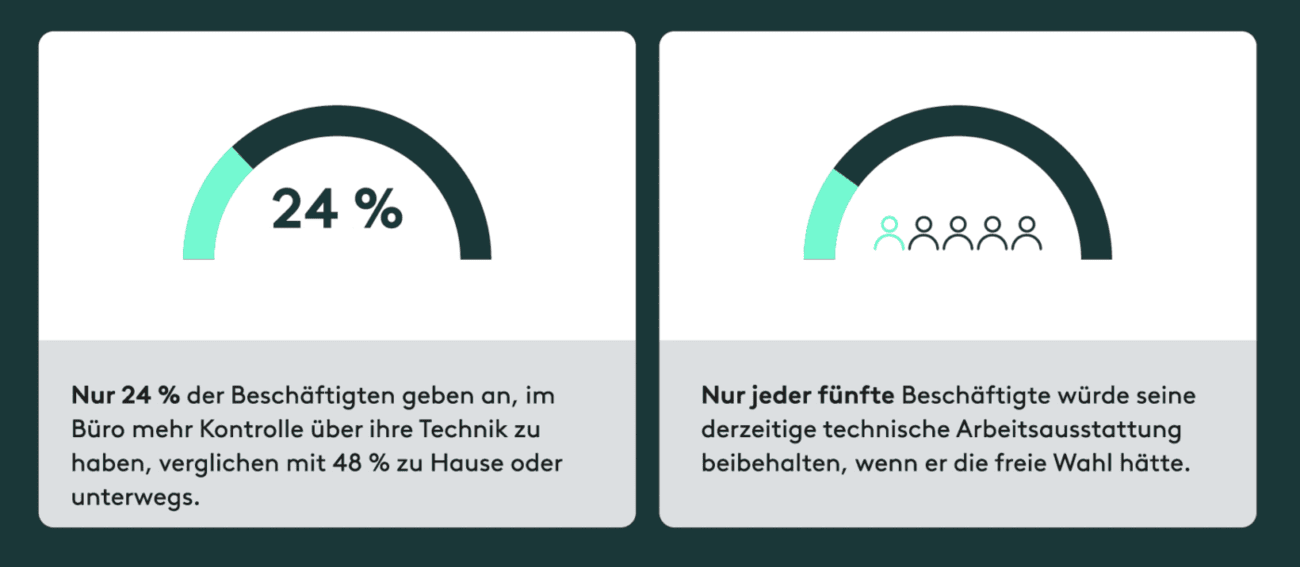
This is where perhaps the greatest point of failure in the modern workplace becomes apparent: While employees have often created a customized, highly functional, comfortable environment for themselves at home, the office, in the eyes of many, has been relegated to the bottom of the list.. Just 24 percent of employees feel they have more control over their technology at the office than at home or on the go. Only one in five employees would voluntarily keep their current office technology.

The consequences are serious: Discrepancies between personal autonomy and frustration with bureaucratic technology hinder concentration, energy, and ultimately employee retention.. While IT decision-makers recognize the problem—after all, 64 percent of them identify as gamers and understand the power of good hardware—only 35 percent formally and regularly track the human impact of their IT decisions using specific metrics.
The Drive for Success vs. Western Skepticism: Where Innovation Meets Fear
The study reveals, in particularly striking terms, the global differences in mindset when it comes to dealing with the future. While in Western countries technology is often viewed as an administrative convenience or a tool for streamlining processes, in emerging nations such as India, China, and Brazil, it serves as the primary driver of social and professional advancement. In India and Brazil, 84 percent of respondents in each country are firmly convinced that technology creates new opportunities rather than new pressures. China (80 percent) and Brazil (78 percent) lead the world in agreement that technology enhances personal potential.
In stark contrast to this cross-national trend, the Old West reveals a potentially fatal skepticism: In France, optimism about technology has dropped to a meager 60 percent, and only 45 percent believe at all in the ability of these tools to make life easier. This discrepancy is also evident when it comes to brand-new artificial intelligence: While 41 percent of people in India are wildly enthusiastic about how AI expands their possibilities, the figure is a meager 16 percent in the U.S., 15 percent in the United Kingdom, and just 13 percent in Australia. Skepticism threatens to become a barrier to innovation in this country, while the Global South is advancing inexorably.
Looking Beyond National Borders: Where Does Switzerland Stand?
Switzerland continues to play its customary special role within the European context: The Swiss consistently rank in the upper middle tier of European countries, yet they operate with a calm, measured approach and a focus on quality.. For example, 73 percent of Swiss people are convinced that greater technical proficiency enriches their lives (global average: 77 percent). When it comes to artificial intelligence, Switzerland—with 23 percent of respondents expressing enthusiasm for the expanded possibilities—is noticeably more open-minded than its major European neighbors (Germany: 13 percent; France: 12 percent), though it remains far behind the momentum of growth in Asia and South America.
Exclusive: Your m&k Payment Service
-
77 percent Of those surveyed worldwide, many are convinced that the better people are at mastering technology, the more they get out of life.
-
64 percent state that technical problems have a negative impact on the overall mood after work and on their personal lives.
-
52 percent Through their mastery of technology, they have already been able to achieve things they previously thought impossible.
-
30 percent People around the world have a high degree of autonomy over their technology; only 10 percent act like confident tech professionals.
-
4.2 billion people Worldwide, they fall into the group of less aware or self-assured users who are at risk of feeling left behind.
-
42 percent Today, users rely more heavily on physical hardware (such as keyboards and mice) than they did five years ago to maintain control.
-
73 percent of the Swiss population agree that better mastery of technology leads to a higher quality of life (global average: 77 %).
-
64 percent of the IT decision-makers surveyed identify as gamers, compared to only 28 percent in the general population.
-
35 percent IT decision-makers formally and regularly monitor the impact of their technology decisions on employee well-being in the workplace.
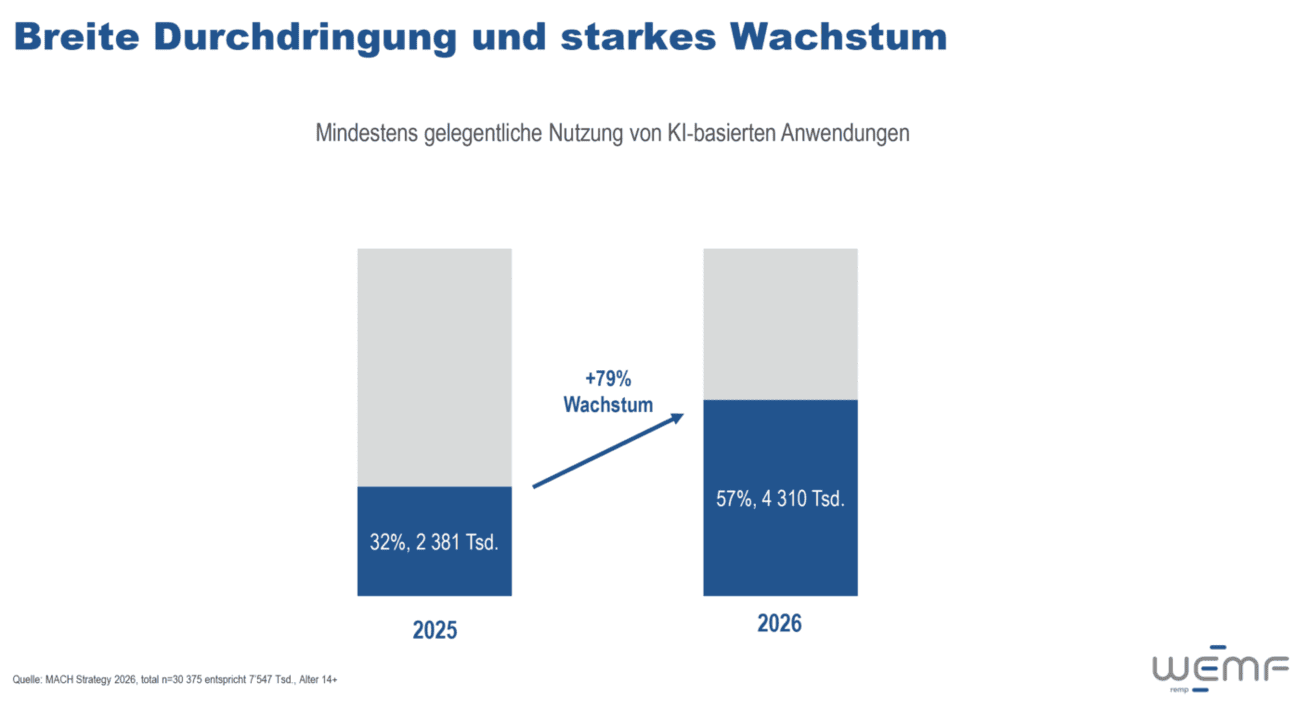
The figures from the latest MACH Strategy survey speak for themselves and mark a historic turning point for media consumption in Switzerland. While last year (2025) about 32 percent of the resident population aged 14 and older reported occasionally using AI-based applications, this figure soared to an impressive 57 percent in 2026. This corresponds to approximately 4.3 million people in absolute terms and a growth of nearly 80 percent in just twelve months. Anna Müller, Director of Product Management at WEMF, describes this finding as follows:
«The data shows a rapid adoption rate: from 32 percent last year to 57 percent today—artificial intelligence is firmly established in the daily lives of the Swiss population.»
A Jungle of Platforms and Clear Market Leaders
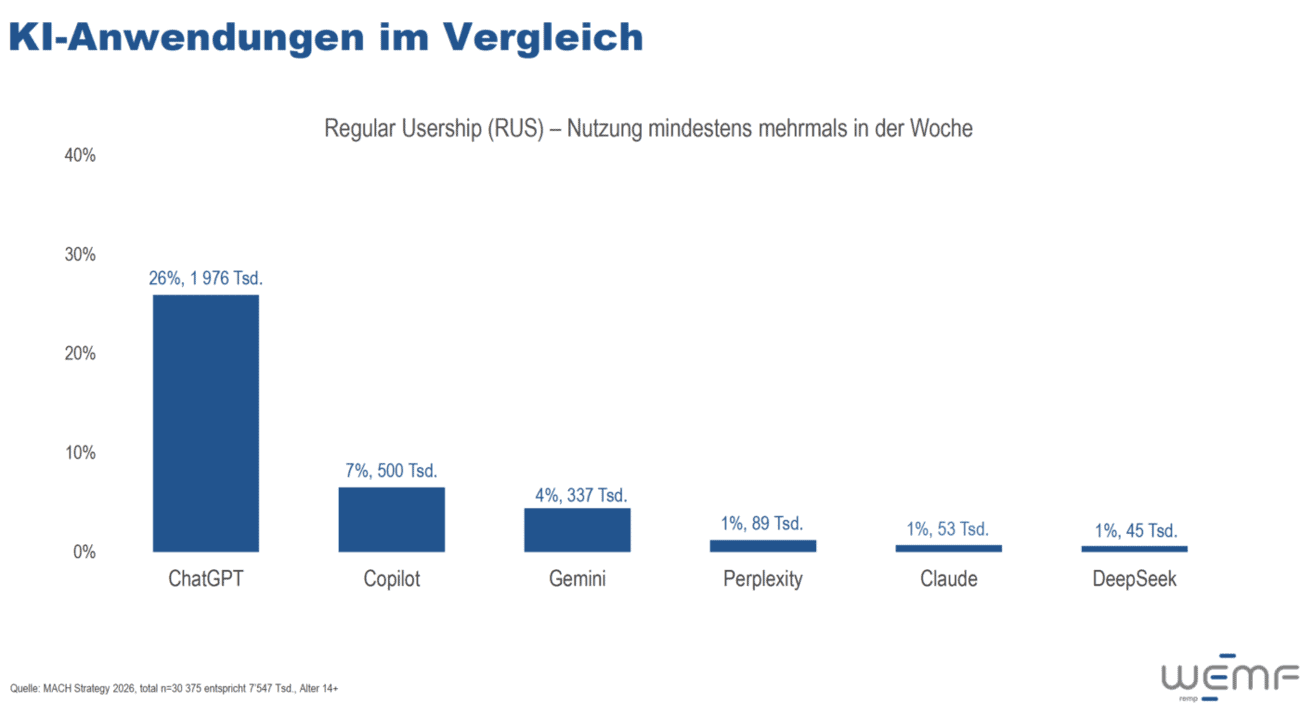
When examining the varied use of individual applications in the context of regular usage, one dominant frontrunner emerges. ChatGPT is the undisputed leader in the Swiss market, with a weekly regular user base of 26 percent, which corresponds to just under two million people. Trailing far behind are Microsoft Copilot, with 7 percent—or about half a million—regular users, and Google Gemini, with 4 percent. Other specialized applications, such as Perplexity, Claude, and DeepSeek, account for a single-digit percentage of the market and serve specific niches. A closer look reveals that the majority of ChatGPT users rely on the free version, while the paid versions are primarily used by heavy power users and professionals.
Demographic Contrasts and Sociocultural Patterns
Upon closer examination, the nuanced picture painted by sociodemographic data reveals fascinating contrasts and clear usage patterns. Although AI permeates all age groups and segments of the population, the extent of its impact varies greatly. Younger age groups, between 14 and 19 years old, use smart assistants most frequently—at over 80 percent—while the usage curve naturally flattens out among older age groups, though it still shows strong growth across all segments. There are also subtle differences based on gender: Men use ChatGPT noticeably more often—about 26 percent—than women, who use it about 17 percent of the time. Nevertheless, it can be said that technology is no longer exclusively a phenomenon of men or young people, but has achieved broad social relevance across the general population.
From an Information Channel to the New Reality of the Advertising Arena
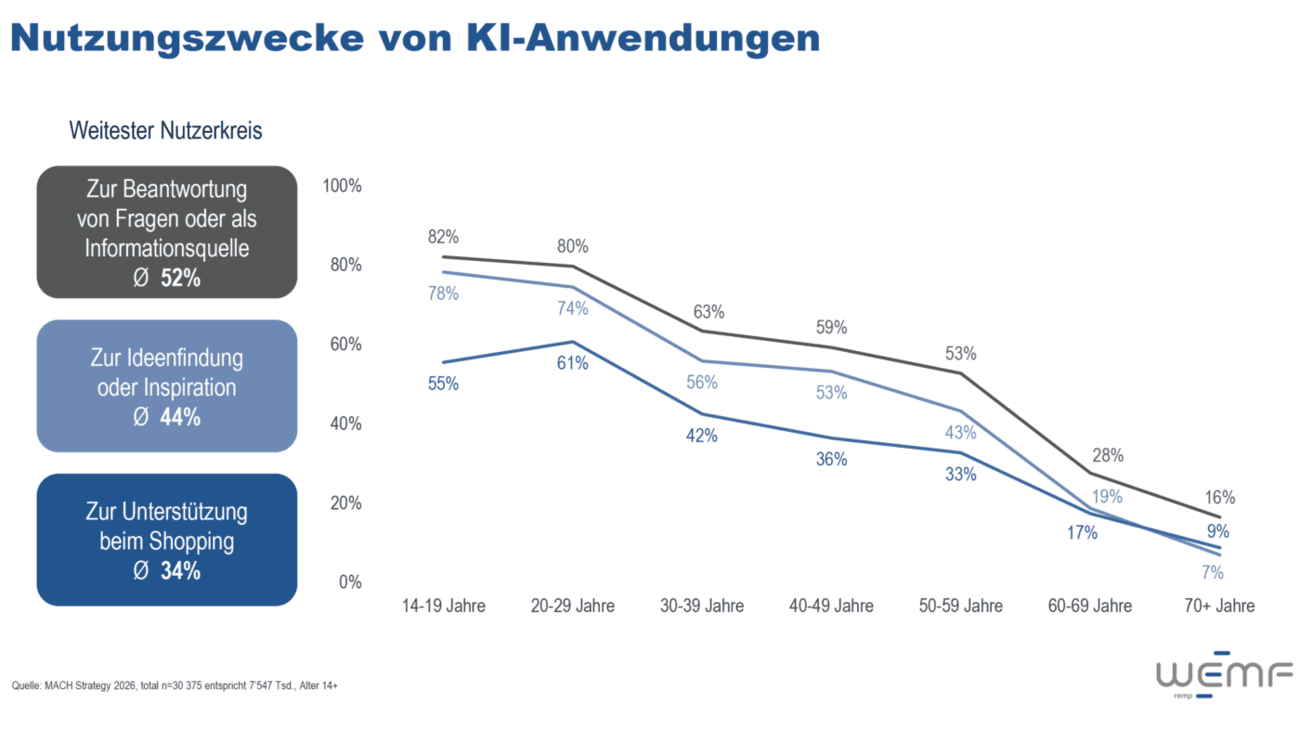
The shift in usage occasions is particularly significant for strategic media planning. The MACH data underscores that AI applications are primarily used to answer questions and as a source of information, with a 52 percent approval rating. Close behind are brainstorming and inspiration at 44 percent, as well as practical assistance with shopping at 34 percent. Topics such as consumer electronics, travel, and continuing education are taking on a completely new form of organic search thanks to AI.
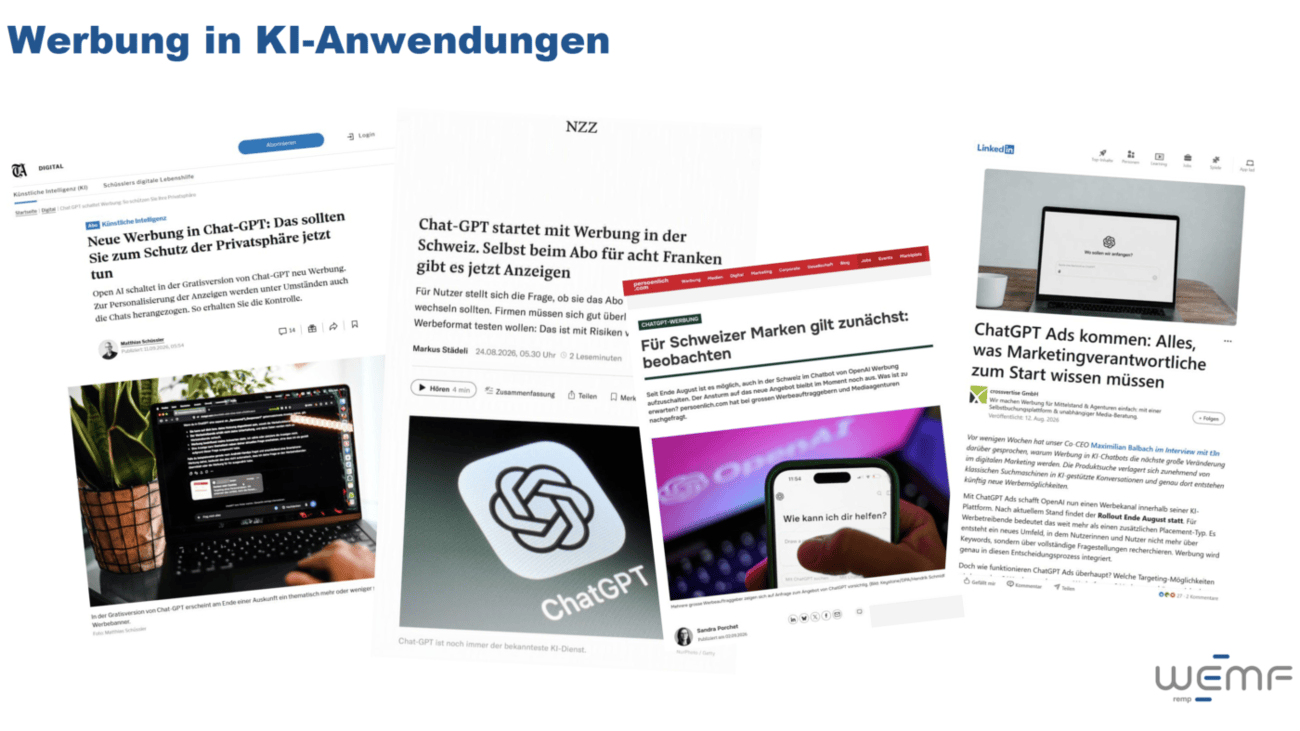
As OpenAI and other providers increasingly display and contextually integrate ads in their free versions, AI is evolving from a mere software application into a full-fledged advertising channel. Anna Müller highlights this paradigm shift:
«Artificial intelligence is no longer a niche topic; rather, it is rapidly evolving into a standalone advertising channel among many others.»
For marketing professionals, this means that future campaigns will no longer be driven solely by traditional keywords, but must be integrated into dialogue-based decision-making processes. This year's MACH Strategy Study thus provides the Swiss communications industry with the essential foundation for guiding this transformation in a data-driven manner and optimizing the media mix.
m&k Data Service: An Overview of the Key MACH Strategy Metrics
-
Total penetration: In 2026, 57 percent of the Swiss resident population aged 14 and older (about 4.3 million people) will use AI applications at least occasionally, representing a massive 79 percent increase compared to the previous year (32 percent / 2.38 million).
-
Platform Ranking (Regular Users): ChatGPT dominates the Swiss market with 26 percent (1.97 million users), followed by Microsoft Copilot with 7 percent (500,000 users) and Google Gemini with 4 percent (337,000 users). Perplexity, Claude, and DeepSeek each account for about 1 percent..
-
Age gap: The highest level of usage is seen among 14- to 19-year-olds, with a penetration rate of over 80 percent. Although older age groups have lower initial adoption rates, they are experiencing strong, steady growth across all age groups..
-
Gender-Specific Use: ChatGPT reveals significant differences between the sexes; about 26 percent of men use it regularly, compared with about 17 percent of women.
-
Paid vs. Free Version: About 16 percent of ChatGPT users in Switzerland use only the paid version, while 83 percent use the free version (which will include ads in the future).
-
Occasions for use: The use of AI focuses primarily on answering questions and gathering information (52 percent), followed by generating ideas and finding inspiration (44 percent) and providing practical assistance with online shopping (34 percent).

Brands in the AI-Driven Information Ecosystem
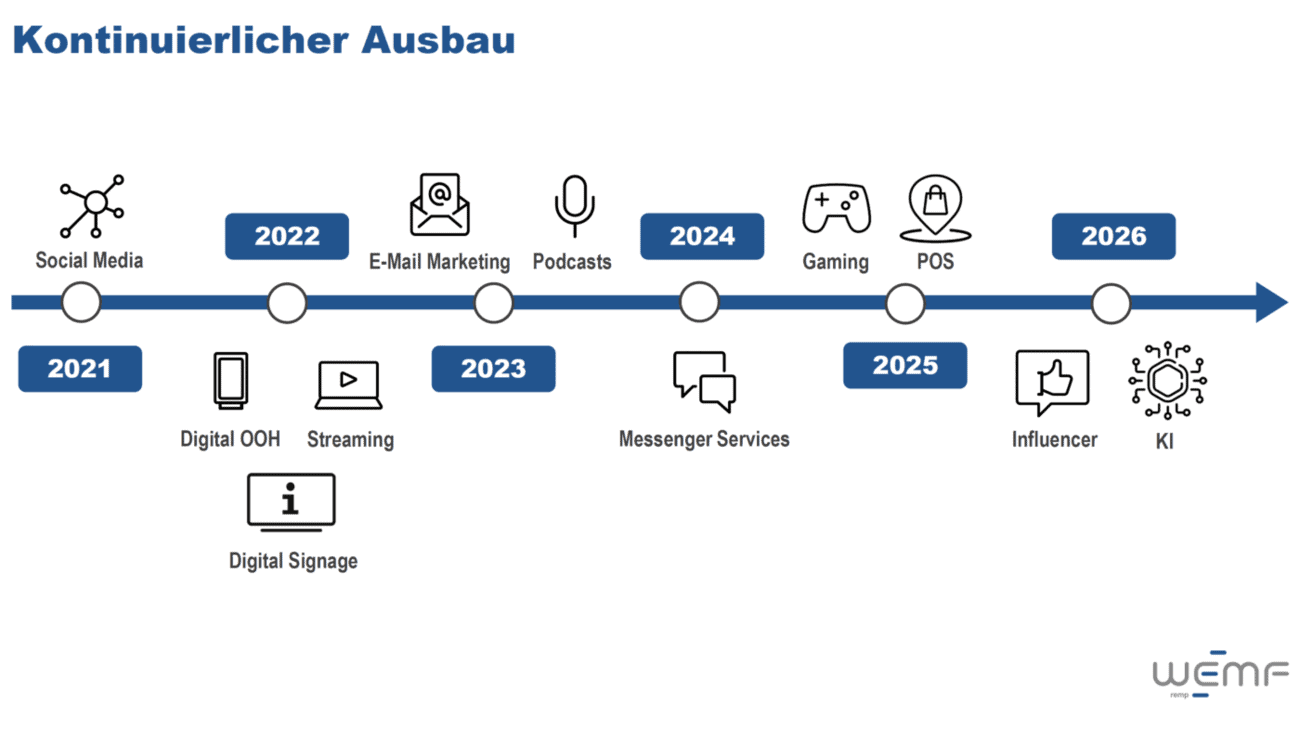
For over thirty years, each technological advancement has changed the way brands attract attention and convey informationtteDigital displays made digital reach scalable. Search engines structured access to information. Social media distributed attention through recommendation algorithms. Programmatic advertising automated large parts of media buying, while marketing automation streamlined communication throughout the customer journey.
The New Interpretive Authority
Large Language Models (LLMs) are not just changing yet another channel. They are transforming the very architecture of information...ttlGenerative systems don't just search for documents; they synthesize content into answers, comparisons, and classifications. This creates a new interpretive entity between the brand and the user. It shapes the characteristicsfte...is linked to an organization whose voices are considered credible and on whose evidence a brand image is based.
The Fragmented Brand Image
As a result, the focus of brand management is shifting. It is no longer enough to simply communicate...fteto position the brand and maximize its reach. Brands must be presented as clear, verifiable, and consistent sources of information—readable by both people and machines. The website, media reports, expert articles, öffePublic statements, guidelines, and entries in trusted data repositories collectively form a distributed brand image. LLMs can reconstruct a narrative from this that does not necessarily align with the desired self-image.
In Switzerland, this is already widespread behavior
Change is not a distant futureftsScenario. According to the IGEM Digimonitor 2026, four out of five people in the Swiss population aged 15 to 75 who use the Internet use AI at least occasionally. 57 percent use AI-based...ttf77 percent use AI mode specifically for searching; 77 percent use AI mode within traditional search engines. ChatGPT is used at least occasionally by 67 percent, or about 4.3 million people. The representative online survey included just under 2,000 people.[1]
The Linguistic Framing of the Brand
It is particularly relevant for brands that this shifts the focus of information searches to top-levelfläshifted to, which Queselect relevant information, synthesize content, and frame a response linguistically. The brand frequently engages with its audiencefighe said in a presentation drafted by AI. Brand management must therefore not only monitor the reach of its own communications, but also the Quathe quality of this algorithmically generated representation.
Synthesis Instead of Search
The classic search organizes links: Users select a result, visit a Que... and form their own judgment. Generative response systems shorten this process. They synthesize multiple Que... formulate a response and, in doing so, can visit a brand's website directly viaflümake it easier. This reduces friction for users, but increases the importance of the upstream selection and interpretation logic.
From Ranking to Representation
This shifts the WettbFrom rankings to representations. AI Visibility—that is, whether a brand appears in generative responses—remains important, but it is only the first metric. What matters most is the context in which the brand appears: Is it described as innovative, expensive, sustainable, reliable, or risky? Which WettbAre buyers mentioned in the same breath? What sources support this account? And is the brand merely mentioned, or is it actually recommended?
The Connected Information Ecosystem
Brand management thus becomes the process of building an information ecosystem. It continues to encompass positioning, design, and emotional meaning. Added to this are information architecture, structured organizational data, knowledge management, corporate publishing, PR, and the Pflehigh-load-capacity DrittqSources. Google, for example, explicitly points out that structured organizational data can help to understand and unambiguously identify an organization. While this is not proof of general LLM optimization, it does illustrate the basic principle of machine-readable unambiguity.[2]
Consumer Trust and Machine Trust
Brands reduce uncertainty. This function remains, but now has a second target audience. Consumer trust describes people’s trust: brand awareness, reputation, experience, identityfikation and the expectation that a performance promise will be kept. In this context, “machine trust” does not refer to an emotion or a...ffeThe officially disclosed internal confidence value of a model. The termff is a strategic framework: It describes how well a brand of information systems is perceived as unique, consistent, and Quecan be processed based on all of the above.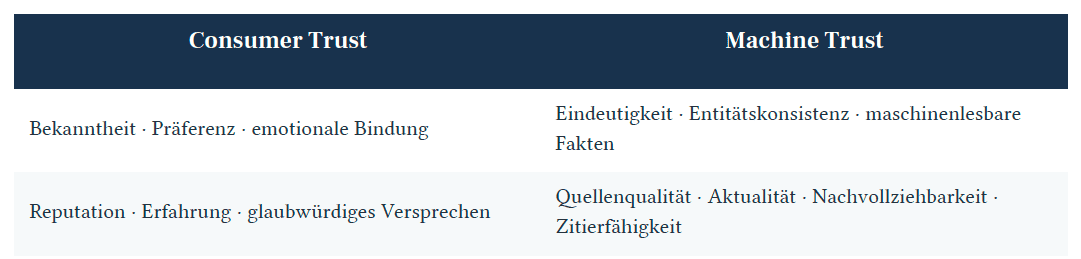
Both forms of trust influenceflucontradict each other. Contradictory statements, unclear responsibilities, or unsubstantiated sustainability promises not only weaken automated classification but also undermine credibility with people. Conversely, a technically perfect data structure alone does not create a strong brand. Without relevance, DiffeWithout context and concrete application, it remains semantically sound but meaningless.
The leadership task, therefore, consists of linking these two levels. Communication and the knowledge structure must be aligned. Claims require evidence. Corporate information requires clear lines of responsibility. Important facts must be up-to-date, accessible, and available through both internal and independent Quebe consistent across the board. This marks a shift from the traditional brand book,ttwWe are introducing a proprietary operating system that integrates language, data, evidence, and governance.
Narrative Intelligence as a New Field of Measurement
Traditional brand measurement tracks awareness, image, preference, reach, and impact. In the generative information space, these tools are not sufficient. Brands must also monitor how response systems reconstruct their meaning in specific usage situations. Narrative Intelligence is well-suited as a new discipline for measurement and management.
Methodology Instead of Ranking Drama
It combines repeatable prompt scenarios with a qqualitative and qQuantitative analysis of the responses. Metrics that can be measured include presence, share of voice, and descriptive Attribute, Quellen, Wettbbusiness environment, propensity to recommend, factual errors, and changes over time. A rigorous methodology is crucial: models, versions, locations, languages, and wording all influencefluThese are results; individual responses are snapshots. Narrative Intelligence must therefore not become a ranking spectacle, but rather requires samples, benchmarks, documented test sets, and human interpretation.
The Control Loop for Brand Managers
A closed-loop system is ideal for control: First, the desired brand narrative is testedfbatranslated into statements. Second, relevant decision-making situations are tested. ThirdtteGaps between the target and actual narratives will be identifiedfizFourth, content, data, supporting documents, and external authority are improved. After that, the measurement process begins again. In this way, Narrative Intelligence becomes more than just reporting; it serves as an integrated management model for brand management, communications, GEO, data, and knowledge management.
Agentic AI is accelerating development
Agent-based systems can process informationftinot only summarize, but also complete tasks involving several stepsttework around. For this article, it is not so much technical autonomy that is crucial as its impact on brand management: The more systems presort information and establish contexts, the more important a clear brand narrative and robust QueClear and consistent public messaging. Agentic AI thus reinforces the shift already driven by LLMs—though it is not the primary focus of strategic brand work.
The Strategic Opportunity for Publishers
Publishers find themselves in an ambivalent but significant role. Generative systems can reduce direct traffic to news sites. At the same time, the value of up-to-date, verifiedfbawell-organized and professionally categorized information. Journalistic QuaData becomes the infrastructure for credible answers—provided that the sourceft,Use and compensation are regulated.
Initial Market Trials for Monetization
This requires more than just technical accessibility. Publishers need control over which systems are allowed to use content for search, inference, or training. In addition to copyright law, direct licensing partnerships are emergingften, ZugriffsControls and usage-based compensation models. OpenAI, for example, has partnered with...ften announced to media companies that the current reporterttung with QueIntegrate help information and links into ChatGPT.[3] Cloudflare initially introduced «Pay per Crawl» in 2025 and further developed the approach toward «Pay per Use» in 2026.[4][5] Such models are early market trials, not an already established industry solution.
CoMP: Technical Interface for Licensed Access
Another component is being developed at the IAB Tech Lab. It is being...ffeIn June 2025, it launched the «LLM Content Ingest API Initiative» to provide publishers and brands with standardized, machine-readable access for LLMs and AI agents. This approach gave rise to the broader «Content Monetization Protocols» initiative, or CoMP for short. CoMP Version 1 was released on April 28, 2026 finrealized.[14]
The standard describes how an AI system requests permission from the rights holder to use the content for the intended purposetteilen and, under an existing agreement, access toffscan receive tokens as well as appropriately packaged content. CoMP definThis establishes an interoperable technical interfacettsOffice for Licensed Accessffe. However, it is neither a licensing marketplace nor a pricing model, nor does it replace accessffscontrol. Its potential value lies in the technical foundation that allows rights, contracts, and various compensation models to be implemented in a scalable manner.
SPUR: Traceability Through Telemetry
One particularly significant development is SPUR, the «Standards for Publisher Usage Rights» coalition. According to an industry update from the Independent Media Association dated August 6, 2026, its membership grew from 36 at the beginning of June to nearly 60. At the same time, the initiative held more than 150 discussions with interested publishers and was on the verge of finalizing the legal framework for its industry-specific nonprofit structure.[6] SPUR is thus moving from coalition-building toward the establishment of operational standards.
The focus is on the Content Telemetry Standard. Its purpose is to make it possible to track whether content has been accessed, used to support an answer, cited, displayed, or reused by users. The
SpezifikThe standard can also link usage events to a license reference. This would make it possible, for the first time, to measure the use of journalistic content across different systems, thereby making it easier to license. The standardfinHowever, it is still in the preview and consultation stage; broad acceptance by publishers, search engines,ttlhe and AI-PlattfThis standard has not yet been achieved.[7]
Swiss Media Companies in the New Ecosystem
Strategically, this could give rise to a market infrastructure for licensing between publishers and AI providers—provided that further markettteParticipants adopt the standard and link it to viable contracts and compensation models. Ringier is already involved as a standard member and is contributing all of its international media brands to the initiative.[8] Swiss publishers thus have direct access to the development of a potential common framework for retrieval, grounding, citation, presentation, and compensation. Such an infrastructure could foster a more symbiotic relationship: AI systems would gain legally compliant access to high-quality journalism, while publishers would gain control, transparency, and a fair balance of value. Whether this will actually lead to a businessftsHowever, whether this model becomes a reality depends on governance, technical implementation, and acceptance on the part of AI providers.
CoMP and SPUR address different levels of the same ecosystem. CoMP standardizes the request, authorization, and delivery of content for licensed AI systems. SPUR’s Content Telemetry Standard is designed to track how content is actually accessed, used to support a response, cited, or displayed. Taken together, both approaches could map the path from rights clearance through controlled access to measurable usage. However, a functioning market will only emerge once publishers, search engines, and other stakeholders adopt these standards.ttlHe and AI providers should implement these standards on a broad scale and tie them to viable contracts.
The Swiss Copyright Reform: AI Becomes the Litmus Test
Technological developments trifft in Switzerland to an offeA legal question. Current copyright law does not contain any provisions specifically tailored to generative AI.tteA regulation. According to the Swiss Federal Institute of Intellectual Property, it is argued that the right of reproduction may cover the use of protected works for AI training. However, it is not clear in all scenarios how existing rules apply to training, fine-tuning, retrieval, summarization, and output.[9]
Petra Gössi's Motion
This is where Petra Gössi's political initiative comes in. Formally speaking, it is not a postulate, but rather Motion 24.4596«Better protection of intellectual property against misuse by AI.» The Council of States adopted it in March 2025. The National Council voted in September 2025 to approve an offein the version drafted by the National Council; the Council of States followed suit in December. The Federal Council is thus...ftrsays that the conditions for comprehensive protection of journalistic content and other copyrighted works when used by AI providers must be createdffen, without research, innovation, and the economyftsSwitzerland's Position in the International...ttbdiscriminate against businesses.[10]
The Time Risk in the Legislative Process
The IGE is drafting a preliminary bill to amend the Copyright Act. According to the currently announced timeline, the bill is scheduled to enter the consultation phase by the end of 2026.[11] At the same time, a separate bill establishing a neighboring right for media companies was rejected by Parliament and returned to the Federal Council in June 2026. It had originally focused on the use of journalistic excerptsttehosted by major online services. Now, an additional check is to be conductedft explore how generative AI influences the functioning of Plattfhow standards and search engines have changed, and what consequences this has for the value of journalistic work.[12]
The logical connection between these topics is clear: snippets, AI training, and AI-powered responses involve different technical processes but all address the same fundamental question of value assignment. However, this poses a significant time risk. During the parliamentary deliberations, there was talk of a delay of approximately
two years ago.[12] For an information market whose products, forms of use, and businessftsIf models change every few months, that's too long.
Care, yes; standstill, no
Legislation should be guided not by a tectonic timescale but by a technological one. This does not mean shortening due process or hastily enacting rigid special laws to...ffen. It means starting consultations earlyffn... to continuously incorporate technical expertise and keep pace with international developmentsqto reflect and verifyfbato design the rules in such a way that they can be adapted to new forms of use.
Clear Distinctions Instead of Blanket Rules
The regulatory framework mustffedistinguish: between training and actual queries, between mere indexing and the substantiation of an answer, between quotation, summary, and substitute reproduction, as well as between research and commercial exploitation. Equally important are practical tools for access, transparency, and remuneration. The formula «Access, Remuneration, Transparency» used by the IGE succinctly describes this balance.[13] Technical standards such as CoMP and SPUR can facilitate controlled accessffeenable and make usage events measurable; however, they do not replace statutory rights or enforceable contracts.
Why Media Quality Is Becoming a Matter of Survival for Brands
For brands, this debatetteby no means a problem limited to the media or publishing industry. The QuaThe quality of generative responses depends on reliable, verifiablefbaand current Que... all of them. Is the economy eroding...ftlWithout the fundamental principles of professional information services, the digital brand ecosystem also loses its solid foundation of evidence. Brands then frequentlyfigIt is reconstructed within a context where original research, independent analysis, and responsible publishing are less prevalent.
The Dilemma of the Open Web
This is where the opportunity for a sustainable symbiosis lies: AI systems gain legally compliant access to high-quality journalism; publishers gain control, transparency, and fair compensation; brands and Öffepublicity perfitto ensure a better information base. To prevent this regulatory framework from being established only after market structures have already solidified, the Federal Council should submit the announced preliminary draft on time and consult with Parliament, the administration, and the affectedffein various industries, accelerate the subsequent legislative process as a high priority.
This also presents an opportunity for the Open Web. When high-quality content is...ffinprintable, citable, and economicftlIf it remains sustainable, its journalistic authority can also be effective in the generative information space. Without sustainable incentives, however, there is a risk of erosion of the very knowledge base on which effective response systems depend.
Conclusion: From Visibility to Decision-Making Capacity
LLMs aren't primarily changing advertising. They're changing the architecture through which information is selected, condensed, and translated into recommendations. This presents brands with a twofold challenge: They must continue to build meaning and trust with people...fba— while at the same time ensuring that intelligent systems can correctly process their identity, performance, and evidence.
Successful brand management therefore combines consumer trust with machine trust and traditional brand measurement with narrative intelligence. Its goal is not to manipulate a model, but to create a consistent, verifiablefbato maintain a comprehensive and relevant information ecosystem. The key question going forward isftiIt's not just a matter of whether a brand is visible. The question is whether the brand is correctly understood and credibly taken into account in the decision-making processes of both people and machines.
Sources and Further Reading
[1] IGEM/WEMF: Digimonitor 2026; usage figures based on the publication dated August 25, 2026, and a representative online survey of the Internet-using population aged 15 to 75.
[2] Google Search Central: Organization structured data – for machine-readable descriptions and disambiguation of organizations.
[3] OpenAI: Strategic Content Partnershipsft with Grupo Folha and Grupo UOL, May 25, 2026.
[4] CloudflaRe: Introducing Pay Per Crawl, July 1, 2025.
[5] CloudflaRe: Pay-Per-Use and Agent-Based Access to Information, July 1, 2026.
[6] Independent Media Association: SPUR Expands Global Publisher Coalition as Work on AI Standards Accelerates, August 6, 2026.
[7] SPUR Coalition: Content Telemetry – offeA Preview SpecialfikAppointment of the rapporteurttung on the use of journalistic content by AI systems.
[8] Ringier: Ringier tritt the international SPUR Coalition, June 3, 2026.
[9] Swiss Federal Institute of Intellectual Property: FAQ – AI and Copyright, as of 2026.
[10] Swiss Parliament: Motion 24.4596Gössi – Better Protection of Intellectual Property Against AI Misuse; Resolutions by the Council of States and the National Council in 2025.
[11] Federal Chancellery/IGE: FAQ – AI and Copyright; Preliminary draft amendment to the Copyright Act, with a planned public comment period through the end of 2026.
[12] Swiss Parliament: Parliament Sends Media Ancillary Copyright Protection Back for Further Review, June 17, 2026.
[13] Swiss Federal Institute of Intellectual Property: AI Regulation in Copyright Law—Access, Remuneration, Transparency, August 13, 2025.
[14] IAB Tech Lab: LLM Content Ingest API Initiative and Content Monetization Protocols (CoMP), updated on April 28, 2026.
Editor's note: «Machine Trust» and «Narrative Intelligence» are used in this article as strategic frameworks. They do not refer to standardized or cross-model uniform definmeasured variables.
About the author
Martin Radelfinger is the founder of Net Gain, a strategic consultant, and an author. His work straddles the linettsthe role of digital publishing, media economics, and ad tech, as well as the growing importance of artificial intelligence for digital brand and corporate communications.
His international career took him to New York, among other places, where he served as Vice President of New Media at Editor & Publisher Company and as Vice President of Market Development at Real Media. He then served as Managing DirectorftsHead of Wirz Homepage AG, an agency for digital corporate communications, and a partner at Wirz Partner Holding. As Managing Director and Chief Strategy OfficAfter leaving Goldbach Audience, he went on to head the agency's digital and advertising marketing businessft the Goldbach Group.
RadelfinHe taught at Temple University in Philadelphia and at the HWZ University of Applied Sciences for BusinessftZurich. He was the founder of IAB Europe and was named honorary president of IAB Switzerland in recognition of his many years of service.
]]>
The view from the 12th floor on Bleicherweg over Lake Zurich provided the perfect backdrop that evening: Where the gaze usually sweeps far across the water, the discussion also centered on foresight and strategic direction. Experts, executives, and industry leaders gathered at the Swiss Life Asset Managers offices to explore the current state and future prospects of digital value creation—an inspiring setting that also served as the backdrop for brief video interviews during the reception that followed.
Dr. Ralf Strauß provided a well-founded, if sobering, introduction with the results of the Marketing Tech Monitor 2026: Between 70 and 80 percent of tech and CRM projects fail or fall short of their goals—resulting in an annual economic loss of approximately 20 to 21 billion euros in «sunk costs» in the DACH region alone. The root cause rarely lies in software quality, but rather in internal shortcomings: Only 6 percent of companies in the DACH region have mastered their data, and hardly anyone understands their customer journey based on genuine, data-driven outside-in insights.
«For the past ten years, you've been talking about tools. For the past three years, you've been talking about AI applications. Over the next five years, we'll be talking about this: What, exactly, does the organization look like in this context?»
- Dr. Ralf Strauß, Managing Partner, Marketing Tech Lab
The Agent Workforce: Autonomous Swarms Instead of Isolated Prompts
Dr. Sebastian Denef (CEO of Agents Inc HQ) demonstrated that artificial intelligence has long since moved beyond the stage of isolated text prompts. The real technological leap is being driven by so-called workforce agents: networked systems consisting of thousands of specialized micro-agents that map real-world business processes autonomously, error-free, and without hallucinations.
Denef illustrated the potential using concrete, real-world examples:
-
Predictive Market Intelligence: Swarms of agents monitor global platforms and social media channels such as TikTok and Instagram around the clock to reliably predict trends, customer sentiment, and even strikes days in advance.
-
Fully Automated Trade Promotion Management: Instead of spending days on manual preparation, agents can handle the entire process of creating print-ready InDesign marketing materials—including image placement, ERP price integration, seal verification, and layout costing—in just 20 minutes and with four clicks.
-
Autonomous B2B Nurturing: After events, agents independently conduct technical discussions via WhatsApp, send presentations, schedule calendar appointments, and seamlessly enter data into CRMs such as Salesforce.
„Never trust the demo. It’s never been easier to build a cool demo with AI. But the last mile is the hardest. AI agents are only 10 percent AI—90 percent is processes, data hygiene, and clean workflows.“
- Dr. Sebastian Denef, CEO of Agents Inc. HQ

Heiko Schäfer, CEO of the Mammut Sports Group, confirmed this focus on efficiency from the company’s perspective. With about 500 active AI users in-house every day, the outdoor equipment manufacturer is pursuing a clear strategy: no expansion of positions in central administrative functions, but rather maximizing the leverage of the existing workforce.

„We’re growing, but we’re not hiring anyone new for our central functions. That’s a very clear message: Step up your game. AI won’t replace people, but people who master AI will replace those who don’t.“
- Heiko Schäfer, CEO of Mammut Sports Group
Retail & Campaigns: A Shift Is Coming for Agencies
Thomas Schwetje (Member of the Executive Board / Head of Digital & Customer) explained in an interview how the Swiss retail giant Coop is tackling this issue. Like the industry as a whole, Coop is still at the beginning of a long development journey, but it is already making targeted use of the technology—especially on the production side of campaigns to increase output and efficiency, while the core creative process remains heavily human-driven.
A prerequisite for this, even in large companies, is clear process mapping: AI can only be effectively integrated once workflows are clearly mapped onto a technology roadmap. Schwetje sees external partners facing immense pressure to take action:
„On the one hand, the biggest challenge is getting our own employees on board. On the other hand, we need to get the agencies to work sufficiently with AI—because if they don’t, we’ll do it ourselves or with partners who consistently think “AI-first.’ A massive change is coming for the agencies, and many aren’t ready for it yet.”
- Thomas Schwetje, Head of the Digital & Customer Division, Coop
When it comes to new buzzwords—such as ad formats integrated directly into LLMs (like ChatGPT)—Schwetje, however, urges caution: In such cases, he says, it’s important to first wait and see how users actually respond and how the technology is adopted in the market, rather than blindly rushing to follow every trend.

Human First: Transformation Starts in the Mind
Host Tim Alexander, CMO of Swiss Life Asset Managers, demonstrated how a holistic realignment can be achieved. With an interdisciplinary team of 44 employees, the company is fundamentally restructuring its marketing and communications stack—focused on five target groups and a consistent integration of internal and external perspectives.

„We’re not talking about just throwing a few tools together here and there. We need to completely rethink our tech stack. Technology is the enabler, but ultimately, people are at the center—both our employees and our relationships with our customers.“
- Tim Alexander, CMO of Swiss Life Asset Managers
Elke Guhl also emphasized the indispensable role of human leadership and warned against the trap of focusing solely on speed: Algorithms do not improve a poor process; they merely make it go bad faster. True differentiation does not arise at the data level, but rather where human judgment and creative courage guide technology.
The Potential of Personalization and the Power of Community
Despite all the justified fascination with autonomous workflows, scalable agents, and efficiency gains, the evening also brought to light a key question for the future of brand management and consumer psychology:
How do we balance individual precision with a collective sense of togetherness?
If, in the future, algorithms tailor every message with surgical precision to an individual’s profile, this will open up unimagined potential for relevance in one-on-one dialogue. At the same time, marketing must not lose sight of a key driving force: the herd instinct. Consumption is and remains, to a large extent, a social phenomenon—shaped by collective enthusiasm, shared rituals, status symbols, and the need to be part of a community. A mountain hike in Mammut gear, the weekly grocery shopping for a family celebration, or an investment in values that span generations are rarely decisions based purely on data; they are rooted in a sense of belonging, identification, and shared emotion.

In the future, when autonomous shopping agents screen platforms and make preliminary decisions, the operational interface will indeed shift to the digital realm. Yet trust, brand enthusiasm, and cultural relevance arise where people experience brand worlds together and connect with one another through genuine dialogue.

The winners of this transformation will therefore not be those who completely dehumanize every touchpoint. They will be the brands that use AI as an invisible, high-performance backbone to create space for what truly matters: genuine human connection, personal relationships, and brand experiences that bring people together.
]]>
For over two decades, Google Search has been a tool for keywords, clicks, and search intent. Now it’s becoming a conversation partner. At Google Marketing Live 2026 this week, Google heralded nothing less than a transformation of its entire advertising ecosystem—from Search to YouTube to Shopping. At the heart of it all is Gemini, the new AI engine. For advertisers, this means ads are becoming answers, campaigns are becoming agents, and marketing is increasingly evolving into a dialogue between humans and machines.
Air Traffic Controller in a Storm
Anyone trying to keep track of all the news from Google Marketing Live 2026 these days might feel a bit like an air traffic controller in the middle of a storm. No sooner is one new AI feature explained than the next one comes along. AI Mode. Ask Advisor. Conversational Discovery Ads. Universal Commerce Protocol. Agentic Commerce. Asset Studio. Demand Gen. Meridian. QFC. Gemini Omni.
Google didn't just unveil new advertising products in Mountain View. The company presented a new approach to how digital advertising will work in the future.
The most significant change: Search is no longer primarily a place for links. Search is becoming an AI-powered decision-making space. That is exactly where Google plans to integrate advertising in the future—in a more subtle, context-sensitive way, and much more deeply embedded in users’ actual thought processes.
Or to put it another way: 2026 could go down in marketing history as the year Google began not just delivering ads—but also thinking along with them.
From Search Engine to Answer Engine
Perhaps the most important statement of the entire Google Marketing Live event was made almost in passing during the media talk in front of us journalists:
«The best ads are simply answers.»
Google is gradually moving away from the traditional search model, in which users type in keywords and are shown ads and blue links. Instead, Search is evolving into a conversational AI interface.
The figures are impressive:
- The average length of search queries in AI mode is already three times longer than in traditional search.
- One in six inquiries is made using multiple modes—that is, via voice, image, or camera.
- According to Google, 75 percent of users say they can make faster and more confident decisions in AI Mode.
As a result, searching is becoming less transactional and more exploratory. People no longer just «Google» things. They engage in a dialogue with the machine. For advertisers, this means that traditional keyword logic is losing its dominance. Instead, understanding context is becoming increasingly important.
Posts Become Replies
To that end, Google introduced two key new formats:
Conversational Discovery Ads
Here, Gemini dynamically generates ads tailored to a user's specific question. As a result, the ad is no longer primarily a sales message, but rather a solution to a problem.

Highlighted Answers
When AI Mode generates lists of recommendations, sponsored content may appear directly as a featured answer in the future.
So the advertisement becomes part of the actual AI response.
This is a fundamental shift. Until now, search engine advertising has relied heavily on buying attention alongside organic results. Now, Google is attempting to integrate advertising directly into the trust logic of AI-generated answers.

Gemini Becomes an Advertising Engine
The big story of GML 2026, however, isn't a single ad format. It's Gemini itself. That's because Google is no longer positioning Gemini simply as an AI model, but as a universal intelligence layer for Search, YouTube, Commerce, and Ads.
Or, as Google puts it:
«Gemini is the engine that drives growth.»
You can see this everywhere:
- Gemini analyzes search queries
- Gemini creates creatives
- Gemini Optimizes Campaigns
- Gemini Explains Products
- Gemini generates shopping recommendations
- Gemini orchestrates agents
- Gemini Evaluates Campaign Performance
In effect, Google is building an autonomous marketing operating system.
Ask Advisor: The Beginnings of Autonomous Marketing
The new AI agent, «Ask Advisor,» is particularly exciting.
It connects:
- Google Ads
- Google Analytics
- Merchant Center
- Google Marketing Platform
in a shared AI interface.

The vision behind it is radical:
In the future, a marketer should be able to simply say:
«Find new customers for my hair care products.»
And Ask Advisor takes care of the rest: retrieving product data, creating campaigns, defining target audiences, analyzing performance, and recommending optimizations.
Google explicitly refers to this as a transition:
«From automation to intelligence.»

YouTube Is Becoming a Commerce Powerhouse
The developments surrounding YouTube are at least as significant as the new features in Search.
Google is increasingly positioning YouTube not just as a branding channel, but as a full-fledged commerce and performance platform.
Among other things, the following are now possible:
- AI-generated video ads
- Dynamic product videos
- Direct Creator Integration
- Shopping features right in the video
- Checkout Processes via UCP
- New locations on Google Maps
Particularly interesting: Google talks about reaching potential customers «before they even start searching.».
YouTube should no longer just meet demand—it should generate demand.
Specifically, using artificial intelligence.
This article provides an overview and does its best to organize the information. As a starting point for further study, we recommend this Blog post from Google including various links explaining how the individual AI features work.
]]>


«Watson, you idiot, someone has stolen our tent!» With this Sherlock Holmes joke, Stephan Klapproth opened an evening at the HSLU Lucerne University of Applied Sciences and Arts that was actually about artificial intelligence - and very quickly landed on a much older question: What remains of humans when everything becomes faster, smoother and instantly available?
More than 150 guests attended the event «Aristotle 4.0 - Life in instant mode: What falls by the wayside?». The event was hosted by Matthes Fleck, Head of the Institute of Communication and Marketing at HSLU, and Patricia Feubli, Head of the Competence Center Communication and Marketing Technologies. The focus was on the talk with Dr. Miriam Meckel and Dr. Léa Steinacker, moderated by Stephan Klapproth. In the accompanying m&k video, Meckel, Steinacker, Klapproth and HSLU Director Fleck have their say at Hürlimann - with a view to an evening that showed: AI has long been more than just technology. It is a cultural issue.

When AI meets human wisdom
Patricia Feubli got to the heart of the new event series early on. At the Institute of Communication and Marketing, AI is not only observed, but also researched and applied in concrete projects: from explainable artificial intelligence in the healthcare sector to AI in candidate selection to information systems for voting or models of consumer behavior.
This is precisely why the HSLU wants to understand what AI does to people, society and humanity. The title of the series - «AI meets Human Wisdom» - was therefore not a decoration, but the program. It was not about the next prompt show, but about the question of how technological acceleration goes hand in hand with responsibility, education and judgment.
Matthes Fleck also told a personal story about this. Around 20 years ago, Miriam Meckel had said to him in Berlin: «This in St. Gallen, it will work.» Research into Web 2.0, and later AI, turned into an academic path that has now led to this series of events at HSLU. The fact that Fleck's family later gave him the book «Alles überall auf einmal» by Miriam Meckel and Léa Steinacker, of all things, was a wonderful little punchline to an evening in which books came to life, so to speak.

Klapproth as a philosophical detonator
Stephan Klapproth, former «10vor10» presenter, journalist and new lecturer at HSLU, took over the evening not with a traditional introduction, but with a detailed, sparkling introductory lecture. His title thought: «Idiots have never been so intelligent.»
Klapproth covered a wide range of topics from Sherlock Holmes to René Descartes, Henri Bergson, Albert Einstein, Alan Turing and Aristotle. It was an intellectual warm-up, cabaret, media criticism and philosophical risk analysis all rolled into one. His basic thesis: the AI revolution could not only take work away from us, but also rob us of something that lies deeper - the «élan vital», the vitality, our own ego, the friction of thinking.

Klapproth was particularly strong where he contrasted the shiny surface of the digital everyday world with the impoverishment of real encounters. We are connected to the whole world at seven in the morning, he said, but anyone who greets the other person on the S-Bahn at half past seven already seems like an exotic with a behavioral problem.

The writing guild also got its comeuppance. Journalists of all people, whose greatest joy should be writing, are now handing over their work to the «electroslaves» with astonishing enthusiasm. That was right. Especially in a room full of communications people.
The orange wrecking ball and the rest of the world
Klapproth was not sparing in his side blows to Silicon Valley, tech billionaires and Donald Trump. The «orange wrecking ball in the Oval Office» became a symbol for a dangerous alliance of power, capital and technology. It was pointed, sometimes hilariously pointed - and was almost part of the compulsory rhetorical program that evening.

With a twinkle in our eye, however, we can add that if Trump is the villain of the moment, he is certainly not the last of the global assortment. And historically, American democracy has had a few more endurance tests than some others. But the punchline served its purpose: Klapproth wanted to show that AI is not created in a vacuum, but in power relations, ownership structures and business models.
This set the framework. The machine may calculate. But people decide what it is used for.
Meckel and Steinacker: open-minded, but not naive
Then Miriam Meckel and Léa Steinacker took to the stage - two of the most prominent voices in the German-speaking AI discourse. Meckel is Co-Founder and Executive Chairwoman of ada and Professor at the University of St. Gallen. Steinacker is a social scientist, CEO of GaiaLogic AG, board member of Weleda AG and lecturer in Technology & Social Science at the HSG.
Together, they form an influential duo in the German business and technology landscape. Their book «Everything everywhere at once» became a Spiegel bestseller in 2024. In it, they analyze how AI is changing society, the economy and politics. They also regularly discuss technological trends in the ada Learning Community podcast.

What stood out in Lucerne: Meckel and Steinacker are not cultural pessimists. They use AI intensively, they see its creative and productive potential, they argue with great openness. But they are far removed from the cheap euphoria that automatically sees every new technology as progress.
Perhaps the most important sentence of the evening therefore came not as a warning against AI, but as a warning against complacency: you have to know when AI supports - and when it replaces thinking.
The «shitty first draft» must come from humans
Klapproth brought the old writing rule into play: «The shitty first draft.» The first draft can be bad, but it has to come from you. Meckel and Steinacker confirmed exactly this point.
According to Meckel, when you start a new chapter, you are faced with a blank document and have to endure the effort of developing a thought in the first place. This effort is not pleasant, but it is crucial. Because if you hand over the process to AI, you not only lose a work step, but a part of your thinking.
Steinacker formulated the problem even more fundamentally: "If an AI writes an article and another AI summarizes it in three sentences, bots end up talking to bots. The human process disappears on both sides - when writing and when reading.
This was one of the strongest moments of the evening. Because here, AI was not morally condemned, but precisely categorized. The danger is not that machines can produce texts. The danger lies in the fact that people no longer want to take the path to thought.

Creativity between promptography and goosebumps
The topic of creativity was particularly exciting. Meckel defended so-called «promptography» using the example of German artist Boris Eldagsen. His AI-generated image had caused discussion at the Sony World Photography Award 2023. Eldagsen did not want to keep the prize, but wanted to initiate the debate: What is creativity when man and machine produce a work together?
Meckel described the process as a hybrid art form. Not classic photography, not pure machine production, but a third space: human idea, machine variation, iterative collaboration.

Steinacker opened up the debate even further. She recounted a conversation with Björn Ulvaeus from ABBA. When asked whether «The Winner Takes It All» would still be art if the song had been written by an AI, Ulvaeus replied: For him, yes - because art is what it triggers in people.
This raised the key question: does the creative process count or the effect on the audience? Klapproth remained skeptical. He referred to AI singers who sound good but have no human behind the voice. Steinacker provided a strong counter-example from comedy: a comedienne who imitates humans with her body, voice and presence is touching precisely because a human can do it. A machine can simulate 74 languages. But it cannot amaze us that a single person can do it all.
The sentence of the evening came from Klapproth: "People are interested in people. This is not just a basic journalistic axiom. It is perhaps also a communication law for the AI era.
AI is not a technology problem, but a cultural problem
Meckel and Steinacker made it clear that the introduction of AI in companies is often misunderstood. Copilot access for all employees is not yet a transformation. It is basically just the moment when the real work begins.
Steinacker talked about companies that believed they were digitized because everyone had a laptop. Today, there is a similar misconception: everyone has access to AI, so the AI problem is solved. This is precisely the mistake. Technology transformation is not a technology problem, but a leadership and cultural problem.
Managers are needed who set an example in dealing with AI. It needs spaces for experimentation. It needs rules, reflection and joint learning processes. And it needs a willingness not to eliminate all friction immediately.
Because friction is not only inefficient. It is productive. It forces people to clarify positions, endure contradictions and develop the power of judgment.
Stupid capitalism or better work?
One particularly concrete field was the labor market. Klapproth brought the example of Klarna into play: an AI bot took over millions of customer chats, massively shortened processing times and saved high costs. For people, this quickly sounds like rationalization in glossy format.
Meckel did not disagree, but differentiated. Klarna itself has now recognized that efficiency alone is not enough. In certain situations, customers still expect a human being. Human contact is therefore becoming a «VIP treatment».
The example of IKEA is even more positive. There, the chatbot «Billy» has taken over many standard interactions. Instead of laying off employees, thousands were trained as design consultants. This has resulted in a new sales channel.
The point: AI can destroy work if it is used in short-term, stupid capitalism. But it can also enable better work if companies use it to relieve people of routine tasks and qualify them for higher-value tasks.
This is not a romantic position. It is a strategic one.
Sentio ergo sum
Klapproth had brought Descartes with him: «I think, therefore I am.» Steinacker wanted to expand the sentence. Feeling had to be included, she said. Perception. Physicality. Experience. «Sentio ergo sum» - I feel, therefore I am.
The evening thus touched on its philosophical core. When AI is increasingly able to calculate, write, design, analyze and simulate, the question of what is human shifts. It is no longer enough to define intelligence in terms of output. The output is often astounding. Sometimes better, faster, cleaner than human work.

But being human is not just about output. It consists of experiencing, doubting, loving, failing and enduring misunderstandings together. This is precisely why Meckel and Steinacker did not answer an audience question about the most important human ability with «creativity», «critical thinking» or «prompting skills». Steinacker said: feeling. Meckel said: love.
It wasn't cheesy. It was a pleasant deceleration in a discourse that otherwise very quickly ends up with use cases, efficiency gains and productivity.
Davide Cortese brings back the practice
Finally, Davide Cortese, CEO of the Lucerne-based digital commerce agency Arcmedia and lecturer at HSLU, gave a practical perspective on the evening. His conclusion was precise: the challenge lies not in the tool itself, but in the design of processes.
A prompt is not yet a process. Organizations must consciously decide where AI should be allowed to accelerate and where friction, discussion, doubt and joint thinking are still necessary.

Cortese warned against seeing AI only as an output machine: faster text, faster analysis, faster code, faster presentation. This is useful, but dangerous if the path to the result disappears. Because it is precisely this path that makes organizations capable of learning.
His strongest sentence: You shouldn't produce nonsense faster just because the machine formulates it more beautifully.
This was a very good end to the evening. Not against AI. But against thoughtlessness. Not against speed. But for care.
What falls by the wayside?
The first edition of «Aristotle 4.0» showed that the crucial AI issues are not only being negotiated in data centers, start-ups or tech companies. They belong in universities, companies, media houses and communications departments.
Klapproth provided the philosophical tinder. Meckel and Steinacker kept the balance between enthusiasm and skepticism. Fleck and Feubli gave the HSLU a stage for a discourse that links research, practice and society. Cortese translated the evening into organizational consequences.
And perhaps that is precisely the task in the AI era: not slowing down for the sake of slowing down. But to think more slowly where speed alone does not generate better thoughts.
In instant mode, many things are available immediately. Answers, images, texts, slides, analyses. What is not there immediately: judgment. Trust. Resonance. A personal attitude.
This still requires people. And sometimes even an evening in Lucerne, where Sherlock Holmes, Descartes, Bergson, Einstein, Aristotle, Trump, ABBA, IKEA, Klarna, AI bots and over 150 guests can fit into a common thinking space.
Everything everywhere at once - but fortunately not without friction.
]]>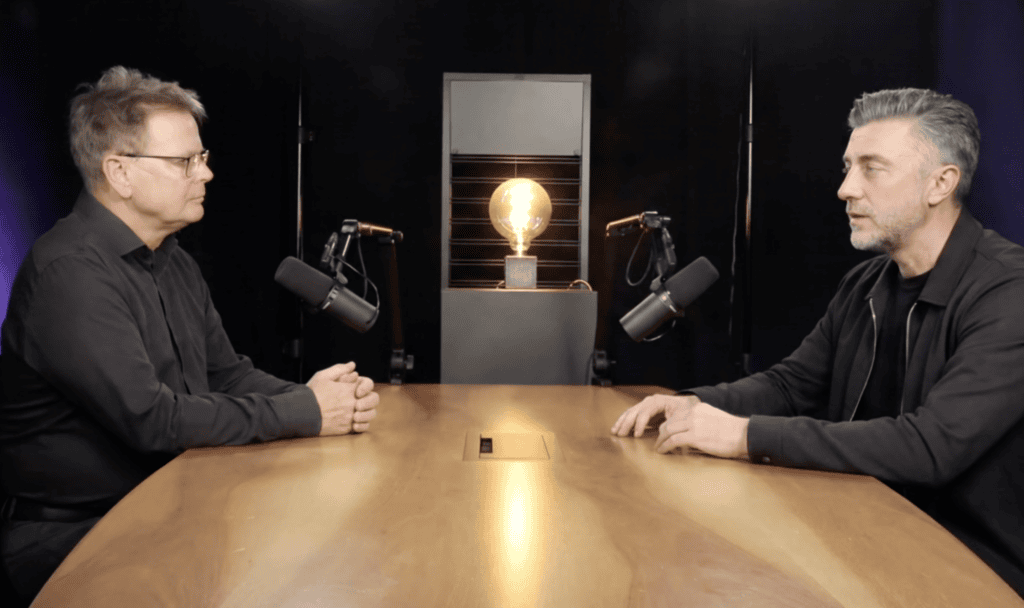
What happens when a podcast guest is not human at all - at least not in the conventional sense? This is precisely the experiment that the current episode attempts. De Sapio, a graduate of the SAE Institute and experienced producer with stations in radio, film and music, takes part in the conversation as a so-called AI twin. His digital twin is based on his real statements, his voice and his specialist knowledge - and thus raises fundamental questions: Where does the human end, where does the machine begin?
What can an AI twin do - and what can't it do? AI twins on the rise: opportunity and risk at the same time
De Sapio initially sees enormous potential in AI twins: scalability, multilingualism and efficiency gains make digital twins a promising tool in media production. At the same time, he warns of risks such as a loss of trust and a lack of transparency. The key question is: how can the technology be used without losing dignity and trust?
The discussion shows how profoundly the creative industry is changing. Traditional job profiles are increasingly giving way to hybrid profiles - from content creator to prompt designer. Although AI is massively accelerating creative processes, judgment and responsibility must remain with humans. Empathy, cultural sensitivity and a willingness to learn are the key skills of the future.
As the founder of AI Media Agency, de Sapio sees his company as a bridge between technology and design. New workflows, a deep understanding of AI tools and a focus on the idea rather than the tool itself distinguish the approach from that of a traditional agency. Clients are often surprised at how quickly the first visualizations are created - and how they serve as a new basis for discussion.
Making visible and sharing knowledge: AMA Award and Creator Day
Two initiatives are particularly close to de Sapio's heart: The AMA Award makes innovative AI projects visible, while the Creator Day provides practical knowledge on AI-supported content production. Both are responses to the growing need for exchange and further training in an industry undergoing radical change.
The podcast episode on Spotify
The video podcast «AI and Society—Paths to a New World,» hosted by Christoph Soltmannowski, is produced by the Text Akademie Foundation. Two episodes are released each month on Spotify, YouTube and the other major podcast platforms.
]]>

Five seconds. Then the skip button appears—and with it, a simple, brutal test of the market: Does an idea even have any relevance today? This isn’t “YouTube logic.” It’s the logic of the modern age. YouTube simply makes it more visible than other places—because there, decisions about what sticks and what disappears are made faster, more publicly, and more ruthlessly.
That’s exactly why the platform serves as a benchmark for adaptation—as a blueprint for principles that are crucial to survival everywhere today. This m&k Learning is based on numerous reports on video, creativity, brand management, marketing, AI, and platforms. We’ve distilled it into seven drivers of advertising- and marketing-based business success.
1) Speed is not a virtue, but rather a new level of strategy
The real shift isn’t “more video.” It’s more iteration. Audiences consume content at the pace of their feeds, competitors react in real time, and trends shift in days rather than quarters. Anyone who still thinks in terms of traditional campaign cycles doesn’t come across as “solid”—but as slow. And in digital markets, slow isn’t neutral—it becomes a weakness.
In this context, speed does not mean rushing, but rather a systematic approach: short cycles, clear responsibilities, rapid iterations, and early learning. The brand remains stable, but its execution becomes agile. This is precisely where the new form of competitiveness emerges: not through volume, but through rhythm.
Adaptable:
- Creation as an Iteration Machine (Testing, Learning, Refining)
- Production philosophy: less “masterpiece at the end,” more “versions at the start”
- Rapid feedback loops between creative, media, data, and community
2) Creativity Requires Craftsmanship: The ABCD Principle as a Transfer Model
When attention is scarce, craftsmanship becomes a lifeline. Creativity alone isn’t enough—it has to work under pressure: in the first few seconds, across different formats, on various screens, and in changing contexts. That’s exactly why the ABCD principle is so valuable: it translates a “good idea” into a structure that holds up in the real world.
ABCD isn't the creative idea itself. It's the framework that prevents an idea from fizzling out due to poor timing, a weak opening, or a lack of clear direction. In short: it's storytelling as a discipline—not as a gut feeling.
- A – Attention: The opening is the pitch. No intro, no “let’s start with some context.”.
- B – Branding: Mark it early as a cue, not late as a sender's stamp.
- C – Connection: Emotion as a driver of impact, not just for show.
- D – Direction: The next step is clear; otherwise, it's just entertainment.
Adaptable:
ABCD is a universal briefing and quality framework for moving images—whether CTV, social media, pre-roll, DOOH screens, or product videos.
3) Culture as a Competitive Advantage: The Cultural Delta
The hardest currency in the market isn’t reach, but meaning. Products can be copied, features too, and prices go without saying. What remains difficult to copy is cultural relevance: the feeling that a brand “knows what’s going on”—and isn’t just “chipping in with its two cents.” YouTube, as a benchmark, illustrates particularly clearly how culture emerges: through friction, remixing, commentary, counterarguments, and repetition. Those who recognize cultural signals early on and interpret them accurately build a cultural delta: a head start that doesn’t come from “trend-hopping,” but from genuine understanding. What matters is the mindset behind it: not artificially inventing trends, but tapping into existing energies—and credibly translating them into brand actions, tone, and storytelling.
Adaptable:
- Don't treat culture as a trend deck, but rather as input for positioning
- “Repurposing” as the supreme discipline: drawing on existing cultural energies, not inventing them artificially
- Storytelling—not just as a sales tool, but as Status Work: Brands build cultural standing by creating meaning, not just messages
4) Trust trumps attention: The creator as an operating system, not as an instruction manual
Attention is abundant. Trust is scarce. This is precisely the core of the creator’s logic: Creators are not “reach providers,” but rather architects of trust. Their audience follows them not because they have to, but because they want to—and because they know the codes: tone, rhythm, attitude, recurring formats, a sense of closeness. This has consequences for brands: Those who treat creators like interchangeable media spaces often get interchangeable results. Those who view creators as partners with their own systems—format, community, editorial, production—can scale authenticity rather than stifle it. And that’s exactly where the game shifts from short-term spikes to long-term preference.
Adaptable:
- Thinking of Partnerships as Media Projects (Format Logic, Continuity, Autonomy)
- Treat the creator not as an extension of the brand, but as an independent publisher
- Measure success not by likes, but by sustainable indicators (retention, search, brand preference, recommendations)

5) Premium is a context, not a broadcaster: The living room as a new seal of quality
“Premium” is no longer what airs on linear TV. Premium is what’s consumed in the right way: sound on, big screen, lean-back, shared attention. The living room is therefore not just another screen—it’s a different mental state. And this state is worth its weight in gold for brands because it allows for storytelling again: longer, more immersive, more emotional, less fleeting. The strategic lesson: CTV is not a format building block, but a funnel building block. At the top, it builds trust and recall; at the bottom, other devices translate that into action. Those who separate the two squander impact. Those who integrate it build a modern full-funnel narrative.
Adaptable:
- CTV as an Upper-Funnel Driver for Storytelling and Brand Building
- Mobile/Desktop as a Lower-Funnel Engine for Action and Conversion
- Design the creative in a way that takes into account the transition between screens (e.g., clear narrative flow, QR codes, search prompts)

6) Measurement without sacrificing brand equity: Brand Lift instead of a fixation on clicks
Many organizations optimize performance to the point where their brand identity evaporates—often not out of stupidity, but because of pressure to measure results. What can be clearly quantified in the short term wins out internally. What has a long-term impact but is more indirect becomes a “soft” metric. The result is well known: short-term efficiency, long-term erosion.
The benchmark principle is therefore this: measurement must protect the brand, not replace it. Brand lift metrics, well-defined control groups, mid-campaign insights—all of this may be less glamorous, but it forms the foundation for justifying branding investments within the company while ensuring that performance is not neglected. The key is a common language: the full funnel as a system, not as a battle between teams.
Adaptable:
- Methodically Validate Upper-Funnel KPIs (Recall, Awareness, Consideration)
- Enable mid-flight learning (rather than waiting until “after the fact”)
- Full-funnel as a shared vision, not as a battle between teams
7) AI is not a tool, but a pacemaker
AI isn't just changing production. It's changing expectations: more variants, faster adaptation, shorter half-lives. As a result, AI is becoming the new pace of business—those who ignore it aren't being “cautious,” but are at an operational disadvantage.
At the same time, AI does not replace what makes brands distinctive. It accelerates what needs to be done anyway: prototyping, testing, and adaptation. The real bottleneck remains human: tone, authenticity, the courage to pursue an idea, cultural understanding, and quality control. The winners aren’t those with the most tools, but those with the clearest synergy between speed and brand.
Adaptable:
- GenAI as a Prototyping Layer (Speed)
- Human Craftsmanship as a Quality Filter (Brand, Tone, Ethics, Differentiation)
- Governance that enables creativity rather than hindering it
Conclusion: The benchmark that hurts—and that’s exactly why it helps
YouTube is the ultimate test. It demonstrates what holds true everywhere in a video-first world: Speed + Craftsmanship + Cultural Understanding + Trust + Premium Context + Measurement = Brand Management. Everything else is “playing it out.” And playing it out is the easiest way to slowly fade away these days.
Transfer Checklist for Agencies and Brands
- Workflow: Iterative? (Versions, quick feedback, short communication channels)
- Creation: ABCD-ready? (Entry, early branding, connection, direction)
- Culture: Cultural Delta Active? (Reading Signals, Building Meaning, Translating Credibly)
- Partnerships: Trust-oriented? (Format, Continuity, Autonomy)
- Screenshots: CTV + Mobile integrated? (Storytelling at the top, promotion at the bottom)
- Measurement: Are Brand Lift and Full-Funnel properly linked?
- AI: Faster prototyping, brand secured?

From the Link to the Answer: A New Search Experience
On October 8, 2025, Google officially launched the new AI Mode in Google Search in Switzerland. This is currently being rolled out in almost 50 additional countries. It may therefore take a few days for the new tab with AI mode to appear on every device. AI mode appears as an additional tab in Google Search and in the Google app for Android and iOS.
In contrast to the classic search, which provides hit lists in the form of "blue links", the AI mode presents directly generated answers in continuous text form. This turns the search into a dialog: Users can ask multi-layered questions that would previously have required several searches - for example, when exploring a topic, comparing options or planning a trip.
Users can now ask questions such as:
«I want to understand the different methods of making coffee. Please create a table for me that compares the differences in terms of taste, ease of use, and required equipment.»
And even follow up with a follow-up question, such as:
«What is the best grind size for each method?»
Initial tests show that search queries in AI mode are two to three times longer than conventional queries. After the first answer, the dialog can be continued - with follow-up questions that are interpreted in the context of the conversation. The search experience thus resembles a natural conversation with an AI assistant.
Technology with Depth: «Query Fan-Out» and Gemini Power
The technological basis is an adapted version of the Gemini models (Gemini 2.0/2.5), which supports advanced logical reasoning (Advanced Reasoning). Central to this is the new «Query Fan-Out» technique: It breaks down a search query into several sub-questions, researches these in parallel in different data sources - including the search index, the knowledge graph and the shopping graph - and combines the results into a coherent answer. The AI mode is also multimodal: queries can be made by text, voice or via the camera.
Quality, Safety, and Transparency
Google is integrating AI mode into its Quality and Evaluation Systems. New methods are being added to improve factual accuracy and certainty. For example, agentic reinforcement learning (RL) is used to reward models for generating verifiable and precise statements.
Known protection mechanisms such as SafeSearch and SpamBrain remain active. Nevertheless, Google emphasizes that the AI mode is not infallible: Like any AI system, it can misinterpret content or, in rare cases "hallucinate" - i.e. present fictitious information with confidence. Users are therefore asked to check important information with several sources. Google continues to provide source links to ensure traceability.
Control is also ensured when it comes to data protection: personalized results appear only if the «Web & App Activity» feature is enabled. You can view and delete your search history at any time.
SEO in Transition: From Keywords to Entities
With the introduction of generative search experiences, the focus in search engine optimization is shifting: entities are replacing keywords.
What are entities? In the SEO context, an entity refers to a clearly identifiable object - a person, a place, a thing, an idea or a concept - defined by name, attributes and relationships to other entities.
The role of the Knowledge Graph: An entity only "exists" online if it is listed in the Google Knowledge Graph. This was introduced in 2012 with the principle "Things not strings" and forms a network of semantically linked topics. This means that Google increasingly understands queries contextually rather than linguistically - even without exact keyword mentions.
Strategic Implications: Because the AI mode delivers answers directly, a decrease in organic search traffic is expected. It will be crucial to be cited in AI-generated answers.
In the future, websites will need to structure their content in such a way that AI systems can interpret it unambiguously:
-
Structured data: Markup codes in the head section help clearly define entities and their relationships. Tags such as
sameAs,Aboutormentionsprovide Google with semantic cues. -
Content Focus: Instead of counting keywords high-quality, relevant content related to entities. Even niche topics are gaining traction, since 15 % of daily search queries are completely new.
-
Internal links: Through Pillar-Based Marketing and strategic internal links can strengthen relationships between entities.
From Search Index to Knowledge Network
The AI mode does not mark an evolutionary step, but a revolutionary one: Google search is evolving from an index to an answer engine - and from keyword hunting to context intelligence. Traditional search results retain their relevance - for example for transactional queries or queries that need to be checked. However, the new AI mode clearly shows that the future of search is dialogical, entity-based and generative.
]]>As part of the first Zurich AI Festival, Google offered insights into cutting-edge research and applications of artificial intelligence at its Hürlimann Campus. Engineers presented state-of-the-art projects in a series of lightning talks—ranging from cybersecurity and image recognition to climate research and accessibility. The event served as a platform for exchange between local talent and global innovation, underscoring Zurich’s growing importance as an AI hub.

Google in Zurich: A Driving Force Behind the Ecosystem
Christine Antlanger-Winter, Country Director for Google in Switzerland, opened the event and emphasized Google’s deep roots in Zurich. The company has been present here for over 20 years and now employs 5,000 people—affectionately known as „Zooglers“—across two campuses. She emphasized that Google sees itself as an active part of Zurich’s thriving tech ecosystem.

This is evident in long-standing partnerships, such as the one with the Greater Zurich Area, whose office is now located in the very spot where the first two Google employees got started in 2004. The company is particularly proud of the fact that former Google employees have already founded 110 startups, creating 1,700 jobs. In addition, Switzerland was the first country where Google launched an apprenticeship program, which now serves as a model for other locations.
Sabine Müller, deputy managing director of the Greater Zurich Area and co-initiator of the Zurich AI Festival, explained the festival’s origins and goals. The festival aims to position Zurich and Switzerland as a global beacon for ethical, impactful, and inclusive AI. The mission, she said, is to make AI accessible and to foster public dialogue about its role in the future. Müller described how Zurich has evolved over the past 20 years from a city once derided as „boring“ into a global innovation hub with a higher concentration of big-tech companies than Silicon Valley.

The idea for the festival arose from a desire to highlight this strength and create a platform for knowledge exchange and collaboration, similar to what other cities are already doing. With 26 partners on board and an expected 5,000 guests, the festival celebrates the concentrated expertise of the local ecosystem. In his opening remarks, Alexander Ilic, Director of the ETH AI Center, emphasized the importance of collaboration between academia and industry and proudly mentioned the release of the first truly open Swiss LLM with 70 billion parameters.
AI in the Shadows: Protection Against Cyberattacks
Daniel Fabian, AI Red Team Manager for Google’s Cybersecurity Team, shed light on the dark side of AI. He explained that new technologies are inevitably exploited by attackers for malicious purposes. Hackers are already using AI as a productivity tool—for example, to create personalized phishing emails more quickly or to autonomously find vulnerabilities in systems. Fabian’s team acts as a „crash test“ unit for AI: They take on the role of attackers to target their own systems and uncover vulnerabilities before others do. The insights gained from these simulated attacks are directly incorporated into the improvement of Google products, such as the Gemini models, and help close entire classes of security vulnerabilities.

Google Lens: Understanding the World Through the Camera
Vanessa Ackermann, Software Engineer at Google, gave an insight into Google Lens, a technology that was invented right here in Zurich. Google Lens turns your smartphone camera into a versatile search tool that processes over 20 billion queries every month. The fundamental problem that Lens solves is the fact that not everything you see can be easily put into words. Whether it’s an unknown plant, a historic building, or a piece of clothing you saw online—Lens bridges the gap between seeing and searching.
The use cases are extremely diverse:
- Identification: You can point to works of art, landmarks, or products to get more information.
- Translation: Lens can translate text in over 100 languages in real time on the camera screen, which is especially helpful when traveling—for example, with menus or signs.
- Homework Help: Instead of simply giving away the answer, Lens breaks down math and chemistry problems into individual steps to support the learning process. To do this, Google works with a team of educators.
- Text and Shopping Features: You can copy text directly from the real world or take photos of products you see to find purchase options, similar items, and reviews.
- Health Information: Lens can also help identify rashes or moles by displaying visually similar images from the internet to provide initial guidance. However, Google emphasizes that this is not a substitute for medical advice.

The core technology behind Lens is what is known as «embedding», which can be thought of as a digital, numerical fingerprint for an image. An AI model is trained using billions of images from the internet to learn how to generate an optimal fingerprint for each image. These fingerprints are designed so that visually similar images are located close to one another in a multidimensional mathematical space. When a user takes a photo, the model calculates the fingerprint for that image and searches for its nearest neighbors in this space. Based on the descriptions of these neighboring images, Lens can then precisely determine what is shown in the photo, even if it has never seen that exact image before. This method makes it possible to recognize even subtle differences, such as those between very similar plant species.
Project Contrails: AI Against Climate Change
Max Vogler, Software Engineering at Google, presented how Google is using AI to combat an often-overlooked climate factor: contrails. These artificial clouds, which form behind airplanes, are responsible for about one-third of the global warming caused by aviation. An AI model, trained using satellite images, can predict the formation of these warming contrails.

Since contrails form only within very narrow altitude ranges, pilots can prevent them from forming entirely by making slight adjustments to their altitude of just a few thousand feet. A study conducted with American Airlines showed that 54 % of contrails could be avoided with an additional fuel consumption of only 0.3 %. This project is part of Google's goal to offset one gigatonne of CO₂ equivalent annually worldwide starting in 2030.
VEO: The Next Level of AI-Powered Video Generation
Pieter-Jan Kindermans, Staff Research Scientist at Google DeepMind, presented VEO, a groundbreaking AI model that converts text prompts into videos. They demonstrated the impressive progress made since the first experiments in 2022—which produced low-resolution, slightly distorted videos of a teddy bear underwater—up to the current VEO 3 model, which represents a major qualitative breakthrough.

What makes VEO 3 special is its ability to produce not only visually appealing, but also to create narratively coherent and physically plausible scenes—including sound, dialogue, and realistic interactions. As a striking example, a video of a male ibex and his son in the Swiss Alps was shown. The model created the scene based on a story about mountain biker Nino Schurter. VEO 3 autonomously generated details—without explicit instructions—that bring the scene to life:
- Realistic sound: The model generated a lower-pitched voice for the father and a higher-pitched one for the son, added animal sounds between sentences, and incorporated ambient sounds such as footsteps.
- Understanding of Physics: It took into account physical realities such as light reflections in a puddle and the interaction of the hooves with the water.
- Cinematic storytelling: Through the use of camera pans and scene changes—such as zooming in on a tire track—VEO creates a narrative structure reminiscent of television productions.
Pieter-Jan Kindermans emphasized that VEO is designed to give everyone the opportunity to bring their imagination to life and tell captivating stories. He encouraged the audience to check out online the amazing creations users have already made with the tool, since even the developers themselves are constantly surprised by what’s possible with their models.
AI Co-Scientist: AI as a Research Partner in Medicine
Petar Sirkovic, Staff Software Engineer, presented the "AI Co-Scientist" project, which aims to radically accelerate the scientific research process. The Gemini-based multi-agent system is designed to help researchers manage the vast amount of existing knowledge and identify the most promising hypotheses. Various AI agents simulate the scientific process: they generate, criticize, evaluate and improve hypotheses in an evolutionary cycle. In a practical test on antimicrobial resistance, a problem that a human research team had been working on for years, the AI Co-Scientist was given the same research question.

After just two days, the top hypothesis generated by the system was identical to the biological solution that the human team had independently validated in the lab. The lead researcher, Prof. José Penadés, was so stunned that his first reaction was: „You’ve hacked my emails.“.
Ask Studio: The AI Partner for YouTube Creators
Patricia Magro, Product Manager at YouTube, introduced „Ask Studio,“ an AI assistant that is integrated directly into YouTube Studio and is being co-developed by a team in Zurich. Since life as a creator is very demanding and many of them work without a team, Ask Studio is intended to serve as a creative partner who takes on complex tasks and provides sound advice.

What sets Ask Studio apart from an ordinary chatbot is its direct access to a channel's specific data and content. This enables the tool to perform in-depth analyses:
- Complex Data Queries: A creator can ask whether their viewers watch for longer on TV or on mobile devices. Ask Studio then analyzes the relevant channel data to provide an answer.
- Content Analysis: If viewers stop watching at a certain point in a video, Ask Studio can analyze the content and transcript at that point and suggest possible reasons, such as an intro that's too long or an inside joke that new viewers don't understand.
- Semantic Search in Comments: Instead of just searching for keywords, Ask Studio can analyze comments based on their meaning to identify, for example, actionable feedback or ideas for new videos.
- Creative Support: The tool can also suggest titles and outlines for new videos to help streamline the creative process.
Another key goal is to provide creators with reliable information. Ask Studio bases its answers on official YouTube guidelines and help articles to debunk myths about „algorithm hacks“ and shift the focus toward creating great content. With just one click, a creator can get a complete analysis of their latest video’s performance—a process that used to take 20 minutes but now takes just seconds.
AI for Accessibility: Technology That Helps Everyone
Dirk Ginader, Accessibility Engineering Lead at Google, closed the event with a compelling presentation on the role of AI in improving accessibility. He emphasized that over a billion people worldwide have some form of disability. Technologies such as Google Lookout, which are based on the same principles as Lens, enable blind people to „see“ their surroundings and live more independently.

Today, AI can automatically generate detailed image descriptions for people with visual impairments where none previously existed. He also introduced „Project Relate,“ an app that is being trained to understand the unique speech patterns of people with speech impairments and to transcribe their words in real time or repeat them in a clear, computerized voice. He pointed out that many technologies we use every day, such as email or captions, were originally developed for people with disabilities and ultimately benefit everyone.
Alexander Ilic, Director of the ETH AI Center, concluded by emphasizing the need for collaboration to pool and strengthen existing resources. With over 1,400 doctoral students and 120 professors, the ETH AI Center is the largest university-based AI center in Europe and is driving basic research forward, for example with the release of the first truly open Swiss LLM with 70 billion parameters. Ilic highlighted how crucial partnerships with companies like Google are for taking this basic research to the next level and creating innovations that we use every day. The synergy between excellent research, a startup-friendly environment, and established tech companies reinforces their shared success.

The Zurich AI Festival is thus more than just a series of events; it is a clear commitment to the mission of making AI accessible, accelerating collaboration between research and industry, and establishing Zurich as a global beacon for ethical and impactful AI. It is an invitation to network and shape the future together.
]]>

The AI in Marketing conference goes beyond the hype: it shows where AI offers real added value in marketing - and where it does not. Organizer Tanja Herrmann, known for the Social Media Summit, is relying on a top-class line-up with keynotes, panels and interactive masterclasses. Which tools and strategies are really relevant, which misunderstandings need to be dispelled and why AI is not just an IT topic, but a change management project - all this and more in the interview.
Can you remember your first personal experience with artificial intelligence - when did you first get the feeling that AI could change marketing?
My first personal contact with AI - as we know it now - was around four years ago. A colleague had registered for the beta version of Dalle. At an aperitif, he showed me how to generate images from text. I thought to myself: "How practical, at last I can describe all the things as I imagine them and visualize them at the touch of a button". But first we spent the evening visualizing a cat in a bikini in a butcher's shop with a cucumber.
What prompted you to launch the "AI in Marketing Conference" - and why now?
The topic of AI is omnipresent - everything is developing so rapidly and often opaquely that it can quickly become frustrating. If you don't have the whole day to deal with it, you feel like you're losing touch. At the same time, there is an overabundance of courses and events - but often far too technical for what I can do myself - or not relevant enough for my needs. The thought was actually: before I have to pick out the 1-2 contents that are relevant to me in marketing at various events, I could put together a program with the topics that concern me and my professional colleagues - without a technical background - the most. The biggest challenge: After eight years of Social Media Summit, I also knew exactly what it would mean if I wanted to set up a second conference. Eight years ago, a good pinch of naivety was quite grateful in hindsight.
The marketing industry often experiences hype around new technologies. What makes AI different - and why is it not enough to simply introduce tools?
It is probably fair to say that we are currently in the hype phase when it comes to AI. But it's not going to go away. What makes AI so different is, on the one hand, the speed with which it has become part of our everyday lives - without any formal training. On the other hand, we work with tools without fully understanding them. This is a problem if we want to rely on the results. The problem with the pure "tool approach" is that we hand over individual work steps in existing processes to AI tools. With AI, however, we have to ask ourselves whether the process as such still makes sense or whether the use of AI opens up completely different possibilities. In companies, AI is therefore not just an IT project, but part of a change management project.
What problem does the conference solve? What misinformation or misunderstandings do you want to dispel with the event?
The conference will provide an overview and put things into perspective: How do the various AI models work, what are the specific use cases and what legal and ethical challenges do we face?
What kind of content and sessions can participants expect? Will it be more about strategy or practical applications?
The conference offers three different formats: Classic keynotes, panels, but also a variety of masterclasses where you can try things out for yourself. For all sessions, we also indicate whether they are aimed at beginners or advanced users and whether specific tools will be used in the session.
How did you select the speakers? What criteria did you use to decide who should really be on stage as an AI expert?
Over the summer of 2024, I was in contact with almost 70 AI experts from all over Europe. I also had longer calls with almost 50 of them. I wanted to find out from them which topics are of concern to research, law and schools. In their opinion, which topics receive too little attention, which projects have already been successfully implemented and what their background is. During such discussions, the wheat is separated from the chaff relatively quickly. New people kept joining us and so, over the months, the Program.
Many new "AI marketing experts" have emerged in recent years. How can you tell if someone really has in-depth knowledge?
By taking a short time to check CVs and references and then talking to people. After so many preparatory conversations with people who have been researching topics such as machine learning, large language models and neural networks even before ChatGPT & Co, you eventually recognize a buzzword bingo. Because real content can also be explained in simple terms.
Who do you personally think are the most exciting speakers at this conference - and why?
Personally, I am delighted that we will also be examining more critical topics relating to AI. The panel with Dr. Sabine Lehmann from Google Deep Mind, Henriette Engbersen from SRF and Prof. Dr. Peter Kichschläger from the University of Lucerne will focus on the tension between innovation and ethics. But all the masterclasses in which the AI tools are used directly are also a highlight for me.
Is there an AI topic that is currently the subject of particularly controversial discussion and could perhaps provide for exciting debates at the conference?
The general controversy is data, where does it come from and what happens to the data that we share through our daily work with the tools. The audience will have the opportunity to ask questions after each session, so I could imagine one or two critical questions being asked directly to the publishers of these tools.
In your opinion, what is too often ignored or underestimated in the current AI debate in marketing?
What incredible power is distributed among a few players. As Switzerland and Europe, we need to think about what dependencies we want to build up for the future and who we want to trust with our data.
How do the perspectives of international and Swiss AI experts differ? Is there a particular dynamic here?
In my opinion, Switzerland takes a very pragmatic approach to the topic of AI. We are aware of the dependency and data insecurity, but our tone is less emotional than in the rest of Europe. As a master of special paths and with the ETH in the heart of Switzerland, I feel less helplessness among experts here in Switzerland.
You have already established one of the largest marketing conferences in Switzerland with the Social Media Summit. What do you take with you from this experience to the AI in Marketing Conference?
That building a conference and its "community" takes time, a sure instinct in communicating with all parties and a lot of attention to detail. It's actually the seemingly small things that make people say at the end: I'll be back.

How do you ensure that your conferences are not only informative, but also inspiring experiences?
By consistently asking myself the question: "Would I really like it that way?". In addition to good content, functioning technology (and lots of food), a conference also needs a pinch of magic. Things that surprise - such as renting an entire mountain village as a location.
What expectations do you have of the first edition of the conference? Is there a particular learning that participants should take away with them?
My aim is for people to be able to say at the end that they now have a better overview of what's going on, concrete tips that I can implement tomorrow and information that is actually relevant for me in my everyday life.
The marketing world is changing rapidly. Will "AI in Marketing" be a one-off event or is a sequel already planned?
We are already busy planning for 2026 in the background and will reveal more on March 27, 2025 at Platz.
In conclusion: If you had to summarize in one sentence why marketers should not miss the conference - what would your answer be?
Because we all need to understand what AI does and does not mean for our everyday working lives today.
The AI in Marketing Conference will take place on March 27 at The Circel, Zurich Airport. Click here for the tickets.
]]>