
The Zurich agency Gestalten has been supporting "Dry January" for many years with the design of the respective campaign visuals. This year, the subject focuses on a series of events that promises all the more fun without alcohol.
The bright yellow eye-catcher can be seen on all digital media, small posters in the respective cities and a poster display in the Zurich catchment area. The latter was also made possible thanks to the generous support of Swiss Plakat and Ace 2 Ace.
Dry January" is supported by the main sponsor, the Federal Office of Public Health FOPH, as well as the project partners Addiction Switzerland, the Swiss Addiction Association, GREA and the Swiss Blue Cross. These organizations successfully ensure that the population reflects on and consciously controls its personal alcohol consumption at the beginning of the year; at least for one month, but increasingly also beyond that.
]]> Uszit lager, which supports the Swiss forest with 5 centimes per can, has had support since May: Hard Tea by Uszit is an iced tea with 4.5% alcohol by volume - and thus a new beverage category in Switzerland. To communicate this to the outside world, Ringier Advertising's Brand Studio launched a campaign celebrating "Tea Time".
The somewhat stiff and dusty concept is broken up by authentic, sometimes unconventional visuals. The typographic solution, reminiscent of graffiti, is intended to reinforce this contrast and give the seven subjects an urban character.
The campaign is aimed at a broad target group of adults. In addition to the website, the launch campaign includes digital advertising material, a large-scale social media campaign and POS and gastronomy measures. As with beer, 5 centimes of every can of Hard Tea will go towards protecting the Swiss forest.
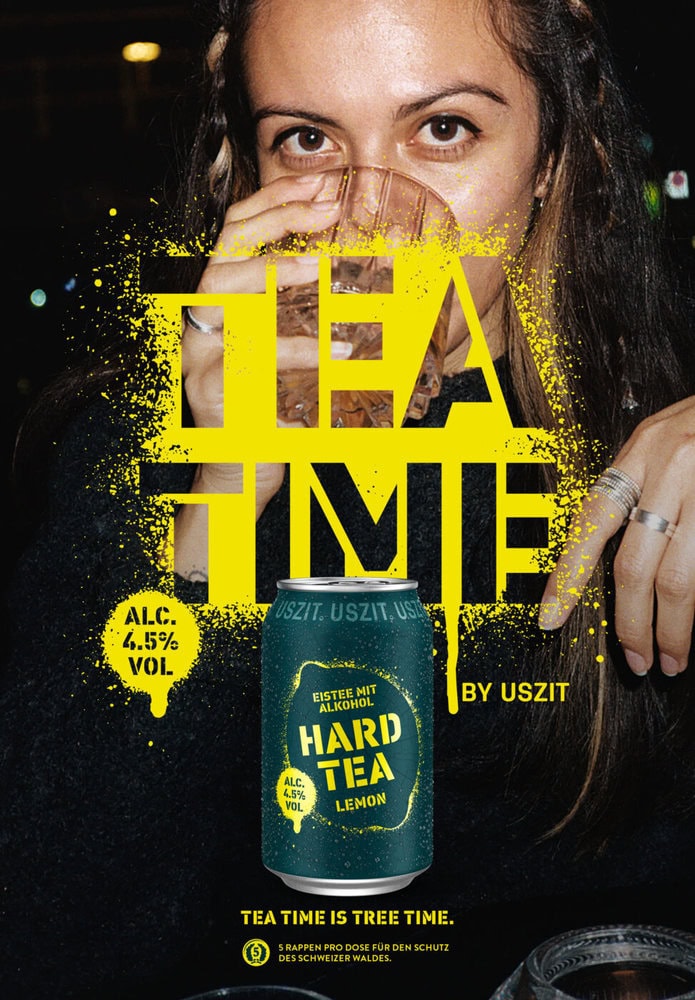
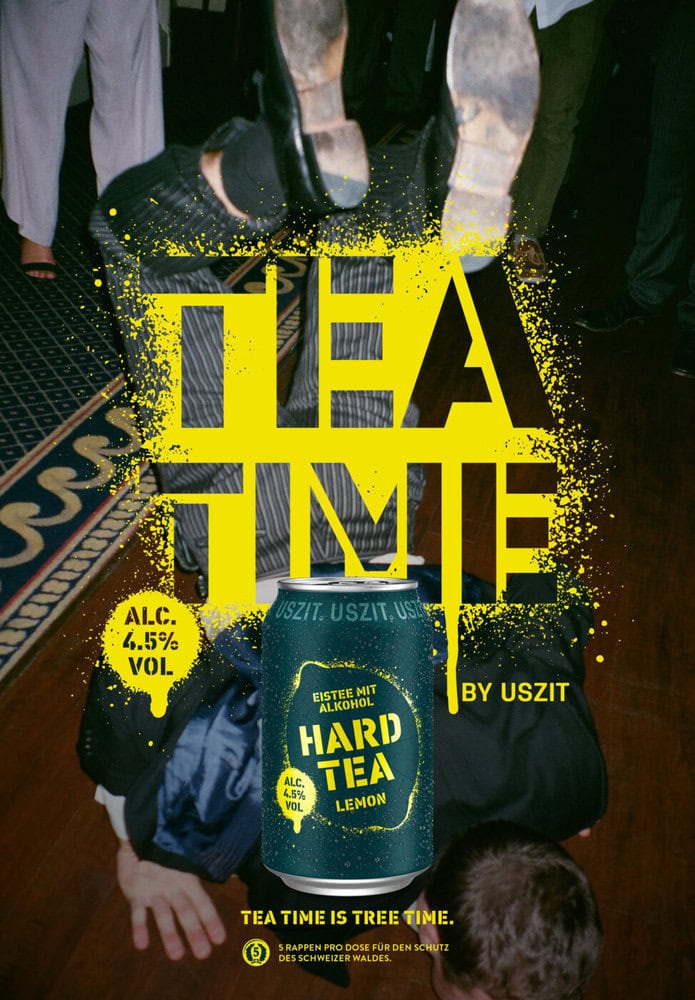
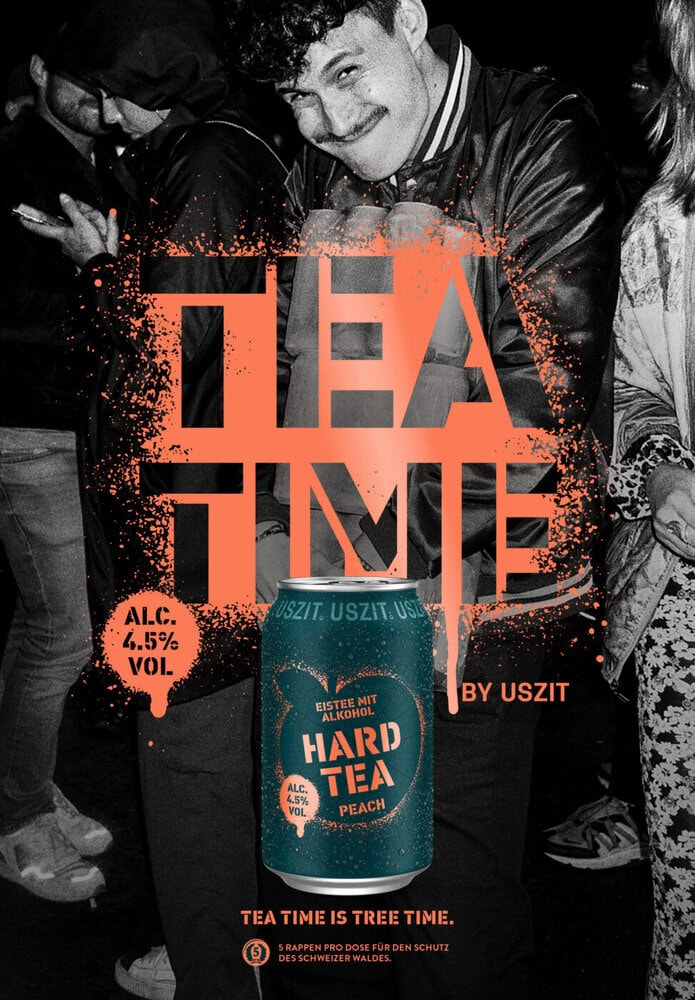
Responsible Brand Studio: Fabian Zürcher (Director), Jana Leonhard (Head of Creative Concepts), Elgee David Wee (Art Director), Laura Mancino (Head of Consulting), Ulli Glantz (Head of Image), Lukas Spichtig (Social Media), Ivo Tuchschmid (Social Media), Hauke Broschat (Senior Media Consultant). Responsible at Uszit: Astrid Roland (Brand Director), Jeannine Grossmann (Senior Brand Manager).
]]> Good humor, taste, emotions - but also know-how: This is how Swiss wine advertises in a new campaign with two short documentaries that show how and where Swiss wine is produced, but also by whom.
To this end, Mattenberger Brandtelling and its partners TVision accompanied oenologist Thierry Ciampi during the grape harvest, during pressing and in the wine cellar. The two emotional social media films are intended to highlight the craft of Swiss wine, but also to show how much passion they put into making it. The production is a collaboration between Swiss Wine and Denner.
]]>
 For a long time, a beer brewed in Switzerland was not allowed to be called "Pils". The background: Since 1927, Switzerland and the Czech Republic (previously with Czechoslovakia) had an international treaty that permitted the designation only for beer of Czech origin. This agreement was abrogated at the end of 2022. For Feldschlösschen, this was an occasion to develop a Swiss Pilsner and thus expand the product range.
With Feldschlösschen Pils, the brewery is offering a new spicy-tart beer made from Pilsner and Munich malts and a blend of hop varieties. Feldschlösschen Pils is available now in the 50-cl can as a 6-pack in selected Coop supermarkets and in the online store JustDrink.ch. From October, the Pils will also be on the beer shelves of Coop Pronto.
Due to the state treaty on the designation "Pils", which had been in force for almost 100 years, a separate category of beer had been created in Switzerland: The Spezialbier or Spezli. While originally including beers brewed in the Pilsner style, the category evolved over the years and adapted to the tastes of Swiss consumers.
]]> Martini has announced the launch of its new anniversary campaign "160 Years of Italian Taste", celebrating 160 years. The campaign aims to open the doors to the world of Martini for consumers around the globe and is inspired by the brand's heritage as a symbol of Italian style and culture.
The brand, founded in 1863 by entrepreneur Alessandro Martini and botanical expert Luigi Rossi, is known for its iconic Italian heritage. The new campaign, "160 Years of Italian Taste," combines the brand's heritage with its vision for the future - inspired by the motto "Volere é Potere" (Where there's a will, there's a way) that adorns the gates of Casa Martini in Pessione, Turin. The creative assets invite viewers:inside to dive into this world - a realm of unlimited possibilities, with images designed to illustrate the brand's departure into a new era.
The new creative concept is also intended to reflect the changing drinking habits of female consumers: Two non-alcoholic vermouths are the focus of the assets and are intended to show how Martini meets the growing demand for mindful drinking and unites it with aperitivo culture.
Developed by AMV BBDO
The "160 Years of Italian Taste" campaign is accompanied by an extensive media and OOH campaign and supported by PR and media cooperations as well as influencer activation. The above-the-line campaign was developed by creative agency AMV BBDO. In Switzerland, the campaign will be played out in French and German from July.
Customer: Bacardi, brand: Martini. Agency: AMV BBDO. Media: OMD. Production: CLM. Photo: Liz Collins. PR: BCW.
]]>
 The wide view sweeps over the Highlands, a lake sparkles in the distance - next to a bottle of whiskey. Or a cozy crackling fireplace, a blanket with colorful checks over your legs - and a tumbler of whisky in your hand. It's images like these that the Scottish tourism industry uses to advertise vacations in the British part of the country.
High-proof alcohol is one of Scotland's best-known symbols and thus also an important economic factor. But the influential industry fears that this could soon be over.
Alcohol problem widespread
Because the regional government in Edinburgh is under pressure. According to the latest available data, more people than ever before died in the UK in 2021 as a result of heavy drinking. Scotland had the highest rate. "Scotland has a deep, long-standing and problematic relationship with alcohol," the government acknowledges.
In order to prevent younger people in particular from consuming alcohol, it is now considering a far-reaching ban on alcohol advertising. To this end, it has launched a "consultation", a public consultation.
Under discussion is, for example, a ban on advertising on billboards and in newspapers, as well as on alcohol-related merchandising. Proposals call for distilleries and pubs to be banned from selling T-shirts and glasses. There is also talk of breweries and other alcohol producers no longer being allowed to sponsor sports and cultural events.
"If all the measures being discussed become law, it could even mean that stores will have to hide their alcohol," commented the Herald.
Economy alarmed
The plans are alarming the business community. "Don't destroy Scotland's drinks industry," warned several drinks giants such as Diageo, Budweiser and Tennent's in an open letter. Young brands fear for their existence if they are no longer allowed to draw attention to themselves as sponsors.
But the tourism industry is also up in arms. "Effectively banning the sale of all alcohol-related items would impact a great many tourism businesses, not just distilleries," said Gordon Morrison, chief executive of the Association of Scottish Visitor Attractions.
With an estimated 84 million pounds (approx. 94 million Swiss francs) a year, whisky tourism plays an important role. Only in recent years have whisky companies invested a lot of money, Morrison said, pointing to examples such as the 140-million-pound expansion of the Macallan distillery in Craigellachie into a visitor attraction.
"The distilleries are often in parts of Scotland that are quite remote," Morrison said. ""There's often nothing else to do there. They bring visitors into the communities."
Opposition wants to use the issue
The Conservative Party, in opposition in Edinburgh, wants to exploit the popular issue, talking of "draconian" rules. "Not only will this cost jobs in Scotland, but it will make it much more difficult for the industry to export to the EU and elsewhere," criticized David Mundell, an MP in the House of Commons.
The Conservative government in London gratefully took up the ball: Secretary of State for Trade Nigel Huddleston promptly warned of "significant negative impacts."
Scotland's head of government Nicola Sturgeon feels misunderstood. "Some insinuations in recent weeks that, for example, hand-painted signs on distilleries or visitor centers are in our sights are not part of our ideas at the moment, let me make that quite clear," Sturgeon stressed.
There is a difference, she said, between a billboard near a school and a cap with a whiskey brand logo. "We have to look at this pragmatically and seriously," Sturgeon said. The "consultation" ends March 9. (SDA)
]]> Artificial intelligence was used to create the new ASMR AI campaign "Unbottling Martini," which will be seen in Switzerland from January 31, 2023. A world first for a spirits brand, the new assets are a clear step toward the future, the company said. It relies on technology to convey the style for which the brand has now been known for 160 years. A total of three assets feature the products, each image created by inputting descriptive text into the AI platforms, using the information to create a unique visual interpretation of the Martini world.
KI Midjourney
The assets were created using visual AI Midjourney to create a completely unique interpretation of the Martini world, the first of its kind to be launched on the company's platforms. Midjourney is an AI program that generates visuals from text descriptions. By inputting descriptive text, the AI creates a completely unique image. To generate the assets, keywords such as: Botanicals, floral, blossoms, flowers, artemisia, and Roman chamomile entered into Midjourney.
Unbottling MARTINI assets are deployed on social and digital platforms in markets around the world.
Creative Director : João Paulo Testa. Social Creative Director: Kalle Everland. Board Account Director: Charlotte Oram. Senior Account Director: Patrick Bolton. Senior Account Manager: Georgia Phillips: Senior Producer. Michelle Walton: Designer. Andrea Casacci: Production company. Packshot Factory: Sound - Pitch & Sink:
]]>
 Abstain from alcohol for a month, right at the beginning of the year. This is what the Dry January movement is all about, with a growing number of followers worldwide. For many people, however, the idea is not that easy, and they fear that they will have to give up fun when they give up alcohol. But that's not the case! Gestalten is now demonstrating this with a new campaign for the Challenge, which is intended to inspire even more followers for the movement. In addition to numerous campaigns, including on social media, by e-mail and with merchandising, an information event was held before the turn of the year at Zurich's Cabaret Voltaire with the first "Dry Night". The Challenge was toasted with non-alcoholic cocktails. Experts from various fields discussed - also with the audience - aspects of alcohol consumption, and took a close look at reactions and consequences of abstaining from alcohol.


 Alcohol has a firm place in our culture and is part of it for many. But the potential for addiction is high: one in five adults exhibits high-risk drinking behavior. Physical and psychological habituation to alcohol can lead to dependence - a serious illness. Those affected can seek treatment at Arud. To ensure that as many people as possible learn about it, the Center for Addiction Medicine has now launched a new campaign with Ruf Lanz, which is all about one thing: discretion. Men and women are presented in the campaign in such a way that they remain anonymous due to the contents of the glass in front of their eyes. All those portrayed deliberately do not conform to the stereotype of neglected alcoholics. After all, alcohol problems should be treated as early as possible.
Counteract fear and shame
"Out of fear and shame, people often do not seek help. With fatal consequences for health and quality of life. We are committed to counteracting this with this campaign," says communications planner Patrizia De Nicoli. The four motifs can be seen from October 10 in the greater Zurich area: in a billboard, on public transport posters, on advertisements, postcards, counter displays with educational material, and in social media.

Responsible at Arud: Patrizia De Nicoli (Communication), Reto Jeger (Managing Director), Thilo Beck (Co-chief Physician Psychiatry), Philip Bruggmann (Co-chief Physician Internal Medicine). Responsible at Ruf Lanz, Zurich: Mario Moosbrugger (art direction), Markus Ruf, Danielle Knecht Lanz (creative direction), Miro Poffa, Nadia Amaru (consulting). External partners: Paolo Emmanuele (photography), Michèle Aschmann (image editing), RTK Medientechnik (lithography), Setaprint (printing).


 Until June 4, 2022, the members of the Migros cooperatives had the opportunity to vote "Oui" or "Non". "Oui" stood for the lifting of the alcohol ban in Migros, "Non" for the status quo. Now the results are in. The supermarkets, restaurants and takeaways of all ten regional cooperatives will remain alcohol-free in the future. In all regions, members voted to retain the ban on alcohol sales, which has existed since 1928 and is enshrined in the bylaws. A majority of two-thirds of the votes in each case would have been required to change this practice.
Great interest in the vote
There was great interest in the vote. In total, more than 630,000 cooperative members took part in the ballot - more than ever before. This corresponds to a 29 percent turnout. "This shows impressively, the great solidarity of the population with Migros and its democratic values," says Ursula Nold, President of the Administration of the Federation of Migros Cooperatives (MGB). "The result is not surprising because all polls pointed to a clear 'no'. The hurdle for a change in the statutes was very high with a two-thirds majority. Migros Democracy has won. And I am glad that the cooperative members decided clearly and unanimously throughout Switzerland," says Ursula Nold.
Marianne Meyer, President of the MGB Delegates Assembly, states: "The impetus to discuss the alcohol ban in principle once again came from the grassroots of the delegates and not from the management. Now our base of cooperative members has decided unequivocally. Something like this is only possible in the Migros community."
Non-alcoholic Migros beer "Non" is launched
Nevertheless, there will be a visible change in the product range of Migros stores, Migros restaurants and Migros takeaways. It is expected that from 2023, the alcohol-free Migros beer "Non" will be offered there. "We already offer a variety of non-alcoholic beverage alternatives, for example for trendy aperitifs," says Ursula Nold. "From now on, the alcohol-free Migros beer will stand as a visible symbol of Migros democracy in the stores."
For Ursula Nold, the results of the vote show: "Migros remains Migros. The members of the cooperative have declared their support for a traditional feature in the alcohol issue. By saying yes to online voting, they simultaneously sent a clear signal that Migros should continue to develop in a progressive way, as has always been part of its nature."
]]>