
Today, moving image planning no longer means thinking in terms of channels, but in terms of user behavior. The focus is on attention, context and impact - regardless of the channel and screen.
Traditional linear TV is still very important in the Swiss media market. On the one hand, high net reach can still be achieved with linear TV. On the other hand, classic TV picks up viewers in a "lean back" situation. At this moment, the focus is on more relaxed, passive use; media content is consumed without actively "interfering" in the action (for example by quickly scrolling or swiping or when using gaming content). This passive use in turn has a positive effect on the advertising impact and thus on the overall success of the campaign, as the activation level of content and advertising is close to each other (source: Video Impact, SevenOne Media GmbH, January 2020).
Despite these advantages of traditional, linear television, linear TV usage is declining. There are increasing gaps in reach, particularly in younger age segments. These gaps can be filled - at least in part - by using moving image offerings that pick up the target audience in the same emotional state, i.e. address them in a comparable "lean back" situation. This includes streaming offers, but also replay ads. Outstream formats (such as those offered by news platforms) and social media formats, on the other hand, are less suitable, as the target audience is in a different emotional state when using them.
If you want to pick up the target persons in "lean back" mode, the TV screen remains central as the playout device, provided the TV is a connected TV, i.e. a device connected to the Internet (such as a smart TV). However, passive media consumption behavior can also take place on mobile devices, be it on a desktop or laptop or even on a smaller screen, whether at home or on the move.
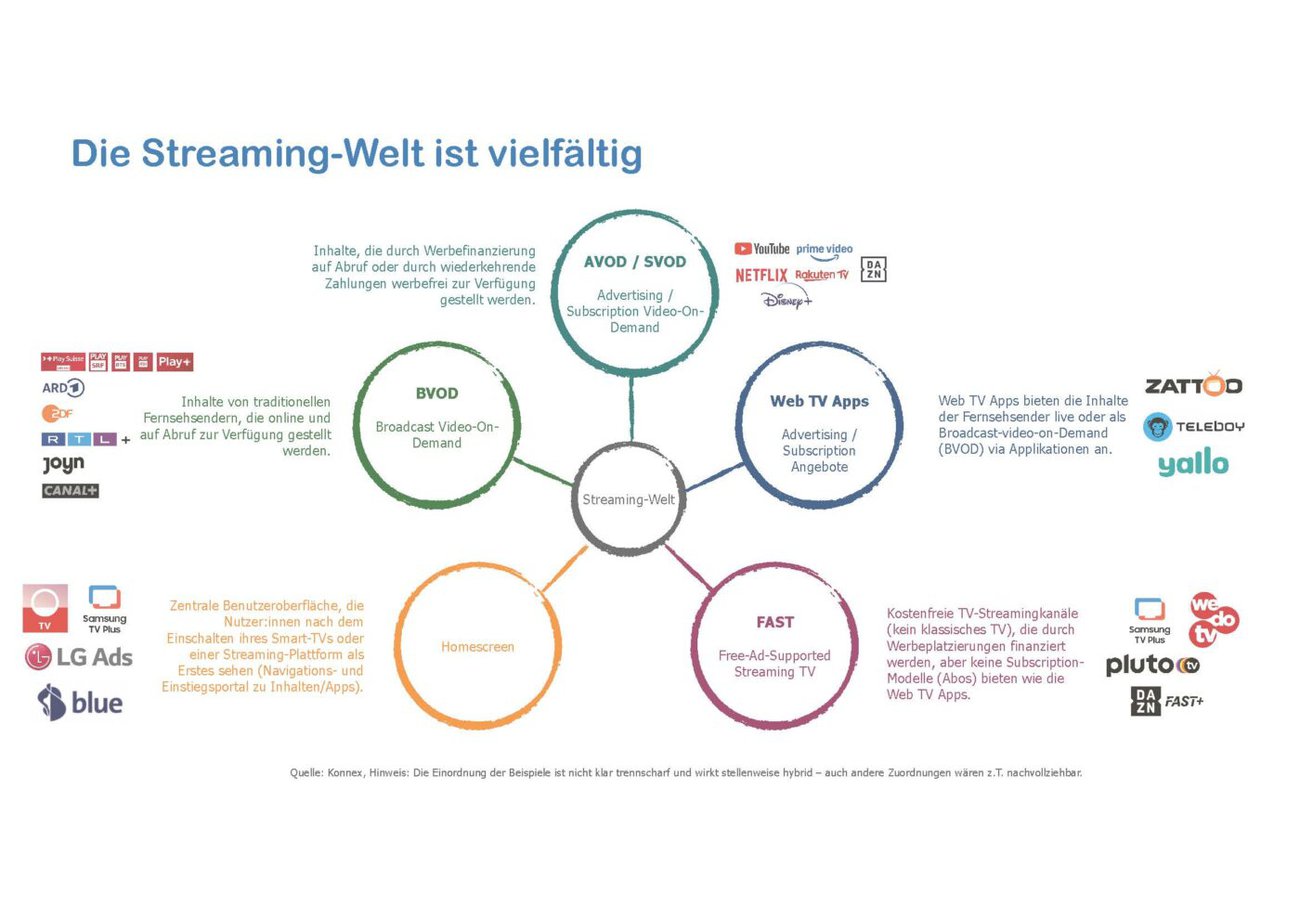
However, implementing holistic moving image planning that combines to form an effective whole is not easy. Even with a focus on the streaming world or even just the CTV sector (i.e. content that is played exclusively on a TV set connected to the internet), advertisers are faced with a highly fragmented ecosystem of platforms, publishers and end devices.
Although the various streaming services can be categorized by provider, type of service or financing, the same inventory is offered by several marketers, which leads to countless overlaps. Here is an example: pluto tv, a free, ad-financed streaming service from Paramount, can currently be booked to target Swiss users via Goldbach Media, Ringier, Screen on Demand and, of course, the Google advertising platform DV360, among others. No marketer can specify the priority of the bookings made through them.
Device owners (i.e. TV device brands such as Samsung or LG) are another market player alongside app and content owners as well as pure marketers. This multitude of providers marketing identical inventory increases the risk of campaign cannibalization. If the same campaign accesses the same advertising space across different platforms, it competes with itself and drives up bid prices. This in turn reduces the efficiency of playout. The advertiser can therefore only focus on as few providers as possible and exclude offers that are marketed by several providers, thus preventing double booking.
However, the streaming market is not only characterized by strong fragmentation on the marketer side, but also on the content supplier side. Irrespective of the risk of possible duplication, this generally makes it more difficult to control playout. The issue of brand safety therefore represents a further challenge.
In contrast, brand safety is a given for bookings in the linear TV environment (at best, the brand fit of certain environments can be discussed). Ad fraud is also becoming a risk with the increasing importance of streaming inventory. This involves the use of bots or fake CTV devices that simulate viewer numbers. As a result, advertisers pay for non-existent or unseen ad placements. Ad fraud can be countered by booking through established, trustworthy marketers. But here too, fraudsters are always one step ahead!
Another major challenge for holistic video planning is the lack of uniform research standards and metrics. When planning TV, we are used to obtaining reach and contact figures. With the exception of replay ads, there are no corresponding standards from the digital platforms. At the moment, it is primarily the gross reach of a campaign that can be measured, i.e. the number of video ads played. Multiple contacts can sometimes be identified at device level, but without personal information. Statements on the number of people reached or on incremental reach are therefore generally based on estimates. In most cases, these are based on login data. However, this does not say anything about who actually uses the media content played and whether only one or several people are sitting in front of the respective device (so-called "co-viewing"). At the same time, this means that in most cases it is not possible to work with target group criteria analogous to TV planning. It is necessary to work much more with environment-related criteria. This is not a disadvantage per se, as the relevance of age-related criteria is debatable. However, the comparability or "fit" with linear TV use is only possible to a limited extent.
This makes the test carried out as part of a joint initiative by Goldbach and Mediapulse to measure the net personal reach of online video ads and combine this with TV reach all the more interesting. The test run was carried out in October 2024 with a Migros campaign. According to the partners involved, the test was so successful that the possibilities of further developing the measurement approach are now being examined and the costs and refinancing options are being clarified.
Until a standardized and neutral measurement solution is available to the market, many assumptions and estimates still have to be made when planning and implementing overall moving image campaigns. The data provided by WEMF's MACH Strategy and IGEM's "igemDigiMonitor" on the use of various moving image platforms is a great help here.
Replay ads are advertisements that are displayed within time-shifted television. They are available on the Swiss advertising windows of German TV channels marketed by Goldbach Media and on CH Media channels and are expected to be available on SRG channels marketed by Admeira in German- and French-speaking Switzerland from January 1, 2026. Their performance can be evaluated both ex ante and ex post and in combination with linear TV campaigns using the TV replay ad data collected by Mediapulse.
Checklist for advertisers for holistic moving image planning:
- Definition of the relevant target group and analysis of their media usage behavior (e.g. using the MACH Strategy)
- Definition of the requirements for the emotional state in which the target group should find itself (based on the communication objectives or the advertising message and campaign content)
- Selection of relevant media channels and platforms and budgetary weighting based on reach potential, environmental criteria, etc. (Rule of thumb: for target groups aged 30 and over, linear TV is still a key medium; for younger target groups, the focus is on digital offerings)
- When booking digital offers: Selection of relevant marketers in order to maximize reach potential while avoiding overlaps.
 Anyone who advertises programmatically these days quickly ends up on a large number of international websites - often without any control over their quality. The Swiss association Digital Ad Trust (DAT) now offers a solution: a freely accessible inclusion list with over 500 quality-certified websites is now available for download on the DAT website.
The listed sites are certified by DAT in the categories Visibility, Ad Fraud and Brand Safety. The Inclusion List largely comprises Swiss media offerings, supplemented by selected German websites with a high proportion of Swiss inventory. It is aimed at media agencies, advertising clients and publishers who focus on quality and transparency in the field of programmatic advertising.
"Our Inclusion List is a targeted response to the often uncontrolled distribution of programmatic advertising," says Roland Ehrler, President of Digital Ad Trust. "It enables precise placement in a high-quality environment - with full transparency for all parties involved."
Digital Ad Trust certification ensures that advertising appears where it is really visible, is protected against fraudulent activities and appears in a brand-safe environment. This gives advertising clients and agencies an efficient tool for optimizing their digital campaigns - with a focus on impact rather than wastage.
The DAT Inclusion List is now available via the Website of Digital Ad Trust available
]]> For the fourth quarter of 2022, Digital Ad Trust Switzerland notes almost unchanged visibility values, although these have improved slightly: on desktop by 0.7 percentage points and on mobile by 0.2 percentage points. Ad fraud - after the significant increase in the last quarter - has now fallen again significantly to a new value of 0.55 percent. The Brand Safety values surveyed by IAS have again fallen substantially from a very low level and now stand at 0.05 percent.
Slightly better visibility rates
In the fourth quarter of 2022, overall viewability across all formats was unchanged at 62.6 percent. The medium rectangle and the half-page ad on desktop, which improved in the last two quarters, now lost slightly with 1.4 and 0.6 percentage points respectively. The Wideboard, which recently lost a lot of visibility, improved by 5.6 percentage points to 57.3 percent. The mobile rectangle increased slightly by 0.2 percentage points to 58.6 percent.

The Sophisticated Invalid Traffic (SIVT) ad fraud rate dropped significantly again in the fourth quarter and now stands at a new value of 0.55 percent across all channels.

At 0.05 percent, the brand safety values surveyed by IAS are at a very low level, almost two-thirds lower than in the previous quarter.

]]>
 The Digital Ad Trust Switzerland (DAT) association was founded on February 3, 2021 by IAB Switzerland Association, Leading Swiss Agencies, and the Swiss Advertising Contractors Association. The new association is primarily committed to greater transparency in digital advertising. The focus is on certification, education and training, especially in the areas of ad fraud, brand safety, visibility, user experience (UX) and other challenges in the digital market in Switzerland.
A central element of the association is the certification of publishers in the areas of brand safety, ad fraud, viewability, and user experience. These certifications were already very successful in the first year, and by the end of 2021 the following publishers and marketers - and thus already a large part of the Swiss market - were certified, namely 20 Minuten Advertising, Audienzz, Goldbach Audience, Ringier Advertising, Teads, and Watson.
One publisher lost certification
However, one publisher had to be stripped of its certification during the term of the certification because the 6-month check could not be successfully passed for one of the publisher's websites.
DAT is looking forward to certifying more publishers this year as well as re-certifying publishers that have already been certified.
In addition, DAT has published regular quarterly reports, thus creating a benchmark comparison for the Swiss market for the first time. Furthermore, a study on brand safety in the Swiss market was prepared and published in cooperation with Zulu5.
With the foundation and the various communication measures, it has already been possible to build up considerable awareness for DAT among advertisers, agencies and publishers. This must now be further increased, especially the demand for certified publishers by agencies and advertisers. A seamless continuation of all activities and even stricter certifications are planned for 2022.
]]>
The report provides market analysis for EMEA, North America, LATAM and APAC on video and display impressions measured year-over-year from January to December 2021, including desktop and mobile web, mobile app and connected TV (CTV).
"The EMEA statistics show a movement in the right direction as rates for Fraud/SIVT and Brand Suitability misplacements are decreasing. However, in global comparison and especially compared to the US, EMEA and Germany still have some catching up to do to make the digital marketing ecosystem stronger and safer for brands," says Michael Fuhrmann, RVP DACH & CEE DoubleVerify.
Most important findings
Record number of fraud schemes driven by CTV and video: The number, of fraud schemes detected by DV, increased by over 70 % from 2020 to 2021 compared to the previous year. This year saw an unprecedented number of fraud schemes in TV and video - the most complex and sophisticated of which were OctoBot, SneakyTerra, ViperBot, and SmokeScreen. DoubleVerify estimates that these schemes alone attempted to defraud advertisers of more than $6 million to $8 million each month - and that they also affected publishers. DV estimates show that the aforementioned CTV schemes alone may have deprived publishers of $140 million last year (2021).
Fire safety violations decrease for the second year in a row: The post bid rate in Brand Suitability continues to decline and is now 9 % lower than last year with an overall rate of 7.1 %. This shows that Brand Suitability misplacements are decreasing as Verification strategies continue to improve. DV also sees momentum for Brand Safety and Brand Suitability floors. In 2019, the Global Alliance for Responsible Media (GARM) and the 4A's released the Brand Safety Floor and Suitability Framework. The Brand Safety Floor identifies topics and content that are considered unsafe and not suitable for monetization. 93 % percent of advertisers analyzed by DV use at least one category of the Brand Safety Floor for avoidance, blocking or monitoring, and 61 % use all categories of the Floor.
Attention metrics growing strongly for video ads - driven by CTV: Video Completion typically refers to the number of times a video plays to completion and is often divided into quartiles to indicate the level of video performance and attention (e.g., 25% Complete, 50% Complete, 75% Complete, 100% Complete). DV has seen moderate but steady improvement in completion rates at the quartile level for quartiles 1, 2, and 3 over the past three years. However, Video Completion Rate (VCR) has improved dramatically, from 62 % in 2019 to 67 % in 2020 to 71 % in 2021. This increase is likely due to increased measurement at CTV, where VCR has increased by 3 % year-over-year and is now 95.6 %.
Pre-bid avoidance increases media quality and performance: Increasing use of pre-bid verification is leading to a decrease in post-bid violations (brand safety/suitability, fraud, and geo violations). Pre-bid activation of verification solutions enables advertisers to reduce blocking by verifying that a programmatic impression is brand-suitable, fraud-free, and geographically appropriate before bidding. Advertisers using pre-bid verification via the media transaction are seeing a significant improvement in the quality of their buys, with post bid misplacements down 6 % year-over-year. Overall, DV advertisers now average just 10 % post bid violations across all quality measurement criteria.
Experience leads to better verification strategies: The longer a brand works with a verification provider, the more sophisticated the collaboration and the better the value of such verification tools is understood. DV found that long-time verification users are most likely to use a broader range of verification tools to prevent fraud and brand suitability violations before an ad is served. These advertisers had a post bid misplacement rate of 9.4 % in 2021 (6 % below the global average and 28 % among new users).
Fhe key findings for the EMEA region and Germany are:
The Fraud/SIVT rate (Sophisticated Invalid Traffic) decreased by 22 % year-on-year (in Germany by as much as 28 %), and although the EMEA region lags behind APAC and LATAM, it outperforms the global
- Misplacements in the area Brand Suitability decreased by 28 % year-on-year in Germany, but EMEA is far behind North America and This may be because advertisers in EMEA use more mobile web and long-tail inventory than advertisers in other regions.
- The EMEA region recorded only very slight changes in the Viewability rates compared to Even though the average display viewability rate remains below 70 % (Germany 59 %) and leaves room for improvement, stagnation at this level suggests that advertisers in the region are starting to focus on more holistic KPIs than viewability.
Double Verify is a measurement and analytics platform for digital media. Double Verify's mission is to make the digital advertising ecosystem stronger and safer in order to preserve the fair exchange of value between buyers and sellers of digital media. Hundreds of Fortune 500 companies use the unbiased data and analytics provided by DV to improve the quality and effectiveness of campaigns and maximize the return on digital advertising investments worldwide.
]]>